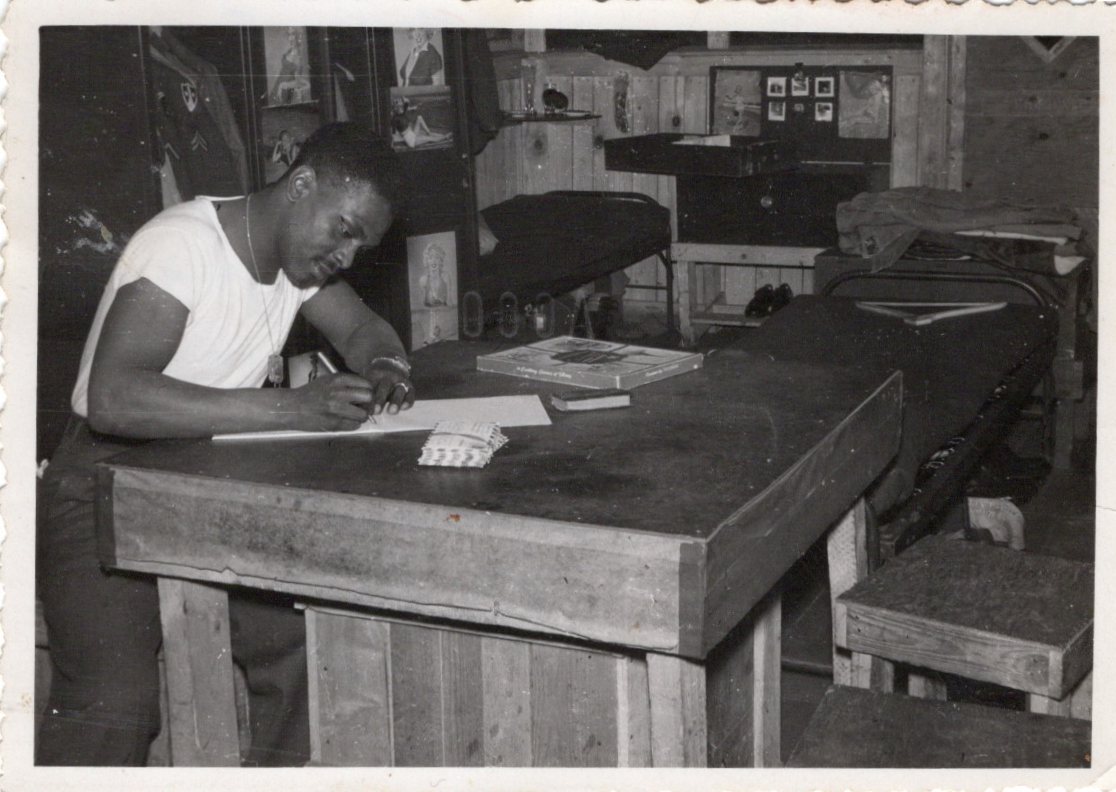
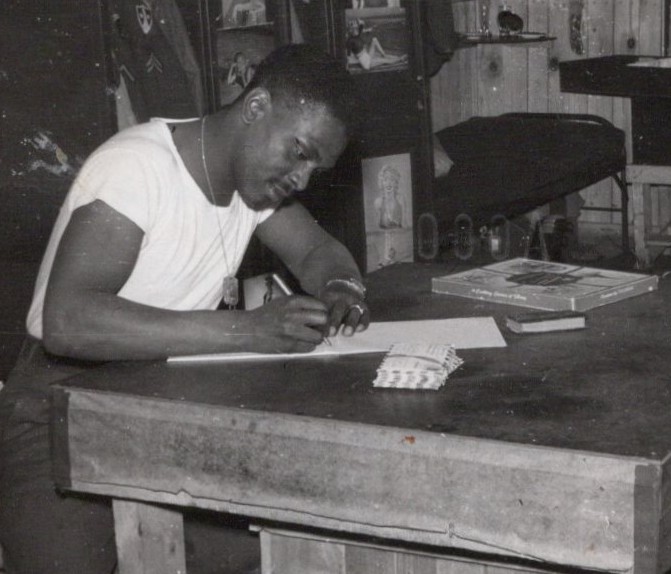
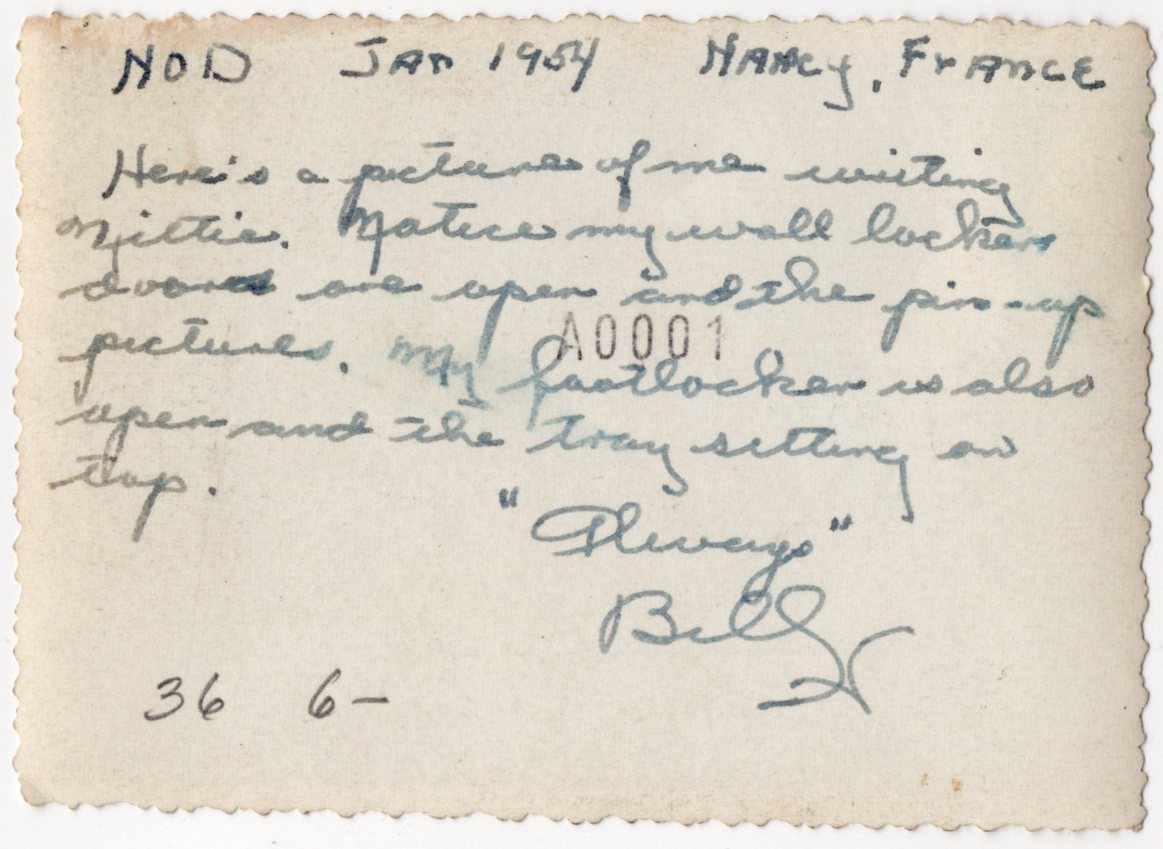
This vintage snapshot photograph features an African American US soldier writing a letter home while he is stationed in Nice, France, in 1954. He also write an inscription on the reverse of this photograph. He points out that his wall locker, doors open, can be seen in the background. He adds that the photos on the inside of his locker are pin ups. He signed the inscription, “Bill”. An interesting factor that many people don’t realize is that the US Army was not fully integrated until November, 1954. That is eleven months after this photograph was taken. The initial order to integrate the military was signed by President Truman in July, 1948. SOLD
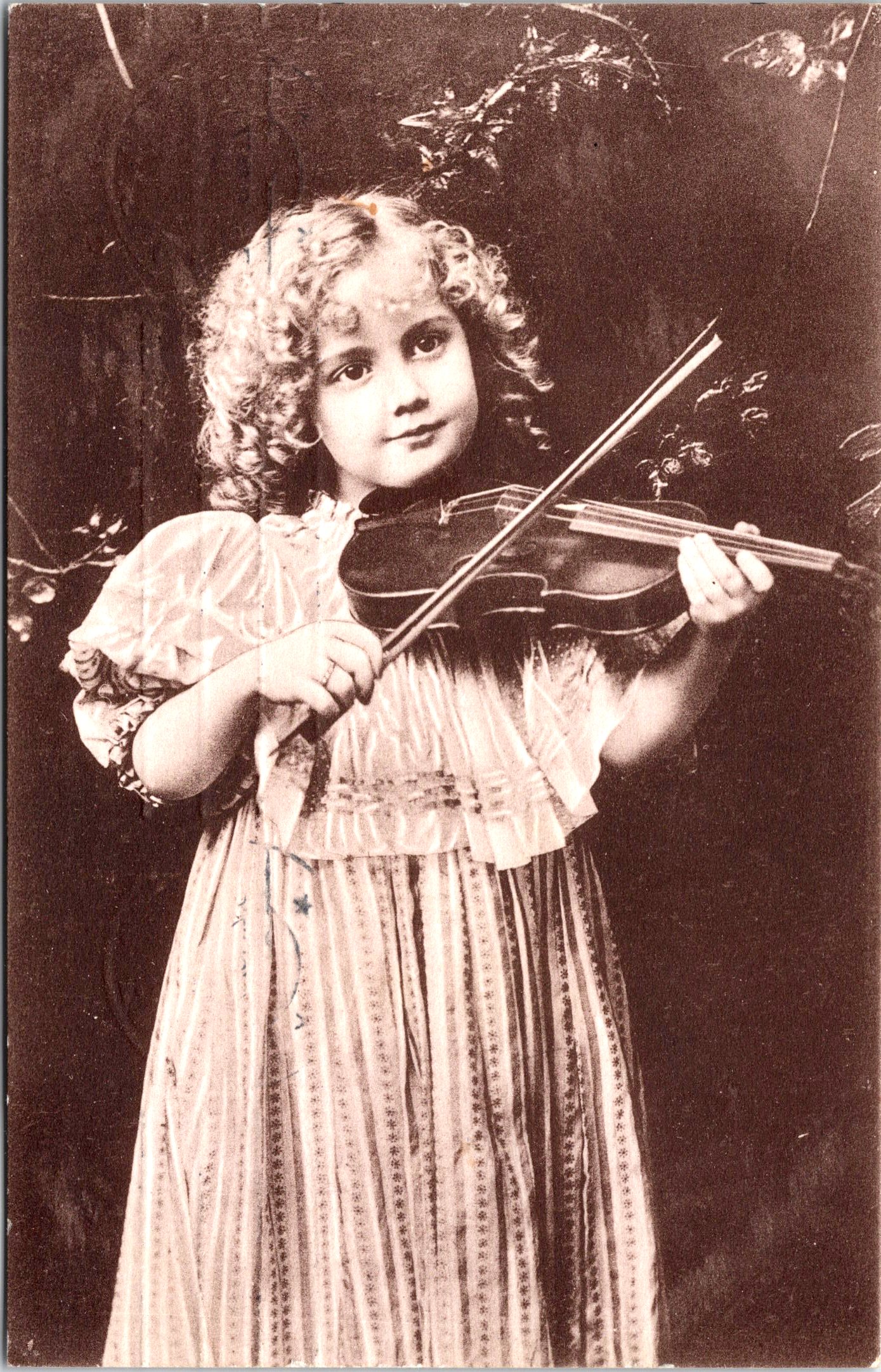
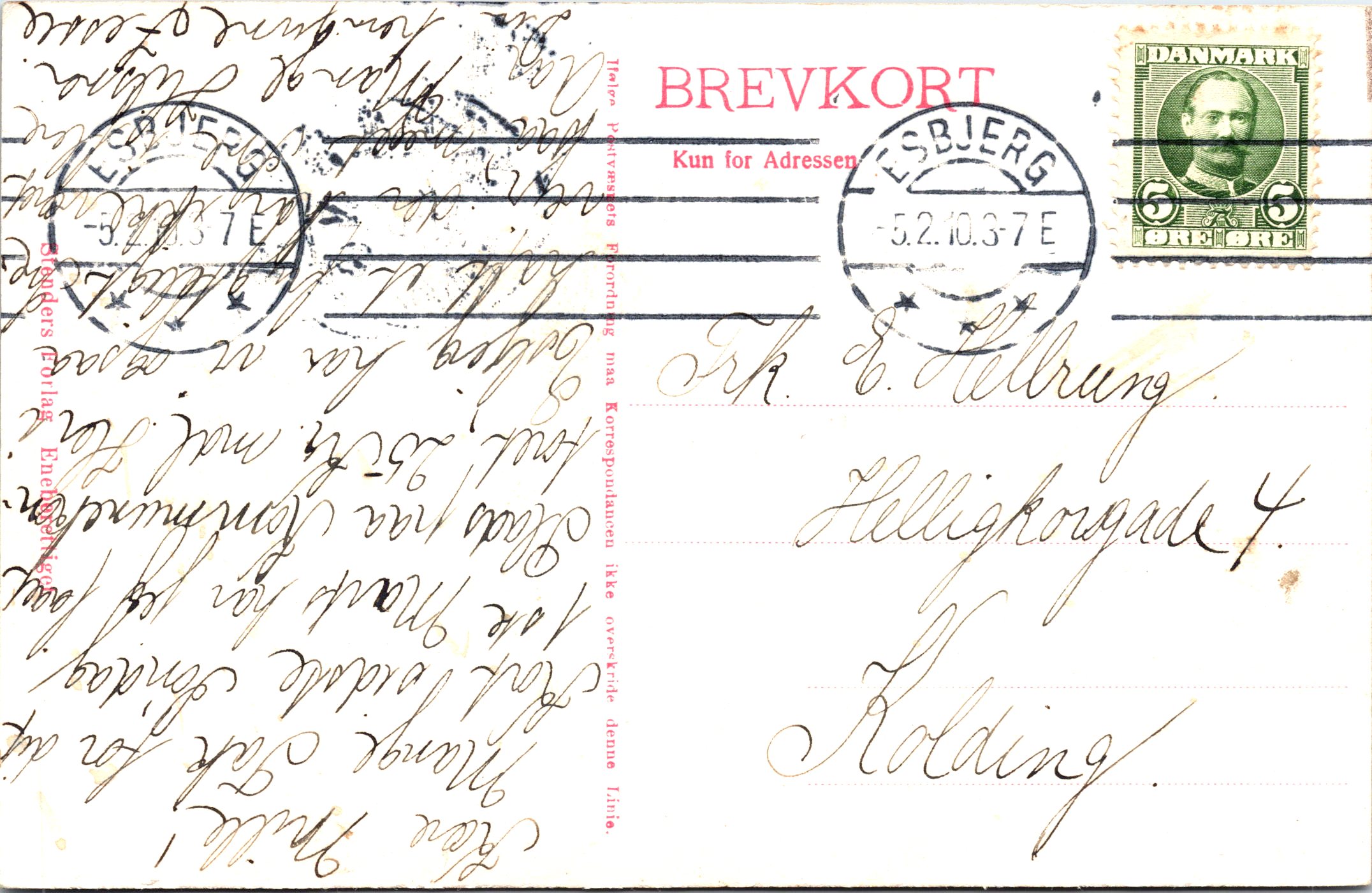
This charming real photo postcard depicts a young child standing and playing a violin, posed formally against a studio backdrop. The child wears a light-colored, ankle-length dress with vertical striping, puffed sleeves, and lace or ruffled detailing at the bodice, giving the image a distinctly late 19th / early 20th century European feel. The child’s softly curled hair frames the face, and the violin is held carefully under the chin, suggesting a staged studio portrait rather than a candid moment. The reverse reveals a Danish postcard, clearly marked “BREVKORT” (the Danish word for postcard). It is franked with a green Danish 5 Øre stamp featuring King Frederik VIII, which was commonly used in the early 1900s. The postcard is postmarked ESBJERG, with a clearly struck circular cancel dated 5.2.07. The address is written to a gentleman residing in Kolding, Denmark. A rough translation (original Danish) of the message on the reverse is: “Can you imagine listening to my little violin? Then you must come down here one day. Greetings from [signature].” The message is affectionate and informal, consistent with family or close acquaintance correspondence, and nicely complements the image of the child musician on the front. This postcard is in Good antique condition for a real photo postcard of this age. The image shows mild surface wear, particularly in the darker background areas. Corners and edges show light wear and there are no creases or tears. The photographic image remains clear, with good detail in the child’s face, clothing, and violin. The reverse shows postal wear, ink marks, and cancellations typical of a genuinely used postcard, with all writing, stamp, and postmark remaining legible (see scans).
This real photo postcard is available for purchase at my store, The History Peddler, for $9.95 or best offer.
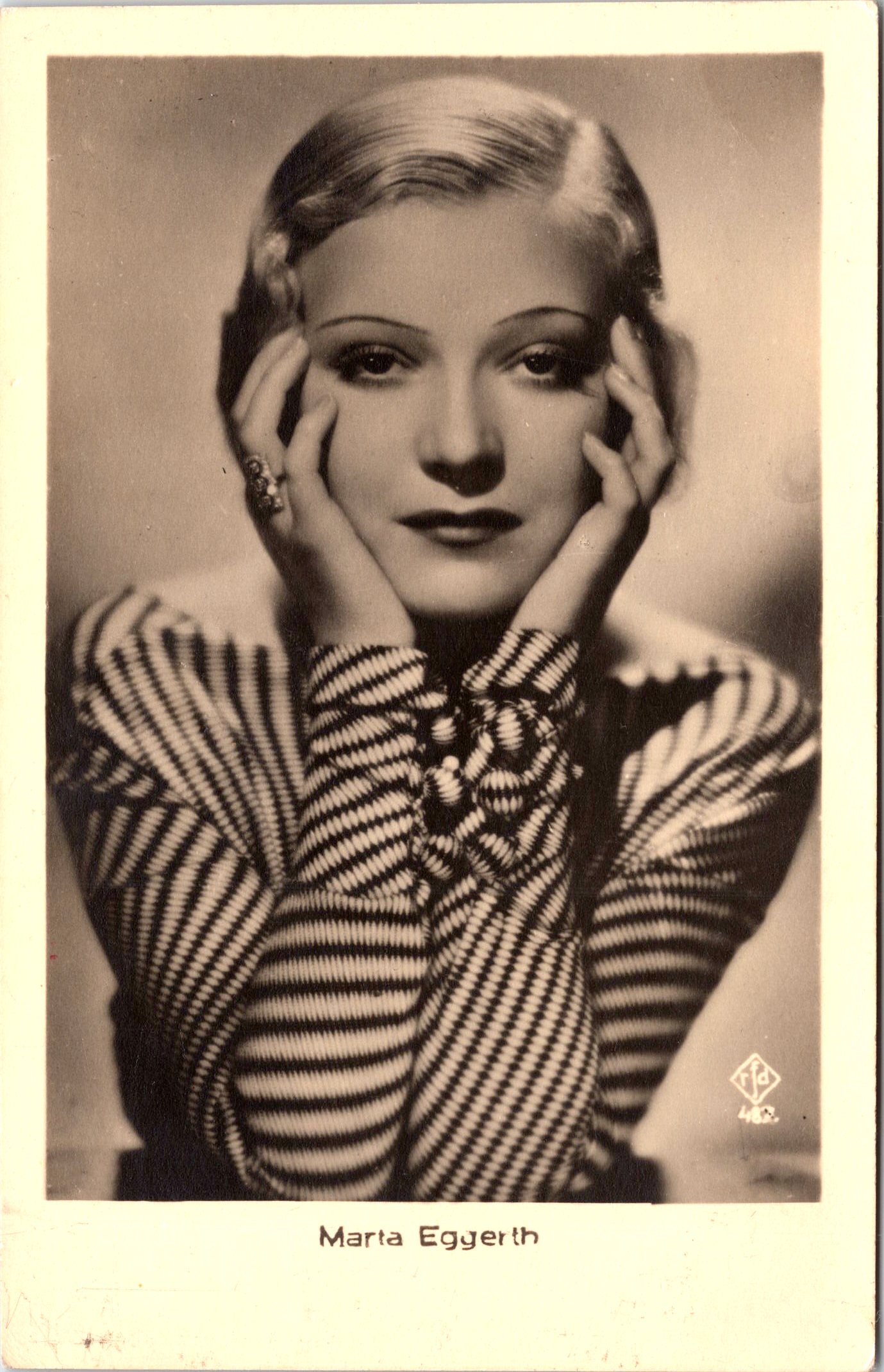
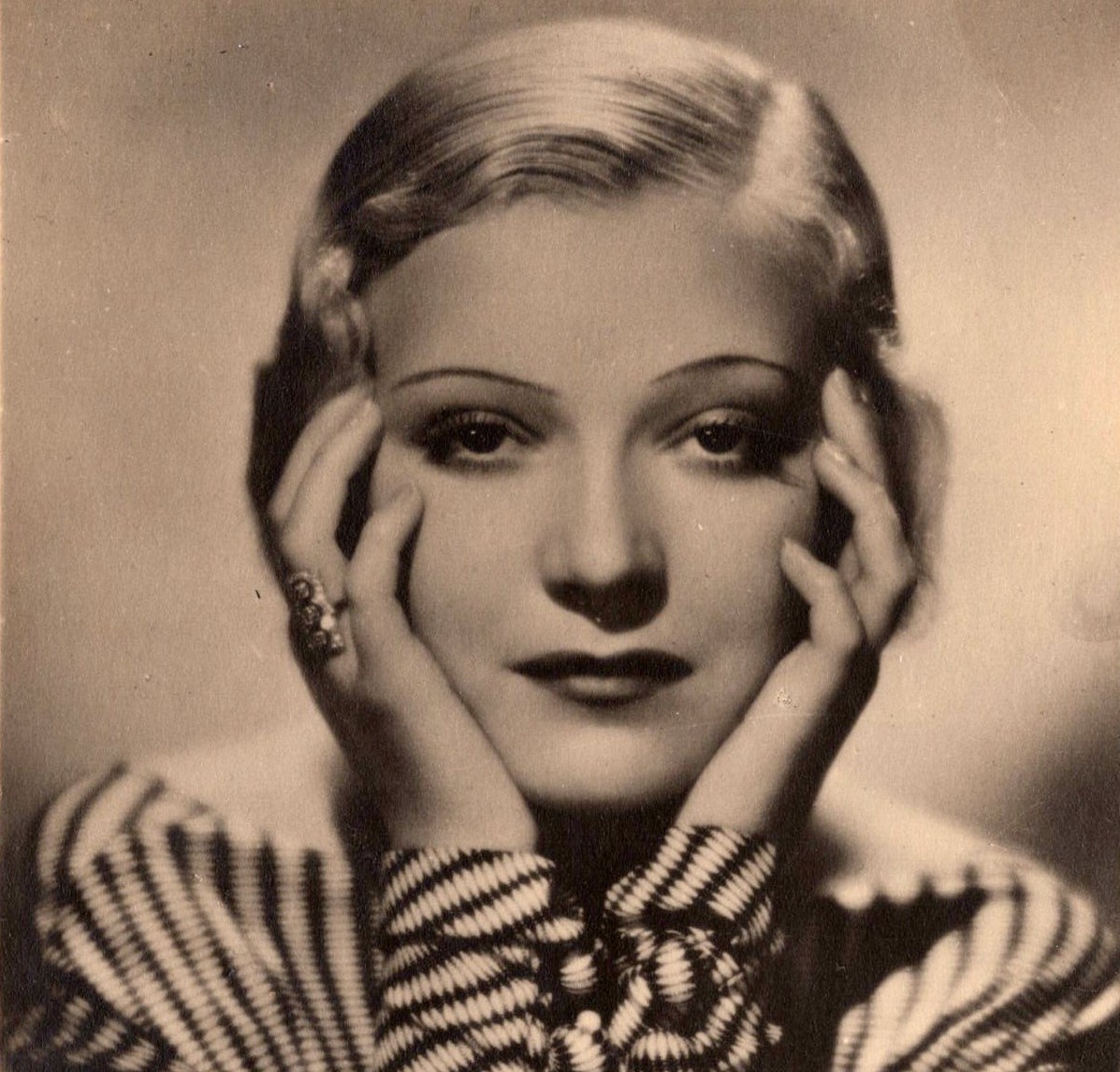
This vintage real photo postcard features Marta Eggerth (1912–2013), the celebrated Hungarian actress and singer who became one of the most important operetta stars of the 20th century. Eggerth is shown here in a striking studio portrait, her face framed by her hands in a pose that emphasizes elegance, symmetry, and quiet intensity. The image has a distinctly early-1930s European glamour aesthetic, with soft lighting, refined makeup, and carefully styled hair typical of the period. Eggerth was born in Budapest, the daughter of a dramatic operatic soprano. She began singing as a child, and her mother devoted herself to developing her vocal and theatrical talents. Eggerth made her stage debut at just eleven years old, and while still a teenager toured internationally performing operatic works. By the early 1930s, she had achieved international fame, appearing in films in five different languages. While making a film, she met Polish tenor Jan Kiepura, whom she married in 1936. Together, they became an international sensation, appearing on stage and screen across Europe and the United States. In the U.S., Eggerth appeared on Broadway, including productions by Richard Rodgers, and starred alongside Kiepura in “The Merry Widow.” Between 1940 and 1945, she appeared in three Broadway productions. She also signed with MGM and made two films with Judy Garland. Remarkably, Eggerth continued performing well into old age; her final stage appearance occurred at age 99. IMDb credits her with 39 acting roles between 1930 and 1999, underscoring the extraordinary longevity of her career. The small diamond-shaped logo in the lower right corner of the image, with the initials resembling “FFD” and a series number, is associated with Film-Foto-Verlag (FFV), Berlin, a major German publisher of real photo postcards during the interwar period. Film-Foto-Verlag specialized in high-quality photographic postcards of film stars, singers, and performers. The postcard format, typography, and photographic style are fully consistent with early-to-mid 1930s German production, when Eggerth was at the height of her European film career. In regard to condition, this postcard’s image remains sharp with strong contrast and excellent facial detail. There is light edge and corner wear. The reverse is unused, clean, and free of writing. Overall, this postcard is in very good vintage condition (see scans).
This cabinet card is available for purchase at my store, The History Peddler, for $12.00 or best offer.
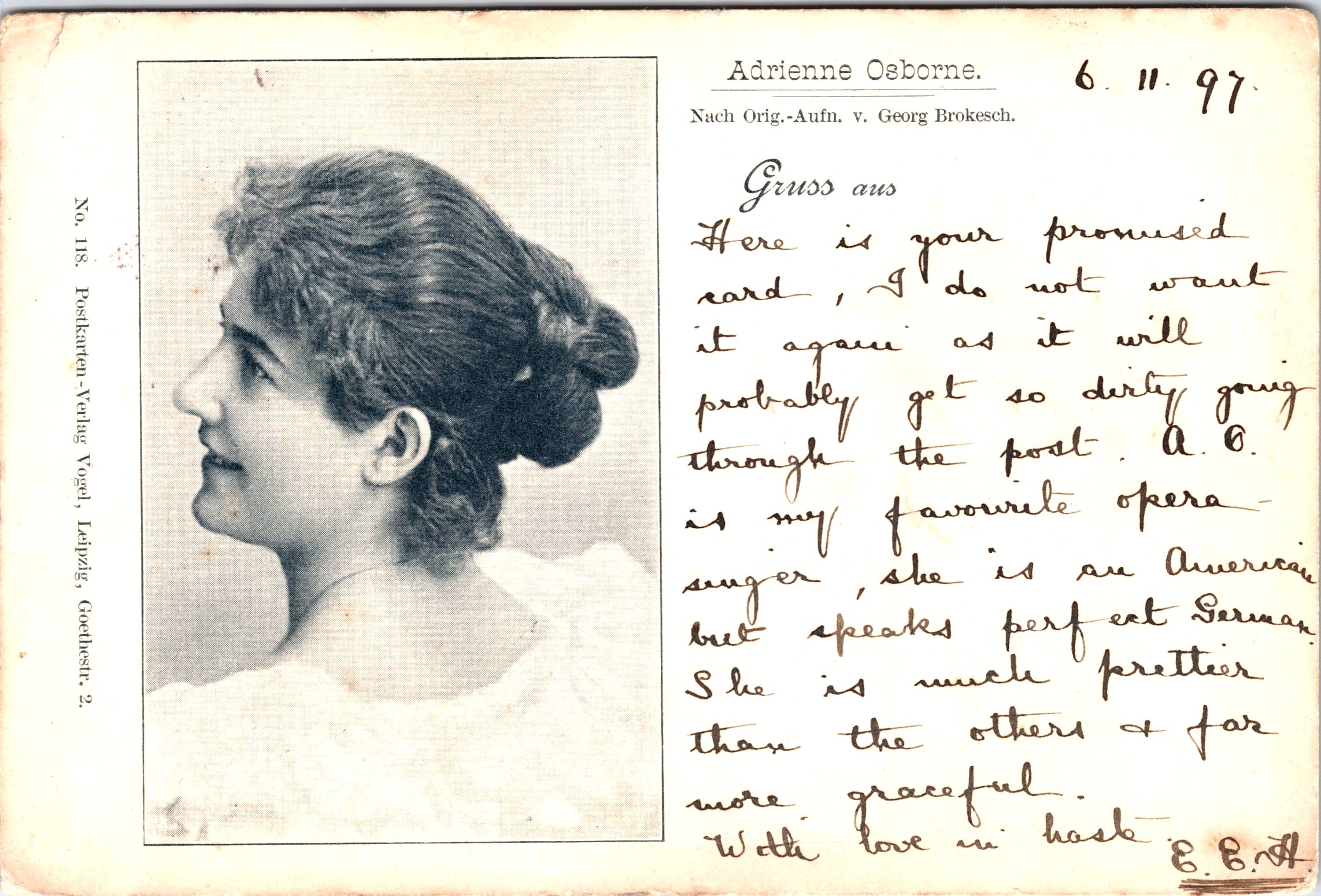
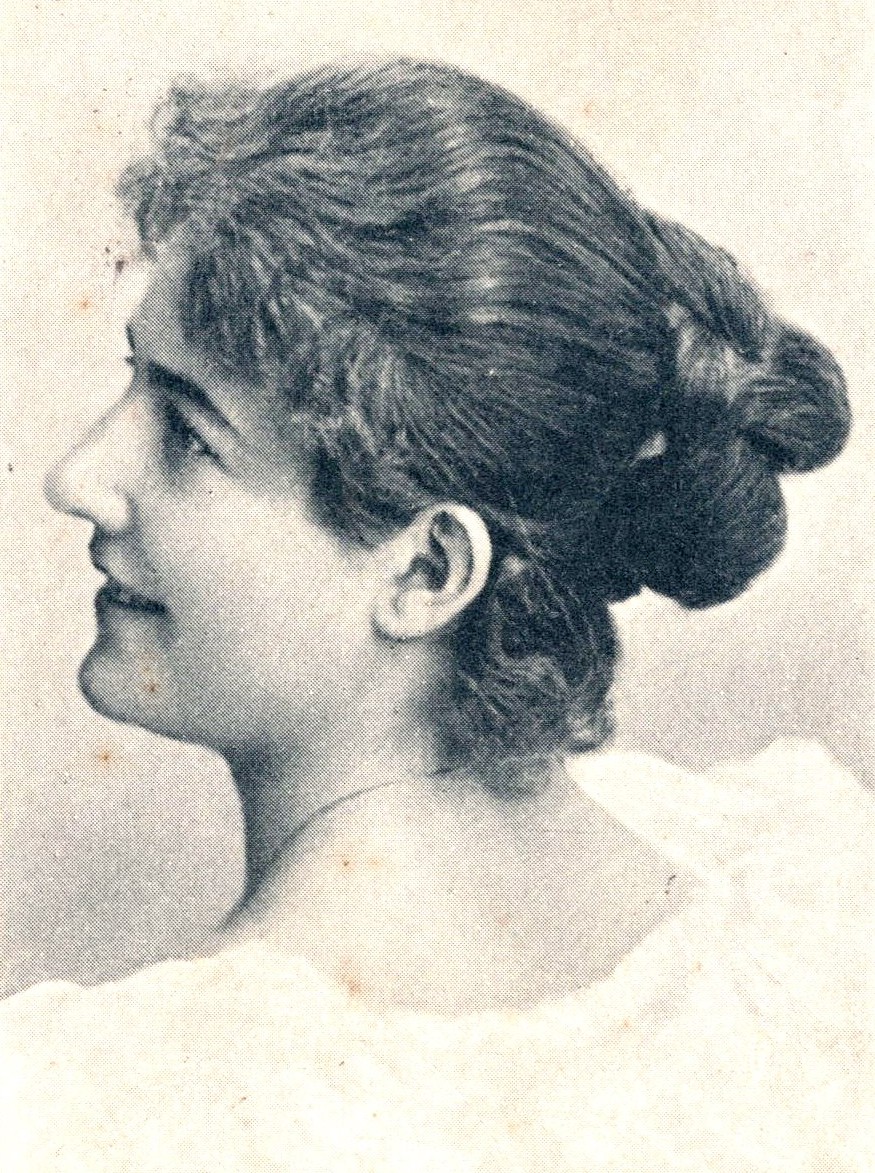
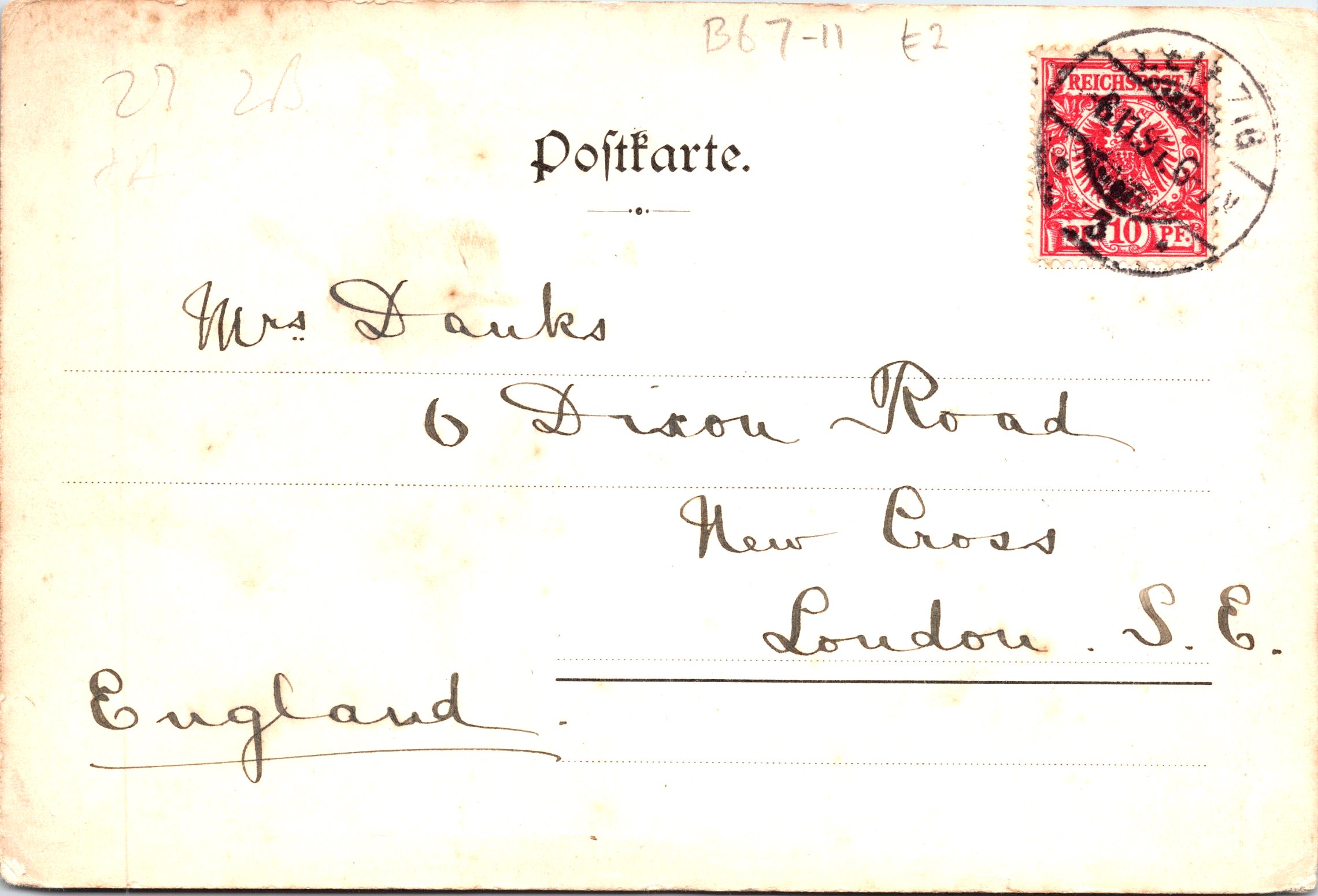
Offered here is a striking and historically rich late-19th-century lithographic postcard featuring the American opera singer Adrienne Osborne, a well-known soprano who enjoyed considerable popularity in Europe—particularly in German-speaking countries—during the 1890s. The image presents Osborne in profile, her hair swept back into a neat, classical bun, with soft lighting emphasizing her refined features and bare shoulders. The pose and photographic treatment are characteristic of continental studio portraiture of the 1890s, designed to convey elegance, poise, and artistic seriousness rather than theatrical flamboyance. It is an intimate and dignified likeness, very much in keeping with the way serious opera singers were marketed to educated European audiences at the time. Beneath the singer’s name appears the printed credit: “Nach Orig.-Aufn. v. Georg Brokesch.” This translates to “After the original photograph by Georg Brokesch.” In other words, this postcard image is not an original sitting, but a reproduction based on an earlier studio photograph taken by Georg Brokesch (1849-1896), a talented professional photographer whose work was frequently used by European publishers for celebrity portrait postcards. This was a common and accepted practice in the 1890s and does not diminish the card’s authenticity or period significance.The card was issued by Postkarten-Verlag Vogel, Leipzig, as indicated along the margin. Leipzig was one of the major European centers for postcard publishing at the turn of the century, especially for musical, theatrical, and operatic subjects. The printed number “118” identifies this image within the publisher’s series of celebrity postcards. In the upper right corner of the image appears the handwritten notation “6.11.97”. This date aligns closely with the German postmark on the reverse, strongly suggesting that the postcard was written and mailed in November 1897, during the height of Osborne’s European career. The handwritten message on the reverse is especially noteworthy for its insight into contemporary opera fandom. Transcribed below (original spelling and punctuation preserved as closely as possible): “Here is your promised card, I do not want it again as it will probably get so dirty going through the post. A.O. is my favourite opera singer, she is an American but speaks perfect German. She is much prettier than the others & far more graceful. With love in haste.” This is a remarkably personal and enthusiastic fan endorsement, praising Osborne not only for her voice, but for her appearance, grace, nationality, and linguistic ability—all qualities that mattered greatly to European opera audiences of the time. The comment that she “speaks perfect German” is particularly telling, underscoring how successfully Osborne integrated into the German operatic world, something relatively rare for American singers in the 1890s. The postcard was mailed from Germany, bearing a German Reich postage stamp, and addressed to London, England, highlighting the international circulation of opera culture and celebrity imagery at the end of the century. In regard to Miss Osborne. she was an American operatic soprano active in the 1890s, known especially for her performances in Germany and Central Europe. She was frequently described in period press accounts as both vocally accomplished and physically attractive, a combination that clearly resonated with audiences and collectors alike. While not a household name today, she was well known enough in her time to merit commercial postcard publication and devoted fan correspondence, as this example vividly demonstrates. This postcard is in very good antique condition for a postcard of this age. Expected age toning, light surface spotting, and mild edge wear are present. The image remains clear and well-defined, and the handwritten message is fully legible. Overall, this is a well-preserved and visually appealing example of a circa-1897 European opera postcard (see scans).
This real photo postcard is available for purchase at my store, The History Peddler, for $75.00 or best offer.
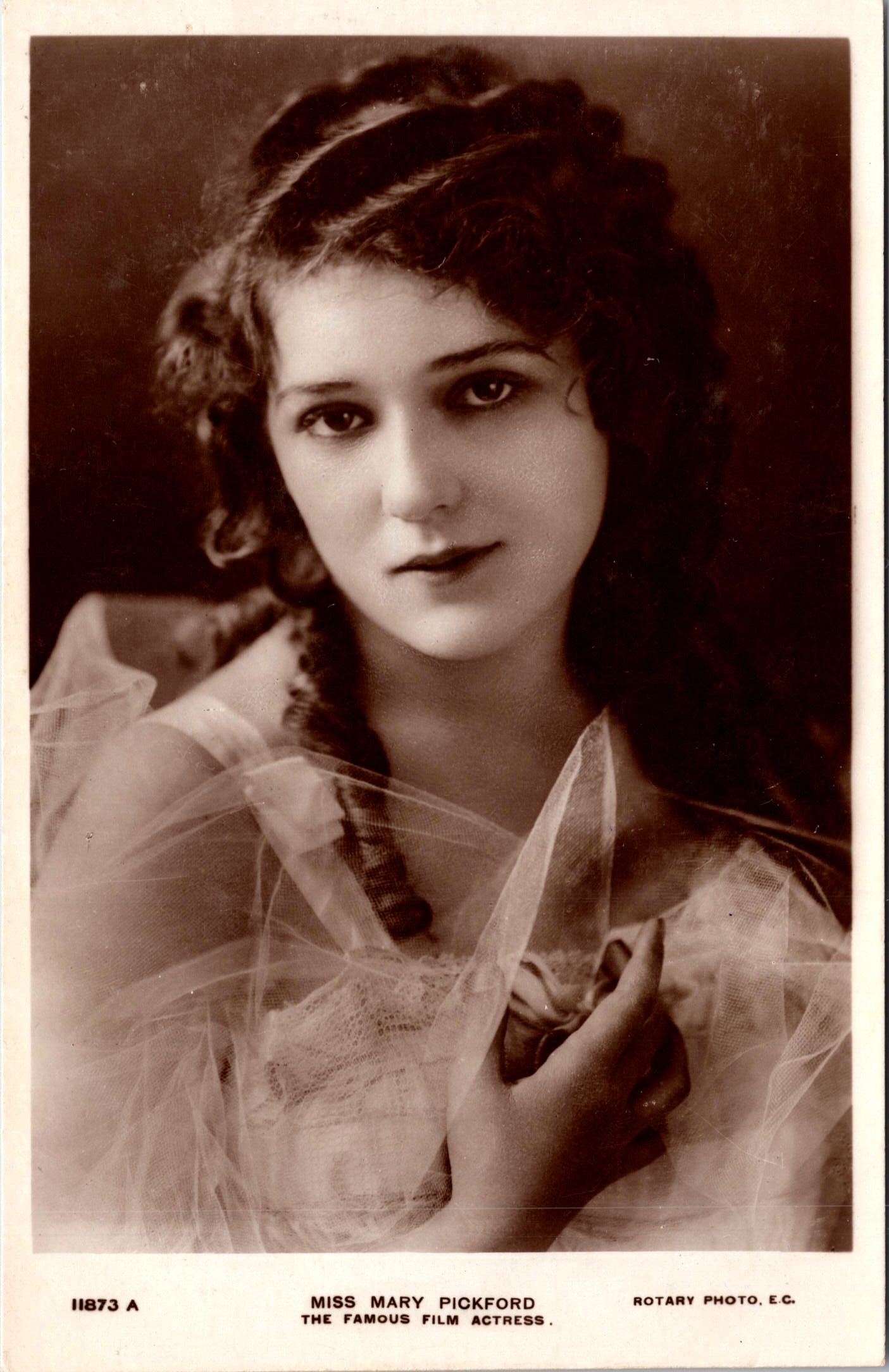
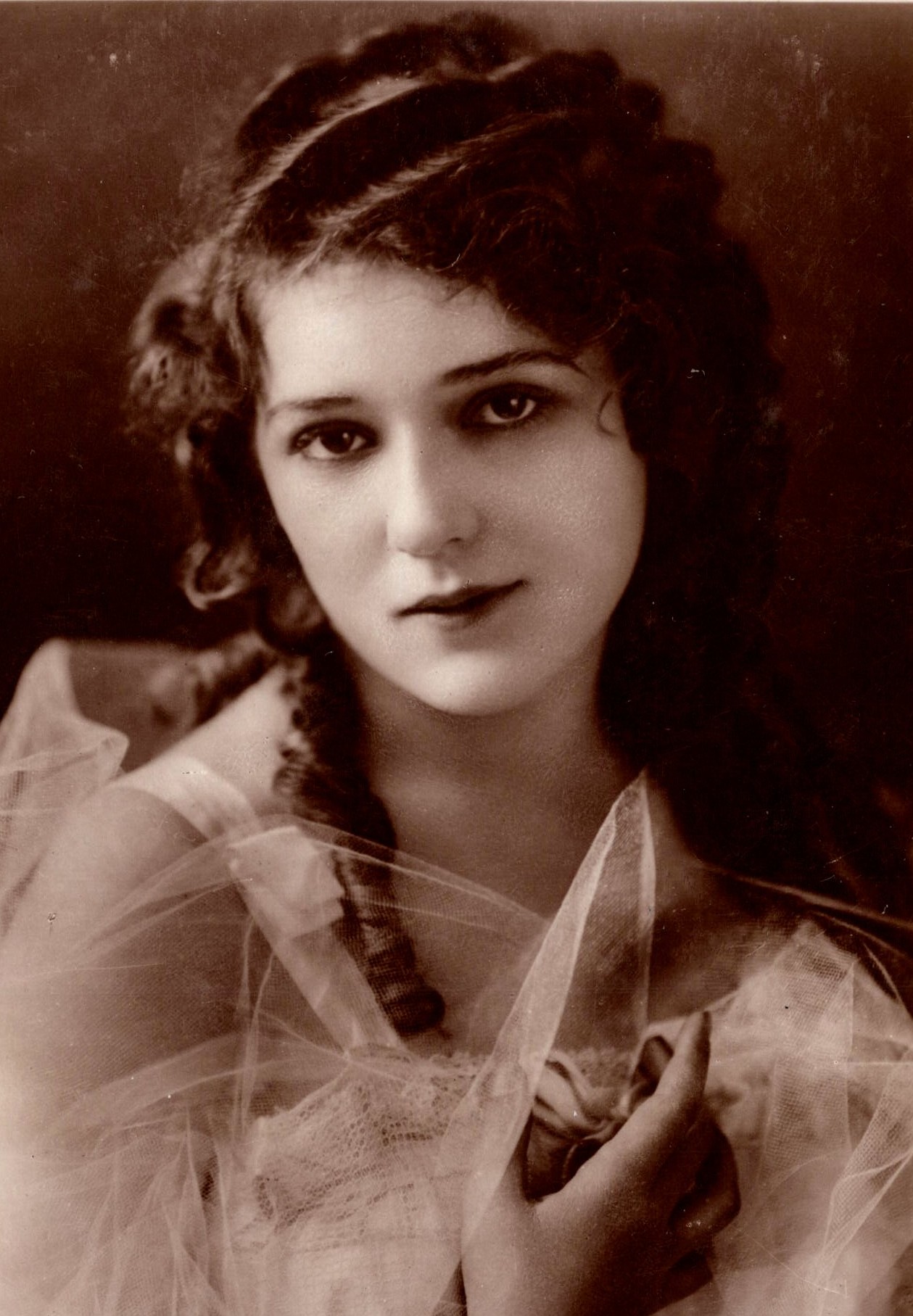
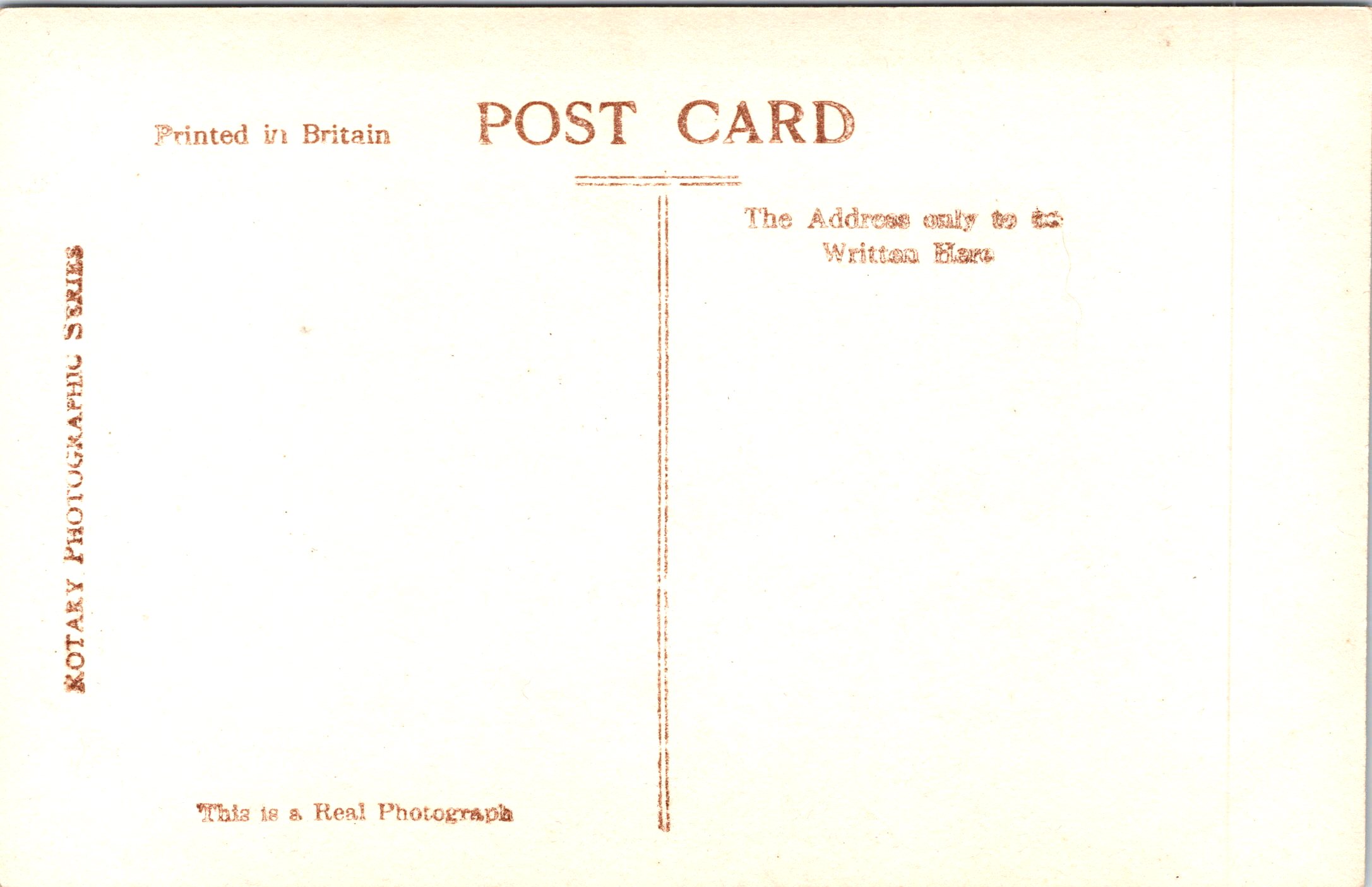
Mary Pickford (1892-1979) was a Canadian-American actress and one of the most influential figures in early Hollywood. She was often referred to as “America’s Sweetheart”. She was a pioneer of silent film and a co-founder of the film industry as we know it today. Pickford’s career began in childhood when she performed in theater productions in Canada and the United States. By the early 1900s, she transitioned to film, working with director D.W. Griffith at Biograph Studios. Her delicate beauty and expressive acting quickly made her a fan favorite, setting her apart in an era when exaggerated stage-style performances dominated silent films. During the 1910s and 1920s, Pickford became one of the highest-paid and most beloved actresses in the world. Starring in films such as Rebecca of Sunnybrook Farm (1917), Daddy-Long-Legs (1919), and Pollyanna (1920), she was known for playing wholesome, spirited young women. Her curly hair and signature on-screen innocence became iconic, but she was also a savvy businesswoman who understood the power of her brand. Pickford was not only a star but also a trailblazer in the film industry. In 1919, she co-founded United Artists alongside Charlie Chaplin, Douglas Fairbanks (her then-husband), and director D.W. Griffith. This revolutionary move allowed filmmakers to control their own productions rather than rely on major studios, changing the industry forever. As the film industry transitioned to “talkies,” Pickford retired from acting in the early 1930s, though she continued to produce films. Her contributions earned her an honorary Academy Award in 1976 for her lasting impact on cinema. Mary Pickford’s influence extends beyond her films. She helped shape the star system, paved the way for women in Hollywood, and co-founded the Motion Picture Relief Fund to support struggling actors. She remains an enduring symbol of early Hollywood glamour and innovation. Mary Pickford was born into a working-class family in Toronto, Canada. Her father, John Charles Smith, was an alcoholic who struggled to provide for the family and died from a workplace accident when Mary was just six years old. Her mother, Charlotte Hennessey Smith, was left to raise Mary and her two younger siblings, Lottie and Jack, on her own. To support the family, Charlotte encouraged her children to enter acting, and Mary began performing in theater at a young age. She soon became the family’s primary breadwinner, and her siblings, Lottie Pickford and Jack Pickford, also pursued film careers. Pickford transitioned from theater to film in the early 1900s, quickly rising to fame with her expressive acting and wholesome on-screen persona. By the 1910s and 1920s, she was one of the most recognizable stars in the world, earning the nickname “Queen of the Movies.” She also helped establish the Academy of Motion Picture Arts and Sciences. Mary Pickford was married three times. Pickford’s first marriage was to silent film actor Owen Moore (1911-1920). Her second and most famous marriage was to fellow silent film actor, Douglas Fairbanks (1920-1936). Her third marriage was to actor Charles “Buddy” Rogers (1937-1979). After retiring from acting in the early 1930s, Pickford focused on producing films and philanthropy. She became more reclusive in her later years, struggling with alcoholism and health issues. Today, she is remembered as a pioneering force in cinema history. This vintage early 20th-century real photograph postcard depicting Mary Pickford, was issued by Rotary Photo, E.C., and bears the serial number 11873A. Rotary Photo was a major British publisher of celebrity and theatrical postcards, known for producing high-quality real photograph cards from studio portraits of prominent stage and film performers. The image presents Pickford in a soft, intimate studio portrait, shown from the shoulders up, wearing a sheer, gauzy costume that frames her face and neckline. Her hair is styled in loose curls, arranged simply rather than theatrically, reinforcing the youthful quality of the image. Her expression is calm and introspective, with a direct, slightly wistful gaze that emphasizes her delicacy and screen presence. In this portrait, Pickford appears quite young, consistent with her image during the late 1910s, when she was already famous but still closely associated with youthful roles. This exact portrait is held by the National Portrait Gallery, London, which dates the photograph to circa 1918, providing a solid institutional reference point for dating. The card was printed in Britain and is clearly identified on the reverse as a real photograph. The postcard is in very good antique condition overall. The image retains strong tonal quality with good clarity and contrast. Corners only show light wear and there are no creases, tears, or losses. The reverse is clean. Overall, the card presents very well and remains highly displayable {See Scans).
This cabinet card is available for purchase at my store, The History Peddler, for $18.00 or best offer.
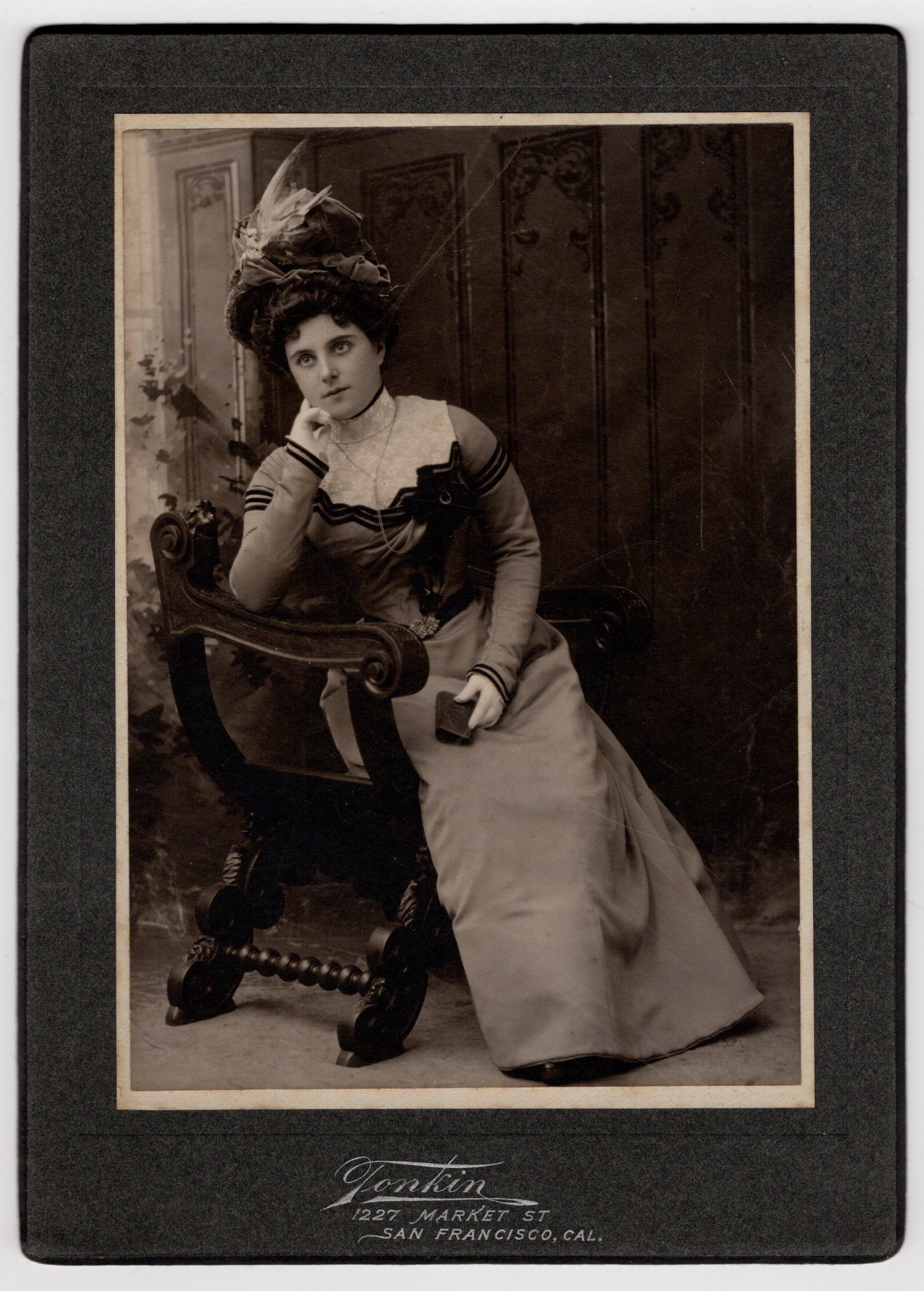
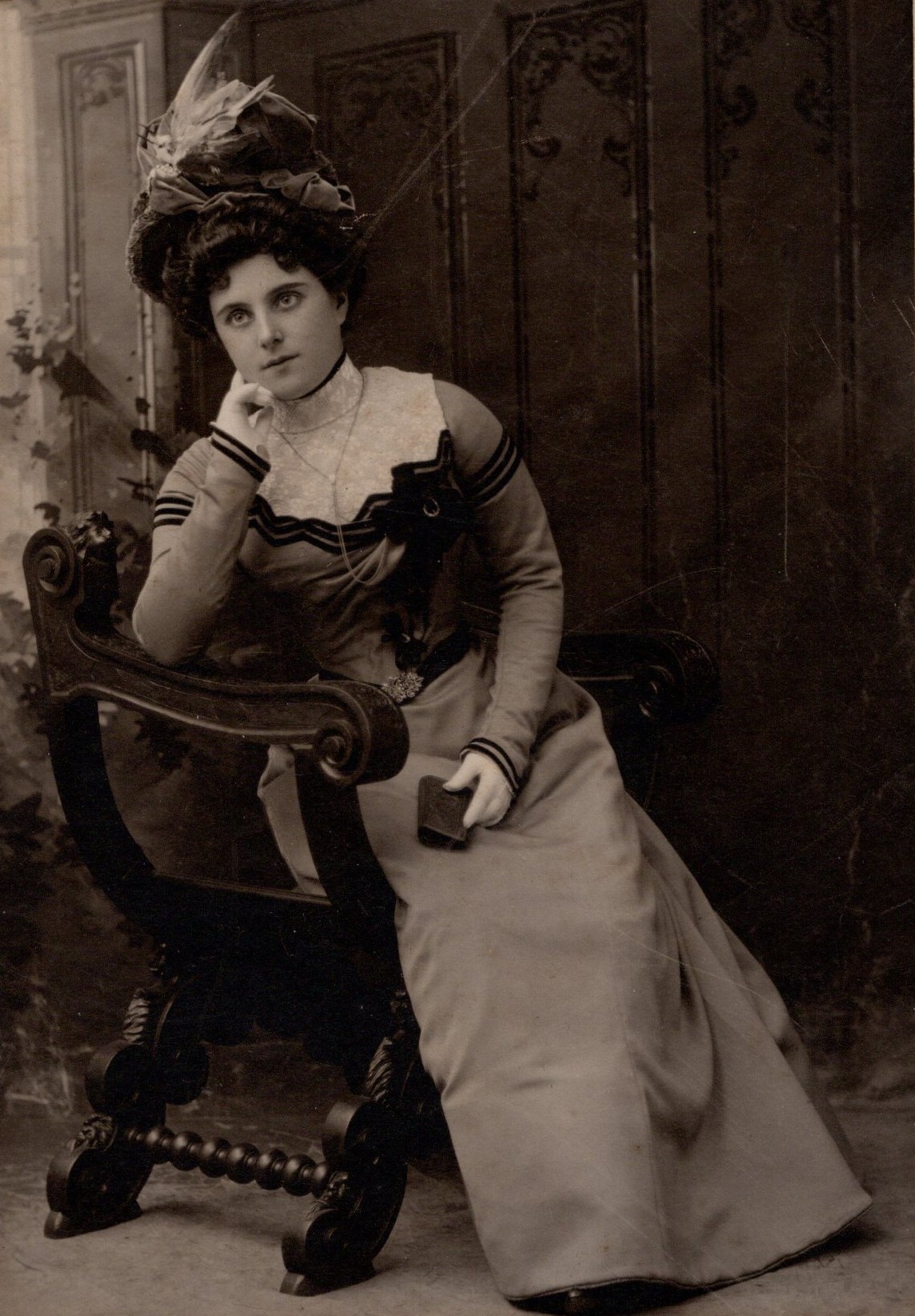
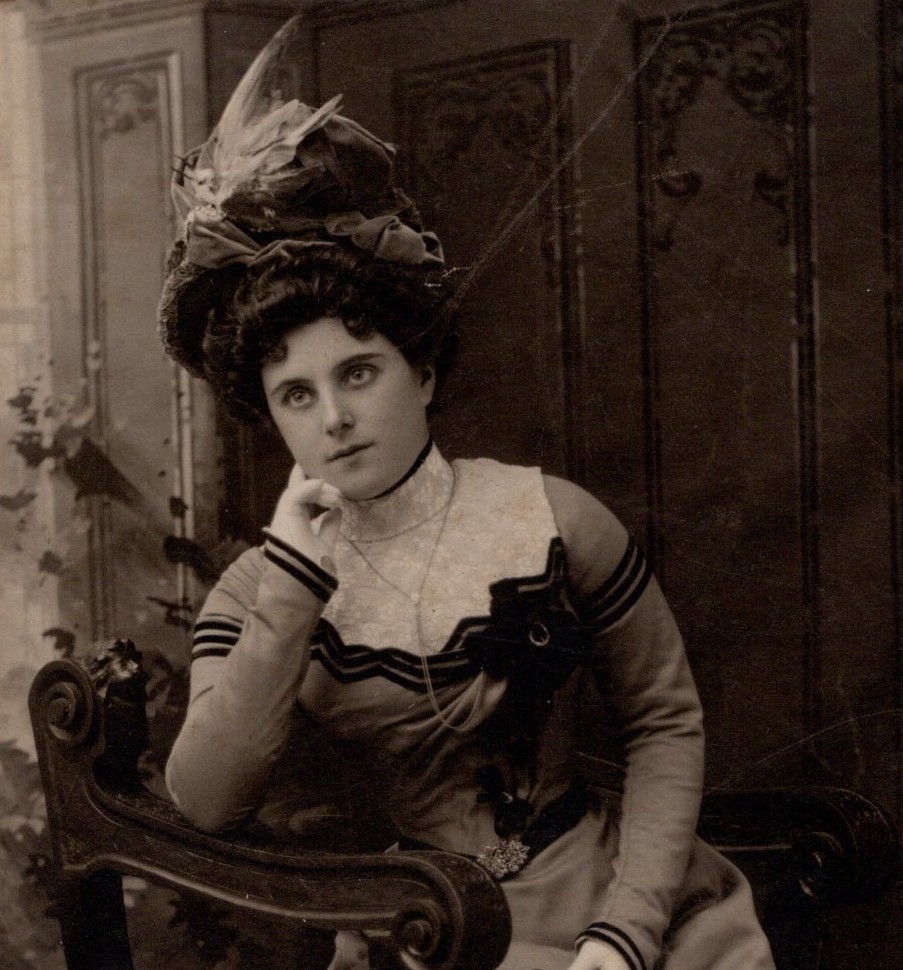
This is a striking vintage 5 x 7 inch mounted photograph featuring a young woman posed thoughtfully in a Victorian-era studio portrait. The sitter leans slightly forward on an ornately carved chair, resting her cheek on one hand, and holds a small box or compact in the other, lending the pose a contemplative, almost narrative quality. Her gaze is direct yet introspective, conveying a soft seriousness. She wears a finely tailored dress characteristic of the late Victorian to early Edwardian period, with fitted sleeves, intricate trim across the bodice, and layered textures that suggest quality and careful fashion sense. Draped over her shoulders is a light fabric or shawl, providing a contrast in texture to the smooth lines of her gown. On her head sits an elaborate hat adorned with what appears to be feathers and ribbons, consistent with fashionable women’s headwear of the era. The photograph is mounted on a dark board bearing the studio imprint at the bottom. This identifies the image as the work of Herbert Tonkin, a San Francisco photographer documented in the 1900 U.S. Census as a studio photographer working on Market Street. He was born in Wales. Tonkin’s portfolio included portraits of local sitters in turn-of-the-century San Francisco, and his work shows fine attention to composition and detail. This photograph is in good antique condition, with the following notes: there are a few very faint scratches visible in the darker background areas of the image. There is light edge and corner wear. The overall tonal quality is solid and the sitters features and attire are detailed and clear. This vintage photo is from circa 1900 and displays beautifully (see scans).
This cabinet card is available for purchase at my store, The History Peddler, for $34.95 or best offer.
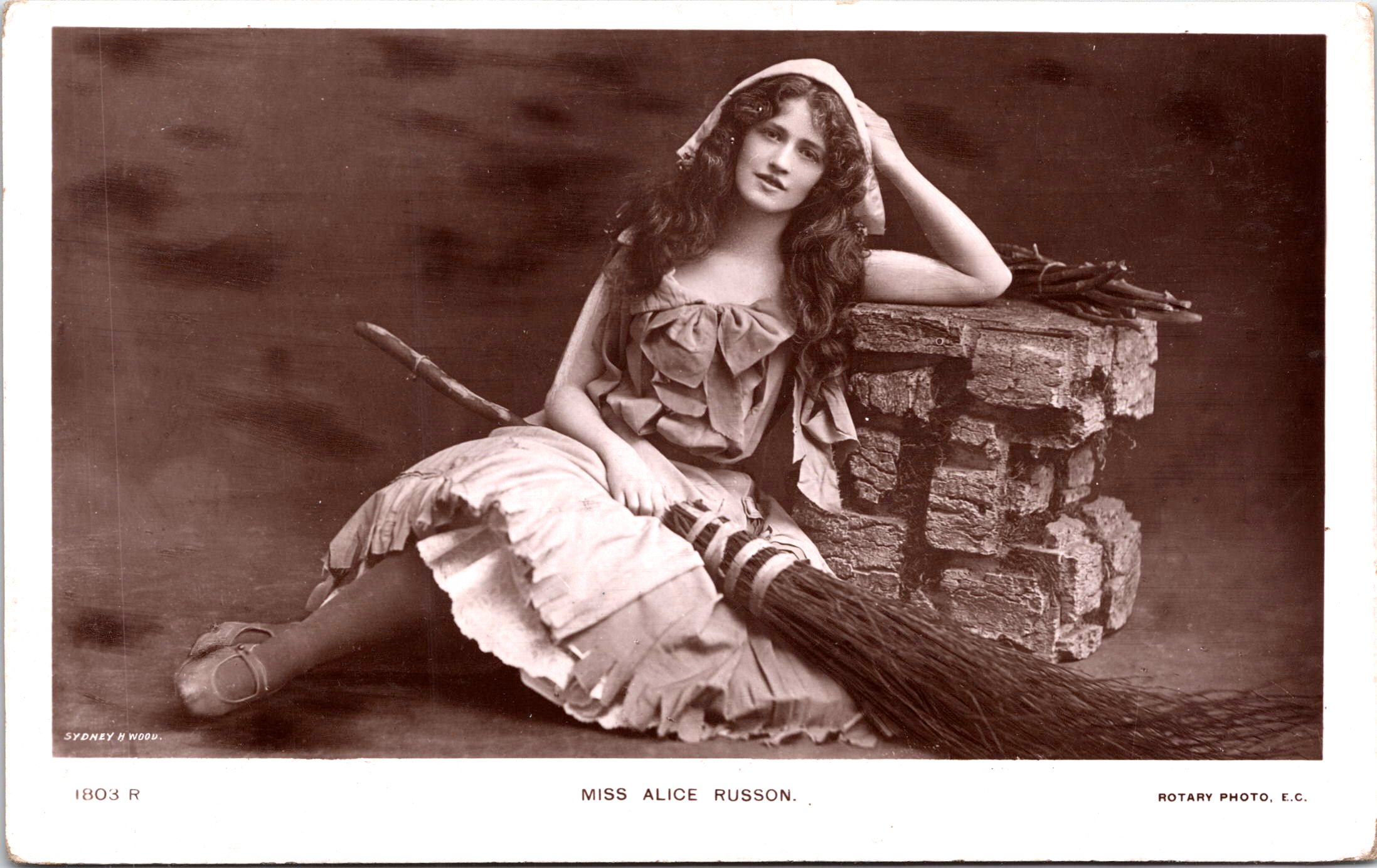
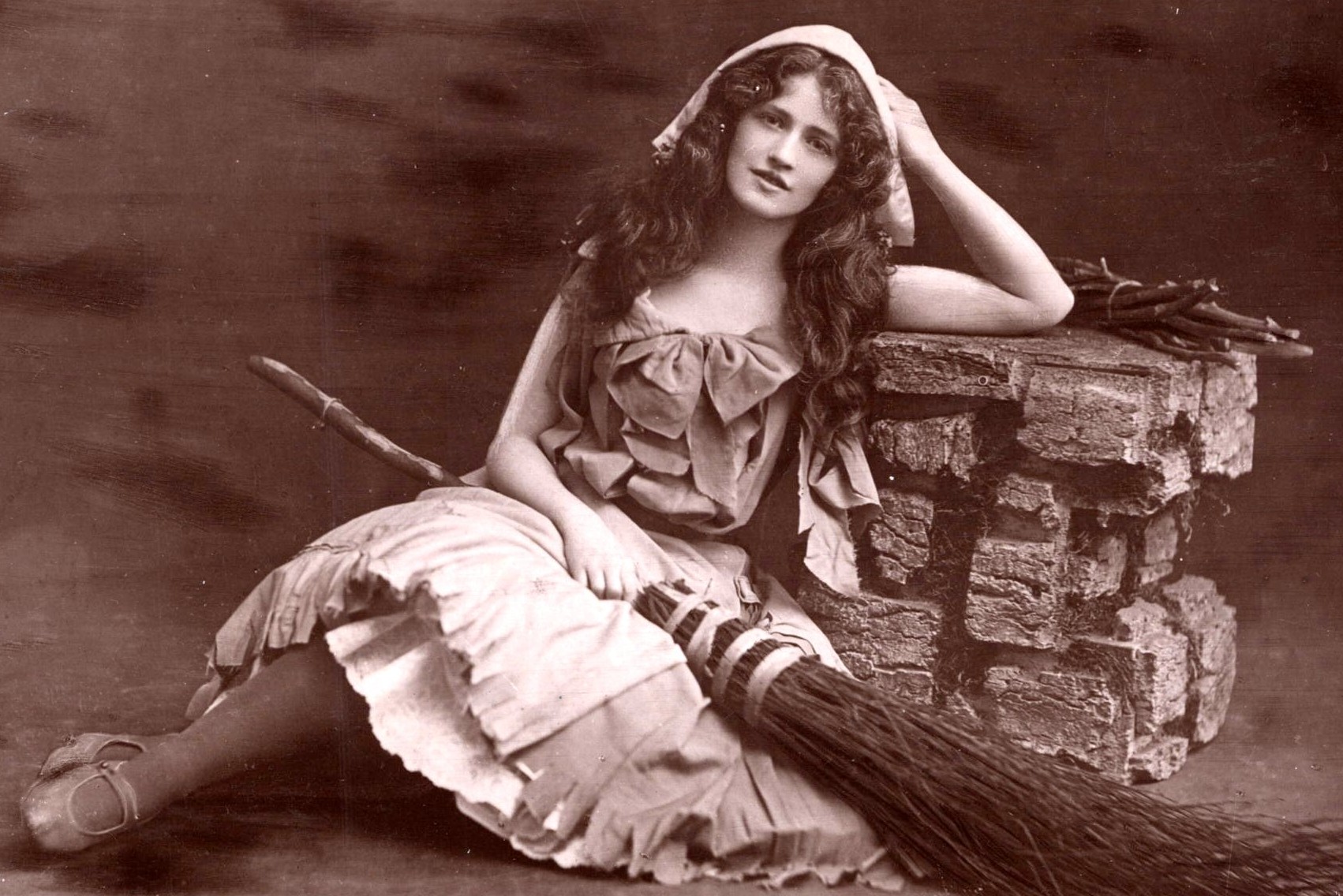
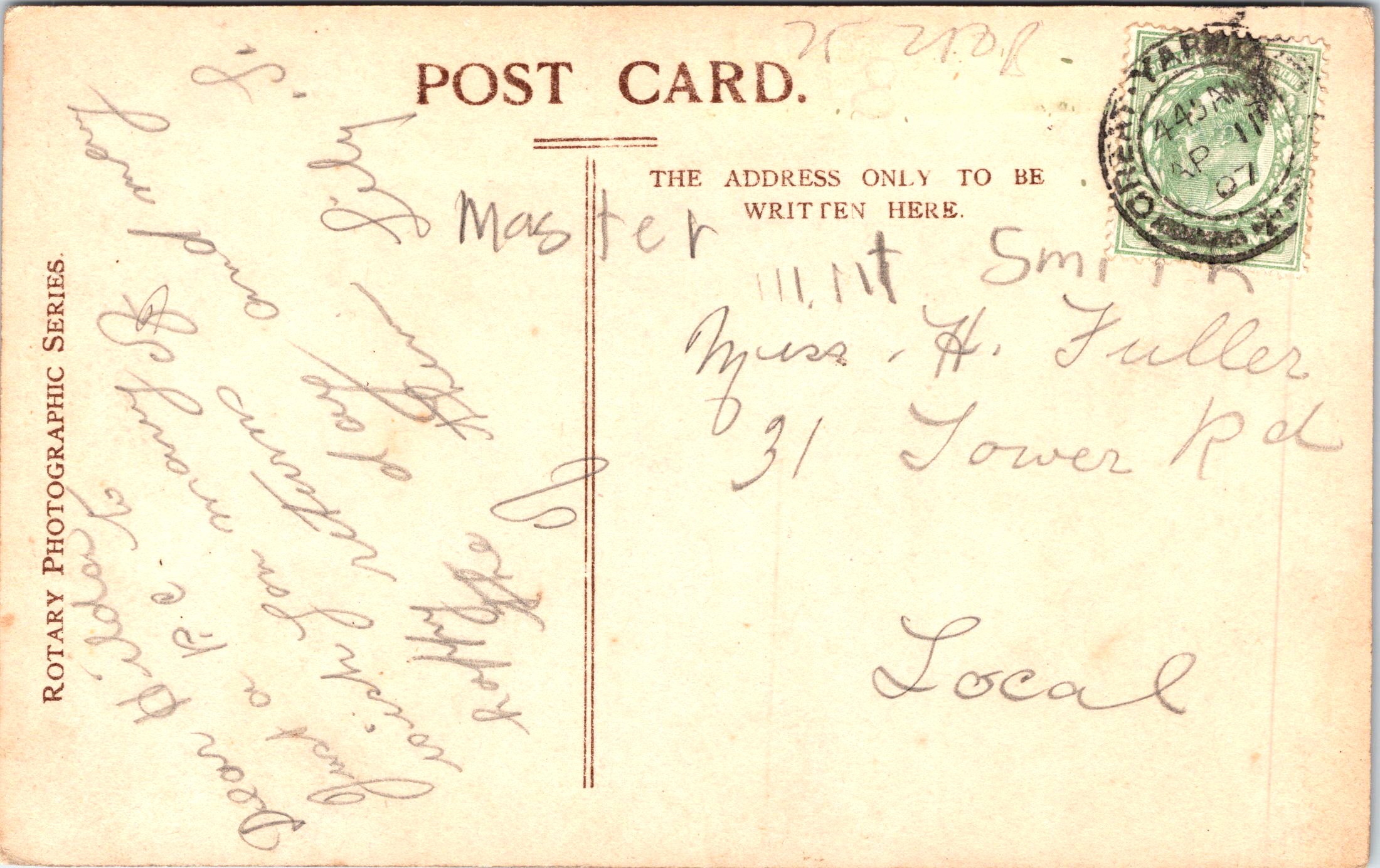
This vintage real photo postcard features Irish actress, singer, and dancer, Alice Russon. She acted in musical comedies and silent films. Russon’s stage work included “The Girl from Kay’s” (1904), “Cinderella” (1907), and “The Arcadians” (1911). In 1906, she appeared in a variety show headlined by Will Rogers. In 1912 and 1913, she performed in Australia. According to IMDb, Russon appeared in three British silent films including “Democracy” (1918) and “All Men are Liars” (1919). Russon was married to actor, Vernon Davidson. It is reported that she was an amateur photographer. This postcard, depicting Miss Russon, was issued by Rotary Photo, E.C., and bears the serial number 1803R. Rotary Photo was one of the most prominent British publishers of actress and theatrical postcards in the early 20th century. The image features Russon seated and leaning on a rustic brick structure and holding a bundled broom, suggestive of a stage role or symbolic costume rather than everyday dress. She wears a soft, flowing costume with layered fabric and a loosely draped head covering. Her long, wavy hair falls freely over her shoulders, reinforcing the youthful and idealized presentation common to Edwardian stage portraiture. Her relaxed posture and direct, gentle gaze give the image an intimate, informal quality that contrasts with more rigid studio portraits of the period. The photograph is credited to Sidney & Wood. The postcard has been postally used and is postmarked 1907. The postcard reads “Just a postcard to wish you many happy returns of the day and many of them”, The card is signed “Lily”. The postcard is in good antique condition. The photographic image remains strong, with good tonal depth and clarity. There is minor corner wear, and some small marks consistent with age and postal handling. The reverse shows normal handling wear, light toning, and writing from postal use, along with a clearly visible stamp and postmark. No creases or tears are present (see scans).
This real photo postcard is available for purchase at my store, The History Peddler, for $18.00 or best offer.
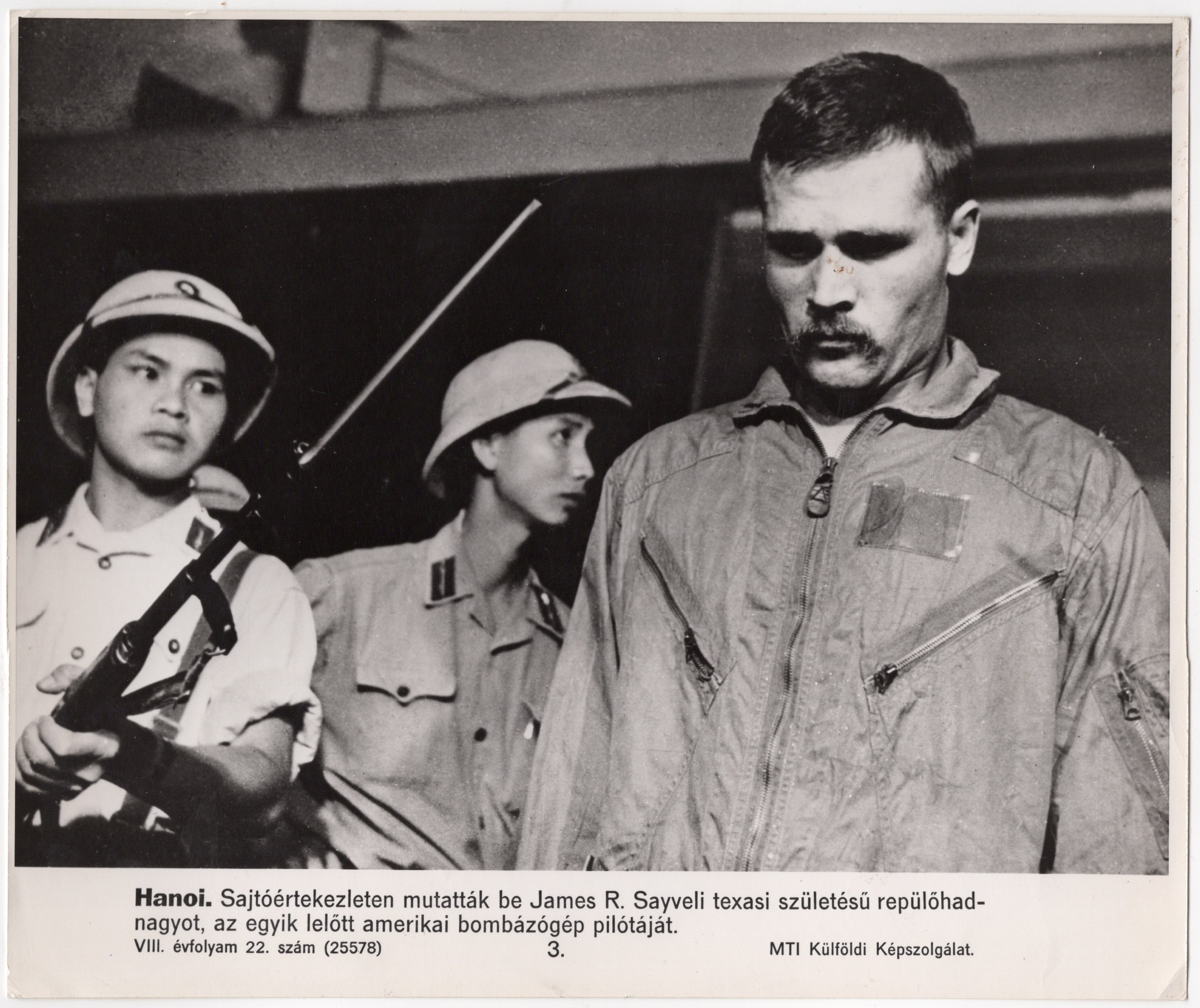
This item is an original c1967 Cold War–era press photograph distributed by the Hungarian news agency MTI Külföldi Képszolgálat. This powerful image shows Captain James Richard Shively, U.S. Air Force, being presented before journalists in Hanoi, flanked by North Vietnamese guards, following the shoot-down of his F-105 Thunderchief fighter-bomber during Operation Rolling Thunder. The translated printed Hungarian caption below the image reads: “Hanoi. At a press conference they presented James R. ‘Sayveli’ (Texas-born) flight lieutenant, pilot of one of the downed American bombers.” (Hungarian press agencies often rendered foreign names phonetically; ‘Sayveli’ correctly refers to James R. Shively.) Shively was born in 1942 in Wheeler, Texas. He graduated from the United States Air Foce Academy in 1964. He was shot down in May of 1967 near Hanoi on his 69th combat mission with the 357th Tactical Fighter Squadron based at Takhli, Thailand. He was held in the infamous “Hanoi Hilton” for nearly six years, enduring brutal torture and starvation. He was released in February of 1973 during Operation Homecoming. He received silver star and multiple service medals. After the war he earned a law degree from Gonzaga, became a federal prosecutor, and served as Interim U.S. Attorney for the Eastern District of Washington. He died exactly 33 years to the day after his release. The year of his death was 2006. (SOLD)
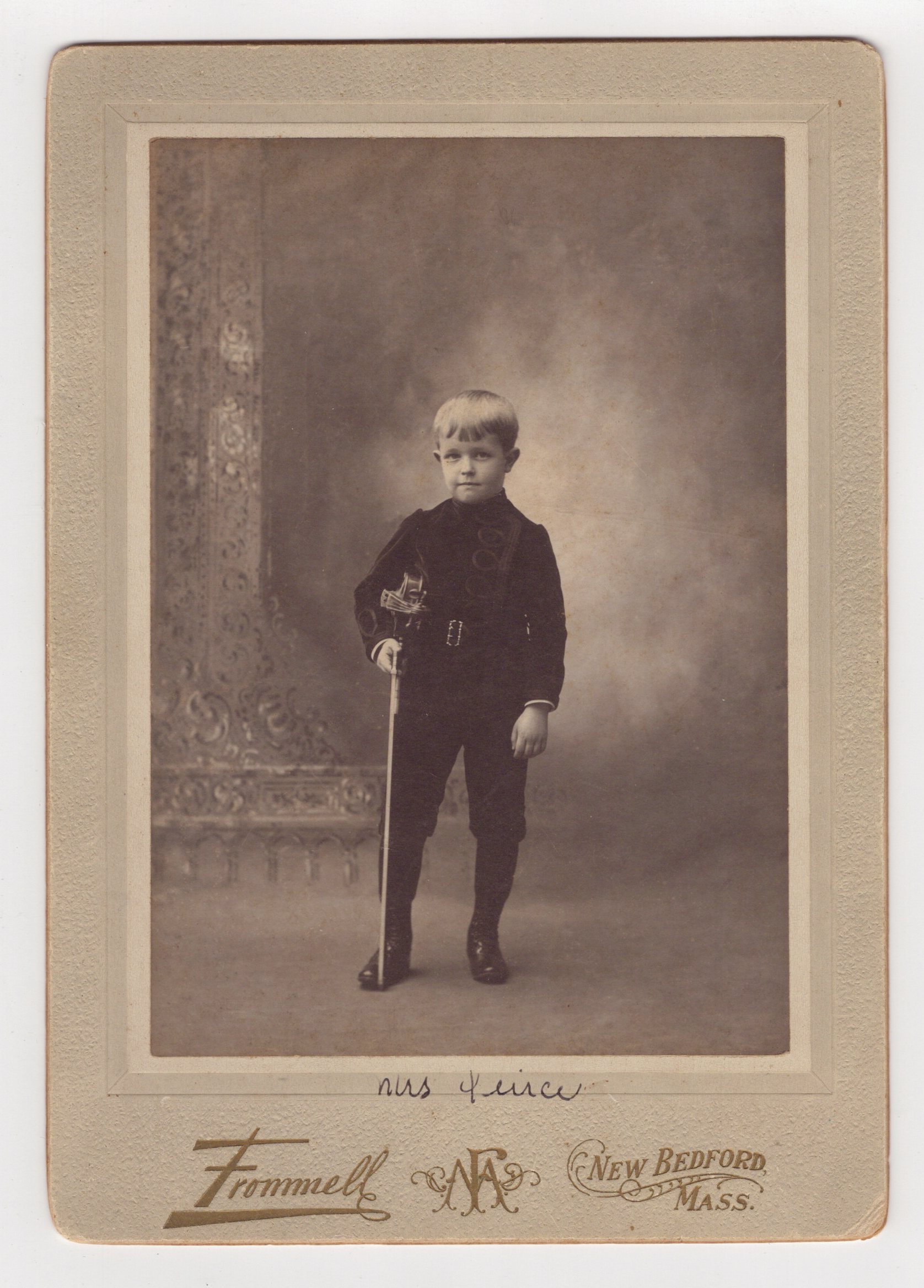
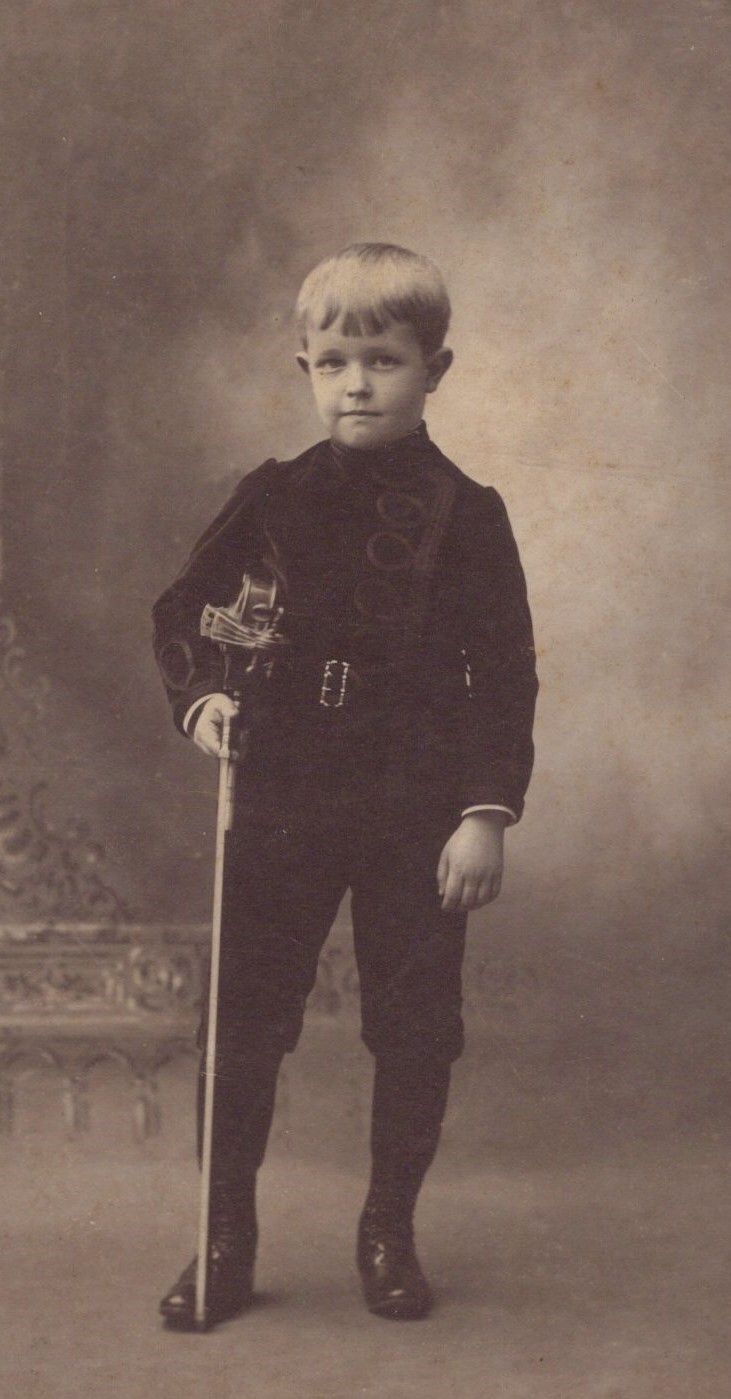
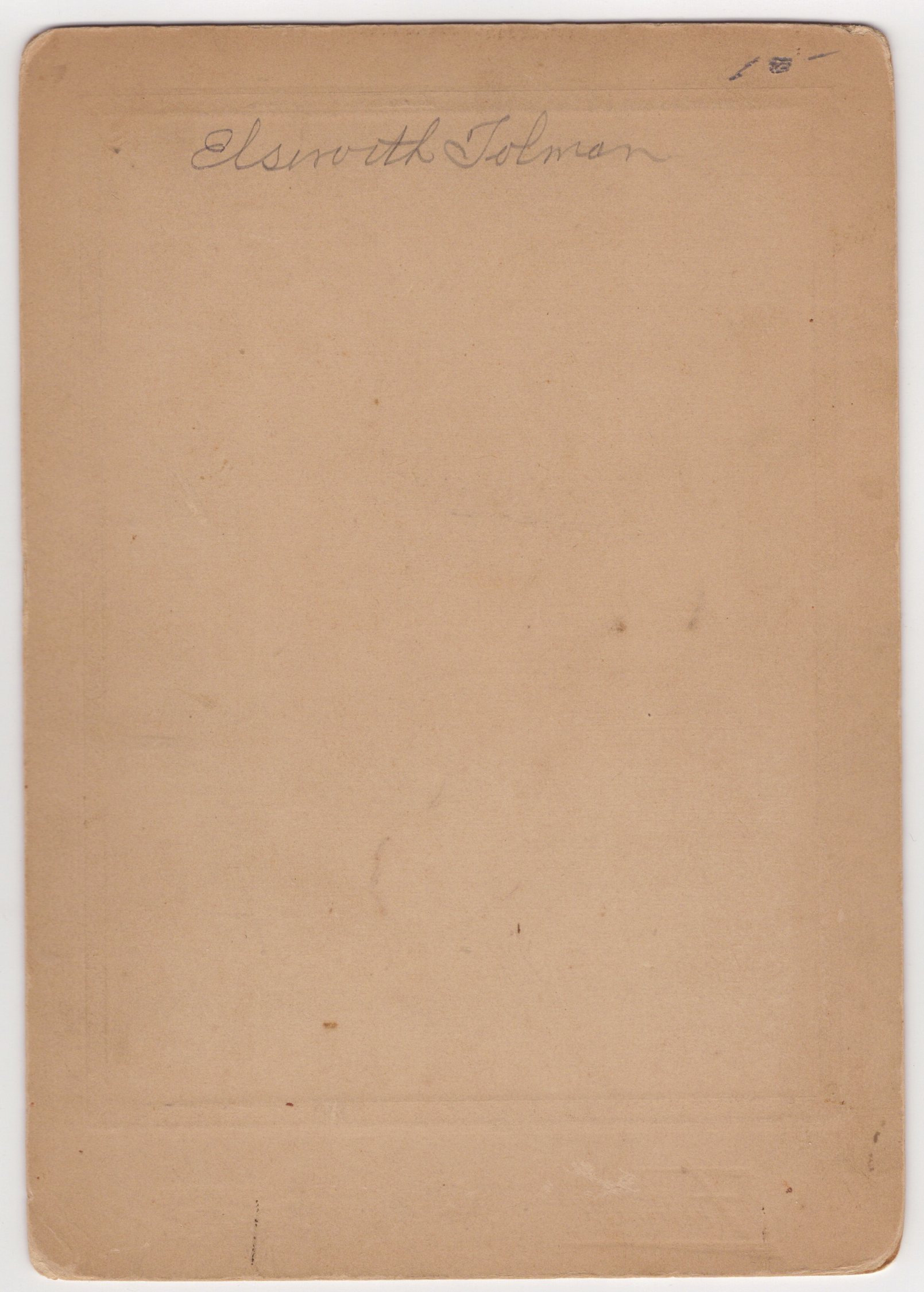
This vintage photograph features a handsome young boy dressed in dark clothing. He is holding a stick of some kind. Is it a toy? It almost looks like a sword. It has been pointed out to me by a Cabinet Card Gallery visitor that the boy actually has a violin under his arm. The “stick” is likely a bow. The child appears to be wearing a uniform (band?). The boy is identified on the reverse of the photograph. His name is Elsworth Baker Tolman and he lived most of his life in New Bedford, Massachusetts. He was born in 1891. His father and mother were named Elmer and Adrianna respectively. The boy’s father was a musician. The 1910 census shows that Elsworth was working as a dry goods salesman. Elsworth was in the Army during World War l. He was a Captain and was assigned to an Engineering unit. Records from the 1930’s reveal that he was working as an engineer and in 1939 he married Dorothy Tolman. In 1940, he was employed as a fire insurance Engineering Inspector. This photo was taken by Martin H. Frommell at his New Bedford, Massachusetts studio.
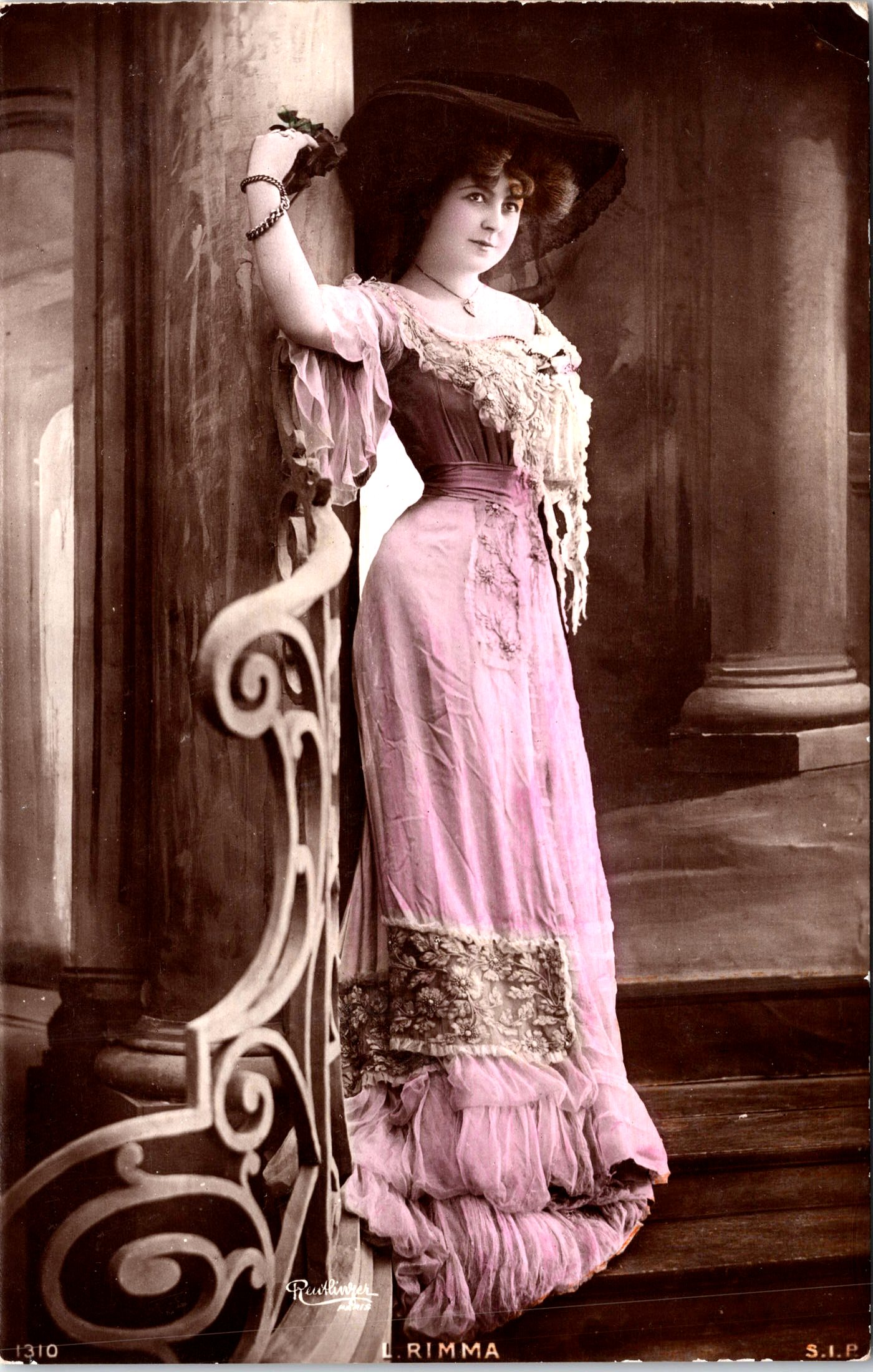
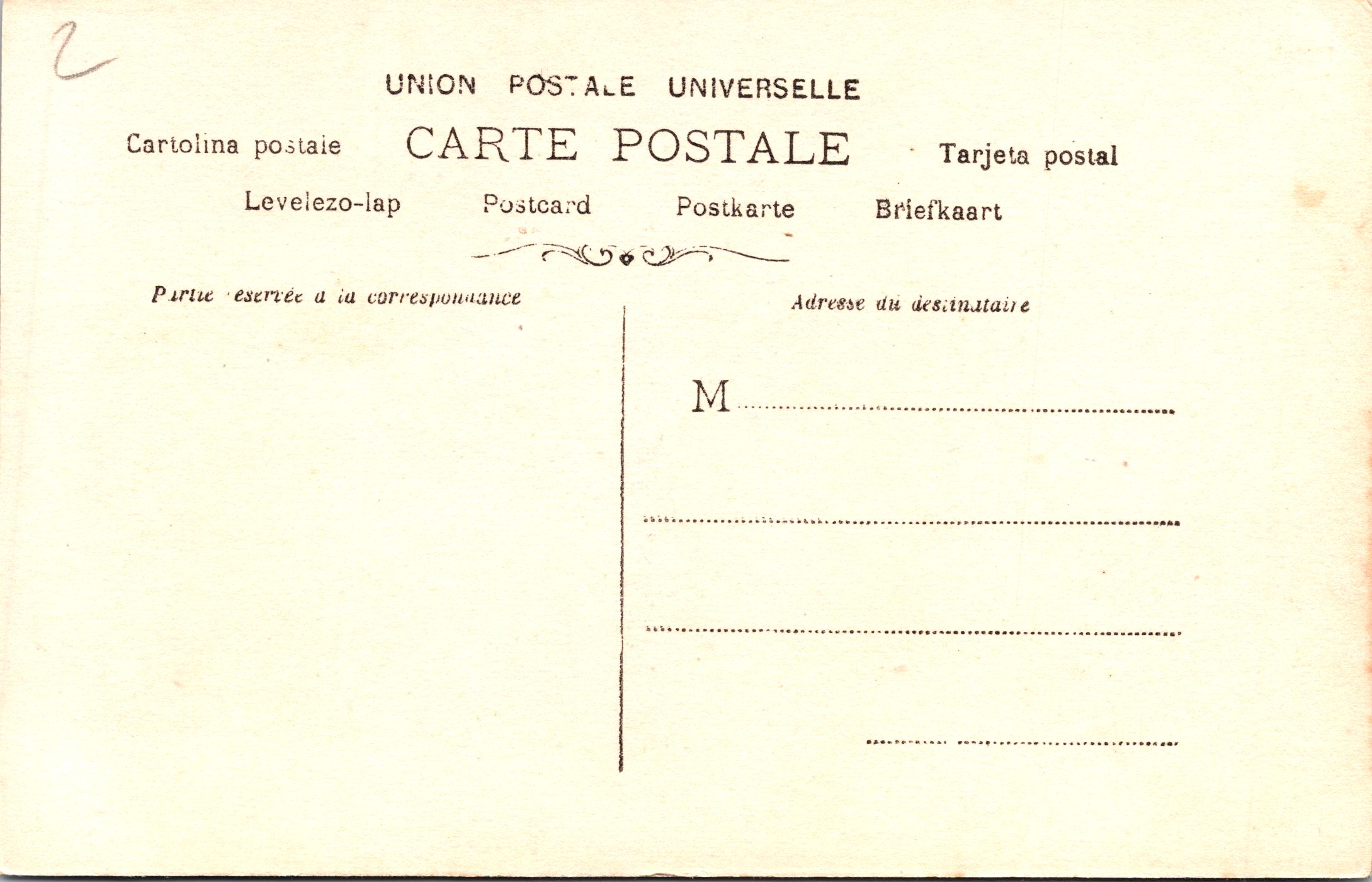
Offered here is a striking early 20th-century French theatrical postcard featuring the actress Lily Rimma, photographed in an elegant studio pose by the celebrated Paris photographer Reutlinger. This is a beautifully composed full-length portrait, showing the performer leaning against an ornate balustrade, framed by classical architectural columns—an image clearly intended to convey refinement, poise, and stage presence. Rimma is dressed in a flowing Edwardian gown rendered in delicate hand-applied pink coloration, with lace detailing, ribbon accents, and a richly patterned hem. She wears a large, dramatic hat with veil, a bracelet, and a pendant necklace, all contributing to the unmistakable theatrical glamour of the period. Her relaxed yet confident pose and direct gaze reflect the visual language commonly used for actresses and singers in Paris at the height of the Belle Époque. The postcard bears the Reutlinger, Paris studio credit in the image. It was issued by S.I.P. (Société Industrielle de Photographie), a well-known French publisher responsible for many high-quality performer postcards of this era. The postcard is part of a series (No.1310). The divided back postcard is consistent with circa 1903–1905 production. This is a fine example of a hand-colored theatrical postcard, combining high photographic quality with subtle color work. SOLD




 THE CABINET CARD GALLERY