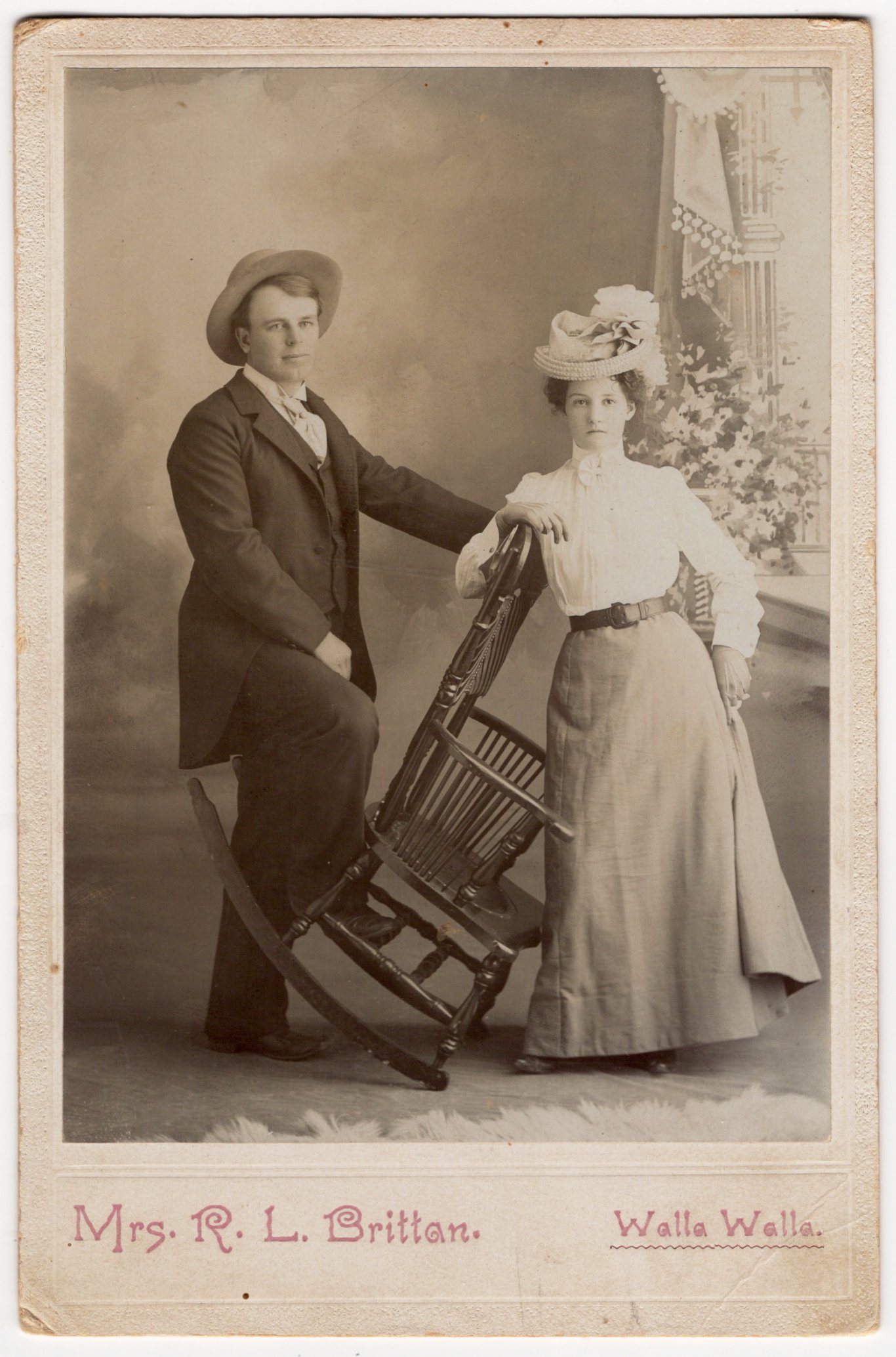
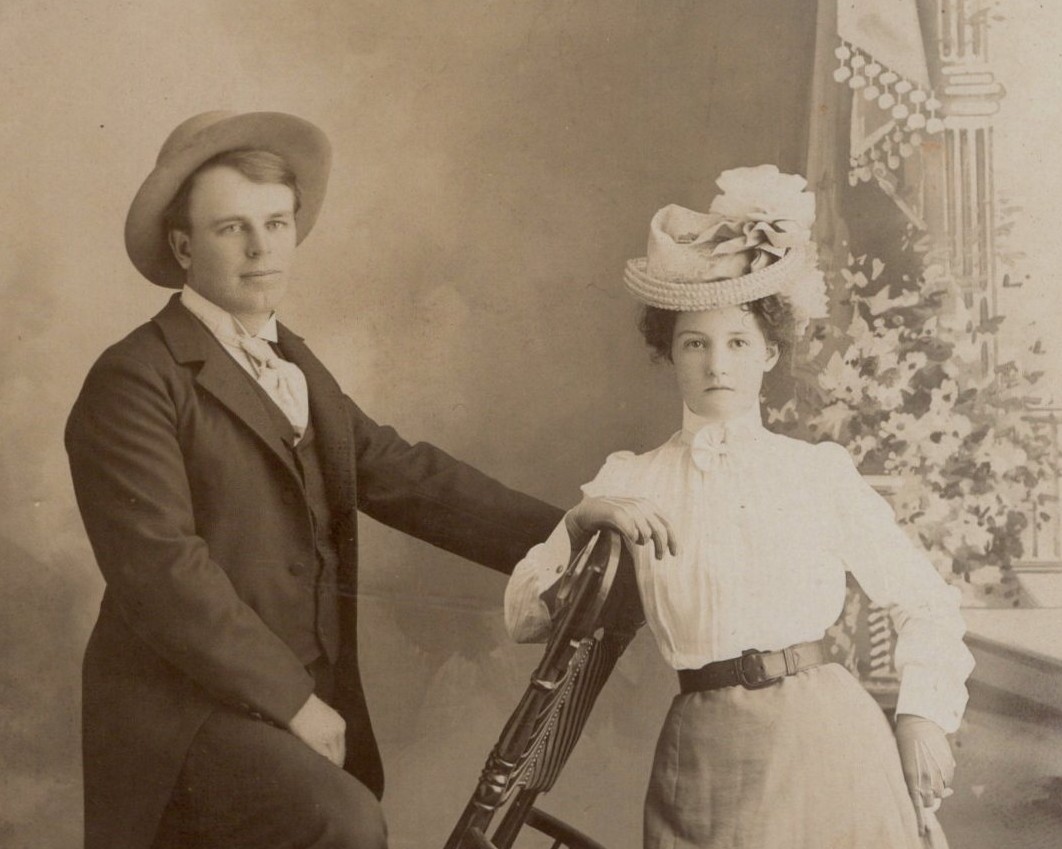
This charming and evocative cabinet card features a young couple—possibly newlyweds—posed in a classic late‑Victorian formal style. The gentleman stands with one foot upon an elegantly turned rocking chair, wearing a suit, light-colored tie, and a broad-brimmed hat. The lady stands beside him, elegantly leaning her arm on the same chair, dressed in a fitted blouse, belted skirt, gloves, and an ornate hat adorned with soft fabric details. Behind them, a painted studio backdrop hints at a window with draped curtains and floral décor. The lower margin of the mount bears the imprint “Mrs. R. L. Britton. Walla Walla.”, indicating it was produced by a woman photographer operating in Walla Walla, Washington—an intriguing and relatively uncommon attribution for the era. Despite searching through records of cabinet-card–era women photographers, I found no specific mention of Mrs R. L. Britton. She was a professional photographer in Walla Walla, WA, at a time when women in photography were still emerging as studio operators. This cabinet card appears to be from the 1890’s.(SOLD)
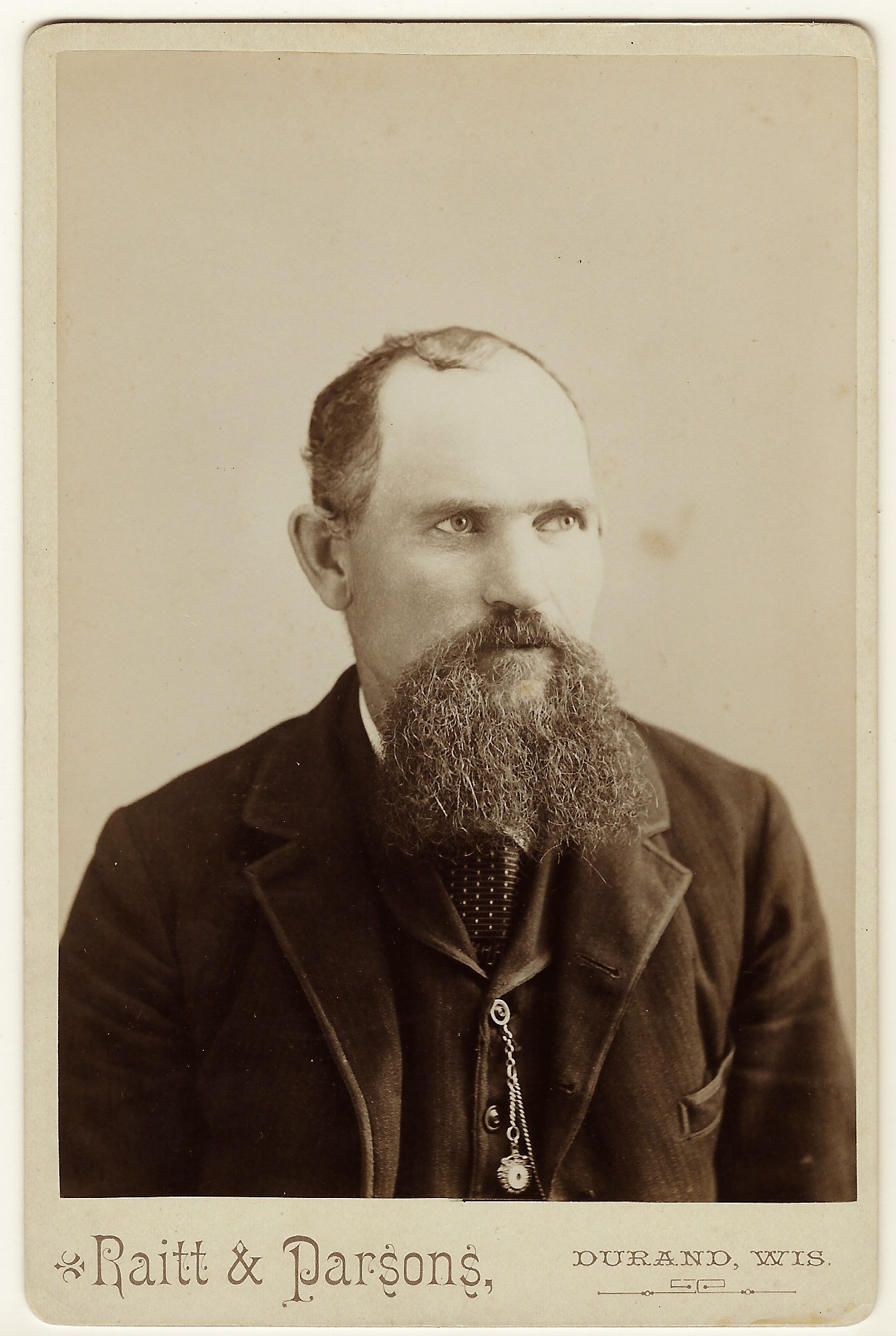
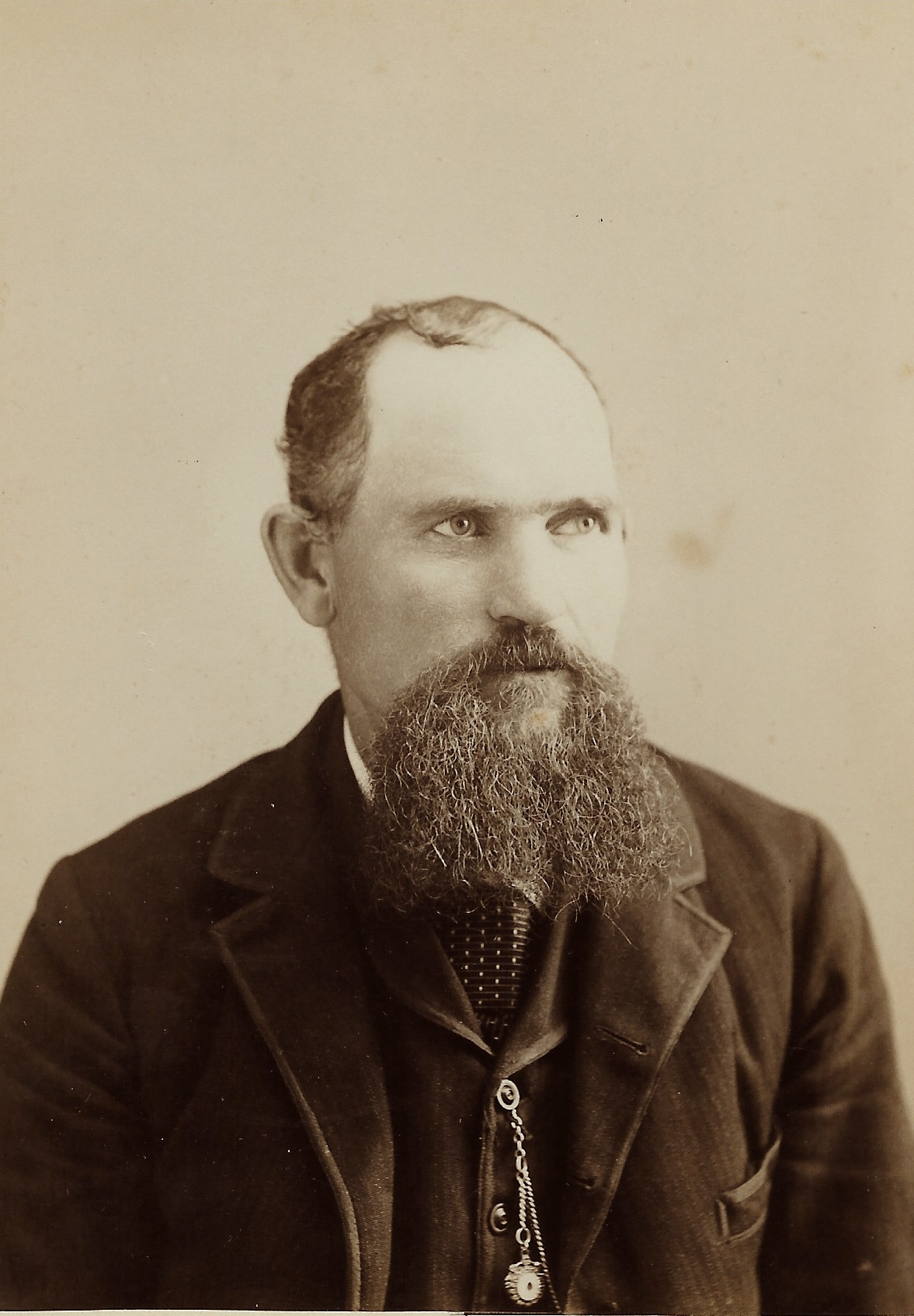
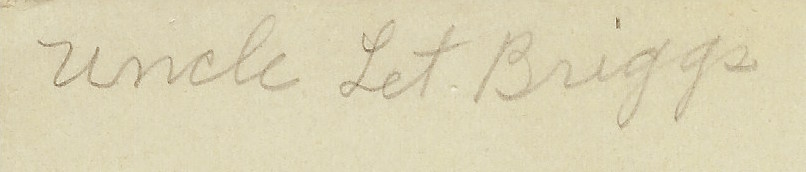
This cabinet card portrait features a well dressed man with a masterful wiry mustache and chin beard. He is wearing a watch on a chain as well as a very serious expression. This photograph was taken at the Raitt & Parsons studio, which was located in Durand, Wisconsin. The town of Durand is in western Wisconsin and was first settled in 1856 by 21 year-old Miles Durand Prindle.. The town was incorporated in 1887. Photographer, Thomas G Raitt (1847-1904) operated a studio with Mr Parsons between 1891 and 1892. He was a sole proprietor photographer between 1893 and 1904. After Thomas died, another Raitt continued to work as a photographer in Durand. The most likely suspect is Mazie Penelope Raitt (1880-1945) who was a daughter of Thomas and his assistant photographer. In 1905, she ran her own studio, which was likely her late father’s business. One can assume she succeeded her father after Thomas’s death. It appears that Mazie later joined forces with photographer Oscar Fryklund. The pair are listed as partners in the Historical Index of Wisconsin Photographers. An inscription on the reverse of this photograph indicates that the subject is “Uncle Let Briggs”. A preliminary investigation did not obtain confirmable biographical information about “Let Briggs”. There was a “Let Briggs” born in Michigan in 1875, but if the subject was this man, it would mean that he would have been in his mid twenties when he posed for this image. The man in this photograph is clearly significantly older than the mid twenties.
This cabinet card is available for purchase at my store, The History Peddler, for $24.00 or best offer .
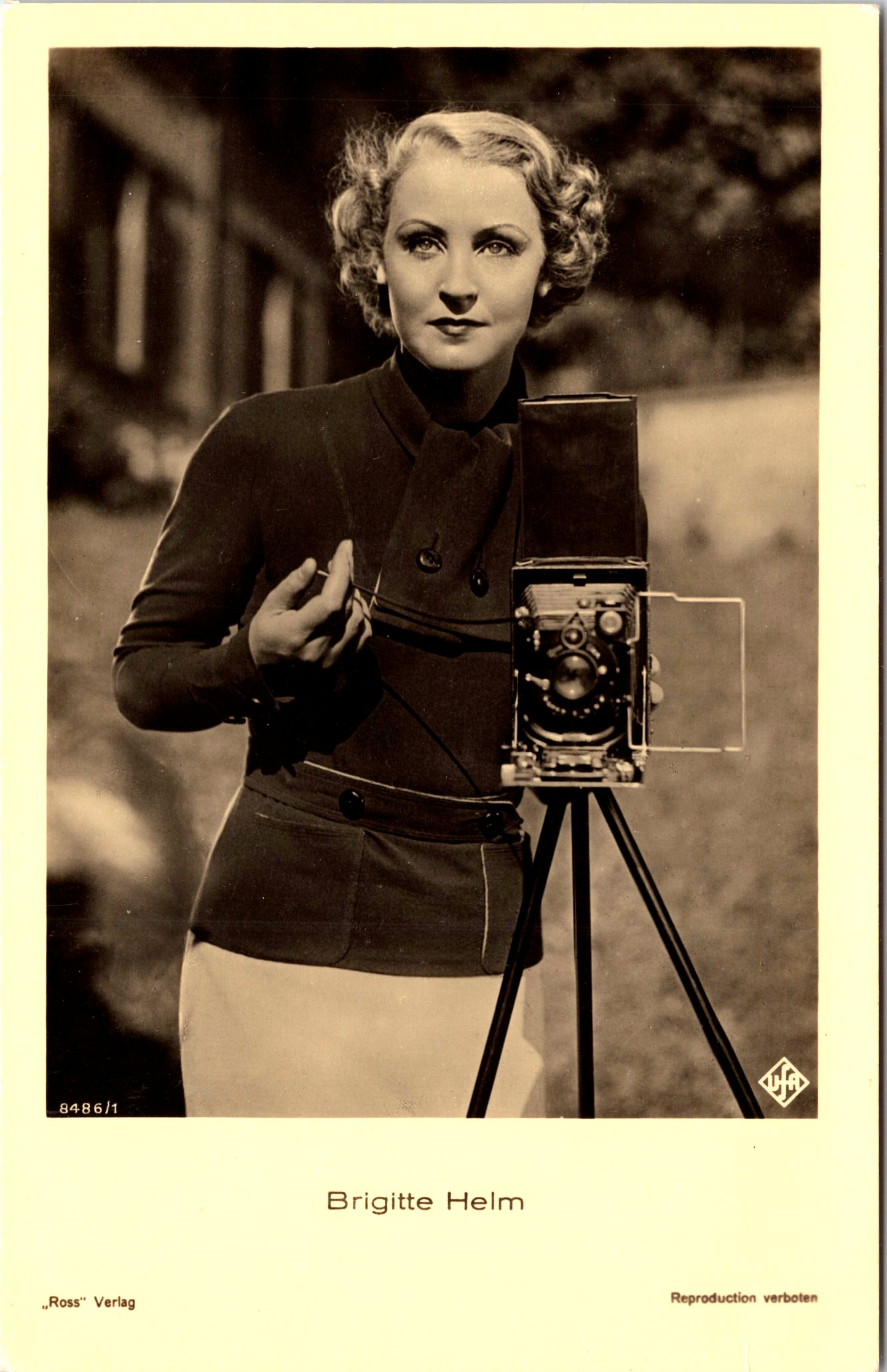
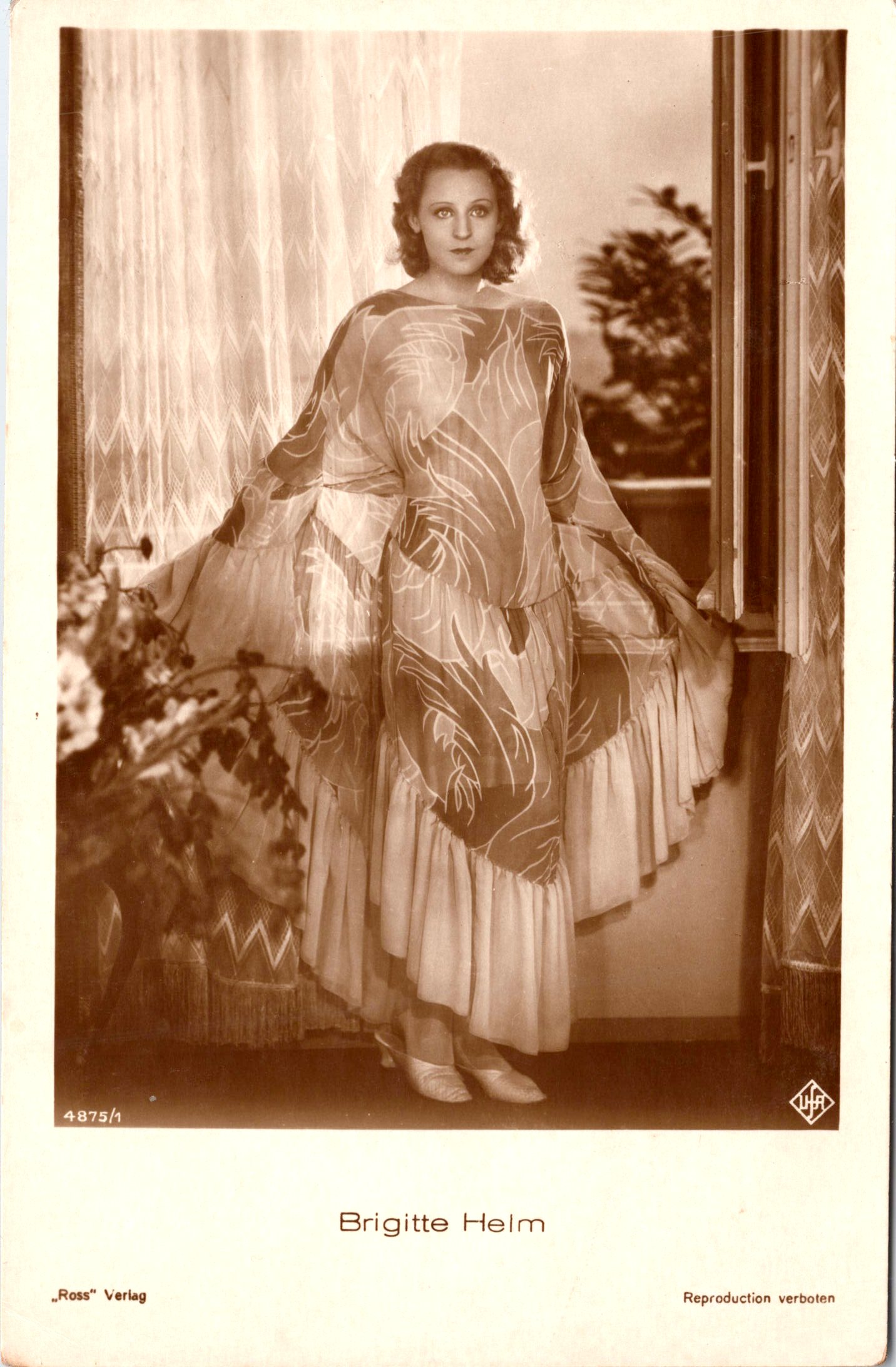
Postcard 1 features German actress, Brigitte Helm (1908-1996). The postcard captures Miss Helm taking a photograph with a camera on a tripod. Photographs of photographers in action are quite collectible. Now, back to Brigitte Helm. She is best known for her dual role in Fritz Lang’s 1927 silent film, Metropolis. After “Metropolis” she played in a long string of movies where she typically had the starring role. Helm was typecast as a Vamp or a femme fatale. She was born in Berlin. Her father was a Prussian Army officer. She was interested in acting at an early age and by age 12, was taking lead parts in school plays. At the age of 17, she acted in “Metropolis”. In 1925 she signed a ten year contract with UFA. She performed in both silent films and talkies. Beside “Metopolis” (1927), Helm was best known for “A Daughter of Destiny” (1928), “L’Argent” (1928), and “Alraune” (1929). Helm had an eventful personal life. Helm was involved in several traffic accidents. In fact, she was briefly placed in prison for manslaughter charges. She married industrialist, Dr Hugo Kunheim. The Nazis were not very pleased with her choice in men because Kunheim was Jewish. In 1935, Helm retired and moved with her husband to Switzerland where they started a family. Helm explained her retirement was because of disgust about the Nazi’s taking over the German film industry. This postcard was published by Ross Verlag as part of a series (No.8486/1). The card has the UFA logo which reveals it was published between 1925 and 1935. (SOLD)
Postcard 2captures Miss Helm in a beautiful dress that illustrates her nice figure.This postcard was published by Ross Verlag as part of a series (No.8486/1). The card has the UFA logo which reveals it was published between 1925 and 1935.(SOLD)
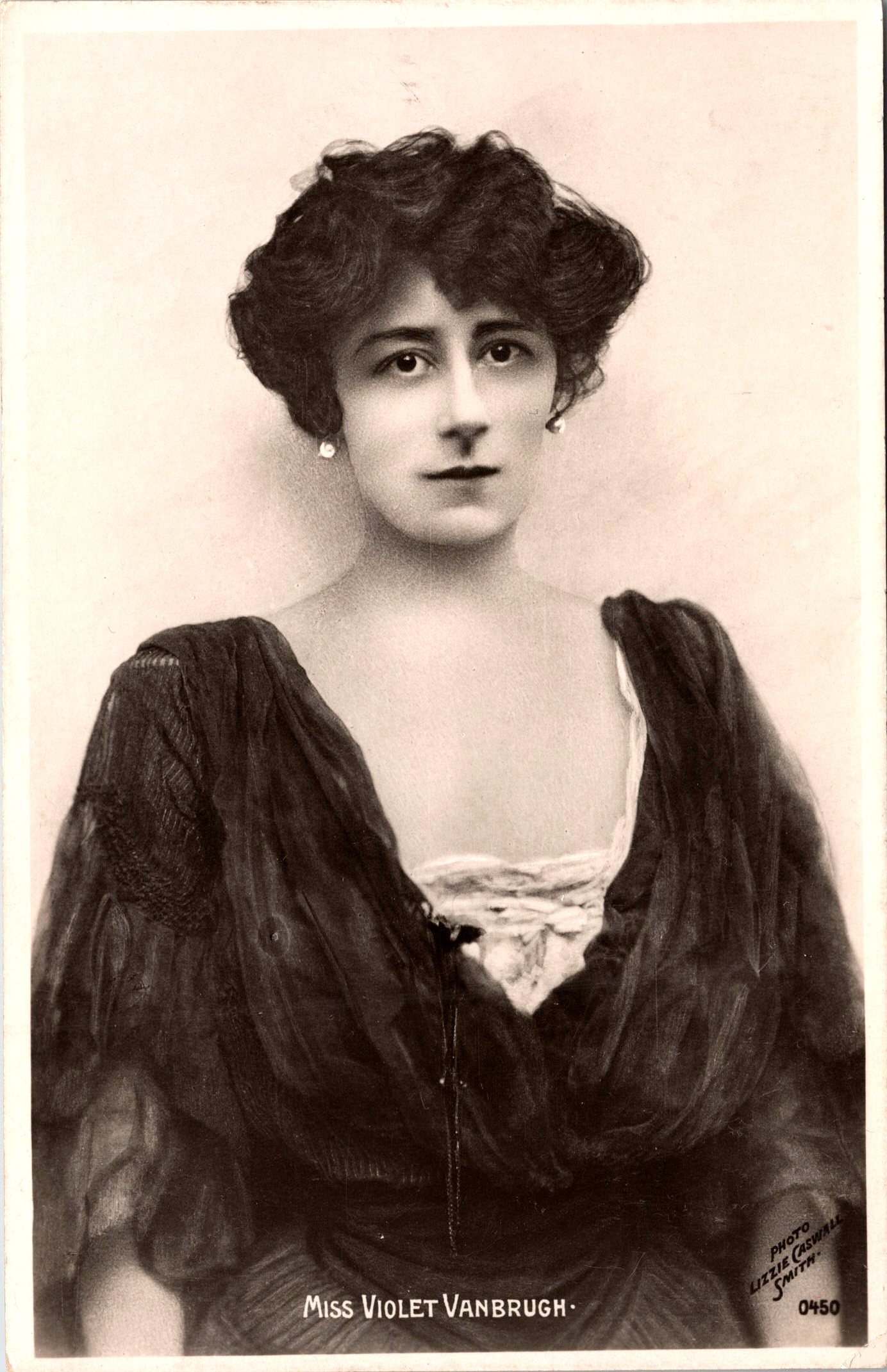
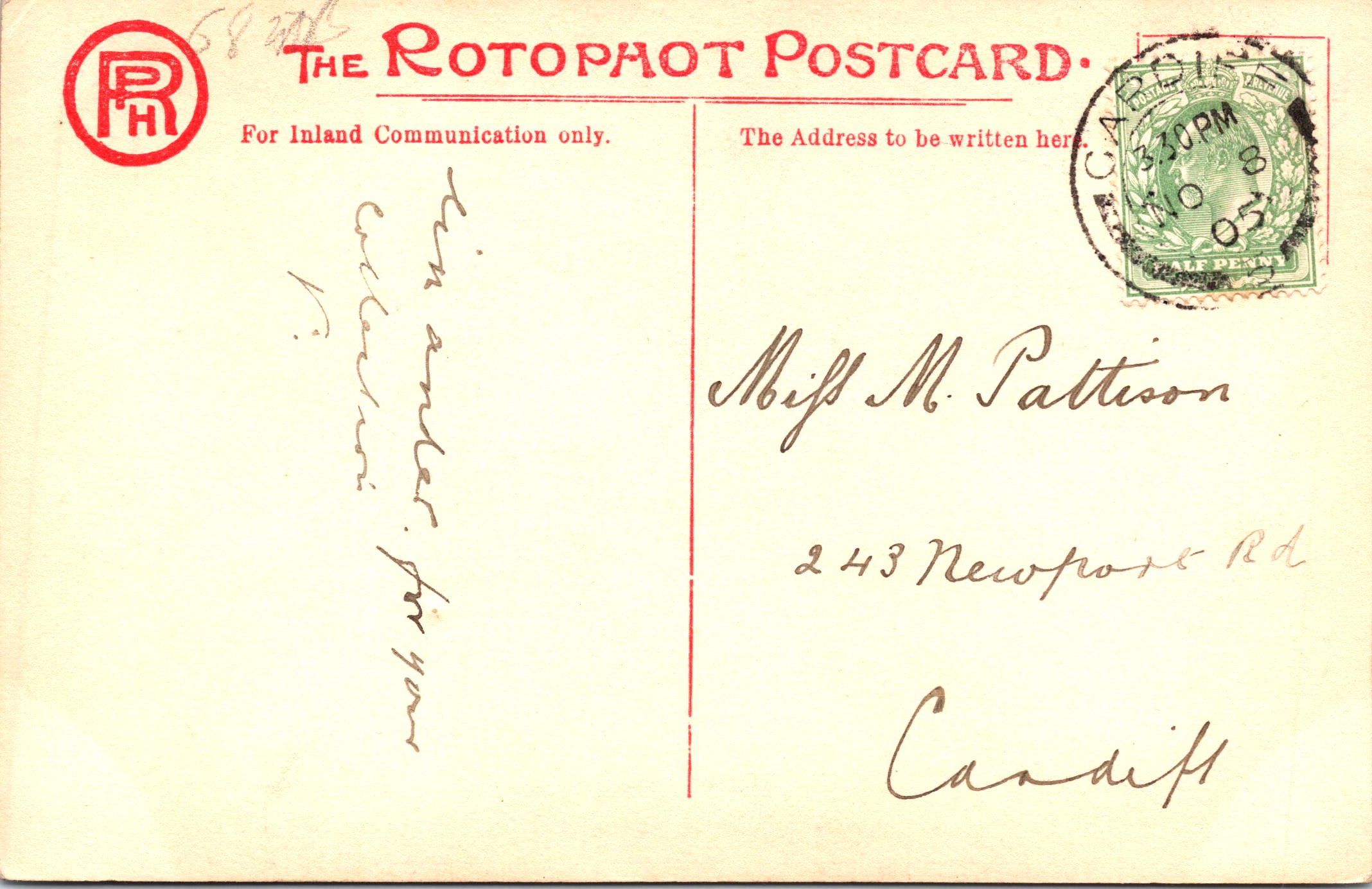
This is a rare and beautifully preserved Rotophot (RP) postcard featuring a striking portrait of the renowned British stage actress Miss Violet Vanbrugh (1867–1942). The postcard, numbered 0450, was published by Rotophot, a German publisher known for high-quality photographic postcards. The portrait itself was captured by Lizzie Caswall Smith, a prominent female photographer of actors and society figures during the early 20th century. This particular image is notable for its excellent clarity and fine detail, showcasing Vanbrugh in an elegant, dark gown with a delicate lace underlayer, her short wavy hair styled fashionably, and wearing simple yet refined pearl earrings. Violet Vanbrugh was part of a theatrical family—her sister, Irene Vanbrugh, was also a celebrated actress. She initially pursued her education at Exeter and developed an interest in drama at a young age. She made her stage debut in 1886 at the Theatre Royal, Margate, before stepping into the London theatre scene. Her breakthrough came when she joined Sir Henry Irving’s company, where she refined her skills and gained recognition for her classical performances. Over the years, she became highly regarded for her portrayals of Shakespearean heroines, including Lady Macbeth, Portia in The Merchant of Venice, and Queen Katherine in Henry VIII. Apart from Shakespeare, she also starred in major productions like “Caste” and “Diplomacy”. Vanbrugh was admired for her commanding presence and emotive delivery, making her a favorite among theatre audiences of the late Victorian and Edwardian eras. Violet Vanbrugh married Arthur Bourchier, a fellow actor, in 1894, and the couple became a theatrical powerhouse, frequently starring together in productions. They also managed the Garrick Theatre in London for a time. However, their marriage eventually ended in divorce. Despite personal setbacks, Vanbrugh remained a distinguished figure in the theatrical world well into the 20th century. She passed away in 1942 at the age of 75. The back of this postcard features the Rotophot logo in red, with a printed divider. It is addressed to Miss M. Pattison of Cardiff, Wales. The handwritten message, written in cursive along the left margin, reads: “another for your collection”. The sender hopes the postcard will be added to the recipients postcard collection. The postcard bears a half-penny green King Edward VII stamp, which was postmarked in Cardiff in 1908. (SOLD)
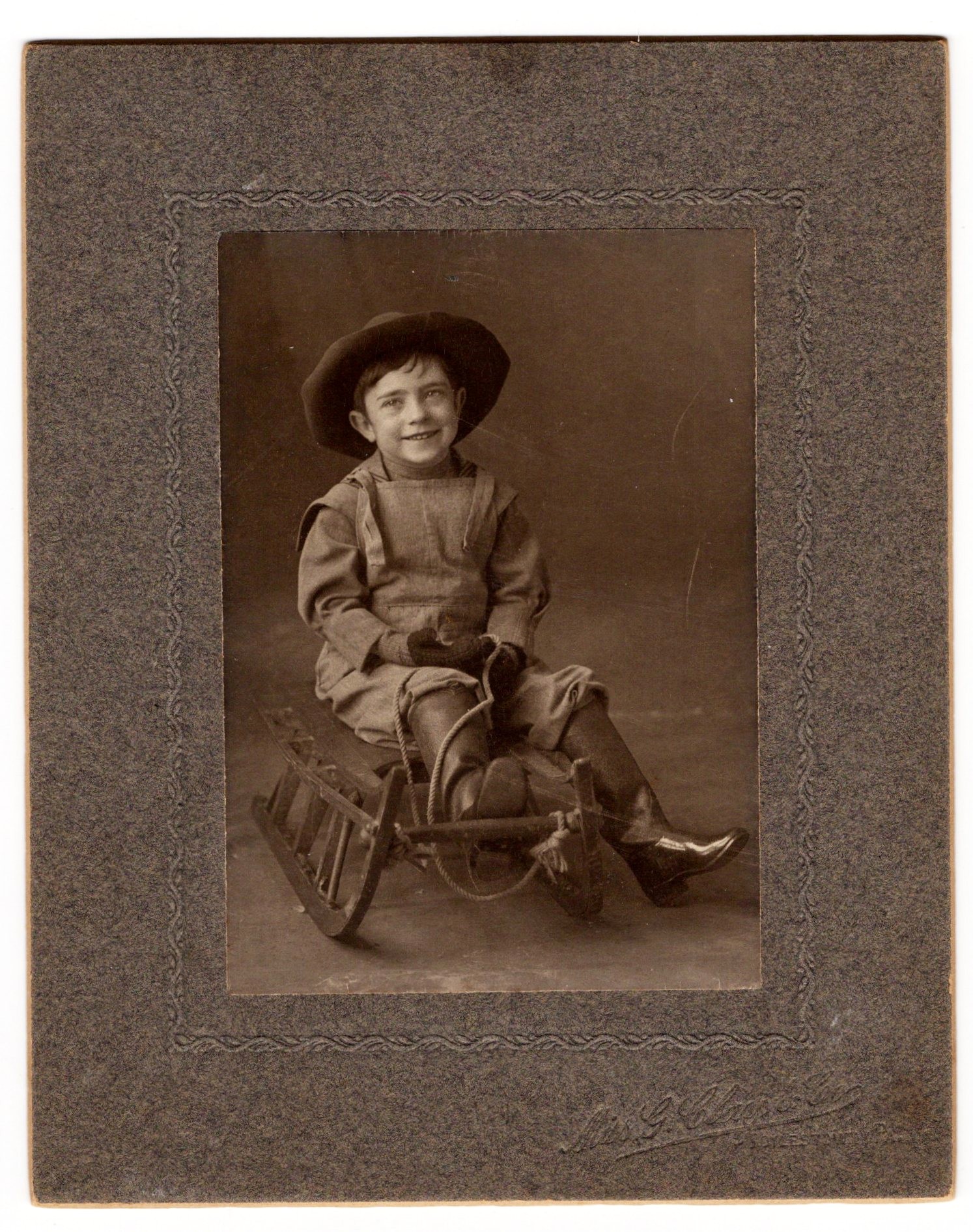
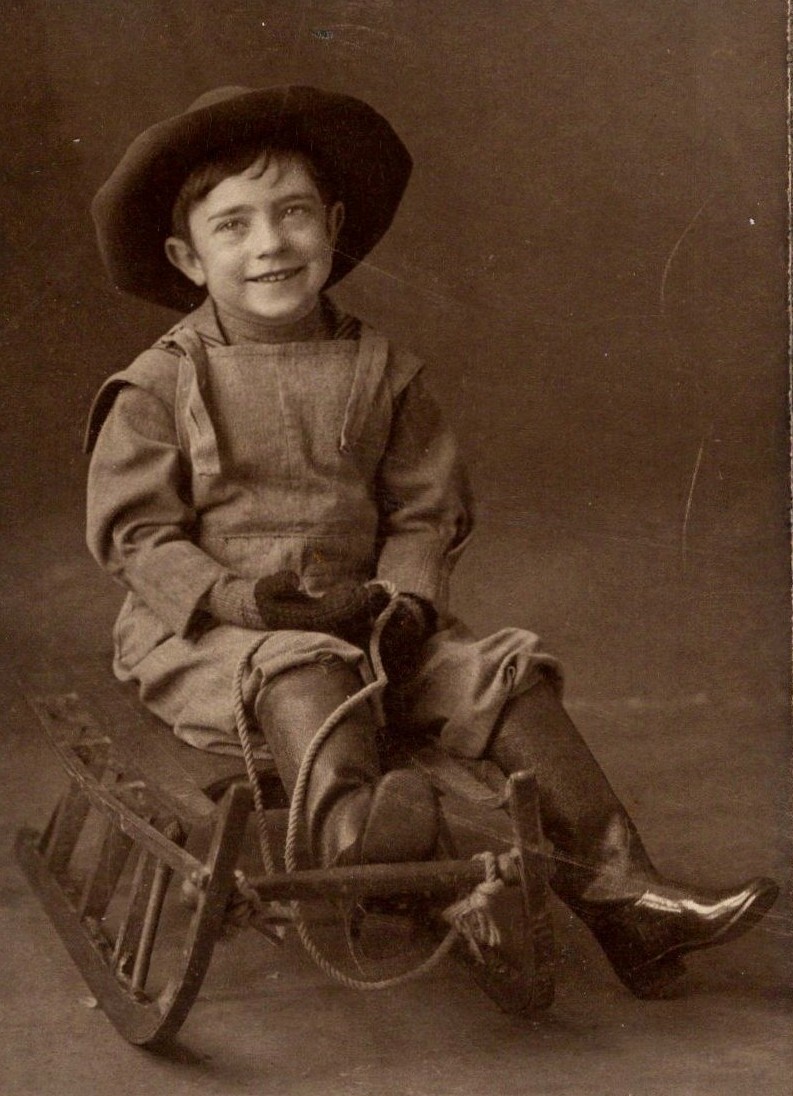
This charming vintage photograph captures a young boy seated on a wooden sled, dressed in winter attire. The image is mounted on gray cardstock with a debossed border, a style prevalent between 1900 and 1915. The boy is dressed in a thick woolen outfit, high leather boots, and a wide-brimmed hat, typical of early 20th-century winter wear. He sits on a wooden sled, which resembles designs manufactured between 1895 and 1915, commonly used in Northern states. The photographer’s signature, “Miss Clarke,” is embossed in script on the lower right corner. The photographer is Miss Clarke, possibly the celebrated Sara Maynard Clark. The photograph was taken at Miss Clarke’s Doylestown, Pennsylvania studio. Various aspects of the photograph indicate that the photo was taken sometime between 1905 and 1912. Sara Maynard Clark (1891–1973) was a prominent writer, editor, historian, and photographer based in Bucks County, Pennsylvania. After relocating to the area in 1933, she contributed extensively to local publications such as The New Hope, Bucks County Traveler, and New Bucks County Magazine, often incorporating her own photographs into her articles. She also collaborated with her husband, Harold (Hal) Clark, and their son, Maynard Clark, both photographers, to document the evolving character of Bucks County through photography. Her work is preserved in the Bucks County Artists Database and has been featured in exhibitions at the Michener Art Museum. If I have dated this photograph correctly, the photographer is likely a different woman than Sara Maynard Clark because she was likely living in Iowa, and not Pennsylvania, when this photo was taken. In addition, Clark is spelled Clarke on this photograph’s mount. Further research is required to confirm the identity of the female photographer who took this photo. (SOLD)
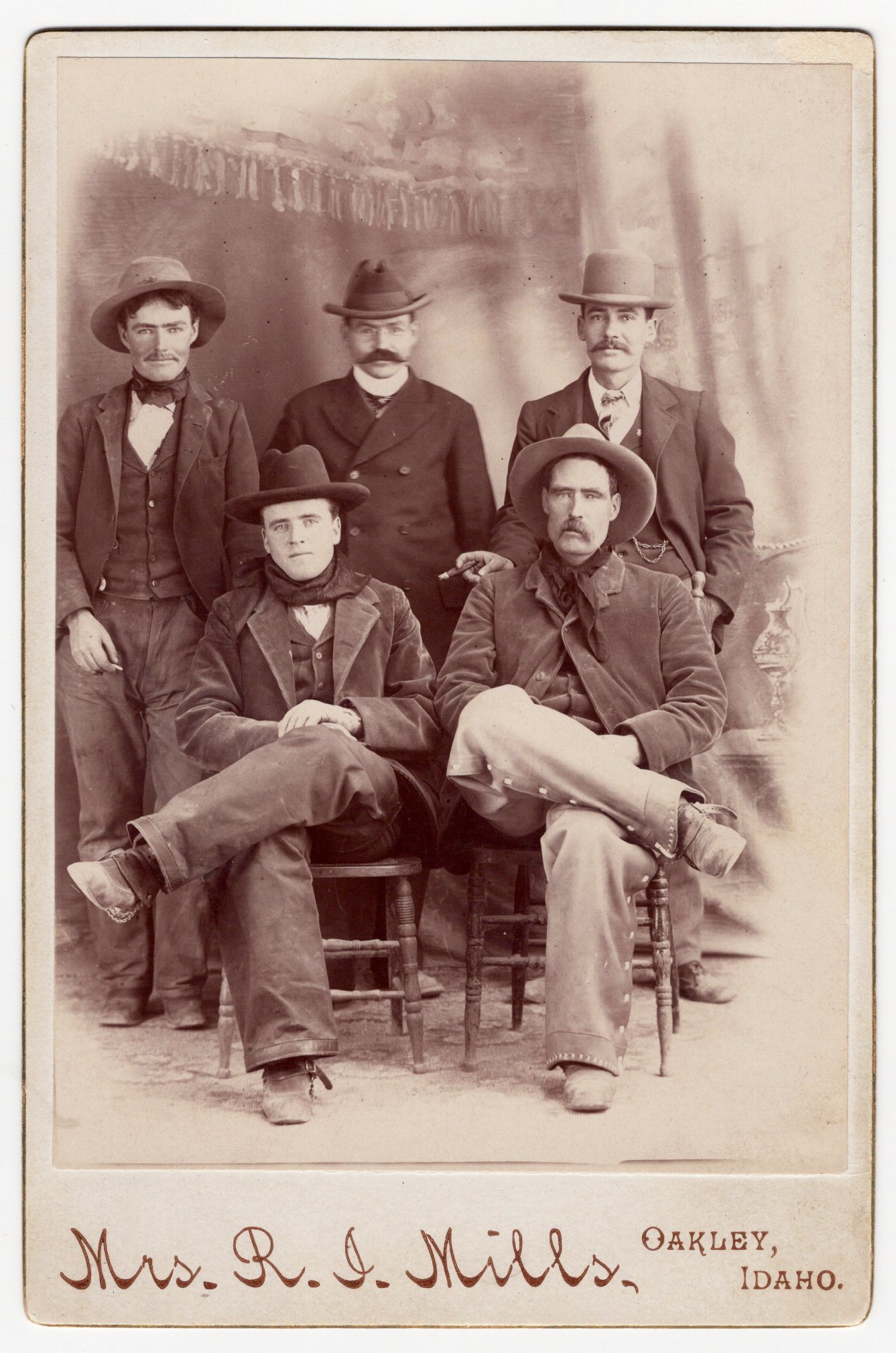
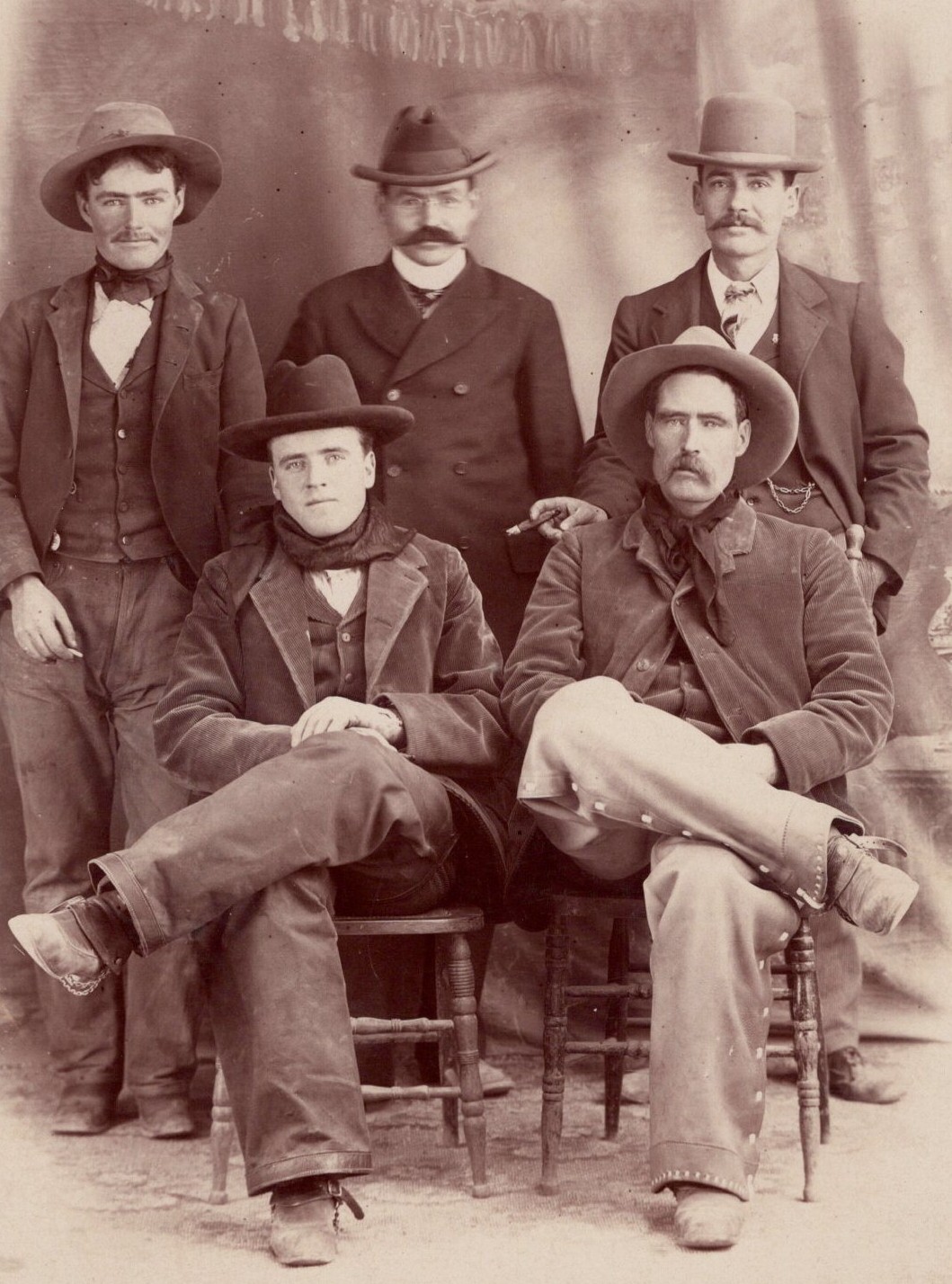
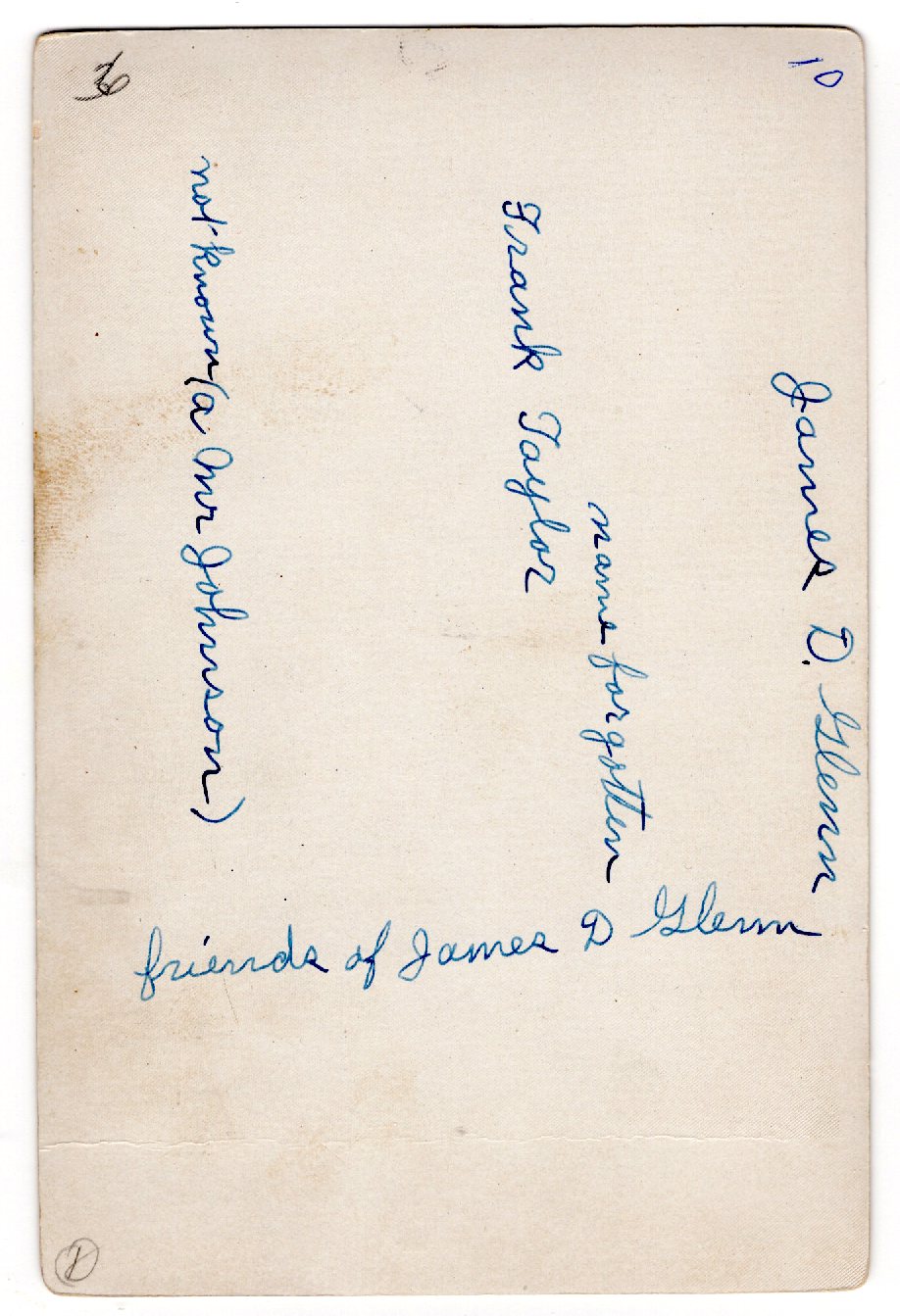
This arresting cabinet card, taken in Oakley, Idaho by the photographer Mrs. R. I. Mills, captures a vivid and timeless portrait of five rugged Western men from the late 19th or very early 20th century. The image radiates strength, camaraderie, and a quiet intensity that invites speculation about the identities and lives of its subjects. The five men are posed against a painted studio backdrop that includes drapery and a classical vase stand, subtly contrasting with the grit and rough-hewn realism of the men themselves. Two sit in the foreground, legs crossed with a relaxed authority, while three stand behind them. All are dressed in frontier attire: wide-brimmed hats, wool coats, high boots, and neckerchiefs. Their layered clothing suggests the chill of the high desert West. The expressions vary slightly—some show stoic resolve, others a more neutral bearing—but none of the men are smiling. Their faces are rugged, with prominent cheekbones, strong jaws, and thick mustaches. The man at center back smokes a cigar, and one gets the sense that these are men of action—likely cowboys, ranchers, or possibly even lawmen or miners. The man seated at the right front—wearing a wide-brimmed hat, dark scarf, and white canvas trousers with riveted side seams—commands particular attention. His intense gaze and imposing posture suggest he may have been a leader among them. The others wear expressions of cool composure, unified by the weathered look of men who knew hard labor or possibly the frontier justice of the American West. Written in blue ink on the reverse of the card is an identification key, apparently penned by someone familiar with at least some of the sitters: James D. Glenn, Frank Taylor, Mr. Johnson. An inscription reveals that the men are all friends of James Glenn. It is likely that this photograph belonged to Mr. Glenn. This photograph was taken by a female photographer. Mrs. R. I. Mills was an early female photographer working in the American West—an unusual and significant occupation for a woman at the time. Her studio was located in Oakley, Idaho, a small Mormon-founded settlement in Cassia County. Historical records show that Mrs. Rachel I. Mills operated a photography studio in Oakley in the late 19th century. She was part of a small but growing number of frontier women who ran their own commercial photography studios. Though little has been published about her biography, her studio was active around the 1880s–1890s, a time when Oakley was transitioning from a pioneer settlement into a more established town with irrigation agriculture and Mormon communal development. Founded in the early 1880s by Mormon settlers, Oakley was a rural, religiously conservative community that grew around farming and ranching. It sat on the edge of the high desert and became a local hub for commerce in southern Idaho. During the time this photograph was likely taken—circa 1890—Oakley would have been a small but lively town, with residents involved in cattle ranching, grain farming, and trade. (SOLD)
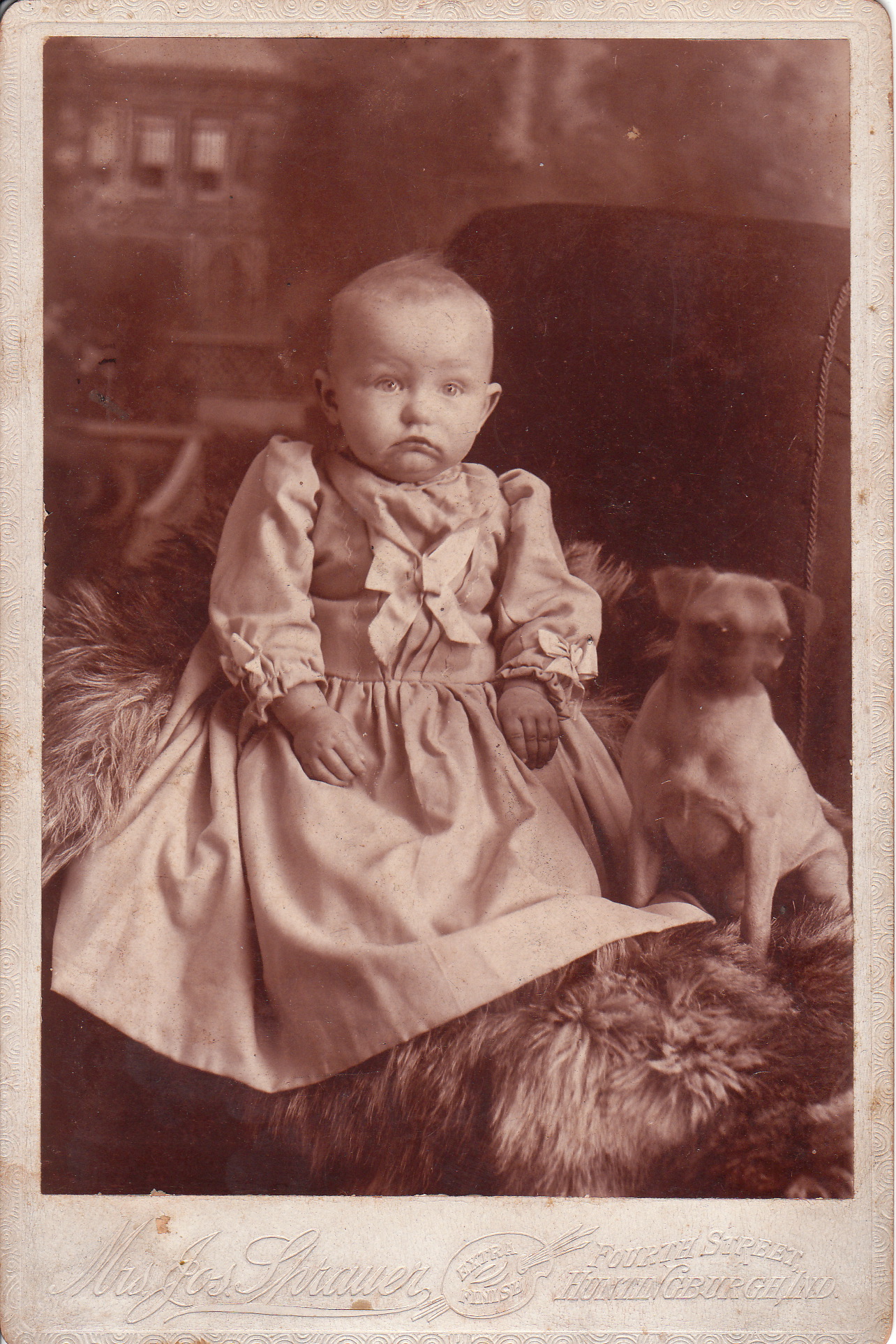
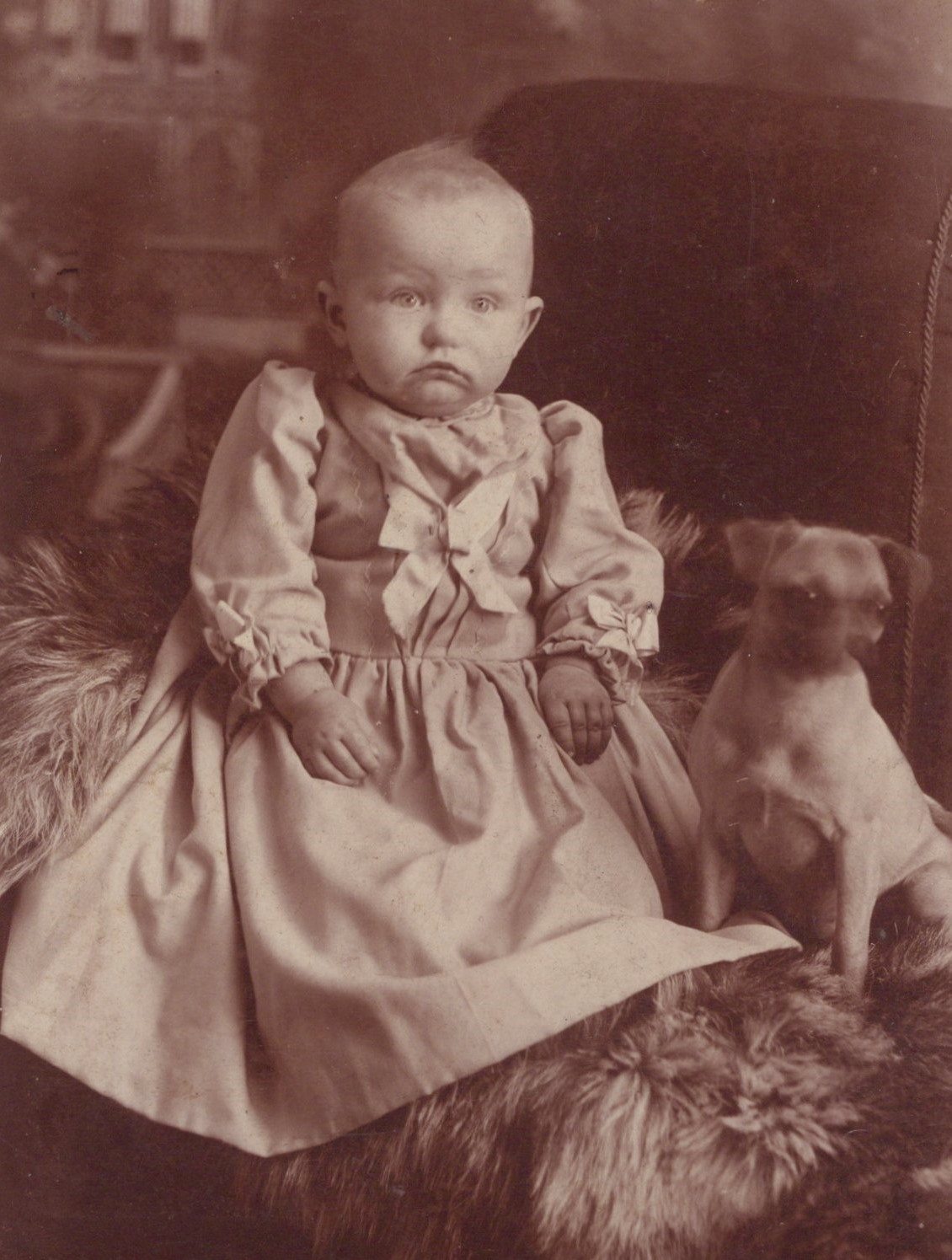
A frowning baby poses for a portrait at a photographers studio on Fourth Street in Huntingburgh, Indiana. The baby is clad in a long gown and sitting on a fur covered surface. The baby is sitting next to a small dog. Research yielded little information about the photographer. The photographer is Mrs. Jos. Sprauer, clearly an early woman photographer. Research found a pioneering photographer named Alois Sprauer of Jasper, Indiana. He founded a studio which operated for decades and was passed on to his son, Albert Sprauer. Jasper and Huntingburgh are nearby towns in southwestern Indiana. The “American Annual of Photography” mentions a W. J. Sprauer of Huntingburgh. The 1880 census includes a Joseph Sprauer, who was born in 1853 in Indiana. Hopefully, the Cabinet Card Gallery’s research department (made up entirely of the sites visitors); can shed some light on the identity of the photographer who created this image. Please leave a comment with any relevant information. SOLD
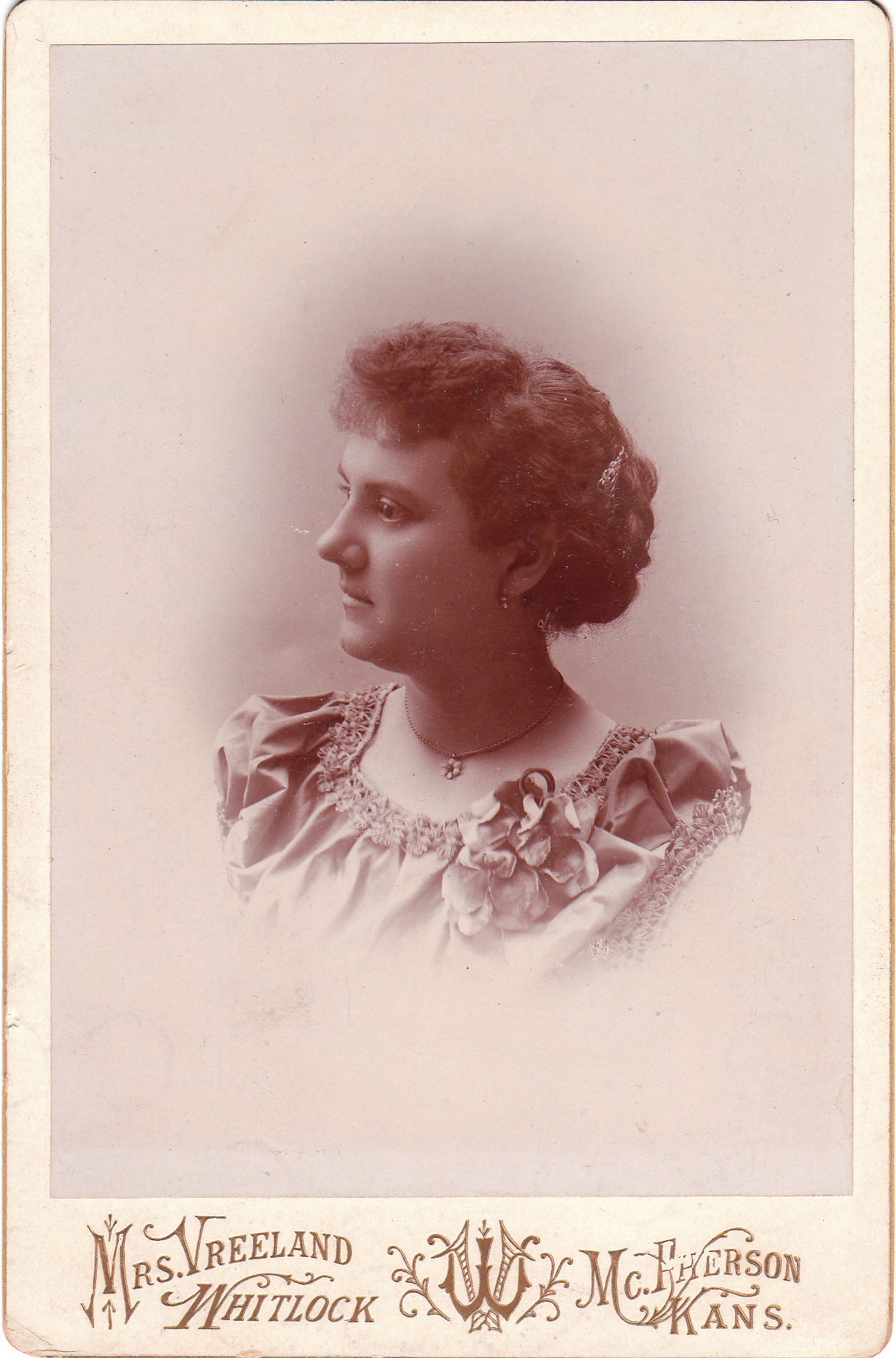
Mrs. Vreeland Whitlock photographed this cabinet card in 1893. Whitlock’s studio was located in McPherson, Kansas. Her subject is a young woman wearing a corsage, necklace, earrings, and a hair clip. The images of other female photographers can be viewed by clicking on the category “Female Photographers”. To view other photographs by Mrs Vreeland Whitlock, click on the cabient card gallery “Photographer: Vreeland”. SOLD
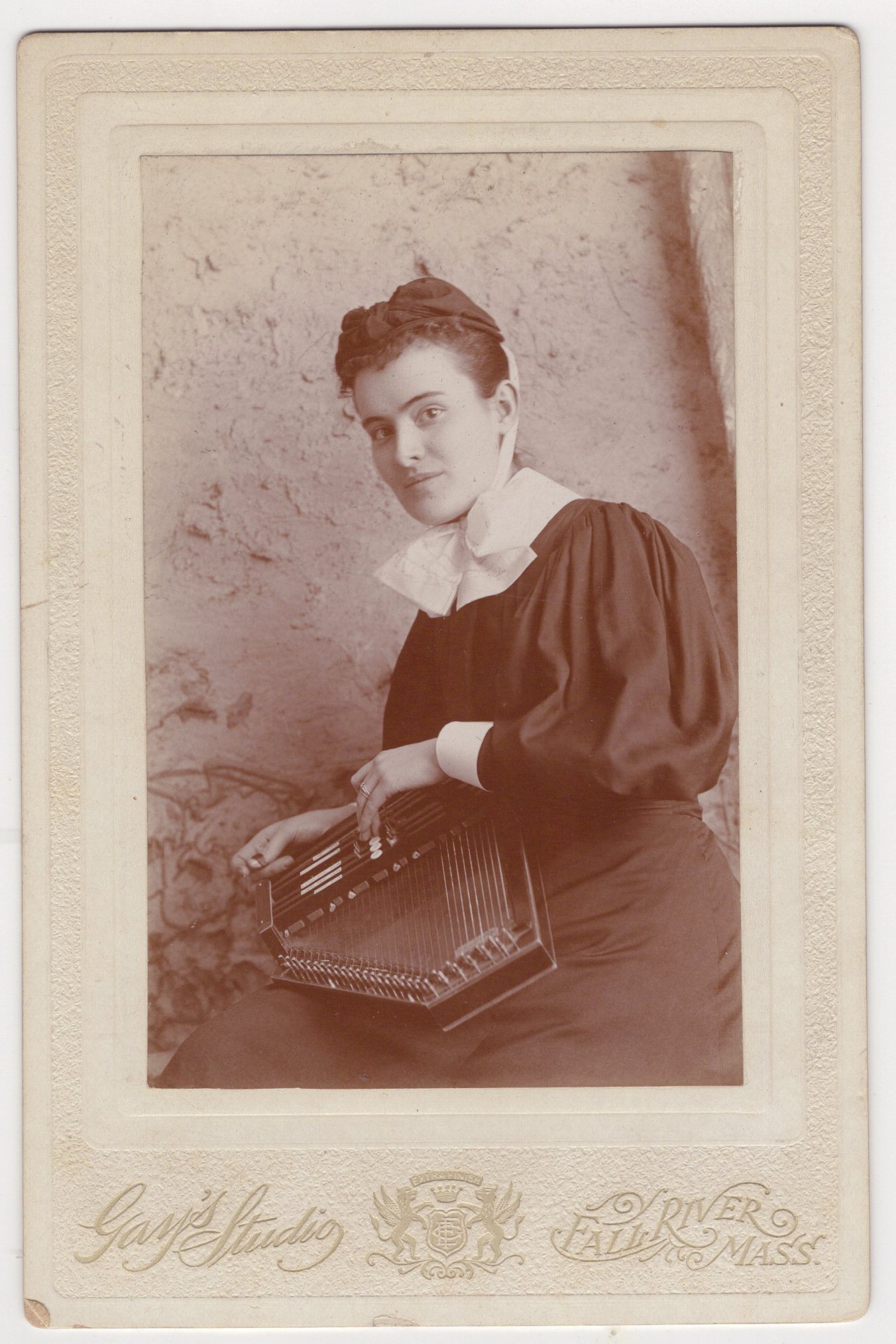
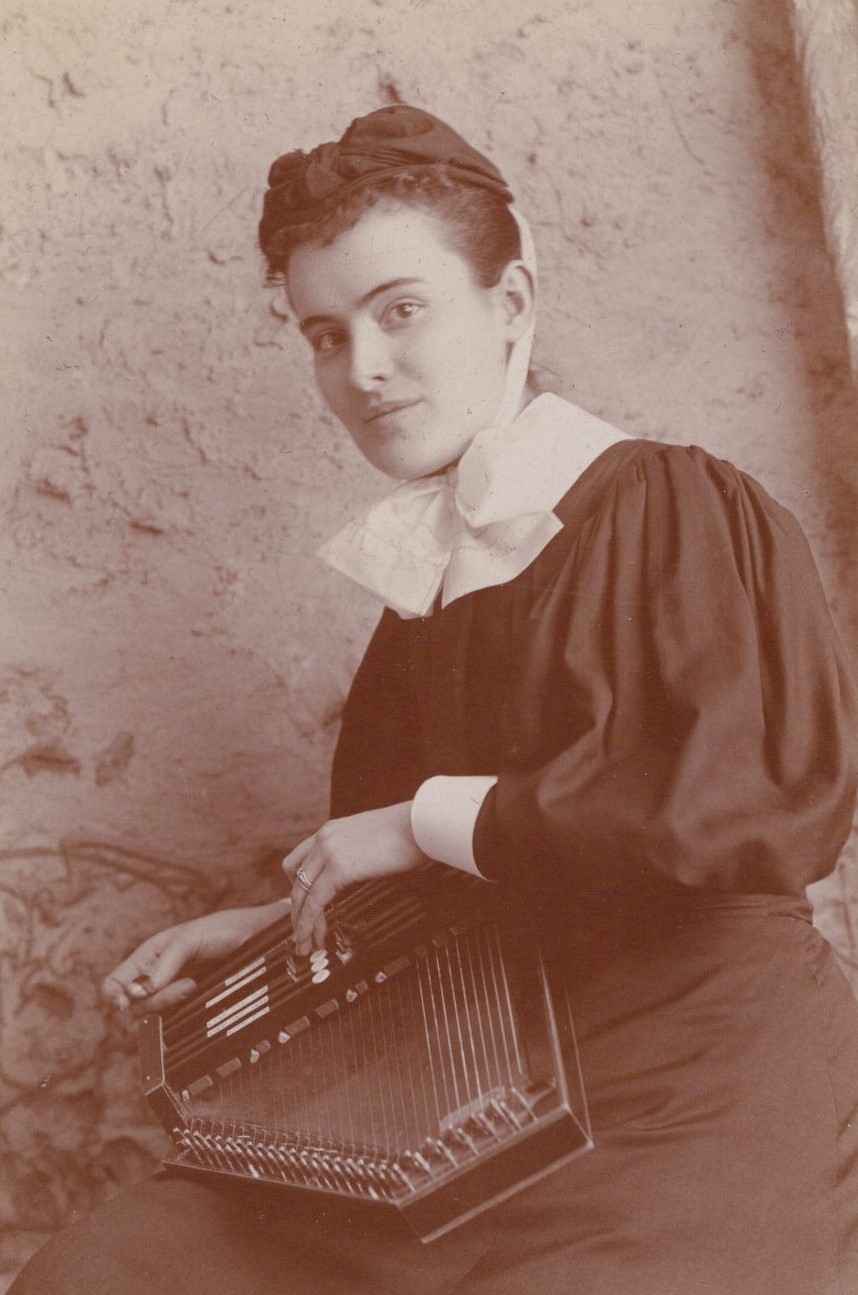
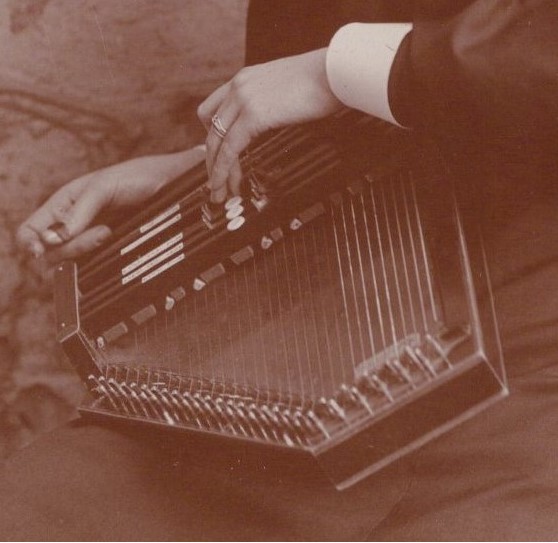
A woman poses for her portrait at Gay’s studio in Fall River, Massachusetts. She likely viewed her self as foremost, a musician. She chose to pose herself, or approved the photographers instructions, to pose sitting and holding her autoharp on her lap. Gay’s Studio was operated by a talented female photographer named Emily Gay. She ran the studio for over 40 years. She established the studio in 1878. Actually, the studio was started in 1863 by her husband Edwin Gay. In 1878, Edwin “lost it” and shot his brother-in-law and abducted his daughter. He absconded to Canada, where he died from TB in 1879. The TB that killed Edwin, caused him to turn the studio over to Emily in around 1878. Somehow, she managed to run the studio despite all the personal drama in her life. When Emily retired in the 1920’s, her daughter succeeded her in running the studio. An interesting sidenote is that Emily (her maiden name was Borden) was a distant relative of Lizzie Borden, the tried and acquitted axe murderer of her father and step-mother. Lizzie lived in Fall River and was photographed at Gay’s Studio. The cabinet card image exists today. SOLD
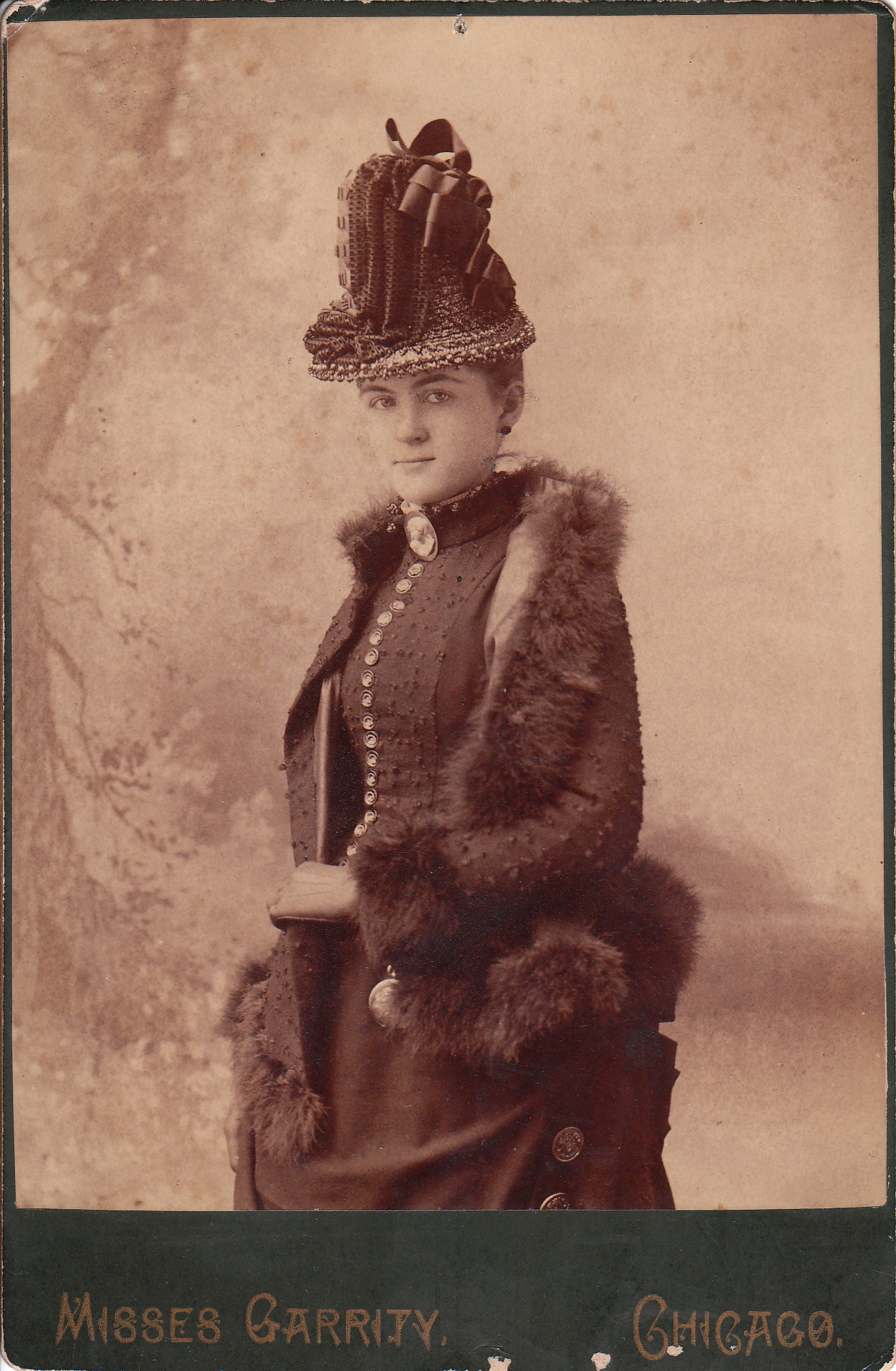
An attractive woman poses for her portrait at the studio of Misses Garrity in Chicago, Illinois. She is wearing a terrific hat, a fur collared coat, gloves, as well as ribbons, cameo collar pin and earrings. She is a stunning woman and is wearing the best finery of the day. Mrs Garrity’s studio was located at the corner of Clark and Elm Streets. Sallie E. Garrity was one of a number of outstanding early female photographers whose marriage stifled a successful career. She opened her first public studio in Louisville, Kentucky, in 1886. She later opened a large and successful photography business in Chicago. In 1893, while working at the Chicago Exposition, she met a man who “wooed her away from Chicago and Photography to Los Angeles and matrimony”. To view other photographs by Miss Garrity, click on the category “Photographer: Garrity”. SOLD