GLADYS COOPER : BEAUTIFUL BRITISH ACTRESS : PRESS PHOTO (1921) AND FIVE POSTCARDS

PRESS PHOTO 1 (SOLD)
POSTCARD 1 (SOLD)

POSTCARD 2 (SOLD)
POSTCARD 3 (SOLD)

POSTCARD 4 (SOLD)

POSTCARD 5 (SOLD)

POSTCARD 6 (SOLD)

POSTCARD 7 (SOLD)

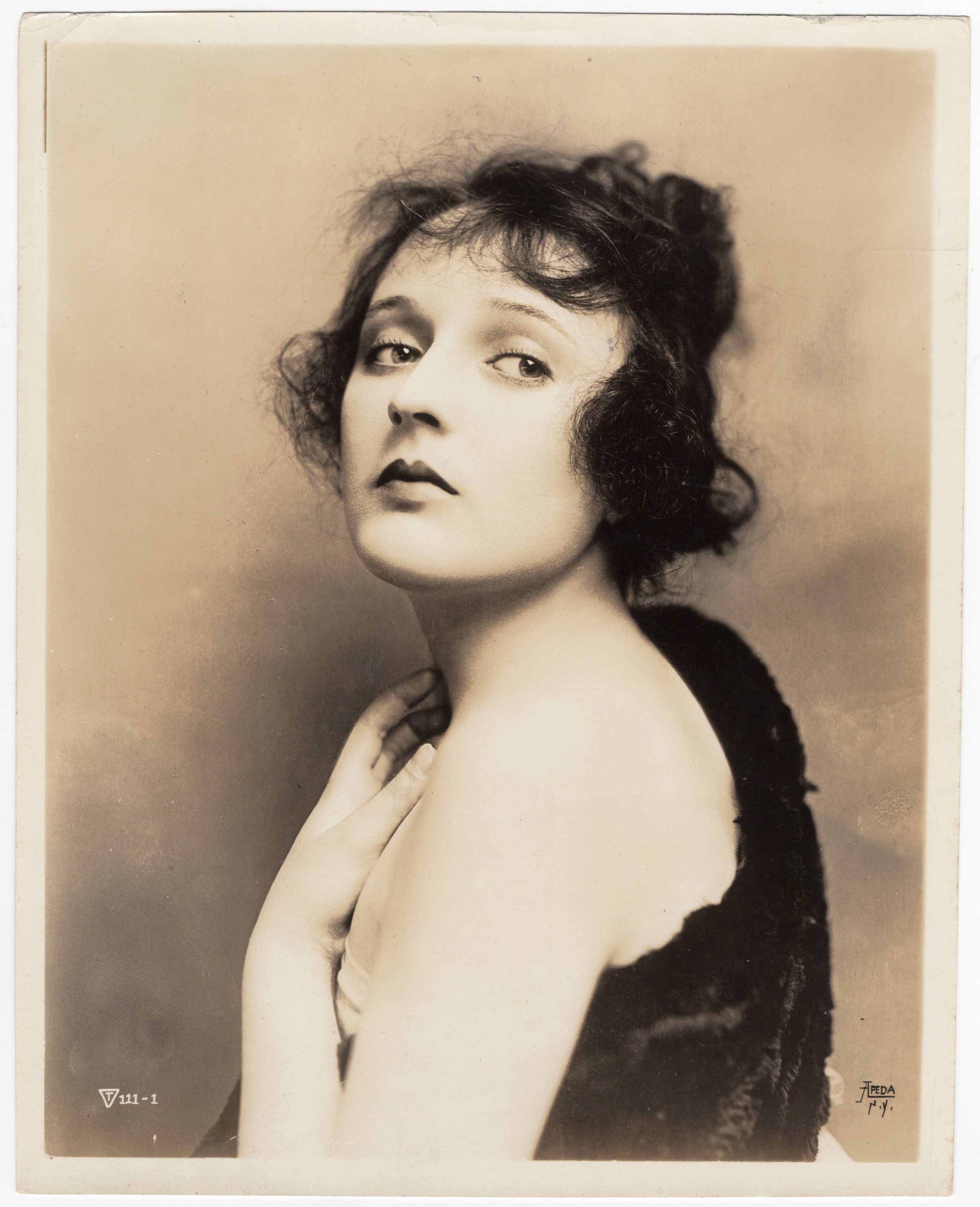
This 1921 press photo (Press Photo 1)features British actress, theatrical manager, and producer Gladys Cooper (1888-1971). Her career spanned over seven decades and she acted on stage, film, and television. She was a popular “pin-up” model for British troops during World War I. In 1967, she was awarded the coveted title of Dame of the Order of the British Empire. Cooper was known for both her talent and her beauty. This press photo focuses on her beauty. In fact the caption of the photograph states “Gladys Cooper : The Most Beautiful Actress In England”. This press photo was produced by the Keystone View Company. Cooper was about 33 years of age at the time this photograph was taken. (SOLD)

Postcard 1 features the Gladys Cooper’s fascimile autograph. This “hand-painted” postcard was published by Rotary Photo as part of the “British Beauty” series (B1-5). The firm was located in London. (SOLD)

Postcard 2 was published by Rotary Photo as part of the “Rotary Photographic” series (11856H). The firm was located in London. (SOLD)

Postcard 3  is “hand-painted” and published by Rotary Photo as part of the “British Beauty” series (B56-6). The message on the card wishes the recipient many happy returns on her birthday. This postcard is in very good condition (see scans).  (SOLD)

Postcard 4 captures Cooper in her role as “Peggy” in “Peggy And Her Husband” (1914). Cooper’s photograph on this card was taken by the Foulsham & Banfield studio. This postcard was published by Rotary Photo as part of a series (6929 J). The firm was located in London. (SOLD)

Postcard 5 features Cooper’s photograph taken by celebrated female photographer, Rita Martin. This uncommon postcard was published by Rotary Photo as part of the “British Beauty” series (A542). The firm was located in London. (SOLD)

Postcard 6 features a portrait of Cooper that was taken by Bertram Park (1883-1972). He was an English portrait photographer. He photographed many celebrities including members of royalty. A number of engravings of his work were used on British and British Commonwealth stamps. Park was also very involved in producing theatrical photographs. His wife, Yvonne Gregory was also an esteemed photographer. In addition, she served as one of his models. The couple produced books on photographing nudes. Park was also an expert on rose cultivation. This  postcard was published by J. Beagles & Co. as part of a series (302W). The firm was located in London.  (SOLD)

Postcard 7 captures a fashionable Miss Cooper standing next to a beautiful luxurious classic automobile.  Cooper’s photograph on this card was taken by the Foulsham & Banfield studio. This postcard was published by Rotary Photo as part of a series (No11861Y). The firm was located in London.  (SOLD)

This image has an empty alt attribute; its file name is gladys-cooper-press-photo-2.jpg
PRESS PHOTO 1
This image has an empty alt attribute; its file name is gladys-cooper-b1-5_0002.jpg

POSTCARD 1

This image has an empty alt attribute; its file name is gladys-cooper-11856h_0002.jpg

POSTCARD 2

This image has an empty alt attribute; its file name is gladys-cooper-b56-6_0002.jpg

POSTCARD 3

POSTCARD 4

POSTCARD 5

POSTCARD 6

POSTCARD 7

GLADYS COOPER : BEAUTIFUL & POPULAR ACTRESS : WORLD WAR I PIN-UP : RPPC

This vintage real photo hand tinted postcard features British actress, theatrical manager, and producer Gladys Cooper (1888-1971). Cooper’s career spanned over seven decades and she acted on stage, film, and television. She was a popular “pin-up” model for British troops during World War I. In 1967, she was awarded the coveted title of Dame of the Order of the British Empire. Cooper was known for both her talent and her beauty. This postcard portrait focuses on her beauty. In fact, she was considered by many to be the most beautiful actress in England. This postcard presents Miss Cooper posed sitting by a window deep in some emotional thought. Cooper’s facsimile autograph is located in the bottom right hand corner. This postcard was published by Rotary Photo as part of the “British Beauty” series (B137-2). The firm was located in London. SOLD

CONSTANCE COLLIER : IN COSTUME AS CLEOPATRA : ACTRESS, ACTING COACH, WRITER

POSTCARD 1 (SOLD)

POSTCARD 2 (SOLD)

Postcard 1 is a vintage real photo postcard featuring English stage and film actress and acting coach, Constance Collier (1878-1955). She also wrote hit plays and films. She has another claim to fame. She was the first person to be treated with insulin in Europe. This postcard captures Miss Collier in costume for her role of Cleopatra in “Antony and Cleopatra” (1906). Marc Antony was played by Herbert Beerbohm Tree and the production’s venue was at  “His Majesty’s Theatre”. Collier began her stage career at the age of three. She appeared in “A Midsummer Night’s Dream”. At the age of 15, she became one of the “Gaiety Girls”. This group was a famous dance troupe based in London’s Gaiety Theatre. In 1905, Collier married English actor, Julian Boyle. He was better known as the famous theatrical cross-dresser, Julian L’Estrange. After appearing in “Antony and Cleopatra”, Collier became very popular and seen as a distinguished actress. In 1908, she made the first of several tours of the United States. In her 1916 tour of the US, she made four silent films including in D. W Griffith’s, “Intolerance”. In 1918, her husband died from the Spanish flu while the pair were on a US tour. The influenza epidemic of 1918-1919 killed 650,000 Americans. It was the era’s version of Covid-19. In the early 1920’s, Collier became close friends with actor, Ivor Novello. They acted and co-wrote together. In the late 1920’s, Collier relocated to Hollywood where she became a voice coach. She filled a valuable role because talkies were beginning to replace silent films and many actors were in need of help with the transition. Her most famous students were actresses, Colleen Moore, Marilyn Monroe, Vivien Leigh, and the Hepburn sisters. While teaching, she still performed on Broadway and made films. The IBDb reports that Collier was in 21 Broadway shows between 1908 and 1939. These shows included Oliver Twist (1912), Othello (1914), Camile (1931), and Dinner at Eight (1933). According to IMDb, Collier performed in 29 films, wrote 7, and was in the crew of 4. She performed for Otto Preminger as well as Alfred Hitchcock. She was awarded an American Shakespeare Festival Theatre Award for distinguished service for training actors for Shakespearean roles. This postcard was published by Rotary Photo as part of a series (No.4039H). Miss Collier’s photographic portrait was taken by the Foulsham & Banfield studio. The National Portrait Gallery possesses this same card in their Constance Collier postcard collection. They possess 33 different photographs of Miss Collier.   (SOLD)

Postcard 2 was published by Rapid Photo as part of a series (No.1834). Note the size of the buttons on her dress and her hair ornament composed of four leaves. (SOLD)

POSTCARD 1

POSTCARD 2

MAUD ALLAN : RISQUE : SALOME : DANCER, ACTRESS, AND CHOREOGRAPHER : 1908 : RPPC

POSTCARD 1 (SOLD)

POSTCARD 2 (SOLD)

POSTCARD 3 (SOLD)

POSTCARD 4 (SOLD)

POSTCARD 5 (SOLD)

POSTCARD 6 (SOLD)

POSTCARD 7 (SOLD)

POSTCARD 8 (SOLD)

POSTCARD 9 (SOLD)

POSTCARD 10 (SOLD)

These risque vintage real photo postcards feature Maud Allan (1873-1956). She was a Canadian-born dancer, choreographer, and actress, who performed in the United States and Europe at the turn of the 20th century. She was known for her performances of the “Vision of Salome”, an interpretive dance based on the Oscar Wilde play “Salome”, in which she portrayed the title character. Allan’s performances were controversial and often drew criticism for their erotic content. She also was known for her court case in 1918 against a British newspaper, the Illustrated Times, who published an article accusing her of promoting immorality and lesbianism. She sued for libel and won. In regard to Allan’s sexual orientation, she was a lesbian and was involved with women her entire life. She had a long affair with Margot Asquith, the wife of Herbert Henry Asquith, the Prime Minister of the United Kingdom from 1908 through 1916. Allan also had a long affair with Verna Aldrich, her secretary.

 Postcard 1 presents Allan dancing as “Salome”. She is wearing a sexually provocative costume. She is covered with jewelry. This postcard was published by Rotary Photo as part of a series (No.4946B). Miss Allan’s photograph was taken by the Foulsham & Banfield studio. An inscription on the card’s reverse reveals that the card is from 1908. (SOLD)

Postcard 2 This postcard also presents Allan dancing as “Salome”. Once again, she is wearing a sexually provocative costume and is covered with jewelry. This postcard was published by Rotary Photo as part of a series (No.4946Q). Miss Allan’s photograph was taken by the Foulsham & Banfield studio. This card is from circa 1908. (SOLD)

Postcard 3 is rare. The card captures Miss Allan wearing a sexually provocative costume. She is covered with jewelry. This postcard was published by Rotary Photo as part of a series (No.11406B). Miss Allan’s photograph was taken by the Foulsham & Banfield studio. This card is from circa 1908. (SOLD)

Postcard 4 is a risque vintage postcard that was published by Aristophot. Allan’s photograph was taken by Leopold Reutlinger as part of a series (no.E1586). This Salome postcard has a 1908 postmark. (SOLD)

Postcard 5: Most vintage postcards of Miss Allan, capture her in various risque poses during her performance in “Salome”. This uncommon postcard portrait captures her well dressed and elegant looking. This card is uncommon and was published by Rotary Photo as part of a series (No.4946Y). Miss Allan’s photograph was taken by the Foulsham & Banfield studio. This card has a 1906 postmark. (SOLD)

Postcard 6 features Maud Allan in an erotic costume as she plays “Salome”. This postcard was published by Rotary Photo as part of a series (No.4946D). Miss Allan’s photograph was taken by the Foulsham & Banfield studio.  (SOLD)

Postcard 7 was published by Rotary Photo as part of a series (No.4946N). Miss Allan’s photograph was taken by the Foulsham & Banfield studio. This postcard features Allan radiating an aura of refined elegance and timeless beauty. Her attire is a masterful display of Edwardian fashion. She wears a high-necked lace blouse adorned with intricate detailing, lending her an air of sophistication and grace. Over this, she dons a luxurious fur coat that adds richness and depth to her ensemble. Around her neck, a delicate pendant peeks out, suggesting a taste for understated yet exquisite jewelry. Her hat is a work of art in itself, lavishly adorned with roses, feathers, and ornate embellishments. The elaborate design frames her face beautifully, complementing her delicate features. Her hair, arranged in soft, voluminous curls beneath the hat, enhances her classic femininity. Maud’s expression is serene yet captivating, her slightly parted lips and soft gaze conveying both intelligence and an enigmatic charm. Her eyes hold a quiet confidence, suggesting a woman of depth, creativity, and individuality. Altogether, Maud Allan’s appearance in this postcard speaks to her remarkable beauty, not only in her physical features but also in the grace and character she exudes. She appears as a woman who is elegant, enigmatic, and effortlessly captivating. (SOLD) 

Postcard 8 is a portrait of Allan wearing an elaborate costume: strands of pearls draped across her shoulders and chest, a large bejeweled ornament on her bodice, and a pearl headdress with a central jewel resting on her forehead. Her dark hair frames her face, and she gazes with a calm, slightly enigmatic expression. The overall mood of the image is both theatrical and regal, emphasizing her role as a stage performer who often blurred the line between classical dance and sensual spectacle. The postcard was published by Rotary Photo as part of their “Opalette” series. The ornate printed “frame” around the oval portrait adds an additional decorative touch. The postcard has a divided back and there is a handwritten note dated in 1911. The correspondence reads: “How do you like this one, I don’t care much for it myself. I have not many more now. Th. B.R.” It is addressed to a man located in London. (SOLD)

Postcard 9 was published by Rotary Photo and is part of the firm’s Opalette Series. this postcard has a postmark from 1909. (SOLD)

Postcard 10 is a striking Edwardian real photo postcard features Maud Allan, the celebrated dancer and stage performer whose career bridged classical, exotic, and highly sensual performance at the turn of the 20th century. Allan is shown seated in a flowing, classical-style gown, posed against a dramatic seaside backdrop of rocks, surf, and stormy skies. The pose is both poised and emotionally charged, with her gaze turned slightly upward, giving the image a dreamlike, almost mythic quality. She is dressed in a soft, empire-waist gown with loose sleeves and a long, flowing skirt. The styling deliberately evokes antiquity and romantic fantasy, which aligns perfectly with Allan’s reputation for expressive, sensuous dance interpretations rather than traditional ballet technique. Her bare foot and relaxed posture add to the quiet intimacy of the image. The photograph was taken by Leopold Reutlinger, one of the most important and accomplished theatrical photographers of the period. Reutlinger’s portraits of performers are widely collected and appear in museum collections; his work is especially prized for its technical quality and dramatic staging. His signature appears in the image, and the postcard carries the Reutlinger studio mark and serial number E1587, confirming it as part of his commercial theatrical series. This is an Aristophot Real Photo Postcard, as clearly indicated on the reverse. Aristophot Co. Ltd. was a London-based publisher, specializing in high-quality photographic postcards of actors, dancers, and performers. The reverse also notes “Printed in Saxony,” which was common for high-end photographic postcard production during this period. This specific image of Maud Allan is uncommon. The combination of Maud Allan + Reutlinger + Aristophot makes this a particularly desirable postcard. In fact, this photograph of Miss Allan can be found in Britain’s National Portrait Gallery. The postcard in their collection was postmarked in 1909.  SOLD

POSTCARD 1

POSTCARD 2

POSTCARD 3

POSTCARD 4
POSTCARD 5

POSTCARD 6

POSTCARD 7

POSTCARD 8

POSTCARD 9

PEARL WHITE : AMERICAN STAGE AND FILM STAR : PERILS OF PAULINE : RPPC

POSTCARD 1 (SOLD)

POSTCARD 2 (SOLD)

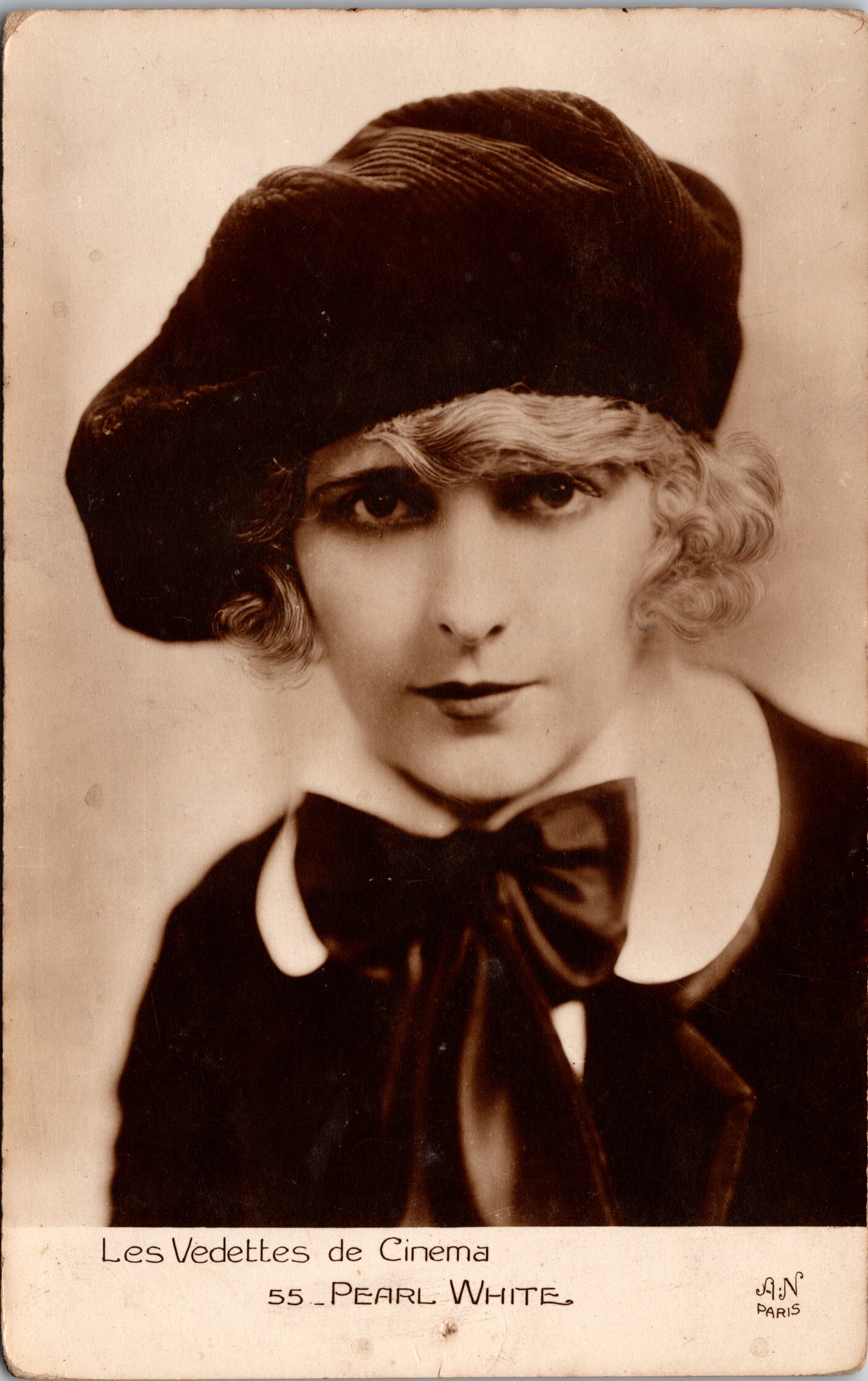
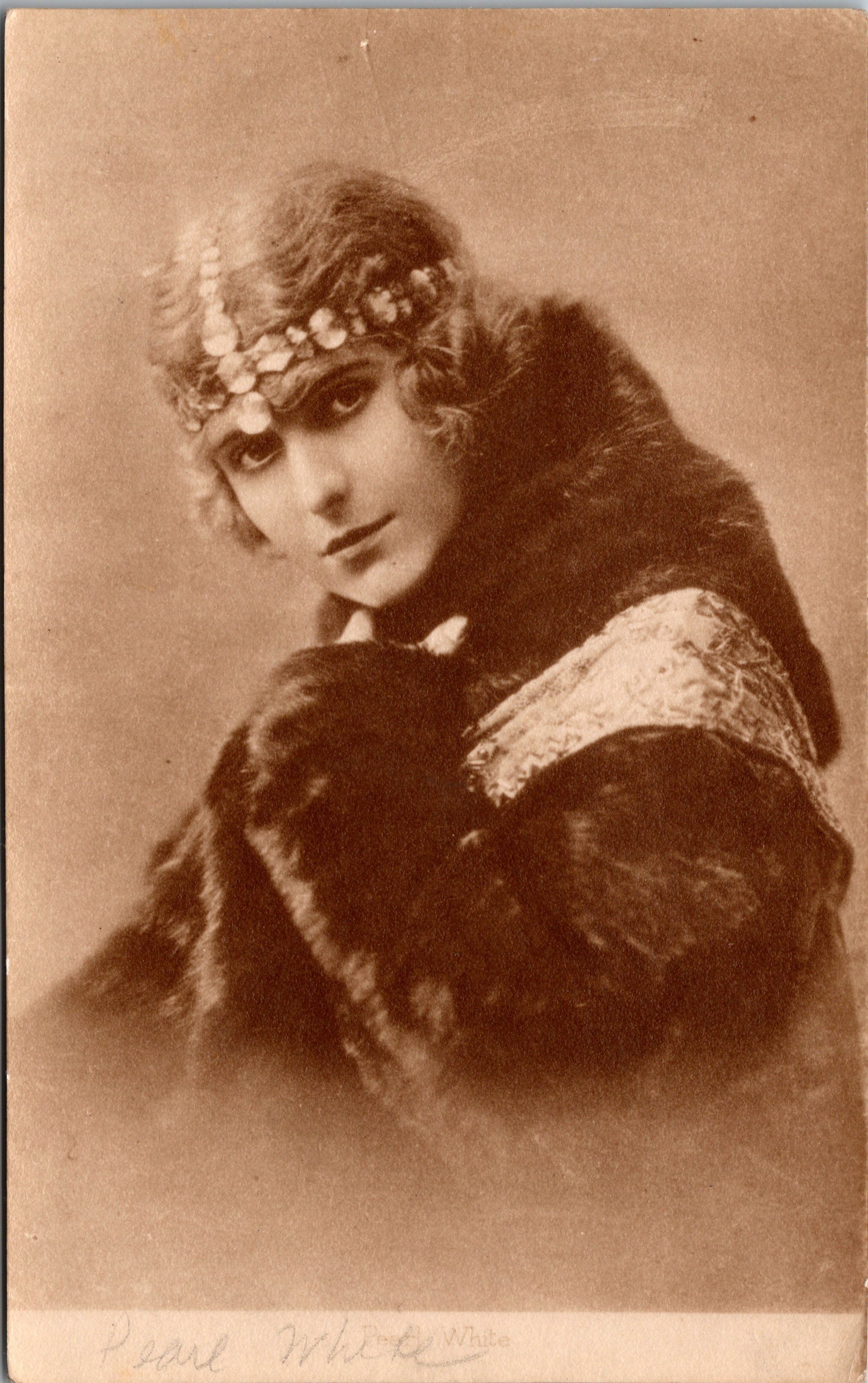
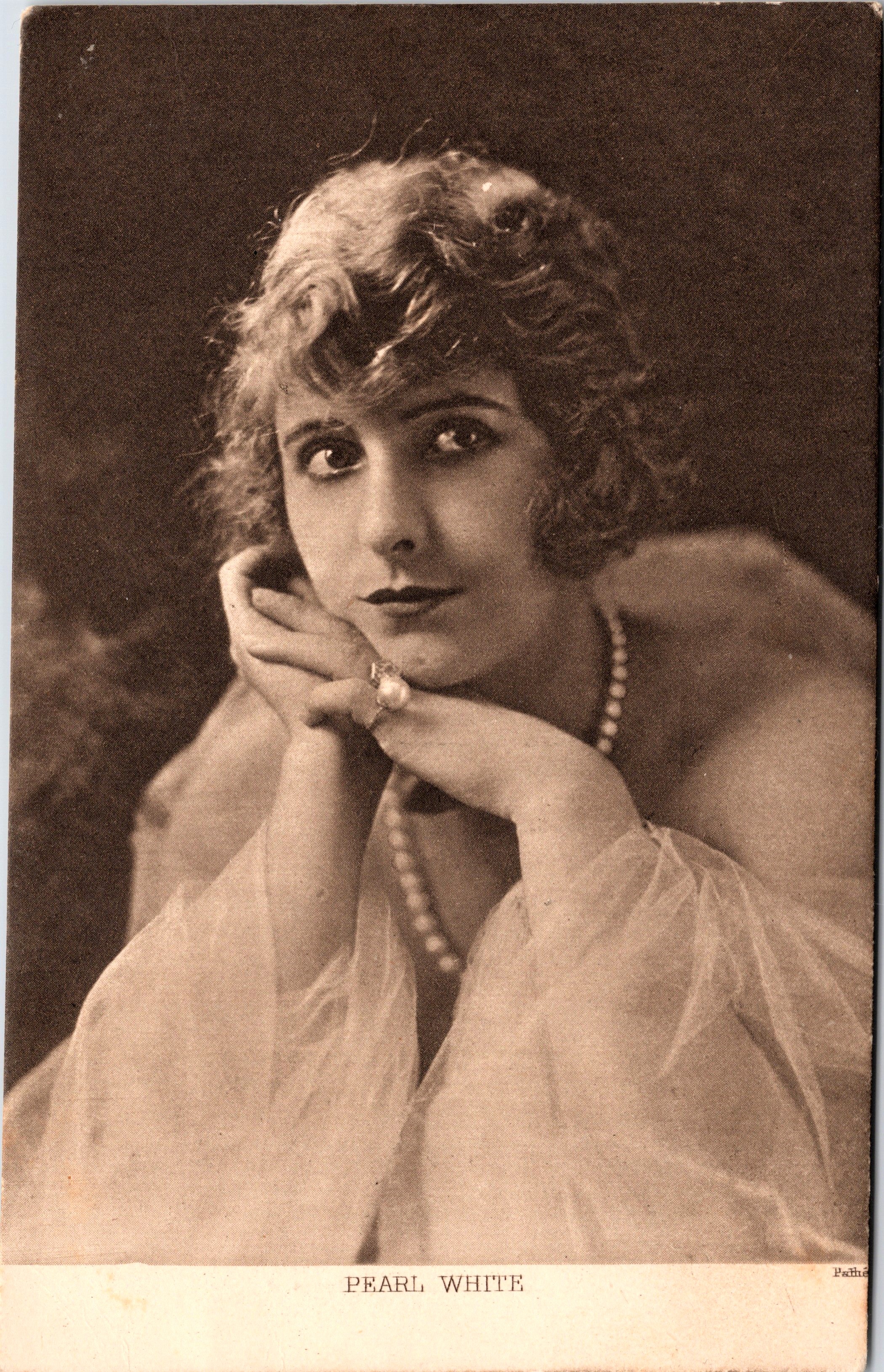
Pearl White (1889-1938) was an American actress of film and stage. She started her career on the stage at just 6 years old in the play, “Uncle Tom’s Cabin”. At thirteen years of age she was a bareback rider for a circus. She dropped out of high school to join a touring stage company. Next she worked as a singer in Cuba and South America. She made her appearances in dance halls and casinos. In 1910, her voice began to fail and she began to appear in silent films, including many popular serials. Her nickname was “Queen of the Serials’. She did the majority of her own stunts in these film serials. She is known well for her role in “The Perils of Pauline”. She was often cast in the role of an athletic heroine, rather than the more typical, innocent young woman. As a result of her appearances in “The Perils of Pauline”, she was soon earning $1,750 per week. She increased her star power as she appeared in other serials. In these films she flew airplanes, raced cars, and did other action hero feats. By 1919 White moved on to more dramatic roles. She appeared in ten drama films for Fox Film Corporation. She finished her career by taking roles in European films, and finally, appearing on the European stage. While performing in London, she earned three thousand dollars a week. At the time of her retirement (1924), White had banked two million dollars. She then began investing. Her investments included a hotel, a night club, and a stable of race horses. White was married twice, each time, for short duration to actors. White died of liver failure, possibly due to her history of heavy drinking. Her drinking may have been attributable to her problems with pain stemming from a spinal injury occurring during her stunt days. The IMDb site credits white with 228 film appearances between 1910 and 1924.

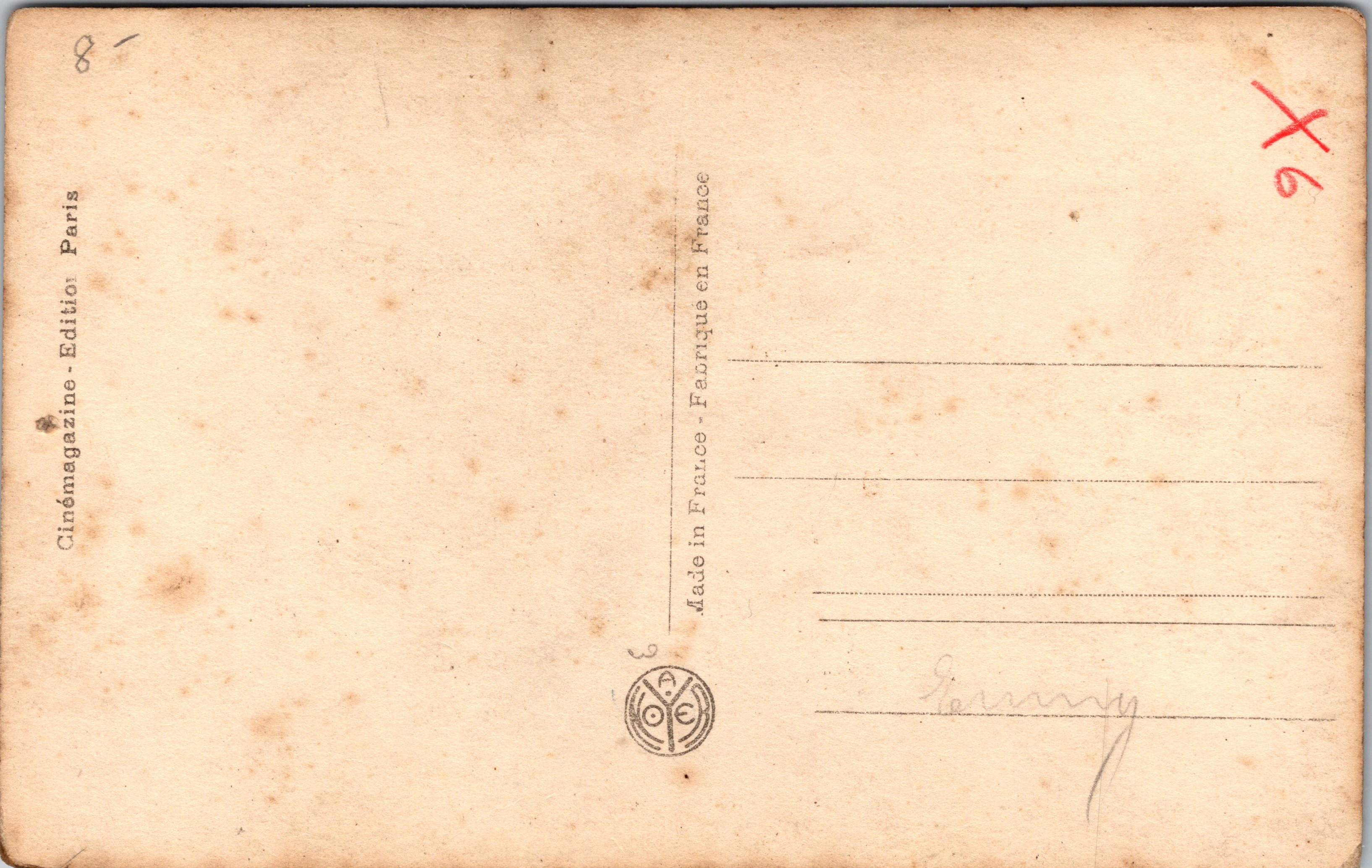
Postcard 1 was published by Cinemagazine (Paris Edition). The card is part of the “Les Vedettes de Cinema” (Stars of the Cinema) series (No.,55). White’s postcard photo portrait was taken by the celebrated photographer, Alfred Noyer. (SOLD)

Postcard 2 features White’s beauty. She is wearing a fur. Note her pretty head band.  Although this card is the size of a standard postcard, there is no printing on it’s reverse.  (SOLD)

POSTCARD 1

POSTCARD 2

MISS DE ROY : PRETTY PERFORMER : MUSIC HALL : CABARET : UNDIVIDED RPPC 1902

This rare vintage real photo postcard features pretty performer, A. De Roy. She looks stunning in her beautiful dress. The card is risque due to her low cut dress. She is identified on the front of the card. De Roy was likely a music hall or cabaret performer. This postcard was published by S. Bluh (SBW) as part of a series (No.437). The firm was located in Vienna, Austria and was the only agent in Austria for postcard publisher Rotophot. The card has a Belgian stamp and was postmarked in 1902. SOLD

MARY PICKFORD : LES VEDETTES DE CINEMA : CINEMAGAZINE : RPPC (1920’s)

POSTCARD 1 (SOLD)

POSTCARD 2 (SOLD)

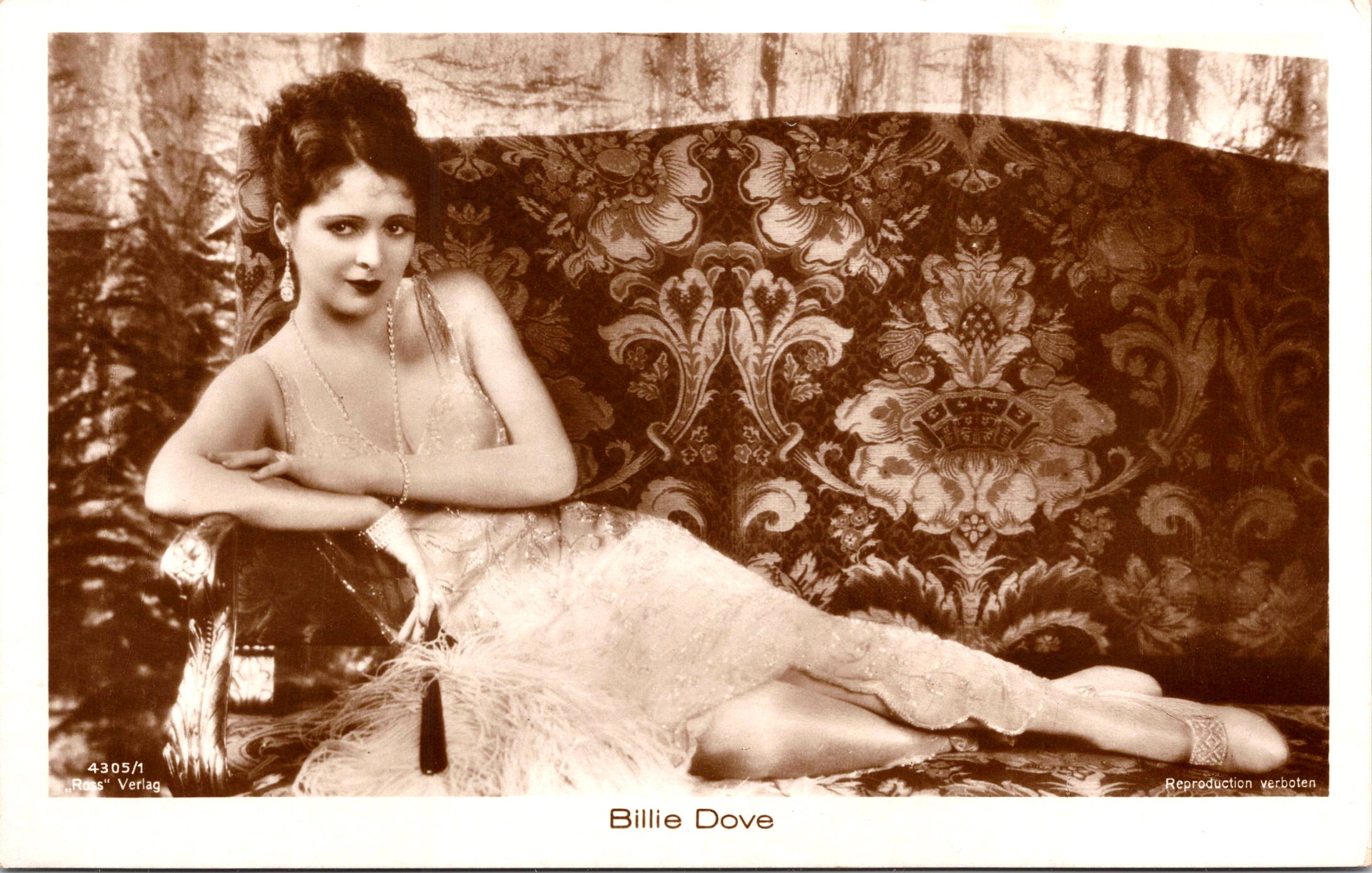
Mary Pickford (1892-1979) was a Canadian-American actress and one of the most influential figures in early Hollywood. She was often referred to as “America’s Sweetheart”. She was a pioneer of silent film and a co-founder of the film industry as we know it today. Pickford’s career began in childhood when she performed in theater productions in Canada and the United States. By the early 1900s, she transitioned to film, working with director D.W. Griffith at Biograph Studios. Her delicate beauty and expressive acting quickly made her a fan favorite, setting her apart in an era when exaggerated stage-style performances dominated silent films. During the 1910s and 1920s, Pickford became one of the highest-paid and most beloved actresses in the world. Starring in films such as Rebecca of Sunnybrook Farm (1917), Daddy-Long-Legs (1919), and Pollyanna (1920), she was known for playing wholesome, spirited young women. Her curly hair and signature on-screen innocence became iconic, but she was also a savvy businesswoman who understood the power of her brand. Pickford was not only a star but also a trailblazer in the film industry. In 1919, she co-founded United Artists alongside Charlie Chaplin, Douglas Fairbanks (her then-husband), and director D.W. Griffith. This revolutionary move allowed filmmakers to control their own productions rather than rely on major studios, changing the industry forever. As the film industry transitioned to “talkies,” Pickford retired from acting in the early 1930s, though she continued to produce films. Her contributions earned her an honorary Academy Award in 1976 for her lasting impact on cinema. Mary Pickford’s influence extends beyond her films. She helped shape the star system, paved the way for women in Hollywood, and co-founded the Motion Picture Relief Fund to support struggling actors. She remains an enduring symbol of early Hollywood glamour and innovation. Mary Pickford was born into a working-class family in Toronto, Canada. Her father, John Charles Smith, was an alcoholic who struggled to provide for the family and died from a workplace accident when Mary was just six years old. Her mother, Charlotte Hennessey Smith, was left to raise Mary and her two younger siblings, Lottie and Jack, on her own. To support the family, Charlotte encouraged her children to enter acting, and Mary began performing in theater at a young age. She soon became the family’s primary breadwinner, and her siblings, Lottie Pickford and Jack Pickford, also pursued film careers. Pickford transitioned from theater to film in the early 1900s, quickly rising to fame with her expressive acting and wholesome on-screen persona. By the 1910s and 1920s, she was one of the most recognizable stars in the world, earning the nickname “Queen of the Movies.” She also helped establish the Academy of Motion Picture Arts and Sciences. Mary Pickford was married three times. Pickford’s first marriage was to silent film actor Owen Moore (1911-1920). Her second and most famous marriage was to fellow silent film actor, Douglas Fairbanks (1920-1936). Her third marriage was to actor Charles “Buddy” Rogers (1937-1979). After retiring from acting in the early 1930s, Pickford focused on producing films and philanthropy. She became more reclusive in her later years, struggling with alcoholism and health issues. Today, she is remembered as a pioneering force in cinema history.

Postcard 1 features Pickford seated gracefully on a carved wooden stool, exuding elegance and poise. She is dressed in a flowing, light-colored gown with delicate embellishments on the bodice and sheer fabric draping over her arms. Her signature curls frame her face, a defining feature of her “America’s Sweetheart” image. She wears a subtle yet confident expression, her eyes gazing slightly to the side with a soft, introspective quality. Her arms are relaxed, with one hand resting gently on her lap and the other elegantly extended. Her accessories include a bracelet on her wrist and a ring on her finger, adding to her refined look. The backdrop behind her is a richly textured tapestry, possibly depicting a pastoral scene. This postcard was likely produced in the 1920s, during the height of Pickford’s career. It is numbered 86 and is part of a larger collectible series showcasing cinema stars of the era. This vintage postcard is part of a series titled Les Vedettes de Cinéma (translated as The Stars of Cinema), and it was published by Alfred Noyer (Paris,France), in collaboration with United Artists, the film distribution company that Pickford co-founded. The back of the postcard identifies the publisher as Cinémagazine – Edition and states that it was Made in France / Fabriqué en France, indicating its European origin. (SOLD)

Postcard 2 features Mary Pickford in a soft, introspective portrait that perfectly captures the romantic visual style of the early 1910s. Pickford is posed in three-quarter profile, her gaze cast downward, with her signature long curls cascading over her shoulders. She wears a delicate, flowing gown rendered in subtle hand-applied color, with pale blue and warm cream tones carefully brushed over the original photograph, lending the image a dreamy, ethereal quality. The overall effect is gentle and luminous, emphasizing her youthful features and expressive eyes. This postcard was produced by Rotary Photo, one of the most prolific and collectible publishers of celebrity real photo postcards in the early 20th century. The image is identified by the ID No. S.62-2, printed at the lower edge, and the reverse confirms it was printed in England via (Rajer Bromide). (SOLD)

POSTCARD 2

FLORENCE KENDALL : BAS-RELIEF : ACTRESS POSTCARDS : SCOPES & CO LONDON : c1910

POSTCARD 1 (SOLD)

POSTCARD 2 (SOLD)

Postcard 1 is a striking Edwardian “Bas-Relief” theatrical portrait featuring English stage performer Florence Kendall, who appeared in musicale and dramatic productions in the early 20th century. The image beautifully captures the soft romanticism of pre-WWI theatrical photography, when actresses were often posed in dreamy, poetic attitudes to reflect elegance, youth, and refinement. Florence Kendall appears here in a gentle three-quarter pose, her head gracefully tilted as she gazes toward the camera with a quiet, introspective expression. Her long dark hair flows loosely over one shoulder, tied with a soft white ribbon at the back — a style aligned with Edwardian ideals of natural feminine beauty. She wears a sheer, light-colored gown with delicate lace or embroidered detailing at the neckline and sleeves, giving the portrait an ethereal, almost fairytale quality. The overall impression is one of youthful grace and gentle charm. The postcard is part of the “Bas-Relief” series, patented in 1908, a premium card type created to mimic low-relief sculpture. The photographic surface creates subtly raised tonal depth, giving the sitter a more dimensional, sculpted look compared to ordinary flat postcards. These special cards were marketed as high-quality portrait editions and are collected today for their unique visual effect and heavier, cabinet-card-style feel. Published by Scopes & Co. Ltd. (London), a known early 20th-century publisher specializing in theatrical and novelty cards. The patent imprint (Pat. No. 4523/08) helps date this card firmly to the late Edwardian era (ca. 1908–1915). The reverse carries a charming handwritten message and original King George VI red “1d” postage stamps. The message reads: “Dear A & all, We arrived home O.K. & enjoyed coming, shall come again soon. We missed bus at Gainsborough. Had to wait till 7:30. So cheerio. Lots of Love”.  (SOLD)

Postcard 2 is a striking early theatrical portrait featuring Kendall in an expressive pose and flowing gown, capturing the soft, romantic theatrical style that defined Edwardian theatre photography. The image shows Kendall in a full-length pose wearing a delicate white dress with lace and ribbon accents. Her soft profile, long loose hair and period costume make this an elegant study typical of British theatrical postcards before World War I. (SOLD)

POSTCARD 1

POSTCARD 2

Published in: on March 27, 2026 at 11:30 am  Leave a Comment  
Tags: , , ,

MARY PICKFORD : AMERICA’S SWEETHEART : PRETTY ACTRESS : ROTARY PHOTO : RPPC

POSTCARD 1 (SOLD)

POSTCARD 2 (SOLD)

Mary Pickford (1892-1979) was a Canadian-American actress and one of the most influential figures in early Hollywood. She was often referred to as “America’s Sweetheart”. She was a pioneer of silent film and a co-founder of the film industry as we know it today. Pickford’s career began in childhood when she performed in theater productions in Canada and the United States. By the early 1900s, she transitioned to film, working with director D.W. Griffith at Biograph Studios. Her delicate beauty and expressive acting quickly made her a fan favorite, setting her apart in an era when exaggerated stage-style performances dominated silent films. During the 1910s and 1920s, Pickford became one of the highest-paid and most beloved actresses in the world. Starring in films such as Rebecca of Sunnybrook Farm (1917), Daddy-Long-Legs (1919), and Pollyanna (1920), she was known for playing wholesome, spirited young women. Her curly hair and signature on-screen innocence became iconic, but she was also a savvy businesswoman who understood the power of her brand. Pickford was not only a star but also a trailblazer in the film industry. In 1919, she co-founded United Artists alongside Charlie Chaplin, Douglas Fairbanks (her then-husband), and director D.W. Griffith. This revolutionary move allowed filmmakers to control their own productions rather than rely on major studios, changing the industry forever. As the film industry transitioned to “talkies,” Pickford retired from acting in the early 1930s, though she continued to produce films. Her contributions earned her an honorary Academy Award in 1976 for her lasting impact on cinema. Mary Pickford’s influence extends beyond her films. She helped shape the star system, paved the way for women in Hollywood, and co-founded the Motion Picture Relief Fund to support struggling actors. She remains an enduring symbol of early Hollywood glamour and innovation. Mary Pickford was born into a working-class family in Toronto, Canada. Her father, John Charles Smith, was an alcoholic who struggled to provide for the family and died from a workplace accident when Mary was just six years old. Her mother, Charlotte Hennessey Smith, was left to raise Mary and her two younger siblings, Lottie and Jack, on her own. To support the family, Charlotte encouraged her children to enter acting, and Mary began performing in theater at a young age. She soon became the family’s primary breadwinner, and her siblings, Lottie Pickford and Jack Pickford, also pursued film careers. Pickford transitioned from theater to film in the early 1900s, quickly rising to fame with her expressive acting and wholesome on-screen persona. By the 1910s and 1920s, she was one of the most recognizable stars in the world, earning the nickname “Queen of the Movies.” She also helped establish the Academy of Motion Picture Arts and Sciences. Mary Pickford was married three times. Pickford’s first marriage was to silent film actor Owen Moore (1911-1920). Her second and most famous marriage was to fellow silent film actor, Douglas Fairbanks (1920-1936). Her third marriage was to actor Charles “Buddy” Rogers (1937-1979). After retiring from acting in the early 1930s, Pickford focused on producing films and philanthropy. She became more reclusive in her later years, struggling with alcoholism and health issues. Today, she is remembered as a pioneering force in cinema history.

In Postcard 1, Mary Pickford is shown in a soft, romantic studio portrait. She is presented in three-quarter view and gazing directly at the camera with a calm, introspective expression. Her most striking feature is her abundant cascade of long, tightly curled hair, which frames her face and falls well past her shoulders, emphasizing the youthful, ethereal image for which she became famous. Her face is delicately lit, with smooth, pale complexion, gently arched brows, and large, expressive eyes that convey both innocence and quiet seriousness. The lighting is subtle and flattering, creating a gentle contrast that draws attention to her eyes and the natural symmetry of her features. Pickford wears a dark, likely velvet garment with a lighter collar visible at the neckline, adding depth and richness to the composition. The image appears hand-tinted, with warm tones in her hair and soft coloration in her clothing, enhancing the lifelike quality while preserving the elegance of early studio portraiture. Overall, the photograph presents Mary Pickford as youthful, graceful, and refined, embodying the carefully crafted screen persona that earned her the nickname “America’s Sweetheart.” This postcard was published by Rotary Photo as part of a series (No.S62-3). The photographer is listed as “Moody”. (SOLD)

Postcard 2 features Pickford appearing on an uncommon postcard. In this glamorous sepia-toned image, Pickford is posed elegantly against a textured backdrop. She wears a large, dramatic hat with a wide brim that frames her face beautifully. Her hair is styled in soft curls that fall to her shoulders, and she wears a sheer, embroidered gown that adds a romantic and ethereal quality to the photograph. A simple yet elegant string of pearls drapes around her neck, which she gently holds with one hand, adding to her demure and sophisticated pose. Mary Pickford’s facial expression is soft and serene, with her large, expressive eyes gazing upward as if lost in a dream. Her lips are slightly parted in a faint, knowing smile, giving her an air of both innocence and quiet confidence. The delicate embroidery on her gown and the flowing tulle layers create an image of timeless beauty and classic Hollywood elegance. The reverse of the postcard identifies the publisher as Pictures Ltd., located at 88 Long Acre, London, United Kingdom. This card is part of their “Pictures Portrait Gallery” series and is numbered No. 144. The design on the back features ornate lettering and a charming illustration of a woman surrounded by art supplies, reinforcing the theme of portraiture and artistry.  (SOLD)

MARY MILES MINTER : SILENT FILM ACTRESS : PICTURES LTD : LINKED TO A MURDER RPPC

This is a vintage real photo postcard featuring the celebrated silent film actress Mary Miles Minter (1902–1984). The card was published by Pictures Ltd., London as part of their “Pictures” Portrait Gallery series, and it is numbered No. 149. The sepia-toned image shows a striking head-and-shoulders portrait of the actress with her trademark flowing, wavy blonde hair and youthful, wistful expression. Minter’s wide, expressive eyes and delicate features reflect the qualities that made her one of the most beloved ingénues of the 1910s and early 1920s. Minter was born in Shreveport, Louisiana, she adopted the stage name Mary Miles Minter to circumvent child labor laws and began appearing in films as a child. She became one of the most popular silent screen actresses of the 1910s, often cast as sweet, innocent heroines. At the height of her career, she starred in such films as Anne of Green Gables (1919), The Eyes of Julia Deep (1918), and Nurse Marjorie (1920). Minter was most noted for her fresh-faced beauty and her ability to convey innocence and vulnerability on screen, making her one of Paramount’s biggest box-office draws of the period. However, her career was cut short in the early 1920s after the sensational unsolved murder of director William Desmond Taylor in 1922. Minter had been romantically linked to Taylor, and although she was never charged with any crime, the intense media scandal surrounding the case effectively ended her Hollywood career. At the time of Taylor’s death, love letters written by Minter to the director were discovered and widely publicized. One of her notes, signed with “Mary Miles Minter” in lipstick on Taylor’s bedroom mirror, was sensationalized by the press. Although the message was innocent, it became emblematic of the scandal, cementing her tragic association with the case. After leaving the screen, Minter lived a long, quiet life away from Hollywood, rarely granting interviews and never making a comeback, though she retained a mystique as one of the silent era’s “lost stars.” (SOLD)