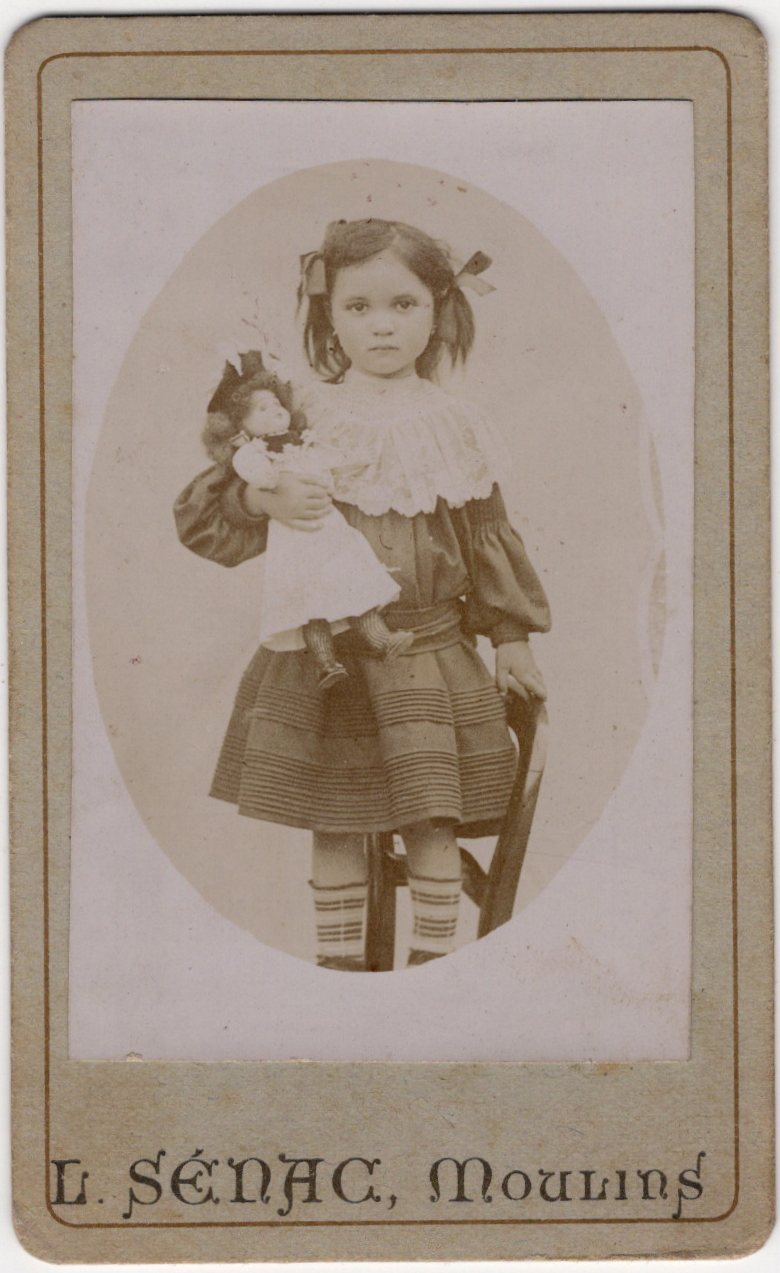
FRENCH GIRL STANDING ON A CHAIR HOLDING HER DOLL : MOULINS, FRANCE : CDV

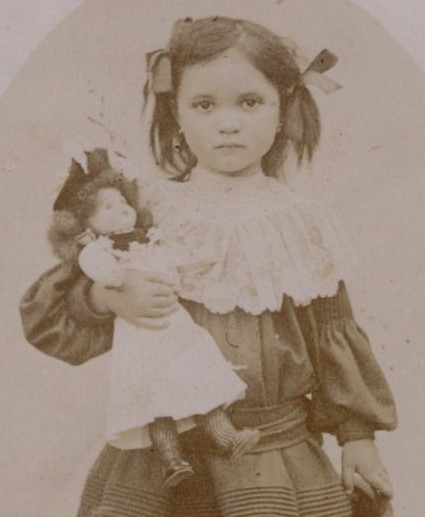
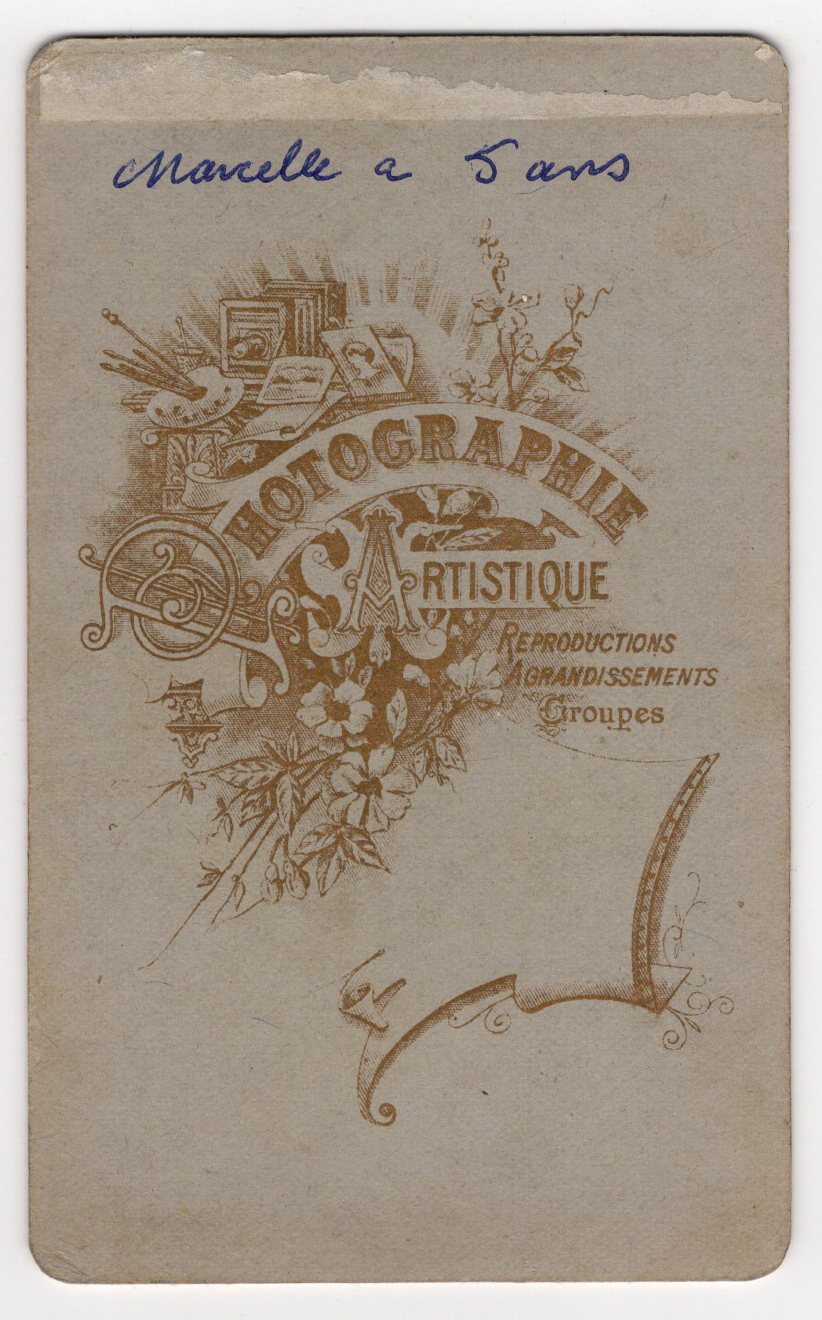
This delightful carte de visite (CDV) captures a young French girl—identified on the reverse as Marcelle, age five —standing atop a wooden chair and holding a cherished doll. The image was produced by photographer L. Sénac, whose studio was located in Moulins, a commune in central France. The child is dressed with obvious care and attention. She wears a pleated skirt with horizontal bands of trimming and a blouse featuring puffed sleeves gathered at the wrist. A large, wide lace collar cascades over her shoulders, adding a touch of elegance typical of the late 19th or very early 20th century. Her long hair is parted and tied into twin pigtails with matching ribbons—each tied into neat bows that frame her face. Her expression is calm, solemn, and slightly curious—a common look in early childhood photography when long exposure times discouraged smiling. In her arms, Marcelle cradles a striking doll. The doll appears to be a bisque-head type with painted features and inset eyes, dressed in a white dress with striped stockings and black shoes. Its curly wig and dark bonnet suggest it was a fashionable toy of the time—possibly German-made, as many high-quality dolls of that period were. The girl’s firm grip on the doll and the central positioning of the toy in the composition suggest that it was a beloved possession, likely included to soothe the child or highlight her status and affection. A noteworthy detail in this CDV is that the girl is standing on a chair—a common practice in studio portraiture to elevate small children to better capture them within the camera’s frame. Her feet, clad in boots and striped stockings, are clearly visible, adding to the charm and authenticity of the image. Turning to the reverse of the CDV, we see elaborate lithographed artwork typical of the era. The back bears the branding “Photographie Artistique,” with additional French text advertising reproductions, enlargements, and group photography. At the very top is the handwritten note identifying Marcelle.  (SOLD)

Published in: on May 16, 2026 at 11:30 am  Leave a Comment  
Tags: , , , , ,

KEWPIE DOLL : PRETTY GLAMOUR MODEL : ART DECO : LEO : RPPC

This vintage French tinted real photo postcard features a pretty young woman holding a very cute kewpie doll. Kewpie is a brand of doll which was modeled after a comic strip character created by cartoonist Rose O’Neill in 1909. The doll had a similar appearance to cupid. In 1912 the first kewpie doll appeared and it was a bisque doll. Later, the dolls were made of composition (1920’s), celluloid (1930’s and 1940’s), and later plastic kewpies made their appearance. The woman in this photo has a beautiful smile and pretty eyes. She is colorfully dressed. This postcard  was published in the 1920’s by Leo as part of a series (No.292).  SOLD

Published in: on May 1, 2026 at 12:00 pm  Leave a Comment  
Tags: ,

VETERINARIAN ADVERTISING POSTCARD : DOG WITH CAST : DR. JANVIER : PARIS, FRANCE

This unusual and charming vintage French advertising postcard promotes the veterinary services of Dr. Janvier, a “vétérinaire spécialiste” (specialist veterinarian) located in Paris, France. The front of the postcard, printed in red and black, features the heading “Maladies des Chiens” (Diseases of Dogs). At right is a photographic image of a small dog seated with a bandaged or splinted paw, symbolizing Dr. Janvier’s care for injured animals. The layout, typography, and design strongly suggest an early 20th-century date (circa 1905–1915). The lower line of text translates to: “Consultations from 2 to 5 o’clock — House Calls.”  (SOLD)

Published in: on April 11, 2026 at 12:00 pm  Leave a Comment  
Tags: , ,

MARY PICKFORD : LES VEDETTES DE CINEMA : CINEMAGAZINE : RPPC (1920’s)

POSTCARD 1 (SOLD)

POSTCARD 2 (SOLD)
Mary Pickford (1892-1979) was a Canadian-American actress and one of the most influential figures in early Hollywood. She was often referred to as “America’s Sweetheart”. She was a pioneer of silent film and a co-founder of the film industry as we know it today. Pickford’s career began in childhood when she performed in theater productions in Canada and the United States. By the early 1900s, she transitioned to film, working with director D.W. Griffith at Biograph Studios. Her delicate beauty and expressive acting quickly made her a fan favorite, setting her apart in an era when exaggerated stage-style performances dominated silent films. During the 1910s and 1920s, Pickford became one of the highest-paid and most beloved actresses in the world. Starring in films such as Rebecca of Sunnybrook Farm (1917), Daddy-Long-Legs (1919), and Pollyanna (1920), she was known for playing wholesome, spirited young women. Her curly hair and signature on-screen innocence became iconic, but she was also a savvy businesswoman who understood the power of her brand. Pickford was not only a star but also a trailblazer in the film industry. In 1919, she co-founded United Artists alongside Charlie Chaplin, Douglas Fairbanks (her then-husband), and director D.W. Griffith. This revolutionary move allowed filmmakers to control their own productions rather than rely on major studios, changing the industry forever. As the film industry transitioned to “talkies,” Pickford retired from acting in the early 1930s, though she continued to produce films. Her contributions earned her an honorary Academy Award in 1976 for her lasting impact on cinema. Mary Pickford’s influence extends beyond her films. She helped shape the star system, paved the way for women in Hollywood, and co-founded the Motion Picture Relief Fund to support struggling actors. She remains an enduring symbol of early Hollywood glamour and innovation. Mary Pickford was born into a working-class family in Toronto, Canada. Her father, John Charles Smith, was an alcoholic who struggled to provide for the family and died from a workplace accident when Mary was just six years old. Her mother, Charlotte Hennessey Smith, was left to raise Mary and her two younger siblings, Lottie and Jack, on her own. To support the family, Charlotte encouraged her children to enter acting, and Mary began performing in theater at a young age. She soon became the family’s primary breadwinner, and her siblings, Lottie Pickford and Jack Pickford, also pursued film careers. Pickford transitioned from theater to film in the early 1900s, quickly rising to fame with her expressive acting and wholesome on-screen persona. By the 1910s and 1920s, she was one of the most recognizable stars in the world, earning the nickname “Queen of the Movies.” She also helped establish the Academy of Motion Picture Arts and Sciences. Mary Pickford was married three times. Pickford’s first marriage was to silent film actor Owen Moore (1911-1920). Her second and most famous marriage was to fellow silent film actor, Douglas Fairbanks (1920-1936). Her third marriage was to actor Charles “Buddy” Rogers (1937-1979). After retiring from acting in the early 1930s, Pickford focused on producing films and philanthropy. She became more reclusive in her later years, struggling with alcoholism and health issues. Today, she is remembered as a pioneering force in cinema history.

Postcard 1 features Pickford seated gracefully on a carved wooden stool, exuding elegance and poise. She is dressed in a flowing, light-colored gown with delicate embellishments on the bodice and sheer fabric draping over her arms. Her signature curls frame her face, a defining feature of her “America’s Sweetheart” image. She wears a subtle yet confident expression, her eyes gazing slightly to the side with a soft, introspective quality. Her arms are relaxed, with one hand resting gently on her lap and the other elegantly extended. Her accessories include a bracelet on her wrist and a ring on her finger, adding to her refined look. The backdrop behind her is a richly textured tapestry, possibly depicting a pastoral scene. This postcard was likely produced in the 1920s, during the height of Pickford’s career. It is numbered 86 and is part of a larger collectible series showcasing cinema stars of the era. This vintage postcard is part of a series titled Les Vedettes de Cinéma (translated as The Stars of Cinema), and it was published by Alfred Noyer (Paris,France), in collaboration with United Artists, the film distribution company that Pickford co-founded. The back of the postcard identifies the publisher as Cinémagazine – Edition and states that it was Made in France / Fabriqué en France, indicating its European origin. (SOLD)

Postcard 2 features Mary Pickford in a soft, introspective portrait that perfectly captures the romantic visual style of the early 1910s. Pickford is posed in three-quarter profile, her gaze cast downward, with her signature long curls cascading over her shoulders. She wears a delicate, flowing gown rendered in subtle hand-applied color, with pale blue and warm cream tones carefully brushed over the original photograph, lending the image a dreamy, ethereal quality. The overall effect is gentle and luminous, emphasizing her youthful features and expressive eyes. This postcard was produced by Rotary Photo, one of the most prolific and collectible publishers of celebrity real photo postcards in the early 20th century. The image is identified by the ID No. S.62-2, printed at the lower edge, and the reverse confirms it was printed in England via (Rajer Bromide). (SOLD)

POSTCARD 2

RISQUE FRENCH NEW YEARS POSTCARD : PRETTY WOMAN : SEE-THROUGH TOP : RPPC

This attractive vintage French postcard features a hand-colorized portrait of a young woman — her hair softly waved, her features delicate, and her expression warm and gentle. She tilts her head slightly and raises one arm, resting her hand near her ear, holding a rose (colorized in vivid pink) against her cheek. The soft hand-tinting gives the card a dreamy, romantic feel: gentle blush on her cheeks, subtle color in her lips, and pastel tones in the background. The fashion and style — the wavy hairstyle, the jewelry, and the sitter’s graceful pose — evoke early 20th-century glamour. In the upper right of the image side appears the gilded greeting “Bonne Année” — a New Year’s wish, adding charm and purpose to the card. The card’s publisher imprint in the lower left reads SUBAR 155-PARIS. The reverse carries a handwritten message and address in French (see translation). “Best wishes and greetings — Marthe”. The card is marked “SUBAR 155-PARIS.” Unfortunately, I was unable to locate reliable reference material definitively describing a postcard house named “SUBAR.” That said, the card’s style — hand-colored portrait, gilded greeting, Paris imprint — is consistent with many small-scale French postcard producers from the pre-WWI and interwar periods, when dozens of modest workshop-publishers issued commemorative and greeting cards for domestic distribution. (SOLD)

Published in: on March 24, 2026 at 11:30 am  Leave a Comment  

THE GLORY OF WAR (VINTAGE REAL PHOTO PROPAGANDA POSTCARDS)

POSTCARD 1 (SOLD)
warPOSTCARD 2 (SOLD)

POSTCARD 3 (SOLD)

These vintage real photo postcards extol the glory of war. We see images of a cute little boy playing with his toy soldiers. Above him, we see an image of a smiling World War I soldier looking down on the young lad. Perhaps these photographs can be interpreted as a soldier at war fondly remembering his days playing with toy soldiers. A second interpretation may be that a little boy is fantasizing fighting in a “real war” while he is playing with his militaristic toys. It is clear that these photo postcards were aimed to stimulate feelings of patriotism during a time of war. Many generations of young boys have had a skewed view of war. Fighting wars has been viewed as glorious and exciting. One teenager once told me that he didn’t want to live his life without having the experience of going to war. When these young boys (and in present times….girls) grow up and become participants in warfare, they realize that the fantasy is nothing like the reality. These postcards are an example of propaganda meant to garner support for France, it’s policies, and it’s troops. These postcards were published in France and are part of a series (0 549).  (ALL THREE POSTCARDS SOLD)

Published in: on March 4, 2026 at 11:30 am  Comments (2)  
Tags: , ,

GLAMOROUS FRENCH MODEL : RISQUE BEADED COSTUME : SEMI NUDE : JEAN AGELOU : RPPC

This risque postcard features a sepia-toned image of a striking woman posed in a theatrical, evocative setting. She stands confidently, her body slightly angled, with one leg bent gracefully at the knee. Her scanty attire consists of an ornate, jewel-encrusted bikini-style costume adorned with beads and shimmering details, complemented by a garter on her thigh. She holds a piece of gauzy fabric in one hand, which adds a sense of movement and allure to the image. Her delicate high-heeled shoes contribute to her poised, elegant stance. The woman’s long, wavy hair cascades over her shoulders, framing her face, which exudes a calm, almost introspective expression. Her gaze is soft, directed downward as though lost in thought, lending an enigmatic quality to her overall appearance. This type of postcard, often referred to as a risqué or “boudoir” card, was a popular collectible in the late 19th and early 20th centuries. While such images were considered daring or provocative for the era, they were also widely accepted within artistic and theatrical circles, particularly in Paris and other European cultural hubs. These postcards often featured dancers, actresses, or models and were sometimes used for advertising performances or as keepsakes. This photograph was likely taken by renowned French photographer, Jean Agélou. Agelou is credited with photographing other real photo postcards from this series.  SOLD

FRANCOISE FABIAN : PRETTY AND PROLIFIC FRENCH FILM ACTRESS

fabian12020-05-24_115834 fabian22020-05-24_120006

The pretty young woman featured in this vintage real photo postcard is Michele Cortes de Leone y Fabianera. Her stage name is Francoise Fabian (1933- ). She is a French film actress and she has appeared in more than 80 French and International films since 1956. She began as a stage actress and performed at the Paris Conservatoire. She trained at the Algerian Conservatory of Dramatic Arts. She is known for acting in “My Night at Maud’s” (1969), “Belle de Jour” (1967), and “Happy New Year” (1973). She acted in films by Eric Rohmer and Louis Malle. Fabian was born in Algiers, French Algeria. Her father was Spanish and her mother was Polish. She was married and widowed twice. Her first husband, Jacques Becker, was a French screenwriter and film director. Her second husband was French film actor, Marcel Bozzuffi. His roles included playing the brutal hit man in “The French Connection” (1971). The photographer of this portrait photo is Sam Levin (1904-1992). He was born in the Ukraine but emigrated to France when he was two years of age. He is famous for his stage photographs and his portraits of movie stars. His studio was in Paris. Levin was a film photographer for 75 films. He was arrested by the Nazis during World War II and was sent to a camp. His crime was, being Jewish. The fact that he was sent to a detention camp rather than a death camp, indicates there was a high ranking Nazi official acting as his guardian angel. He photographed nearly all the major French and European movie stars of the 1950’s and 1960’s. He is particularly celebrated for his photos of Brigitte Bardot. Levin did over 180 magazine covers in the United States. This postcard was published by Kores, a French company. The card is part of a series (#894). The series is comprised of 100 postcard portraits.  (SOLD)                                    

fabian32020-05-24_120219

SIKH SOLDIERS BRITISH INDIAN ARMY : BASTILLE DAY : PARIS : POSTCARD : WW I 1916

This striking World War I–era postcard captures a powerful and historically important moment: Indian Sikh soldiers marching through Paris on July 14, 1916, France’s Bastille Day. The scene shows a column of turbaned Sikh troops advancing down a Parisian boulevard, sabers drawn, while a French woman steps forward to present flowers—an evocative gesture of gratitude and solidarity from the French public toward Allied colonial troops. The men are Sikh soldiers serving in the British Indian Army, identifiable by their turbans, beards, and traditional curved sabers (talwars), worn alongside British military uniforms and equipment. Sikh regiments were highly respected for their discipline and battlefield effectiveness, and tens of thousands served on the Western Front during the First World War. Many fought in France and Belgium between 1914 and 1918, sustaining heavy casualties far from home. This particular image documents their ceremonial participation in a Paris victory parade, rather than a battlefield scene. By 1916, Sikh and other Indian troops had become a familiar—and deeply symbolic—presence in France, representing the global reach of the Allied war effort. Public parades such as this one were meant to boost morale and emphasize unity among the Allies. The interaction in the foreground—flowers being handed to a senior Sikh soldier—adds a human and emotional layer to the photograph, underscoring the respect these men received from civilians who understood the sacrifices being made on their behalf. The caption under this postcard’s image can be translated as “July 14 in Paris, 1916 – The Indian Sepoys”. The term cipayes (sepoys) was commonly used in French to describe Indian soldiers serving under British command. The small monogram “ELD” at the bottom left of this postcard, is the publisher’s photographic logo and corresponds to Éditions Le Deley, a major Parisian postcard publisher active in the early 20th century. Le Deley was especially known for producing high-quality photographic postcards documenting current events, military subjects, and international themes during World War I. The reverse confirms the publisher as Le Deley, with a Paris address printed along the left edge. Le Deley issued thousands of wartime postcards and played an important role in visually documenting France’s experience during the Great War, including its colonial and Allied forces. (SOLD)

PRETTY WOMAN TAKING A BATH : RISQUE : PROVOCATIVE : FRENCH RPPC : c1910

This vintage French photographic postcard presents a playful and deliberately risqué studio scene, produced in France during the early 20th century, likely circa 1905–1915. The image shows a young woman reclining nude in an ornate bathtub, leaning over the tub’s edge with her arms folded and smiling directly at the viewer. Her expression is open, flirtatious, and self-aware, clearly intended to engage the recipient in a lighthearted, teasing manner. The setting is a stylized interior, with a patterned background and a decorative porcelain bathtub, lending the scene an air of theatrical elegance rather than explicit exhibition. While the subject is unclothed, the composition remains suggestive rather than explicit, placing the postcard squarely within the tradition of French “risqué” or “galant” postcards that were popular in the Belle Époque period. The card is marked “REX 811” on the image side, identifying it as part of a commercial French postcard series, produced for novelty and adult amusement rather than private photography. Such cards were widely collected, mailed discreetly, or kept in albums, and today they are sought after for their blend of early photography, social history, and erotic ephemera. A translation of the message is as follows: “Peek-a-boo… it’s me!” “Yes, it really is me… in flesh and bone, In flesh above all — but behind closed doors…” The wording is intentionally playful and suggestive, reinforcing the private, teasing tone of the image and making the postcard unmistakably risqué by period standards. The postcard is in very good vintage condition. There is light edge and corner wear consistent with age. The image remains clear, with good contrast and no major distractions. The reverse shows light handling wear (see scans).

This vintage postcard is available for purchase at The History Peddler for $38 or best offer

Interested collectors may view the listing here:

https://www.ebay.com/itm/236552618037

Published in: on December 27, 2025 at 12:00 pm  Comments (3)  
Tags: , , , , ,