This charming antique studio photograph measuring about 5 x 4 inches, features a poised young woman in what appears to be an Edwardian-era portrait with a rustic, theatrical flair. The sitter stands in a confident, slightly angled pose, her left hand resting at her hip while her right arm is raised to support a small wooden bucket resting over her shoulder. The prop suggests a staged pastoral or character study—possibly evoking a milkmaid or country theme, a popular motif in early studio photography. She is dressed in a fitted, patterned dress with a cinched waist and softly gathered skirt, the fabric adorned with a delicate floral design. At the neckline is a decorative bow or rosette, adding a touch of femininity to the ensemble. Her wide-brimmed hat, embellished with flowers, frames her face beautifully and enhances the period aesthetic. Her expression is calm and self-assured, with a faint, knowing smile. SOLD
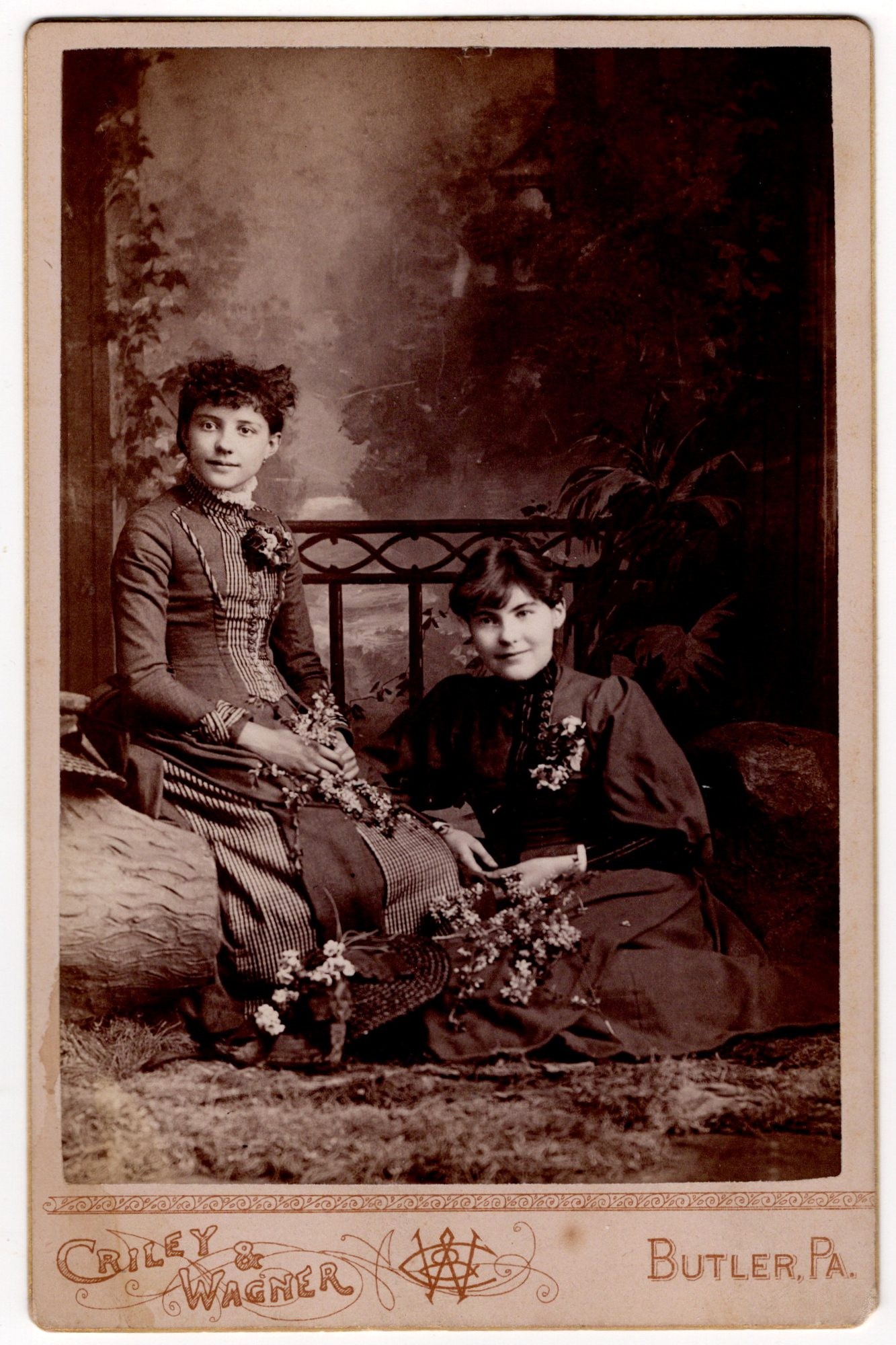
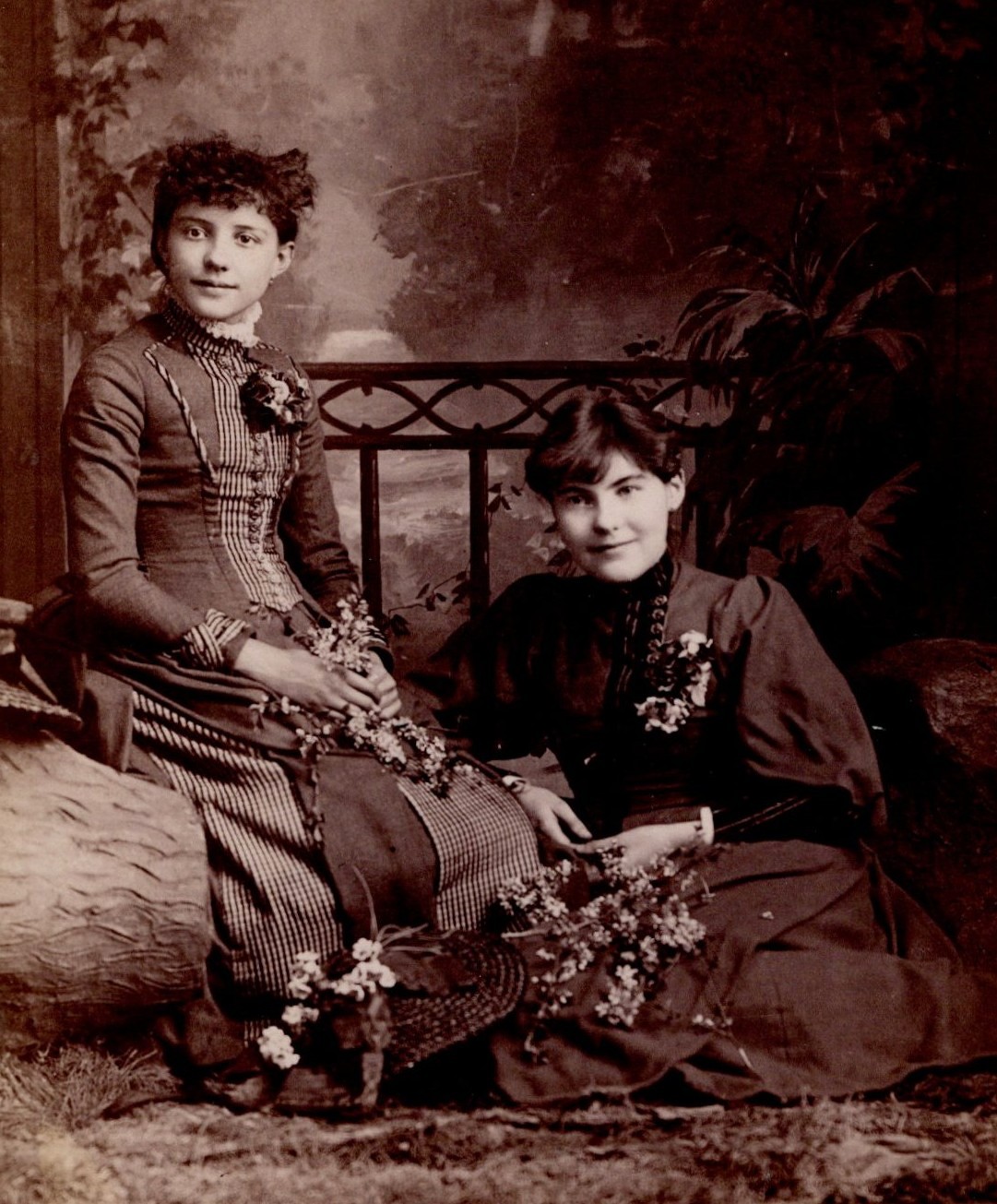
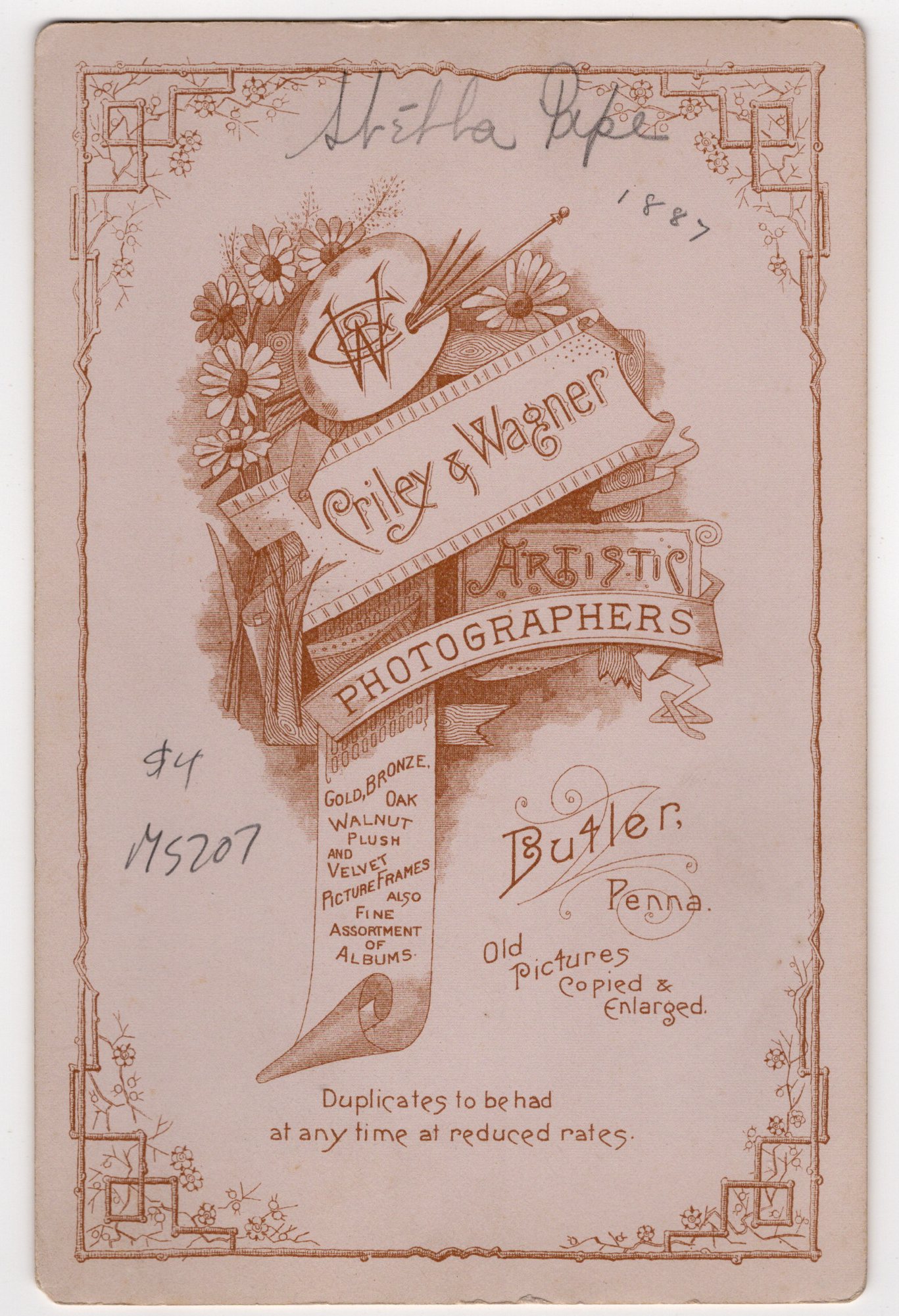
This touching 1887 cabinet card portrait captures two teenage girls posed gracefully in a lush, studio garden setting. One of the young women is identified on the reverse as Stella Pape (DeStella L. Pape, 1872–1956). She was about sixteen years old when this photograph was taken. One of the women sits tall and composed, her expression poised yet full of youthful curiosity, while her companion—slightly younger and seated beside her—leans forward with a softer, more reflective look. Together, they create an image that feels both intimate and timeless, showing the gentle friendship and grace of Victorian girlhood. Both girls are dressed in finely detailed 1880s gowns, complete with ruffled collars, pleated bodices, and corseted waists that reflect the fashion of the late Victorian era. Each wears floral adornments on their bodices and holds sprigs of blossoms in their hands, suggesting spring or early summer—a classic motif for Criley & Wagner’s “artistic photography.” The backdrop, featuring vines and a painted landscape, reinforces the romantic atmosphere typical of high-end portrait studios of the period. The studio responsible for this fine image, Criley & Wagner, operated in Butler, Pennsylvania during the 1880s and 1890s. A brief biographical note helps bring this cabinet card to life: DeStella “Stella” L. Pape was born in 1872 in Butler, Pennsylvania. In the 1900 U.S. Census, she is listed as living with her mother Mary and brother Nielsen in Butler. She later married George Reiber, a man twenty-one years her senior, and the couple welcomed a son, George Jr., in 1905. Stella eventually moved to Pittsburgh, where she passed away in 1956. She now rests beside her son, closing the circle of a life that began in this small Pennsylvania town over a century ago. Butler, Pennsylvania, the setting for this image, is a small city located about 35 miles north of Pittsburgh. Once a thriving industrial town, it’s now best known to many Americans as the site of the assassination attempt on Donald Trump during a 2024 campaign rally—an event that unexpectedly placed Butler in the national spotlight. This cabinet card is in very good antique condition, with rich tonal contrast and excellent clarity. The mount is clean and sturdy, showing only light edge wear typical of its age. The back is especially attractive, featuring ornate sepia-printed advertising for the Criley & Wagner studio, along with the handwritten inscription identifying Stella Pape and the year 1887 (see scans). I own at least three other cabinet cards from this studio. Remarkably, one of these cabinet photographs also features Stella Pape. In that photo, Stella is accompanied by three teenage companions. (SOLD)
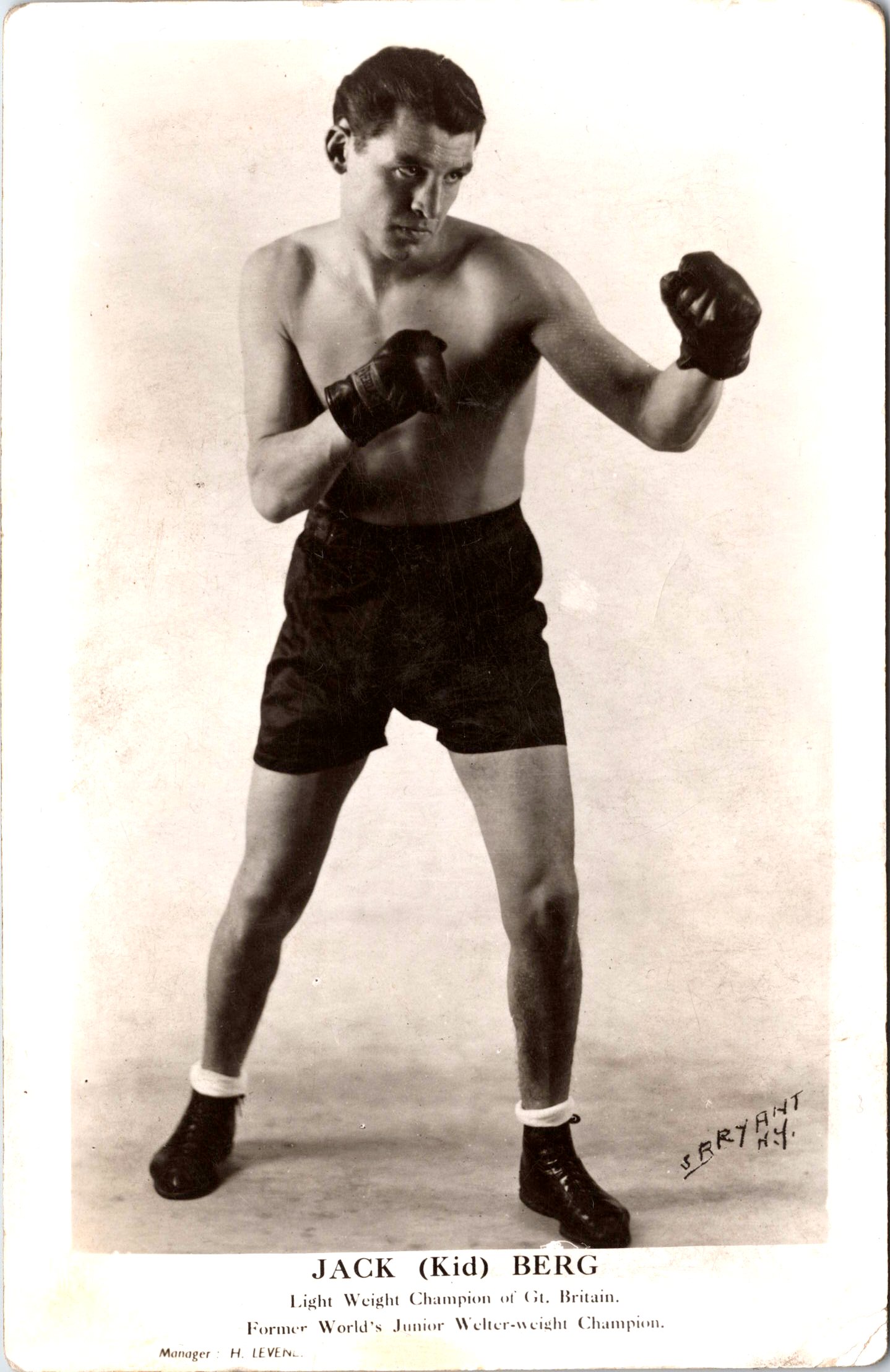
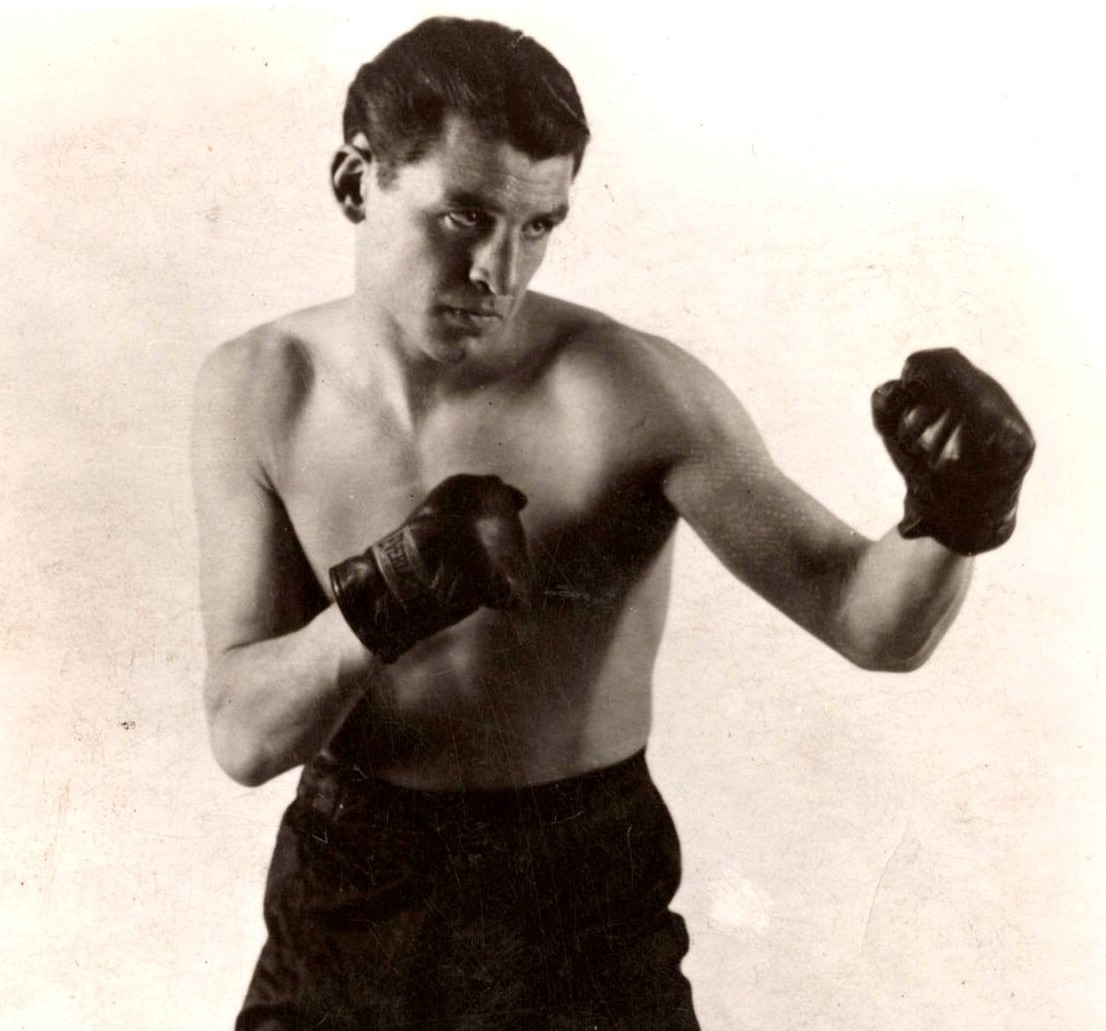
This vintage real photo postcard features boxer, Jack “Kid” Berg (1909-1991). Berg was born in London (Whitechapel) to a working-class immigrant family of Lithuanian-Jewish descent. He grew up in a rough area of London, setting the stage for his entry into the world of boxing. From an early age, he showed natural ability in the pugilistic sport. Success in Berg’s boxing career made him one of the most famous Jewish boxers of the twentieth century. Berg began his boxing career at the age of 14. He was a ferocious competitor and gained a reputation for his relentless pace and sharp boxing skills. He earned the nickname “The Whitechapel Whirlwind” due to his energetic fighting style. Berg wore a Star of David on his boxing shorts. Berg rose to prominence in British boxing by winning the British Lightweight Championship. However, his ambitions extended far beyond the UK. In the late 1920s, he moved to the United States to further his career, a move that would bring him international fame. In 1930, Berg achieved his most significant career milestone by defeating Mushy Callahan in a 10th-round stoppage to claim the World Junior Welterweight Championship. This victory solidified his status as a world-class fighter. Over the course of his career, Berg faced several notable opponents, including: Tony Canzoneri, Billy Petrolle, and Kid Chocolate. Berg’s record reflects his remarkable skill and determination in the ring. He retired with a professional record of 157 wins, 26 losses, and 9 draws, including 61 wins by knockout. After retiring from boxing in 1945, Berg remained involved in the sport as a trainer and mentor to young fighters. Berg also authored an autobiography, “Whitechapel Whirlwind,” which provides a detailed and colorful account of his life and career. Berg lived a flamboyant out-of-the-ring life. It has been reported that he had an affair with Mae West and he had a long-lasting friendship with Jack Comer, a colorful Jewish East Ender gangster. Berg was inducted into the International Boxing Hall of Fame as well as the International Jewish Sports Hall of Fame. This postcard features Berg as Light Weight Champion of Great Britain. The caption below Berg’s photo reports that he was managed by Harry Levene. Berg’s photo was taken by S. Bryant in New York.The photo was taken in or around 1934, the year he won the championship. SOLD
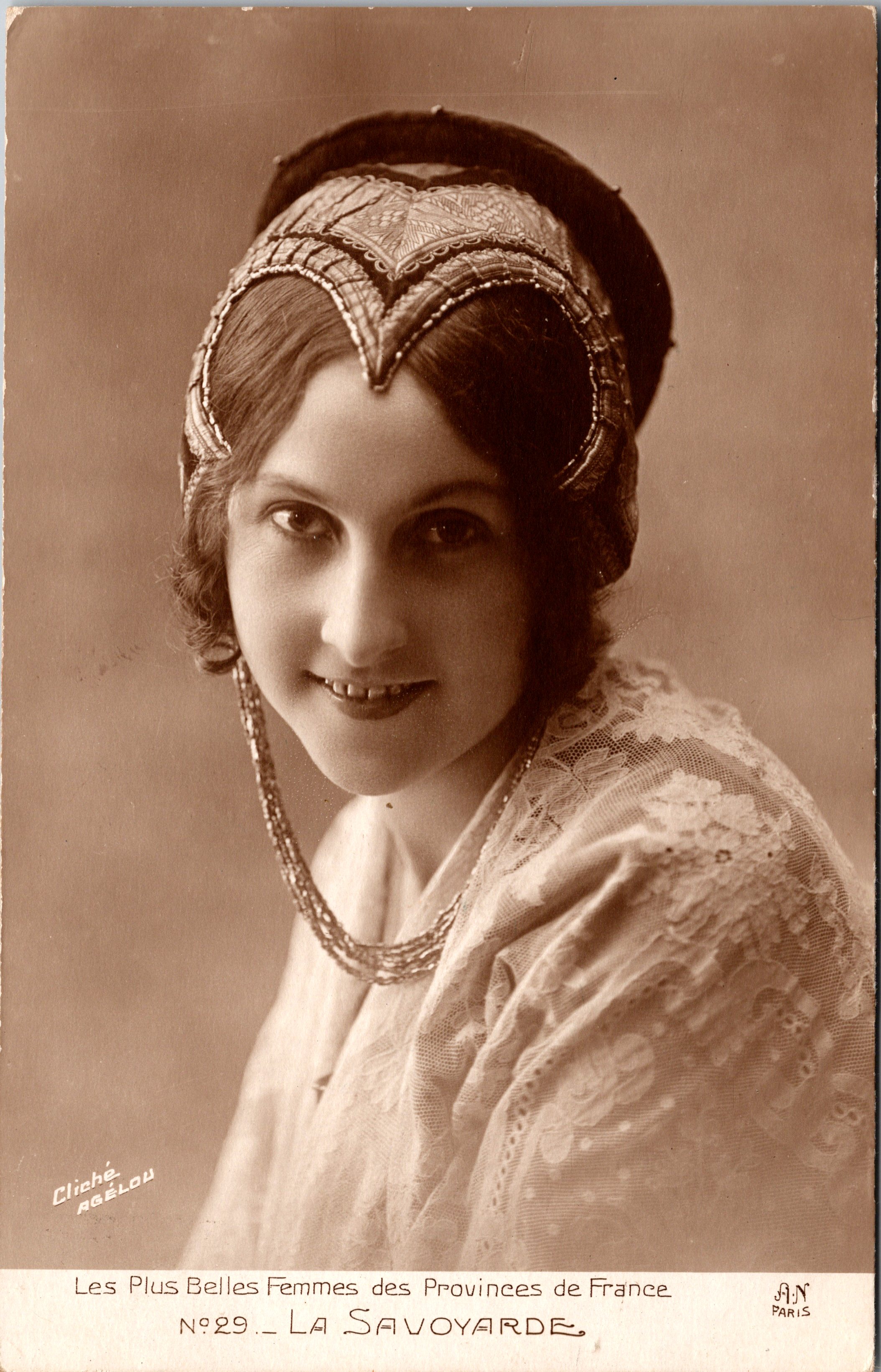
This vintage real photo postcard is part of a series named “Les Plus Belles Femmes de France” (The Most Beautiful Women of France). This series is about the Provinces of France, and the model for this image represents La Savoyarde. This postcard is no. 29 in the series. There were a number of different series published. The Province series was one of the more popular series. The models in this series represent different French Provinces and wear traditional clothing from that particular area of the country. This postcard was published by well known photographer Alfred Noyer. The celebrated photographer supervised a large photo studio in Paris. The Noyer Studio operated from 1910 until the 1940’s. Many of his early postcards were reproductions of artworks. He also produced illustrated patriotic postcards during World War I. With the onset of the 1920’s he began producing postcards of children and women. Many of the postcards he produced of women were nudes or risque images. Some of his postcards list his name while others are simply marked “AN”. The photographer of this postcard portrait is Jean Agelou (1878-1921). Agelou was a French photographer of the 1910’s and 1920’s who is best known for his erotic and nude photographs. He was born in Egypt and not much is known about his private life. Agelou generally used models between the age of 20 and 24 years-old. He had a favorite model. Her name was “Fernande” and in addition to modeling, she was Agelou’s lover. Her full name was Fernande Barrey (1893-1960). She was a prostitute by trade. She also modeled for for painters (Amadeo Modigliani and Chaim Soutine). Fernande later became a painter. Although the 1900’s was the “golden age” of erotic photograph, photographers who took such risque photos had to use discretion. As a result, Agelou signed his work “JA”. In 1908, nudity in photographs was banned in France and photographers had to cover nude women images with strategically placed undergarments or other materials. Nude images had to circulate on the down low. They were sent in the mail inside of envelopes. Fernande remained popular and her erotic photographs were enjoyed by soldiers on both sides during World War I. Jean Agelou died in 1921; the result of a car accident. His brother George, who managed Jean’s business, also was killed in the crash. SOLD
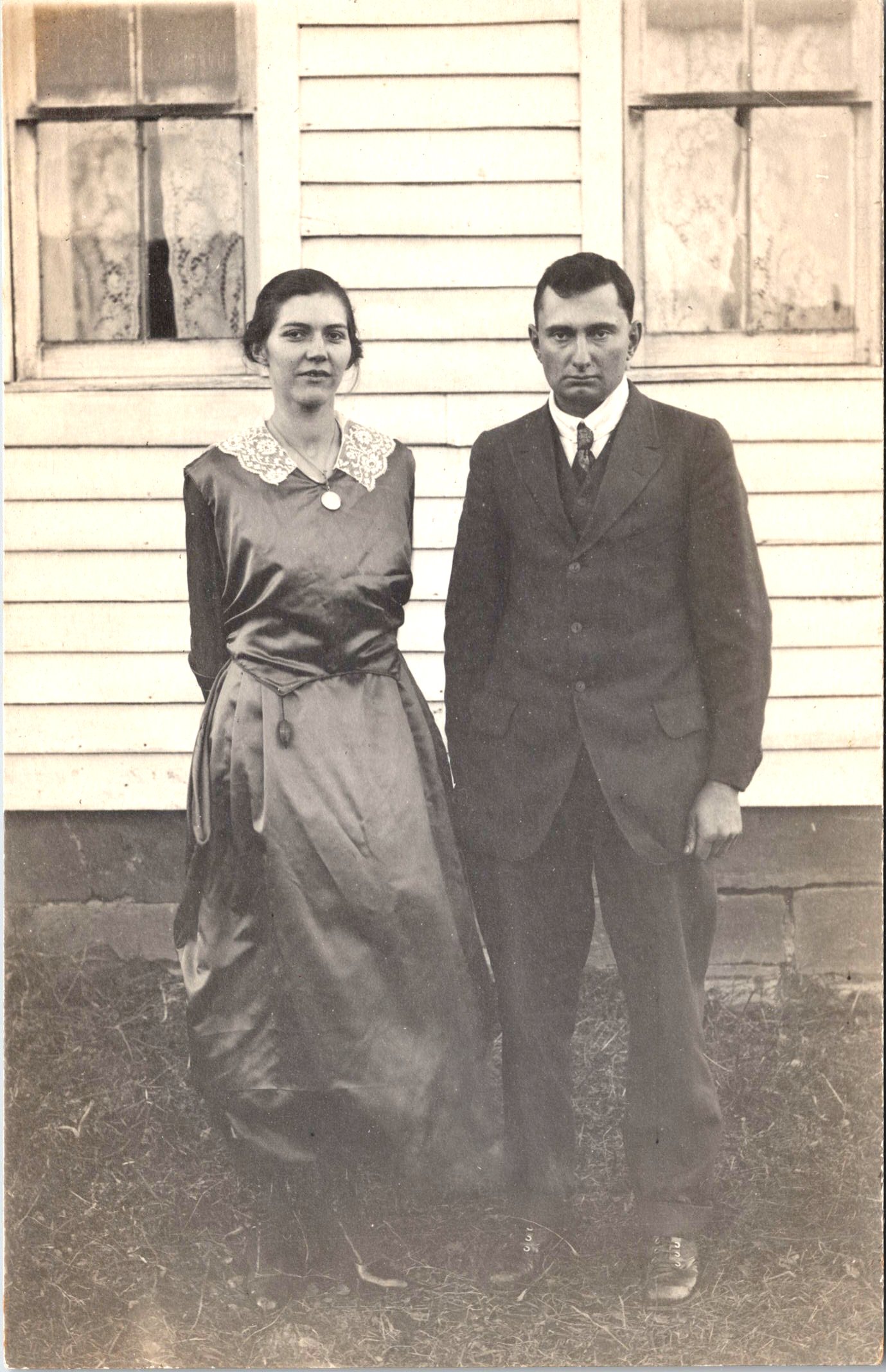
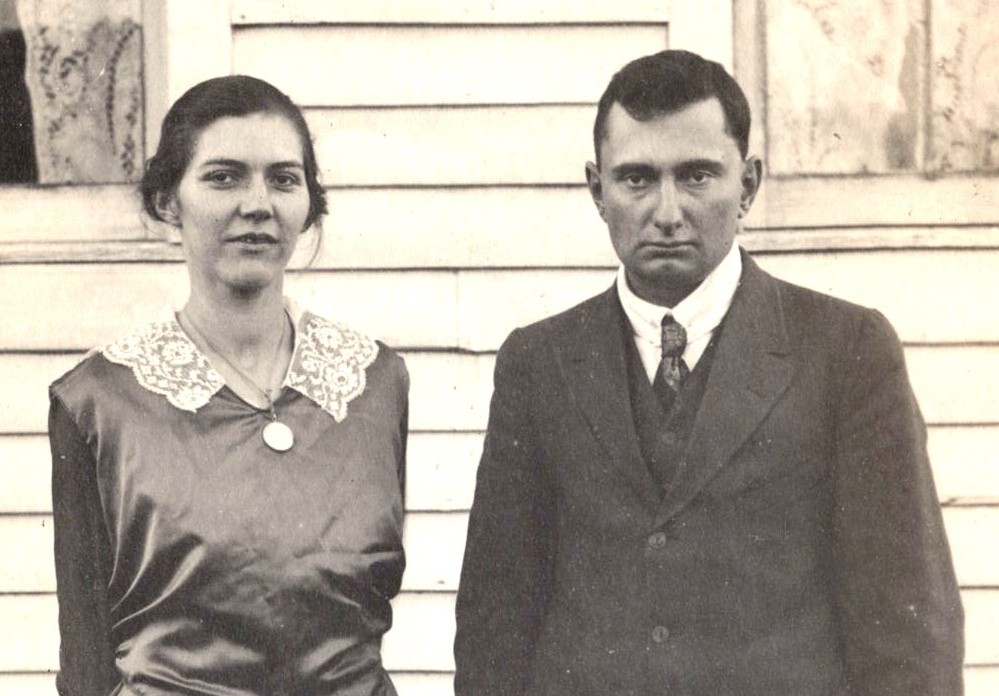
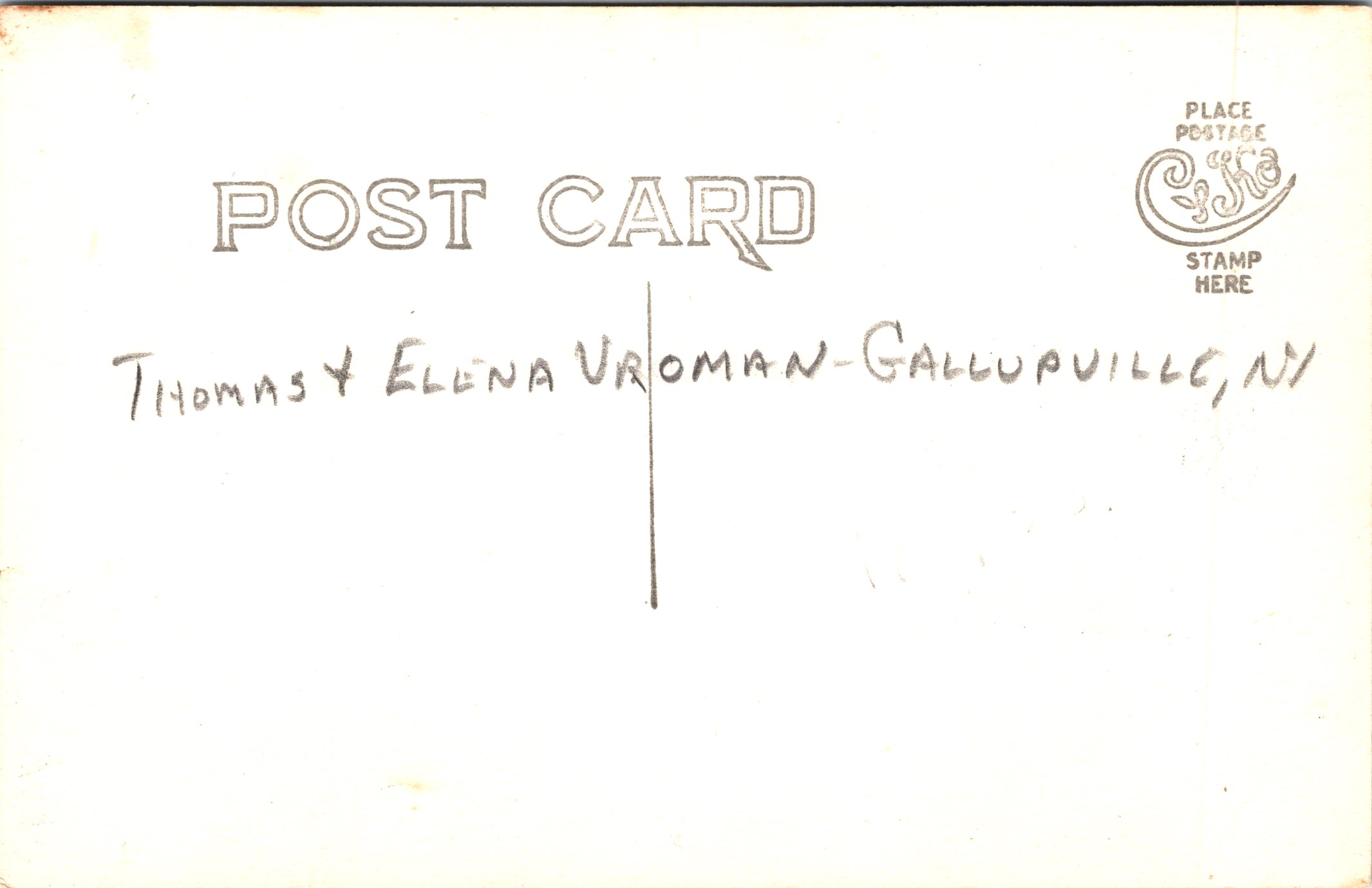
This real photo postcard features a solemn yet striking portrait of a young couple, identified on the reverse as Thomas & Elena Vroman of Gallupville, New York. The pair stands outside a clapboard-sided home, their expressions serious in the traditional early-20th-century photographic style. The woman wears a satin-like dress with a lace collar and a pendant at her neck, her hands clasped behind her back; the man stands in a suit and tie, maintaining a steady, direct gaze toward the camera. Lace curtains in the window behind them add a domestic touch, grounding the image in a rural family setting. This image captures the look and feel of rural New York farm and village life in the 1910s–1920s era — simple clothing, earnest expressions, and a sense of quiet dignity. It is an evocative portrait and a wonderful example of early American vernacular photography from upstate New York. Gallupville is a small hamlet in Schoharie County, located in eastern upstate New York, southwest of Albany and near the Helderberg Mountains. The card stock bears a CYKO stamp box, known for its ornate, almost calligraphic design. CYKO postcard paper was produced between 1904 and the mid-1920s which aligns perfectly with the fashion and photographic style seen here. The back is pencil-inscribed with the sitters’ names and hometown, providing valuable provenance.(SOLD)
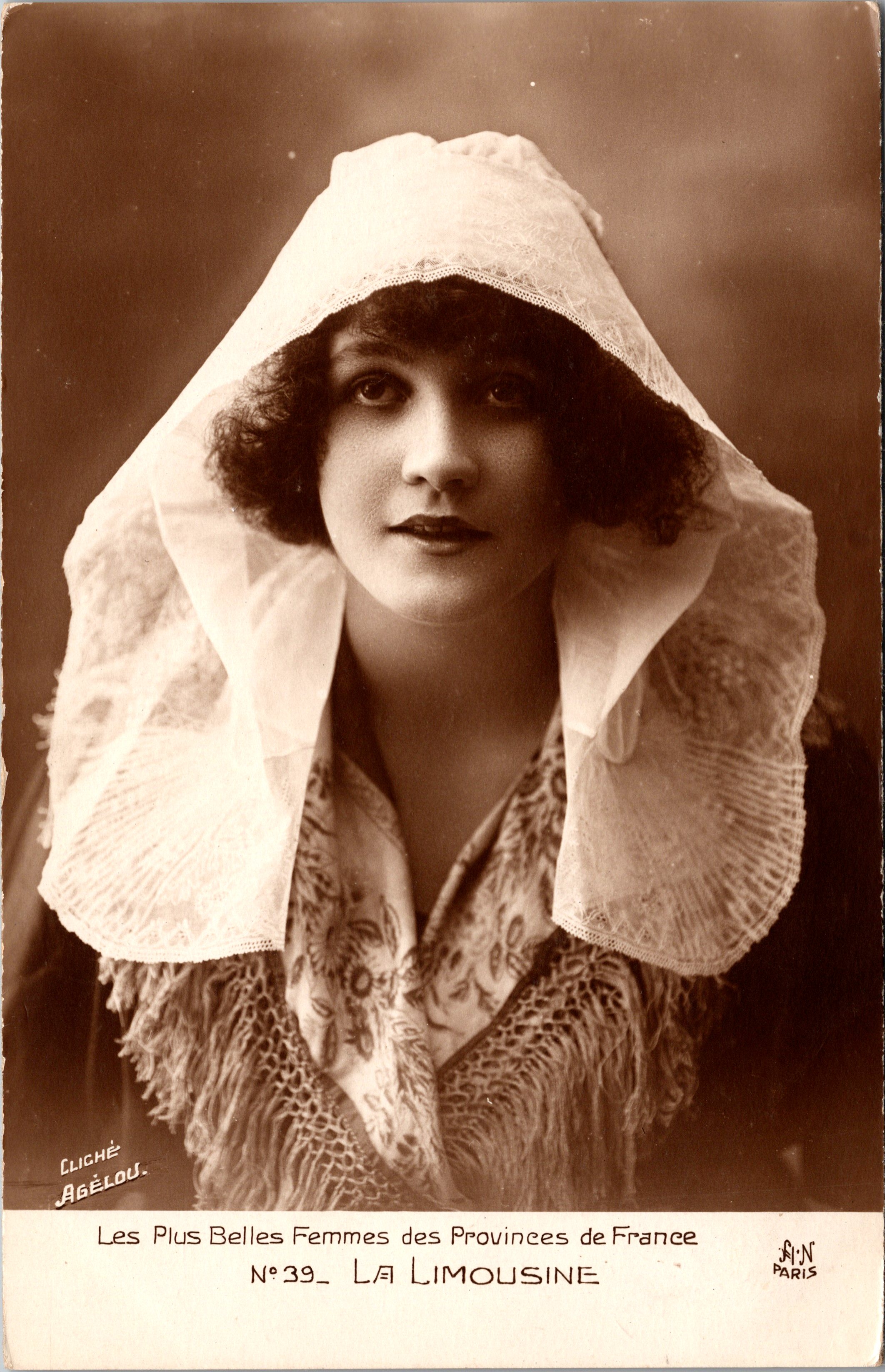
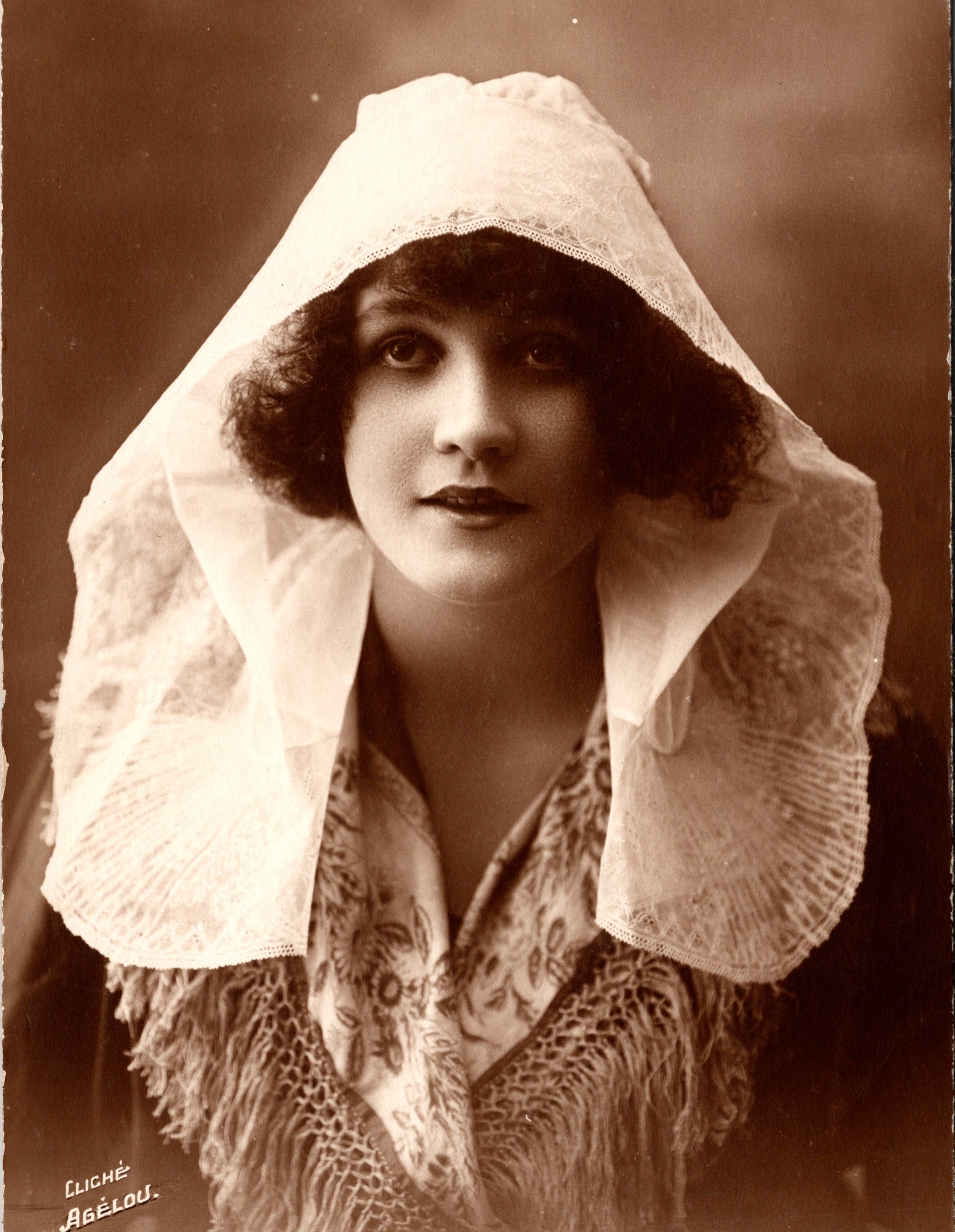
This vintage real photo postcard is part of a series named “Les Plus Belles Femmes de France” (The Most Beautiful Women of France). This series is about the Provinces of France, and the model for this image represents “La Limousine”. The postcard is no. 39 in the series. There were a number of different series published. The models in this series represent different French Provinces and wear traditional clothing from that particular area of the country. This postcard was published by Alfred Noyer. The Noyer Studio operated from 1910 until the 1940’s. This photo portrait was taken by the talented an esteemed French photographer, Jean Agelou (1878-1921). He was a photographer of the 1910’s and 1920’s and was well known for his erotic and nude photographs. SOLD
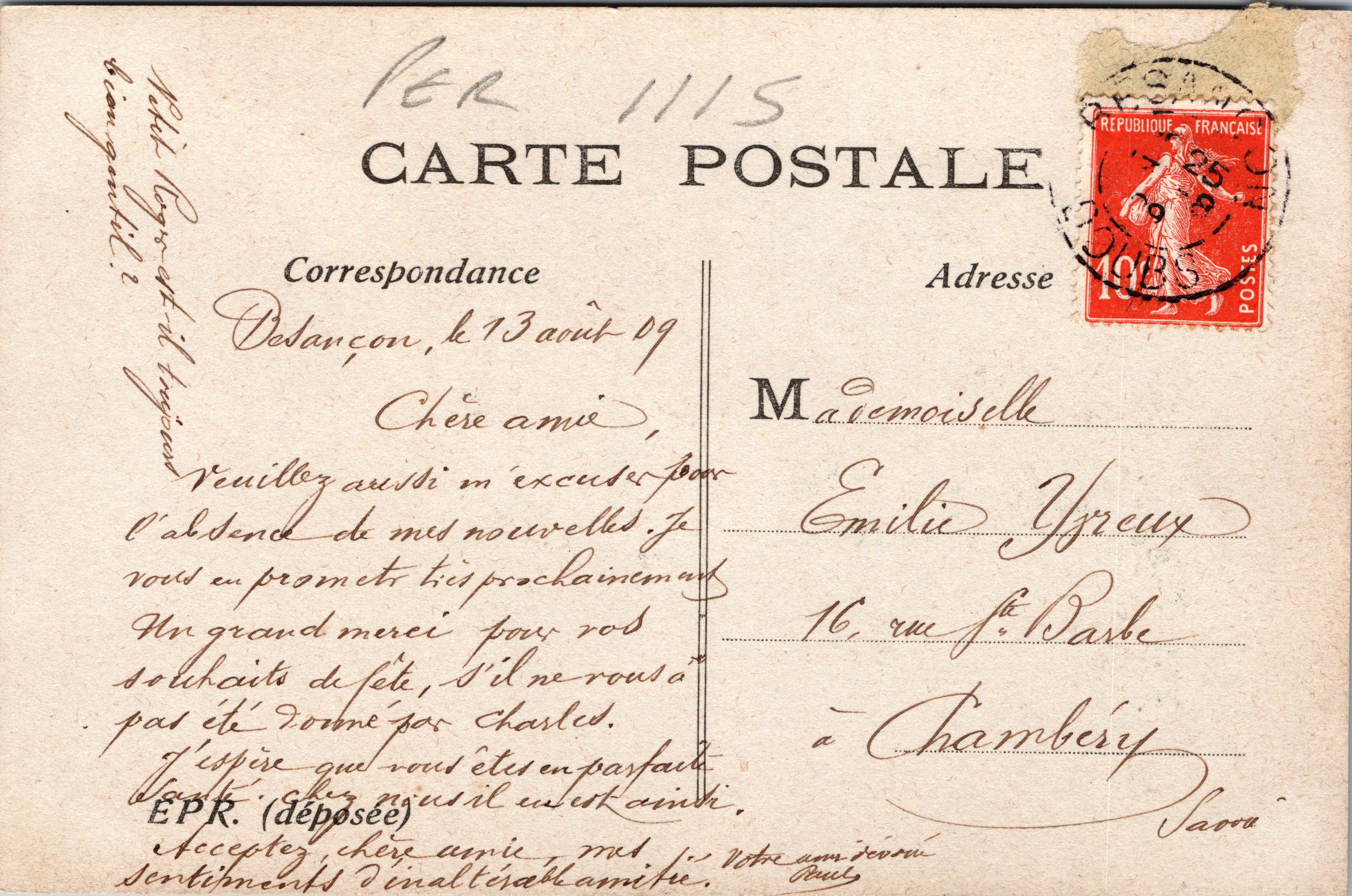
This vintage real photo postcard features Marcelle Louys, a pretty stage performer at the Moulin Rouge. The venue is located in Paris, France. The cabaret opened in 1889 and is best known as the birth place of the can-can dance. The Moulin Rouge remains in business and is a popular tourist destination. This postcard was published by EPR as part of a series (no.144). The postage stamp on this card is from France and the postmark is from 1909. This postcard is in very good condition (see scans)
This Vintage Real Photo Postcard is available for purchase at my store, The History Peddler, for $16.89 or best offer
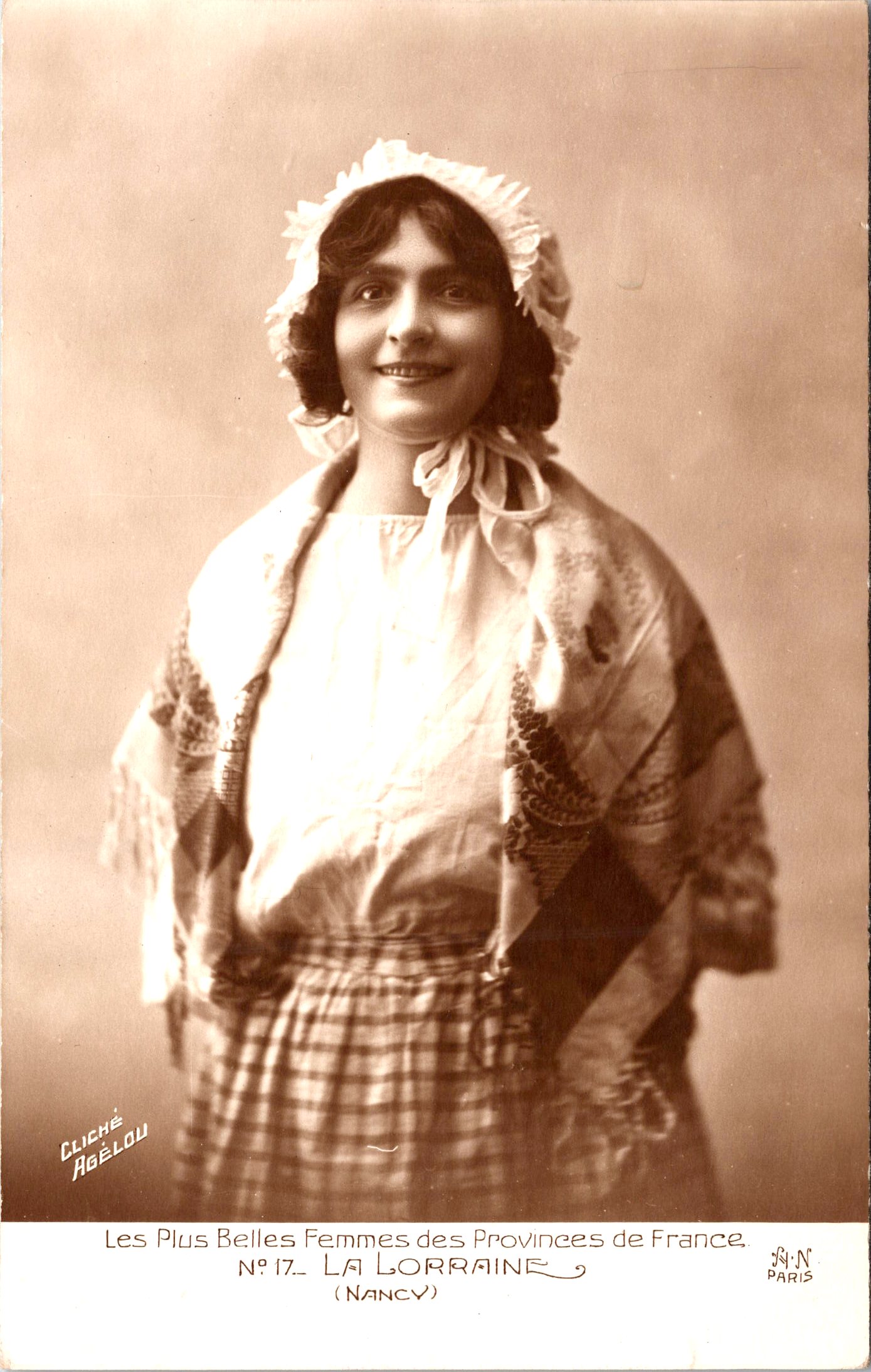
This vintage real photo postcard is part of a series named “Les Plus Belles Femmes de France” (The Most Beautiful Women of France). This series is about the Provinces of France, and the model for this image represents La Lorraine. More specifically, the woman represents the city of Nancy. Note that the woman in this photograph is wearing a pretty smile. This postcard is no.17 in the series. There were a number of different series published. The Province series was one of the more popular series. The models in this series represent different French Provinces and wear traditional clothing from that particular area of the country. This postcard was published by well known photographer Alfred Noyer. The celebrated photographer supervised a large photo studio in Paris. The Noyer Studio operated from 1910 until the 1940’s. Many of the postcards he produced of women were nudes or risque images. The photographer of this postcard portrait is Jean Agelou. He was renowned for his photographs of nude women. His work is highly collectible. SOLD
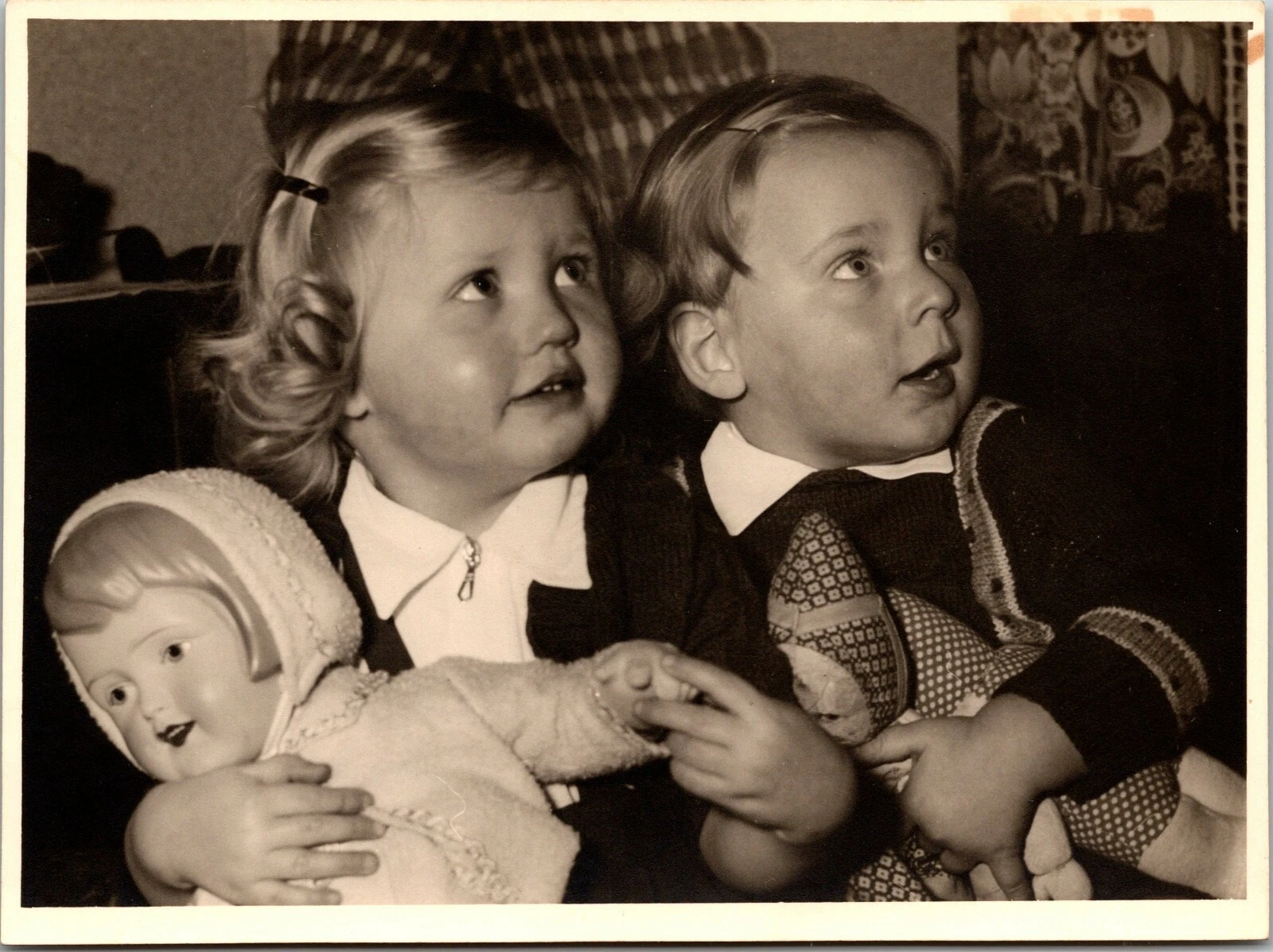
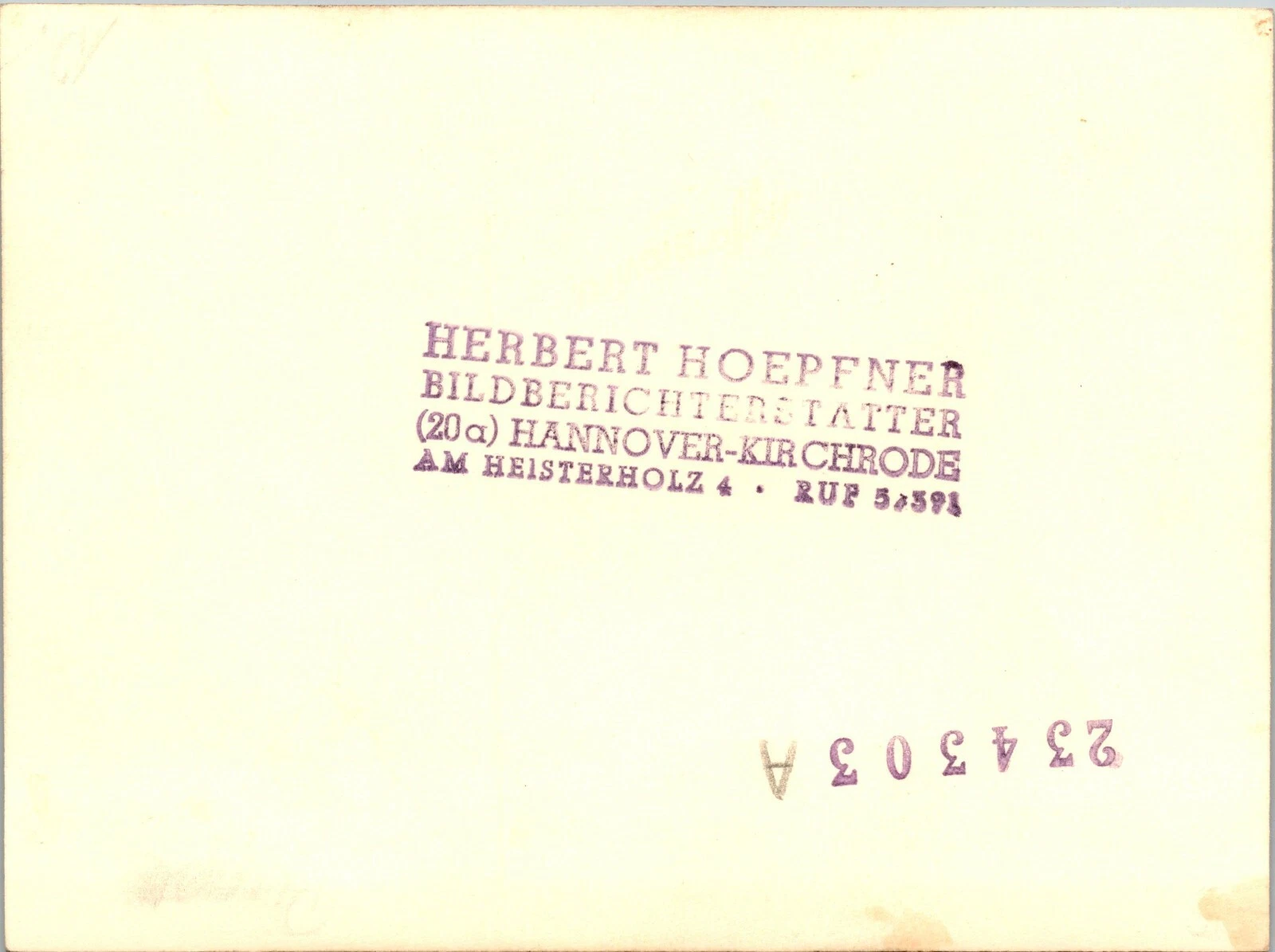
This vintage photo features a well-dressed little boy and girl. The boy is wearing a cute cardigan sweater. The girl and boy are holding dolls. These children are absolutely adorable. They appear to be siblings, perhaps even twins. The stamp on the reverse of this photograph indicates that the image is a press photo. I wouldn’t have guessed that it is a press photo because the quality of the image and the entire photograph is so excellent. It absolutely has the look and feel (to the touch) of a studio photograph.The photographer of this photo is Herbert Hoepfner and his studio was located in Hannover, Germany. This vintage photo measures about 4 1/2″ x 3 3/8″ and is in very good condition, The photo has excellent clarity.
This Vintage Photograph is available for purchase at my store, The History Peddler, for $24.00 or best offer
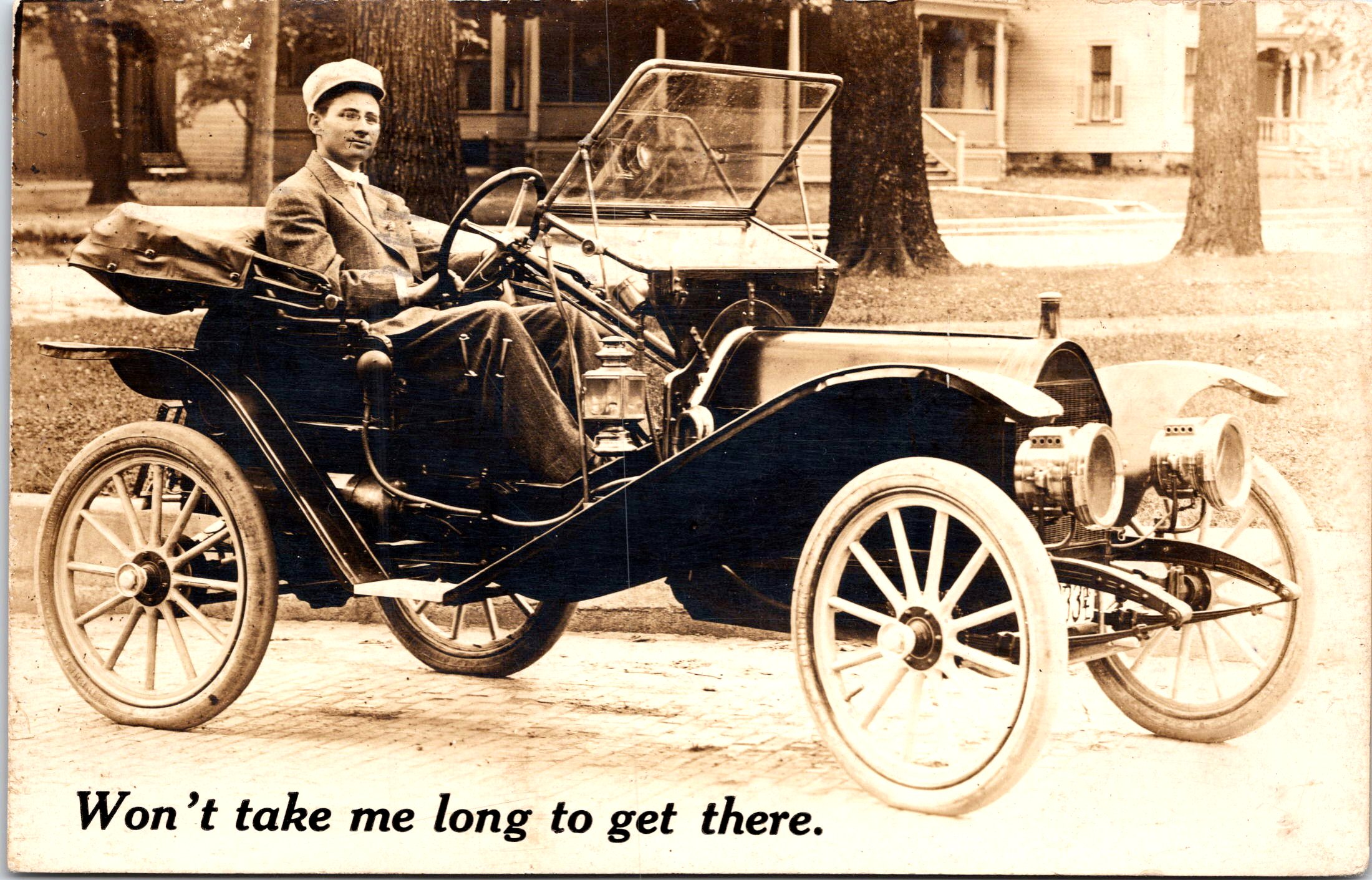
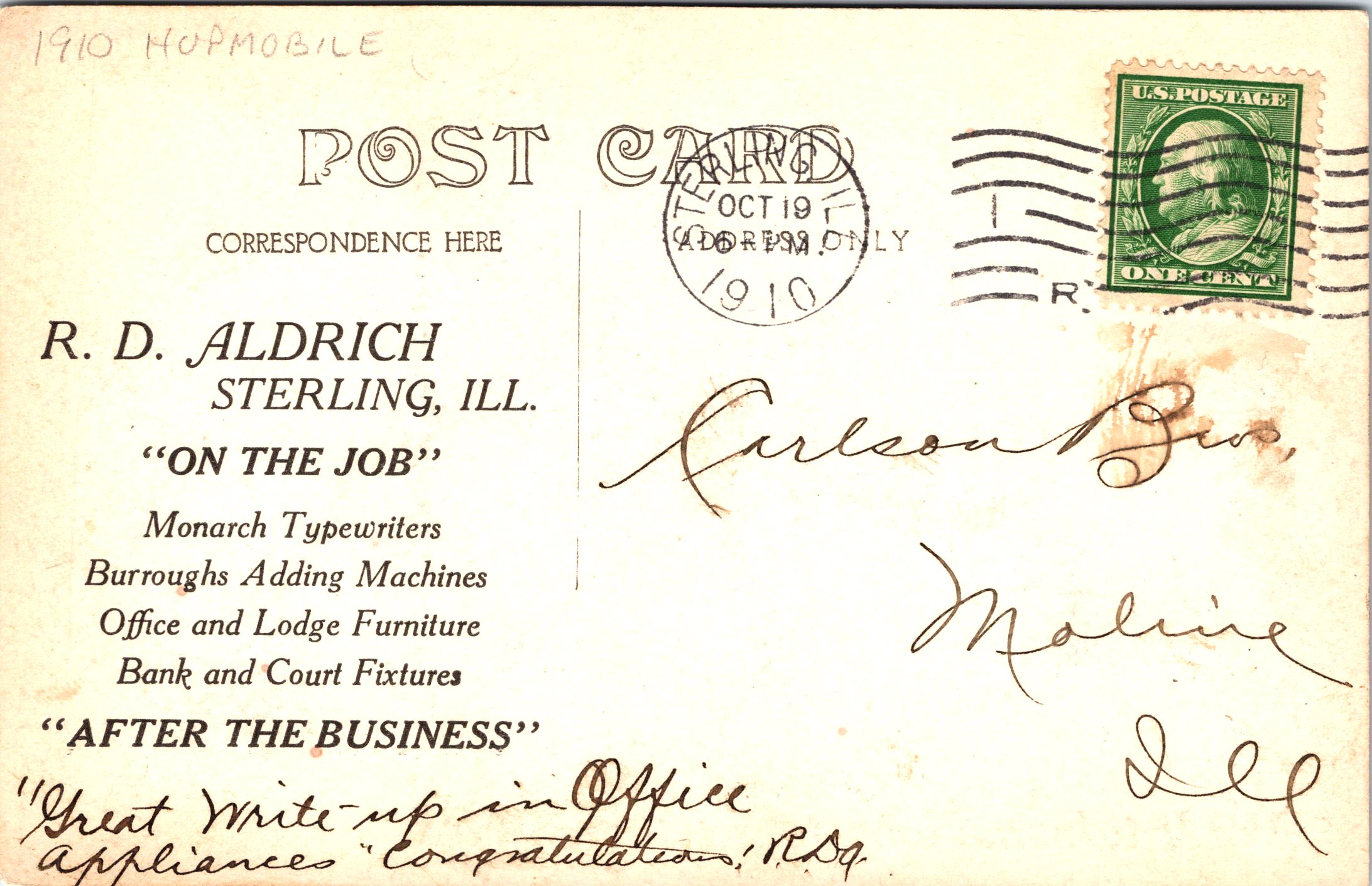
This vintage real photo postcard advertises “R. D. Aldrich”, an office supply store in Sterling, Illinois. The advertising on the card indicates that the firm sold Monarch Typewriters, Burroughs Adding Machines, Office Furniture, and more. The postcard was aimed at a retailer and it announces that a salesman from the company would be stopping by the retail store. The photograph on the front of the card is shows a salesman on his way to make a sales call. The caption states that the salesman will drop by soon. Writing on the reverse of the postcard indicates that the automobile in the photo is a Hupmobile. Comparing the car on the card to other photos of hupmobiles confirms that it is in fact a Hupmobile. Hupmobile started selling its cars in 1909. The office supply salesman who sent this card added a personal messageon the back of the card. This postcard has a 1910 postmark. SOLD