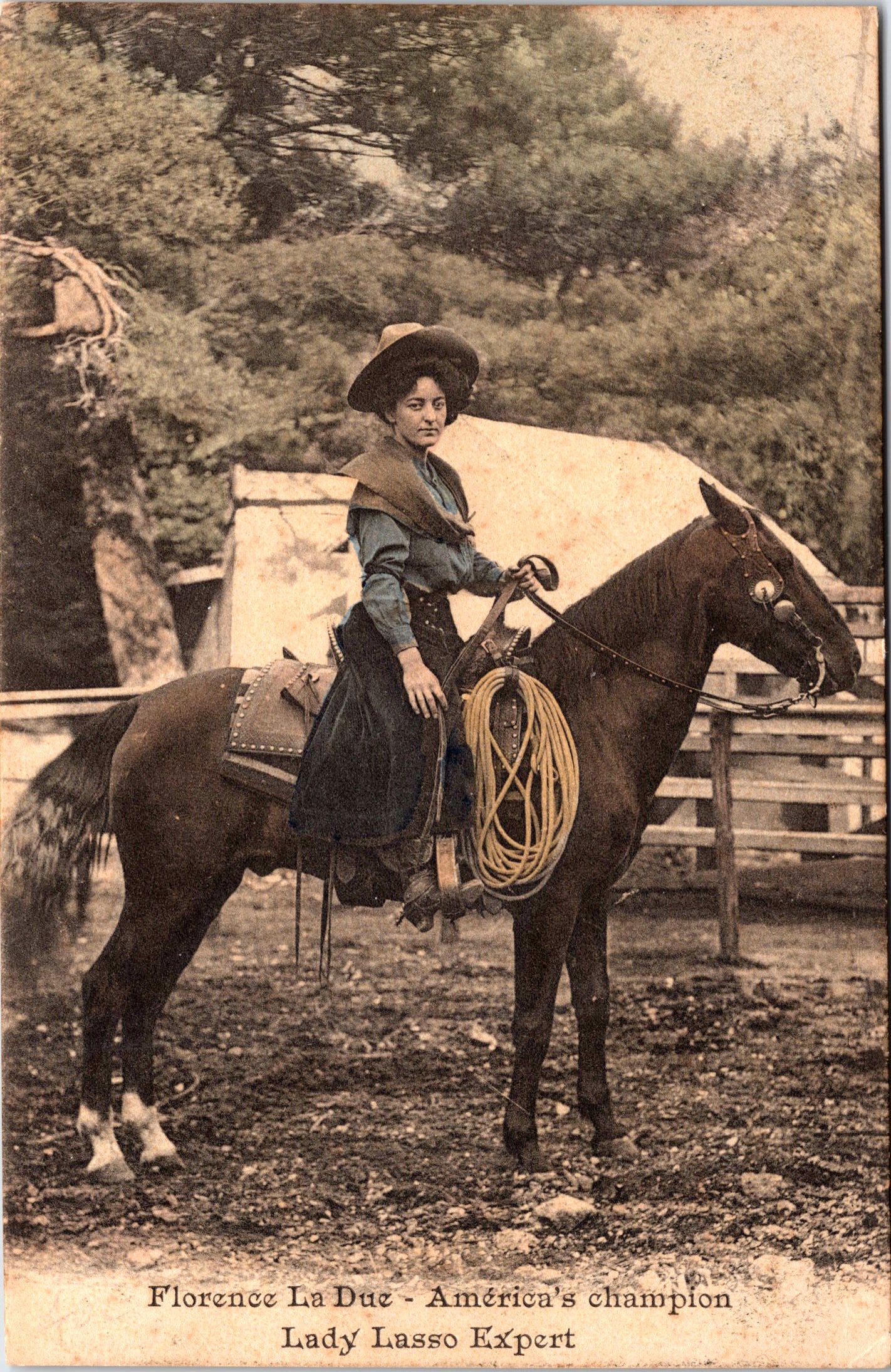
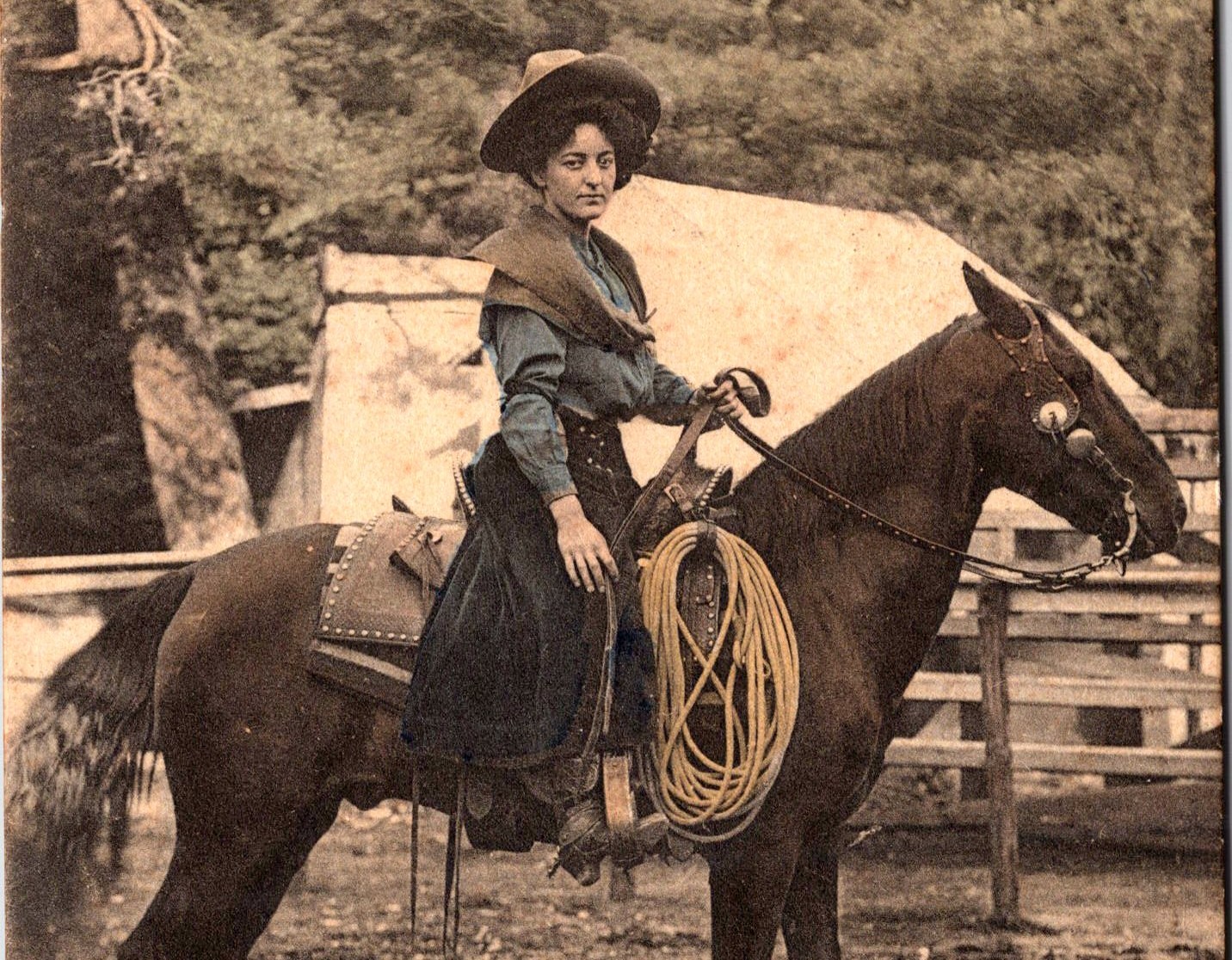
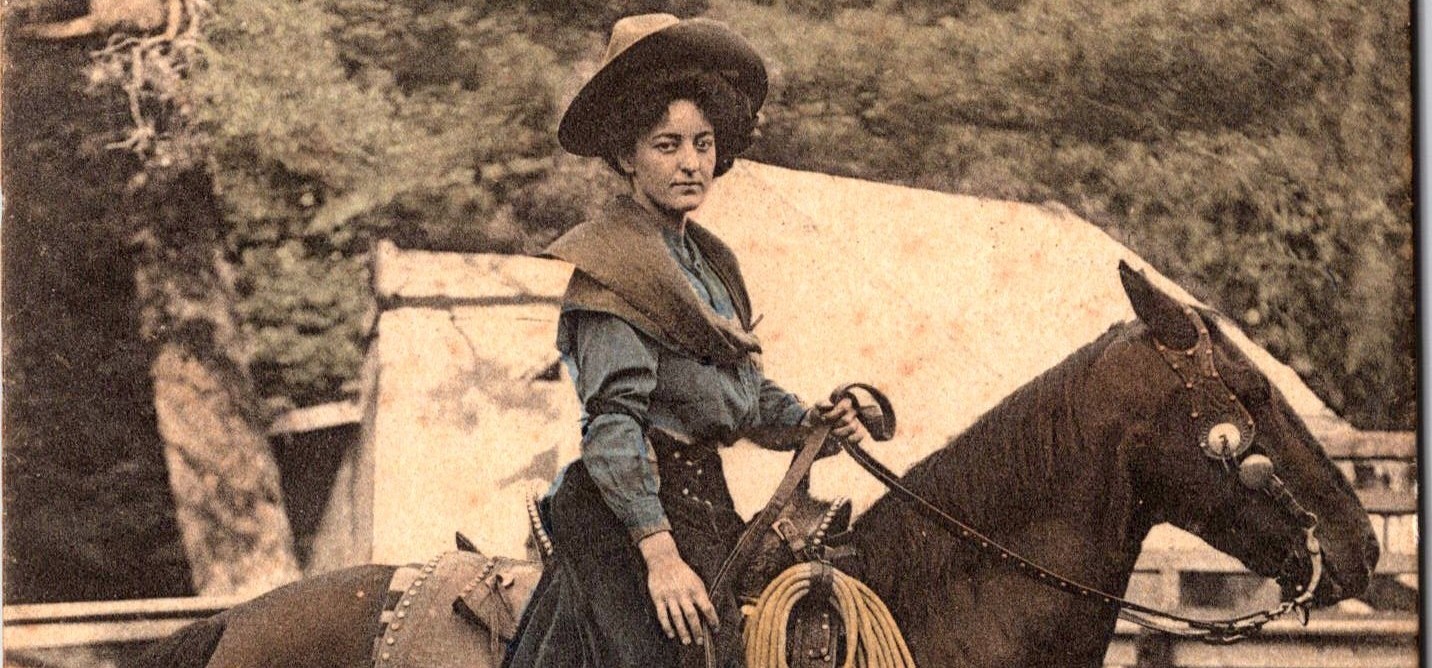
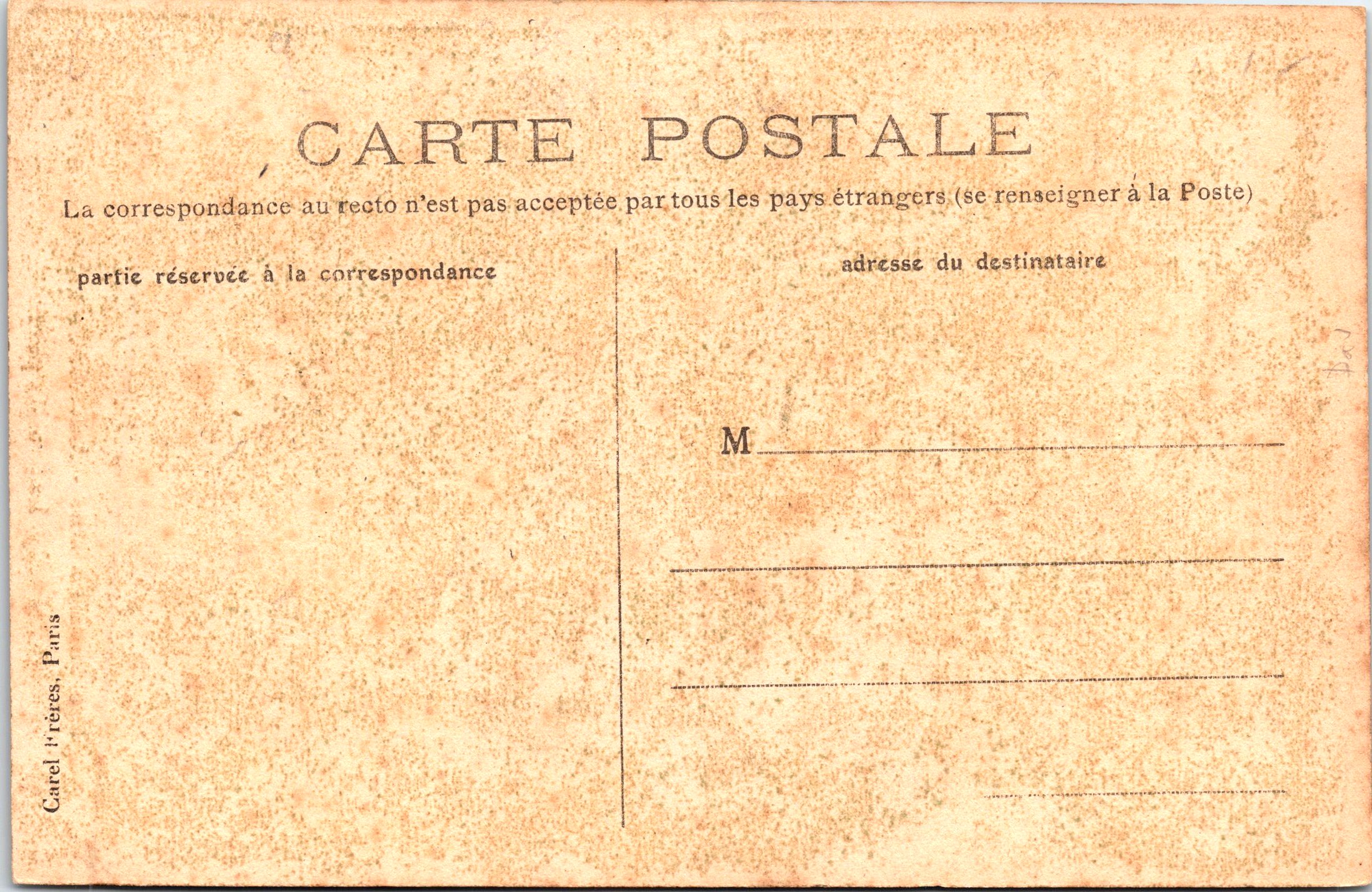
This striking early 20th-century French postcard features Florence Laduz, posed confidently on horseback in full working cowgirl attire—wide-brimmed hat, practical skirt, boots, and coiled lariat at the saddle. The image blends realism and performance: Laduz is presented not as a novelty but as a capable rider, projecting quiet authority and self-possession. Her direct gaze toward the camera reinforces that impression, making this a particularly compelling portrait of a woman in a traditionally male-dominated role. The photograph likely dates to the circa 1900–1910 period, a time when European fascination with the American West—and with female equestrians and performers—was at its height. In France especially, images of women riders were popular in postcards, circus publicity, and illustrated journals, often straddling the line between documentary portrait and performance persona. The postcard was published by Carpel Frères, Paris, a French publisher active in the early postcard era and known for producing high-quality photographic and semi-photographic cards, including portraits of performers, costumed figures, and theatrical or novelty subjects. Florence Laduz, better known on stage as Florence LaDue, was the professional name of Grace Maud Bensel (1883–1951), a celebrated vaudeville performer and internationally recognized champion trick roper. Born in Montevideo, Minnesota, she experienced an unconventional upbringing: her mother died when she was an infant, and she spent much of her childhood on a Sioux reservation, where her grandfather served as a government agent. These early years appear to have shaped both her independence and her remarkable horsemanship. As a young woman, Bensel left home—by some accounts running away to join a Wild West show—and adopted the stage name Florence LaDue. By 1905, she was performing with Cummins’s Wild West Show and Indian Congress, where she met fellow rider and roper Guy Weadick. The two married in 1906 and spent the next several years touring extensively across North America and Europe. LaDue enjoyed a distinguished career in vaudeville and Wild West exhibitions, appearing with major circuits including Keith-Albee, Orpheum, and Pantages, and performing internationally in London, Glasgow, and Paris—making the presence of her image on a French postcard especially fitting. She appeared both solo and with her husband, sometimes billed as Weadick and LaDue, and was equally at home in theatrical settings and competitive roping exhibitions. She also appeared on Broadway in the production Wyoming Days and later with Will Rogers’ Wild West Show. By 1912, LaDue and Weadick settled in Calgary, Alberta, where she played a foundational role in the creation of the Calgary Stampede. LaDue retired after a 31-year career as the undefeated World Champion Lady Fancy Roper, a title that underscored her status as one of the most accomplished female ropers of her era. In recognition of her legacy, Florence LaDue was inducted into the National Cowgirl Museum and Hall of Fame in 2001. Her contributions continue to be honored: in 2024, the Calgary Stampede announced that a major park approach would be named “Flores LaDue Parade,” commemorating her central role in the event’s early history. She died in 1951 in Phoenix, Arizona. (SOLD)


 THE CABINET CARD GALLERY
Leave a comment