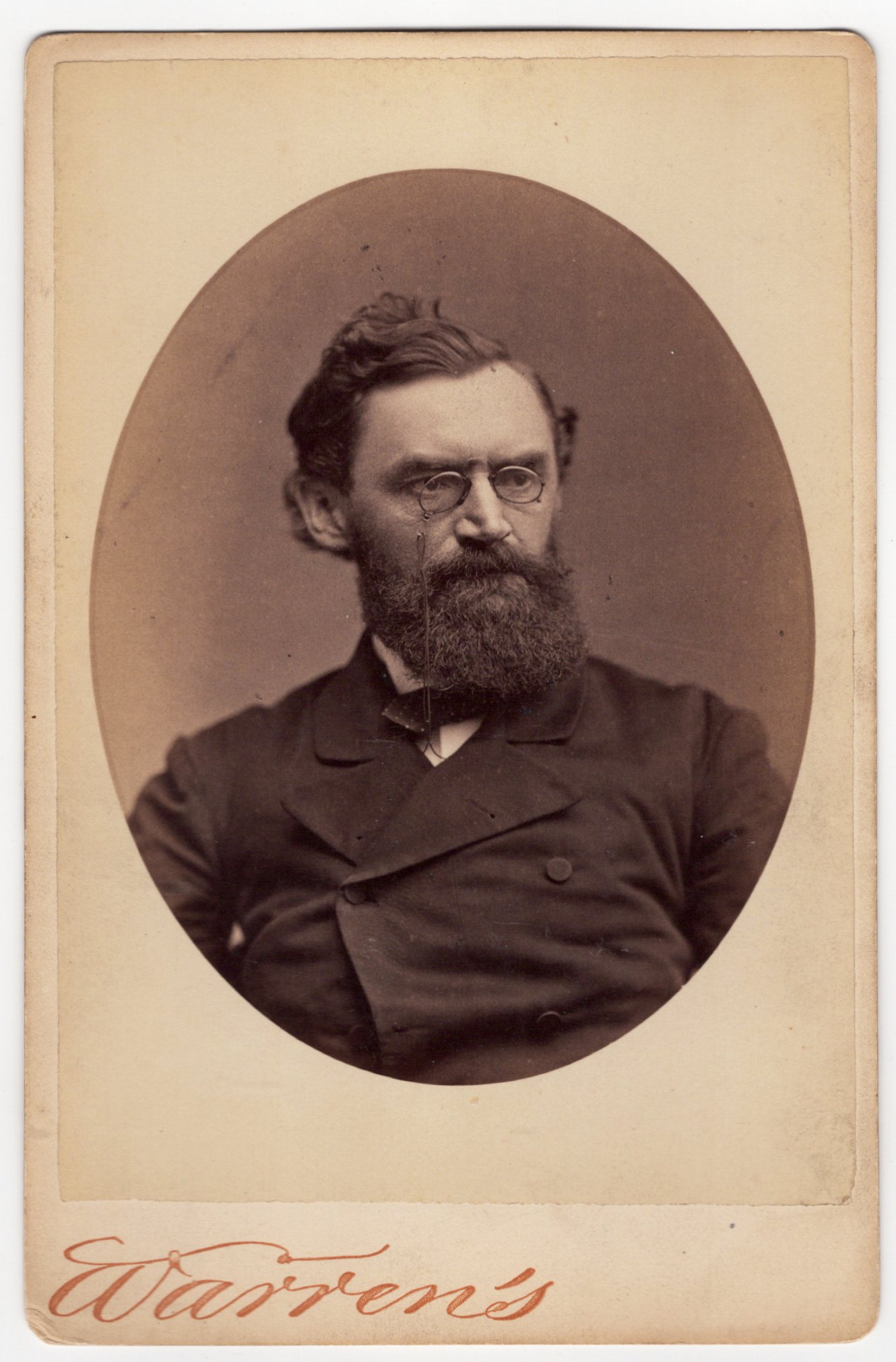
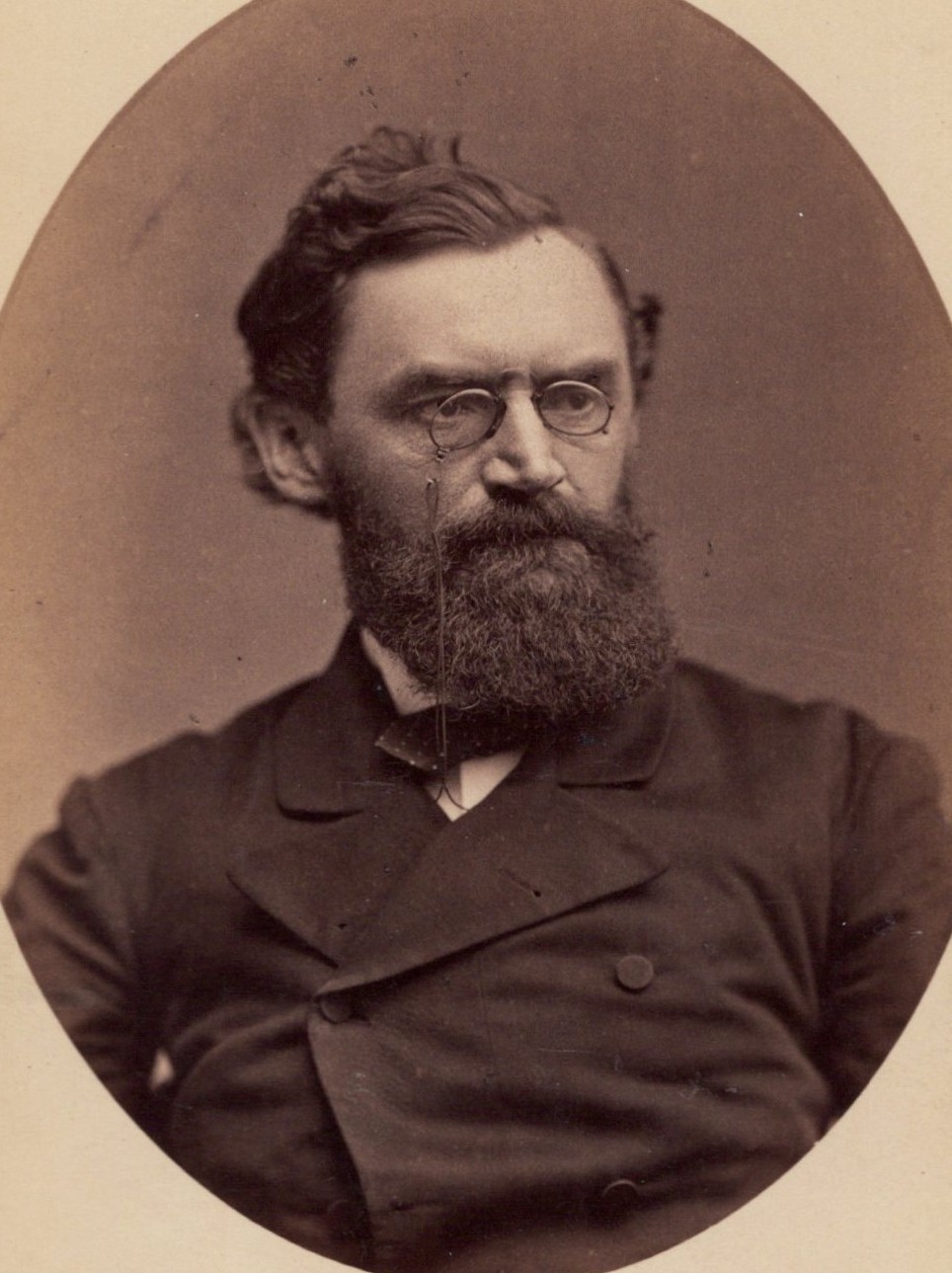
This striking 19th-century cabinet card features The Honorable Carl Schurz (1829-1906), a distinguished Civil War general, U.S. Senator, and reform-minded statesman. The photograph was taken at Warren’s Portraits, a prestigious Boston studio located at 465 Washington Street and renowned for its elegant images of notable figures during the late 1800s. In this formal portrait, Schurz is captured in a three-quarter view, seated in a dark, double-breasted coat with a subtle bow tie at his collar. His thick, well-kept beard and wavy hair give him a scholarly yet commanding presence. He gazes slightly to his left, a monocle suspended at his eye—projecting a look of intellectual rigor and seriousness. The background is a simple studio gradient, helping focus all attention on Schurz’s intense expression and refined appearance. On the reverse, the card is elegantly marked with the Warren’s Portraits logo. In pencil is written: “Hon. Carl Schurz,” affirming the identity of the sitter. Carl Schurz was born in Liblar, Prussia (modern-day Germany) in 1829. A revolutionary in his youth, he fought in the 1848 German uprisings, which ultimately failed, forcing him to flee Europe. He emigrated to the United States in 1852, where he quickly became involved in politics and the anti-slavery movement. During the American Civil War, Schurz was appointed brigadier general of Union volunteers by President Lincoln in 1862. He eventually rose to the rank of major general. Though courageous and respected, his battlefield performance received mixed reviews. He fought in key engagements including: the Second Battle of Bull Run (1862), the Battle of Chancellorsville (1863), and the Battle of Gettysburg (1863), where his XI Corps was flanked on the first day. While he was not a professional military man, Schurz’s service was notable for his efforts to advocate for German-American troops and his commitment to the Union cause. He did not have prior military experience in Europe before serving in the U.S. Army. After the war, Schurz enjoyed a long and prominent career in politics. He served as a U.S. Senator from Missouri (1869–1875) and later as Secretary of the Interior under President Rutherford B. Hayes (1877–1881). A staunch advocate of civil service reform and anti-corruption measures, he became one of the leading voices of the Liberal Republican movement. This cabinet card was produced by Warren’s Portraits, one of Boston’s most prominent photography studios in the 19th century. Operated by William Shaw Warren, the studio specialized in elegant, high-quality portraits and was especially known for photographing celebrities, politicians, military figures, and distinguished members of Boston society. Warren’s operated primarily during the 1860s through the 1890s. Warren’s images often feature clean studio backdrops, strong lighting, and detailed retouching, emphasizing refinement and dignity—qualities clearly present in this cabinet card of Carl Schurz. (SOLD)
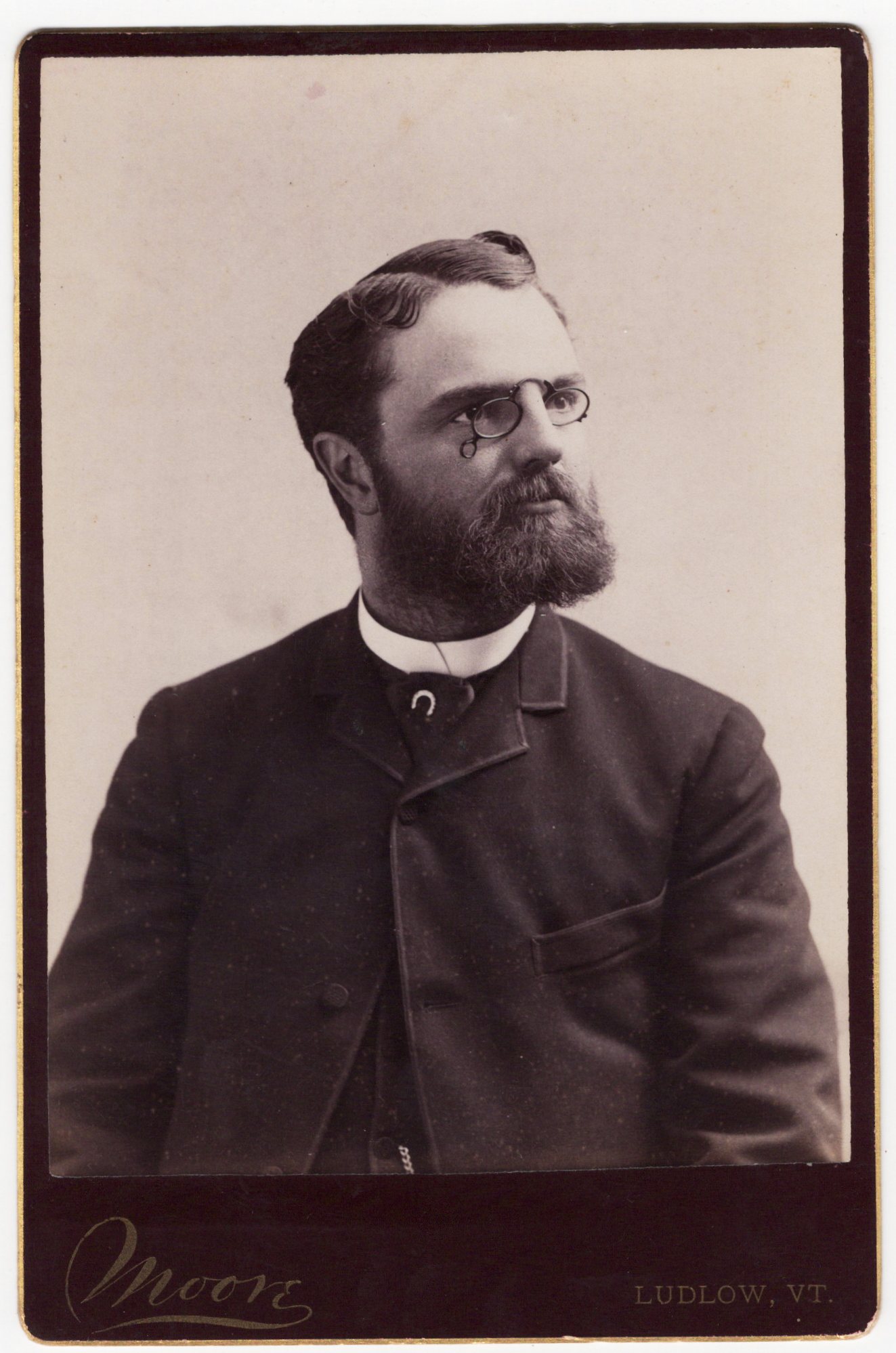
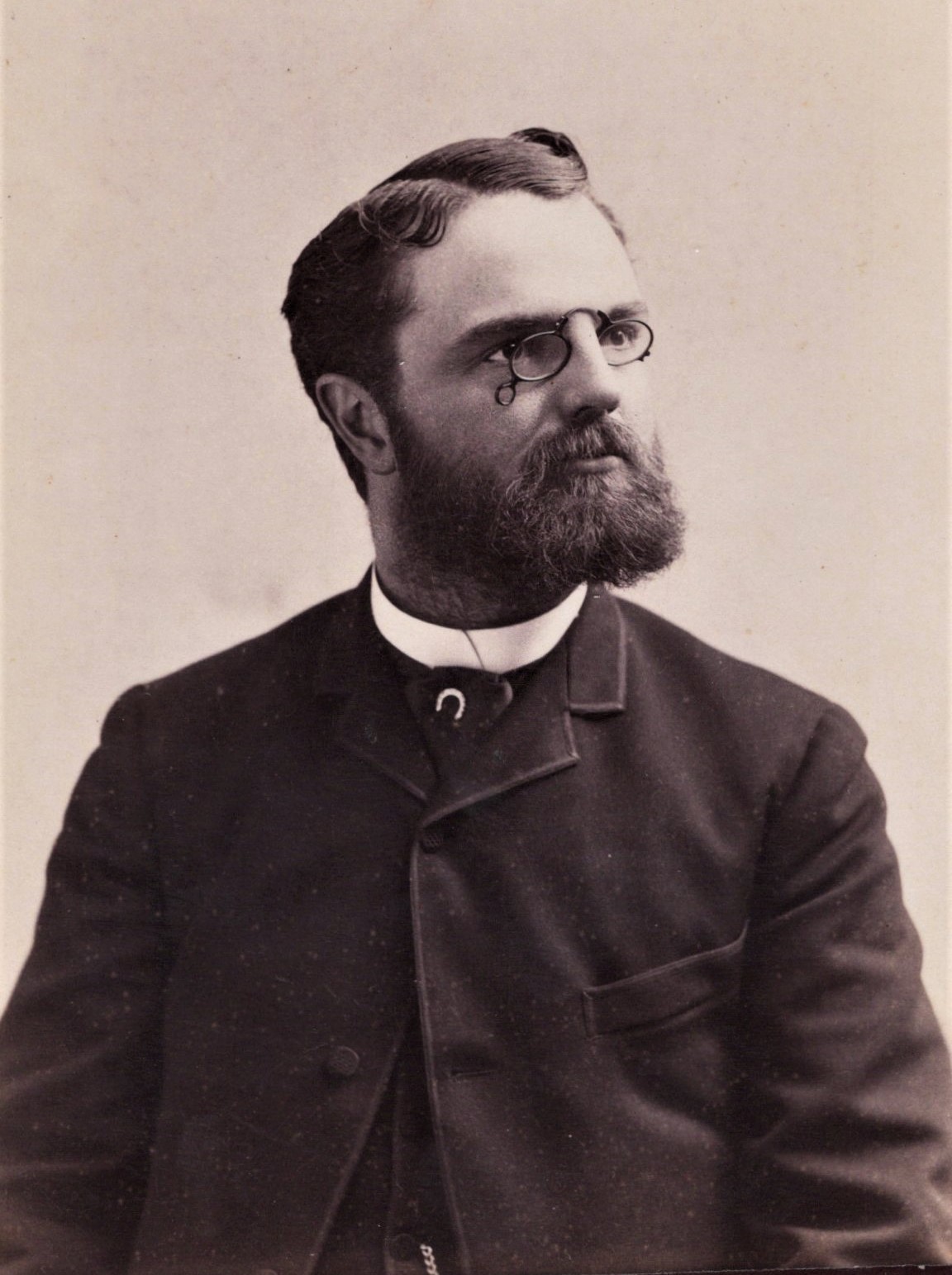
CLERGYMAN IN LUDLOW, VERMONT

Vermont. The man has an educated appearance emanating from his beard and pince-nez spectacles.Pince-nez are a style of spectacles that was popular in the nineteenth century. These glasses were not supported by ear pieces but instead, stayed on the wearer by pinching on the bridge of his or her nose. The clergyman is wearing a pin near his collar and part of the chain from his pocket watch is visible at the bottom of the image. The Photographic Journal of America (1890) mentions photographer, C. A. Moore of Ludlow, Vermont. He is likely the same Moore that created this image. (SOLD)
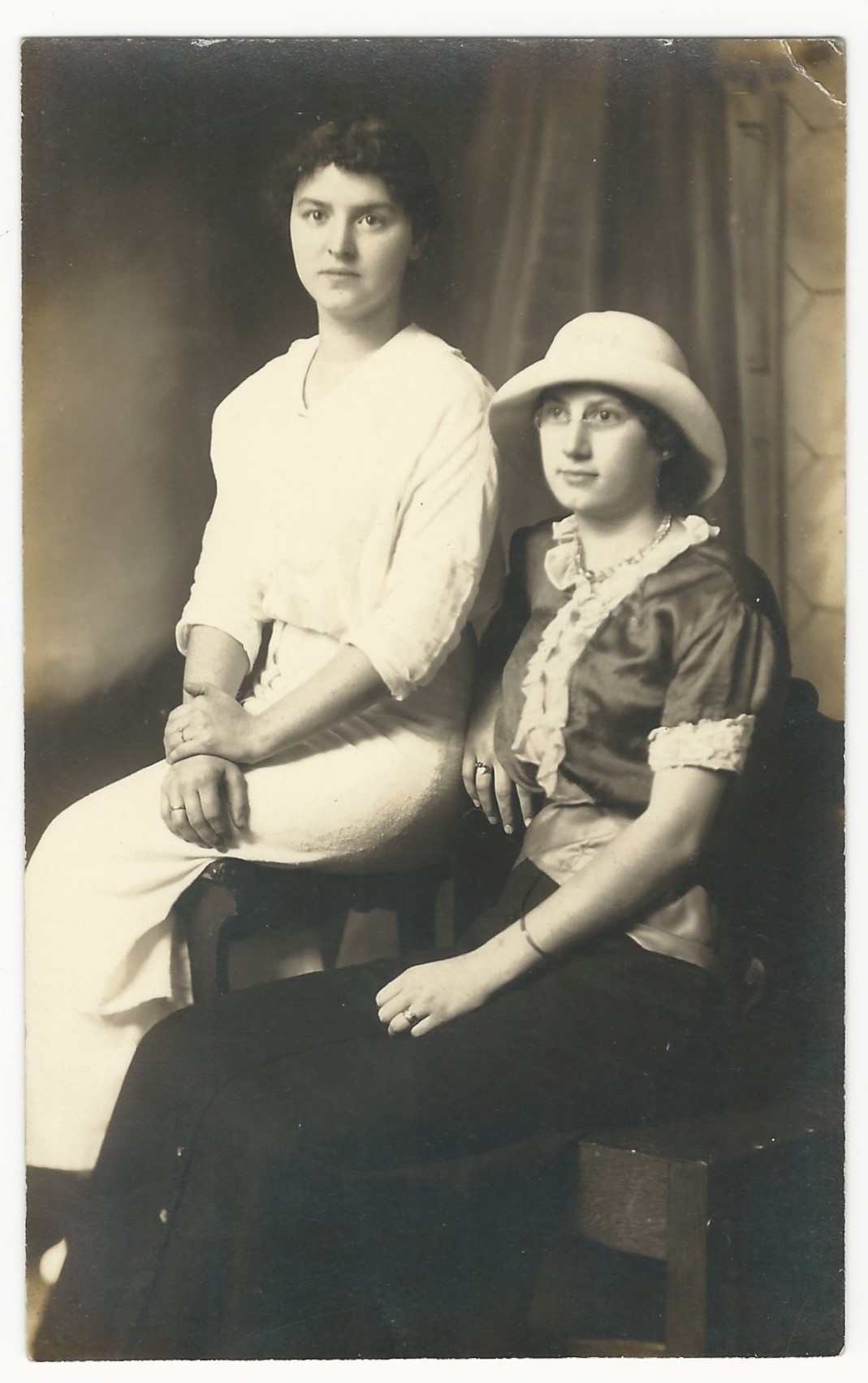
A PORTRAIT OF TWO NICELY DRESSED AND PRETTY YOUNG WOMEN (VINTAGE RPPC)

This vintage real photo postcard features two young women posing together for their portrait. Perhaps the pair are mother and daughter although I believe they may be sisters. The woman in the dark dress and hat is wearing a pince nez. Both woman are wearing at least two rings. The postcard, on AZO paper, was produced sometime between 1904 and 1918. SOLD

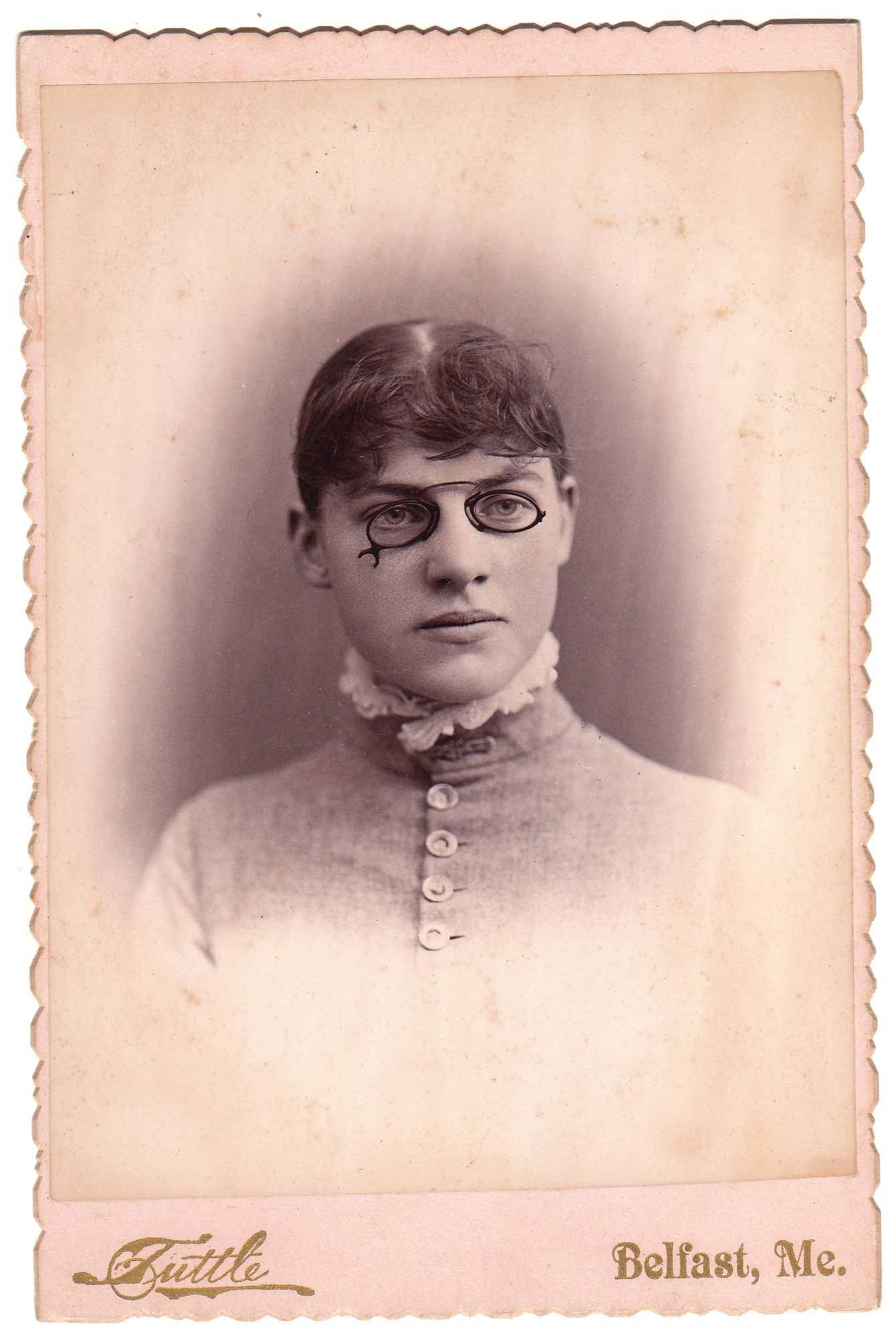
YOUNG WOMAN WEARING INTERESTING GLASSES IN BELFAST, MAINE
This cabinet card features a young woman wearing a pair of unusual eyeglasses. The spectacles are of the pince-nez var iety and what makes the glasses odd are the dark color and the thickness of the frames. This portrait was produced by the Tuttle Studio in Belfast, Maine. William C. Tuttle (1835-1901) was an early Belfast photographer. In addition to working as a photographer, he also wrote about the practice of the profession. Tuttle wrote an article in the journal Mosaics {1878} which was titled “Babies”. The article dispensed humorous tips on how to effectively photograph babies. A book by Joseph Williamson entitled “History of the City of Belfast” (1913) reveals that Tuttle’s studio burned down in a major fire occurring in Belfast in 1885. At one point in his career, Tuttle also had studios in other Maine towns including Winthrop, Castine, Kent’s Hill, and Northport. A classified listing in the Bulletin of Photography (1918) advertises that Tuttle’s Belfast studio was up for sale. The advertisement stated that one of its selling features was that there was “no competition” in Belfast. Tuttle had at least one son that entered his business so it is possible that this son may have been the photographer of this cabinet card. The 1870 Federal Census reveals that Tuttle was married to Georgia Tuttle, a woman who was 14 years his junior. At the time of the census, the couple had a seven month old son named Adrian. Research also discovered that Tuttle had enlisted in the Union army during the civil was. In 1861 he joined Maine’s 13th Infantry regiment as a musician. During the war he reached the rank of full Drum Major. Tuttle is buried in the Grove Cemetery in Belfast.
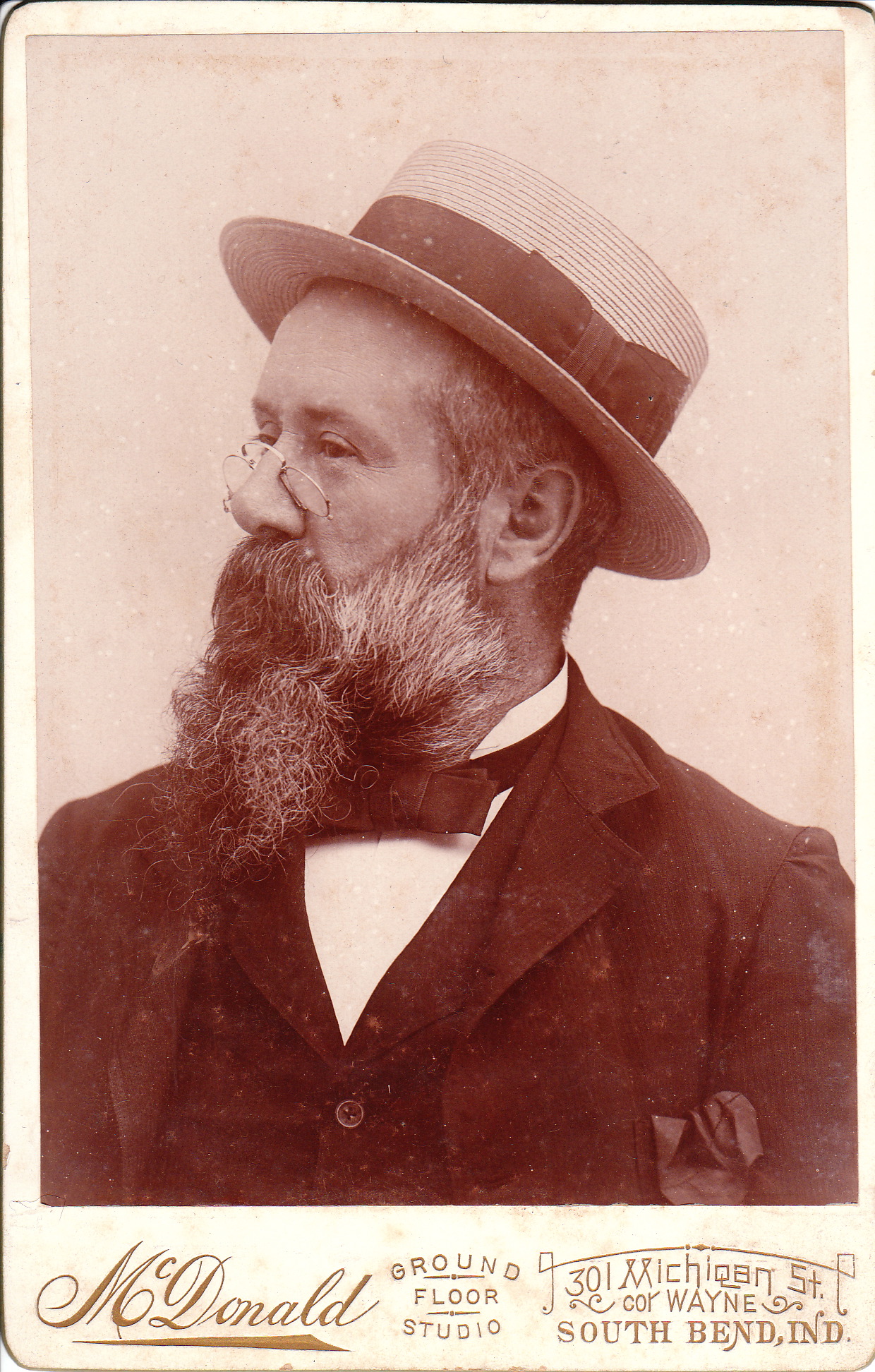
GENTLEMAN WITH PINCE NEZ EYEGLASSES IN SOUTH BEND, INDIANA
This cabinet card features a very interesting looking and nicely dressed gentleman. He is wearing a straw hat and pince nez glasses. He has the appearance of someone well educated. The subject of this portrait has a unique looking beard. To view other distinctive beards, click on the category “Beards (Only the Best). The photograph was produced by the McDonald Studio of South Bend, Indiana. The McDonald studio remains in business today. It is the oldest photography studio in the Michiana area. What is Michiana? Michiana is a region in northern Indiana and southwestern Michigan centered on the city of South Bend.. Albert J. McDonald founded the gallery in 1861. He operated the business for 41 years and was succeeded by his son. The Bulletin of Photography (1917) printed McDonald’s obituary. The article reports that he was born in Rochester, New York in 1841. His family moved to South Bend when he was nine years of age.
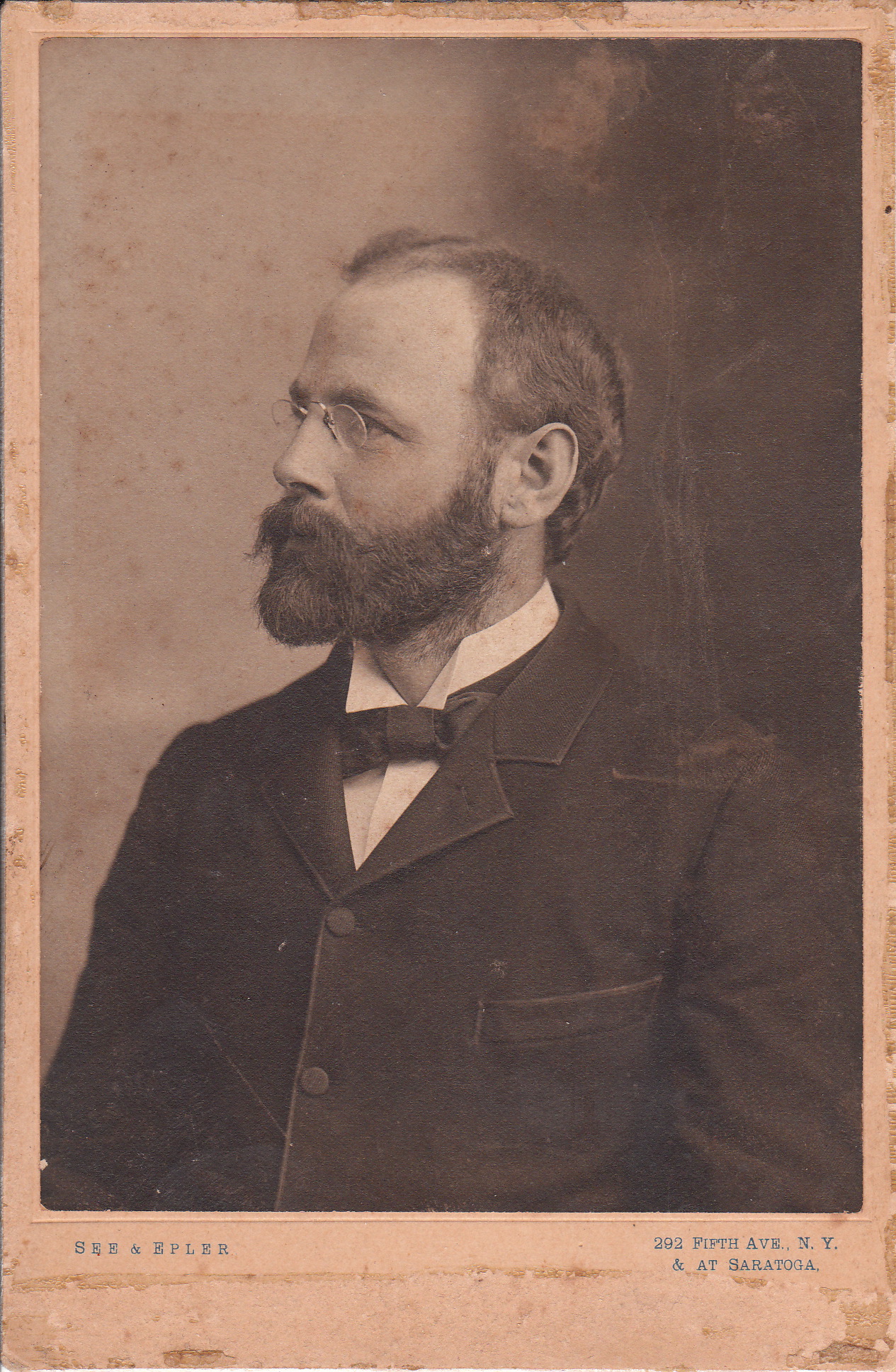
A STUDIOUS LOOKING MAN WEARING PINCE-NEZ SPECTACLES IN NEW YORK CITY, NEW YORK
The gentleman pictured in this cabinet card has the appearance of a scholarly man. The man’s pince nez eyeglasses, and his beard contribute to his studious look. Pince-nez glasses are a style of spectacle that is supported without earpieces, by pinching the bridge of the wearer’s nose. The name has French origin and this type of eyewear reached peak popularity between 1880 and 1900. The photographer of this cabinet card is H. T. See & H. (I. or J.) Epler. The middle initial of Epler is unclear in the reference where it was found. An advertisement for the See & Epler studio appeared in the Columbia Spectator (1899). The advertisement stated the studio was the “Photographer to Columbia University” and that the firm offered special rates to students. The studio was located in New York City and Saratoga, New York.