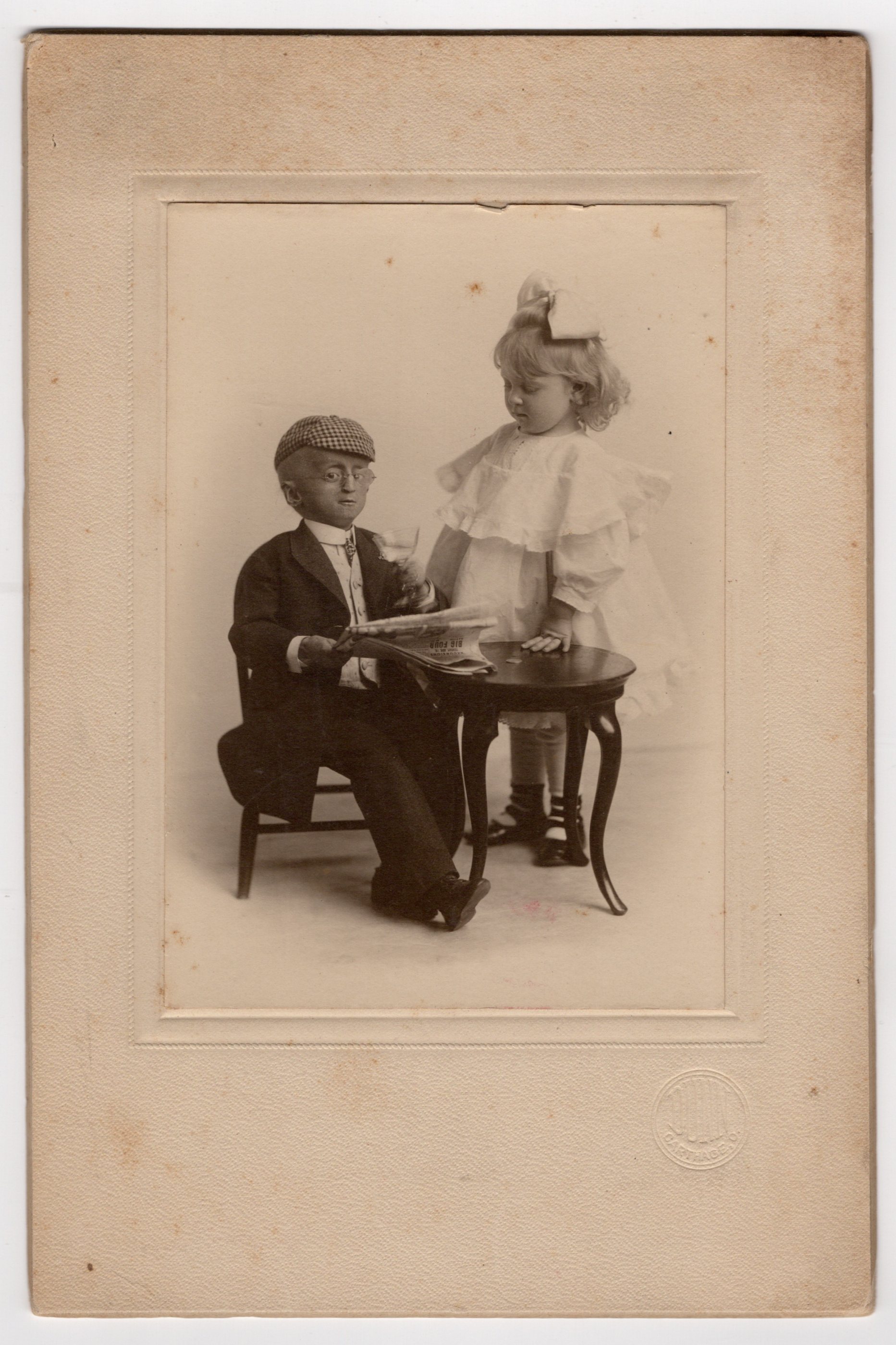
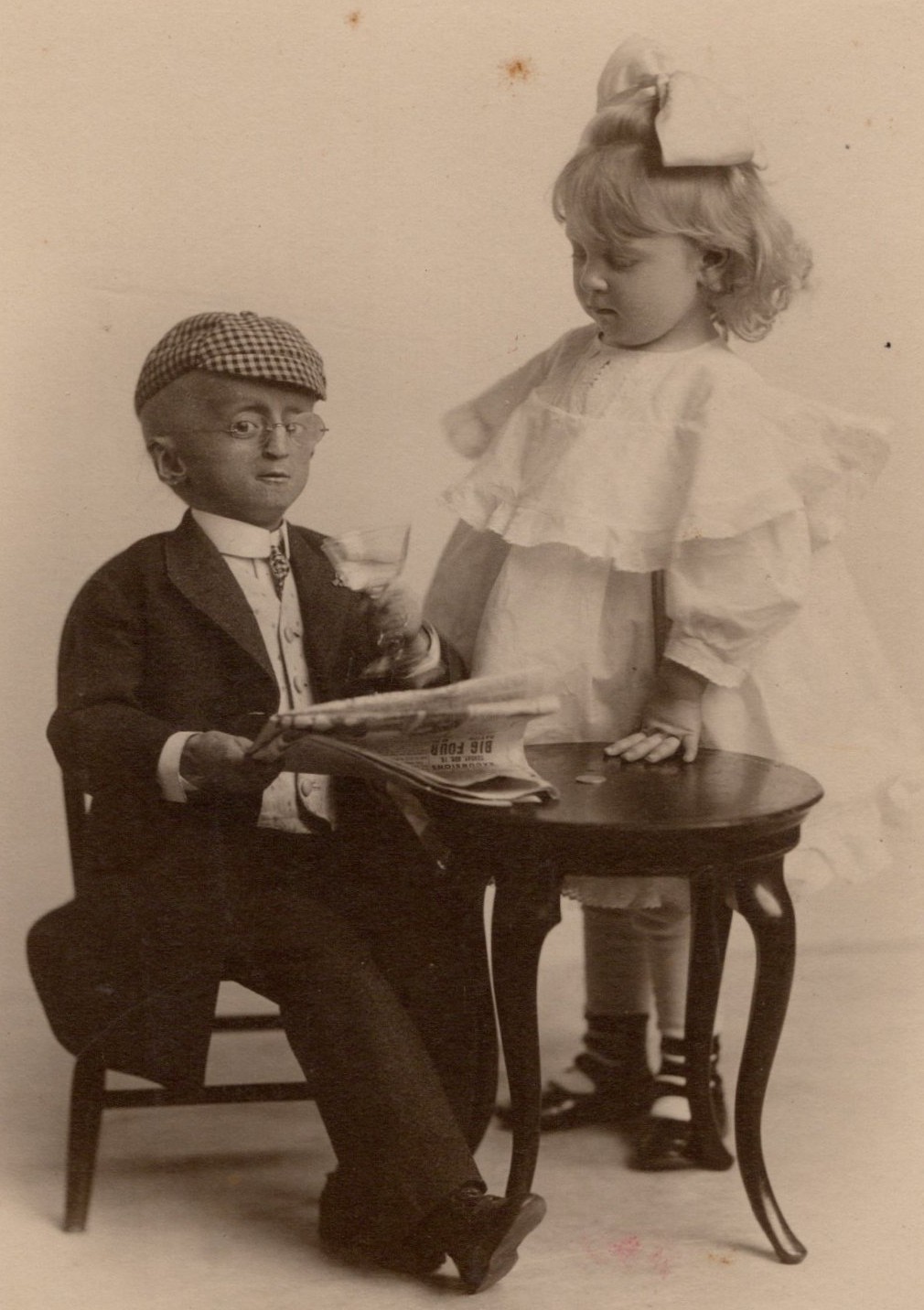
This vintage cabinet card features a formal indoor studio portrait of a well-dressed man seated at a table with a young woman beside him. The photograph, likely taken in the 1890s or early 1900s, comes from the Dunn studio in Carthage, Ohio, a historically independent village that was later annexed into Cincinnati. The man in the photo appears to be in his late middle years. He wears a smart three-piece suit, an unusual flat-topped cap, and wire-rim glasses. He is captured holding a stemmed glass—possibly filled with wine or another beverage—in one hand, while his other hand rests on a folded newspaper. The expression on his face is dignified and contemplative. Standing beside him is a young female, dressed in a formal white or light-colored dress with puffed sleeves and a ribbon at the waist. Her hairstyle and attire match fashion trends of the late Victorian or early Edwardian period. Her smaller physical stature raises the question: is she a child, or is she an adult woman with dwarfism (historically referred to by the now-outdated term “midget”)? Her mature facial features and posture lean toward the latter possibility, though this cannot be confirmed with certainty. The back of the card has handwritten ink notations that appear to read: “Ruth, midget, Carthage O.” This further supports the interpretation that the subject may be an adult woman of short stature. The photographer’s stamp can be seen in the lower right corner of the front of the card. SOLD
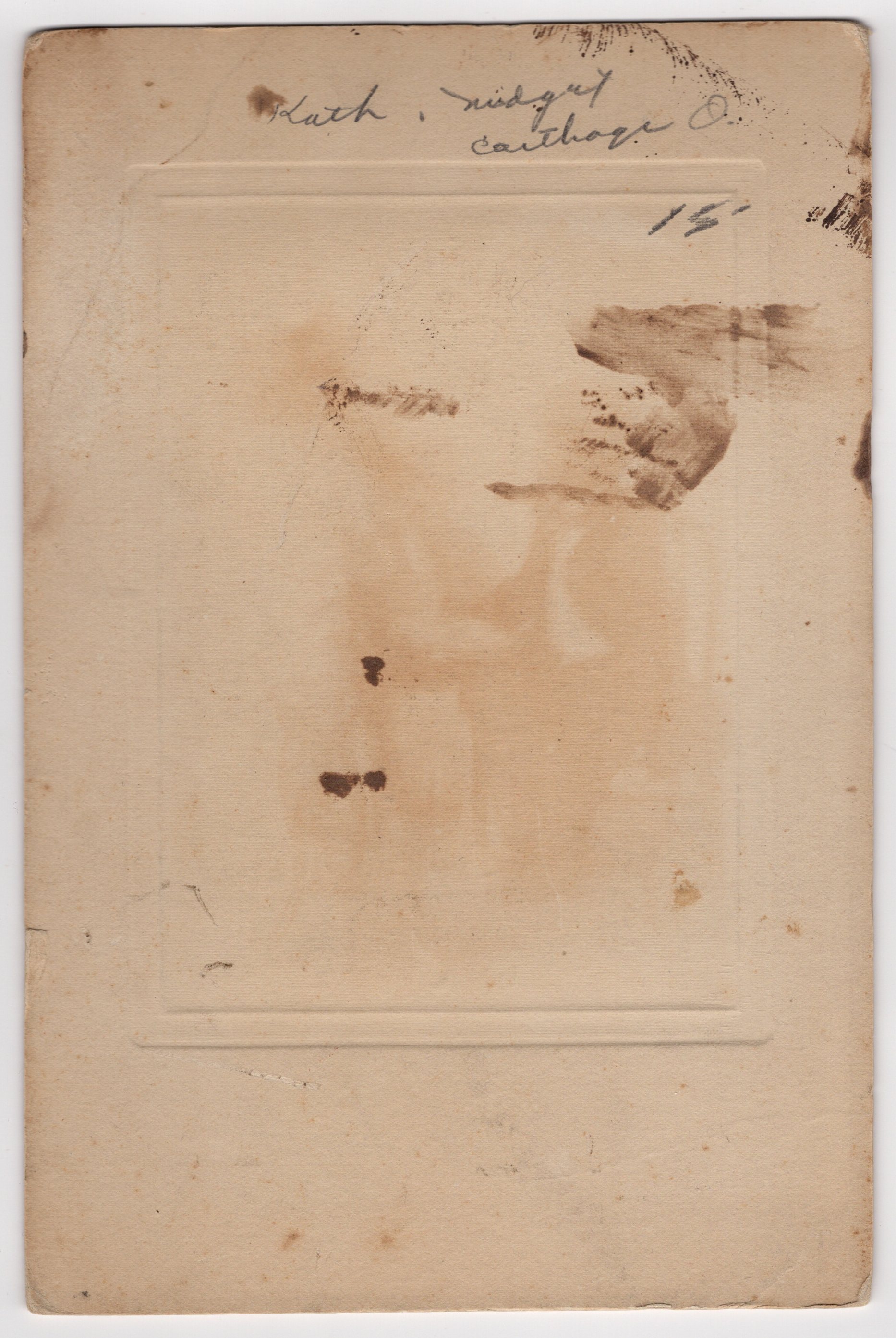
PHOTO OF YOUNG WOMAN : BLACK PHOTOGRAPHER : DAVID BECKFORD : BOSTON : CABINET CARD
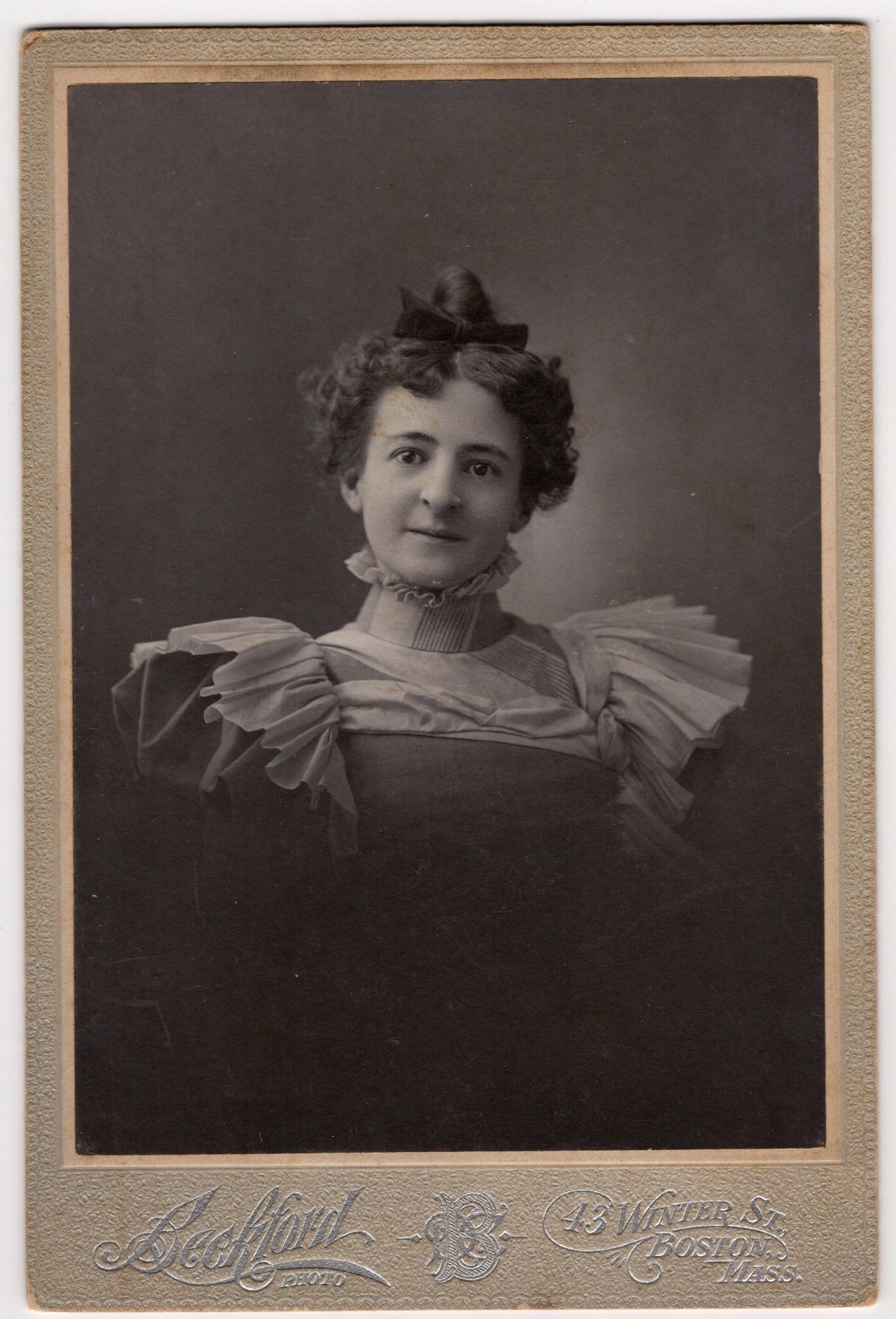
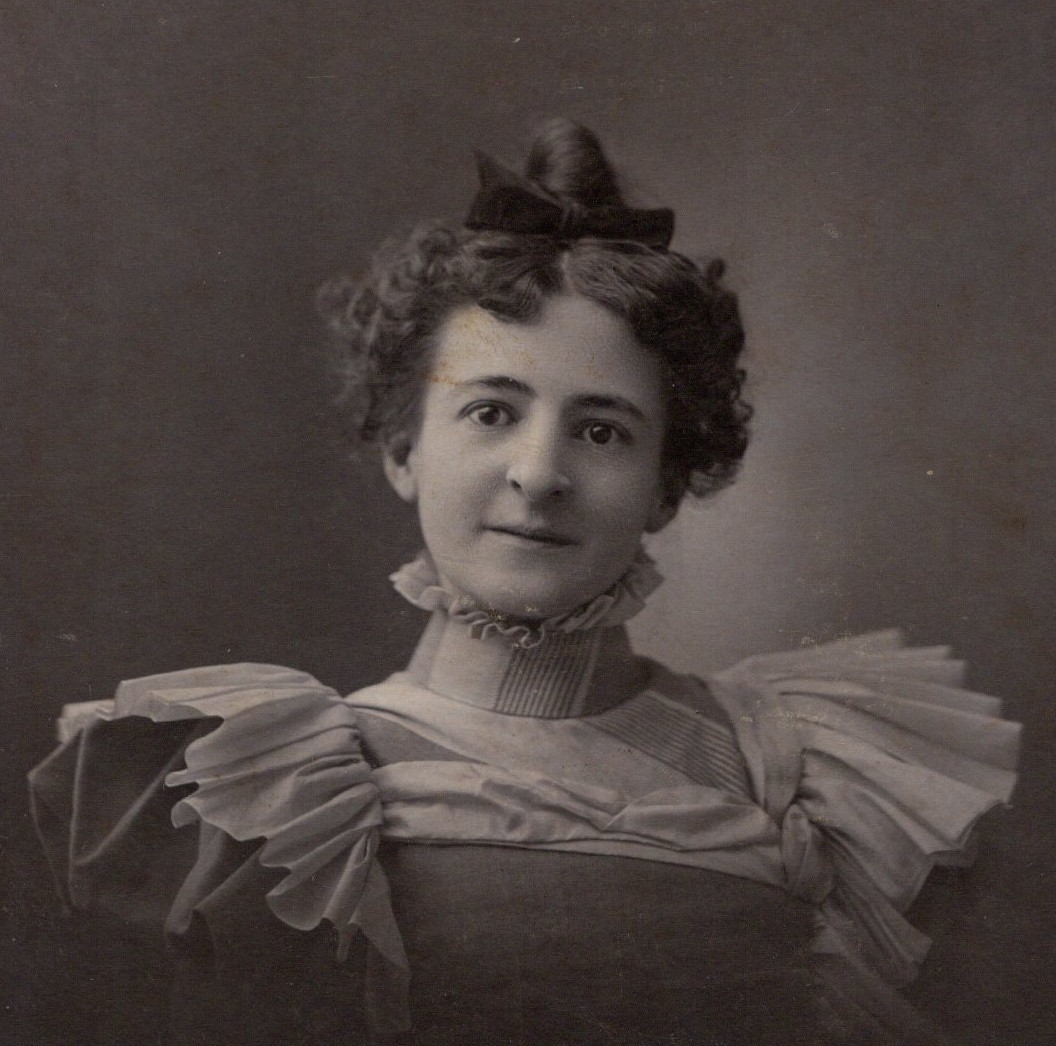
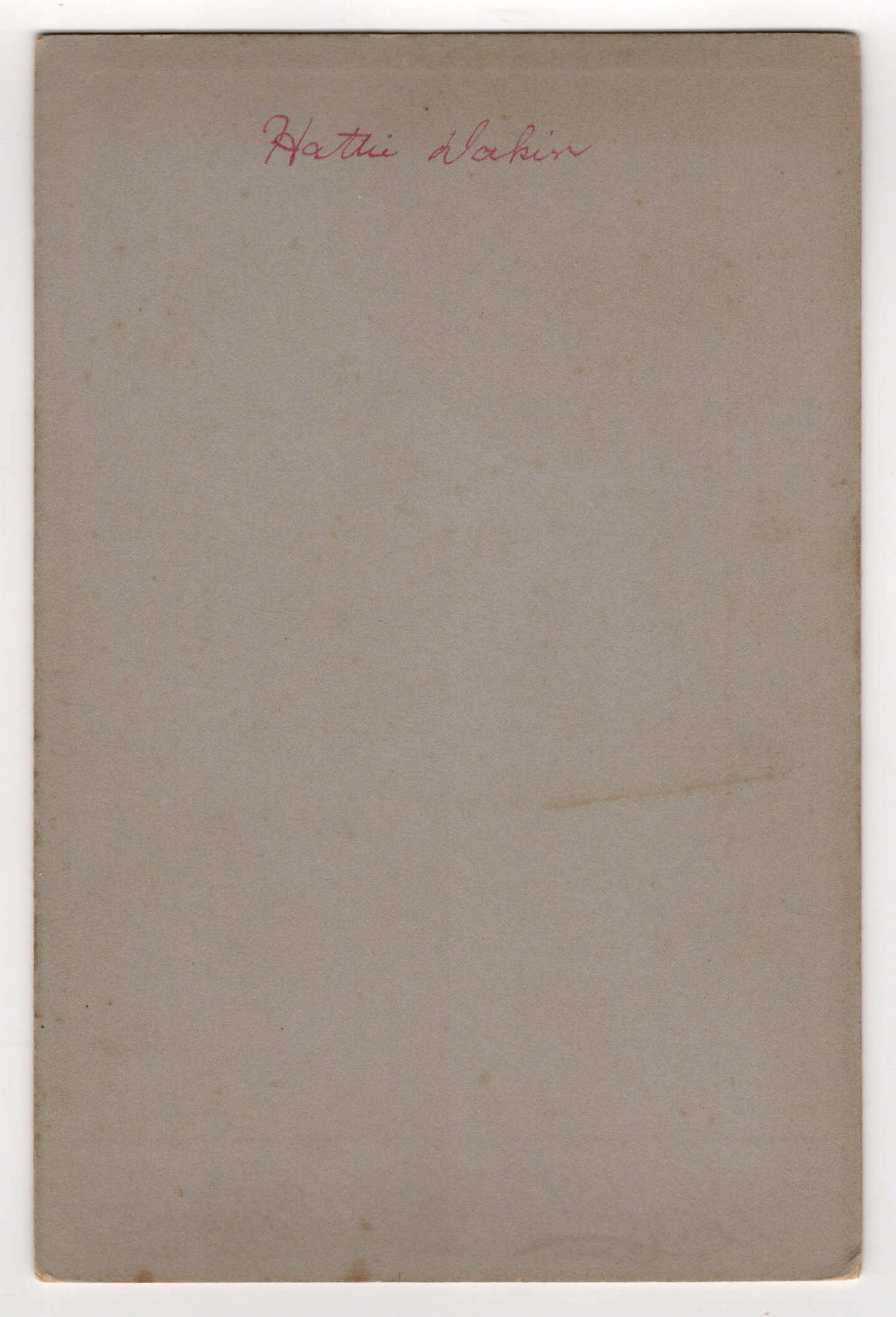
This original 1899 cabinet card photograph features a charming and elegant young woman identified on the reverse as Hattie Dakin. Her portrait is beautifully posed and lit, capturing her in a high-necked gown typical of the late Victorian period—with puffed gigot sleeves, delicate pleats, and a structured bodice. Her hair is styled in curls, pulled up with a ribbon bow, and her expression is serene, with just a hint of a smile. The reverse inscription provides her name. This cabinet card was discovered as part of a larger group of similar photographs, all featuring young women, each dated and named—supporting the theory that these were likely taken to commemorate a school graduation in 1899. What makes this particular image especially significant is the identity of the photographer: David C. Beckford, an African American photographer whose studio—Beckford Photo, 43 Winter Street, Boston, Massachusetts—was among the leading photography establishments of its time. David C. Beckford was a native of Jamaica, born in 1856, and immigrated to the United States in 1872. He originally worked for Walter E. Chickering (a disreputable businessman), and eventually took over the business in 1888, renaming it under his own name. His studio employed four assistants and was highly respected. Beckford operated his photography studio until at least 1909, while also managing a hardware business in Jamaica, which he rebuilt after a devastating earthquake. Beckford’s status as a Black photographer in turn-of-the-century Boston is noteworthy. He received recognition in the book “Boston: Its Commerce, Finance, and Literature,” and is also referenced in a 1909 article in The Southern Workman, confirming both his heritage and his professional stature. His life reflects the resilience and entrepreneurship of a man who overcame barriers of race and geography to establish himself as a photographic artist and businessman. Photographs by African American photographers from the 19th century are uncommon. (SOLD)
PORTRAIT OF A WOMAN ART CRITIC IN PHOENIX, ARIZONA TERRITORY
The woman in this photograph does not want to compete with the sculpture alongside her so she adeptly covered the top of the piece with her hand. Perhaps its not the competition she feared but instead she wanted to protect the viewers of her portrait from seeing the “bad art” beside her. Most likely the real reason why she’s holding the statue is that she didn’t know what else to do with her hand. This is where the photographer is supposed to play a role by posing his subject. However, Mr Hartwell seems to have been asleep at the camera and didn’t notice the posing faux pas. Mr Hartwell operated his studio in Phoenix, Arizona. The city of Phoenix was no booming metropolis. It’s population in 1880 was only 2,453. At the time of this photograph, Arizona was a US territory and would not become a state until 1912. The subject of this portrait is unidentified. She is dressed well and is wearing a wide bracelet. Her nice figure is likely accentuated by a corset. The photographer of this cabinet card, Frank A. Hartwell, became a US citizen in 1882 while living in Arizona. He formerly was a citizen of England. He is listed in the Phoenix City Directory (1903) as a photographer. He placed an advertisement for his studio in The Native American (1908). The Pacific Coast Photographer (1894) includes a human interest story pertaining to Mr. Hartwell. The article reports that upon the birth of his daughter, Hartwell, thinking like the creative photographer that he was, decided to formulate a list of all the baby girls born on the same day as his daughter and gather them all together for a group photograph. Due to the absence of today’s HIPA’s privacy laws, his research produced a list of six baby girls. I do not know if Hartwell ever photographed these six infants, but I certainly would love to have that photograph, if it exists, to exhibit in the Cabinet Card Gallery. SOLD
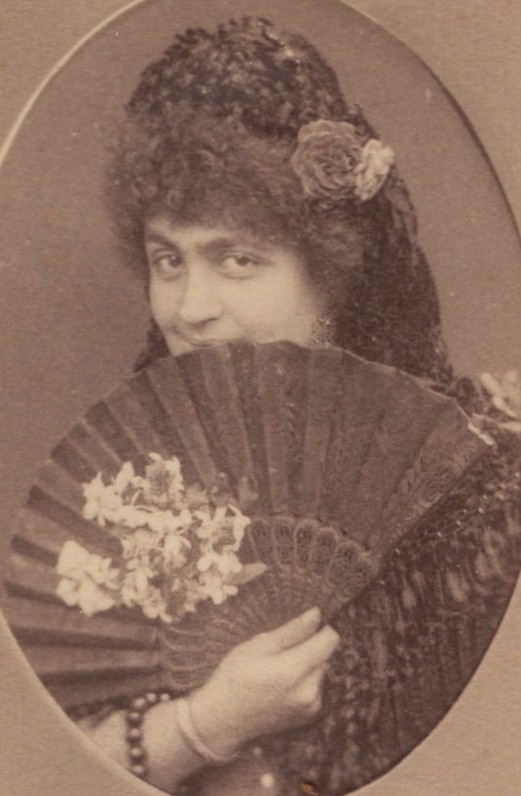
MYSTERIOUS VICTORIAN BEAUTY WITH LACE & FAN : 19th CENTURY ELEGANCE : CDV
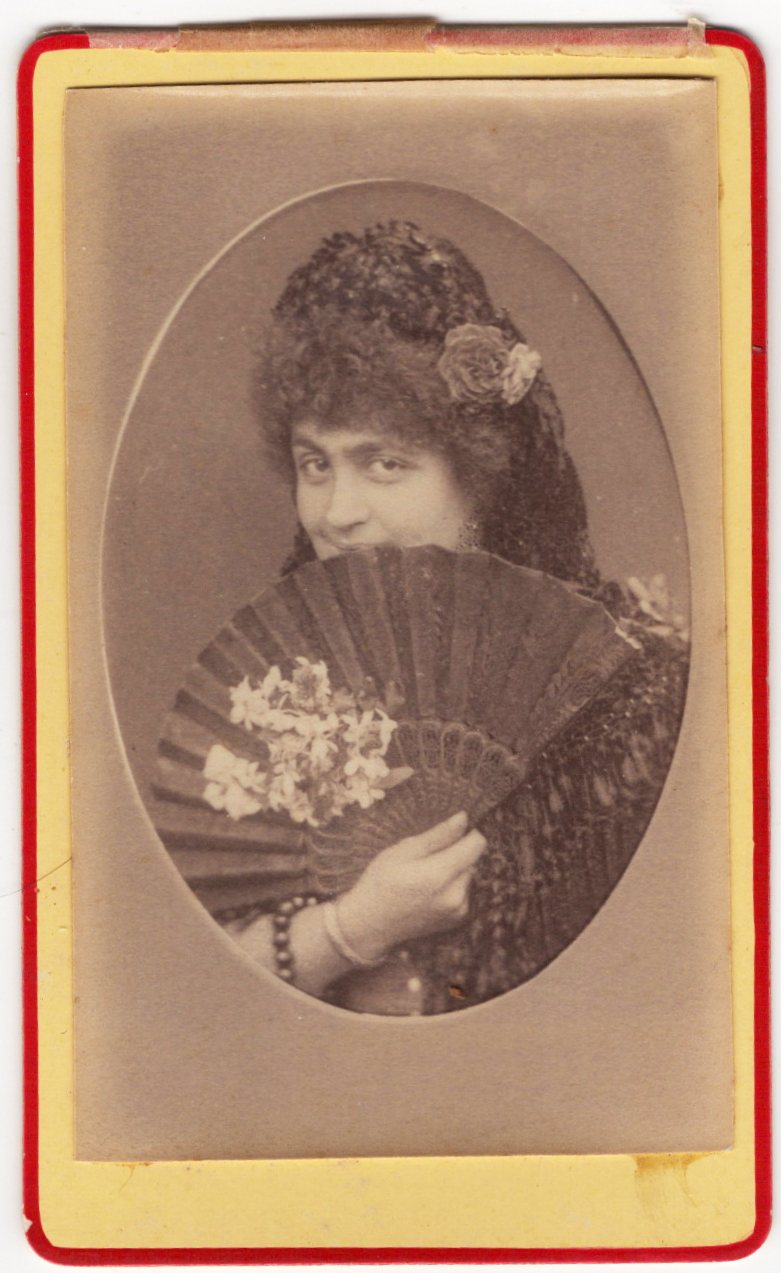
This carte de visite presents an elegant and mysterious woman from the late 19th century, captured in a striking, staged portrait. She gazes directly at the camera with an enigmatic expression, her dark eyes hinting at amusement or perhaps secrecy. Her face is partially obscured by a beautifully detailed folding fan, adorned with delicate flowers, which she holds just below her nose, adding an air of flirtation and intrigue. The fan’s design suggests an appreciation for fine accessories, possibly hinting at a woman of refined taste or theatrical flair. Her hair is voluminous and curly, styled in a way that suggests fashion-forward sensibilities for the time. A decorative flower adorns her locks, further enhancing her romantic and dramatic appearance. She is dressed in a richly textured, dark garment, possibly velvet or lace, with intricate embellishments. A beaded bracelet encircles her wrist, another indication of elegance. This portrait seems to capture not just an image but a persona—perhaps that of an actress, performer, or a woman who enjoyed playing with identity and allure. Her playful concealment behind the fan suggests confidence, charm, and perhaps a bit of mischief. SOLD
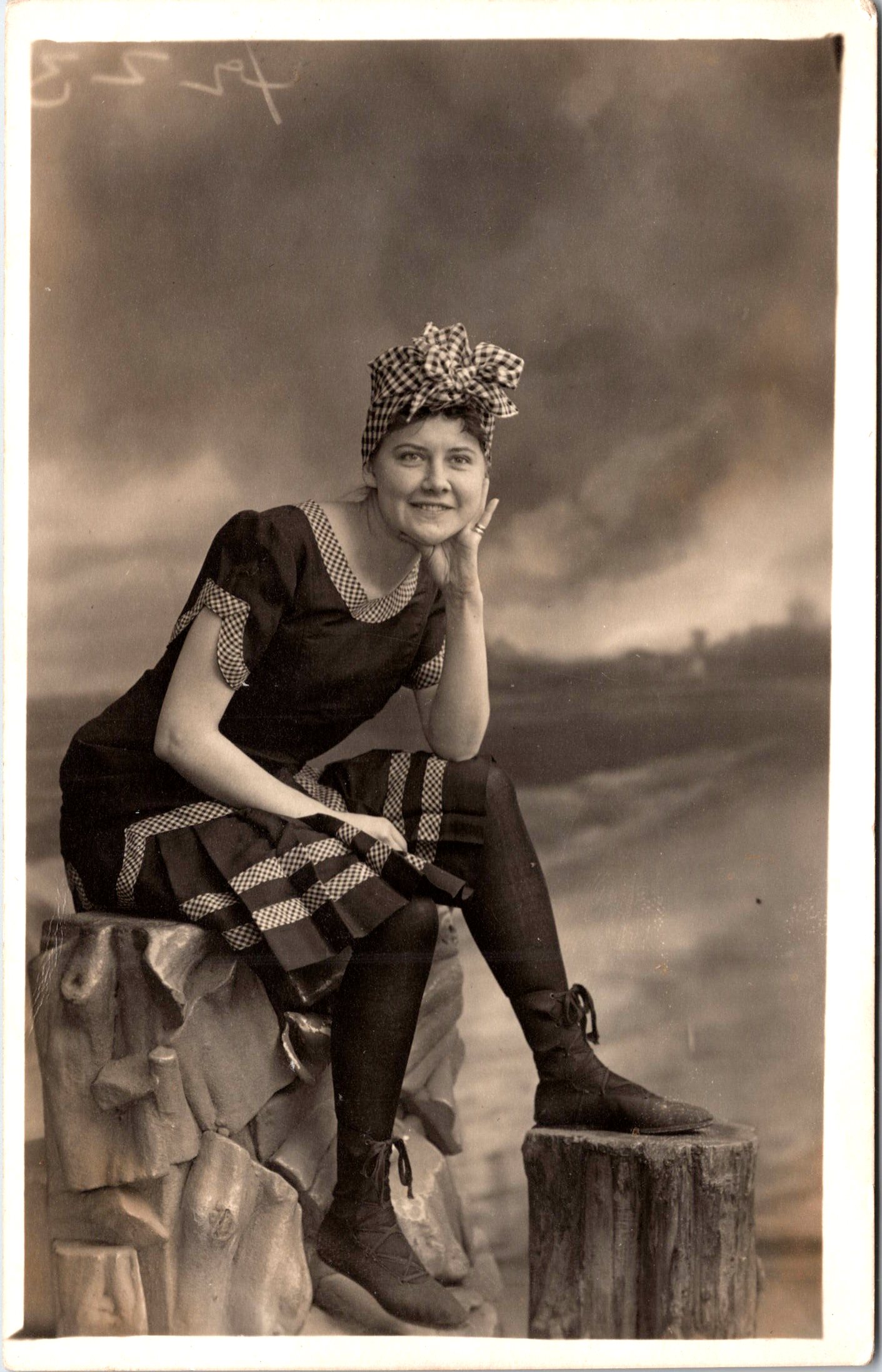
BATHING BEAUTY : PALACE STUDIOS : ATLANTIC CITY : CYKO : RPPC 1920’s
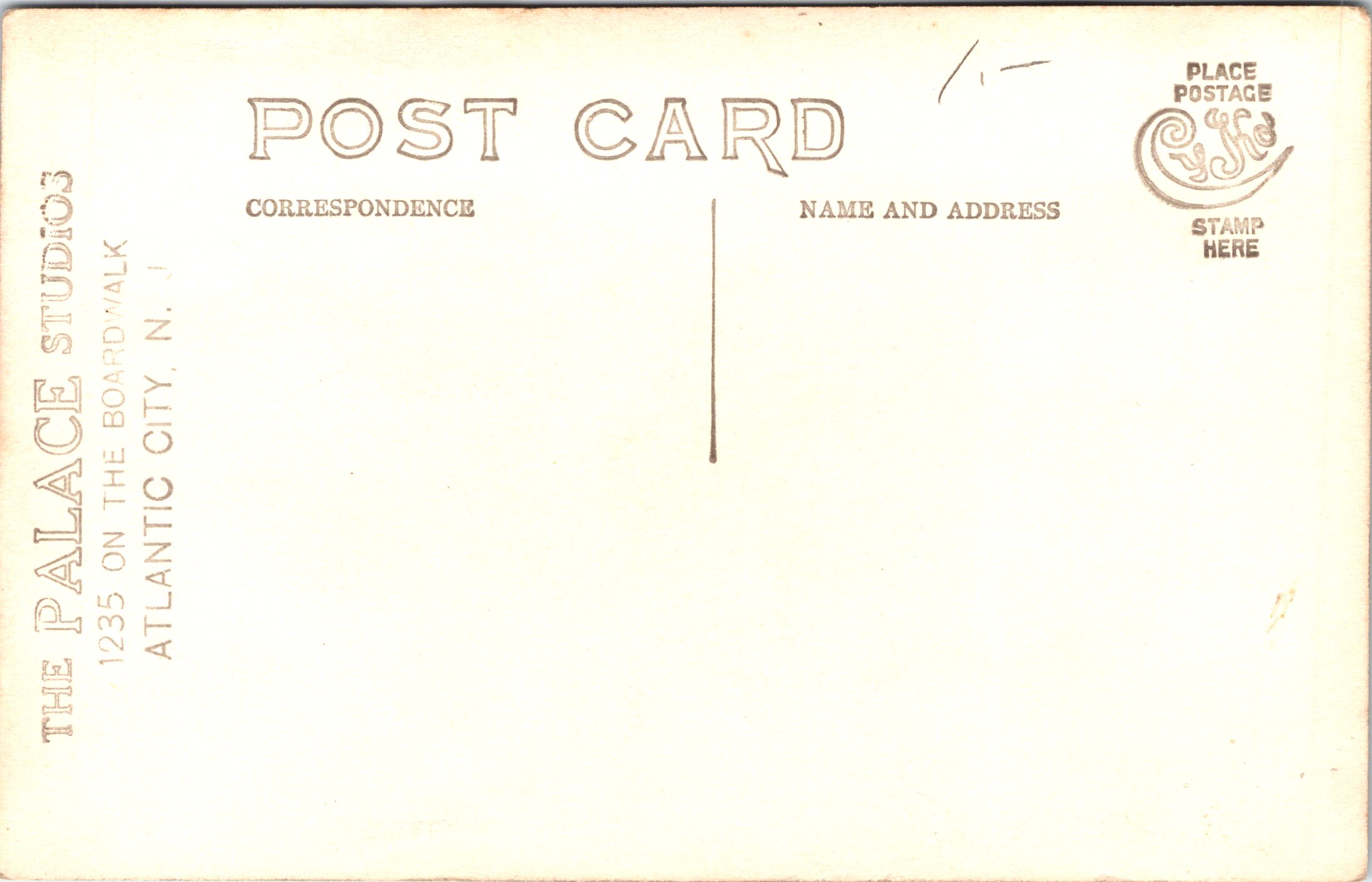
This delightful real photo postcard features a cheerful young woman seated on a faux rock formation, wearing a charming bathing costume and matching head wrap. Her outfit is a stylish two-piece ensemble made of dark fabric with bold, checked gingham trim on the collar, sleeves, and skirt hem—a classic look from the 1910s to early 1920s. Her lace-up bathing boots and the studio backdrop, which imitates a beach setting, reinforce the seaside theme. The woman’s expression is warm and welcoming; she smiles gently at the camera, her chin resting lightly on her hand in a relaxed pose. There is an engaging sense of playfulness and personality in the portrait—characteristics that make it especially appealing to collectors of early 20th-century beach imagery and character photography. This postcard was produced by The Palace Studios, located at 1235 on the Boardwalk, Atlantic City, New Jersey, a popular tourist destination in the early 20th century. Palace Studios specialized in novelty and souvenir portrait photography for beachgoers, offering whimsical props and painted backdrops that gave visitors an idealized memento of their seaside vacation. The reverse of the postcard features a CYKO stamp box, a format used by the CYKO photographic paper brand, which helps to date this postcard to the 1910s–early 1920s. The card has a divided back, which also aligns with that time frame. SOLD

BEAUTIFUL WOMAN IN A PRETTY WHITE DRESS (VINTAGE PHOTOGRAPH)
This vintage photograph features a beautiful young woman wearing a pretty dress. The woman has a terrific smile. She is wearing a necklace and a hair bow. This photograph measures 3″ x 6″ and has no identifying information. SOLD
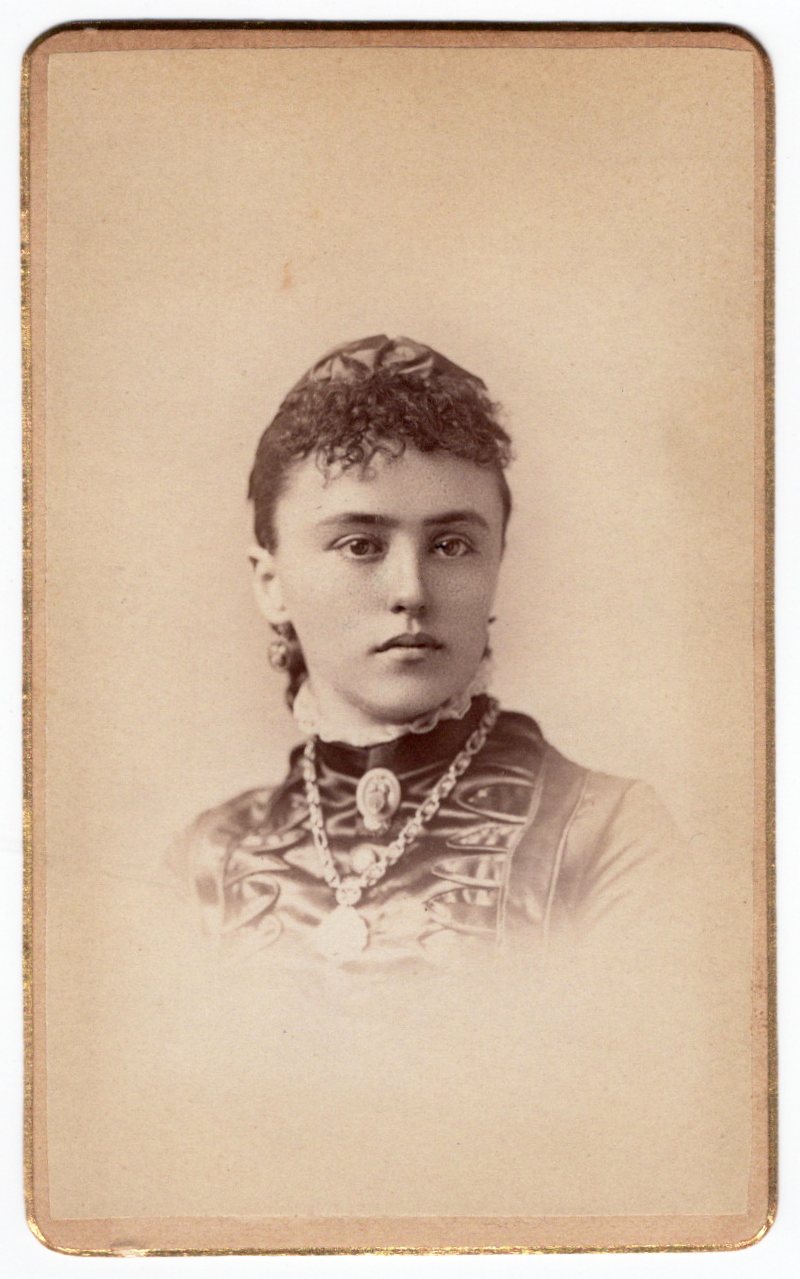
YOUNG WOMAN IN ELEGANT DRESS WITH CAMEO JEWELRY : CDV : YORK, PENNSYLVANIA : 1870
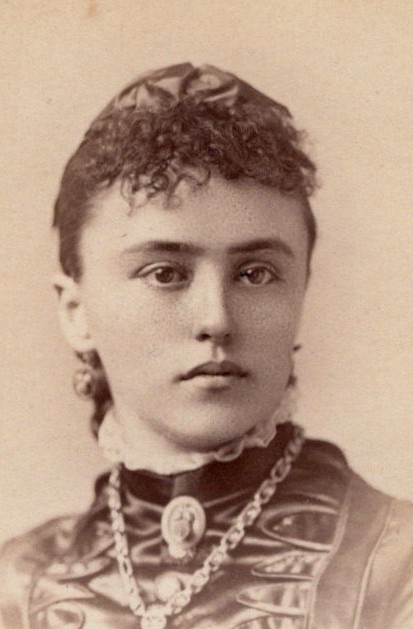
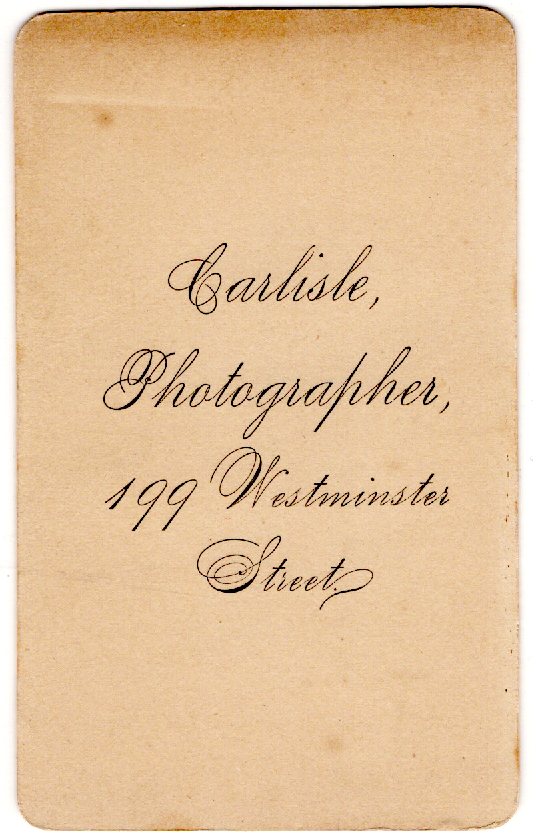
This is a beautiful antique carte de visite (CDV) photograph featuring a young woman dressed in elegant Victorian attire, dating from the 1870s to early 1880s. Her high-collared dress showcases intricate details, likely made of silk or a similar luxurious fabric, adorned with ornate embellishments. She is wearing layered jewelry, including a prominent cameo necklace, chains, and a possible pendant, highlighting her refined sense of style. The subject’s hairstyle, with tightly curled bangs and a carefully styled updo, is indicative of Victorian fashion trends during this period. Her expression is calm and composed, as was customary for formal portraiture in the 19th century. This photograph was taken at the Carlisle studio, in York, Pennsylvania. This photo has gold beveled edges. SOLD
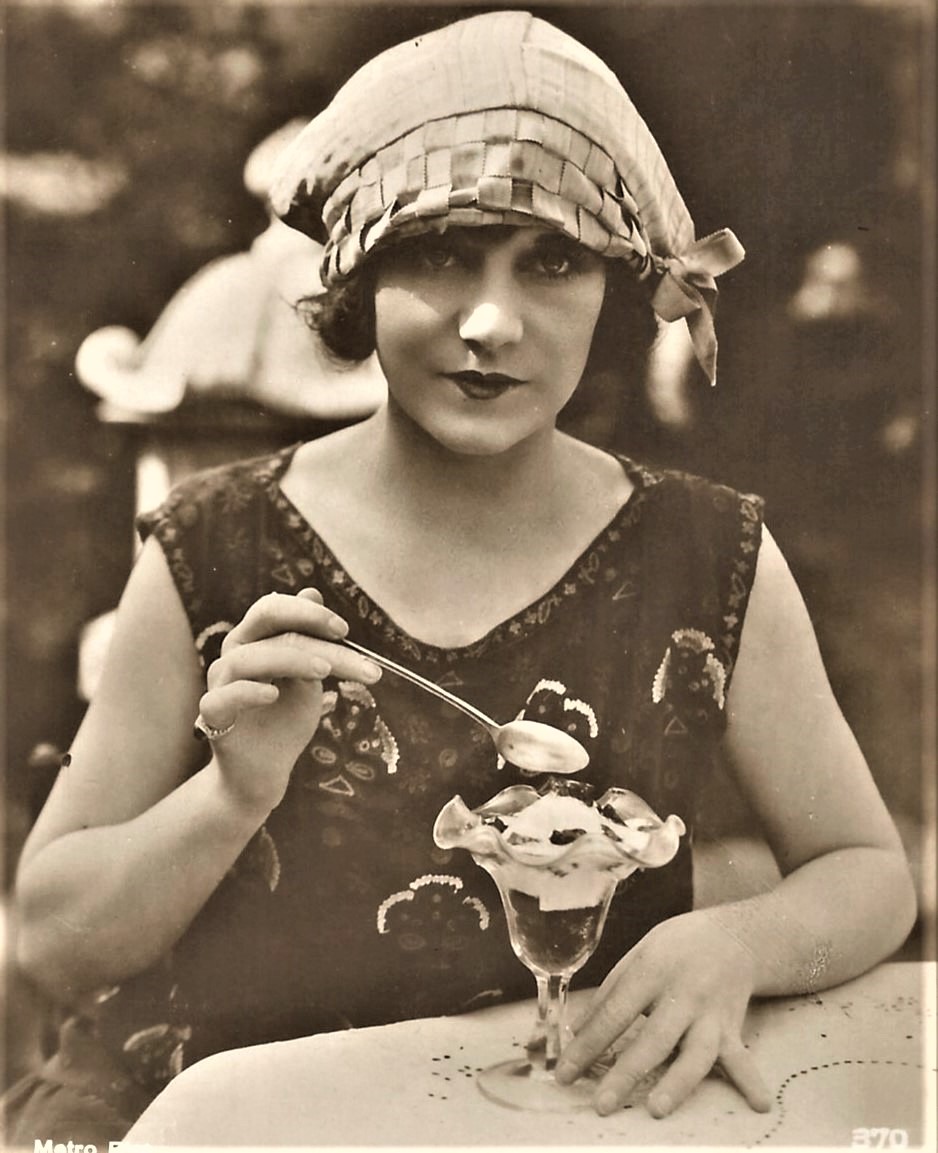
VIOLA DANA : PROLIFIC SILENT FILM ACTRESS : FACED SIGNIFICANT LOSS
POSTCARD 1 (SOLD)
POSTCARD 1 (CLOSE-UP)
POSTCARD 2 (SOLD)
The pretty woman seen in this vintage real photo postcard is American silent film actress, Viola Dana (1897-1987). The photographer captured Miss Dana as she was about to eat something that looks a lot like dessert. Dana hailed from Brooklyn, New York. Her given name was Virginia Flugrath. I understand why she changed her name in the interest of her film career. She had two sisters, and they both became actresses. Their names were Shirley Mason and Edna Flugrath. Dana began performing on the stage at the ripe old age of three years-old. She continued to act in theater but between 1910 and 1912, she made appearances in four films. At age 16, she became an audience favorite in David Belasco’s “Poor Little Rich Girl”. Around this time, she began to perform in vaudeville with famed actor, Dustin Farnum. In the early part of her film career she became a star with Edison Studios. She fell in love with a studio director there, John Hancock Collins. She married him in 1915, at or around the age of eighteen. In 1916, Dana and Collins went to work for Rolfe Photoplays which released their films through Metro Pictures. Tragedy struck when Collins died from influenza during the 1918 flu pandemic. Dana continued acting for Metro through the 1920’s. Over time her popularity faded. Interestingly, one of her roles toward the end of her career, was in Frank Capra’s first film, “That Certain Thing” (1928). She retired in 1929, at about 32 years of age. She had appeared in over one hundred films. Dana, like many other film performers, was a casualty of the transition from silent films to sound films. Her voice was not compatible with the new medium. Dana had more than her share of tragedy in her personal life. After losing her first husband, she began a relationship with Ormer Locklear. He was an aviator and a burgeoning actor. He also was a married man. In 1920, while filming the movie, “The Skywayman”, Locklear was killed when his aircraft crashed. Dana witnessed the accident and did not fly again for 25 years. In 1925, she married Yale football star and actor Maurice “Lefty” Flynn. The marriage ended in divorce in 1929. Her third marriage was to Jimmy Thompson, a professional golfer. The marriage lasted fifteen years and ended in divorce in 1945. During her later years, she volunteered at the Motion Picture & Television Country House and Hospital. She became a resident there in 1979.
— Postcard 1 was published by Iris Verlag as part of a series (no 370). AMAG, another publishing house is also listed on the card. The bottom left corner of the image has the name “Metro Pictures”, which as stated earlier, was the company responsible for releasing a number of Dana, and her husband Collins, films. (SOLD) –
-Postcard 2 was published by the Photo Card Co. of Los Angeles, California. This photo card was likely published in 1929. The AZO stamp box indicates that the postcard itself was made sometime between 1910 and 1930. Miss Dana’s beauty is evident in this image. She has lovely eyes. (SOLD)
POSTCARD 1

PORTRAIT OF JIHAN SADAT – DAUGHTER OF THE LATE EGYPTIAN PRESIDENT – ANWAR SADAT

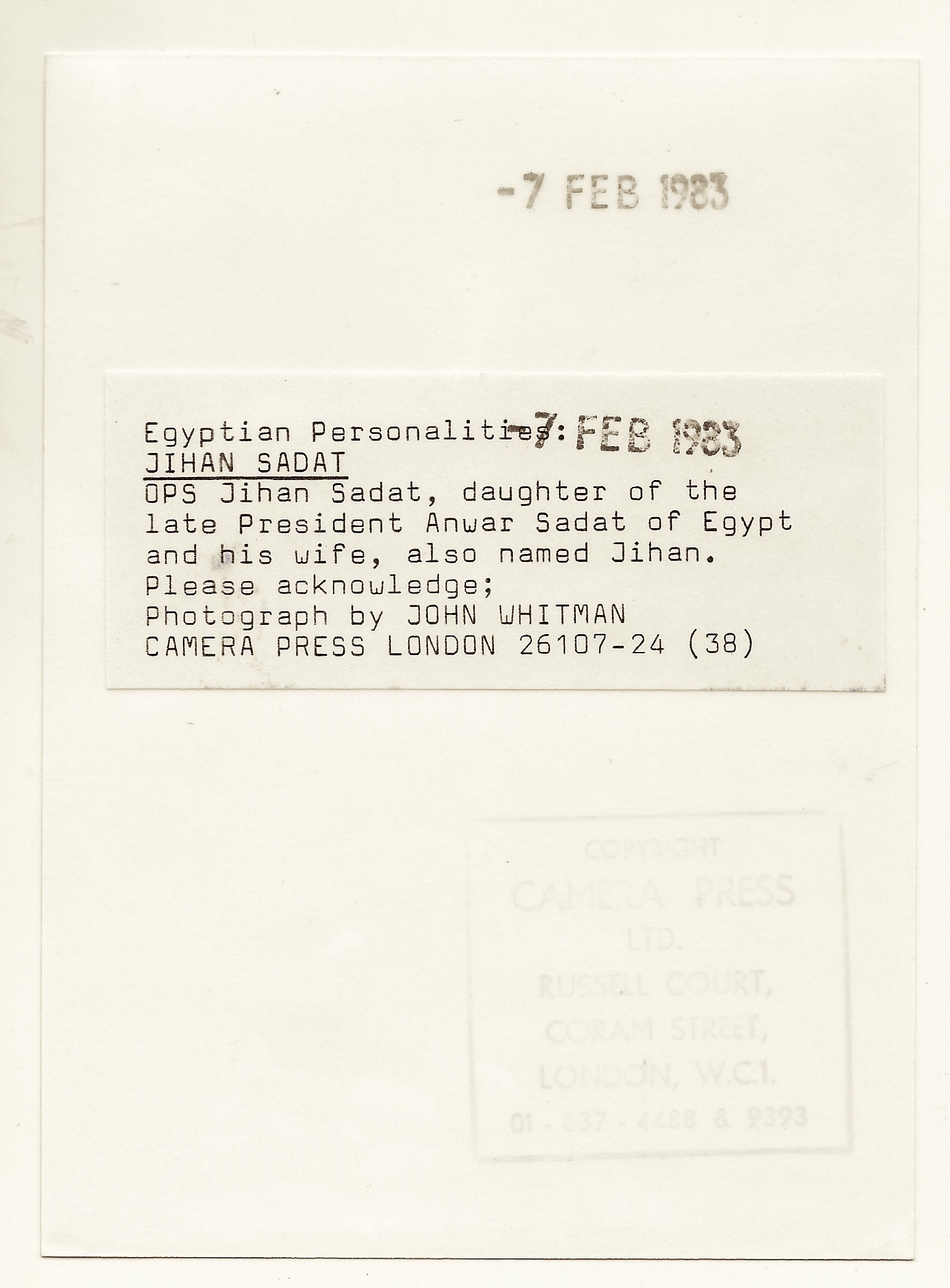
This press photo features Jihan (Jehan) Sadat. She is the daughter of the late Egyptian President, Anwar Sadat (1918-1981). He was the third President of Egypt and served from 1970 to 1981. He was assassinated while in office. He negotiated a peace treaty with Israel’s Menachem Begin and the two shared the Nobel Peace prize. This photograph was taken by John Whitman of Camera Press, located in London, England. It was taken in 1983. SOLD

FEMALE PIERRETTE CLOWN : BURLESQUE : CABARET : GERMANY : RPPC : 1920’s
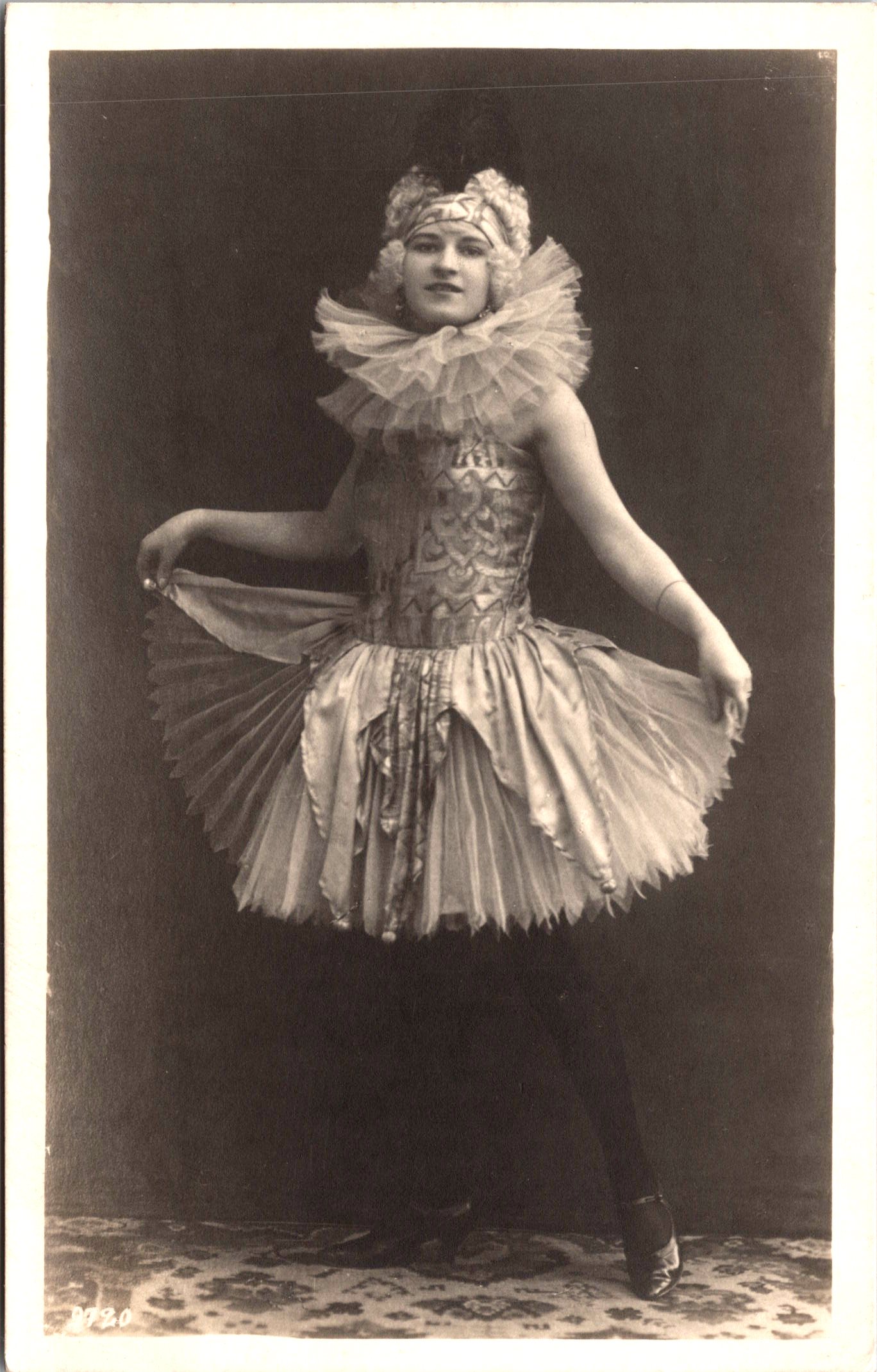
This vintage divided back real photo postcard features a young woman dressed as a Pierrot. Actually, the female version of a Pierrot is “Pierrette”.
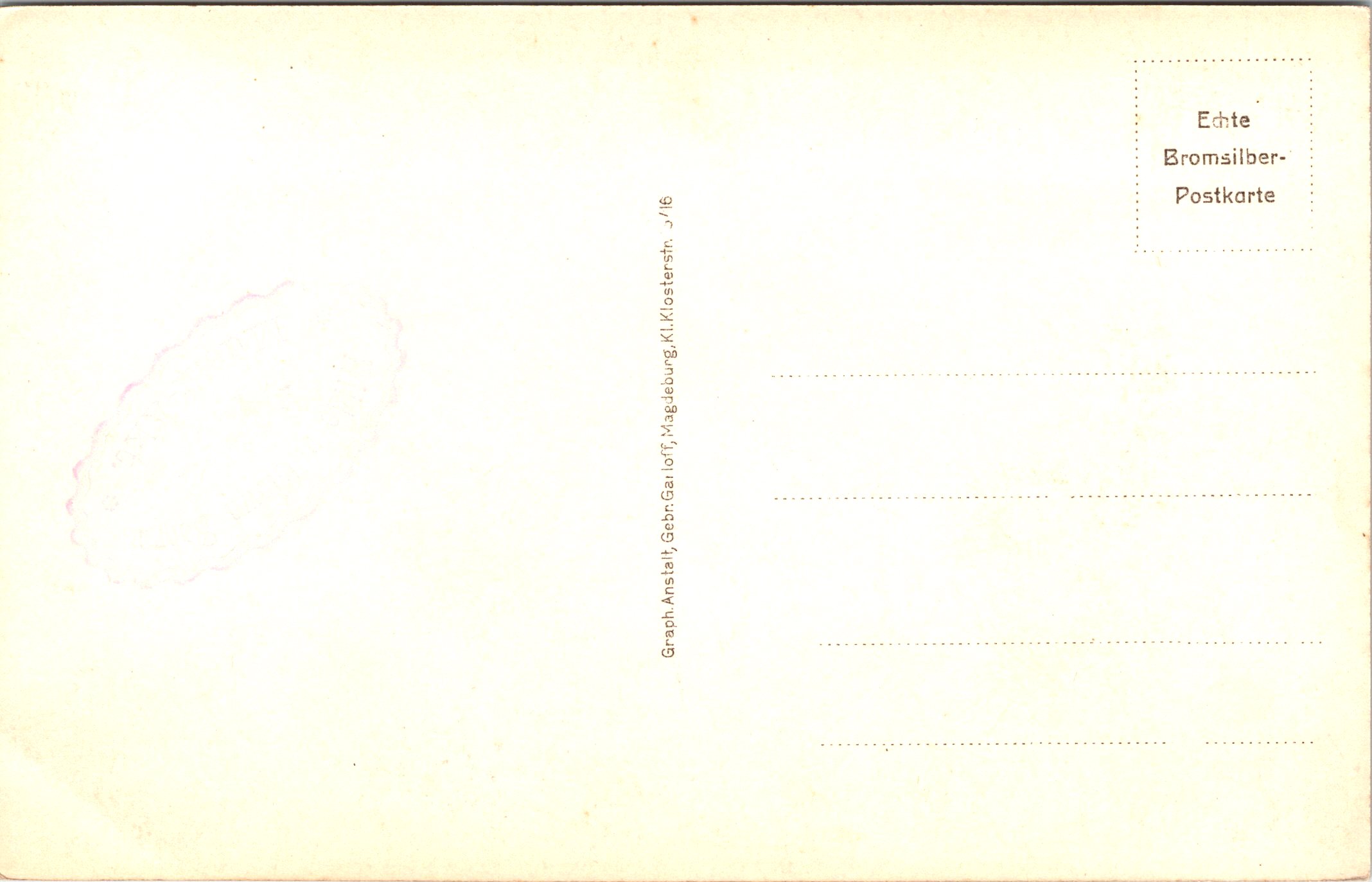
The girl’s photo was taken by Hilde u. Clown Sarra Musik-Akt. The publisher of the postcard was Graph. Anstalt, located in Magdburg, Germany. (SOLD)