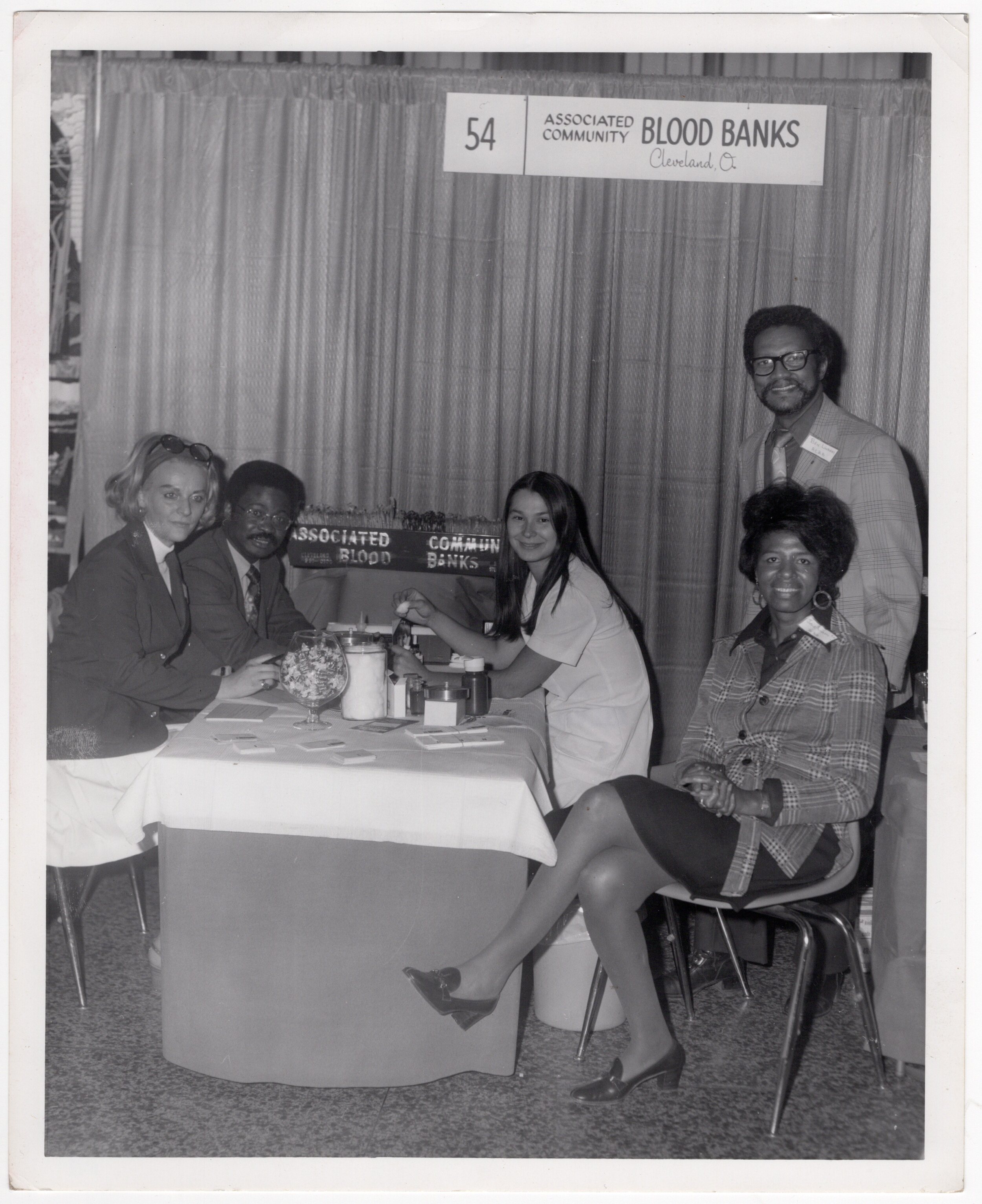
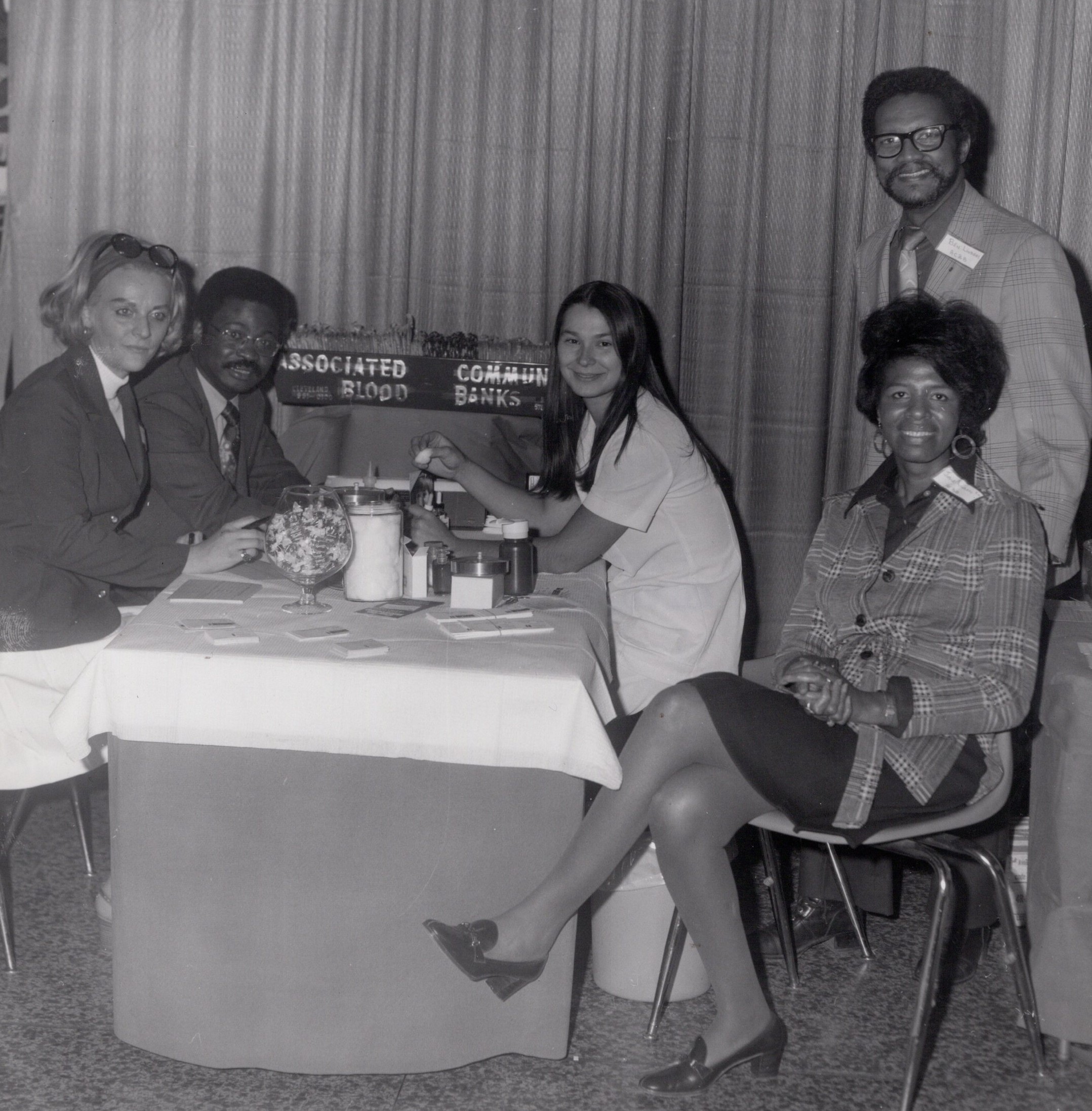
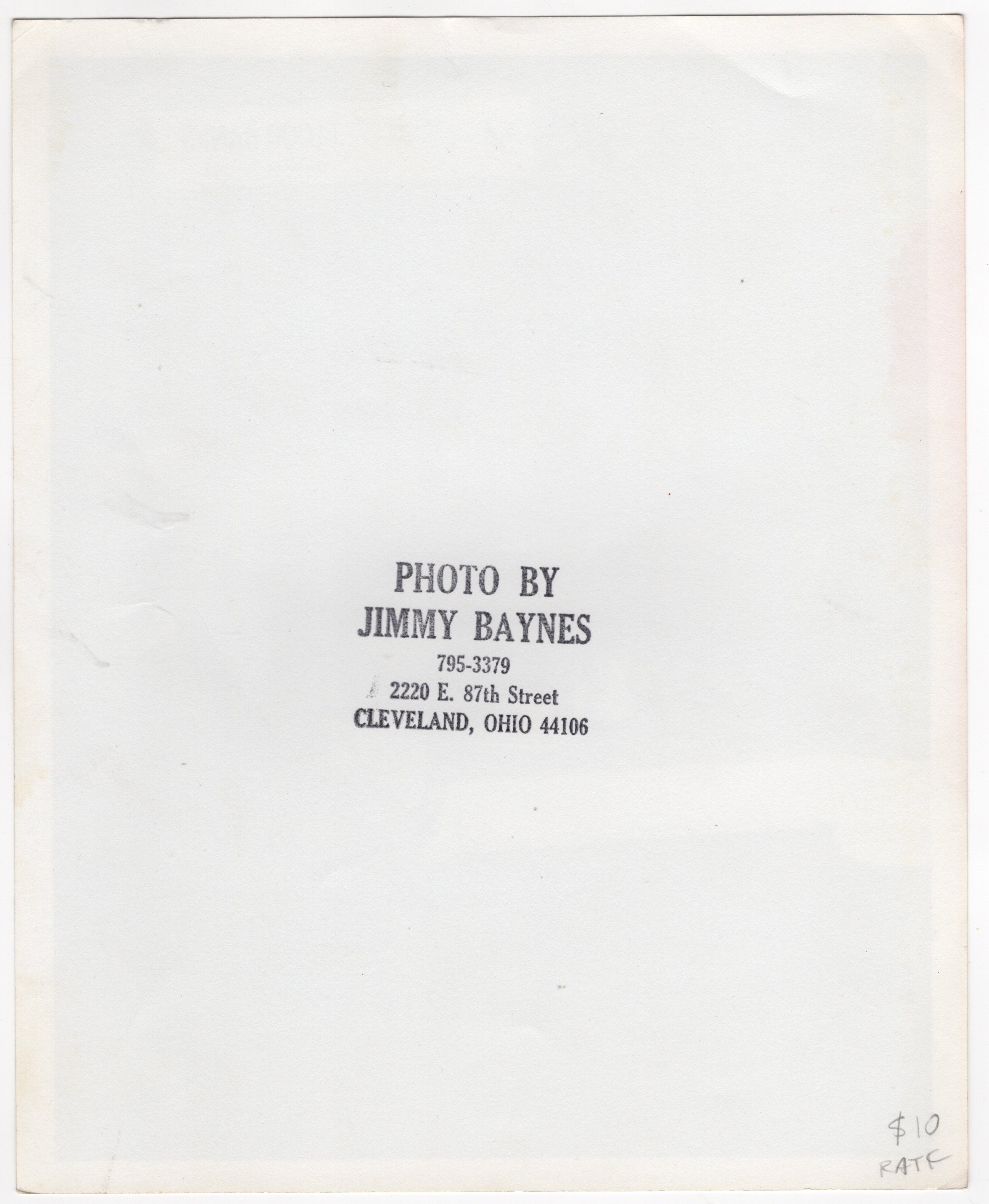
This original black-and-white press photograph was taken by noted Cleveland photographer Jimmy Baynes, whose stamp appears on the reverse. Baynes was a prolific photojournalist and chronicler of Cleveland’s African American community during the mid-20th century. His work documented civic events, political gatherings, cultural programs, and the everyday lives of African Americans in Cleveland. His images today stand as a vital record of local history and are increasingly valued by collectors of press photography and African American ephemera. The photograph depicts a group at the Associated Community Blood Banks booth (Cleveland, Ohio). The booth is labeled “54 Associated Community Blood Banks” on the backdrop. Five individuals are present. One of the individuals is a young woman wearing a white uniform and holding testing equipment. She is likely a nurse or a blood bank technician. The scene captures both the professionalism and community service focus of Cleveland’s blood bank efforts in the late 1960s or 1970s, with an emphasis on outreach, participation, and health education. The candid but posed composition reflects Baynes’s signature style of highlighting people within civic and cultural spaces. The photographer of this photograph, Jimmy Baynes was known for his ability to capture the essence of African American life, culture, and entertainment from the 1950s through the 1980s. Originally a postal worker, Baynes pursued photography as a passion, ultimately founding Baynes Foto Service. His work chronicled the vibrancy of mid-century African American social life, from intimate gatherings and beauty contests to the pulsating energy of live music performances and political events. Baynes photographed some of the most iconic figures in entertainment history, including Aretha Franklin, Louis Armstrong, Count Basie, Mahalia Jackson, Louis Jordan, Jerry Lee Lewis, the Platters, and the Drifters. His ability to capture both candid and staged moments gave his work a lasting impact, preserving the rich history of Cleveland’s African American community. His legacy is recognized today by institutions such as the Rock and Roll Hall of Fame and Museum Library and Archives in Cleveland, which houses a collection of his photographs, primarily focusing on music and entertainment. In 2010, shortly before his passing, his work was featured in the “Polaroid: Instant Joy” exhibition in Brooklyn, New York, reaffirming his role as a visual storyteller of African American life in the mid-20th century. (SOLD)


 THE CABINET CARD GALLERY