
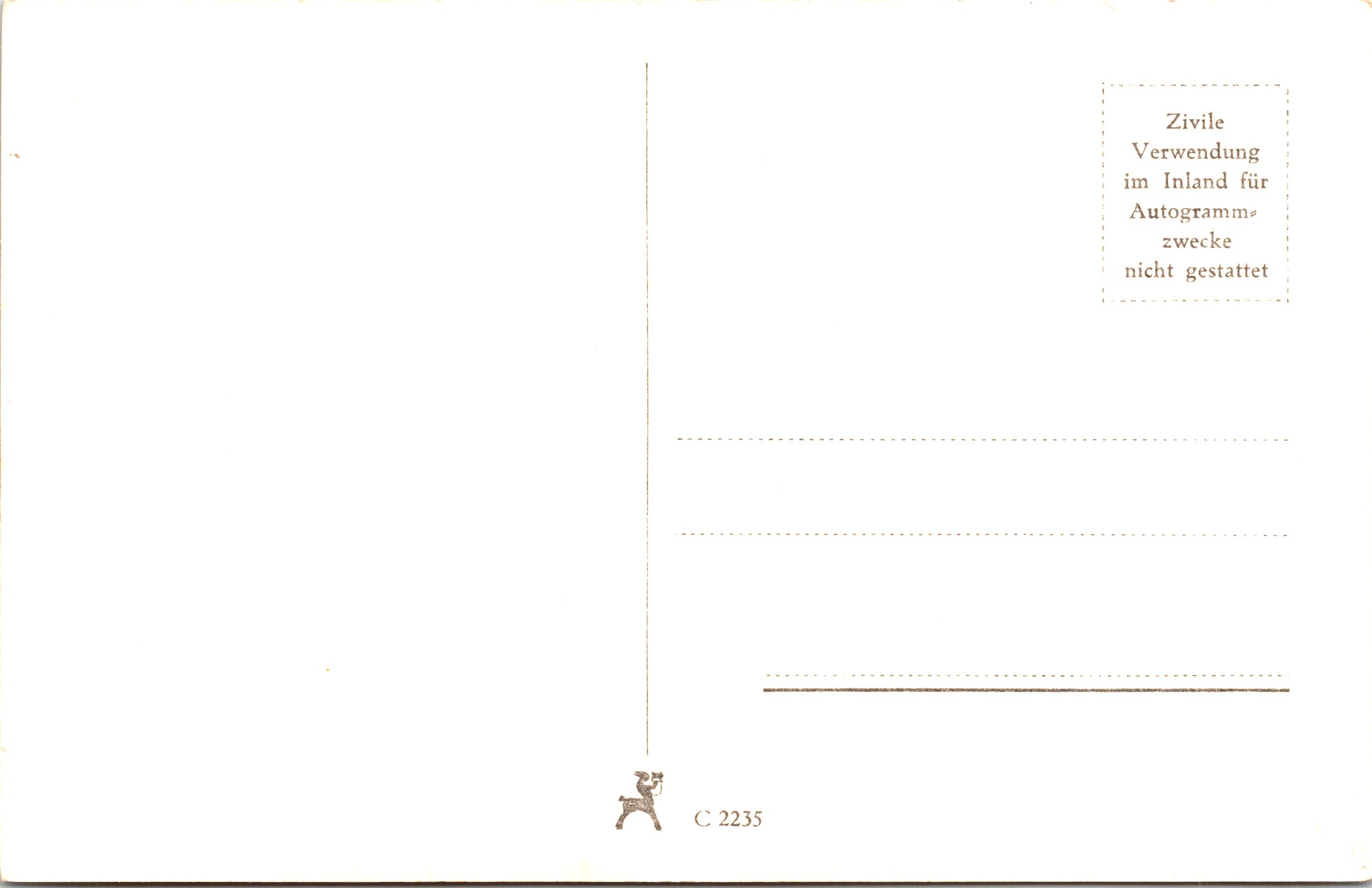
This striking vintage real photo postcard features a glamorous close-up portrait of Ilse Werner, a celebrated German-Dutch actress and singer known for her charismatic screen presence and unique whistling talent. In this image, Werner is draped in a shimmering veil that frames her face with a soft, radiant glow. Her expressive eyes, long lashes, and glossed lips project a poised, serene beauty, while the glinting fabric around her adds a mystical, almost cinematic aura. The postcard was published by Film-Foto-Verlag, a major distributor of German film star postcards during the 1930s and 1940s, and is marked “A 3732/1” in the lower left corner. The photo credit goes to Foto Quick. .On the reverse is the wartime disclaimer: “Zivile Verwendung im Inland für Autogrammzwecke nicht gestattet” (Civilian use for autograph purposes not permitted), reflecting its origin in Nazi Germany. The cards were meant for building national morale and not private autograph collecting. A small fawn symbol in the stamp box area marks it as part of the Film-Foto-Verlag series. Ilse Werner was born in 1921, in Batavia, Dutch East Indies (now Jakarta, Indonesia), where her father worked as a Dutch colonial official. Her mother was German, and the family moved to Germany when she was a child. She trained at the Max Reinhardt Seminar in Vienna, one of the premier acting schools in the German-speaking world, and made her film debut in 1939. Her breakout role came in the film Wunschkonzert (1940), one of the most popular and propagandistic films of the Nazi era. She quickly became a favorite among German audiences, known not only for her acting but also for her unusual skill as a professional whistler, which she often demonstrated in her recordings and film appearances. During the Nazi period, Ilse Werner became one of Germany’s most beloved film stars, appearing in state-approved entertainment. Though she never joined the Nazi Party, her films were often apolitical and aligned with the regime’s values of escapism and wholesome entertainment. Her popularity made her a public symbol of the Third Reich’s cultural life, though she was not considered an overt political supporter. After the war, her Dutch citizenship initially barred her from performing in postwar Germany due to denazification policies, which caused a temporary decline in her career until restrictions were lifted. lse Werner was married to actor Tony Rödel for a brief period. The marriage ended in divorce. She did not have children. Her later years were marked by occasional television appearances and nostalgic performances of her trademark whistling songs. She passed away in 2005 at the age of 84. (SOLD)


 THE CABINET CARD GALLERY