
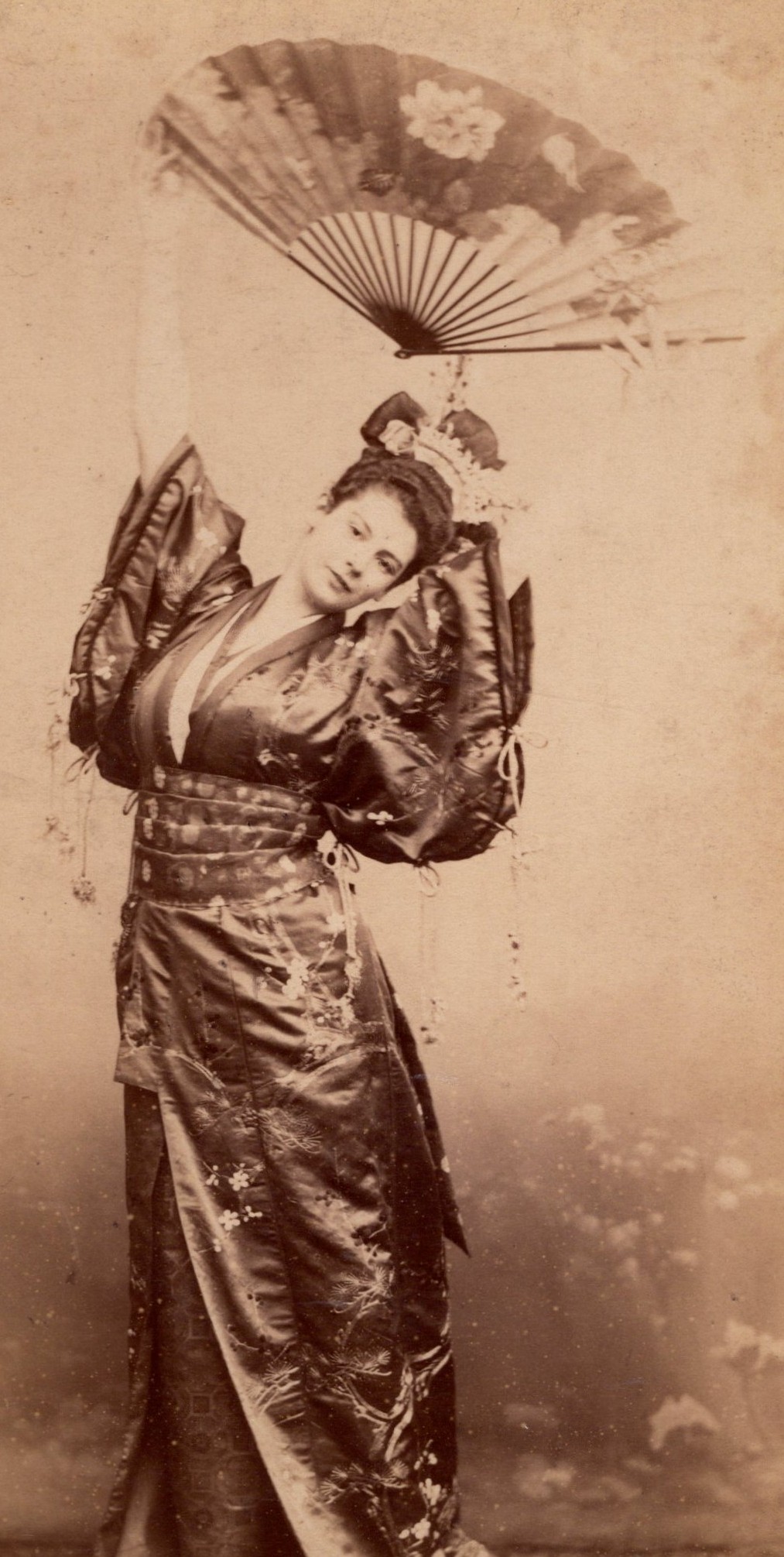
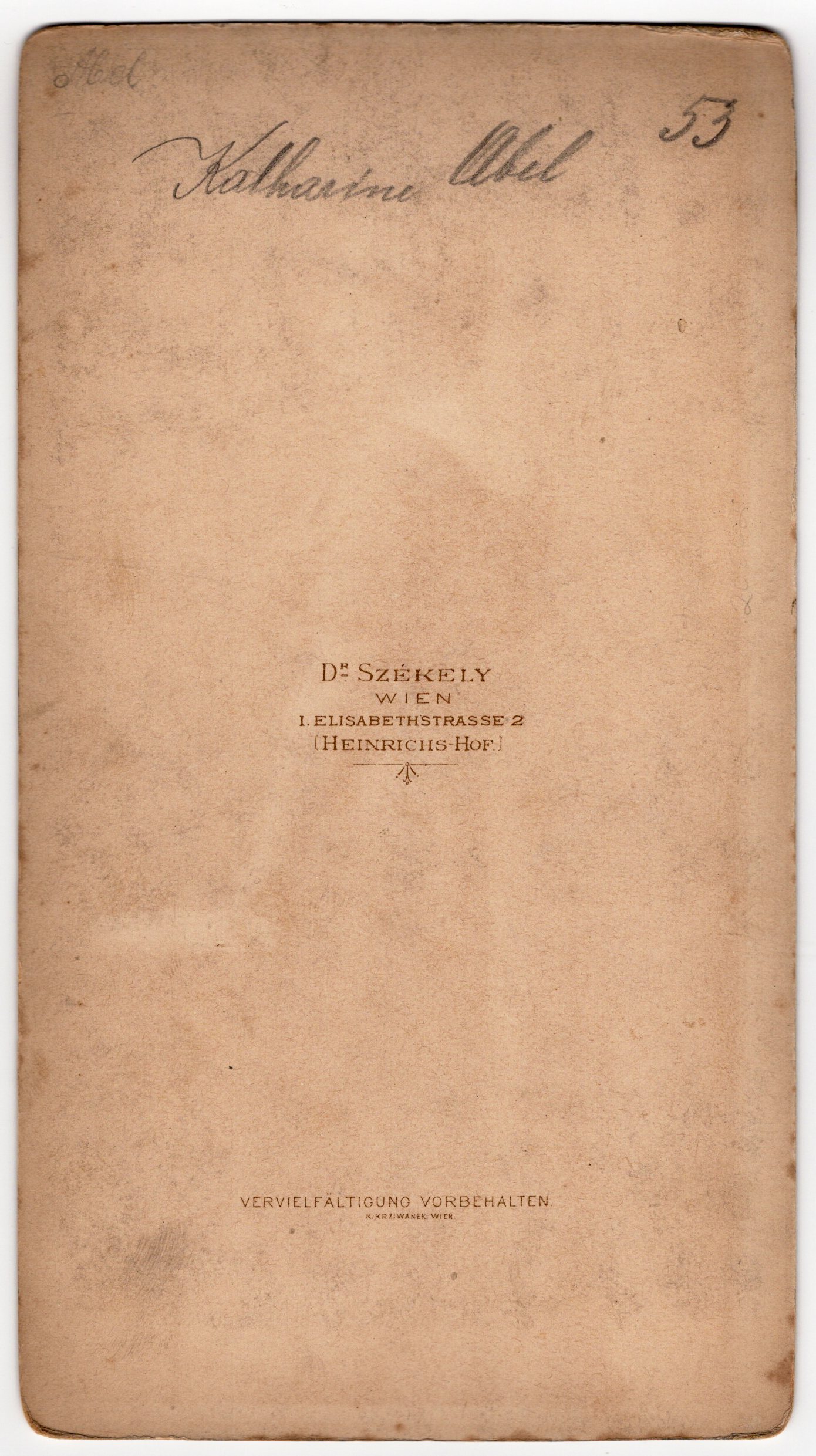
This cabinet card features Katharina Abel (1856 –1904), a distinguished Austrian ballerina renowned for her tenure as a solo dancer at the Vienna Court Opera (now the Vienna State Opera). She was born in Vienna. Abel was accepted into the ballet school of the Kärntnertortheater at the age of twelve. Under the tutelage of ballet mistress Johanna Telle, she honed her skills in classical dance. In 1871, Abel joined the Vienna Court Opera. She captivated audiences with her grace and charm, particularly excelling in pantomimic roles. Her breakthrough came on October 4, 1879, when she performed as the leader of the Amazons in the ballet “Dyellah oder die Reise nach Indien.” Her compelling performance led to her appointment as a solo dancer at the opera. Throughout her career, Abel starred in numerous productions, including the ballet “Coppélia” and the operas “Die schöne Melusine” by Louis Schindelmeisser and “Die Stumme von Portici,” where she portrayed Fenella. She also featured prominently in divertissements such as “Wiener Walzer,” “Die Puppenfee,” “Sonne und Erde,” “Fantasca,” “Fata Morgana,” and “Der Stock im Eisen. In 1890, Abel married Count Georg Orssich von Slavetich, who was ten years her junior. The couple resided on the count’s estate in Theresienfeld. Prior to her marriage, Abel had a daughter born in 1876. The father’s identity remains undisclosed. Abel’s illustrious career was abruptly halted during a performance of “Giselle” when a mechanical failure caused her to fall approximately ten feet onto the stage, resulting in a foot injury that ended her solo performances. She continued to engage audiences in pantomimic roles for a time. In 1892, she retired from the stage. Despite undergoing multiple surgeries, Abel succumbed to cancer in 1904. This photograph is a striking portrait of Abel. Abel is adorned in an elaborate costume that reflects her talent for embodying diverse and exotic roles on stage. She wears a kimono-style garment, richly embroidered with intricate floral patterns. The fabric’s texture and sheen suggest luxurious materials befitting her status as a renowned performer. Her theatrical pose, with arms gracefully extended and a large fan arched behind her head, exudes poise and fluidity. The delicate placement of her hands and the tilt of her head convey a sense of grace. This cabinet card photograph was taken in 1888 by Dr. Josef Szekely (1838-1901). He captured her performance in “The Doll Fairy”. Székely was an Austro-Hungarian chemist and photographer renowned for his contributions to early photography in Central and Southeastern Europe. He had a master’s degree in pharmacy and a doctorate in chemistry. He taught at the University of Vienna before becoming a photographer. He was very successful as a photographer. Székely’s work garnered international acclaim. He was awarded the Bronze Prize at the 1867 World’s Fair in Paris and a silver medal in 1878. His studio produced portraits of many notable figures. This photograph is in the collection of the Theater Museum in Vienna. This cabinet card measures approximately 4.25 x 8 inches, which is larger than the standard cabinet card. SOLD



 THE CABINET CARD GALLERY