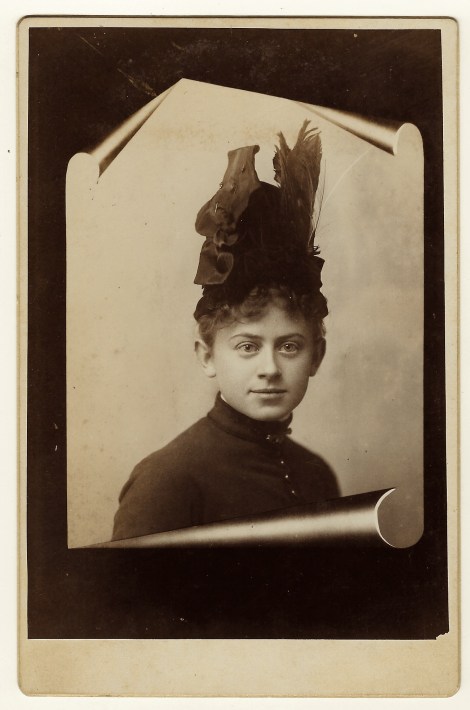

This cabinet card portrait features a relatively close-up view of a pretty girl dressed in dark clothing. She appears to be in her late adolescence. Her photograph is presented as if it is on a scroll. I have come across much debate as to whether the “scroll images” are memorial photographs. After reading both sides arguments, I tend to believe that they are not necessarily memorial photographs. The teen seen in this photograph is wearing a hat that reminds me of an old adage, “A bird on the hat is worth two in the bush”. Perhaps I may be confused about that proverb but the young lady seen in this cabinet card is wearing a “bird hat”. This style hat is not one of my favorite examples of millinery design. At the turn of the 19th century it became the style in the US and Europe to wear feathers and even whole taxidermied birds on their hats. This resulted in the killing of millions of birds all around the world. An article in “Sociological Images” (2014) reports on a single order of feathers by a London dealer in 1892 requiring the “harvesting” of 6,000 Birds of Paradise, 40,000 Hummingbirds, and 360,00 of various East Indian birds. Ornithologists started to speak out in resistance to this practice. One asserted that 67 types of birds were at risk for extinction. Ornithologists and their supporters began to target women who were supporting the practice of slaughtering birds. Women were receiving the blame for the barbarism being committed against birds. The writer, Virginia Woolf (1882-1942) reminded readers that it was men who were actually murdering the birds and making a profit from them. Interestingly, middle class women were major advocates in the bird preservation movement. In the US the movement sparked the development of the first Audubon societies. The Massachusetts Audubon Society organized a feather boycott, and soon the US government passed conservation legislation that protected the birds. The photographer of this cabinet card is J. B. Gibson who operated a studio in Coatesville, Pennsylvania. John Banks Gibson is reported to have been a photographer from the 1870’s until the 1890’s. He initially worked producing ferreotypes (tintypes). In 1893 he sold his business to photographer Robert Young. Gibson was born in East Nottingham, Pennsylvania and died in 1913 in Coatesville at 75 years of age. He learned photography as a young man from Alexander McCormick of Oxford, Pennsylvania.




 THE CABINET CARD GALLERY