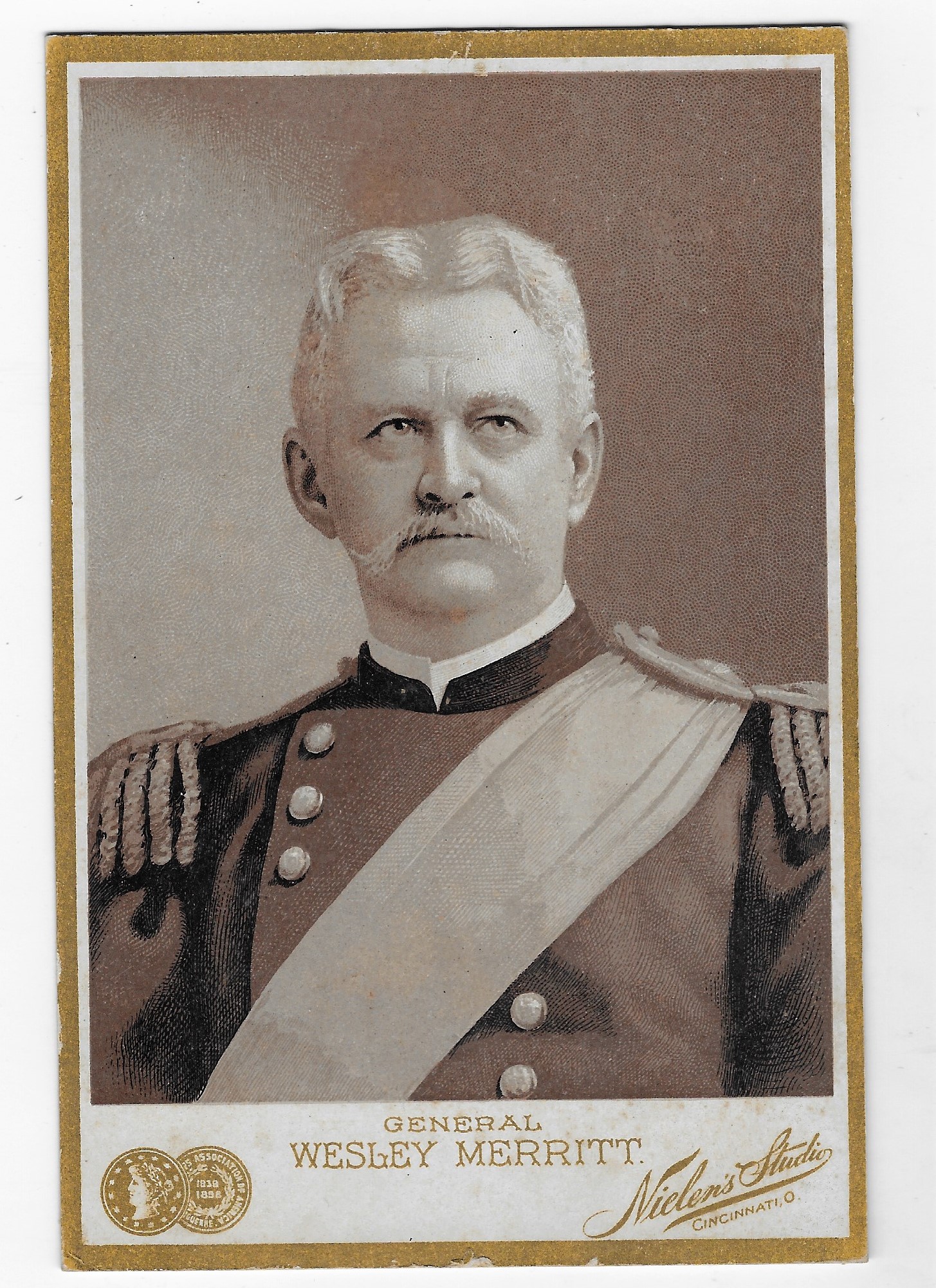
This cabinet card features a portrait of civil war General Wesley Merritt (1836-1910). During the war, he served on the side of the Union. Merritt graduated from West Point in 1860. Initially, as a second lieutenant, he served under John Buford in Utah. In 1862, he was named a Captain in the 2nd Cavalry and participated in the defense of Washington D.C.. In 1863, he was appointed adjutant for Major General George Stoneman. Merritt participated in Stoneman’s Raid in the Battle of Chancellorsville. He participated in the Gettysburg campaign as commander of the Reserve Brigade, 1st Division, Cavalry Corps of the Army of the Potomac. He saw no real action until the third day of the battle. He took part in the attack, led by Brig Gen Judson Kilpatrick on the Confederate right. He sustained a slight wound in the Battle of Brandy Station. His actions at Brandy Station contributed to his promotion to Brigadier General. Upon the death of John Buford, Merritt took over command of the 1st Division of the Cavalry Corps. He led the division during Grant’s Overland Campaign in 1864. Merritt later became the commander of the 1st Division Cavalry Corps of the Army of the Shenandoah, under Major Gen. Phillip Sheridan. He participated in Sheridan’s Valley Campaigns of 1864. His division routed the confederates in the Third Battle of Winchester. He was second to command under General Sheridan during the Appomattox Campaign and was present for the Confederate surrender at Appomattox. He had a long and accomplished career in the military, after the civil war. He commanded the Cavalry in the Southwest and participated in the Indian Wars. After serving on the frontier, he spent five years as superintendent of West Point. In 1895 he was promoted to major general in the regular army. In 1898, he commanded the Eighth Army Corp in the Spanish American War. After the victory, Merritt became the first American military governor of the Philippines. Merritt retired from the army in 1900. His military career had a 40 year duration. This cabinet card appropriately shows General Merritt in military uniform. Nielen’s Studio, in Cincinnati, Ohio is credited just below Merritt’s image. Andries Nielen (1850-1940) was born in Holland. He emigrated to the United States and in time, became the head of a tea and spice firm in Cincinnati. He retired in 1905 and he travelled around the world. He began a new career as a photographer and postcard publisher. He also was an amateur philosopher. He ran a publication espousing his philosophy as well as published the “wisdom” of others. SOLD




 THE CABINET CARD GALLERY