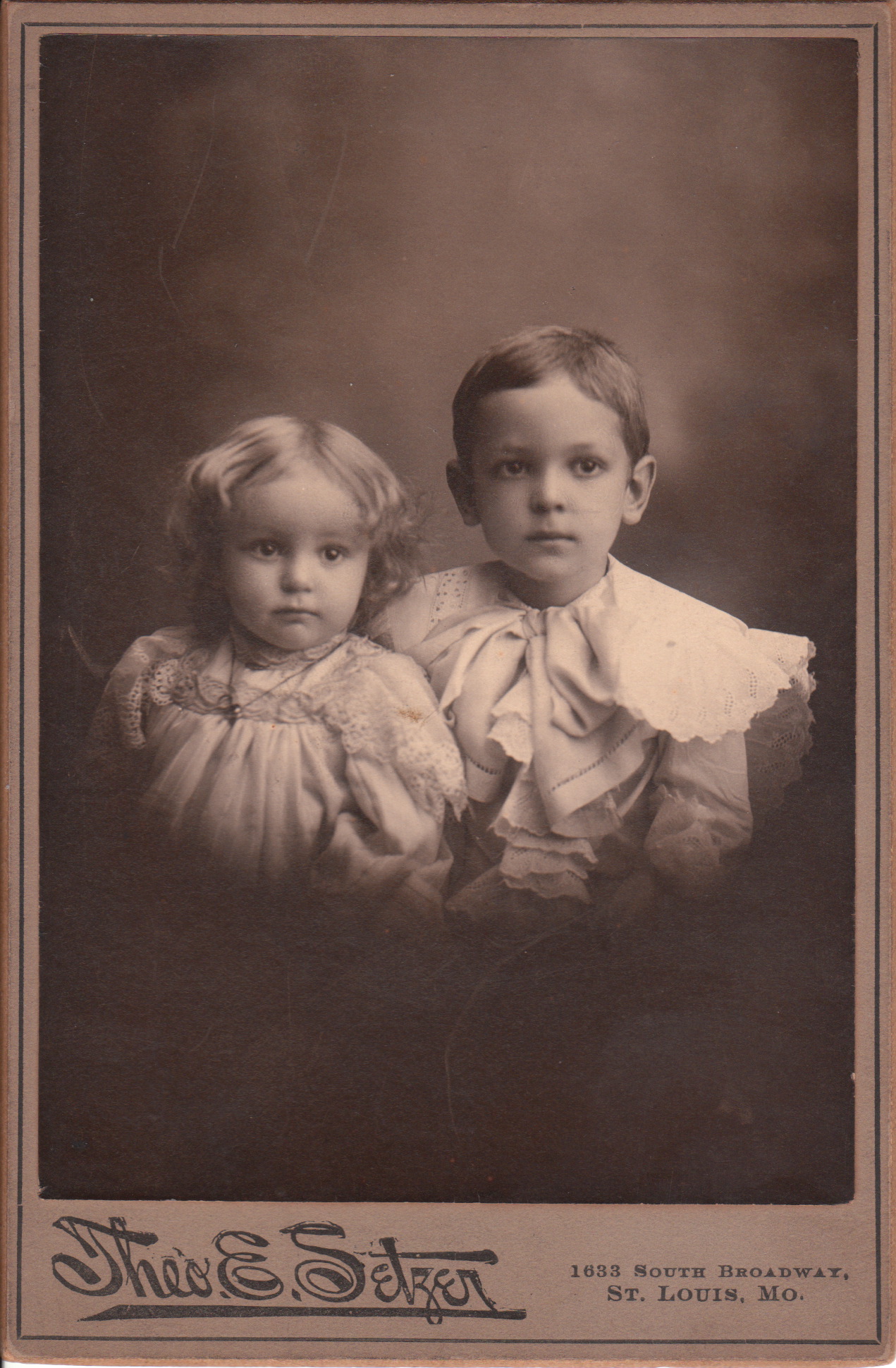
This cabinet card features adorable siblings posing for their portrait at the Setzer studio in St. Louis, Missouri. The photographer is Theodore E. Setzer. Setzer operated his studio from the South Broadway address from about 1890 until 1910, according to one photographer reference book. Between 1885 and 1890 he conducted business from that address as Setzer & Roth.
TWO YOUNG GIRLS, A DOLL, AND A BUILDERS CATALOG IN ST. LOUIS, MISSOURI
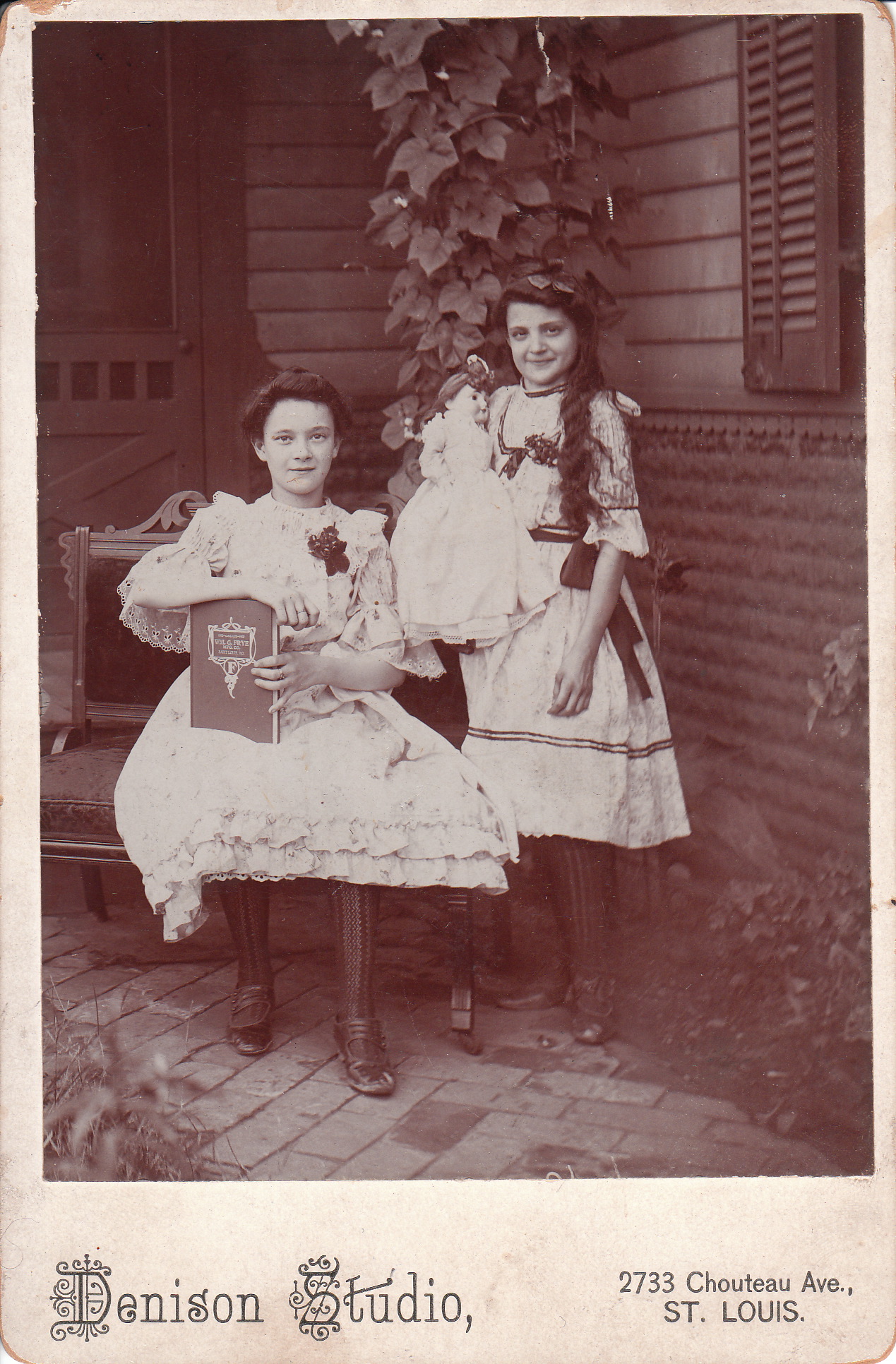
This cabinet card features two young girls posing in front of a nicely landscaped house. The house may actually be just part of a house, and serve as a prop inside the photographic studio of Mr. Denison, in St. Louis, Missouri. One girl, with long braids, is holding a doll. The second girl is holding something very unusual for a child to be displaying, That is, unless she is an aspiring home builder. This girl is proudly brandishing a 1902 catalog from the William G. Frye Company. This business was located in St. Louis, and sold door, sash, blinds and many types of millwork. In regard to Mr. Denison, no information was found about him except that his Chouteau Avenue address (about 1900) was followed by a move to 1452 Cass Avenue (about 1906), also in St. Louis.
TWO BOYS AND A HOOP TOY IN ST. LOUIS MISSOURI (SHADES OF THE LITTLE RASCALS)
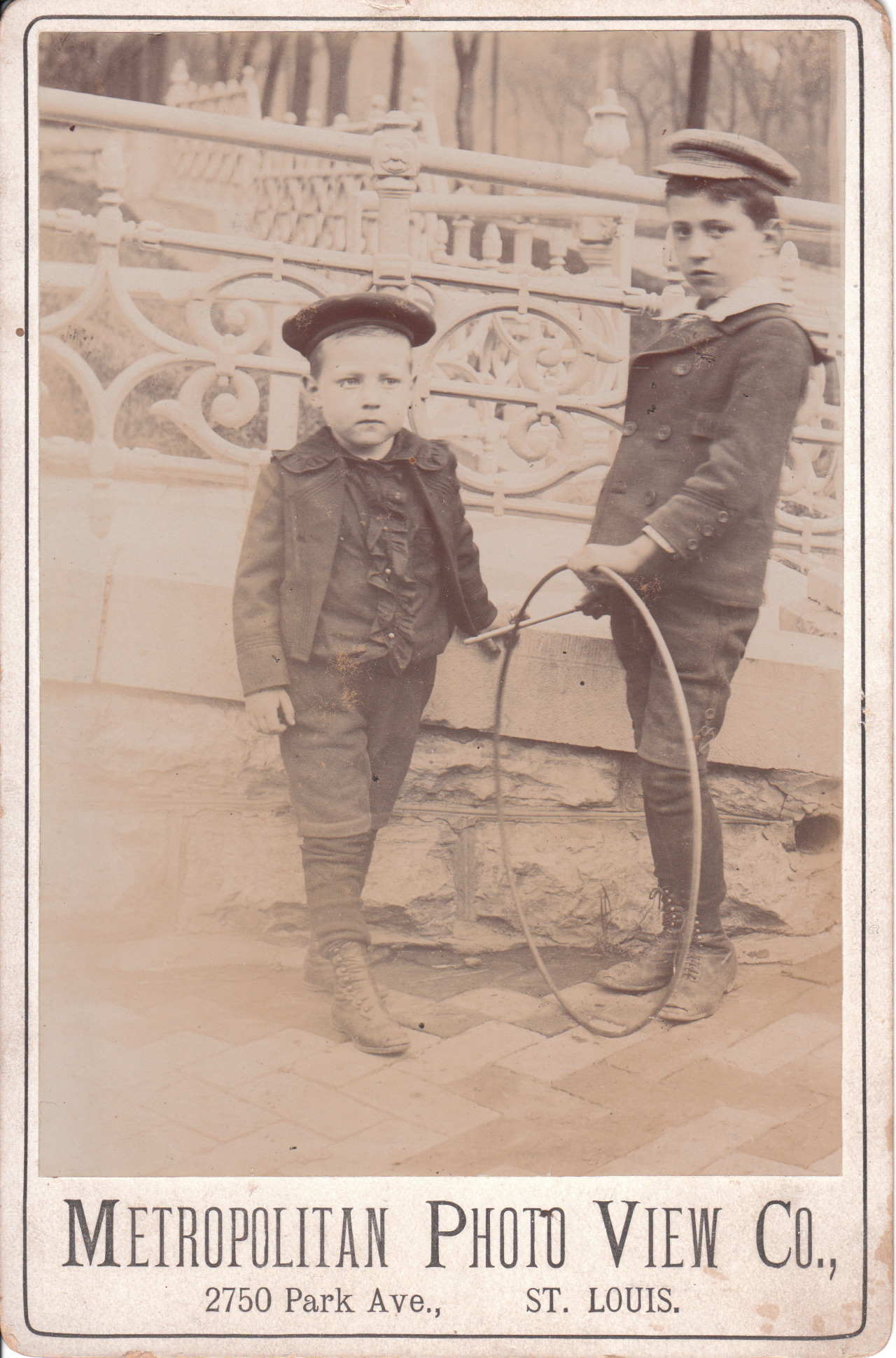
This cabinet card is an image of two street kids posing with their hoop toy. The boys have a mischievous expression and appearance reminiscent of the boys who were featured in the vintage television series, “The Little Rascals”. They are wearing wonderful caps. Caps like these must be the predecessors of the baseball cap seen on similar aged boy of today. The studio that produced this photograph was the Metropolitan Photo View Company of St. Louis, Missouri. No further information has been located about this studio or concerning the identity of the two “Our Gang” members. To see other photographs of turn of the century toys, click on the Cabinet Card Gallery category of “Toys”.
OLDER WOMAN MAKES FASHION STATEMENT IN ST. LOUIS, MISSOURI
This cabinet card features a very fashionably dressed older woman posing for her portrait at the Block Studio, in St. Louis Missouri (1225 Franklin Avenue). The woman is wearing a very interesting hat that includes feathers and assorted other materials. She is wearing a pin and earrings. Research indicates that Louis Block worked as a photographer in St. Louis between 1900 and 1919 although he may have also worked there during other additional years.
Stylishly Dressed African American Man in St. Louis, Missouri

This Cabinet card offers a very clear and detailed image of a young Black man who is very nicely dressed. He posed for this photograph at the studio of Genelli in St. Louis, Missouri. To learn more about this studio and to view other photographs produced by Genelli, click on the category “Photographer: Genelli”.
Fireman in St. Louis, Missouri

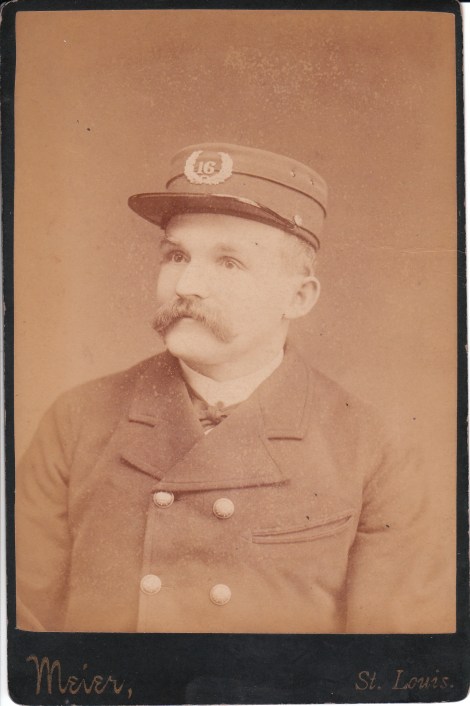
This fireman is posing for his portrait in St. Louis, Missouri. The photographer is Meier.Charles F. Meier was a photographer in St. Louis between 1875 and 1900.
Richard Bartholdt: U.S. Congressman from Missouri

Richard Bartholdt (1855-1932) was born in Schleiz, Germany where he attended college and then immigrated to the United States in 1872. He initially settled in Brooklyn, New York where he learned the printing trade and became a newspaper writer and publisher. He then moved to St. Louis, Missori in 1877 and continued in the newspaper trade. In 1893, while editor in chief of the St. Louis Tribune and member of the St. Louis Board of Education, he was elected as a Republican to the U.S. Congress where he served until 1915. While in Congress he served as chairman of the Committee on Immigration and Naturalization and other committees. In 1911, President Taft appointed him special envoy to the German Emperor to present a statue of Baron Steuben as a gift from Congress and the American people. After serving his time in congress, Bartholdt devoted himself to literary and further political pursuits. He was an esperantist, ind in 1914 he proposed a resolution to have Esperanto taught in American schools. During World War I, he was president of the American Independence Union, which was committed to establishing an embargo on munitions sales by the United States companies to belligerent nations. He died in St. Louis, Mo. This Cabinet card was photographed by C M (Charles) Bell of Washington D.C. The reverse of the card is inscribed by Barholdt. He writes “With the compliments of the season. Yours very truly, Richard Bartholdt M.C.” It is very likely that M.C. signifies “Member of Congress”.