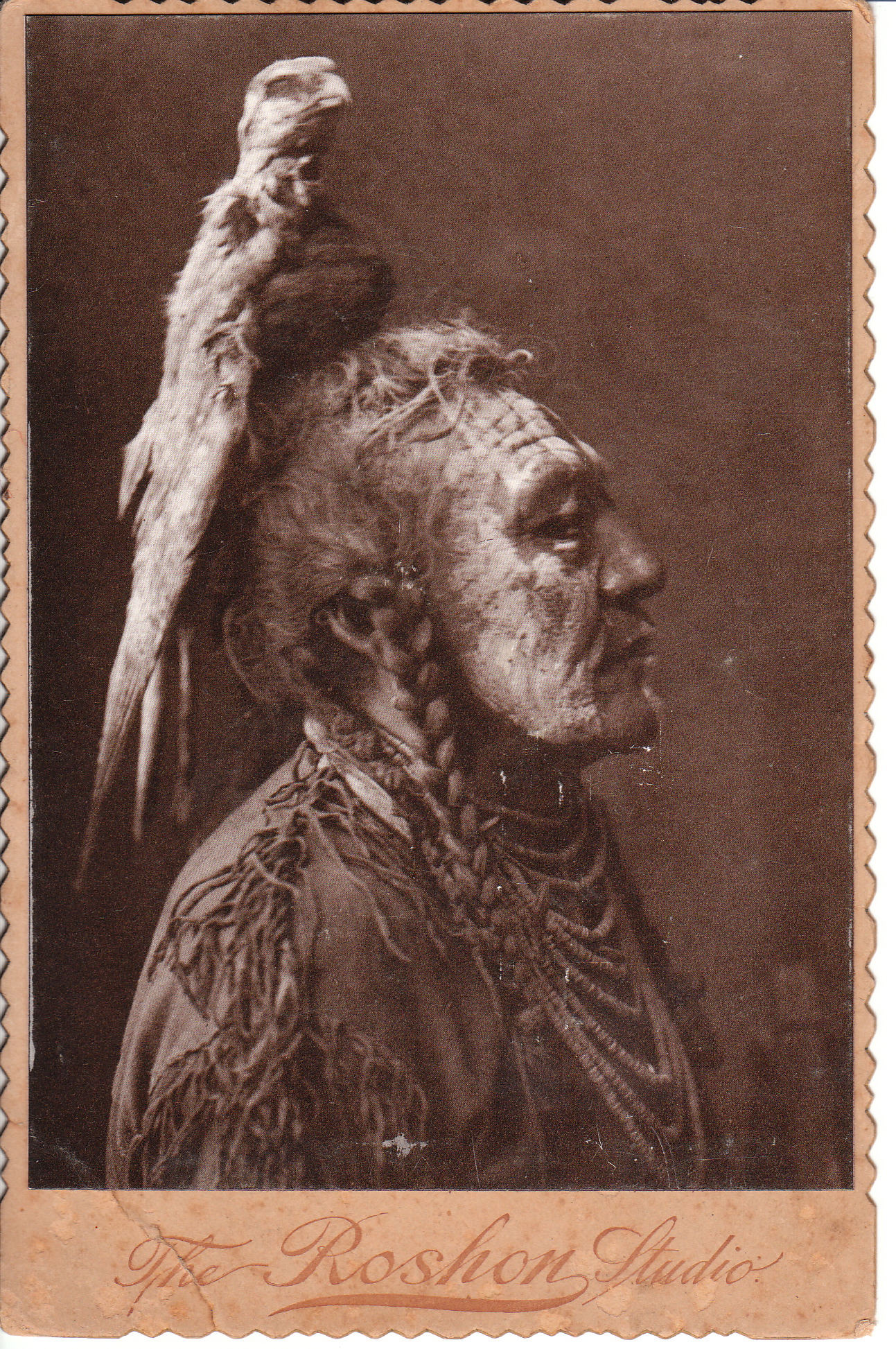
 This cabinet card is a terrific image of a Native American dressed in his tribal clothing. He has a bird on his head that looks as weathered as he does. The bird may be a turkey vulture. Hopefully, a visitor to this site with some ornithology knowledge, can better identify or confirm the bird’s species. What an amazing photograph? However, is it a counterfeit cabinet card? I located the cabinet card in an antique store and purchased it with a great deal of reluctance. Native American cabinet cards have a history of being a popular type of cabinet card to counterfeit, due to their potential high value and strong demand. There are a number of methods to make fake images. This photograph does not seem to be a product of a high tech copy machine. However, the image could be a Native American postcard pasted over an “ordinary” cabinet card image. This cabinet card, if not the image, is from the studio of C. S. Roshon of Lebanon, Pennsylvania. The photograph was produced in 1892. Perhaps a traveling western show was in the area of Lebanon; or perhaps Roshon purchased this image to sell at his galleries. The Roshon Galleries were located at 142 North 8th Street, and 22 South 9th street, in Lebanon. Roshon also had a studio somewhere in New Jersey. Any comments from Cabinet Card Gallery visitors, regarding the authenticity of this cabinet card, would be greatly appreciated. To view other photographs from Roshon’s studio, click on the category “Photographer: Roshon”.
OUTSTANDING PHOTOGRAPH OF A NATIVE AMERICAN MAN WITH A TURKEY VULTURE PERCHED ON HIS HEAD… (IS THIS IMAGE COUNTERFEIT OR GENUINE?)

The URI to TrackBack this entry is: https://cabinetcardgallery.com/2011/06/14/outstanding-photograph-of-a-native-american-man-with-a-turkey-vulture-perched-on-his-head-is-this-image-counterfeit-or-genuine/trackback/


 THE CABINET CARD GALLERY
While it’s a fascinating, if somewhat bizarre, image, I’m afraid the grainy texture of the photograph itself doesn’t bode well for it being a genuine, original image. I can’t be sure from the image you have on the net, but over the whole photo there appears to be graininess which just wouldn’t be present in a real photographic print. In the lighter areas in particular, this is most noticeable. There also appear to be some diagonal artefacts – these may be an artefact caused by your scanner. It often happens when scanning images from postcards, magazines, etc printed with the rotogravure process.
Not a turkey vulture but maybe a small hawk or falcon.
@Brett Payne. Interesting observation. What I see though, can been seen at the maximum resolution and only in the white areas. It is there that you can see a diagonal ‘curduroy’ style pattern. Like lots of rows of thin stripes. Probably a reason for that, though.
The graininess appears to be a half-tone dot pattern.The presence of a half-tone dot pattern suggests that this may very well be a later copy.That said, it must be noted that the half-tone printing process, if memory serves me correctly, was introduced in the 1880’s. I have in my collection several original cabinet card photographs which were printed in the 1890’s by the half tone process. At the time this would have been a fairly new means of producing a “press run” of photographs for public sale at a relatively inexpensive cost, thus bypassing the more costly process of contact printing by the traditional photographic printing process. Finally, I have been collecting Cabinet Card photographs for 30+ years and have never come across this particular image. I would be interested in hearing if anyone else has.
Looks like the work of Edward S. Curtis. Even Curtis was guilty of using different “authentic props” to adorn his subjects. You might investigate that possibility. Love your site. Collector of over 40 yrs.
I have a Roshon panoram of Harrisburg. They produced some fine images. As for the portrait above, I think it’s authentic, and I’m pretty sure the bird in question is a pheasant.
This is the true answer to your questions : yes, one of you is right. This is a photo from E. S. Curtis. Well known photo of Two Whistles, Apsaroke Tribe (Crow), 1908. No doubt! http://bit.ly/1T3JeNH
Raphaël PONCE (France)
You can find Edward Curtis photos at the library of congress if you ever need to check another. He did so many wonderful native American photos it’s likely to come up again, plus it’s just great viewing.
http://www.loc.gov/pictures/search/?st=grid&co=ecur
I know nothing about historical photography, printing processes, or cabinet cards. But I do know a little about animals. I can pretty much guarantee that this bird is dead, and stuffed. As in, a prop.
Just an opinion.
This image is by Edward Curtis, as mentioned by a reader above. The Native American’s name is Two Whistles, also known as Ishichoshtupsh. He is from the Mountain Crow of the Not Mixed clan. The bird he wears is a medicine hawk, which he purchased from the Sioux for the price of a single horse. So — let’s just say the image is a reprint. I’ve read that this was a common way of advertising the “skills” of a photography studio.
Thanks so much for sharing the information regarding this image. I have seen the image elsewhere a couple of times over the past couple of decades. On both occasions I saw the photo at historical sites. In addition, I think you are correct about other cabinet card era photo studios reprinting original historical photographs from other studios. Not only did reprinting show case the copying photographers skills, selling celebrity photograph reprints was a good source of income.