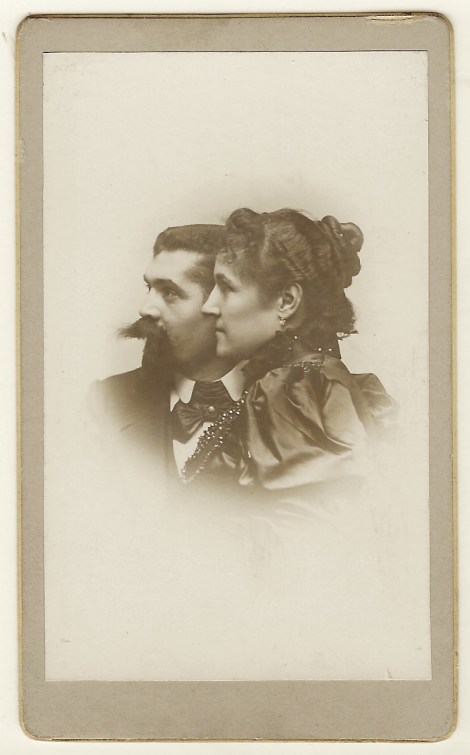
This carte de visite portrait captures a very attractive and well dressed couple. They are also well-coiffed. The previous owner of this cdv reported that the photograph is of French origin. However there is no evidence on the photograph that confirms that claim. (SOLD)
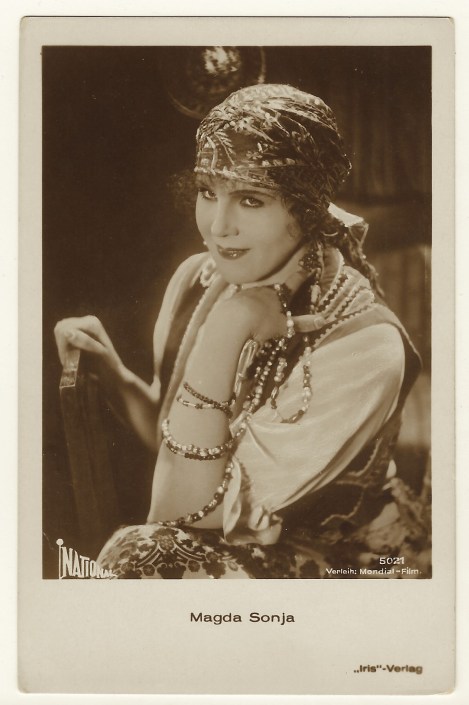
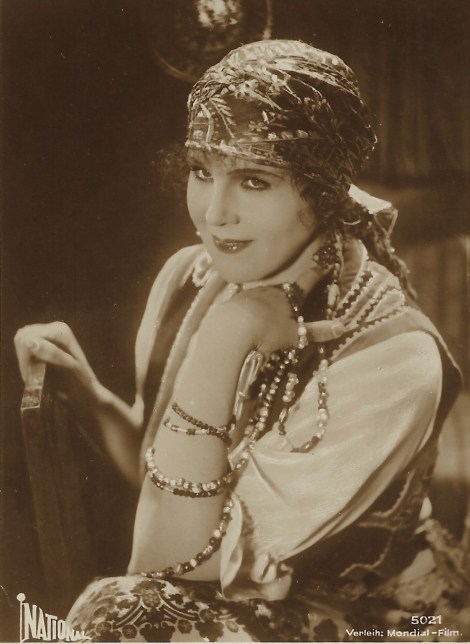
This vintage real photo postcard features Austrian actress Magda Sonja (1886-1974). She was married to film director Friedrich Feher. Her acting career began when she was twenty years of age when she appeared in a production in Vienna. She then appeared in a number of Cabaret performances. She began her silent film career in 1917 in the film “About A Woman”. By 1918 she was a star of Austrian silent films along with Liane Haid. In fact, Sonja was the actress with the most appearances for the very productive Sasch-Film company. Among her films were “The Other Me” (1918), “Don Juan’s Last Adventure” (1918), “The Venus” (1922), and “Drakula halala” (1923). She is considered to have reached the height of her career in (“Mata Hari, The Red Dancer”). The IMDb credits Sonja with appearing in 43 films between 1917 and 1937. Magda Sonja was another actress who’s career cooled off after the advent of sound movies. In 1933, she and her husband emigrated to England to avoid the persecution of Jews. In 1937 they moved to the United States. Sonja was the mother of actor Hans Feher. It is unfortunate that Sonja and her husband had no success in resuming their careers in Hollywood. This postcard was published by Iris Verlag as part of a series (no, 5021). Logos for “National” and “Mondial-Film appears on the front of the postcard. Mondial-Film was a production company and a film distributor.
This vintage photograph is very effective at capturing a warm family moment. They appear to be in the family’s living room. Note the assorted photographs in the room as well as the flowers in a couple of vases. Mom stands by her elder daughter while the daughter is playing the piano. The mother is touching the sheet music which may indicate that she is turning the pages for her. The adorable younger daughter is sitting on her father’s lap and she is reading a book. Magnification reveals that she is reading a book called “Becassine”. Becassine is a comic strip character, in fact, the first female protagonist in the history of comics. The comic was first released in 1905. Between 1913 and 1950, 27 volumes of the adventures of Bécassine were published. This photograph and board measures approximately 8 1/2″ x 10″. The actual image itself measures about 6 1/2″ x 4 3/4″. SOLD
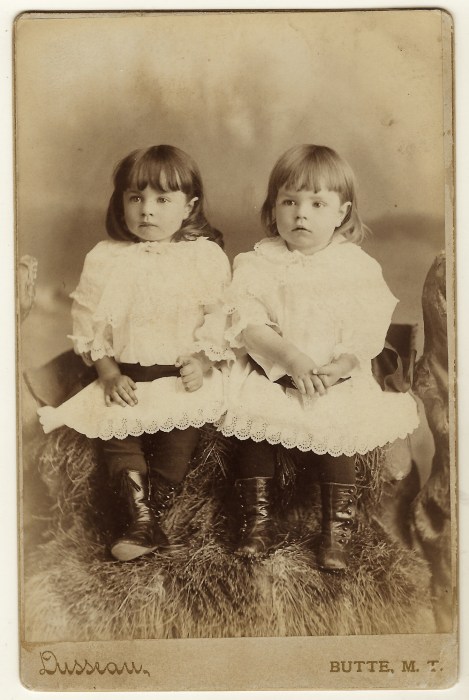
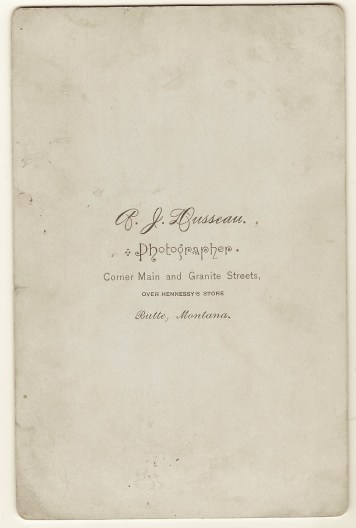
The little girls seen in this cabinet card photograph are adorable. Perhaps these identically dressed girls are twins. Note the black belt that each of them are wearing. Is the belt part of their dresses or is it a photographer’s accessory to hold the girls safely on a chair. The photographer of this image is A. J. Dusseau. His studio was in Butte, which was located in the Montana Territory (1864-1889). Dusseau was born in Vermont in 1842. His employment before becoming a photographer included being an engineer on a steamboat and working as a musician. In 1874 he operated a photography studio in Deer Lodge, Montana and he then moved his business to Butte in 1877. The Cabinet Card Gallery has a number of his photographs which can be seen by clicking on the category “Photographer: Dusseau”. (SOLD)
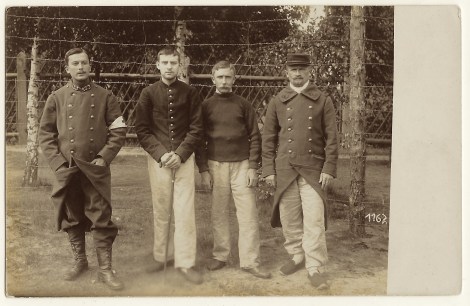
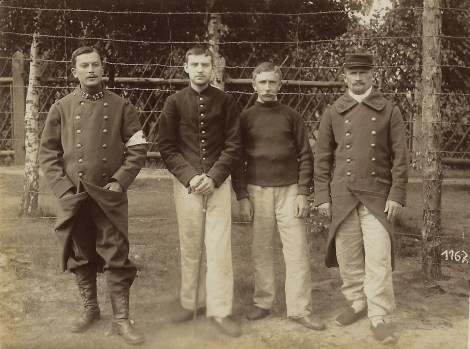
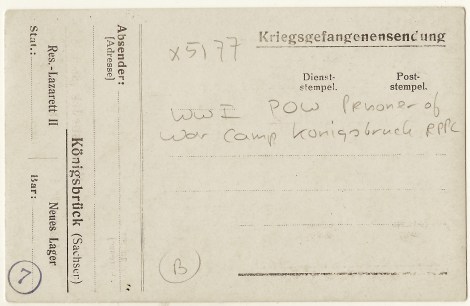
Some images are very effective at capturing history. This real photo postcard is one of those historic photographs. The image features World War I prisoners of war held at Camp Konigsbruck. The POW camp held Serbian, Russian, and French prisoners of war. The camp held about 15,000 captives. I am unsure if this photo shows four prisoners or two prisoners and two guards (the men wearing heavy coats). One of the possible “guards” is wearing a red cross armband. Note the high barbed wire fence in the background. This photograph was taken sometime around 1916. Konigsbruck is a town in the German state of Saxony. It is located only 17 miles from Dresden.
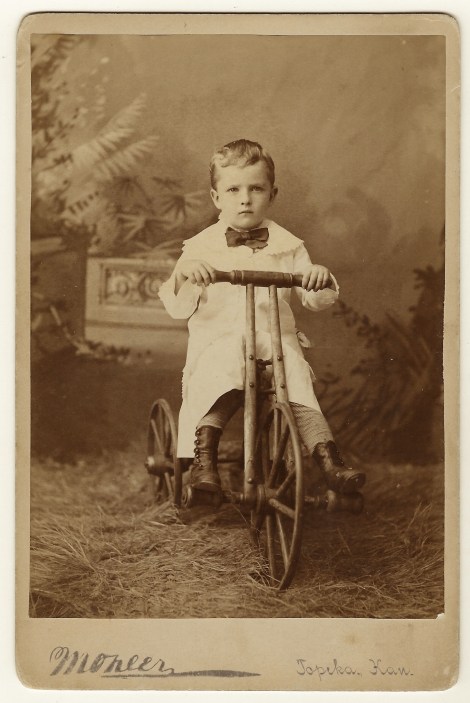
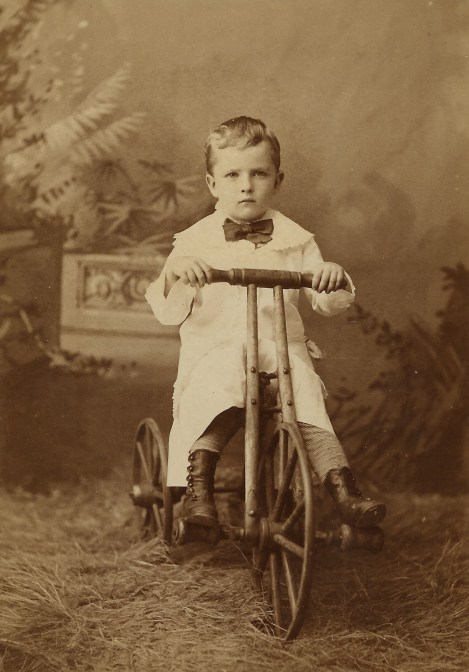
This cabinet card portrait features a little boy sitting on a tricycle. The bike appears to be made from wood. The child is wearing a bow tie and a serious expression. The image was produced by the Mohler studio in Topeka, Kansas. J. W. Mohler was born in Indiana in 1850. While young, his family moved to Missouri. Mohler enlisted th the 3rd Illinois Infantry (Co. H) as a fifer. He spent two years at a garrison in Detroit. In 1871 he married Belle Viard. He came to Topeka to work as a photographer in 1880. He is listed in the Topeka business directories from at least 1882 through 1895. At one point he was partnered in a photography business named Mohler & Rector.
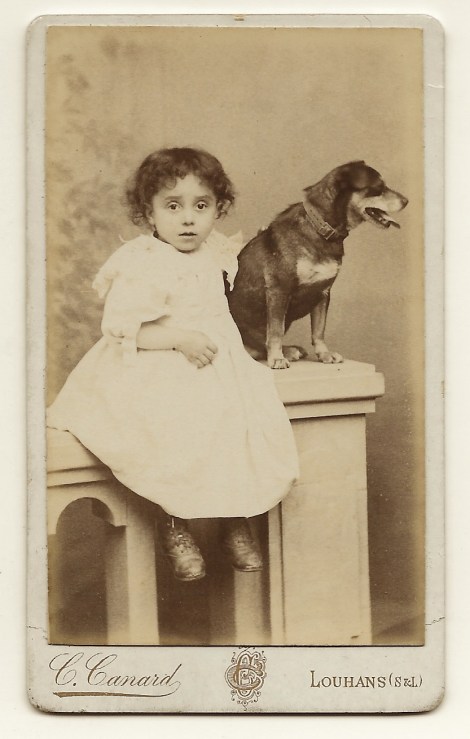
This carte de visite portrait features a young child sitting on a short wall alongside his/her dog. The child is adorable. This cdv photograph was taken by the C. Canard studio in Louhans, France. Louhans is located in the region of Bourgogne in eastern France. (SOLD)
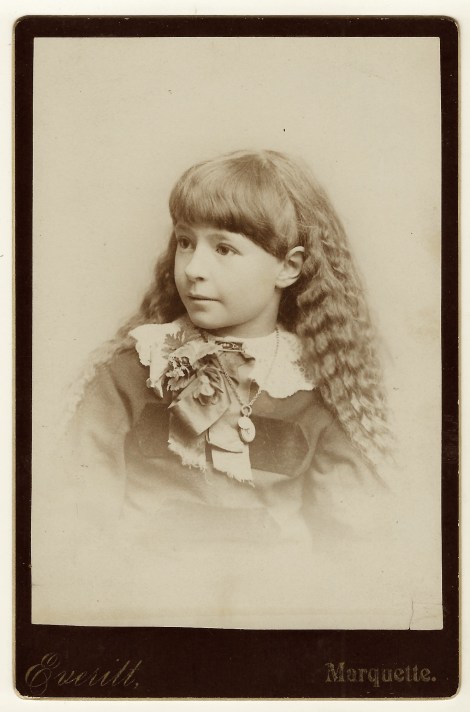
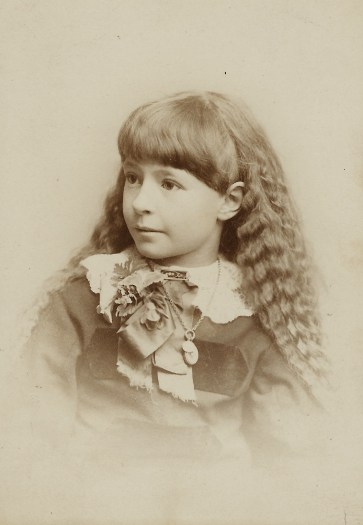
This cabinet card photograph features a cute little girl posing for her portrait at the Everitt studio in Marquette, Michigan. She is wearing jewelry, flowers and a ribbon and lace collar. She is also wearing an adorable expression. The photographer of this image is Henry Everitt. He is listed in Marquette’s 1894 business directory. SOLD
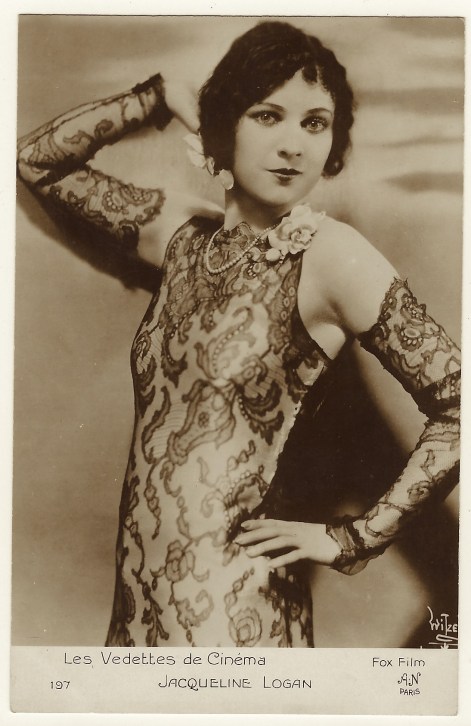
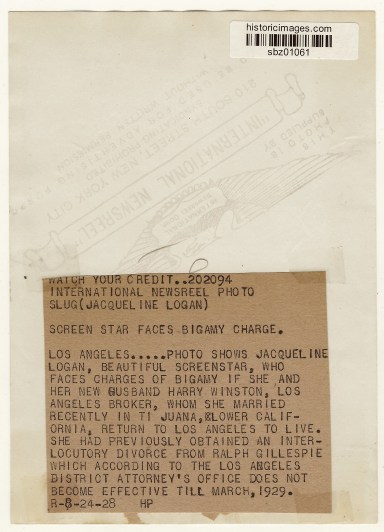
This vintage real photo postcard features silent film star Jacqueline Logan (1904-1983). Logan had auburn hair and green eyes. She was considered to be very beautiful. Logan was a “WAMPAS Baby Star” of 1922. The Western Association of Motion Picture Advertisers sponsored the WAMPAS promotional campaign. Each year between 1922 and 1934 the promotion honored 13-15 young actresses who were predicted to be on the cusp of movie stardom. Other honorees besides Logan included Clara Bow, Joan Crawford, Fay Wray, and Ginger Rogers. Jacqueline Logan was born in Corsicana, Texas and grew up in Nebraska. She worked briefly as a journalist in Scottsbluff, Nebraska and than went to Colorado Springs for health issues. She took a journalism course there and than moved to Chicago where she found a job dancing in a stage production. She had told her family she was going to Chicago to attend college. She then went of New York City with a theater troupe. While in New York, she received a small part in the Broadway musical “Florodora (1920). She was noticed by Flo Ziegfeld who hired her as a dancer. She also was selected to model in photographs by Alfred Cheney Johnston. By 1921, she began appearing in films. Her first role was in “The Perfect Crime”. Also featured in the film was Carole Lombard, who at the time, was a child actress. Cecile B. DeMille selected Logan to play Mary Magdalene in the film “King of Kings” (1927). The movie broke audience attendance records. With the advent of “talkies”, Logan had less success. However, she did appear in “Show of Shows” (1929) in which she was a member of an all-star cast. Next, she went to England to do stage work. She received many good reviews. She was then hired by British International Pictures to write and direct films. She was successful in her writing and directing. When she returned to Hollywood she found that studios were not interested in hiring her for behind the camera work. Their resistance was likely predominately due to not wanting a female to direct films. Back in America, she appeared in several Broadway shows including “Merrily We Roll Along” and “Two Strange Women”. In 1934, after her marriage to an industrialist, she retired from films. The IMDB web site reports that Logan has 61 film credits between 1921 and 1931. The Internet Broadway Database lists 3 Broadway play credits for the actress between 1920 and 1935. In her later years, Logan became a conservative political activist and member of the John Birch Society. This real photo portrait postcard was produced in France. It was part of a series (no. 197) called “Les Vedettes de Cinema (Stars of the Cinema)”. The photograph was taken at the Alfred Noyer studio (AN) in Paris. The actual photographer may have been Witze. The postcard includes an advertisement for Fox Film, indicating Logan’s affiliation with the studio at the time of the photograph. The second photograph of Miss Logan is a press photo from 1928. Judging by the title of the text on the reverse (see below), this image appeared in a newsreel. Jacquline Logan had made the news because she had committed bigamy. Apparently she married Larry Winston before her divorce from Ralph Gillespie had become finalized. It appears she was too impatient to wait for the ink to dry on her divorce decree.
The beautiful woman seen on this vintage real photo postcard is Miss Paulette. I have been unable to find biographical information about her. The former owner of this photo postcard identified her as Miss Paulette and stated she performed in Paris at the Folies Bergere, a cabaret music hall established in 1869. This portrait of the actress is risque for it’s era but it is certainly tastefully done. In an attempt to identify this actress, I came across the five postcards seen below. I believe that the pretty woman seen in the postcard above is Paulette Del Baye although I lack any concrete convincing evidence. This postcard has a German stamp that is postmarked in Rixdorf (a neighborhood in Berlin). The card was postmarked 1912. The postcard was published by Neue Photographische Gesellschaft (NPG) which was located in Berlin and Stuttgart, Germany.The company was in business between 1894 and 1948. It was founded by Arthur Black (1862-1943) and it became one of the most well known and largest companies involved in the production of postcards. SOLD








 Paulette
 Paulette
 Paulette Del Baye
 Paulette Del Baye
 Paulette Debrives


 THE CABINET CARD GALLERY