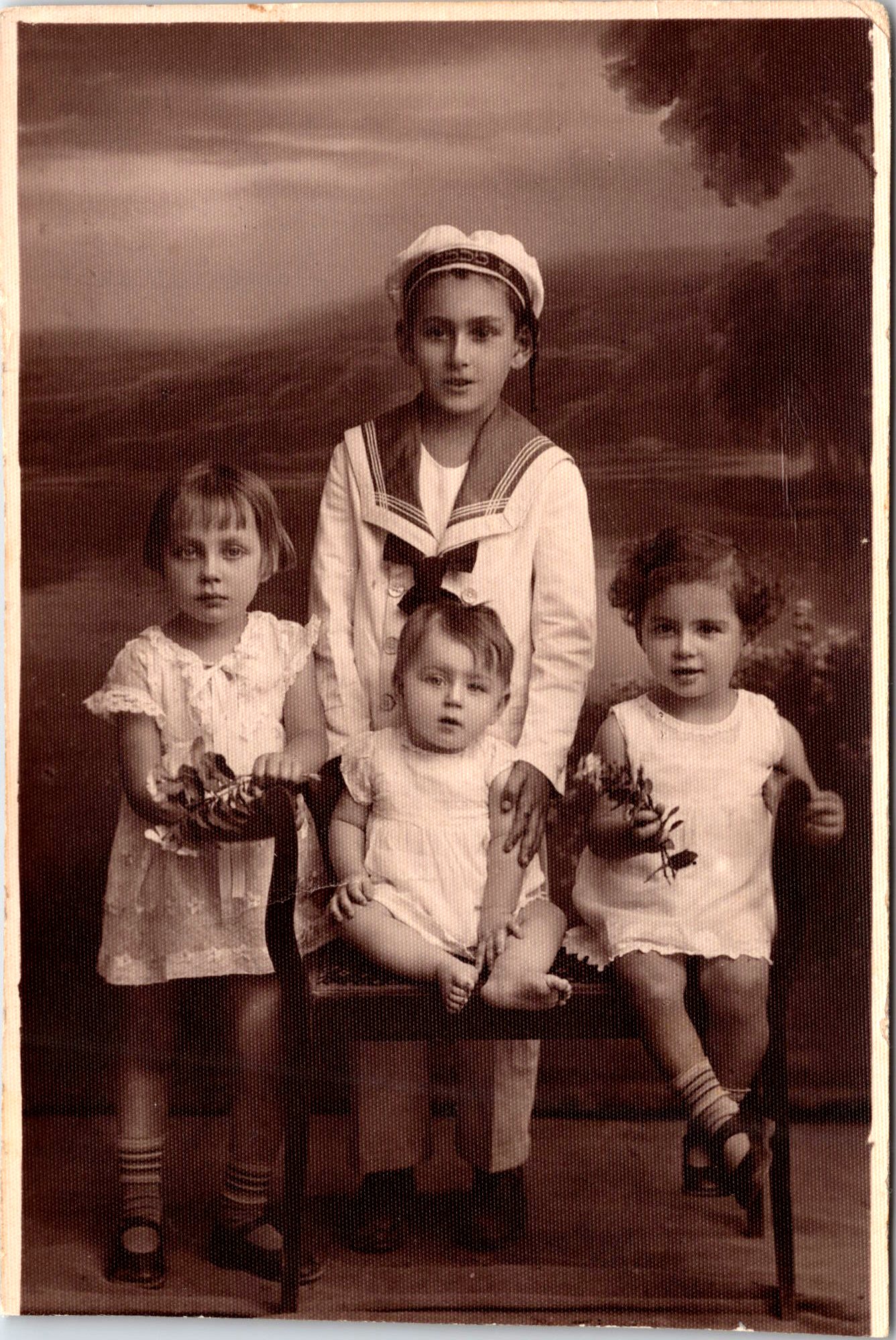
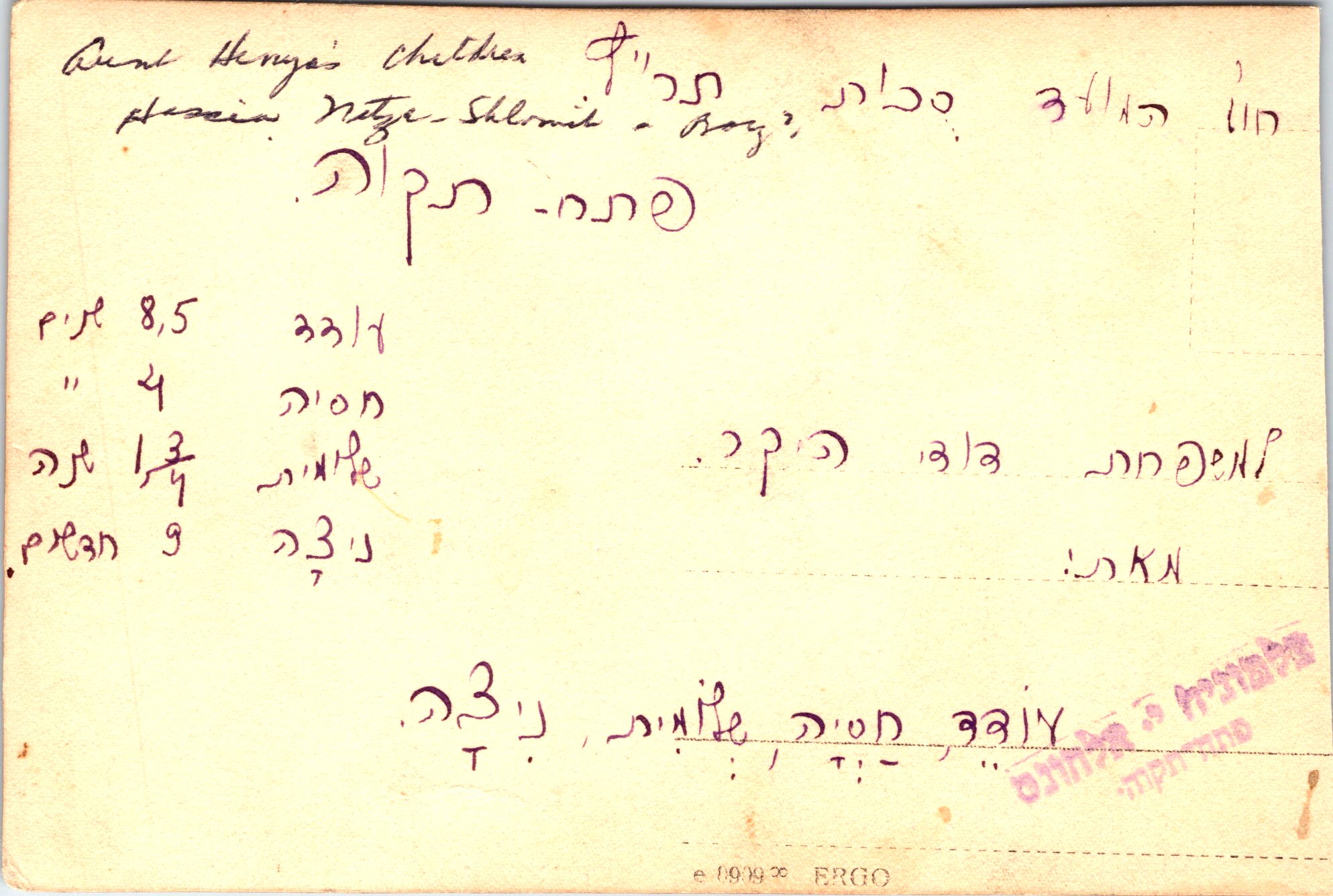
This evocative early 20th-century lithographic photograph depicts four children, likely siblings, posed together in a domestic or courtyard setting. The composition is striking for the contrast in age: one older child, standing or seated protectively behind or beside three much younger children, who appear to range from toddler to early childhood. The older child’s posture and expression suggest responsibility and attentiveness, reinforcing the impression of familial hierarchy and care. The children are dressed in simple but carefully chosen clothing typical of the pre-World War I or interwar Jewish diaspora, with modest garments that reflect everyday life rather than studio formality. Their expressions are sober and composed, a common feature of period photography, particularly within Eastern European or immigrant Jewish communities where photographs were often made to commemorate family continuity or to be sent to relatives abroad. Turning to the reverse, the photograph bears handwritten Hebrew text, written in a flowing but economical hand. The inscription appears to be a personal dedication, likely identifying the children or addressing a family member. In narrative translation, the text conveys a sense of familial connection and remembrance rather than a commercial or studio notation, suggesting the photograph was intended as a keepsake rather than a public portrait. Taken together, the image and inscription strongly suggest a Jewish family context, possibly Eastern European or immigrant, dating to approximately the 1910s–1920s. Photographs of this type are historically significant, as they document ordinary Jewish family life during a period marked by migration, instability, and profound cultural transition. The following is an AI translation of the text on the reverse of the photo. The reverse of the photograph bears handwritten Hebrew identifying the children by name and age. Three girls—Chava, Rachel, and Sarah—are listed, along with a fourth child, a baby boy noted as nine months old. The ages are carefully recorded: one child aged eight and a half, another four years, a toddler of one and three-quarters years, and an infant. The place name Petach Tikva is prominently written, situating the family in what was then a Jewish settlement in Mandatory Palestine. The inscription reads as a personal family record rather than a postcard message, likely intended to document and preserve the identities of the children. A brief closing—“From me!”—suggests the photograph was sent as a keepsake to relatives. An English annotation at the top, reading “Aunt Henny’s Children”, appears to have been added later, reinforcing the photograph’s role as a family archive object rather than a commercial image. This photo measures about 3.25 x 5 inches. The photograph presents well overall. The photograph is possibly trimmed at it’s bottom. The image has a crease which can be seen on the seated middle child’s right hand. The handwritten Hebrew inscription on the reverse remains legible and intact (see scans).
This cabinet card is available for purchase at my store, The History Peddler, for $36.00 or best offer.
Interested collectors may view the listing here:
https://www.ebay.com/itm/236574661382


 THE CABINET CARD GALLERY
Leave a comment