PORTRAIT OF PRETTY FRENCH FILM ACTRESS JOSYANNE

josey

This vintage real photo postcard features French actress Josyanne (1901-1999) as she appeared in her screen role in the film “Carnelvale di enezia” (1928). The IMDb credits her with 14 film roles between 1924 and 1939 including L’aube de sang (1924), Le costaud des PTT (1931), and Aces of the Turf (1932). This postcard is of Italian origin and was edited by G. B. Falci of Milan. The postcard is part of a series (no. 103). Listed on the front of the photograph is the name Stefano Pittaluga (1887-1932). He was an Italian film producer credited with helping revive the Italian film industry in the late 1920’s and early 1930’s. He began as an owner of cinemas and than expanded to become a powerful distributor of Hollywood movies. Pittaluga further grew his business by becoming a major film producer.  (SOLD)

josey-1

Published in: on January 13, 2017 at 12:00 pm  Leave a Comment  
Tags: , ,

PORTRAIT OF KARINA BALL: BEAUTIFUL ACTRESS AND BREWERY DIRECTOR

bell


bell-1

Karina Bell’s beauty is quite apparent in this vintage real photo postcard portrait.  She was born in Hellerup, Denmark in 1898 and died in Denmark in 1979. Bell was a film actress who began her career as a ballet dancer. She made her stage debut in 1919. Most of her films were silent films produced in Sweden, Denmark or Germany. She did appear in two talkies. She was known for her roles in “Little Dorrit” (1924), Klovnen (1926), and “5 Raske Piger” (1933). Bell was one of the most popular stars of the Nordisk Films Kompagni in the 1920’s. She was married in 1934 to Knud Parkov (1894-1949). He was the director of a Danish brewery (Wiibroes Brewery) and a member of the Danish resistance. She retired from acting after she got married. The IMDb gives Karina Bell 20 credits. Her film appearances occurred between 1919 and 1933. Upon her husbands death, Bell took over his director duties at the brewery. This Austrian postcard was produced by Iris Verlag as part of a series (no. 589). The photograph was by Lux-Film.

bell-2

SEXUAL CHEMISTRY IN FILM: VIRGINIA VALLI AND GEORGE O’BRIEN (RPPC)

valli

valli-1

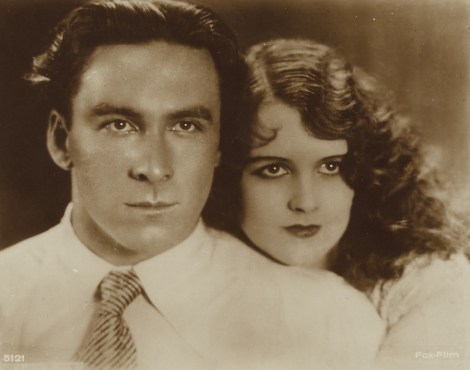
Can sexual chemistry be photographed? This fantastic vintage real photo postcard provides evidence that the answer is yes. This image captures early film stars George O’Brien and Virginia Valli in an emotionally charged scene in an unknown movie. The pair starred together in at least two silent movies produced by Fox. The films were “Paid to Love” (1927) and “Eastside Westside” (1927). Virginia Valli (1898-1968) was an American stage and film actress. Her early acting experience was with a Milwaukee based stage troupe. Her film career started in the silent film era and ended in the early stages of the talkies (1930’s). She has 65 credits on the IMDB web site. She began her film work with Essanay Studios in her hometown of Chicago in 1916. By the mid 1920’s, she was an established star at Universal Studios. She was the star of  King Vidor’s “Wild Oranges” (1924). Most of her films were produced in the mid 1920’s and include Alfred Hitchcock’s first feature movie, “The Pleasure Garden” (1925). Her first sound picture was in 1929. She left the movie business in 1931 due to her high salary command and declining appeal to audiences. She moved to Palm Springs, California with her second husband, actor Charles Farrell. She was very much part of the social scene there. She died in Palm Springs at age seventy. George O’Brien (1899-1985) was an American actor popular during the silent film era as well as the early talkies era of the 1930’s. He is remembered most for his role in Murnau’s 1927 film “Sunrise: A Song of Two Humans”. He had an active film career which is evident by the fact that the IMDB web site gives him 85 credits. O’Brien was born in San Francisco and his father at one time, was the city’s chief of police.  During World War I, O’Brien was in the US Navy and served on a submarine chaser. He worked as a stretcher bearer for wounded Marines and was decorated for his bravery. Following the war, O’Brien became the light-heavyweight champion of the Pacific Fleet. After completing is service, O’Brien was in his early twenties and he went to Hollywood to seek work as a cameraman. He did find employment in the field and helped film for Tom Mix and Buck Jones. He then entered acting by playing bit parts and by being a stuntman. His first starring role was in “The Man Who Came Back” (1927) where he played opposite Doroth Mackaill. He then appeared in “Iron Horse” by famed director John Ford in which his counterpart was Madge Bellamy. The film was a great success and the experience forged a colloborative relationship with Ford that resulted in O’Brien appearing in nine more of the directors films. He spent much of the 1920’s as a leading man in action and adventure type roles. During the 20’s he received the nickname “the torso” because of his excellent physique. With the arrival of sound, O’Brien appeared predominately in Westerns during the 1930’s and he was considered a major draw. With the arrival of World War II, O’Brien re-enlisted in the US Navy and served as a beachmaster in the Pacific theater. He was decorated several times and when he was discharged he had attained the rank of commander. He later joined the Naval Reserve where he served as a captain. O’Brien’s last leading role was in a film that included the Three Stooges. According to his obituary,  O’Brien was buried at sea courtesy of the US Navy. This real photo postcard was published by Iris Verlag and made in Germany. The postcard is part of a series (no. 5121) and credits Fox Film.
ADDENDUM: After viewing this image, a visitor contacted me to claim that the beautiful woman in this photograph is not Virginia Valli, but instead, it is June Collyer (1906-1968). I was unable to locate information or relevant comparison images to definitively confirm that it is Collyer that is in the photograph, but I did find a film publicity photo identical to the postcard image above. The description of that photo indicates that the pictured woman is Collyer. Collyer was born in New York City and as a society girl was chosen by Allan Dwan (Director, Producer, Screen Writer) to her first starring role in “East Side, West Side. She did eleven silent films and made a successful transition to talkies. In 1928 she was he was one of the thirteen girls selected as “WAMPAS BABY STARS”. In 1930 she appeared in “The Three Sisters” and “Sweet Kitty Bellairs”. From 1930 through 1936 she starred in nineteen films. She took a sabbatical from acting in the 1940’s and did television acting during the 1950’s. June was the sister of radio actor/announcer Bud Collyer (1908-1969). He became a major game show star hosting such programs as “Beat the Clock” and “To Tell the Truth”. June Collyer was married to actor Stu Erwin. In conclusion, I am unsure whether the beautiful woman in this image is Miss Valli or Miss Collyer. It is an answerable question if someone is willing to do the requisite research.

valli-2

MISS EVELEEN RAINE: PRETTY THEATRE ACTRESS (PHOTO BY ELLIOTT AND FRY)

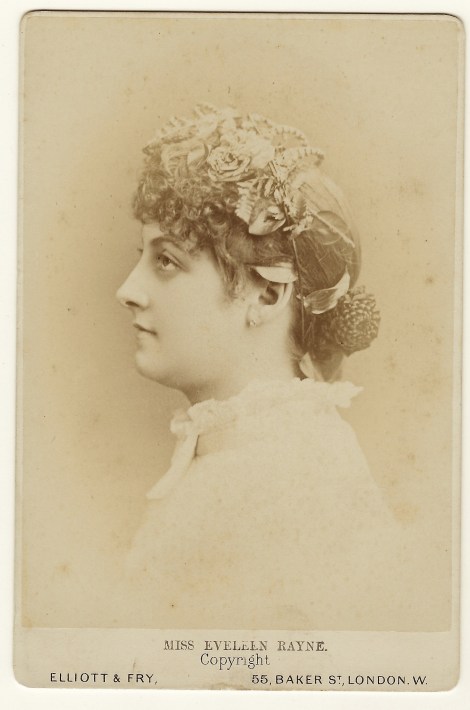
rayneThis cabinet card portrait features stage actress Eveleen (Evelyn) Rayne. She became titled when she married George Fitzwilliam in 1888. She died in 1925. The Elliott & Fry studio produced this image. This Victorian photographic studio and photographic film manufacturer was founded in 1863 by Joseph John Elliott and Clarence Edmund Fry. For an entire century the studio took and published images of leading Victorian luminaries from the fields of science, public service, art, politics as well as celebrities of the day. To view other photographs by this studio click on the category “Photographer: Elliott & Fry”.

rayne-1

Published in: on December 7, 2016 at 12:00 pm  Leave a Comment  
Tags: ,

BEAUTIFUL STAGE ACTRESS JOHAN WITTMAN (PUBLICITY PHOTO)

publicity-photo

Beautiful stage actress Johan Wittman posed for this publicity photograph for her appearance  in “The Perfect Fool”, a play that appeared at the George M. Cohan Theatre” in New York City (Broadway). Ed Wynn provided the book, lyrics, and music. The revue played in 1921 and 1922 and ran for 275 performances. Miss Wittman looks elegant in her “to the floor” beaded dress. The previous owner of this photograph hypothesized that the dress was modeled after a peacock feather. I agree with his observation. Miss Wittman is holding a feather fan behind her head. She truly is representative of the flapper era. According to Broadwayworld.com, Miss Wittman’s Broadway experience was confined to her role in “The Perfect Fool”. The photographer of this lovely portrait was Ira Daniel Schwarz (1878-1946) who was based on West 48th Street in New York City. Schwarz was a Brooklynite and one of the first New York portrait artists to work in the movie industry. He began his career as a pictorialist art photographer and during World War I he went to work for Screencraft Pictures (located in New York) as Cinematographer and Stillman. He displayed a lot of talent as a Stillman and in 1919 became the chief portrait photographer for the company. The website “Broadway Photographs” reports that Schwarz was fascinated with shade and that his images were often recognized for their “plummy blacks”. In 1924 he left Photocraft and established his own studio. In regard to his skill as a portrait photographer “Broadway Photographs” assert that Schwarz was considered “a photographic psychologist” by his colleagues because he was excellent at “capturing the mentality of his sitter”. During World War II he closed his studio due to the silver shortage.

publicity-photo-1

MISS JOSE COLLINS: BEAUTIFUL STAGE AND FILM STAR (VINTAGE REAL PHOTO POSTCARDS)

jose-collins POSTCARD 1  (SOLD)

collins POSTCARD 2

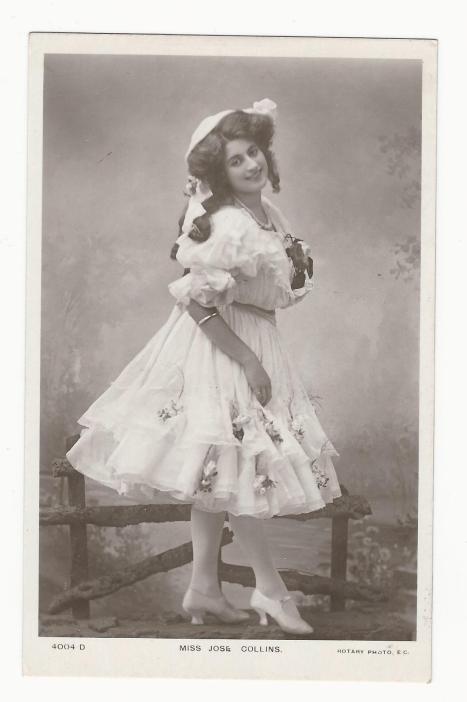
The pretty woman featured in this vintage real photo postcard is Miss Jose Collins (1887-1958). The name “Jose” was a shortening of her given name “Josephine”. She was an English actress and singer known for her appearances in musical comedies and early movies. She was born in London. Her mother was a music hall performer and comedian named Lottie Collins. Interestingly, she was the singer who popularized the song “Ta-ra-ra Boom-de-ay”. Jose Collins father was Stephen Patrick Cooney, her mother’s music coach. Collins began as a child actress and as a teenager had already appeared in both pantomine and music hall performances as a singer and actress. Her debut performance in the West End was a major role in “The Antelope” (1908). She also appeared on Broadway  in the production of “Vera Violetta (1911), “The Merry Countess (1912), “The Whirl of Society” (1912), and other shows. In the later production, she sang a duet with Al Jolson. She also appeared in the Ziegfeld Follies (1913). In 1917 she appeared in the hit musical “The Maid of the Mountains”, a role for which she received much acclaim. She actually earned a nickname from the show; she was known as “The Maid of the Mountains”. She appeared in a number of shows through 1925. One of these productions was “A Southern Maid”  (at Daly’s Theatre) and this postcard portrait captures her in that role. The show was an operetta and her costar was Bertram Wallis. The production ran for 306 performances. The remainder of her career was spent acting in revues, variety and non-musical roles. She also appeared in films. The IMDB reports that she appeared in thirteen movies between 1915 and 1933. Miss Collins was married three times and these unions produced no children. The link below will take you to a Ziegfeld Follies performance by Jose Collins. She is singing “Just You and I and the Moon” (1913). This postcard was published by J. Beagles & Co. of London, England. The postcard is part of a series (no. 222 U). The photograph of Miss Collins is by Reville Studios.

The second vintage real photo postcard presents Miss Collins in a relatively short frilly dress. She looks very pretty as she flashes a nice smile. The postcard was produced by Rotary Photo and is part of the Rotary Photographic Series (no. 4004 D)


jose-collins-1                                                                                                                 POSTCARD 1

collins-2                                                                                                                                                                                                        POSTCARD 2

MEET THE VOKES FAMILY: JESSIE, VICTORIA, AND ROSINA VOKES WERE TALENTED SISTERS OF THE BRITISH STAGE

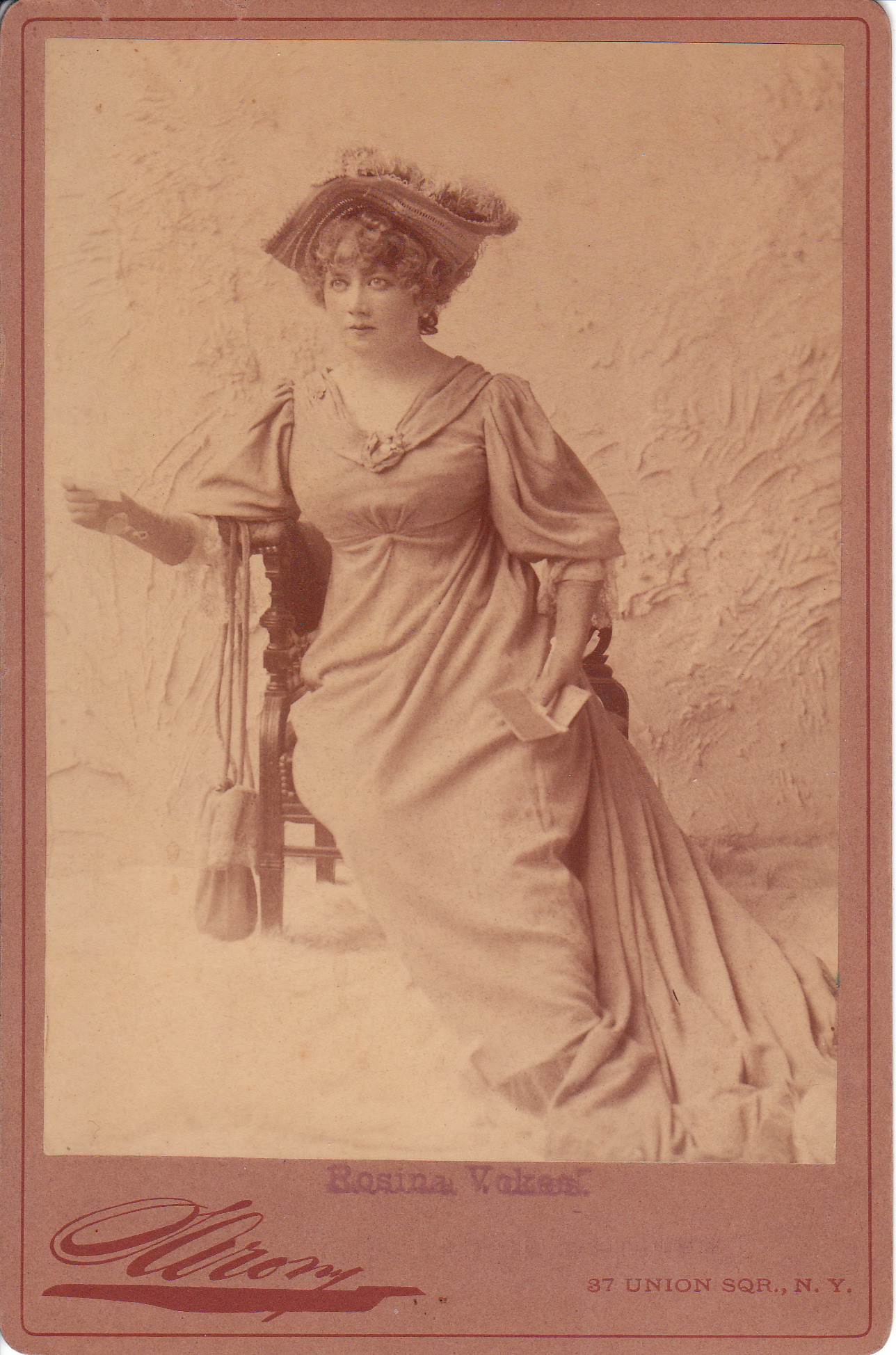
Rosina Vokes

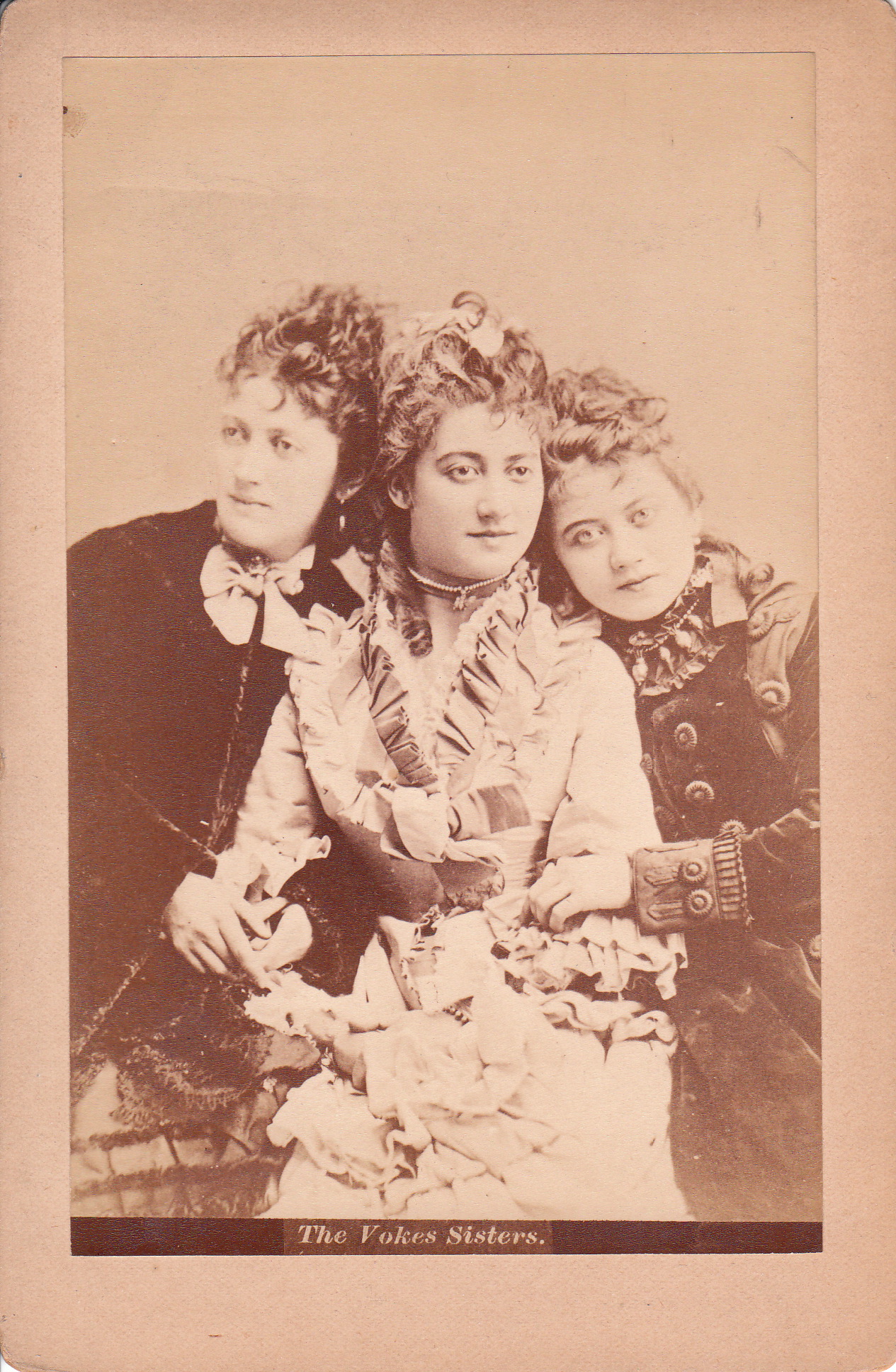
Rosina, Jessie, and Victoria Vokes

vokes

Victoria Vokes

The top photograph in this grouping features stage actress Rosina Vokes (1854-1894). She was the daughter of a London costumer. She came to America with her two older siblings and Fawdon Vokes to make a career in the theatre. Interestingly, Fawdon Vokes was not a member of the Vokes family. His name was actually Walter Fawdon, but the name change was necessary for him to join the family troupe. The group made their New York debut in 1872 in “The Belles of the Kitchen“. They played in a number of shows over time and from the beginning, Rosina was considered “infinitely the cleverest, the most bewitching” of the group. When she reappeared in America in 1885 with her own company, she was warmly welcomed. One paper wrote “she is still young, agile, slender and graceful; the piquant prettiness of her face and the droll charm of her manner still exert a strong influence on the susceptible spectator”. She toured with made-to-order productions, until shortly before her early death, at about, forty years of age. The New York Times (1893) published an article entitled “Rosina Voke’s Serious Illness: It Deprives the Anglo-American Stage of One of its Brightest Ornaments”. The article favorably compares her to her other acting family members and reveals that Vokes had embarked on a voyage from America to England whose purpose was to allow her to die in her home country. The young actress was terminally ill with consumption (pulmonary disease). Judging by the content of the many obituaries that appeared in American newspapers after Rosina Vokes succumbed to her illness, the actress was a well respected and loved performer of the American stage. It is important to note that the Vokes theatrical family included a brother named Fred Vokes (1846-1888). He was an actor and a dancer. This cabinet card comes from the studio of famed celebrity photographer, Napoleon Sarony. To view other photographs by Sarony, click on Cabinet Card Gallery’s category, “Photographer: Sarony”.

The second photograph captures Rosina and her two sisters posing for an unidentified photographer. The sisters have been identified as Jessie (1851=1884) and Victoria (1853-1894). The reverse of the photograph indicates that the image was formerly part of the “Harold Seton Collection”. Who is Harold Seton? Research reveals that Harold Seton was best known for his work as a journalist, author and collector. He wrote about theatre and society in his column, Theatre Thoughts”, which appeared in Theatre Magazine. He accumulated over ten thousand theatrical photographs of actors and actresses who performed between 1870 and 1900. He donated some of his collection to the New York Historical Society and some are  located at the Wake Forest University library, as well as a number of other institutions. A Harold Seton was a theatre actor who performed in eight plays between 1919 and 1935. Although I doubt that the two Harold Setons’ are the same men; no evidence could be found to determine if they were one and the same man.

The third image in this group is a carte de visite portrait of Victoria Vokes. The photograph was taken at the Broadway studio of Napoleon Sarony. Victoria was born in London and began her career at the Royal Surrey Theatre at just two years of age. Over time she played a variety of children’s roles in London theatres. In 1861 she appeared with her brothers and sisters at the Operetta House in Edinburgh as one of the “Vokes Children” (later changed to “The Vokes Family”. Victoria earned her early popularity with her voice but soon she was gathering acclaim via her acting. Her performance in “Amy Robsart” (1871) at Drury Lane Theatre is an example of one of her excellent exhibitions on stage. “The Cornell Daily Sun” (1890) wrote about an appearance by Victoria Vokes and her Company. The reviewer asserted that “Few actresses have appeared in Montreal whose genius is so versatile as that of Miss Yokes. She sings with a fine contralto of great power, dances like zephyr and acts in comedy — well, like one of the Yokes”.

MISS GERTIE MILLAR: BEAUTIFUL AND TALENTED BRITISH STAGE ACTRESS

millar

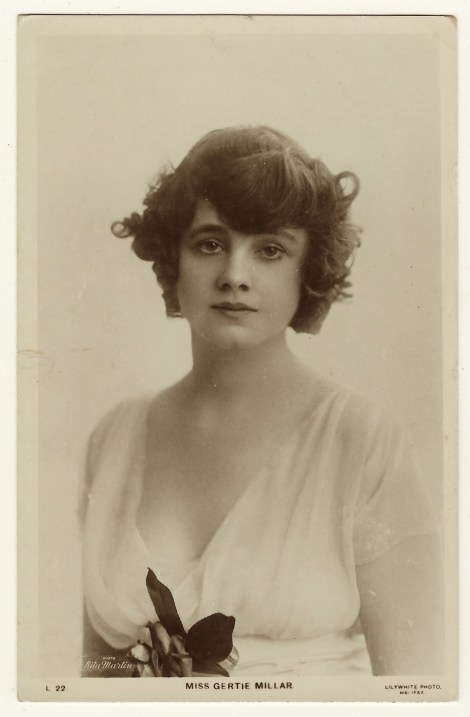
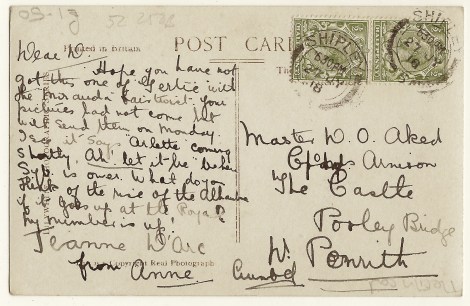
This vintage real photo postcard features beautiful English actress and singer Gertrude (Gertie) Millar (1879-1952). She was well known for her performances in Edwardian musical comedies. She began acting as a child (age 13) and was a well known star of musical comedies for two decades. Her first husband, Lionel Monckton, was the composer of many of her shows and songs. Monckton died in 1924 and Millar later married the 2nd Earl of Dudley, making her the Countess of Dudley. Some of Millar’s earlier appearances involved roles in “A Game of Cards” (1897), “Cinderella” (1899), “The Messenger Boy” (1900), and “The Toreador” (1901) at the Gaiety Theatre. By this time some of the songs she performedad become big hits. Gertie Millar was quite beautiful and was one of the most photographed women of the Edwardian period. Evidence of her popularity is the fact that there are 88 photographs of Miss Millar in England’s National Portrait Gallery. Many of these images appeared on postcards which became a popular collectors item.Gertie Millar was tall, thin and attractive with dark hair and large and very clear eyes. In addition she has been described as tough, determined and ambitious. Miss Millar appeared in many theatrical productions as the twentieth century progressed. In fact, between 1901 and 1910 Millar was the leading star of the Gaiety Theatre. Millar’s appearances included “The Orchid” (1903), “The Girls of Gottenberg” (1907), and “Our Miss Gibbs” (1909), “Gipsy Love” (1912). Gertie Millar went to the United States to star in the “Girls of Gottenberg” (1908) on Broadway. In 1914 she appeared in a film entitled “The House of Bondage”. After appearing in a number of less successful theatrical productions, Gertie Millar left the stage in 1918. Her husband died in 1924 and two months later she married the 2nd Earl of Dudley. The speed at which she remarried may reflect the unhappy state of her relationship with Mr. Monckton. The website “Stage Beauty” informs us that this theatrical couple had problems for many years. In fact the couple had unfortunate theatrics in their personal life. Mr Monckton was a jealous man and Miss Millar was a woman who attracted lots of male attention. This was a bad combination. A major dramatic incident occurred in  1905 when a young German nobleman who was infatuated with Gertie, broke into her marital residence and committed suicide by shooting himself in the head  at her dressing table. Gertie denied any involvement with the obsessed man but her husband refused to believe her denial. In 1910 her romantic life was in the news again because of speculation about her involvement with the Duke of Westminister. This publicity was considered a major cause of the Duke’s estrangement from his wife. This postcard portrait was taken by celebrity photographer, Rita Martin. She is considered one of the best British photographers of her time. Rita had a specialty in photographing actresses. Her sister was celebrated society photographer Lallie Charles. To learn more about Rita Martin and to view more of her photographs, click on the category “Photographer: Rita Martin”. This postcard portrait is part of the “Lilywhite Series” (no. L 22). The postcard has a postmark from Shipley, England (1918) and is addressed to someone in Penrith, England. The postcard has an interesting message which includes the following first line; “Hope you have not got this one (postcard) of Gertie …..”. Click on the you tube video below to hear Gertie Millar sing “Moonstruck” from the musical comedy “Our Miss Gibbs” (1909).   SOLD


millar-1

JOAN OF ARC: READY FOR BATTLE (VINTAGE REAL PHOTO POSTCARD)

joan-of-arc

This vintage real photo postcard features a pretty actress portraying “Joan of Arc”. She is wearing armor, and holding a flag in one hand and a shield in the other. Her medieval costume includes breastplates and a helmet. She has a sword hanging at her side and is wearing boots that almost look “space age”. Joan of Arc (1412-1431) was nick named “The Maid of Orleans” and is a heroine of France for her role in the Hundred Years’ War. She was canonized as a Roman Catholic saint. After being captured, she was tried and burned at the stake. The life of Joan of Arc became a popular subject in literature, theater, and film. Even Mark Twain wrote about her in the novel “Personal Recollections of Joan of Arc (1896) as did Sir Arthur Conan Doyle in “The Mystery of Joan of Arc” (1924).

joan-of-arc-2

PORTRAIT OF ACTRESS MISS ETHEL ERSKINE APPEARING IN “GIPSY LOVE” (VINTAGE REAL PHOTO POSTCARD)

pretty-actress-4

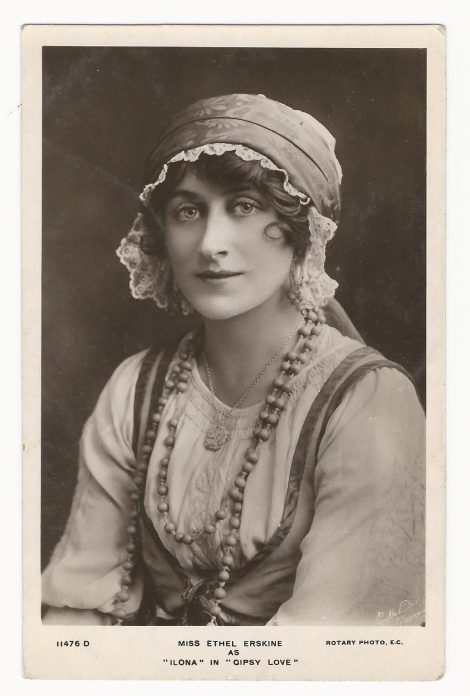
This vintage real photo postcard features theater actress Miss Ethel Erskine as she appeared in the role of Ilona in the production of “Gipsy Love”. Miss Erskine was a beautiful woman with dazzling and engaging eyes. Preliminary research discovered little about her biographical history. However, some information was found about the production of “Gipsy Love”. The show was a romantic operetta in three acts. The production played at the Carltheater in Vienna (1910), the Globe Theatre on Broadway (1911), and Daly’s Theatre in London (1912). This postcard was printed in Britain and produced by Rotary Photo as part of a series (11476 D).  SOLD

pretty-actress-2