This cabinet card is quite unusual in that it has photographic images on both sides of the card. A very pretty ballet dancer is from the Alhambra Ballet production of Cupid is pictured in each image. In one photograph her legs are crossed while in the second photograph her legs are open and her undergarment is visible through her transparent tutu. The cabinet card is risque for it’s era. The Alhambra was a theatre in London, England. It was opened in 1854 as “The Royal Panopticon”. A circus ring was added and it was reopened in 1858 as the Alhambra. The theatre stage hosted music hall acts, aerial acts, ballet, light opera, and other events. The theatre was closed and demolished in 1936. This cabinet card features a dancer from the ballet, Cupid which opened at the Alhambra on 5/24/1886. The principal dancer in this production was Emma Bessone, and research reveals that the ballerina in this image is likely Emma Bessone. She was an Italian dancer who trained at La Scala and became prima ballerina for both the Maryinsky and Bolshoi companies in Russia. The photographer of this cabinet card was Samuel A. Walker whose studio was located in London. SOLD
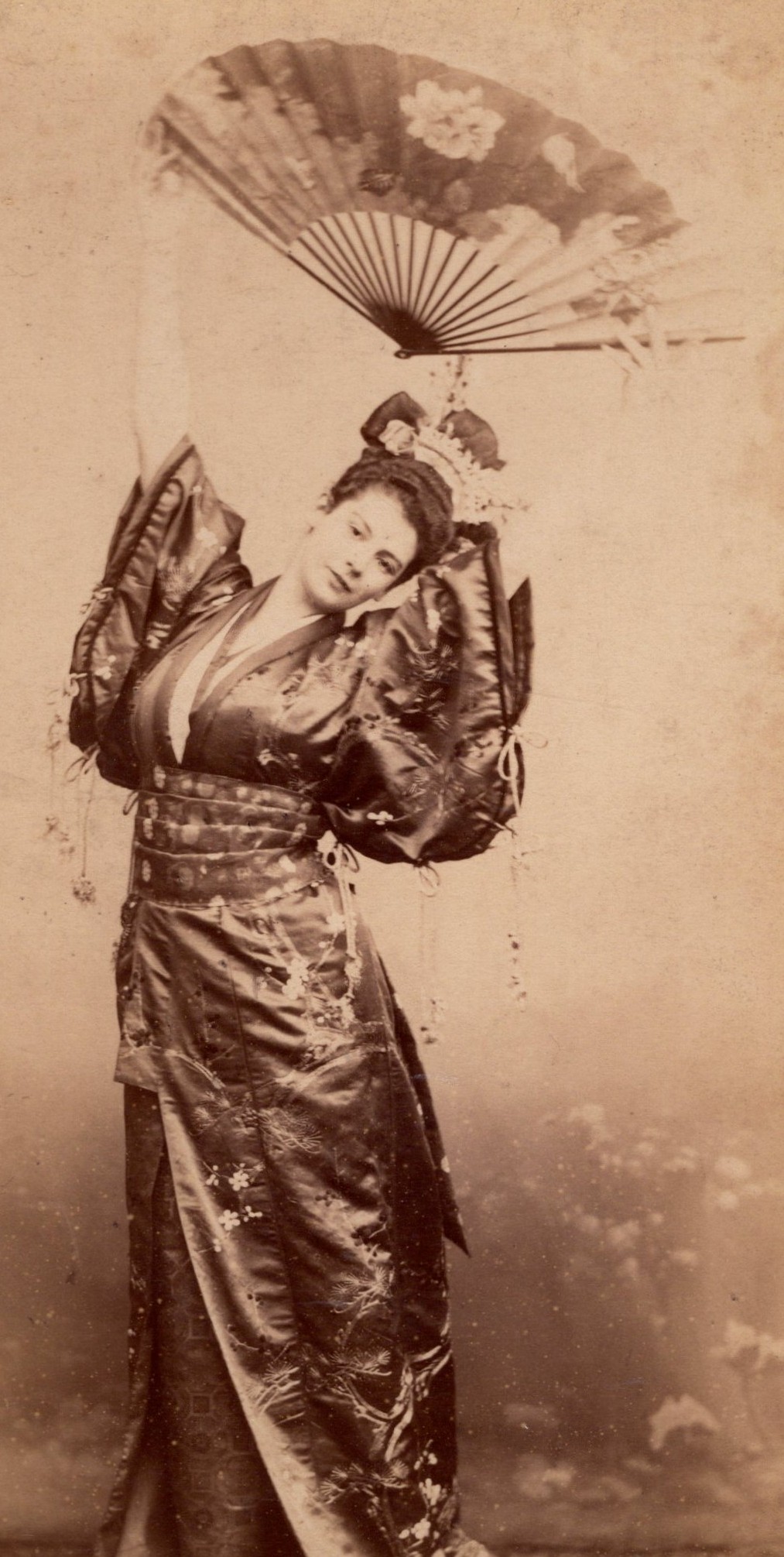
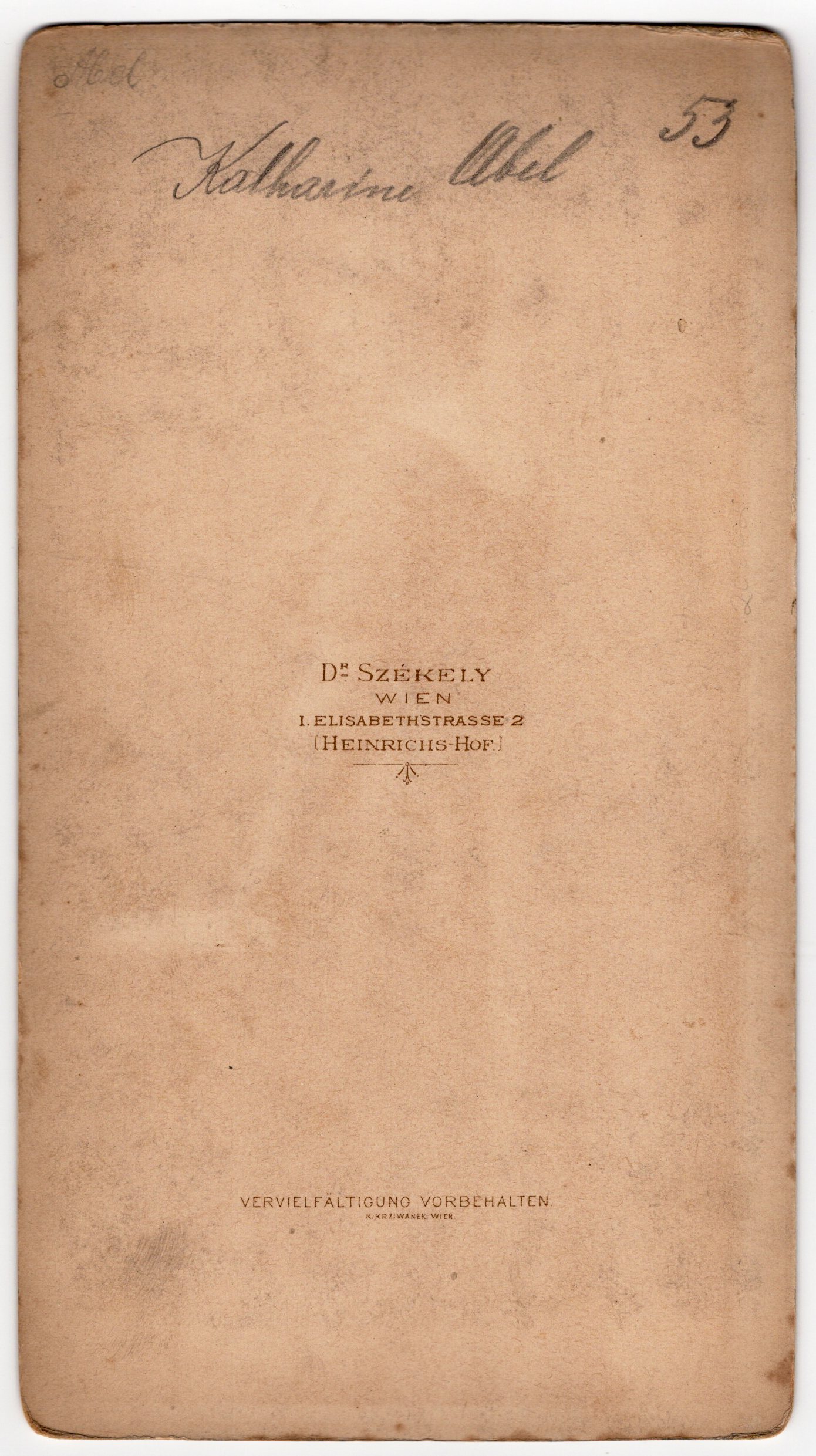
This cabinet card features Katharina Abel (1856 –1904), a distinguished Austrian ballerina renowned for her tenure as a solo dancer at the Vienna Court Opera (now the Vienna State Opera). She was born in Vienna. Abel was accepted into the ballet school of the Kärntnertortheater at the age of twelve. Under the tutelage of ballet mistress Johanna Telle, she honed her skills in classical dance. In 1871, Abel joined the Vienna Court Opera. She captivated audiences with her grace and charm, particularly excelling in pantomimic roles. Her breakthrough came on October 4, 1879, when she performed as the leader of the Amazons in the ballet “Dyellah oder die Reise nach Indien.” Her compelling performance led to her appointment as a solo dancer at the opera. Throughout her career, Abel starred in numerous productions, including the ballet “Coppélia” and the operas “Die schöne Melusine” by Louis Schindelmeisser and “Die Stumme von Portici,” where she portrayed Fenella. She also featured prominently in divertissements such as “Wiener Walzer,” “Die Puppenfee,” “Sonne und Erde,” “Fantasca,” “Fata Morgana,” and “Der Stock im Eisen. In 1890, Abel married Count Georg Orssich von Slavetich, who was ten years her junior. The couple resided on the count’s estate in Theresienfeld. Prior to her marriage, Abel had a daughter born in 1876. The father’s identity remains undisclosed. Abel’s illustrious career was abruptly halted during a performance of “Giselle” when a mechanical failure caused her to fall approximately ten feet onto the stage, resulting in a foot injury that ended her solo performances. She continued to engage audiences in pantomimic roles for a time. In 1892, she retired from the stage. Despite undergoing multiple surgeries, Abel succumbed to cancer in 1904. This photograph is a striking portrait of Abel. Abel is adorned in an elaborate costume that reflects her talent for embodying diverse and exotic roles on stage. She wears a kimono-style garment, richly embroidered with intricate floral patterns. The fabric’s texture and sheen suggest luxurious materials befitting her status as a renowned performer. Her theatrical pose, with arms gracefully extended and a large fan arched behind her head, exudes poise and fluidity. The delicate placement of her hands and the tilt of her head convey a sense of grace. This cabinet card photograph was taken in 1888 by Dr. Josef Szekely (1838-1901). He captured her performance in “The Doll Fairy”. Székely was an Austro-Hungarian chemist and photographer renowned for his contributions to early photography in Central and Southeastern Europe. He had a master’s degree in pharmacy and a doctorate in chemistry. He taught at the University of Vienna before becoming a photographer. He was very successful as a photographer. Székely’s work garnered international acclaim. He was awarded the Bronze Prize at the 1867 World’s Fair in Paris and a silver medal in 1878. His studio produced portraits of many notable figures. This photograph is in the collection of the Theater Museum in Vienna. This cabinet card measures approximately 4.25 x 8 inches, which is larger than the standard cabinet card. SOLD
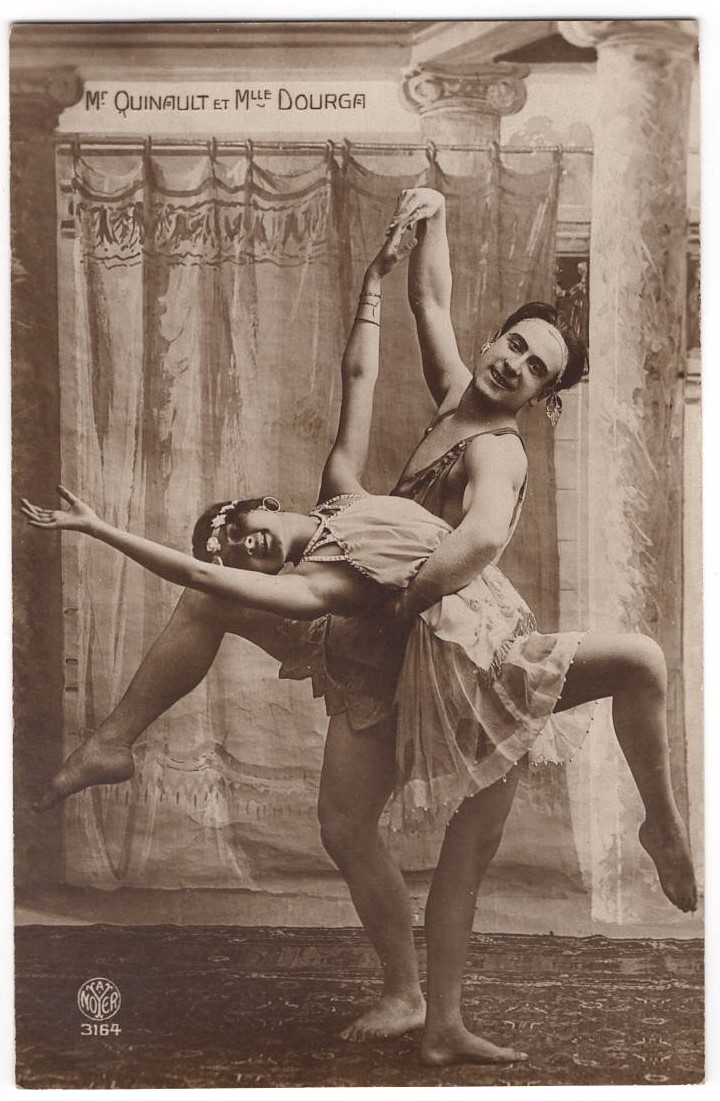
These vintage postcards feature a pair of ballet dancers, Mr Quinault and Mlle Dourga. These action photos capture the two dancers in beautiful ballet poses. (ALL SOLD)
This vintage real photo postcard features Russian ballerina, choreographer, and silent film star, Vera Karalli (1889-1972). She was born in Moscow. Her father was an entrepreneur and her mother was an actress. Karalli was active between 1914 and 1921. Karalli was a graduate of the Moscow Theatre School in 1906. She performed in the Ballets Russes company in 1909, and then again, in 1919 and 1920. She was a soloist with the Bolshoi Theater and after two years became a ballerina in 1915. She often danced with ballet star, Mikhail Mordkin. Karalli becan acting in 1914 and she became one of Russia’s most celebrated film actresses. From 1914 to 1919, Karalli appeared in about sixteen Russian silent films. One of these films was an adaptation of Tolstoy’s “War and Peace”. Her last film was a German drama released in 1921. Karalli was a mistress of the Grand Duke Dmitri Pavlovich of Russia. He was the cousin of Nicholas II. It was reported that she was a co-conspirator in the 1916 murder of Grigori Rasputin. After the October Revolution, she fled to the West. Between In the 1920’s she taught dance in Lithuania. Between 1930 and 1935 she was ballet mistress of the Romanian opera in Bucharest. She lived in Paris between 1938 and 1941. She later settled in Baden, Austria. (SOLD)
This vintage real photo postcard features Russian actress Vera Vasilyevna Kholodnaya (1893-1919). Sometimes she is referred to as Holodnaja). She was the first star of Russian silent film. The number of films that she appeared in, is unknown. It is estimated the number of appearances is somewhere between fifty and one hundred. It is unfortunate that only five of her films survived the passage of time. She was born in Poltava which was part of the Russian Empire, and is now located in the Ukraine. At the age of two, she moved to Moscow to live with her grandmother. As a child, she fantasized about becoming a classical ballerina. She eventually enrolled in the Bolshoi Theatre ballet school From early childhood, she participated in family theater productions, While attending her school prom to celebrate her graduation she met Vladimir Kholodny, whom she married in 1910. He is known as one of Russia’s first race car drivers. The pair had two children. In 1908, after seeing actress Vera Komissarzhevskaya in a stage role, she decided that she wanted to pursue a career in films. She sought out Vladimir Gardin, a major Russian film director, and he gave her a minor role in Anna Karenina. In 1915, film director Yevgeni Bauer was searching for an actress who possessed great beauty. After meeting Vera Kholodnaya, he found the enchantress that he was looking for. Bauer’s film was a resounding success. He then made a second film starring Kholodnaya. These two Bauer films made Vera a major celebrity. She soon became known as “the Queen of Screen” and had great successes with other films. By 1918, she was a film phenom. When Russia entered World War I, her husband joined the military. She participated in charity concerts to support the soldiers and their families. It is reported that she was “worshipped” by soldiers. By the time of the Russian Revolution (1917), a new Kholodnaya film was released every three weeks and she continued to experience acclaim and success. Around this time, the actress moved with her film company to Odessa. She died there, at age 25, during the 1918 flu pandemic.This version of the flu, was known as the “Spanish Flu” and it infected 500 million people around the world between 1918 and 1920. Estimates are that between 50 and 100 million people died during the pandemic. (SOLD)
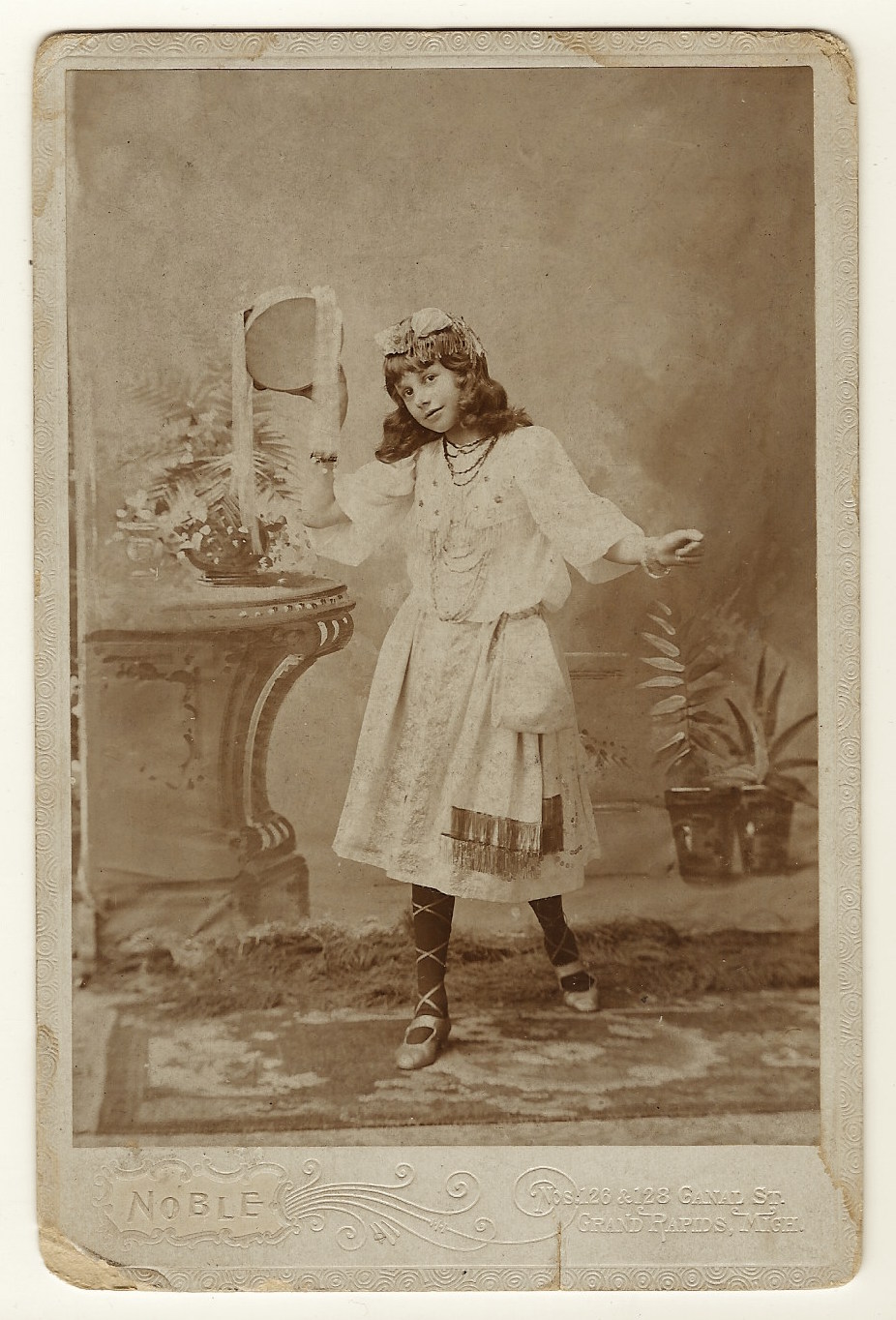
An adorable young girl wearing ballet shoes, poses for her portrait at the Noble Studio in Grand Rapids, Michigan. The photographer posed her as if she was dancing. The bright eyed young girl has a terrific smile. The photographer of this image is Thomas Frederick Noble (1866-1932) and he operated a photography studio at various addresses in Grand Rapids. His career spanned between 1890 and 1931. The 1920 US census found him living in Grand Rapids with his wife Pauline (age 50) and two of their children, Fred (age 17) and Pauline (age 15). The 1900 US census reveals that he also had a daughter named Lily. Noble died in 1932 and is buried in Graceland Memorial Park in Grand Rapids.
This cabinet card portrait features pretty celebrated Italian ballerina, Carlotta Brianza (1867-c.1933). Note that the jewelry that is hanging from her necklace is shaped like a horse. It is also worth mention that this photograph is somewhat risque for the era. Brianza was born in Milan, Italy and was the prima ballerina at La Scala before going to Russia. She created a sensation in Luigi Manzotti’s ballet “Excelsior” as the Spirit of Light. She went to Russia in 1887 after completing a US tour. She was acclaimed for her work in “Sleeping Beauty” and “Esmerelda”. She returned to the west in 1891 when she became the prima ballerina for the Vienna Opera. She died in Paris under suspicious circumstances that suggest she committed suicide. This portrait was produced by celebrity photographer Benjamin J. Falk of New York City. To view other photographs by Falk, click on the category “Photographer: Falk”.
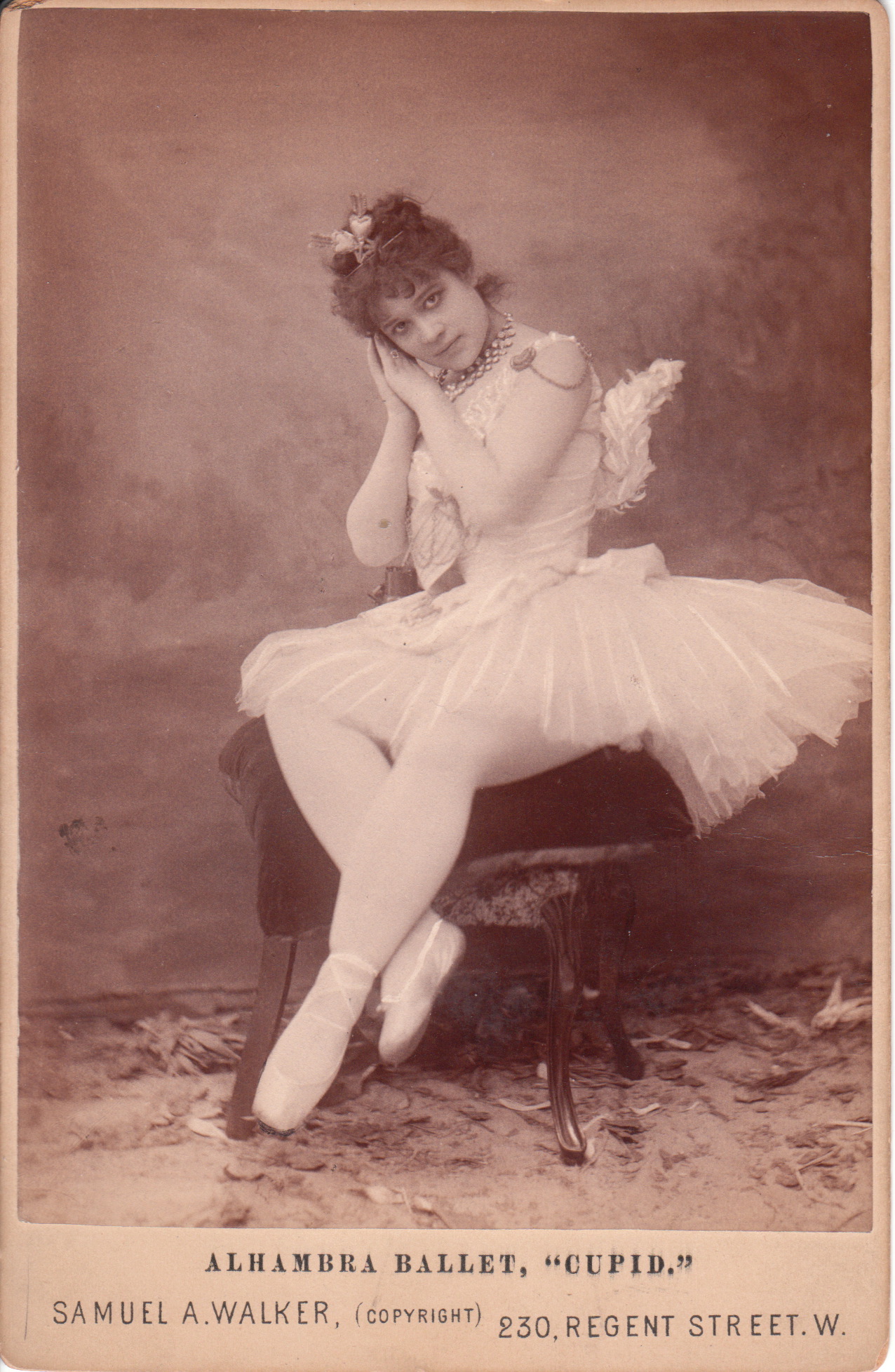
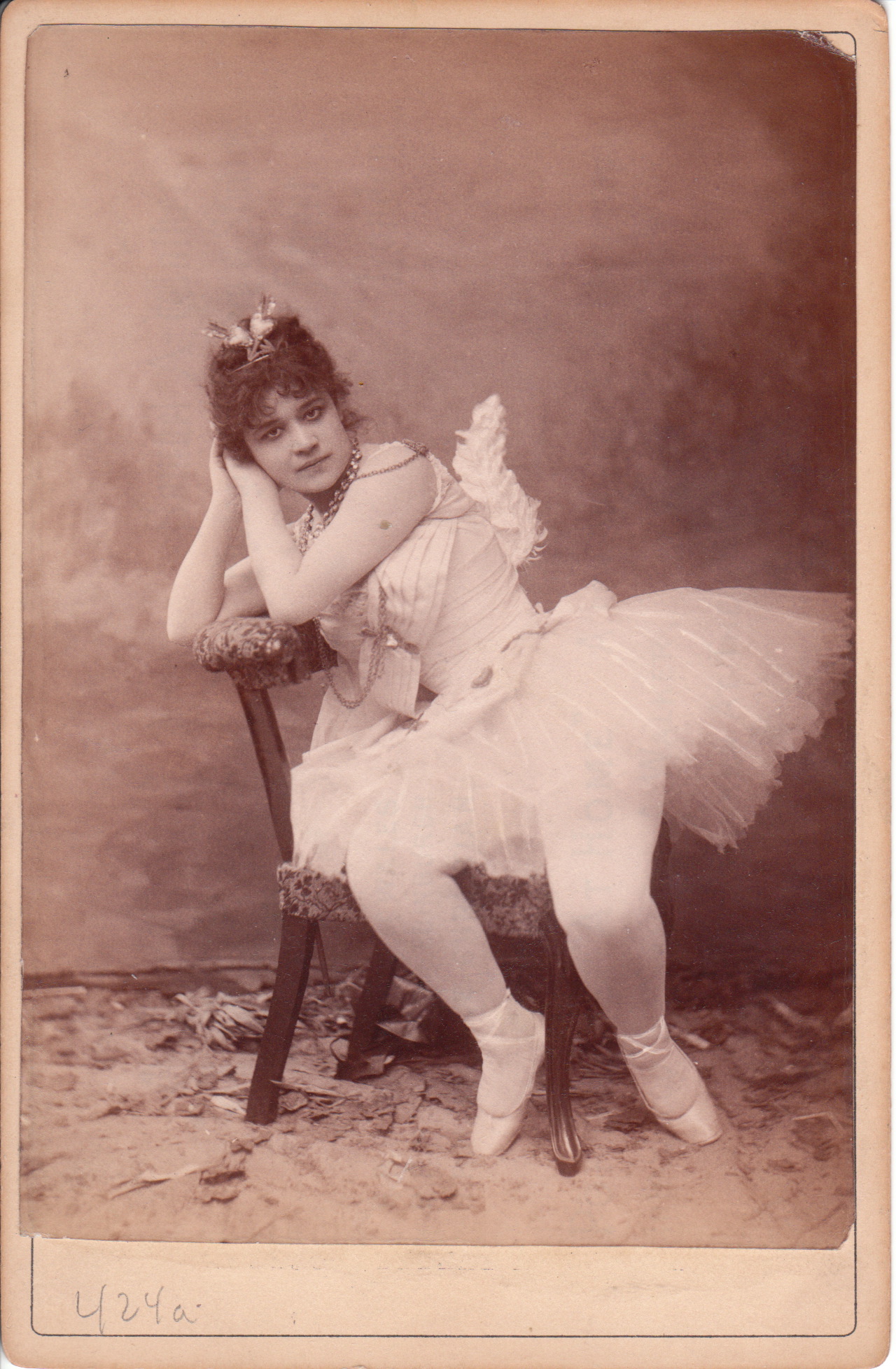 This cabinet card is quite unusual in that it has photographic images on both sides of the card. A very pretty ballet dancer is from the Alhambra Ballet production of Cupid is pictured in each image. In one photograph her legs are crossed while in the second photograph her legs are open and her undergarment is visible through her transparent tutu. The cabinet card is risque for it’s era. The Alhambra was a theatre in London, England. It was opened in 1854 as “The Royal Panopticon”. A circus ring was added and it was reopened in 1858 as the Alhambra. The theatre stage hosted music hall acts, aerial acts, ballet, light opera, and other events. The theatre was closed and demolished in 1936. This cabinet card features a dancer from the ballet, Cupid which opened at the Alhambra on 5/24/1886. The principal dancer in this production was Emma Bessone, and research reveals that the ballerina in this image is likely Emma Bessone. She was an Italian dancer who trained at La Scala and became prima ballerina for both the Maryinsky and Bolshoi companies in Russia. The photographer of this cabinet card was Samuel A. Walker whose studio was located in London. SOLD




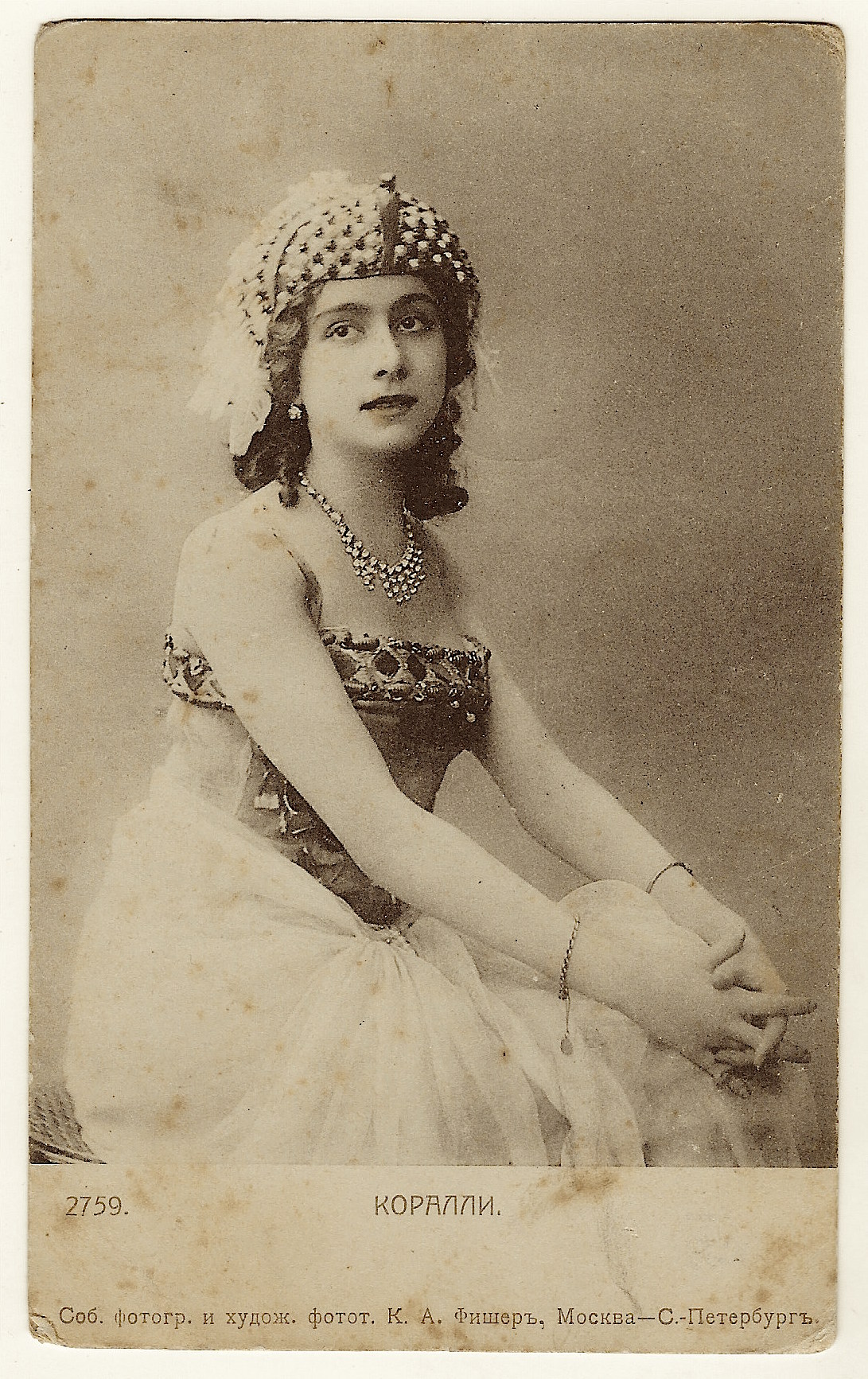
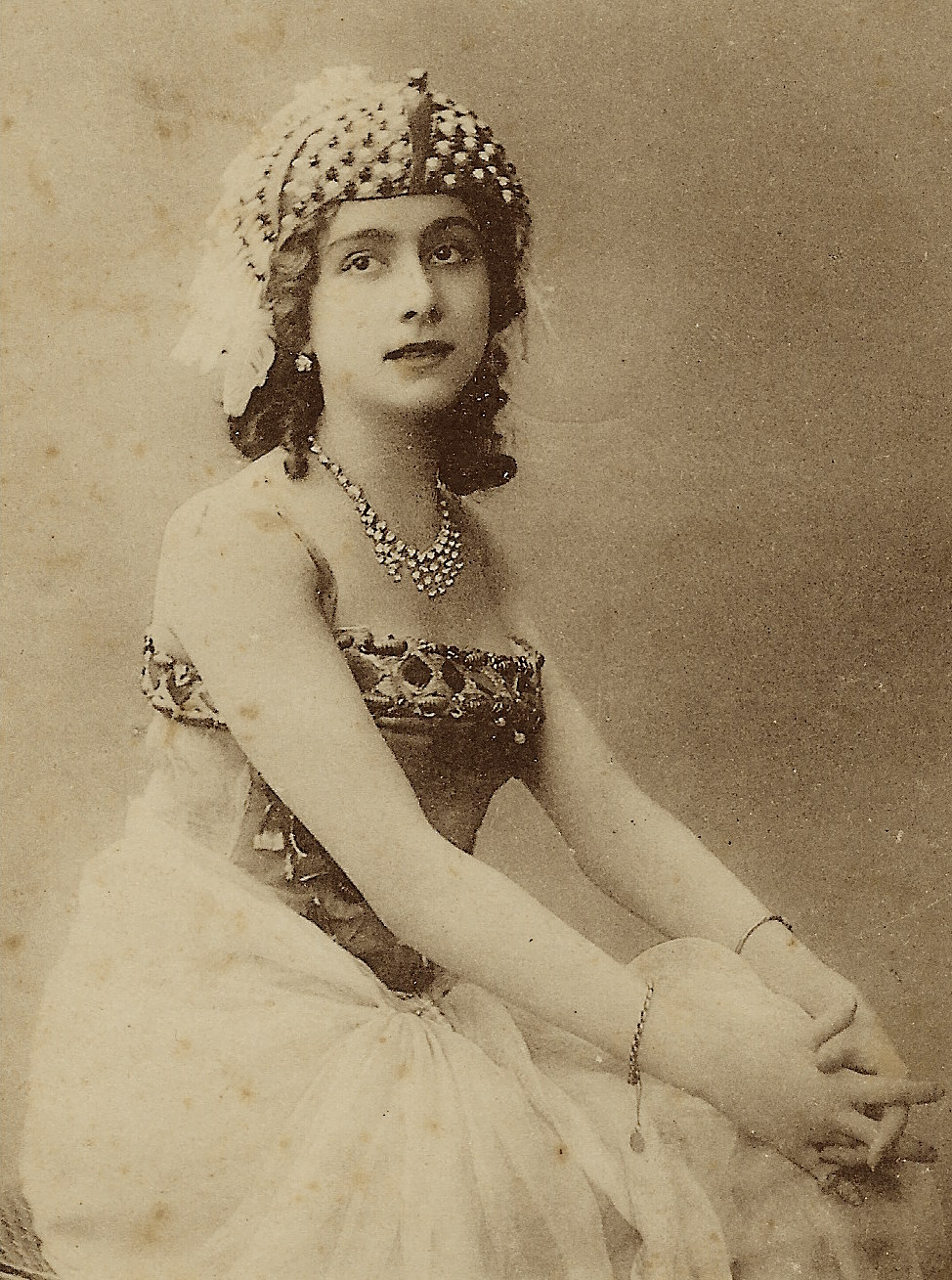 This vintage real photo postcard features Russian ballerina, choreographer, and silent film star, Vera Karalli (1889-1972). She was born in Moscow. Her father was an entrepreneur and her mother was an actress. Karalli was active between 1914 and 1921. Karalli was a graduate of the Moscow Theatre School in 1906. She performed in the Ballets Russes company in 1909, and then again, in 1919 and 1920. She was a soloist with the Bolshoi Theater and after two years became a ballerina in 1915. She often danced with ballet star, Mikhail Mordkin. Karalli becan acting in 1914 and she became one of Russia’s most celebrated film actresses. From 1914 to 1919, Karalli appeared in about sixteen Russian silent films. One of these films was an adaptation of Tolstoy’s “War and Peace”. Her last film was a German drama released in 1921. Karalli was a mistress of the Grand Duke Dmitri Pavlovich of Russia. He was the cousin of Nicholas II. It was reported that she was a co-conspirator in the 1916 murder of Grigori Rasputin. After the October Revolution, she fled to the West. Between In the 1920’s she taught dance in Lithuania. Between 1930 and 1935 she was ballet mistress of the Romanian opera in Bucharest. She lived in Paris between 1938 and 1941. She later settled in Baden, Austria. (SOLD)

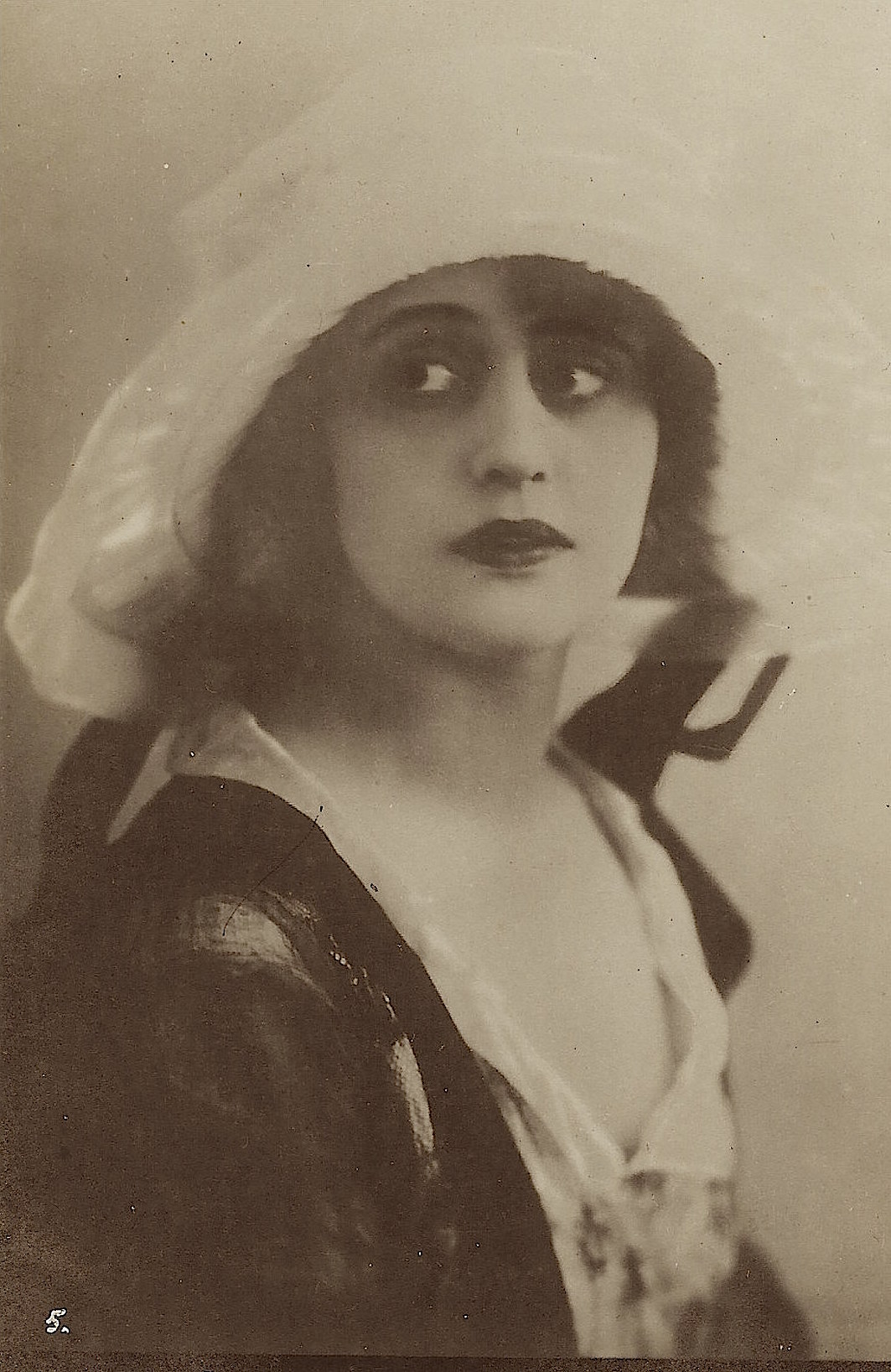 This vintage real photo postcard features Russian actress Vera Vasilyevna Kholodnaya (1893-1919). Sometimes she is referred to as Holodnaja). She was the first star of Russian silent film. The number of films that she appeared in, is unknown. It is estimated the number of appearances is somewhere between fifty and one hundred. It is unfortunate that only five of her films survived the passage of time. She was born in Poltava which was part of the Russian Empire, and is now located in the Ukraine. At the age of two, she moved to Moscow to live with her grandmother. As a child, she fantasized about becoming a classical ballerina. She eventually enrolled in the Bolshoi Theatre ballet school From early childhood, she participated in family theater productions, While attending her school prom to celebrate her graduation she met Vladimir Kholodny, whom she married in 1910. He is known as one of Russia’s first race car drivers. The pair had two children. In 1908, after seeing actress Vera Komissarzhevskaya in a stage role, she decided that she wanted to pursue a career in films. She sought out Vladimir Gardin, a major Russian film director, and he gave her a minor role in Anna Karenina. In 1915, film director Yevgeni Bauer was searching for an actress who possessed great beauty. After meeting Vera Kholodnaya, he found the enchantress that he was looking for. Bauer’s film was a resounding success. He then made a second film starring Kholodnaya. These two Bauer films made Vera a major celebrity. She soon became known as “the Queen of Screen” and had great successes with other films. By 1918, she was a film phenom. When Russia entered World War I, her husband joined the military. She participated in charity concerts to support the soldiers and their families. It is reported that she was “worshipped” by soldiers. By the time of the Russian Revolution (1917), a new Kholodnaya film was released every three weeks and she continued to experience acclaim and success. Around this time, the actress moved with her film company to Odessa. She died there, at age 25, during the 1918 flu pandemic.This version of the flu, was known as the “Spanish Flu” and it infected 500 million people around the world between 1918 and 1920. Estimates are that between 50 and 100 million people died during the pandemic. (SOLD)


 THE CABINET CARD GALLERY