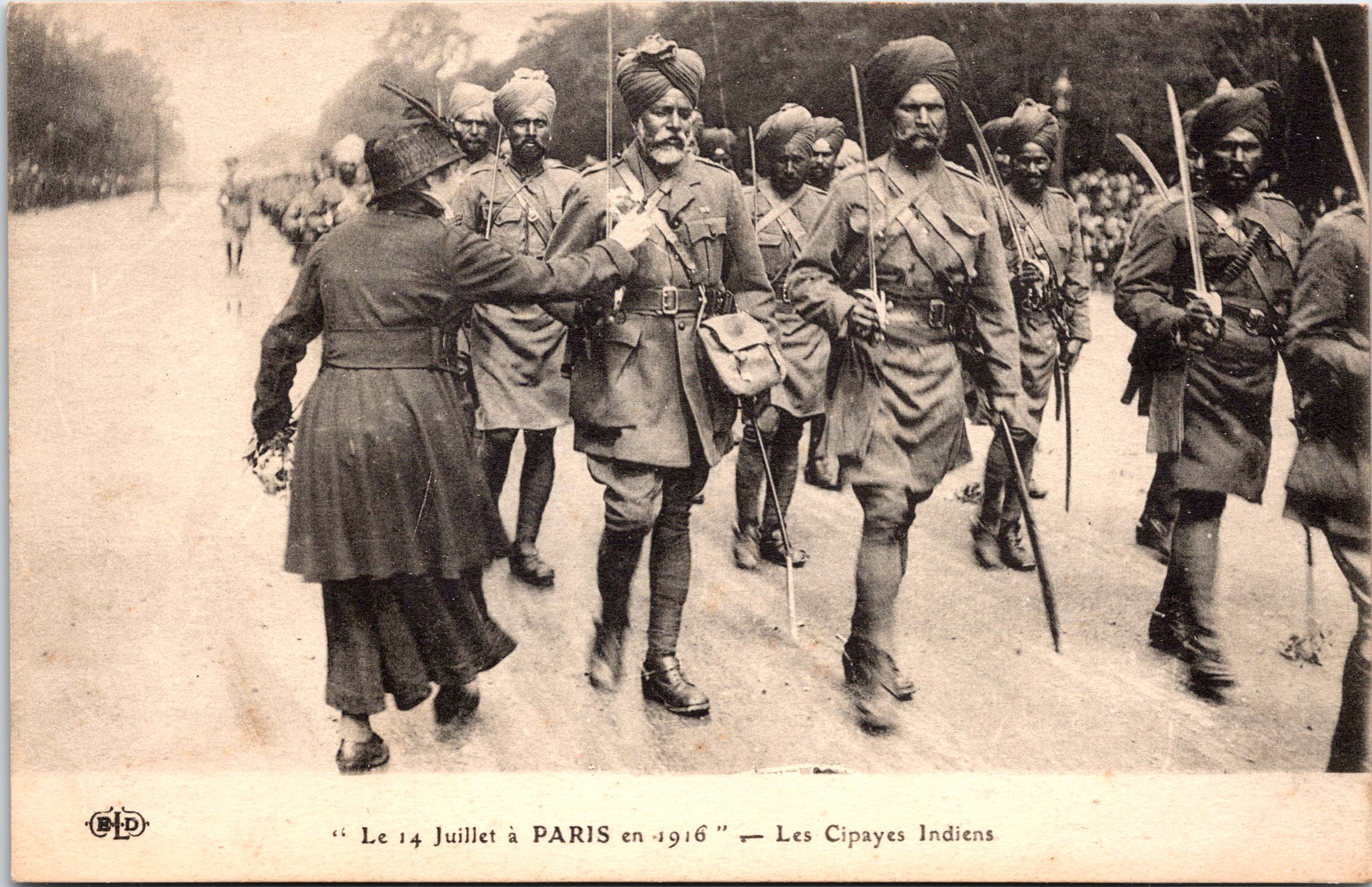

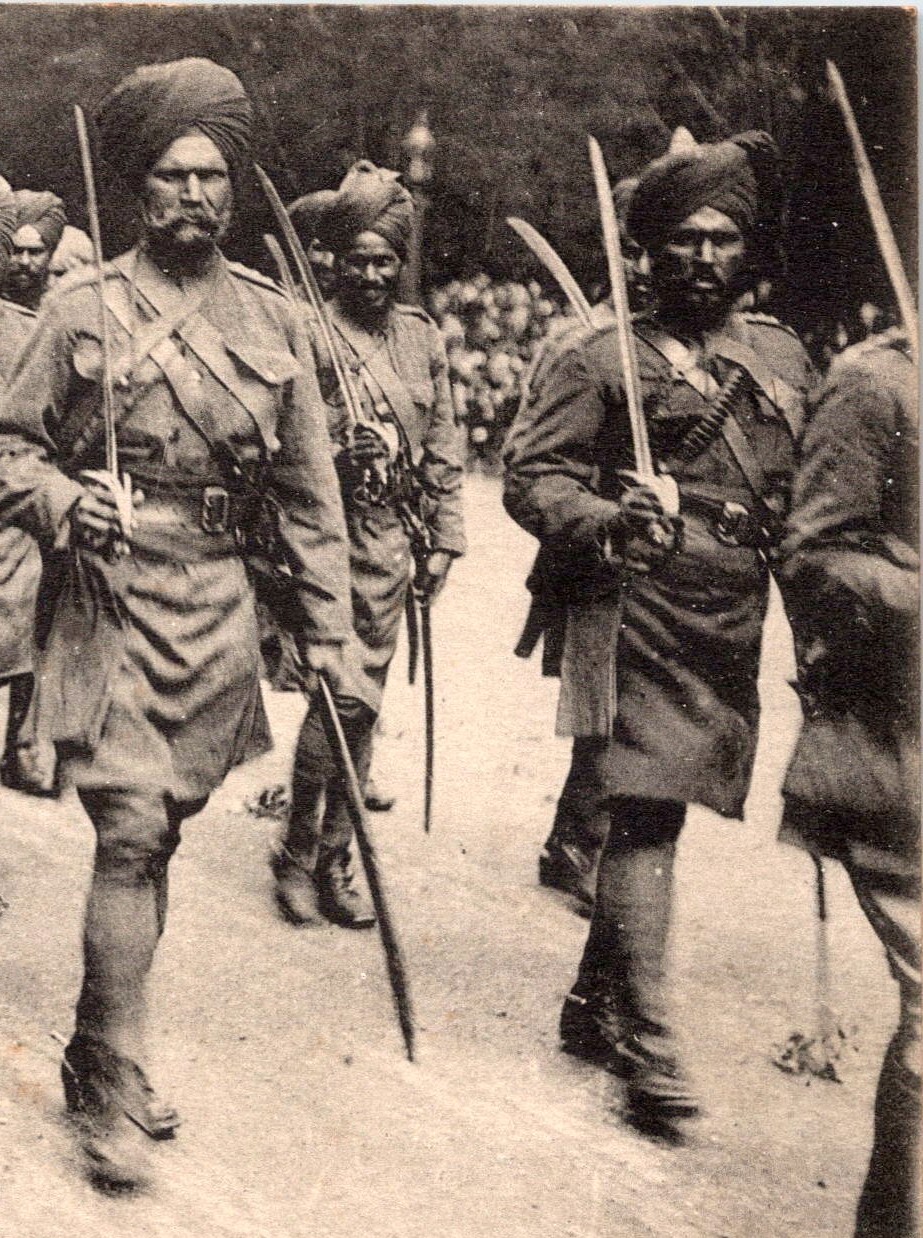
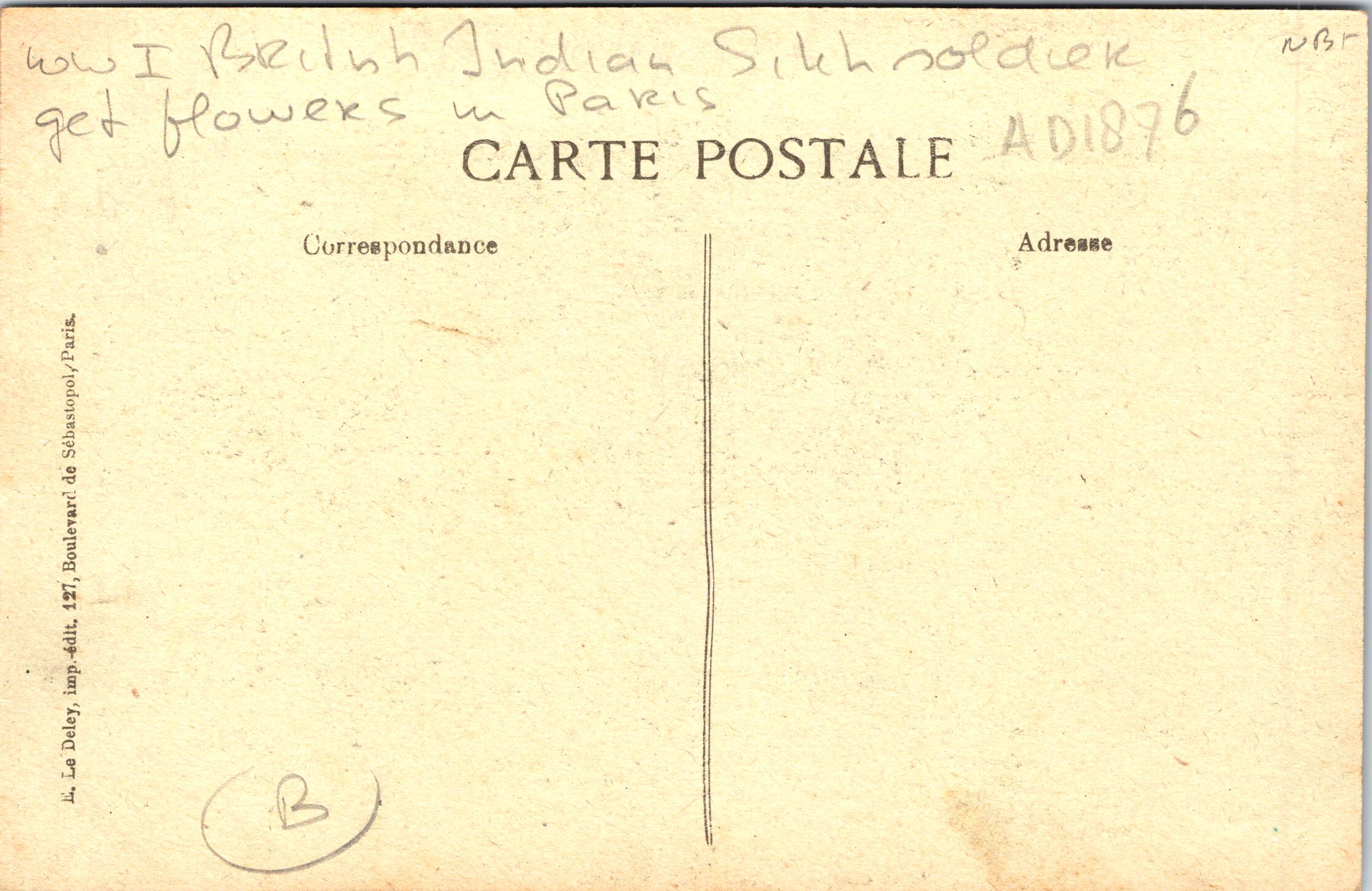
This striking World War I–era postcard captures a powerful and historically important moment: Indian Sikh soldiers marching through Paris on July 14, 1916, France’s Bastille Day. The scene shows a column of turbaned Sikh troops advancing down a Parisian boulevard, sabers drawn, while a French woman steps forward to present flowers—an evocative gesture of gratitude and solidarity from the French public toward Allied colonial troops. The men are Sikh soldiers serving in the British Indian Army, identifiable by their turbans, beards, and traditional curved sabers (talwars), worn alongside British military uniforms and equipment. Sikh regiments were highly respected for their discipline and battlefield effectiveness, and tens of thousands served on the Western Front during the First World War. Many fought in France and Belgium between 1914 and 1918, sustaining heavy casualties far from home. This particular image documents their ceremonial participation in a Paris victory parade, rather than a battlefield scene. By 1916, Sikh and other Indian troops had become a familiar—and deeply symbolic—presence in France, representing the global reach of the Allied war effort. Public parades such as this one were meant to boost morale and emphasize unity among the Allies. The interaction in the foreground—flowers being handed to a senior Sikh soldier—adds a human and emotional layer to the photograph, underscoring the respect these men received from civilians who understood the sacrifices being made on their behalf. The caption under this postcard’s image can be translated as “July 14 in Paris, 1916 – The Indian Sepoys”. The term cipayes (sepoys) was commonly used in French to describe Indian soldiers serving under British command. The small monogram “ELD” at the bottom left of this postcard, is the publisher’s photographic logo and corresponds to Éditions Le Deley, a major Parisian postcard publisher active in the early 20th century. Le Deley was especially known for producing high-quality photographic postcards documenting current events, military subjects, and international themes during World War I. The reverse confirms the publisher as Le Deley, with a Paris address printed along the left edge. Le Deley issued thousands of wartime postcards and played an important role in visually documenting France’s experience during the Great War, including its colonial and Allied forces. (SOLD)


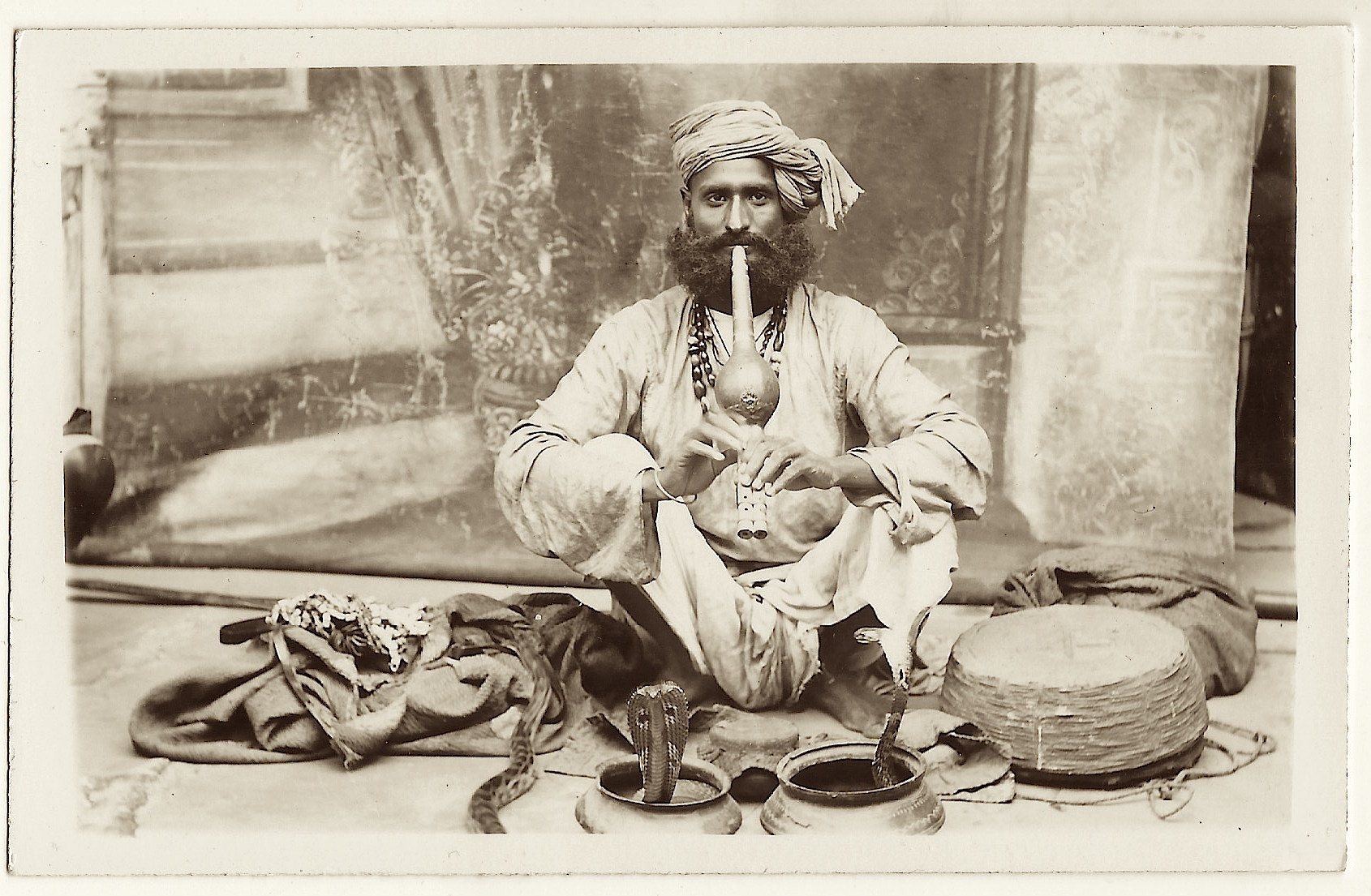
 This vintage real photo postcard features a snake charmer doing his charm in Benares, India. Ophidiophobics should think twice before adding this postcard to their collection. This photograph is a snake phobics nightmare. The photo was taken in Benares, which in India is known as Varanasi. The city is on the banks of the Ganges river. Benares is a major religious hub in India. In fact, it is the holiest of India’s seven sacred cities. What is the point of snake charming. It is the practice of hypnotizing snakes by playing and waving around an instrument called a “pungi”. A popular species of snake used in this practice are cobras. The snake charmer handles the snakes and performs dangerous acts with them. They also do other types of street performances (ie juggling or sleight of hand). India is considered the center of snake charming but the practice is also common is Pakistan, Thailand , Malaysia, Sri Lanka, and other Asian and North African countries. The popularity of snake charming is on the decline.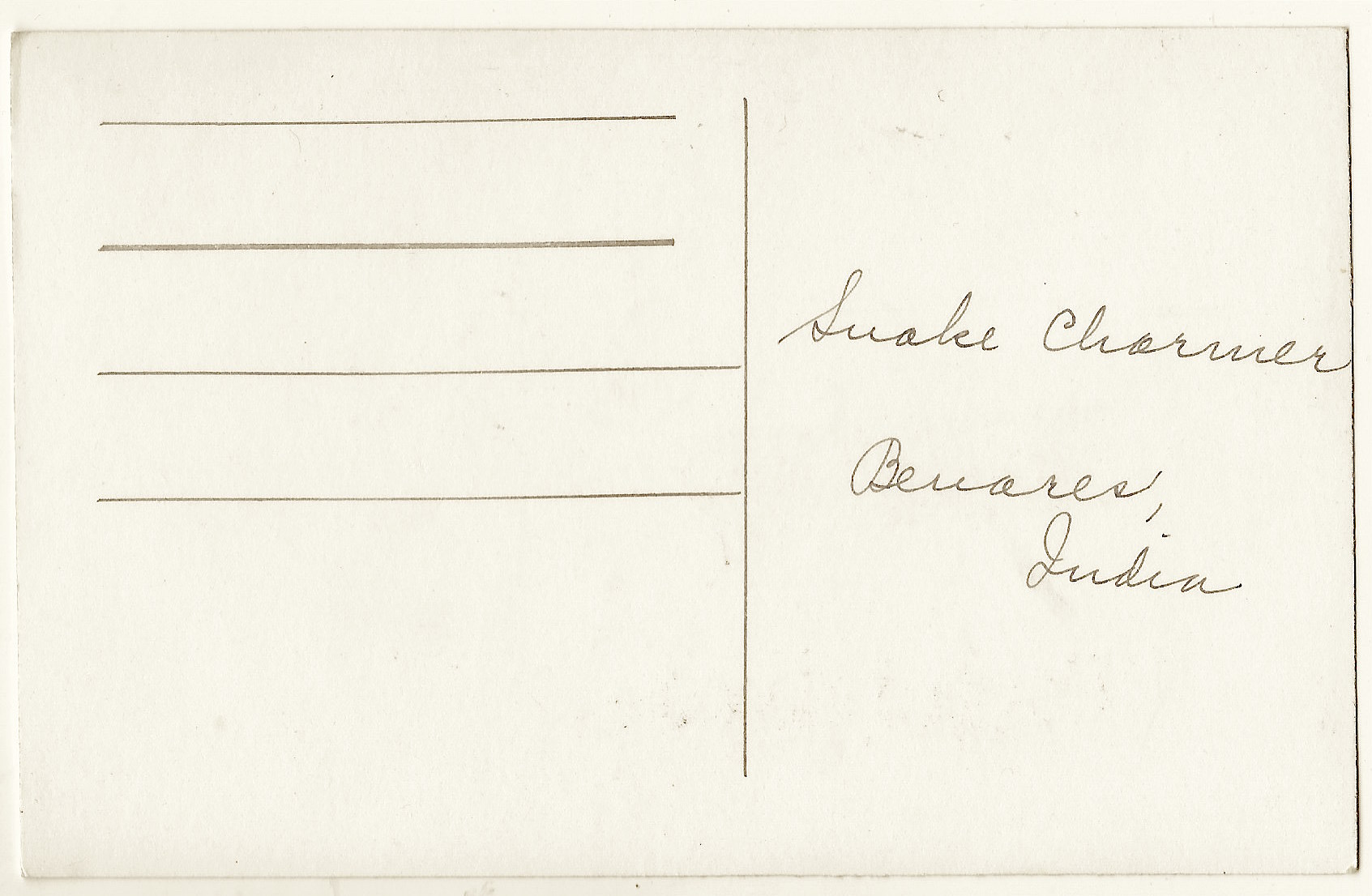





 THE CABINET CARD GALLERY