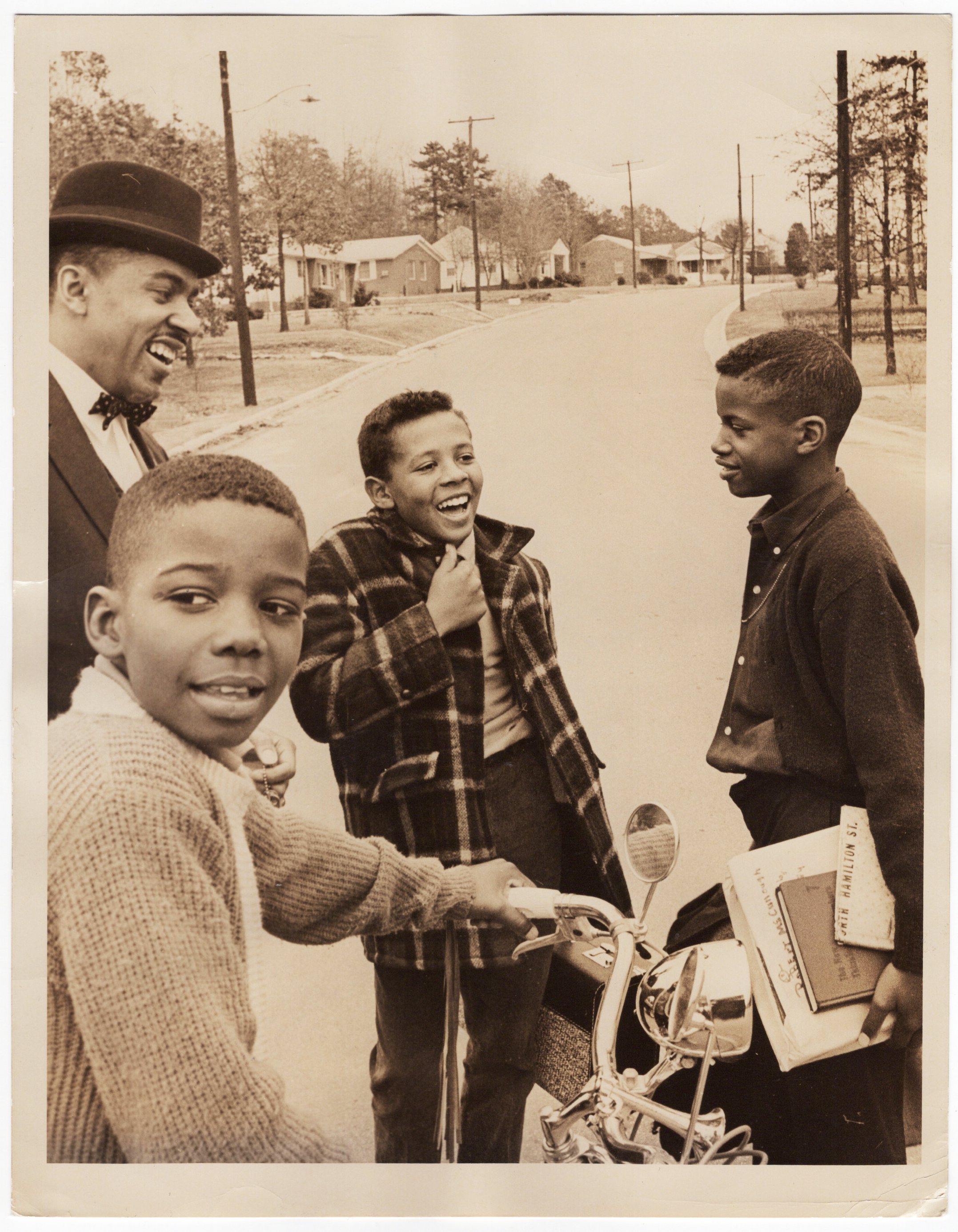
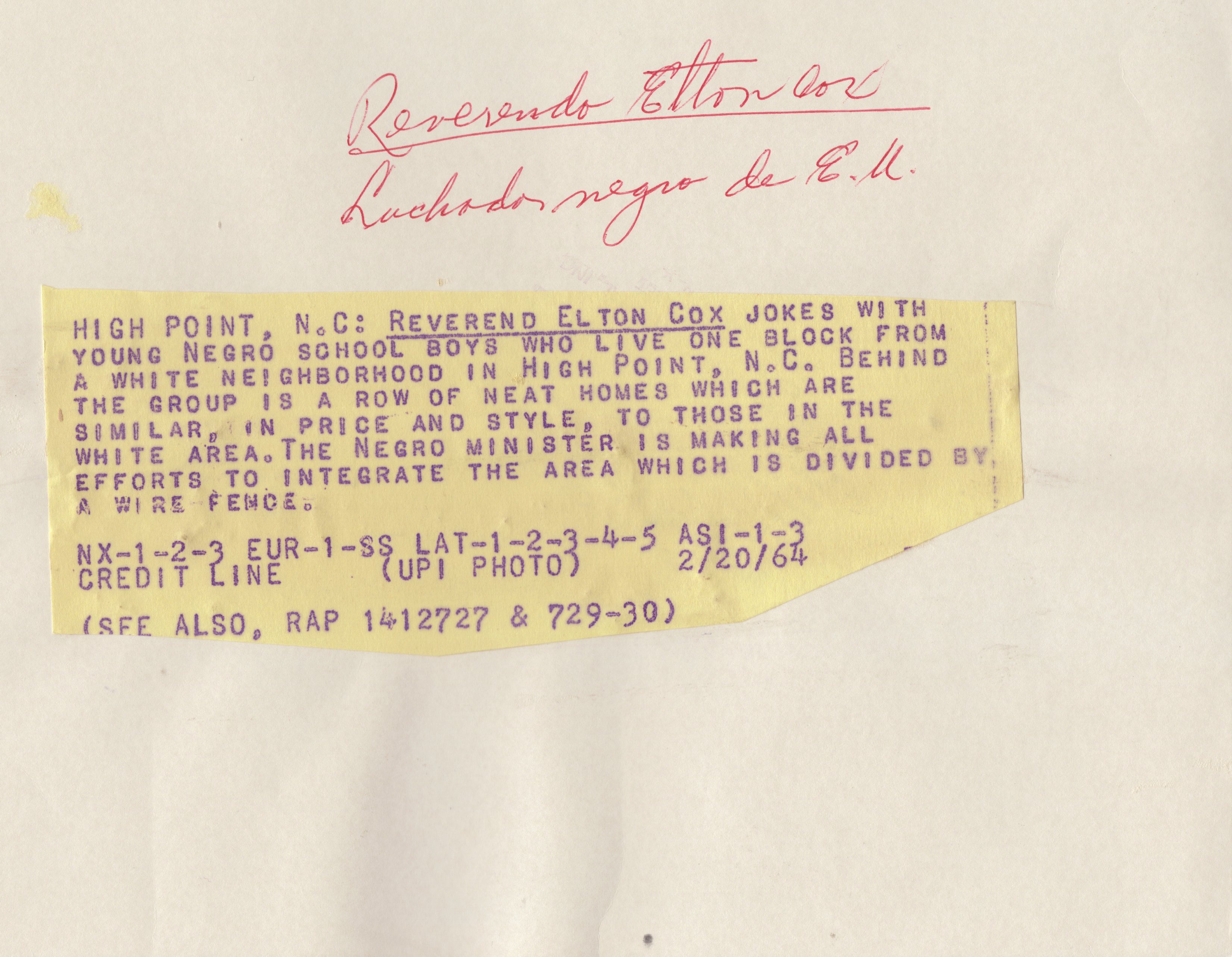
This vintage press photo features an African American clergyman named Reverend Elton Cox (1931-2011). He was photographed while joking with some neighborhood children who appear to be going to, or returning from school. Reverend Cox is in the neighborhood for a reason. The community is segregated. There is a wire fence dividing the white area from the black area. The caption on the reverse of the photograph points out that the houses on each side of the fence are basically the same. The fence is an unnatural boundary. Reverend Cox is determined to find a way for the Black and White residents in the community to integrate. He had a tough battle ahead of him to reach that goal. Racism, unrealistic fear, and unfair discriminatory laws all stood in the way. It is now nearly 60 years after this photograph was taken. I wonder whether the neighborhood is integrated today. Most would hope so. This photograph was taken in 1964 by a United Press International (UPI) photographer. Elton Cox was a civil rights movement activist and preacher. He was part of the Freedom Riders protest in 1961 and interviewed in the documentary about it. He was nicknamed “Beltin” Elton”. He grew up in Kankakee, Illinois. He had to take a break from high school to work to help support his family. He graduated high school at age 20 and went on to Livingston College in Salisbury, North Carolina. Next he studied for a Divinity degree at Howard University. He was ordained in 1958. He became a pastor at the Pilgrim Congregational Church in High Point. He quickly went to work to support the civil rights movement. His work included starting desegregation efforts at local schools. Cox had strong beliefs in non-violence. James Farmer, then of the NAACP, hired Cox to help push for civil rights in the south. He worked with students and organized non-violent sit-ins. Despite his non-violent approach, Cox was arrested seventeen times over the decades. One arrest, in Louisiana for “disturbing the peace” resulted in a conviction that was appealed all the way to the US Supreme Court where his conviction was overturned. Later in life, Cox returned to High Point to work as a Minister. Next, he worked as a chaplain at a VA hospital in Illinois. His final position was working as a school counselor in Jackson, Tennessee. Elton Cox is one of many unsung heroes of the civil rights movement. SOLD

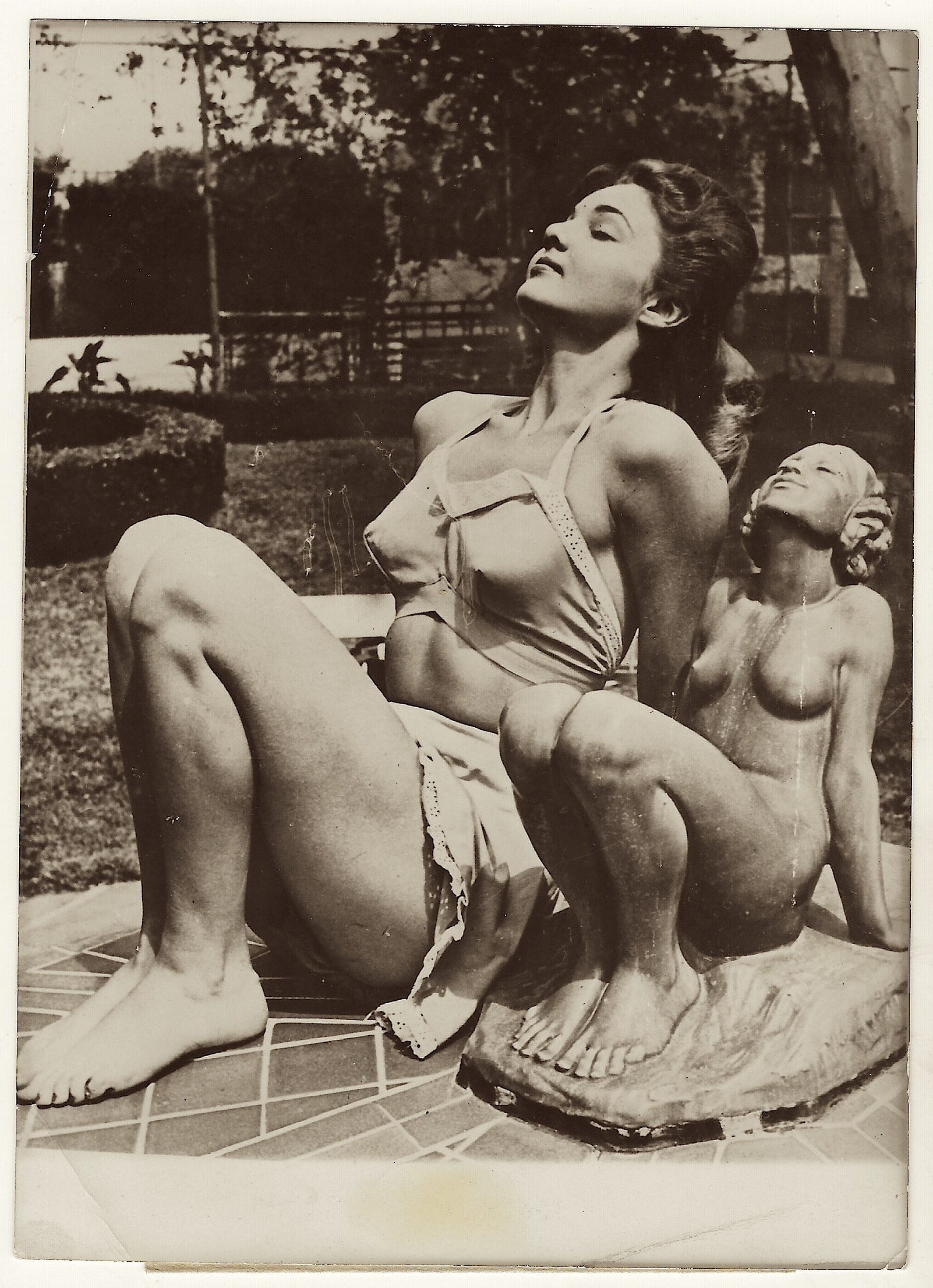
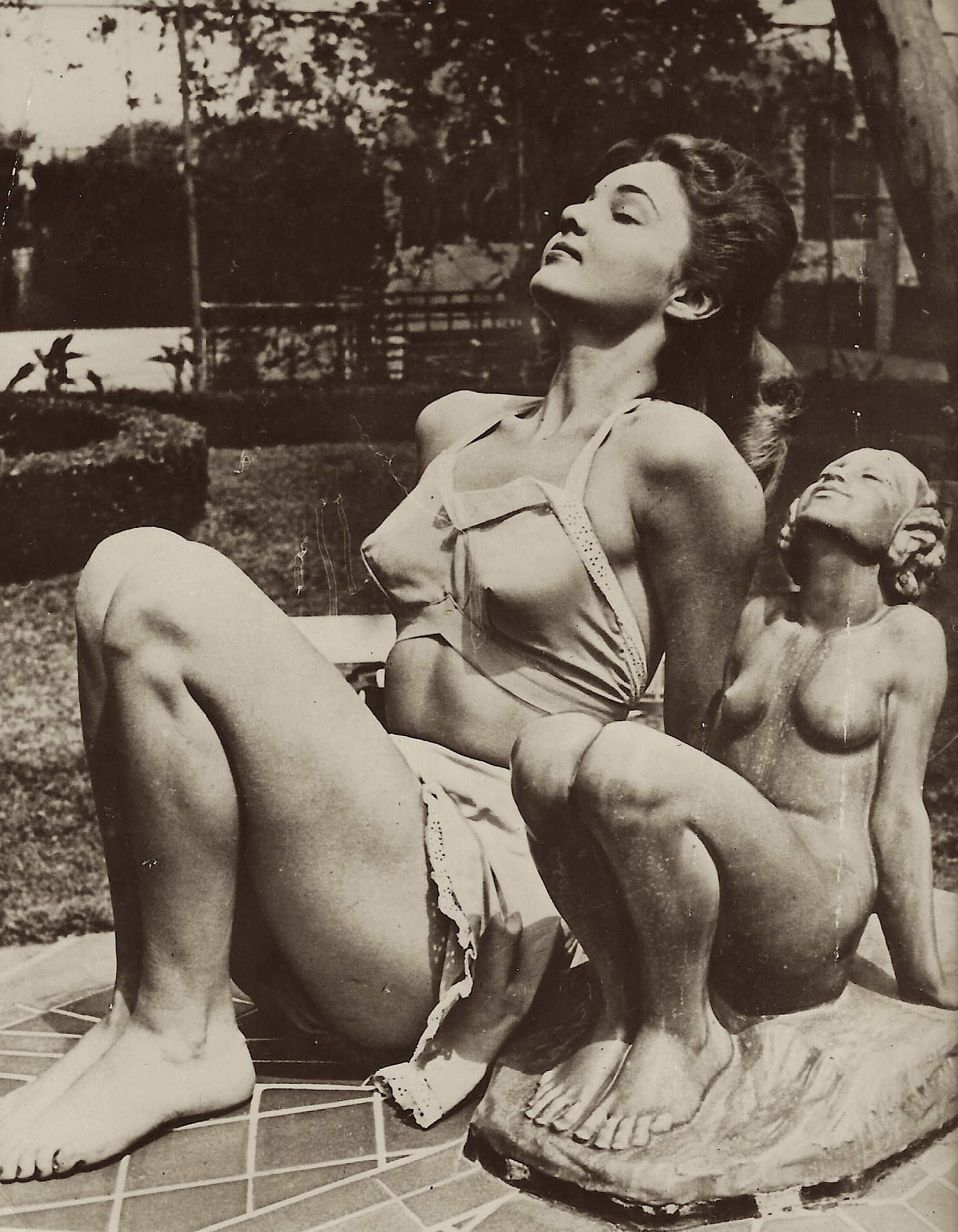 The photographer of this press photo must have been in a playful and creative mood at the time that this photograph was taken. The image features a statue and its model, side by side, in identical poses. The caption of the photograph, affixed to the reverse, indicates that the model is “beautiful” Hollywood star, Toni Seven. It also states that she was the fiance of Senator Warren G Magnuson of Washington state. The photograph was taken in 1949. Toni Seven (1922-1991) was born as June Elizabeth Millarde. Her mother was noted stage and silent film actress, June Caprice. Caprice also worked as a model. Toni’s father, Harry F Millarde, was a film director. Toni’s father died when she was just 8 years old. She was orphaned at age 13 when her mother died. Her grandparents took on the responsibility of raising young Toni. She was raised in the town of Great Neck, located on Long Island in New York state. An article in Time Magazine (1949) indicates that she was financially secure. It was reported that she was a heiress to a fortune worth 3 million dollars. It appears that Toni Seven was genetically loaded to become a performer. As Toni Seven, she was a popular American cover girl and actress, In the early 1940’s she played minor roles in three films. One of these films was the well known “Yankee Doodle Dandy” (1942). She later appeared in two more films. When World War II began, she became a volunteer at the “Hollywood Canteen”, The canteen offered food, dancing and entertainment to servicemen, many of whom were preparing to go overseas. Everything at the canteen was free for uniformed servicemen and servicewomen, She was named pin-up of the year by US soldiers in the European theater in 1945. In 1944, she changed her name to Toni Seven. She thought it would be fun to sign her name “Toni 7”. When the first pin-up exhibition in the United States was held in 1944, Toni Seven was featured along with many other beautiful models, including Jane Russell. In 1946, Seven reclaimed her original name. In 1949, newspapers ran articles asserting that Toni was romantically involved with Washington US Senator, Warren Magnuson. Although the caption of this press photo states that she and Magnuson were engaged, the pair never married. However, the couple dated on and off between 1948 and 1953. Looking at Toni Seven’s biographical data, it is clear that her acting career was unremarkable. Toni appeared in only five films. Stellarstar writes in the blog “Those Obscure Objects of Desire” that “Toni Sevin is proof that a girl who lands in Hollywood, has money to burn, a great press agent and more than enough beauty, can still end up a complete unknown”. Toni was successful in other areas of her life. She was a great horsewoman, and also excelled at swimming and tennis. She despised gossip but created some when she dated Errol Flynn and other celebrities. This press photo belonged to the Intercontinental agency, located in Paris, France. An additional photograph of Miss Seven can be found below. SOLD
 PHOTO OF TONI SEVEN (NOT FOR SALE)
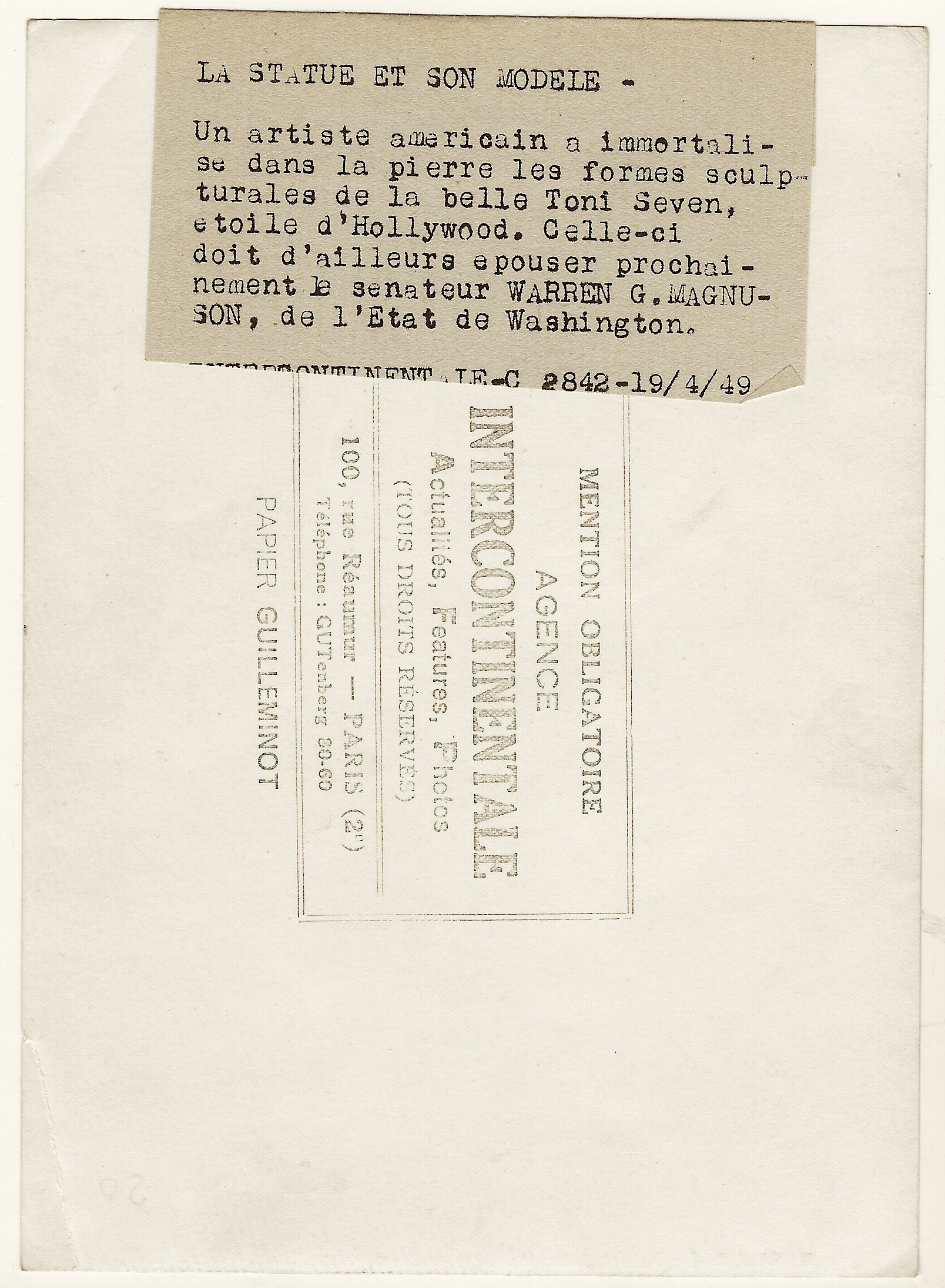 REVERSE OF PRESS PHOTO
 Photo of George Grantham Bain



 THE CABINET CARD GALLERY