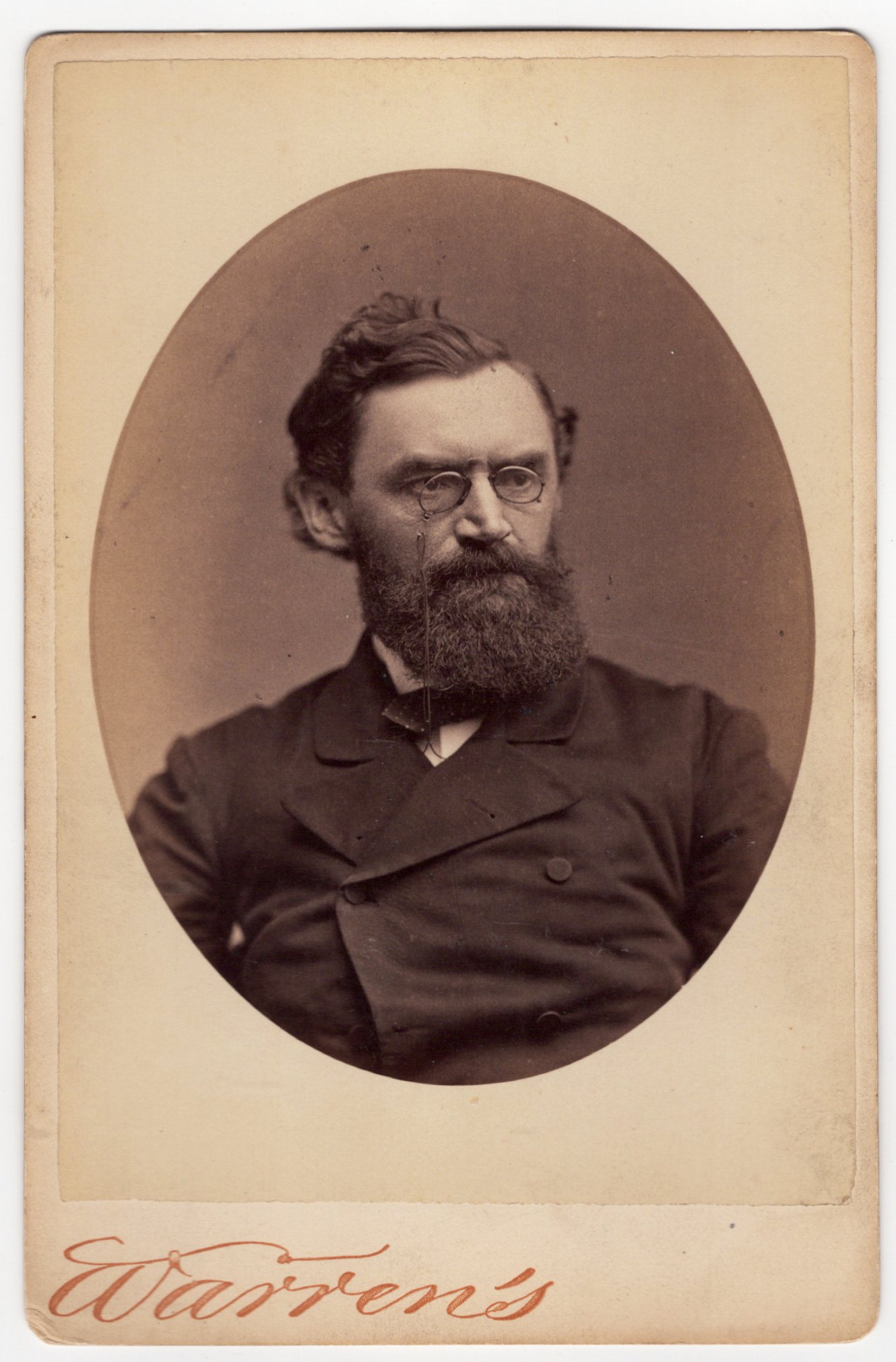
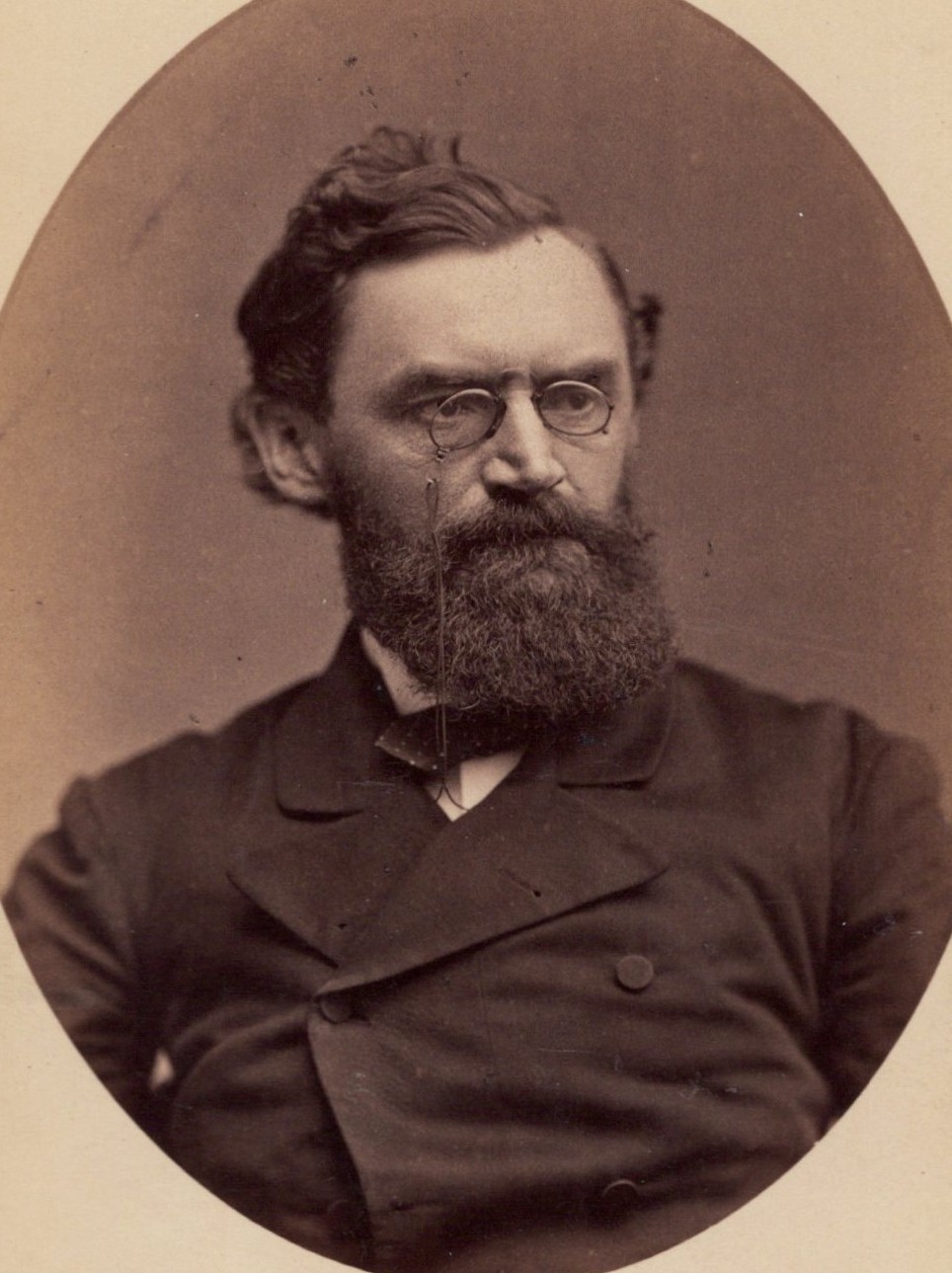
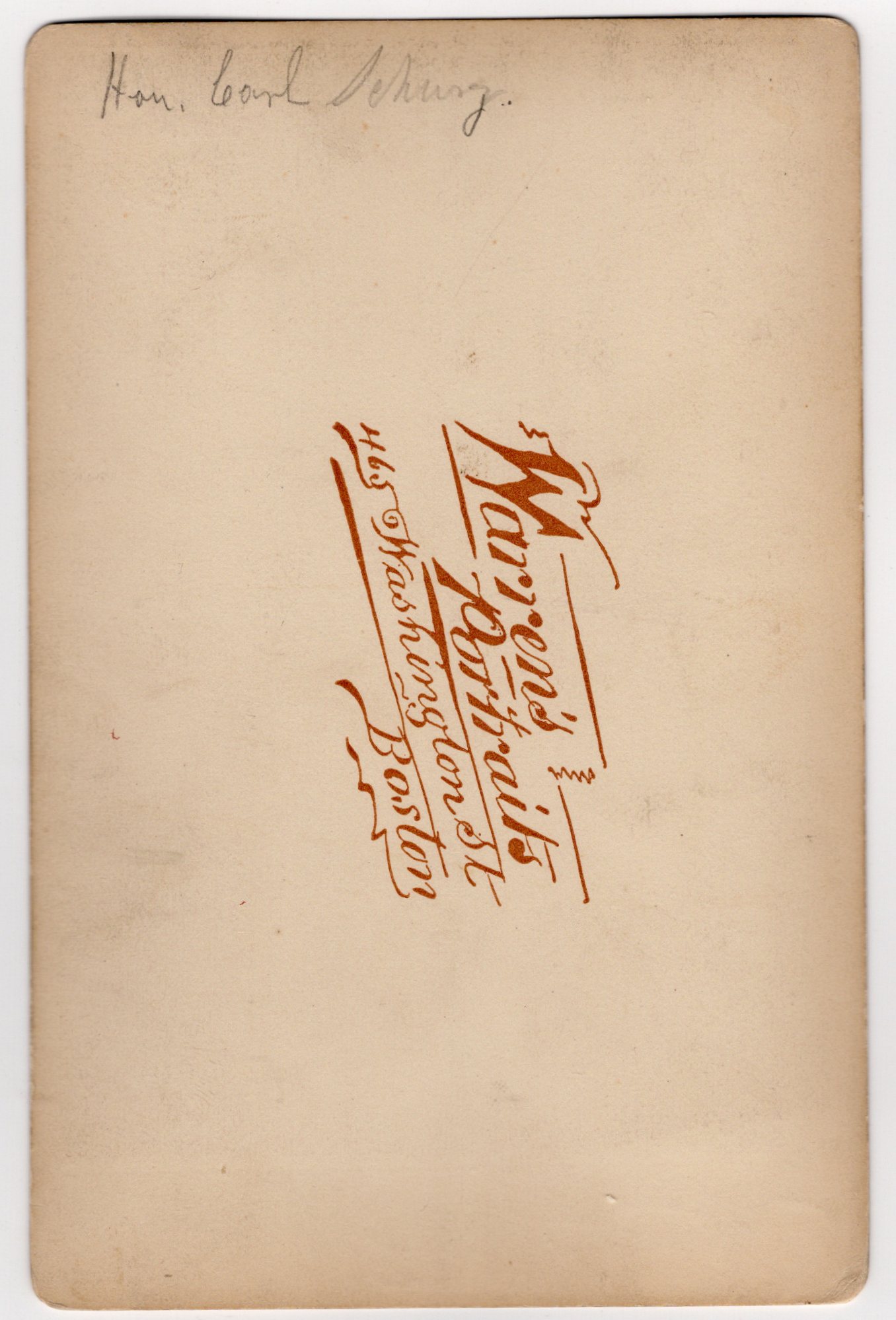
This striking 19th-century cabinet card features The Honorable Carl Schurz (1829-1906), a distinguished Civil War general, U.S. Senator, and reform-minded statesman. The photograph was taken at Warren’s Portraits, a prestigious Boston studio located at 465 Washington Street and renowned for its elegant images of notable figures during the late 1800s. In this formal portrait, Schurz is captured in a three-quarter view, seated in a dark, double-breasted coat with a subtle bow tie at his collar. His thick, well-kept beard and wavy hair give him a scholarly yet commanding presence. He gazes slightly to his left, a monocle suspended at his eye—projecting a look of intellectual rigor and seriousness. The background is a simple studio gradient, helping focus all attention on Schurz’s intense expression and refined appearance. On the reverse, the card is elegantly marked with the Warren’s Portraits logo. In pencil is written: “Hon. Carl Schurz,” affirming the identity of the sitter. Carl Schurz was born in Liblar, Prussia (modern-day Germany) in 1829. A revolutionary in his youth, he fought in the 1848 German uprisings, which ultimately failed, forcing him to flee Europe. He emigrated to the United States in 1852, where he quickly became involved in politics and the anti-slavery movement. During the American Civil War, Schurz was appointed brigadier general of Union volunteers by President Lincoln in 1862. He eventually rose to the rank of major general. Though courageous and respected, his battlefield performance received mixed reviews. He fought in key engagements including: the Second Battle of Bull Run (1862), the Battle of Chancellorsville (1863), and the Battle of Gettysburg (1863), where his XI Corps was flanked on the first day. While he was not a professional military man, Schurz’s service was notable for his efforts to advocate for German-American troops and his commitment to the Union cause. He did not have prior military experience in Europe before serving in the U.S. Army. After the war, Schurz enjoyed a long and prominent career in politics. He served as a U.S. Senator from Missouri (1869–1875) and later as Secretary of the Interior under President Rutherford B. Hayes (1877–1881). A staunch advocate of civil service reform and anti-corruption measures, he became one of the leading voices of the Liberal Republican movement. This cabinet card was produced by Warren’s Portraits, one of Boston’s most prominent photography studios in the 19th century. Operated by William Shaw Warren, the studio specialized in elegant, high-quality portraits and was especially known for photographing celebrities, politicians, military figures, and distinguished members of Boston society. Warren’s operated primarily during the 1860s through the 1890s. Warren’s images often feature clean studio backdrops, strong lighting, and detailed retouching, emphasizing refinement and dignity—qualities clearly present in this cabinet card of Carl Schurz. (SOLD)
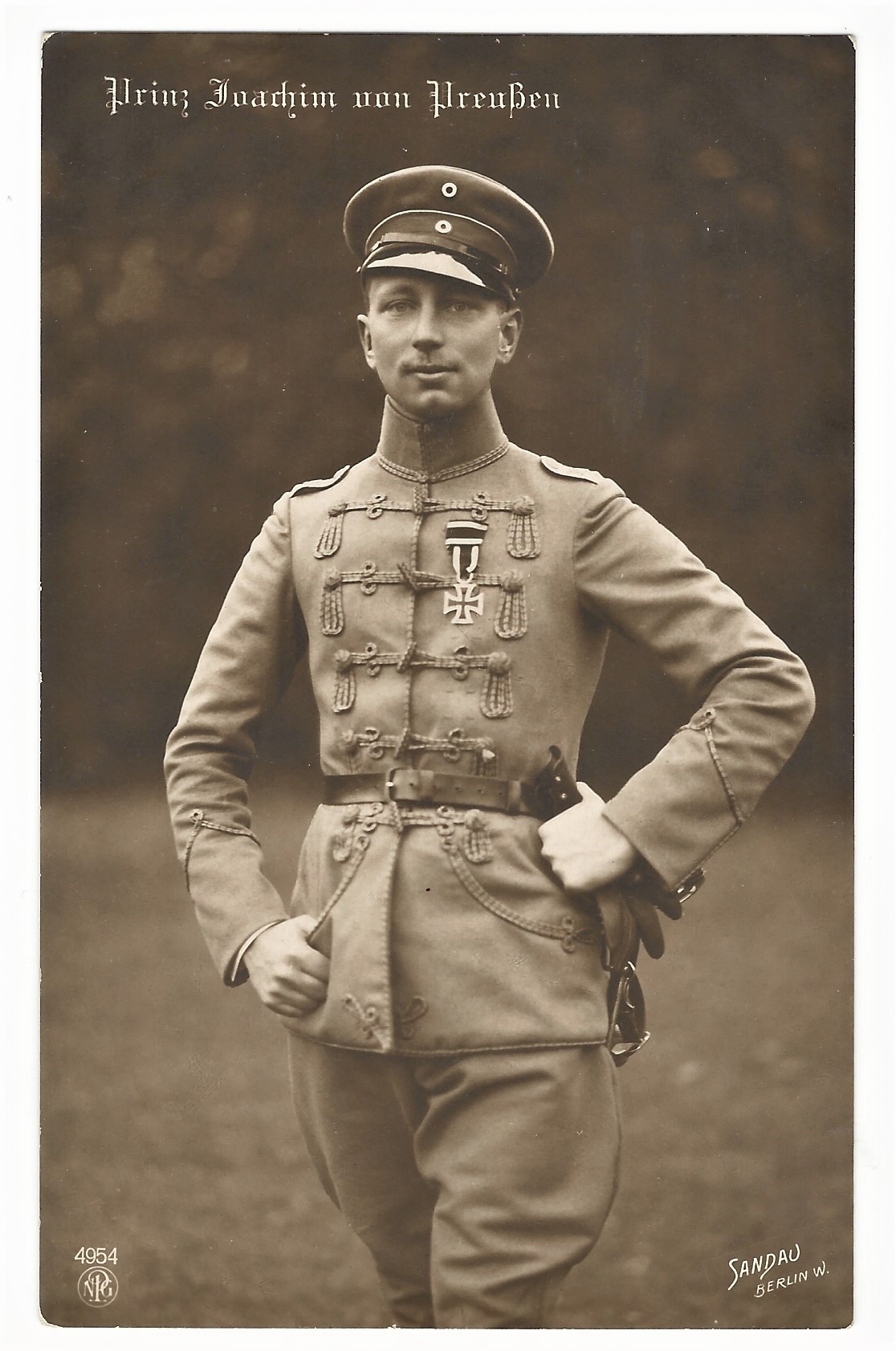
PRINCE JOACHIM VON PREUBEN : STORY OF A SAD SHORT LIFE

The young man looking sharp in his crisp military uniform is Prince Joachim Franz Humbert of Prussia (1890-1920). He was the sixth child of Wilhelm II, the German Emperor. His mother was Augusta Victoria of Schleswig-Holstein. In 1916, officials in Ireland gave thought to giving the throne to Prince Joachim with the idea that Ireland would be safer a German King if Germany were to win World War I. Prince Joachim was also considered as a possible candidate to the Georgian throne after its independence following the Russian Revolution of 1917. The Prince held the rank of 2nd Lieutenant in the 1st Regiment of Foot Guards. He held over thirty honors awarded by several nations. His awards included the Iron Cross from Germany. In 1916, Joachim married Princess Marie-Auguste of Anhalt (1898-1983). The couple had one son, Prince Karl Franz Josef Wilhelm Friedrich Eduard Paul (1916-1975). They may have had only one child, but they used enough first names to cover six more sons. I suppose that is a liberty reserved for royalty. Joachim became a commoner when his father abdicated the thrown. He became very depressed and committed suicide by gunshot in 1920. He was only 29 years old at the time of is death. It is believed that he had significant financial woes that added to his depression. Prior to his death, he divorced his wife, which likely led to further mood problems. This real photo postcard was published by “NPG” (Neue Photographische Gesellschaft) as part of a series (no.4954). The company was a leading bromide photo printing company for many years. The photographer was Ernst Sandau (1880-1918). He was born in Sweden and died in Germany. Some believe that he may have been killed in World War I. Sandau operated a studio in Berlin, Germany and was active between 1912 and 1918. His son, Ernst Jr., was also a photographer. SOLD

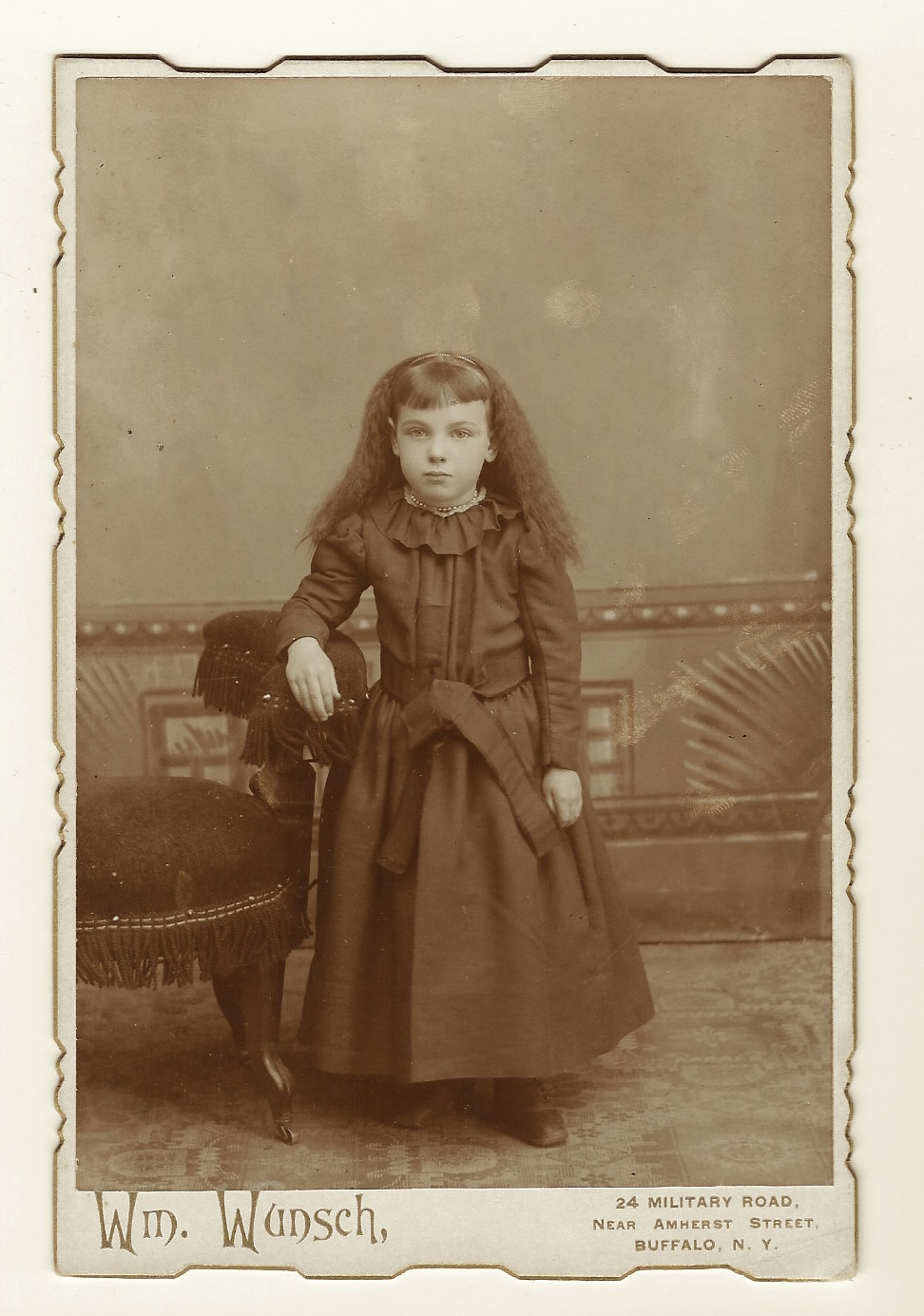
ADORABLE LITTLE GIRL IN BUFFALO, NEW YORK
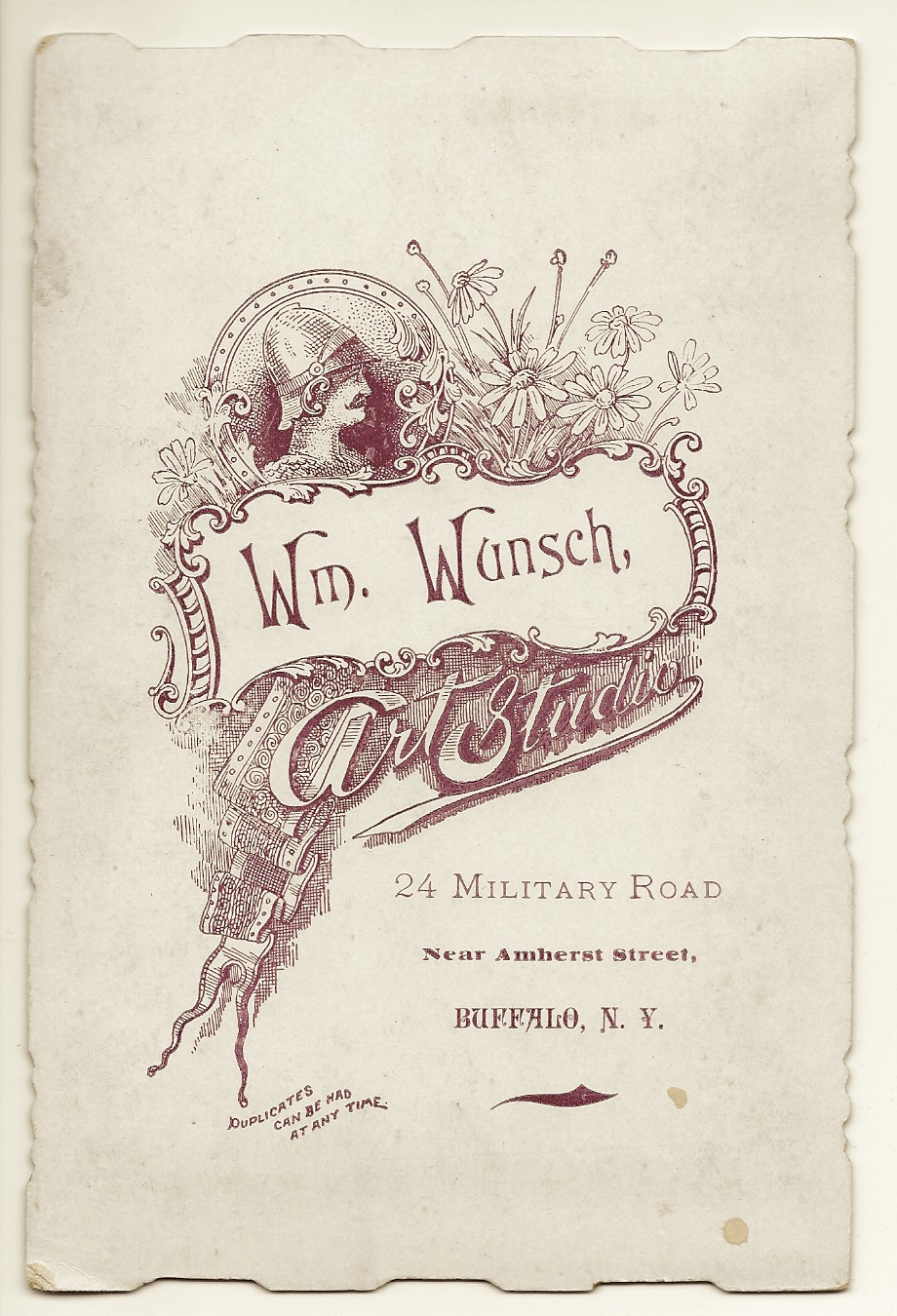
This cabinet card portrait features a charming little girl wearing a long dark dress and a serious expression. The photographer of this image is William Wunsch (1846-1929). His obituary, which appeared in the Buffalo News, indicates that he was a war hero. As Wunsch requested, he was buried with three war medals (including the Gold Cross). Wunsch was a lieutenant in the Franco Prussian Wars and he was decorated for bravery. He came to the United States in 1871 and was granted citizenship in 1876. He was married to Sophia E. Steinmetz Wunsch (1878-1949). He resumed his Prussian career as a photographer after immigrating to the United States. He was very active in the German community of Buffalo, particularly with singing societies. Wunsch was still a photographer at the time of his death even though he was 83 years old. He is buried in Buffalo’s Forest Lawn Cemetery. Judging by the scalloped edges of this photograph, the image was produced sometime after 1886. Wunsch’s studio was located on Military Road at least between 1878 and 1927. It is interesting to note that this war hero photographer located his studio on a street called “Military Road” and used a military figure in his business logo which can be seen on the reverse of the cabinet card (see image below). (SOLD)
DESK JOCKEY CONDUCTS BUSINESS IN POSEN, PRUSSIA
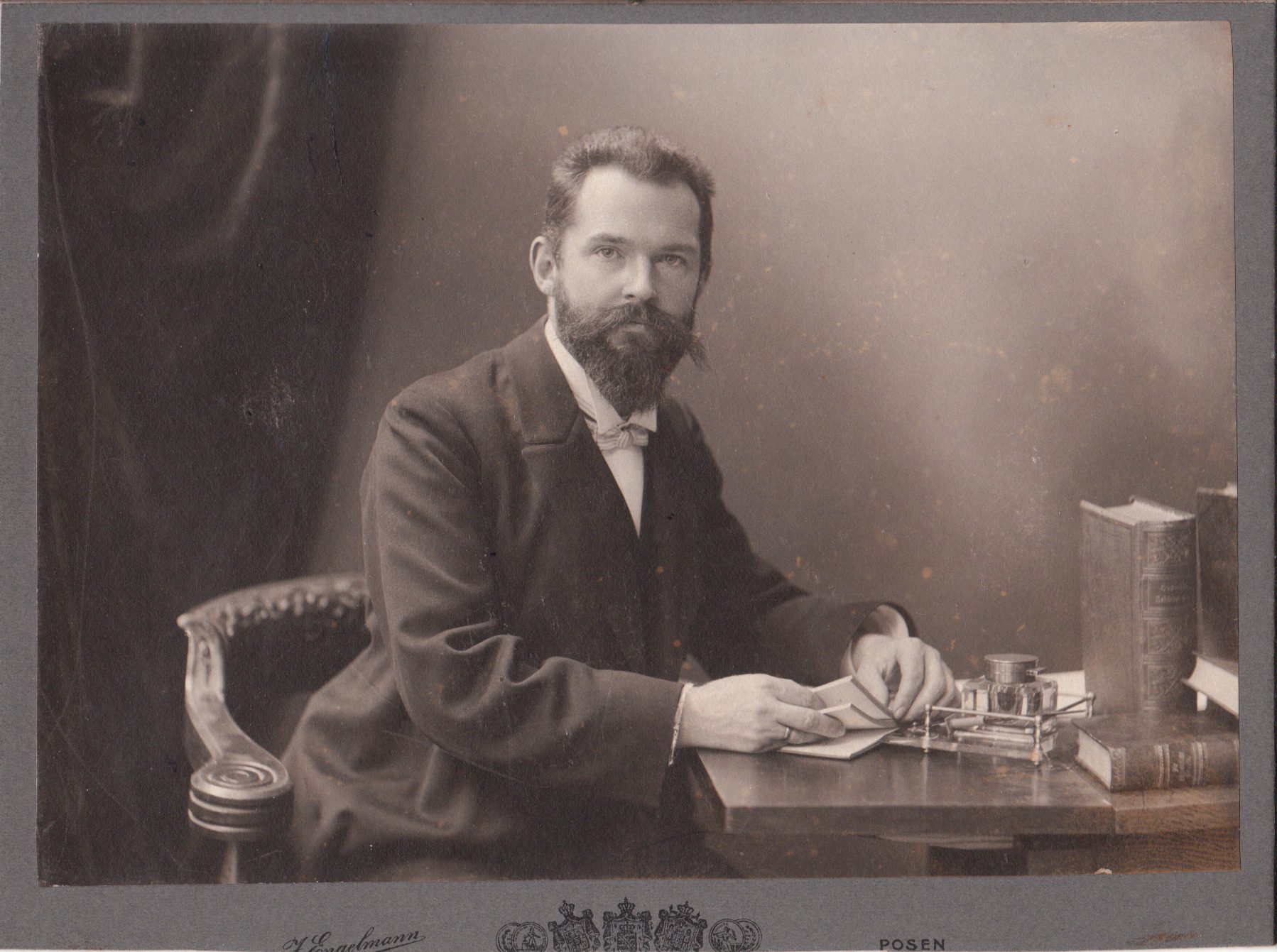
A handsome well dressed gentleman sits at his desk and poses for this portrait by the Engelmann studio in Posen, Poland. At the time of this photograph, Posen was a province of Prussia and part of the German Empire. The man in this photograph appears to be a professional of some type. Perhaps he was an attorney or politician. He is leafing through some papers and looking at the camera. Note the large books (journals?) and the inkwell on his desk. He is wearing a wedding ring and a bow tie. (SOLD)
AN OFFICER AND TWO LADIES IN FRANKFURT, PRUSSIA
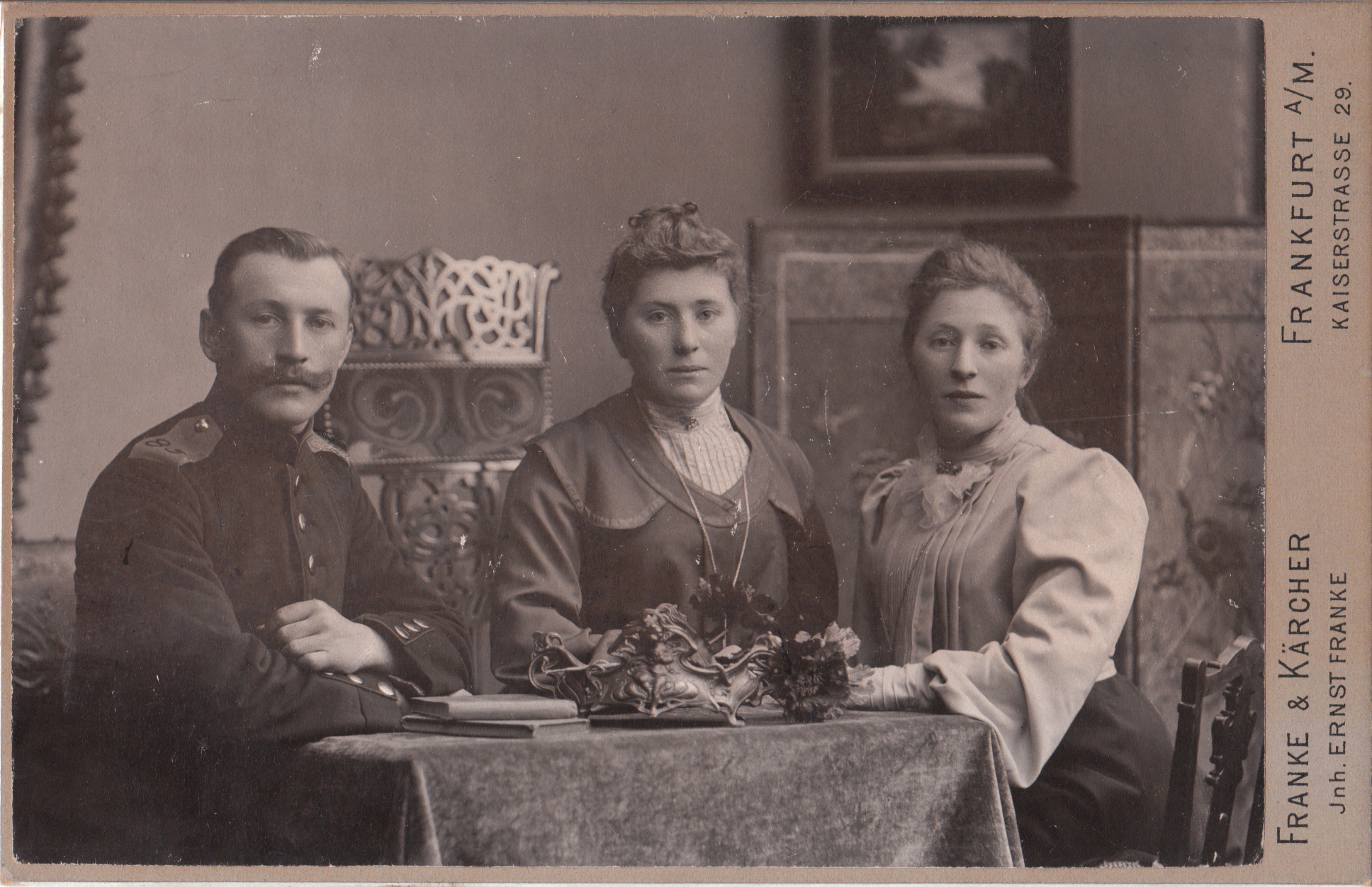
This cabinet card features a military officer and two women seated at a table. All three individuals appear quite austere. On the table are two small books and a bowl with contents that include a pair of scissors. Perhaps this is a family photograph, but there is likely an interesting story about the lives of the subjects in this photograph. The photographer of this image is Franke & Karcher of Frankfurt. At the time of this portrait, Frankfurt was ruled by Prussia.