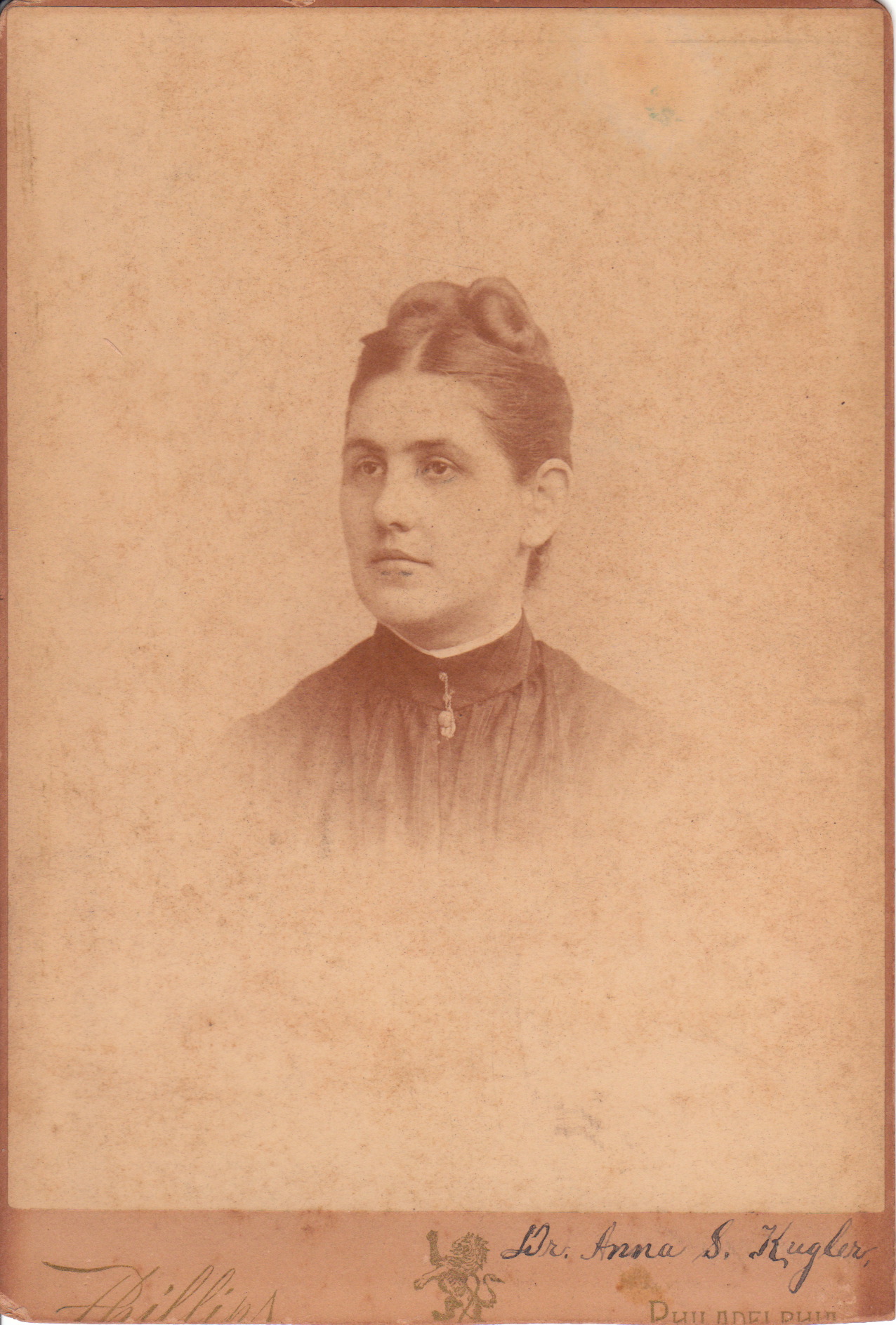
 It is not the quality of the image that makes this photograph special. This is a unique photograph because of the identity of the subject. Meet Dr. Anna S. Kugler. Anna Sarah Kugler (1856-1930) provided 47 years of service ministering to the spiritual and physical health of the people of southern India. She was the second female missionary and the first female medical missionary sent by the General Synod of the Evangelical Lutheran Church of the United States. She was born in Ardmore, Pennsylvania in 1856. In 1879 she graduated from Women’s Medical College in Philadelphia. She did her internship at Norristown State Asylum in 1880. Two years later, after receiving a cleric’s invitation to come work in India to help resolve the major health issues faced by poor Indian women, Kugler decided to take on the challenge. She sailed for India in 1883 and was disappointed that her appointment as a missionary was directed at teaching, not providing medical care. She hoped to change the church’s mind on that matter. During her first year in India she found time to see over 400 patients and still take care of her teaching responsibilities of the Muslim harem women. In 1884 she became the director of the Hindu Girls School, a post she kept for three years. Finally, in 1885, she was appointed a medical missionary. In 1893 she opened a hospital and dispensary in Guntur, India. Over time she established specialized pediatric, maternity, and surgical units in the hospital. After Kugler’s death, the hospital was named after her. Have you heard this quote? “Well behaved women seldom make history”. Women who went to medical school in the 1870’s were likely not considered well behaved because they were entering into a man’s profession. Going to India and working with the poor was also probably seen as outside the realm of being a woman. Thank goodness Dr Anna S Kugler ignored gender boundaries because she accomplished great things and certainly “made history”. This photograph was produced by the Phillips studio in Philadelphia, Pennsylvania. To view other photographs by Mr. Phillips, click on the category “Photographer: Phillips”. Phillip’s subjects among his images in the Cabinet Card Gallery include theater great, Ethel Barrymore. At the time of this photograph, Phillips operated his studio at 1206 Chestnut Street. A biographer called Henry C. Phillips (1843-1911) “A pillar of photography in Philadelphia”. He began working as a photographer while still in his teens. He opened his first studio on Chestnut Street in 1862. He partnered with Samuel Broadbent between 1868 and 1874. (To view other photographs by Broadbent, click on the category “Photographer: Broadbent). After that partnership and another brief one, he opened his 1206 Chestnut studio and it operated for 36 years under Henry and than his two sons, Howard and Ryland. Henry Phillips was a portrait artist and on the side, he was a celebrity photographer. He did not like to use painted backdrops in his portraits. He preferred to photograph faces and figures against neutral or blank backgrounds. Photographs from the studio that utilized painted backgrounds were usually the work of Ryland.





 THE CABINET CARD GALLERY
