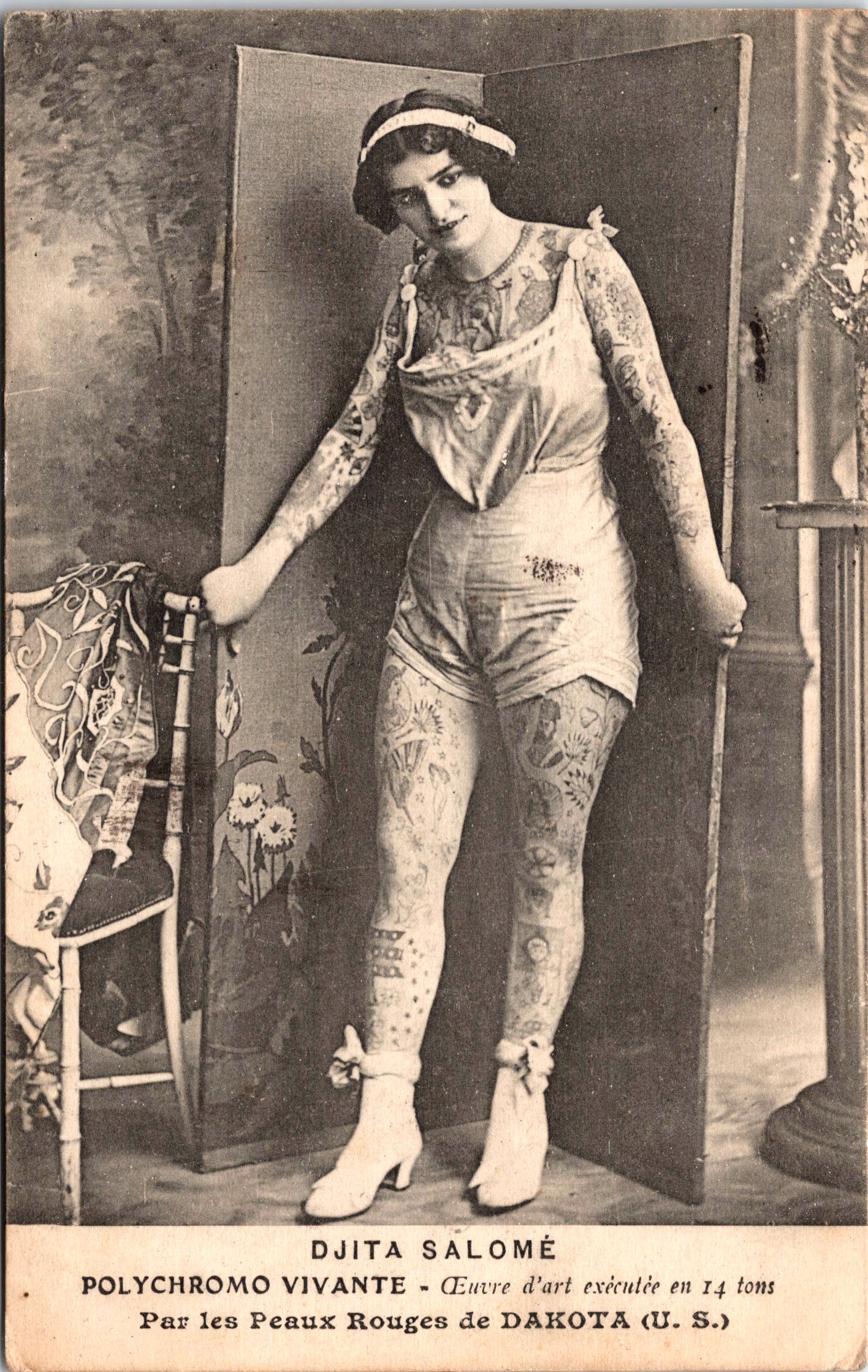
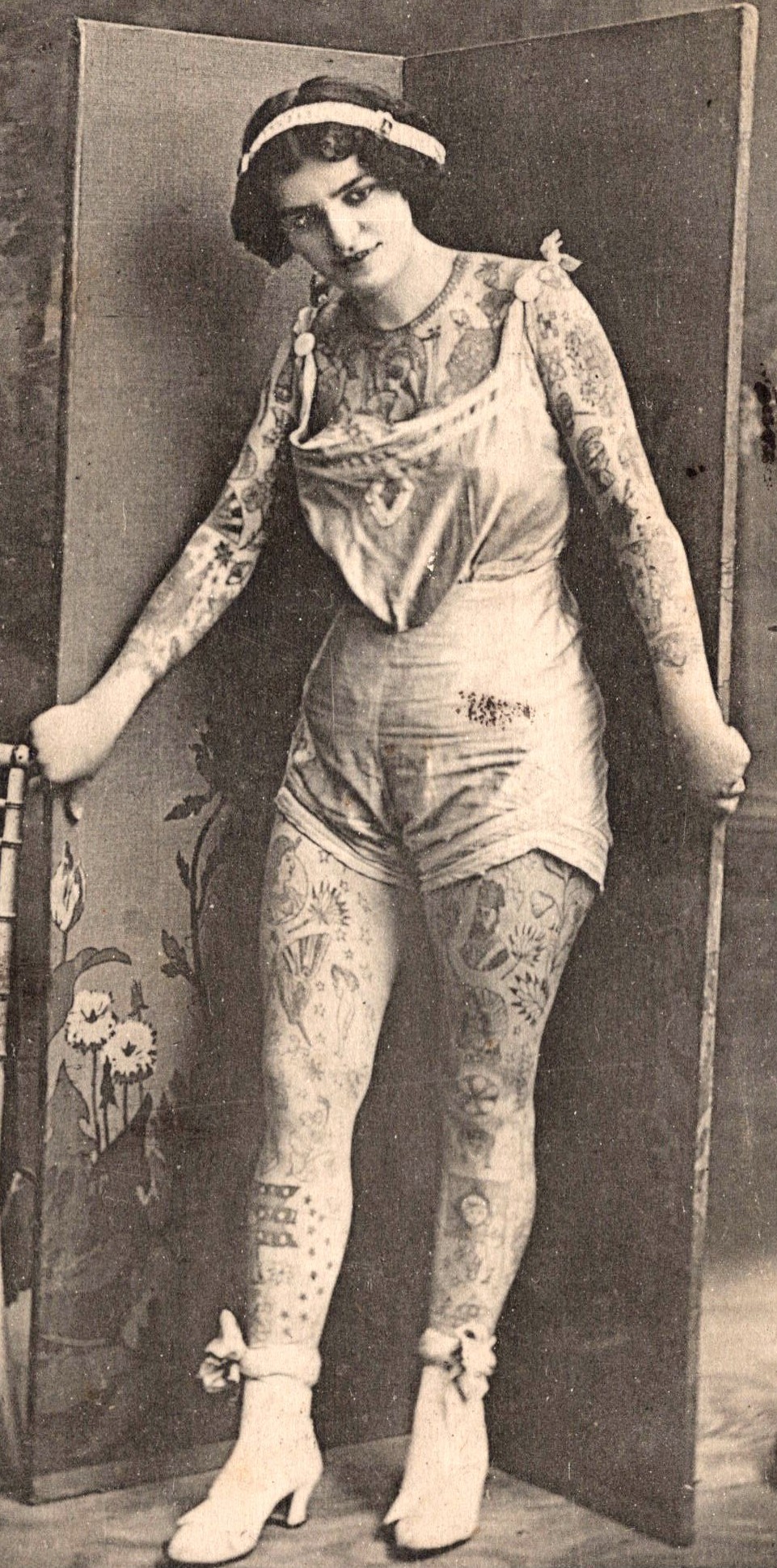
This extraordinary real photo postcard features Djita Salomé, one of Europe’s most celebrated tattooed ladies of the early 20th century. Salomé toured widely on the sideshow and carnival circuit and was promoted as a “living polychrome work of art.” Her entire body was covered in elaborate tattoos, executed in up to 14 different colors, making her a sensation across Europe. She performed at major venues including Edinburgh’s Waverley Market (1911), Toulouse’s Théâtre des Nouveautés (1913), Laval (1914), and Paris’s Bal Tabarin (1914). The postcard’s printed caption (in French) describes her as: “Djita Salomé – Living Polychrome – Work of art executed in 14 tones by the Red Skins of Dakota (U.S.)”. Such phrasing was typical of the bold circus-style marketing used to promote her act. The card carries a handwritten message dated 1916,. The card was sent from Drome, France; and was addressed to Léon Florançon at a local barracks. The following is a rough translation of the message : ” My dear Léon, I received your letter of the 14th with great pleasure. I am happy to know that you are well. Here, everything is going fine, and we are all in good health. Papa is working as usual, and we are managing with the household accounts as best we can. I sent the 25 francs you asked for last week—please let me know if you received it. Write more often when you can; your letters always bring us joy. Mama sends you her warm affection. Courage, my dear boy, and remember that we think of you every day. With tender kisses, Your loving sister, Jeanne.” This message not only adds personal warmth but also situates the postcard directly in the context of World War I France, where families maintained contact with sons and brothers in service. (SOLD)



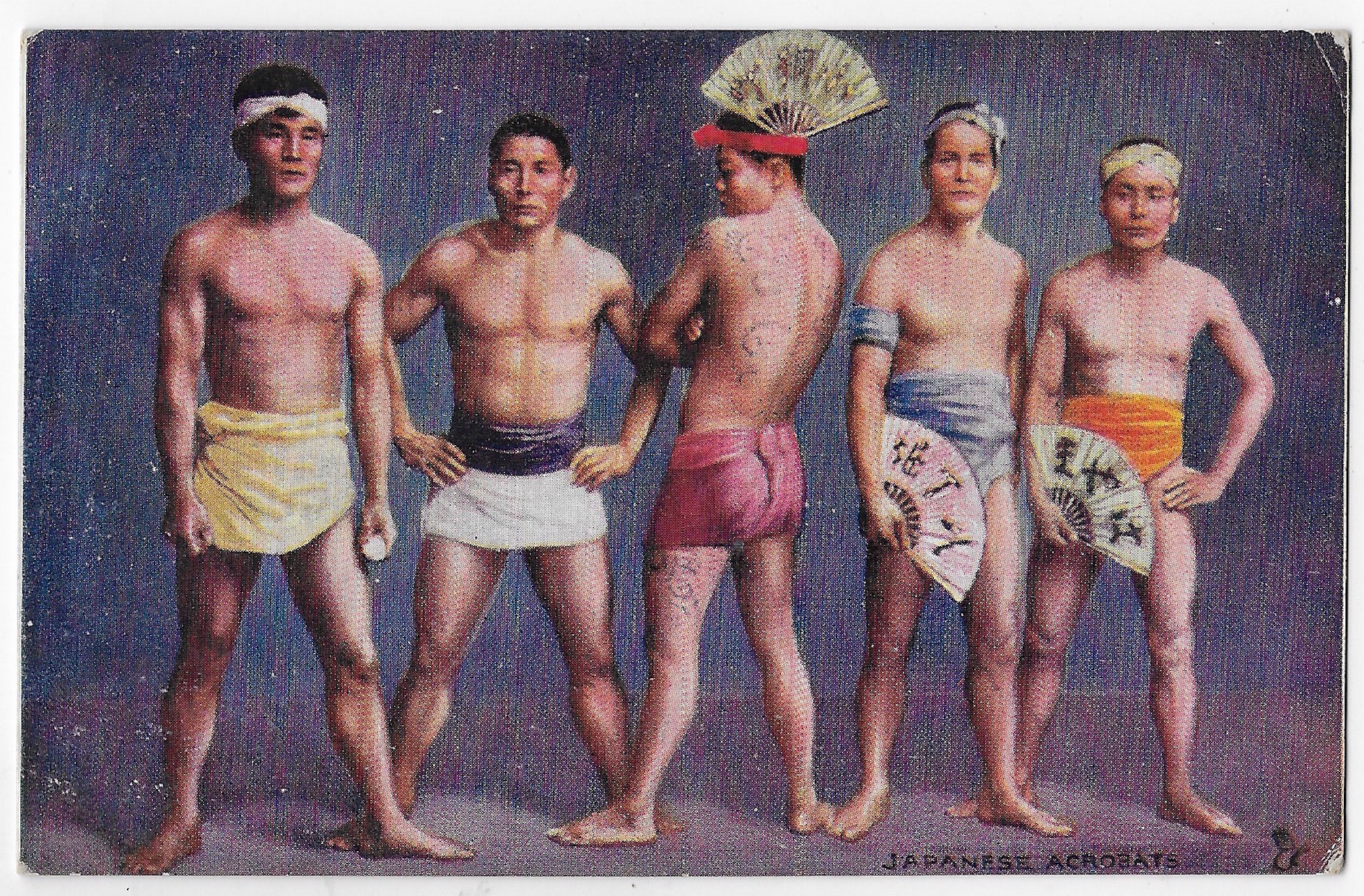 This vintage postcard was published by Raphael Tuck & Sons and is titled “Japanese Acrobats” (no. 6465). The performer in the middle has tattoos on his back, as well as on the back of his left leg. Note the acrobats are holding paper fans and that the center acrobat is wearing his fan on his head. The card is part of a sub-series named “Japanese at Home”. The postcard is also a member of the “Oilette ” series, which was introduced in 1903. The 1930 Tuck catalog states that the oilettes are “veritable miniature oil paintings;” with six designs in a packet. These postcards were printed with the “finest modern colour methods direct from original paintings”. Raphael Tuck and his wife started their photography business in 1866 in London. Their store sold pictures, greeting cards, and in time, postcards. Their success came from the sale of postcards during the late 1890’s and early 1900’s. In the early 1900’s the firm conducted postcard competitions for collectors of Tuck postcards. These competitions offered cash prizes and they were very popular. The winner of one of these competitions had a collection consisting of over twenty-five thousand cards. Three of Tuck’s four sons participated in the business. The company was devastated by German bombing during World War II. In 1959 the company merged with two other printing companies. (SOLD)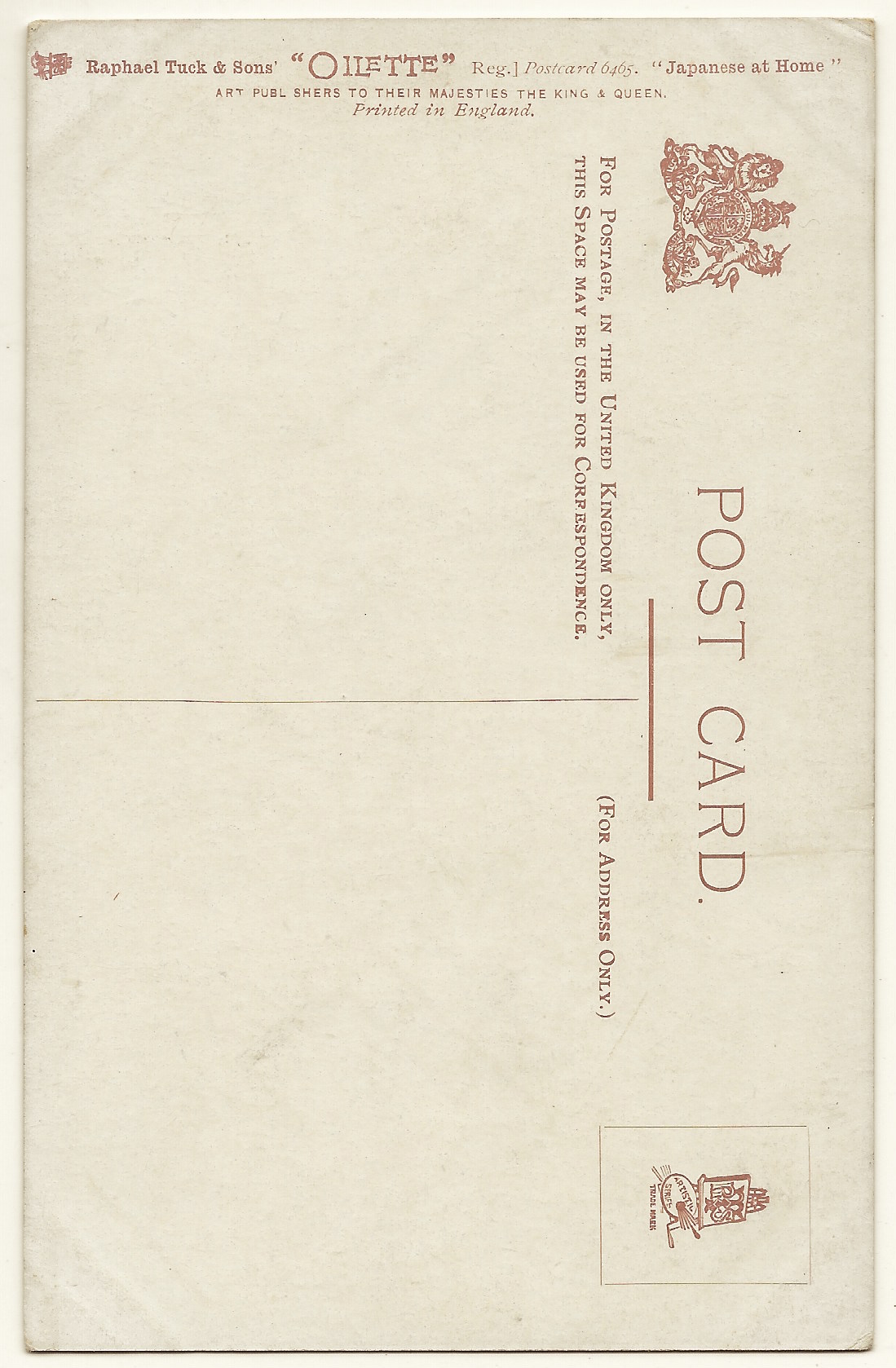


 THE CABINET CARD GALLERY