PORTRAIT OF A LOVELY COUPLE IN SAN FRANCISCO, CALIFORNIA

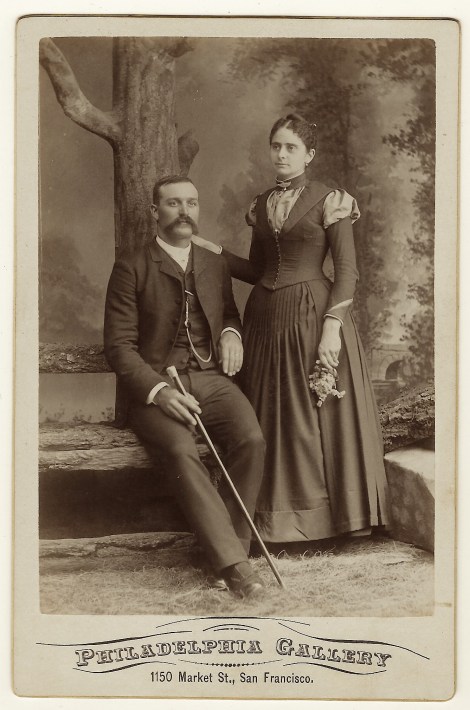
This cabinet card portrait features a lovely couple posing for their portrait at the Philadelphia Gallery in San Francisco, California. The gentleman is wearing a three piece suit and a pocket watch. He has a handsome mustache and is holding a walking stick. The woman is well dressed. She is wearing a collar pin and earrings. She is holding a small bouquet of flowers. This cabinet card has great clarity and is in very good condition.

Buy this original Cabinet Card photograph (includes shipping to the US) #2455

To purchase this item, click on the Pay with PayPal button below

$28.50


Buy this original Cabinet Card photograph (includes international shipping outside the US) #2455

To purchase this item, click on the Pay with PayPal button below

$36.50

A STREET SCENE IN AGUA PRIETA, SONORA, MEXICO (BEFORE THE FIASCO)

down mexico way 1

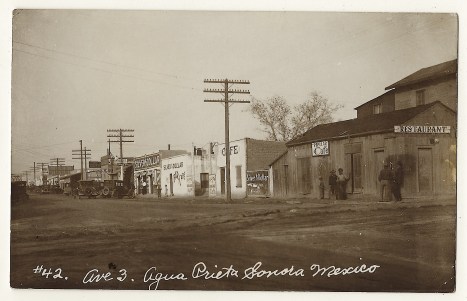
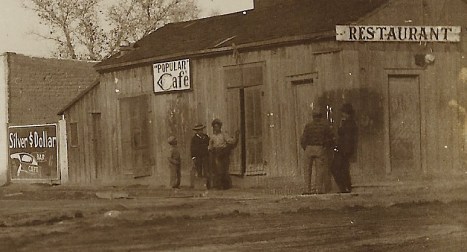
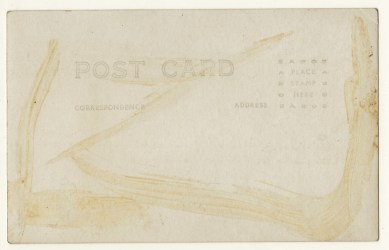
Welcome to Agua Prieta. The town’s name is not very appetizing. In English, the town’s name is “Brown Water”. According to the postcard’s AZO stamp box, this street scene photo was taken between 1924 and 1949. The photo shows “Avenue 3” in Agua Prieta. Note the signage in the photograph. There is a restaurant, a cafe, and the Silver $ Dollar Bar. Further down the avenue are some old cars.  The town is located in the northeastern corner of the Mexican state of Sonora. It is a border town and is adjacent to the town of Douglas, Arizona. Agua Prieta was developed at the end of the 19th century as railroads were built between Douglas and the Mexican town of Nacozari. The trains would transport minerals and other goods. The first settlers in Agua Prieta were employed by the US mining company Phelps Dodge Corporation. The company was based in Douglas, Arizona. The town of Agua Prieta was unofficially founded in 1899 but did not become an independent municipality until 1916. This photograph was taken long before the fiasco of the current US immigration policy. Today, Douglas has a population of about 16,500 people. Although the town is depressed, the border crossing remains busy. According to US Customs and Border Protection records for 2016, more than 3.8 million people passed through the town’s port of entry on foot, or by car. It is important to note that many of these people were going between Mexico and the US to visit family, conduct business, or shop. Therefore, their visits were of short duration. I hope that Congress will be able to formulate and pass a more rational, humane, and constructive immigration policy; and do so in a timely fashion.  (SOLD)

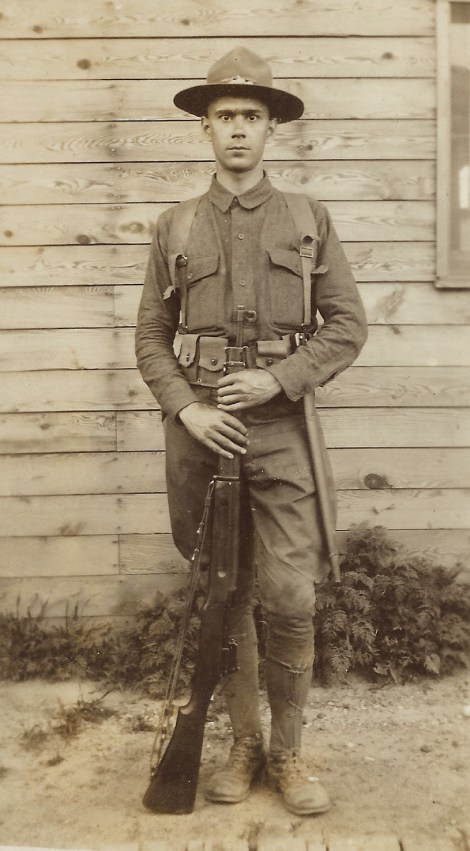
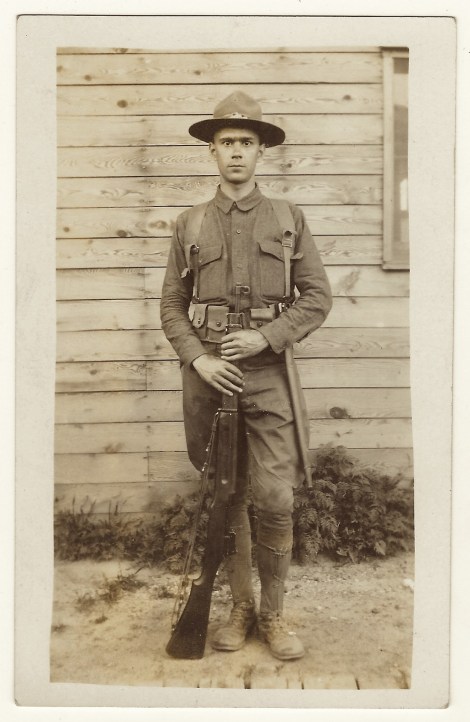
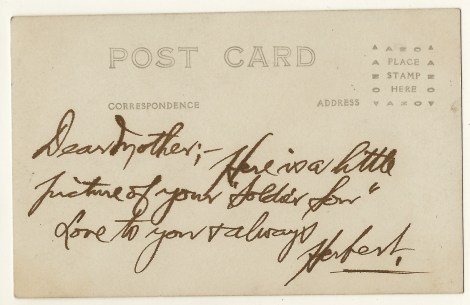
PORTRAIT OF “SOLDIER SON”: SENT TO HIS DEAR MOTHER WITH LOVE

This vintage real photo postcard features a young uniformed soldier. He is holding his rifle in front of him and he appears to be ready for action. Note his multi faceted utility belt and his boots. The young man wrote a message to his mother on the reverse of the postcard. He proudly presents himself as his mom’s “soldier son”. His message also reveals that the soldier’s name is “Herbert”. The “AZO” stamp box indicates that this photo postcard was published sometime between 1918 and 1930. Interestingly, World War I ended in 1918. Perhaps Herbert was a soldier in the “War to end all Wars”. This postcard is in excellent condition (see scans).      SOLD

Published in: on June 23, 2018 at 12:00 pm  Comments (3)  
Tags: , , ,

A DAY AT THE BEACH WITH A PRETTY WOMAN IN A FASHIONABLE STRIPED BATHING SUIT

The pretty young woman seen in this vintage real photo postcard is wearing a flashy striped bathing suit. This fashionista accessorized her bathing suit with a large matching hair bow. It was published by “NPG” (Neue Photographische Gesellschaft). The company was a leading bromide photo printing company for many years. The stamp box of this particular postcard has an interesting story. “NBC” (Neue Bromsilber Convention) was price cartel established in 1909 that continued until the 1930’s. The purpose of the cartel was to ensure that the minimum price charged for postcards was kept at a sufficiently profitable level. A number of postcard publishing companies joined the cartel in an effort to stave off the effect of competition on the pricing of postcards. This postcard is part of a series (no. 7194/5).  (SOLD)

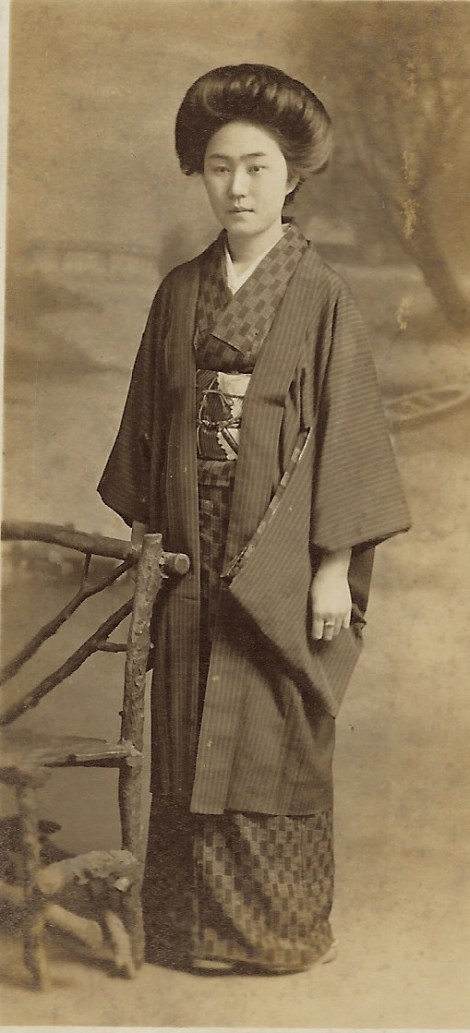
PRETTY JAPANESE WOMAN WEARING A KIMONO IN TOKYO JAPAN

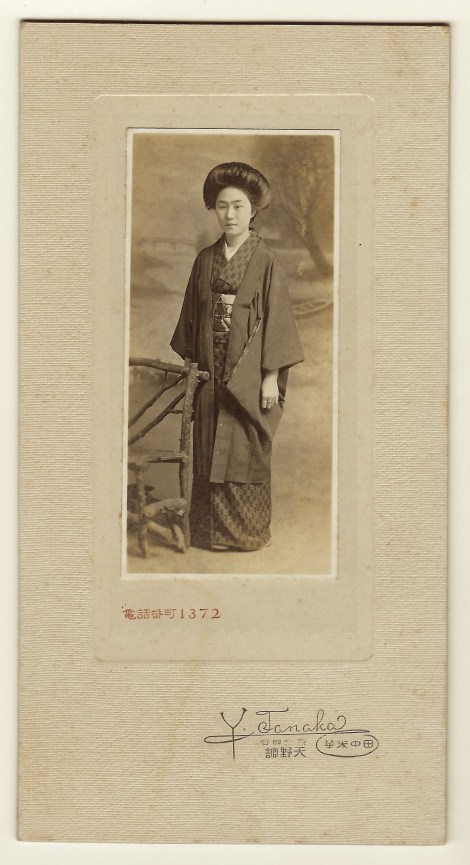
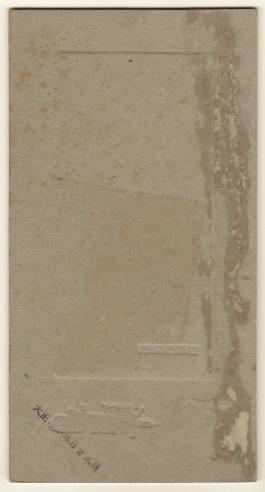
This vintage photograph features a pretty Japanese woman wearing a kimono. I am curious about why her hair is styled in such a perfectly coiffed straight up fashion. My guess is that the hair style’s purpose is to show the woman’s complete facial beauty. Just a guess on my part. The previous owner of this photograph identified the year it was taken as 1915. It is likely that this date is printed (in Japanese) on the front of the photograph. At the very least, this image is from circa 1915. The photo was taken by Tanaka who operated a studio in Tokyo, Japan. This antique photograph measures about 6 3/4″ x 3 1/2″ and is in very good condition (see scans). Residue on the reverse of the photograph indicates that it once resided in a photo album.

SOLD

Published in: on June 22, 2018 at 12:00 am  Comments (1)  
Tags: , ,

WOMAN IN OLD WEST CLOTHING SITTING SIDE SADDLE ON A STUFFED HORSE: BOYFRIEND OFFERS MORAL SUPPORT

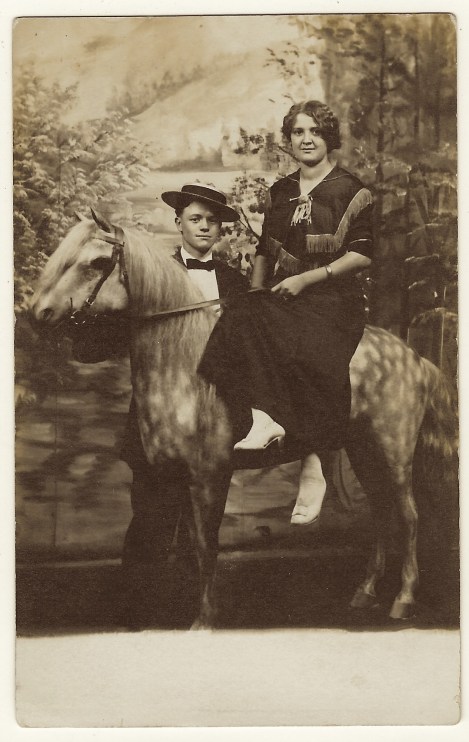
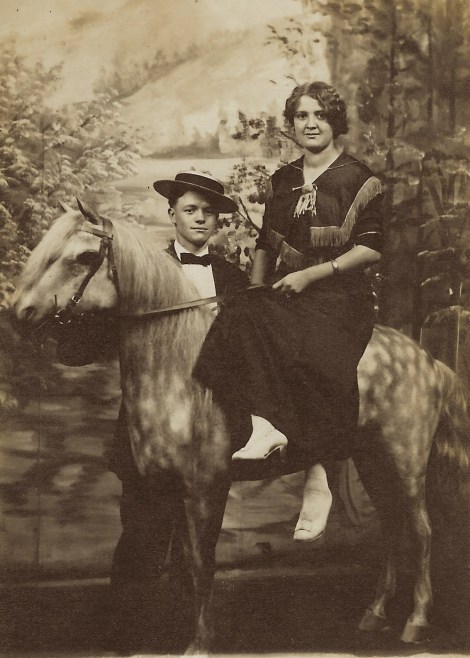
A young woman sits side saddle on a small horse, or donkey, as her boyfriend, or husband provides moral support. The horse has appaloosa type coloring. The woman is wearing a fringed western dress and a nice smile. The gentleman is wearing a suit accessorized with a bow tie and a bowler hat. This vintage real photo postcard is from a private studio; not mass produced. The postcard was published sometime between 1904 and 1918.


Buy this original Real Photo Postcard (includes shipping in the US) #2445

To purchase this item, click on the Pay with PayPal button below.

$28.50


Buy this original Real Photo Postcard (includes International shipping outside the US) #2445

To purchase this item, click on the Pay with PayPal button below.

$36.50


Published in: on June 21, 2018 at 12:00 pm  Comments (1)  
Tags: , , ,

THE TRAGIC LIFE OF STAGE AND FILM ACTRESS MARIA ORSKA

This vintage real photo postcard features stage and film actress Maria Orska (1893-1930). She was a major star in Germany during the 1920’s. She was born in Russia and her birth name was Rachel Blindermann. She was born into a Jewish family that lived close to Odessa in the Russian Federation. Today, her birthplace is located in the Ukraine. Her father was a lawyer. Just prior to World War I she moved to Vienna, Hamburg and Berlin. Orska must have been bright because she was fluent in German, French, Italian, Russian, and Polish. In Berlin, she worked with Rudolf Bernauer, Max Reinhard, and other well known directors. She became popular in Germany for her film parts, though she favored theater. Her first movie was “Damon Und Mensch” (1915) and it was produced by Jules Greenbaum, a pioneer of the German cinema. Oscar Kokoschka, an Austrian artist, drew Orska’s portrait, and lithographs of the work are now part of several museum’s collections. Orska married a much older man who was an influential Jewish banker from Berlin. They married in 1920 and divorced in 1925. Her next significant relationship was with a wealthy Jewish industrialist and geologist named Julius Heinrich Koritschoner from Vienna, Austria. In 1928 he fatally shot himself, leaving Orska a letter. Koritschoner’s morphine addiction was thought to have led to his suicide. Orska’s sister had committed suicide just two years earlier. She committed the act of self destruction just after having an intense argument with Maria. Orska was extremely popular in Central Europe during the 1920’s. The IMDb credits Maria Orska with 14 movie appearances between 1915 and 1923. She was seen as an extraordinary actress and her photographs appeared on many magazine covers and postcards. Suicide had taken the lives of her ex husband and her sister; and she too, eventually succumbed to self-annihilation. She committed suicide in 1930 while in Vienna. It was speculated that, like her ex-husband, morphine addiction resulted in her suicide. Here is some information about this postcard. It was published by Film Sterne. Around 1916 Rotophot began publishing three series of postcards with the RPH logo (see bottom left corner of above image).The first series was called “Buhnen-Sterne” (stage stars) and was comprised of German stage performers. The second series was named “Film Sterne” (film stars) and this postcard portrait of Maria Orska is part of that series (no. 118/1). The third set of postcards, “Film Sterne” (film scenes) showed scenes from German films and identified both the film and the performers. The photographer of this postcard portrait of Miss Orska, was the Becker & Maass studio, located in Berlin.    SOLD
PORTRAIT OF THE WEAVER FAMILY AND THEIR LOOM (VINTAGE PHOTOGRAPH)

This vintage photograph features a young woman at a loom. There are four more people in the room but we are compelled to guess who they are. My hypothesis is that the children belong to the young woman and the gentleman on the bench is her husband. The man standing may be the grandfather to the children. Your guess is as good as mine. A knowledgeable source asserts that this image dates back to Imperial Russia (c. 1917). There is a question clawing at me. I wonder if this photograph was taken in a weaving room, or if the photo was taken in a photographer’s studio. The walls of the room appear to be painted, as if they are backdrops. However, I have never seen a loom used as a prop in vintage photographs. This photo is in very good condition (see scans).

Buy this original Vintage Photograph (includes shipping to the US) #2442

To purchase this item, click on the Pay with PayPal button below.

$85.00


Buy this original Vintage Photograph (includes International shipping outside the US) #2442

To purchase this item, click on the Pay with PayPal button below.

$93.00

Published in: on June 18, 2018 at 12:00 pm  Comments (1)  
Tags: , ,

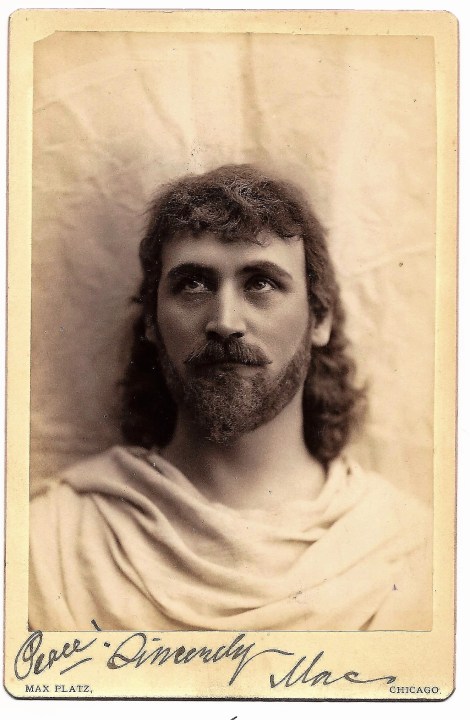
PORTRAIT OF MAC BARNES PLAYING JESUS IN A THEATRICAL PRODUCTION (PHOTO BY MAX PLATZ)

This cabinet card photograph features actor Mac Barnes. He certainly looks like that he is in character to play Jesus in a theatrical production. His long hair, beard, and robe lead me to this hypothesis. An inscription below the image on the cabinet card states “Peace! Sincerely, Mac”. Before seeing this inscription, I thought my generation (Baby Boomers) were the first cohort to use the word “peace” when addressing each other. Mac Barnes (1863-1923) is listed in the IMDb. He was born in Bedford, Indiana, He was a vaudeville, stage, and screen actor. He was known for his roles in “The Food Gamblers” (1917), “The Haunted House” (1917), and  “Experience” (1921), His filmography includes 21 credits from 1909 through 1921. The photographer of this cabinet card photograph is Max Platz (1850-1894) who operated a studio in Chicago Illinois. Platz was born in Germany. His father was a tanner and he moved the family to Racine, Wisconsin when Platz was still a lad. He began his career at age 16 as a “positionist” in his brother-in-laws photographic gallery. His brother-in-law was Henry Rocher, a very talented and well respected photographer. He was Rocher’s primary assistant from 1867 through 1881. In 1881 Platz established his own photography business and encountered immediate success. He was a life long bachelor and clubman and was known for his wit, friendliness, and story-telling. He developed quite a following from members of the theater, German-American society, and the fashion world. His studio was decorated very elaborately. He employed antiques as props, much in the same way as Napoleon Sarony. It is written that his posing style resembled his friend, Benjamin Falk. Platz was an active member of the Chicago Photographic Association in 1893, he played an major role in the Department of Art for the Columbian Exposition. When Platz died in 1894, his studio and negatives went to his friend and fellow Rocher Student Joseph Gehrig and his pupil, James Samuel Windeatt. Wilson’s Photographic Magazine (1904) declares that a photographic session with Platz could be quirky. It seems that he had a habit of disappearing mid-sitting in order to find a quiet place to ponder the best poses he could utilize for his sitter. Platz earned the nickname “The Sarony of the West”. This cabinet card portrait is in very good condition. (see scans).   (SOLD)

PORTRAIT OF AN ICE SKATER AND HIS FRIEND IN MONROE, MICHIGAN

This vintage photograph features two young men wearing overcoats. The men are wearing gloves and are dressed for winter weather. One of the young men has a pair of ice skates draped over his shoulders. Perhaps his next stop, after having his portrait taken, is to a local frozen lake where he can enjoy some ice skating. This photo was taken at the Beck  studio in Monroe, Michigan. The photograph measures about 5″ x 7″ and is in very good condition (see scans).   (SOLD)

Published in: on June 8, 2018 at 12:00 pm  Comments (1)  
Tags: , ,