PORTRAIT OF A ROCKABILLY FAMILY FROM THE 1800’S

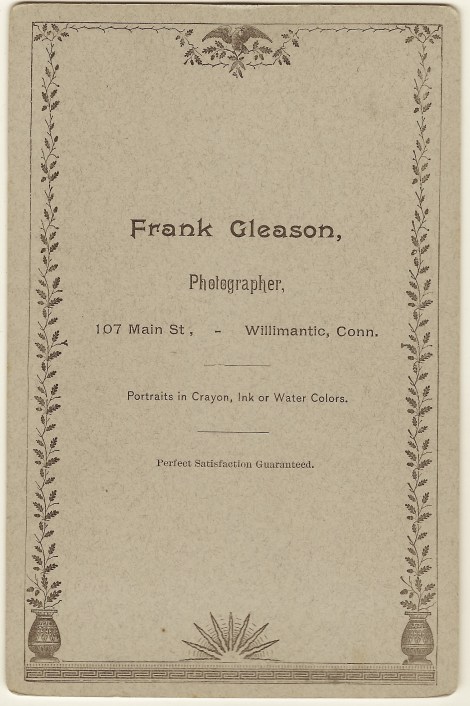
This cabinet card portrait features a young husband and wife posing with their baby at a studio located in Willimantic, Connecticut. The father looks as if he may have been one of the originators of the rockabilly culture. The photographer of this image is Frank Gleason. He is listed in the 1898 Willimantic business directory as a photographer.  SOLD

Published in: on July 8, 2018 at 12:00 pm  Comments (2)  
Tags: , ,

HANDSOME YOUNG MAN WITH A SCRUFFY HAIR STYLE (TIN TYPE PHOTOGRAPH)

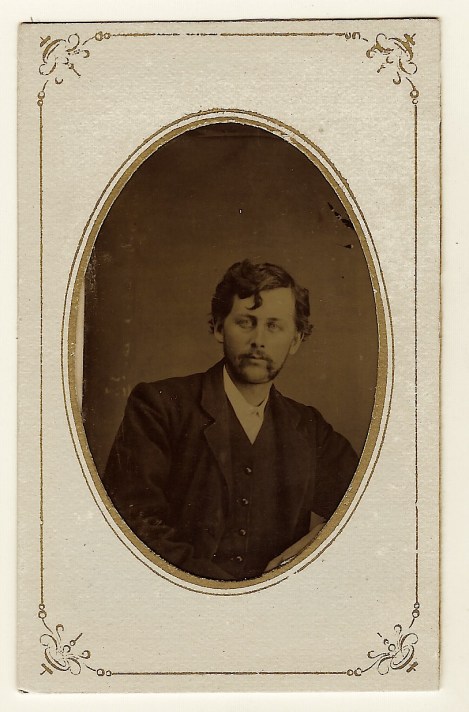
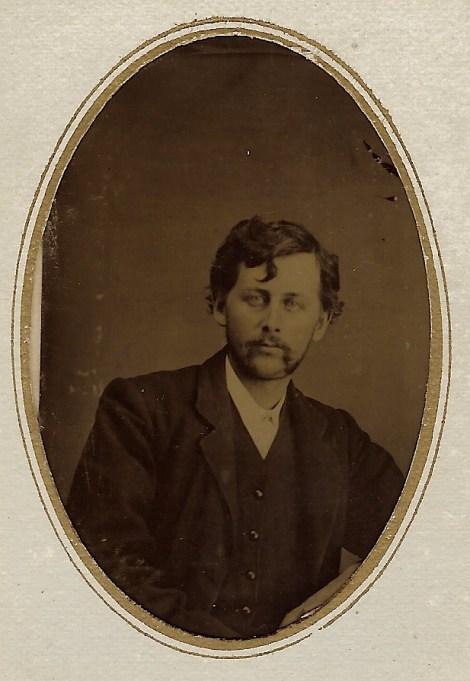
This tintype photograph features a handsome well dressed man with scruffy hair. Although he looks young, he gives the appearance of a man that has experienced a lot in his life. He exudes intensity and toughness. Tintypes were popular between 1856 and 1867. Tintypes did not totally disappear for the next few decades but they became a novelty.    SOLD

Published in: on July 6, 2018 at 12:00 pm  Leave a Comment  
Tags:

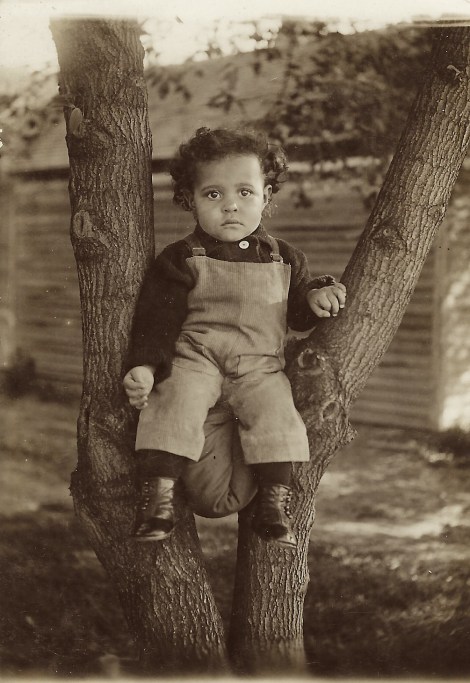
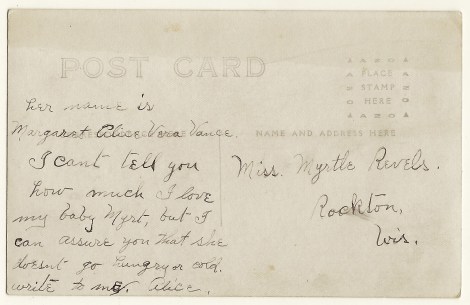
AFRICAN AMERICAN LITTLE GIRL WITH A BIG NAME: MARGARET ALICE VERA VANCE

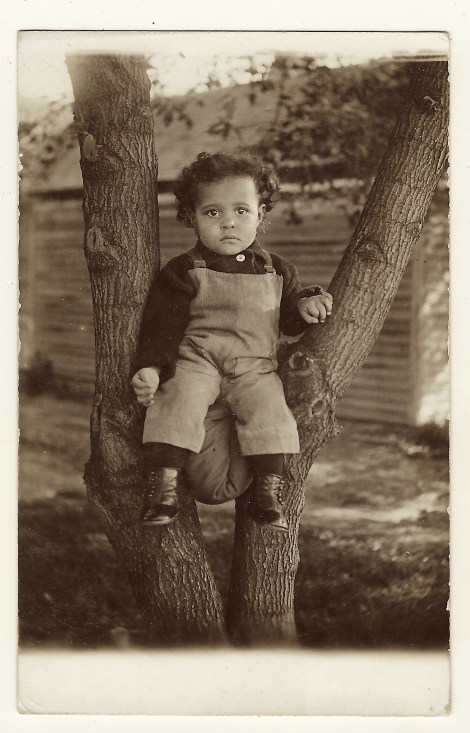
This vintage real photo postcard features an adorable African American little girl sitting in a tree. The little girl’s mother wrote a touching message on the reverse of the postcard. “Her name is Margaret Alice Vera Vance. I can’t tell you how much I love my baby “Mgrt” but I can assure you that she doesn’t go hungry or cold.”  This postcard was never mailed and is in very good condition. The “AZO” stamp box indicates that the postcard was produced between 1904 and 1918.

SOLD

Published in: on July 5, 2018 at 12:00 pm  Comments (2)  
Tags: ,

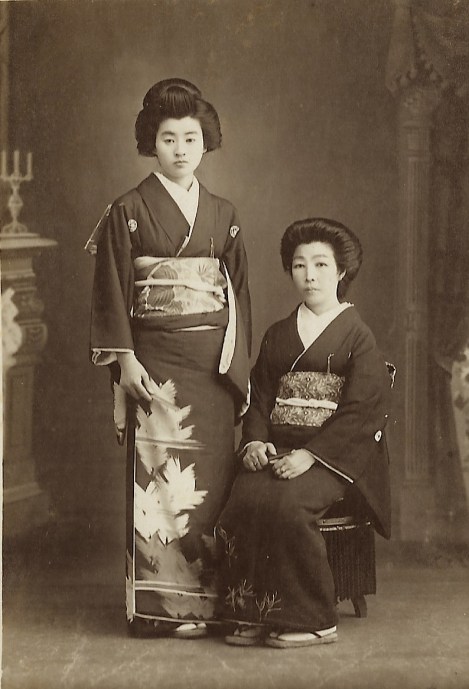
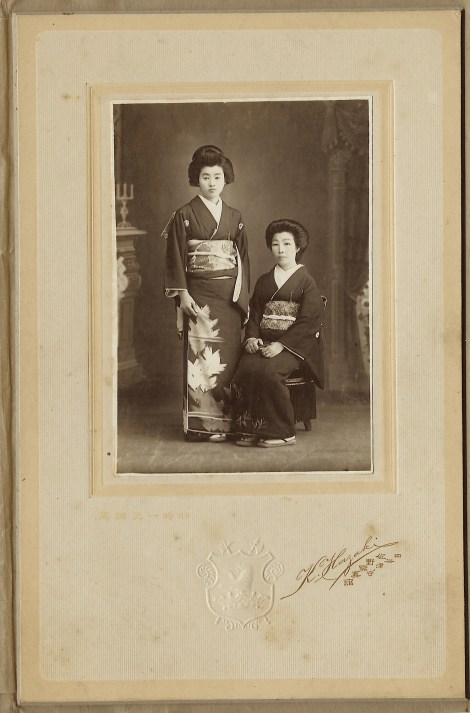
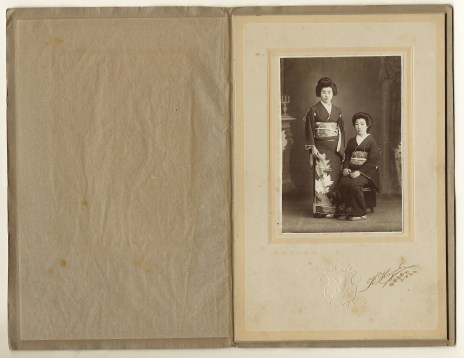
TWO PRETTY JAPANESE WOMEN WEARING KIMONOS

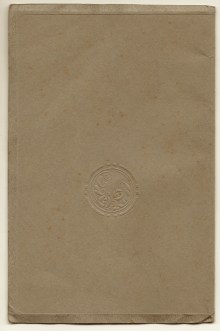
This vintage photograph is of the folder variety and even has the original protective paper tissue. The image captures two pretty young Japanese women wearing dark kimonos. The photographer is Hazaki and he operated a photo studio in Tokyo, Japan. The closed folder measures about 5″ x 7 1/2″. The photo was taken circa 1910-1919 and is in very good condition (see scans).  SOLD

Published in: on July 3, 2018 at 12:00 pm  Comments (1)  

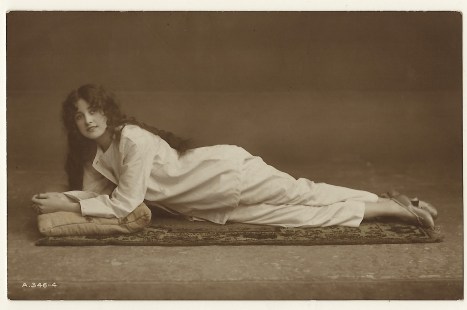
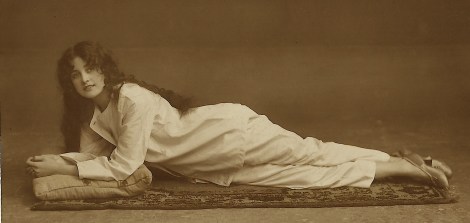
PORTRAIT OF A PAJAMA CLAD RECLINING BRITISH BEAUTY

prettybritish woman 2

pretty british woman 2

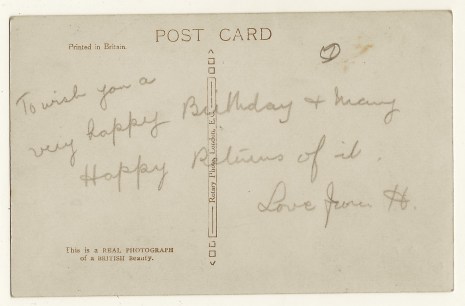
The reverse of this vintage real photo postcard has printed advertising that describes the woman seen in this photo as a “British Beauty”. She certainly is beautiful and she seems to be wearing night clothes as she reclines on a mat and rests her arms on a pillow. The postcard was published by Rotary Photo of London, England. The message on the verso wishes the receiver of the postcard, a happy birthday. The card is likely from the 1910’s.  (SOLD)

Published in: on July 2, 2018 at 2:07 pm  Leave a Comment  

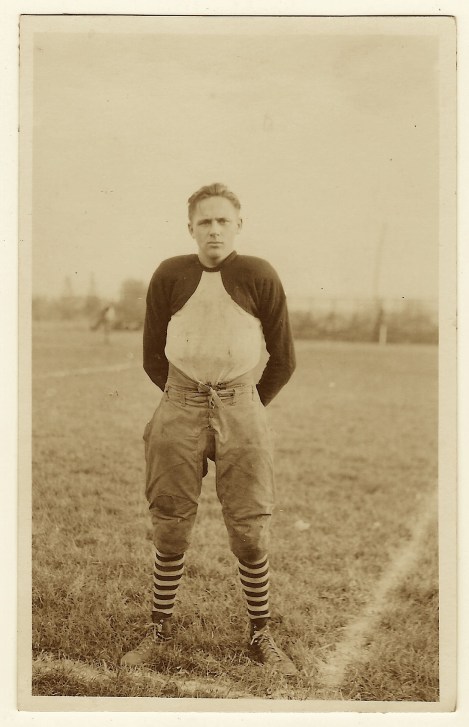
PORTRAIT OF AN EARLY COLLEGE AGE FOOTBALL PLAYER

This vintage real photo postcard is a memento from the early history of football. This warrior of the gridiron stands at attention for his sports portrait. He appears to be college age and may be a member of a college football team. He is wearing his practice uniform and this image certainly reminds us of the major changes that have taken place over the years in the realm of sports equipment technology. This postcard has a divided back as well as a white border. It was likely produced during the White Border Era (1915-1930). The white borders were a method employed to help postcard publishers save on the expense of ink. This postcard is in good condition and the reverse of the card indicates that it once resided in a postcard album.

Buy this original Real Photo Postcard (includes shipping within the US) #2456

To purchase this item, click on the Pay with PayPal button below

$30.00


Buy this original Real Photo Postcard (includes International shipping outside the US) #2456

To purchase this item, click on the Pay with PayPal button below

$38.00


PORTRAIT OF THREE BEAUTIFUL WOMEN DRESSED IN THE FASHION OF THREE DIFFERENT CULTURES

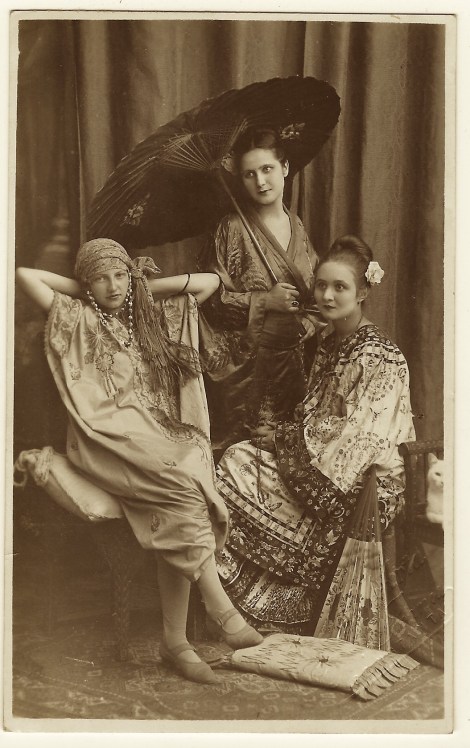
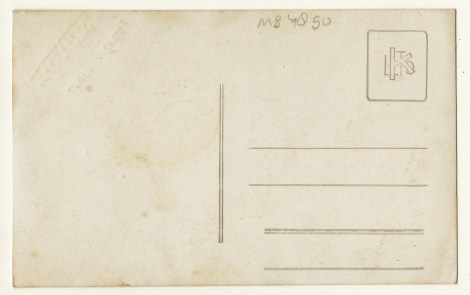
This vintage postcard is another one of those images that immediately piques my interest. I wish I knew what brought these three women together and why they are dressed the way that they are. It seems to me that the women are dressed in a fashion to represent the clothing of different ethnicities. The woman wearing the beads represents gypsies. The woman with the parasol and kimono represents the Japanese culture. The woman with a flower in her hair, represents Spain. Perhaps these ladies are dressed to go to a party. Note the cat sitting next to Miss Spain. This image is from a private studio. There is a studio name and location lightly embossed on the front of the postcard. This intriguing photo was taken at a studio located in Constanta, Romania. The city is located in the Dobruja region of Romania, on the Black Sea coast. The stamp box in this postcard indicates that the postcard was produced by K Ltd., sometime between 1918 and 1936.   (SOLD)

Published in: on June 30, 2018 at 12:00 pm  Comments (2)  
Tags: , ,

PORTRAIT OF A LOVELY COUPLE IN SAN FRANCISCO, CALIFORNIA

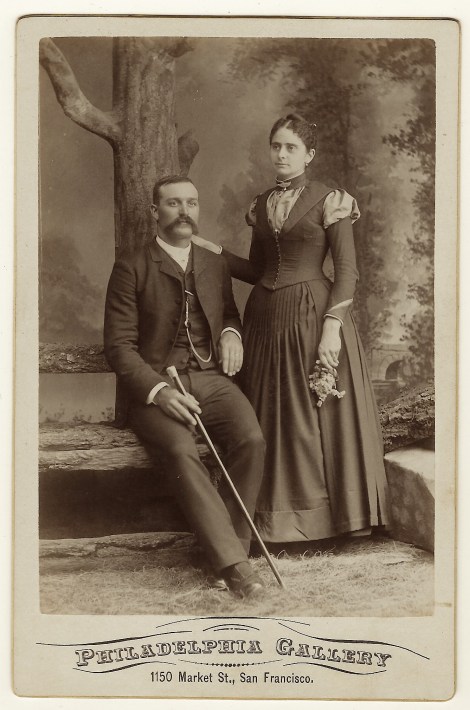
This cabinet card portrait features a lovely couple posing for their portrait at the Philadelphia Gallery in San Francisco, California. The gentleman is wearing a three piece suit and a pocket watch. He has a handsome mustache and is holding a walking stick. The woman is well dressed. She is wearing a collar pin and earrings. She is holding a small bouquet of flowers. This cabinet card has great clarity and is in very good condition.

Buy this original Cabinet Card photograph (includes shipping to the US) #2455

To purchase this item, click on the Pay with PayPal button below

$28.50


Buy this original Cabinet Card photograph (includes international shipping outside the US) #2455

To purchase this item, click on the Pay with PayPal button below

$36.50

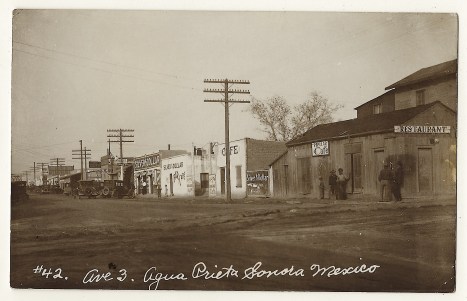
A STREET SCENE IN AGUA PRIETA, SONORA, MEXICO (BEFORE THE FIASCO)

down mexico way 1

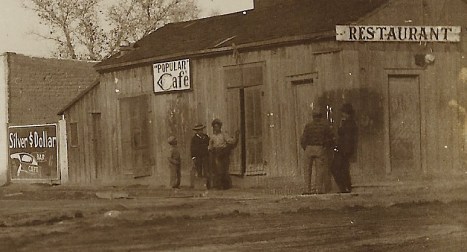
Welcome to Agua Prieta. The town’s name is not very appetizing. In English, the town’s name is “Brown Water”. According to the postcard’s AZO stamp box, this street scene photo was taken between 1924 and 1949. The photo shows “Avenue 3” in Agua Prieta. Note the signage in the photograph. There is a restaurant, a cafe, and the Silver $ Dollar Bar. Further down the avenue are some old cars.  The town is located in the northeastern corner of the Mexican state of Sonora. It is a border town and is adjacent to the town of Douglas, Arizona. Agua Prieta was developed at the end of the 19th century as railroads were built between Douglas and the Mexican town of Nacozari. The trains would transport minerals and other goods. The first settlers in Agua Prieta were employed by the US mining company Phelps Dodge Corporation. The company was based in Douglas, Arizona. The town of Agua Prieta was unofficially founded in 1899 but did not become an independent municipality until 1916. This photograph was taken long before the fiasco of the current US immigration policy. Today, Douglas has a population of about 16,500 people. Although the town is depressed, the border crossing remains busy. According to US Customs and Border Protection records for 2016, more than 3.8 million people passed through the town’s port of entry on foot, or by car. It is important to note that many of these people were going between Mexico and the US to visit family, conduct business, or shop. Therefore, their visits were of short duration. I hope that Congress will be able to formulate and pass a more rational, humane, and constructive immigration policy; and do so in a timely fashion.  (SOLD)
PORTRAIT OF A FAMILY IN NORWAY, MAINE BY A MYSTERIOUS DISAPPEARING PHOTOGRAPHER

This cabinet card features a family portrait by the Swan & Stone gallery in Norway, Maine. The composition of this family seems to include an older couple and their adult daughter. The women are well dressed in black dresses and the gentleman is wearing a vested suit. The older woman is wearing a collar pin and has a newspaper or magazine on her lap. The younger woman has a ribbon on the upper part of her dress. The older man is wearing a pocket watch and chain. Perhaps this image is a mourning photograph. Research revealed some information about the photographers of this photo. To view additional photographs by Swan, place his name in this blog’s search box.  John Wesley Swan (1857-?) appears in the 1884 Portland, Maine city directory as a photographer. The 1900 US census reveals that Swan was Canadian born and lived in Norway with his wife (Annie) and their two daughters. Swan married his wife in 1883. According to Anthony’s Photographic Bulletin (1900), Swan’s studio was destroyed by fire and he lost a large number of valuable negatives of scenery in the area of Norway. The journal also states that the “loss was large and the insurance is said to be small”. Swan was the official photographer of the Grand Trunk Railway system. He won a gold medal at the Paris Exposition according to Photo-Era magazine (1900). At one point in his career in Norway, Swan had a partner in his business (Swan & Cobb). John Wesley Swan was involved in a bizarre incident that made the annals of the history of Norway. The book,  “A History of Norway, Maine: From the Earliest Settlement to the Close of the Year 1922”, tells a  mysterious story about Mr. Swan. While on a trip to Boston in 1893, Swan disappeared for a period of about six months. The writer states that Swan “claimed to have been sand-bagged and robbed in Boston and when he partially recovered consciousness found himself in New Orleans”. His memory had “left him” and he wandered around until his memory returned while he was in Texas. Swan returned to Norway and explained his disappearance to his friends and family, and community. According to the writer, many doubted the validity of his explanation. I found less information about photographer, George F. Stone (1856-1924). He is listed as a photographer in the 1910 and 1920 US census. Business directories list report that he was a photographer at least between 1915 and 1922, He was listed as a painter in the 1889 directory.   (SOLD)

Published in: on June 26, 2018 at 12:00 pm  Comments (3)  
Tags: , , ,