Photographer Adolph Westphal photographed this wonderful carte de visite portrait of an adorable pouting little boy in Chicago, Illinois. Westphal (1835-1913) was a photographer in Prussia before he opened a photography studio in Chicago in 1864. He also bought a tavern which included a dance hall and beer garden. He eventually closed the tavern and began bottling beer. Wesphal’s son continued the carbonated soft drink business after his father died. SOLD
An adorable little boy is featured in this cabinet card portrait from the Schmidt studio in Ashland, Kentucky. This cute child is wearing overalls, high top shoes and a terrific wide brimmed hat. Judging by his outfit, one might hazard a guest that he is growing up on a farm. The photographer of this photograph was John William Schmidt (1859-1943). He was a photographer in Ashland and at least at one time, his studio was located at 110 Greenup Avenue. His name can be found in Ashland directories including 1912 and 1930. He is listed as a photographer. He is also listed as a photographer in the 1910 and 1940 US census. Schmidt was born in Ohio and he was married to Alice Schmidt. SOLD
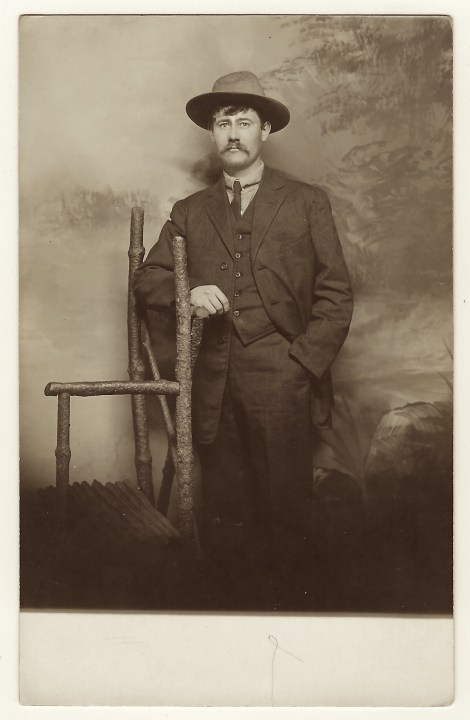
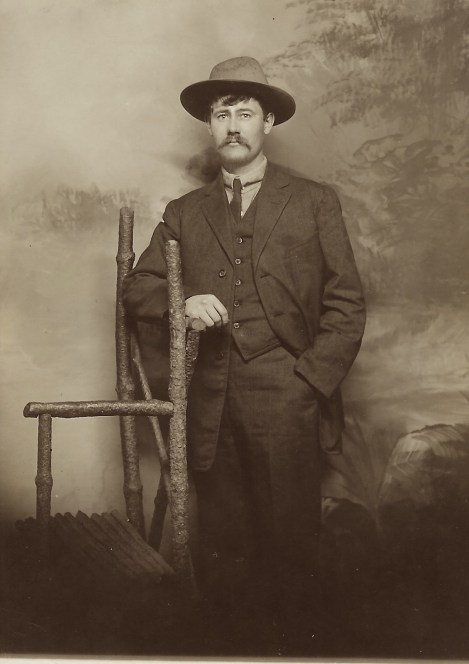
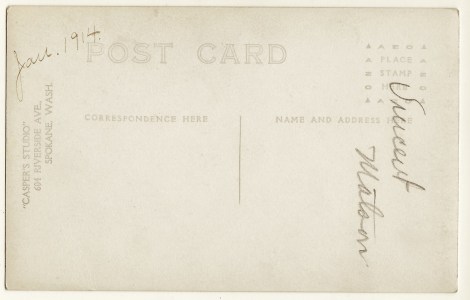
A handsome man poses for his portrait at “Casper’s Studio” in Spokane, Washington. An inscription on the reverse of this vintage real photo reveals that the gentleman’s name is Vincent Vergel Matson (1885-1978). Matson dressed up for this photograph. He is wearing a western vested suit and western hat. Matson was born is South Dakota. The 1900 US census finds him living with his family on the Blackfoot Indian Reservation in Teton, Montana. The 1910 census lists him as living in Edwards, Montana and working as a farmer. By 1920, he moved again. This time he was residing in North Bonners Ferry, Idaho and working as a laborer. He was still working as a laborer at the time of the 1930 census and he was living in a Boarding House in Spokane. He was living in Kalispell, Montana at the time he registered for the draft in 1942. He was listed in the 1943 Kalispell directory as a laborer. At the time of Matson’s death in 1978, he was living in Beaverhead, Montana. My research did not find any record of Matson ever marrying. One has to wonder if Matson was a bit of a drifter. He appears to have moved around a lot, not letting the grass grow under his feet. He had no wife or kids, and could take on labor work wherever he lived. This postcard has an AZO stamp box indicating that it was produced between 1904 and 1918. (SOLD)
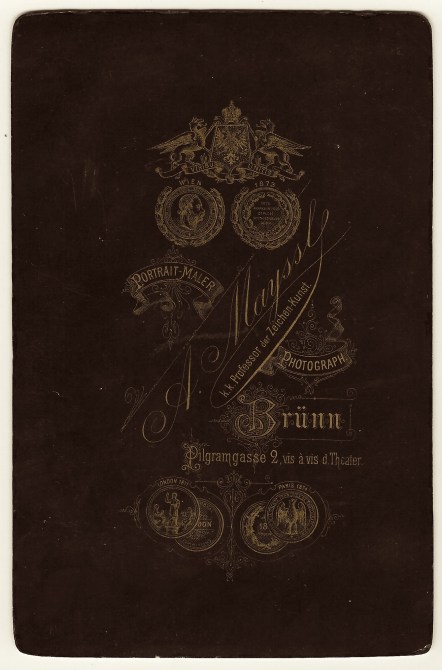
A solemn young girl poses for her portrait at the Mayssl studio in Brunn, Germany. The girl has very long hair. A name is written in the top right corner of the cabinet card. The name likely belongs to the child seen in this image. The photographer, Mayssl had advertising printed on the reverse of the cabinet card. Included in the advertising are drawings of six medals that he had won in various photographic exhibitions.Included are London (1871), Vienna (1873), Paris (1874). The dates of these awards indicate that this cabinet card is likely from the 1870’s. There is also a German phrase on the back of the cabinet card that roughly translates to “Professor of Characters Art” (thank you Google Translate). Perhaps Mayssle was a teacher of photography.
This snapshot captures three pin boys as they work at a bowling alley. Pin boys, also known as pin setters were stationed in a sunken area of a bowling alley which was located behind the pins. The pin boy removed pins after they were knocked down, replaced pins each frame, and returned the bowlers ball. The day of pin boys is long over as automation and computers became employed in bowling alleys. At least two of the young men in this photo are smoking while they are working. The pin boys are wearing tee shirts, presumably because they were exerting themselves in a hot environment. Being a pin boy doesn’t look like a fun job.
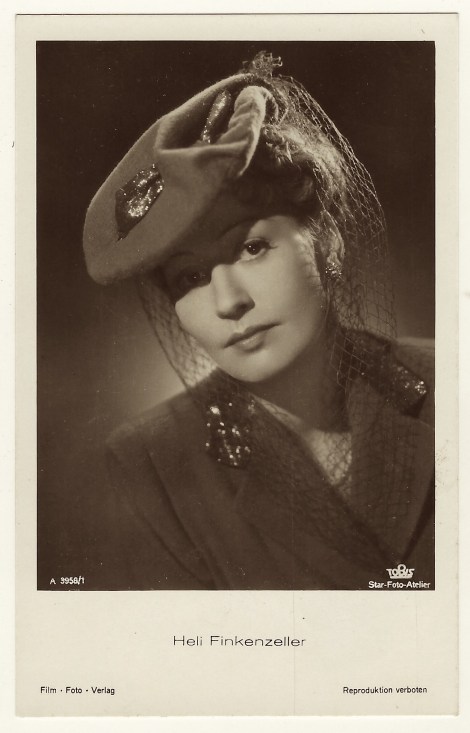
This vintage real photo postcard features pretty German film actress Heli Finkenzeller (1911-1991). During her career she appeared in more than 80 films and television shows between 1935 and 1991. Among her films, she was known for Emil un die Detektive (1954), Teorie und Praxis (1962), and Unser Pauker (1965). She was married twice, to an actor (Will Dohm) and than to a film director (Alfred Bittins). She is the mother of Gaby Dohm, an Austrian actress. During Finkenzeller’s youth she hoped to become an opera singer. She had an excellent voice but it was too weak for opera. Instead she became an actress. She was discovered for film by director Karl Ritter in 1935. She was popular in films for UFA. a German film company. Later in her career she became active as a stage actress. This postcard was produced by Verlag and is part of a series (no. A 3958/1). The photographer was Star Foto. The logo for Tobis Film appears on the front of the postcard. Tobis was a German film production and distribution company founded n the late 1920’s. The company was discontinued in 1942 when the Nazi controlled government combined it with three other studios (Terra Film, Bavaria Films, UFA) to form a single state controlled film company.
The duet below is from Boccacio (1936) and it features Heli Finkenzeller and Willy Fritsch. One source states that Finkenzeller got “help” with the singing from Rosl Seegers.
This wonderful photographic portrait features a basketball player in his game day uniform. Note his high top sneakers and long athletic socks. His uniform reveals that he played for St. Mary’s. There were many schools called St. Mary’s so it is unclear where the school was located or whether it was a high school or a college. Writing on the basketball discloses that this photograph was taken in 1925. There is a name inscribed on the reverse of the photograph but it is hard to decipher. The photo measures about 5 5/8 x 3 3/4 and is on paper that has the consistency of postcard paper. (SOLD)
The little girl that is the subject of this vintage photographic portrait is absolutely adorable. She is wearing a cute patterned dress trimmed with lace. She also is wearing a couple of hair bows. The photographer of this image is Hubert Quante who had a studio in Ferdinand, Indiana. At least I think it is Hubert Quante. The embossment below the photograph is very difficult to decipher. My research found a man named “Hubert Quante” who lived in Ferdinand. Quante (1866-1927) can be found in a number of US censuses but his occupation is never listed as a photographer. It is likely that his foray into operating a photo studio was of short duration and never coincided with a year that the census was conducted. He may not have been a photographer for a long period of time, but he did a masterful job of taking and posing this photograph. Quante was German born and arrived in the United States in 1884. In 1897 he married Ida M. Quante. The town of Ferdinand was founded in 1840 and was named after the Emperor Ferdinand 1 of Austria. Most of the town’s early settlers were German speaking and they came to the US from central Europe. SOLD
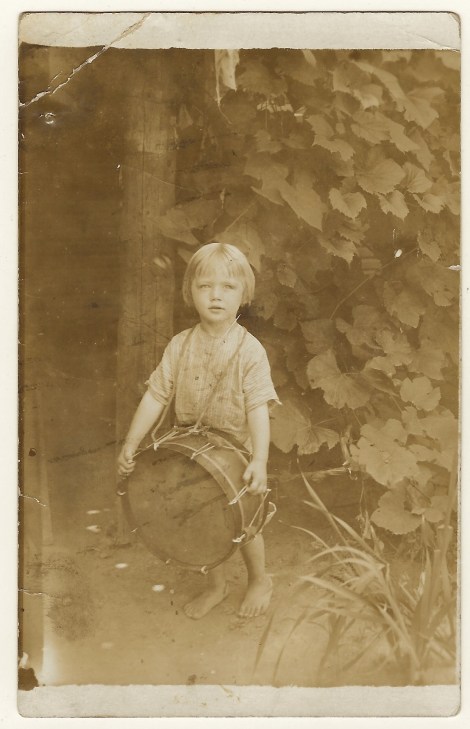
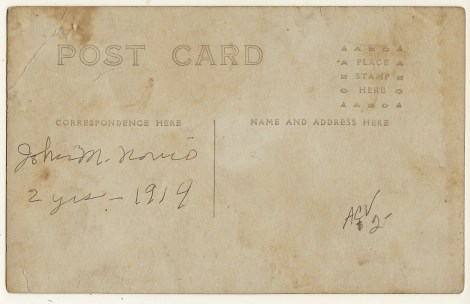
This endearing vintage real photo postcard captures a barefoot little boy and his drum. He is looking quite proud and serious. The drum does not look like a toy. Perhaps it saw some action during the civil war. The reverse of the postcard has an inscription revealing that the child is named John M. Norris and that he is two years old. The inscription also states that this photograph was taken in 1914. The AZO stamp box offers a confirmation of the date. This stamp box was utilized between 1904 and 1918. This postcard was purchased near Austin, Texas. SOLD
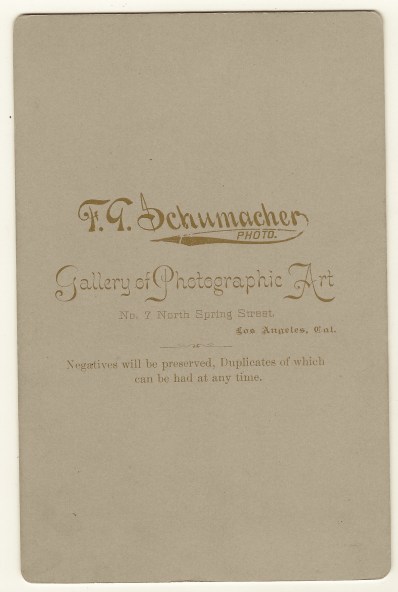
This cabinet card features a profile portrait of a a very pretty young woman. The photograph was taken by the F. G. Schumacher Gallery of Photographic Art in Los Angeles, California. The subject of this photograph appears to be in her teenage years. An article in the Los Angeles Herald (1886) is quite complimentary of Mr Schumacher. He is described as “one of the best photographic artists on the coast”. He is also referred to as “a graduate of the famous studio of Bradley & Rulofson” in San Francisco. The article also reports that he had taken portraits of many celebrities and had a particular talent in photographing children and infants. (To view photographs by Bradley & Rulofson, click on category Photographer: Bradley & Rulofson). Frank G. Schumaker (1861-1930?) was born in California. The University of California (Berkley) archives asserts that he established a photography studio in 1882 on North Spring Street in Los Angeles. He is listed in Los Angeles business directories from at least 1888 through 1904. Wilson’s Photographic Magazine (1897) printed an article entitled “Photographic Studies by Schumacher. The article praised his work. “SOLD”










 THE CABINET CARD GALLERY