A YOUNG BOY WEARING A STRAW HAT

straw-hat

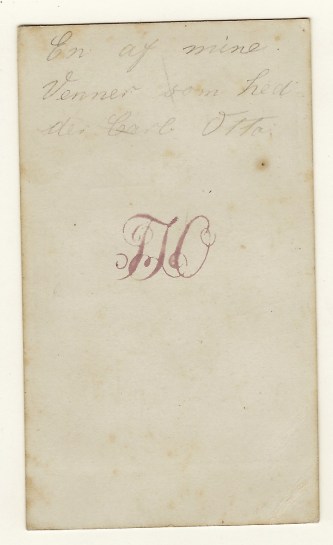
This CDV (Carte de Visite) features a well dressed young boy wearing a straw hat. The photographer is unknown as only his initials appear on the reverse of the photograph. Also on the reverse of the photograph is an inscription. I believe that the inscription is written in German.

straw-hat-2

Published in: on December 12, 2016 at 12:00 pm  Leave a Comment  
Tags: ,

YOUNG SALVATION ARMY WOMAN IN MINNEAPOLIS, MINNESOTA

bishop-salv

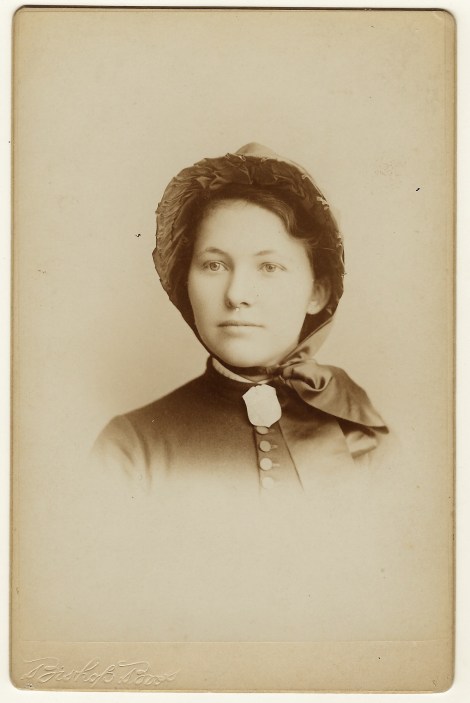
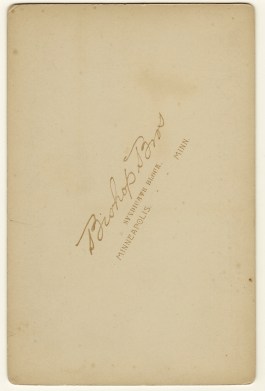
A young woman wearing her salvation army uniform and badge poses for her portrait at Bishop Brothers studio in Minneapolis, Minnesota. Her appearance suggests a personality of “sweet, pure, and innocent” which certainly would be complimentary to her role of helping those in need. The mainstay of Bishop Brothers was Henry Theodore Bishop (1853-1917). He began his photography career in his childhood hometown of Chambersburg, Pennsylvania. He moved to Minneapolis and operated at the address of 62 Syndicate Block. The Directory of Minnesota Photographers reports that he was a photographer in Minneapolis between 1885 and 1903. Later he conducted business for a year in Austin, Minnesota. It is a bit confusing as to who was the “other brother” at the Bishop Brother’s studio. The Minnesota Historical Society’s directory (referenced above) asserts that his partner was James E. Bishop and that they worked together only in 1885. However, Henry Bishop’s obituary which appeared in the Altoona Tribune (1917) reports that James E. Bishop was Henry’s son and that the brother he partnered with in Minnesota was W. M. Bishop. This photograph is one of many Salvation Army images that can be found in the Cabinet Card Gallery. To view the others, click on the category “Salvation Army”.   (SOLD)

bishop-salv-1

Published in: on December 10, 2016 at 12:00 pm  Comments (1)  
Tags: , , , ,

MISS EVELEEN RAINE: PRETTY THEATRE ACTRESS (PHOTO BY ELLIOTT AND FRY)

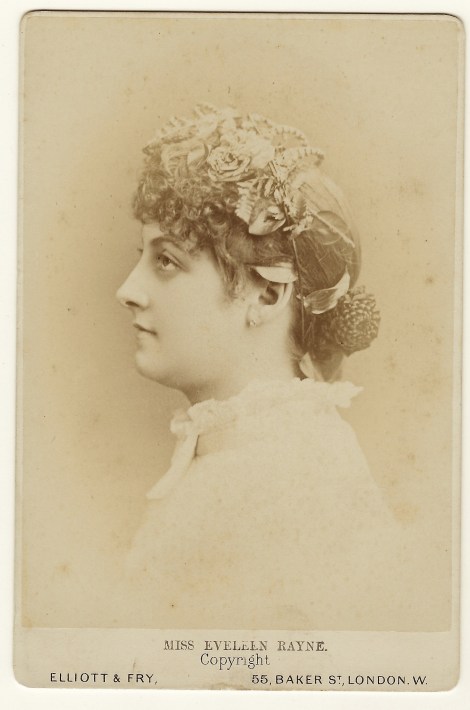
rayneThis cabinet card portrait features stage actress Eveleen (Evelyn) Rayne. She became titled when she married George Fitzwilliam in 1888. She died in 1925. The Elliott & Fry studio produced this image. This Victorian photographic studio and photographic film manufacturer was founded in 1863 by Joseph John Elliott and Clarence Edmund Fry. For an entire century the studio took and published images of leading Victorian luminaries from the fields of science, public service, art, politics as well as celebrities of the day. To view other photographs by this studio click on the category “Photographer: Elliott & Fry”.

rayne-1

Published in: on December 7, 2016 at 12:00 pm  Leave a Comment  
Tags: ,

A MAN AND HIS HORSE AND WAGON (VINTAGE OCCUPATIONAL REAL PHOTO POSTCARD)

delivery-cart

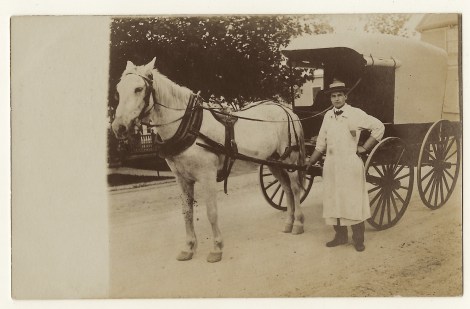
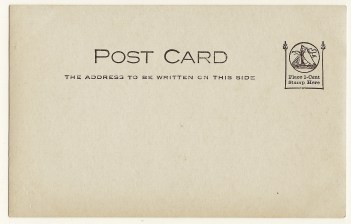
This vintage real photo postcard features a man and his horse and his partially covered wagon. Judging by the man’s clothing; he is a working man. Perhaps he is a delivery man of some sort. He is wearing a white shirt, bow tie and smock. I believe that he is wearing long heavy gloves. The gloves probably pertain to his occupation. The stamp box on the reverse of this postcard indicates that when it was published, the postcard postal rate was 1 cent. The one cent rate was in effect until World War I when it was raised to 2 cents on a temporary basis (1917-1919). The rate was again raised between 1925 and 1928. The rate became permanantly two cents in 1951. As a result, the stamp box in this case, is not helpful in establishing the date that this postcard was produced. However, the style of the front of this postcard indicates that it was produced not long after the 1900’s or 1910’s.

delivery-cart-1

Published in: on December 5, 2016 at 8:37 pm  Comments (2)  
Tags: ,

BEAUTIFUL STAGE ACTRESS JOHAN WITTMAN (PUBLICITY PHOTO)

publicity-photo

Beautiful stage actress Johan Wittman posed for this publicity photograph for her appearance  in “The Perfect Fool”, a play that appeared at the George M. Cohan Theatre” in New York City (Broadway). Ed Wynn provided the book, lyrics, and music. The revue played in 1921 and 1922 and ran for 275 performances. Miss Wittman looks elegant in her “to the floor” beaded dress. The previous owner of this photograph hypothesized that the dress was modeled after a peacock feather. I agree with his observation. Miss Wittman is holding a feather fan behind her head. She truly is representative of the flapper era. According to Broadwayworld.com, Miss Wittman’s Broadway experience was confined to her role in “The Perfect Fool”. The photographer of this lovely portrait was Ira Daniel Schwarz (1878-1946) who was based on West 48th Street in New York City. Schwarz was a Brooklynite and one of the first New York portrait artists to work in the movie industry. He began his career as a pictorialist art photographer and during World War I he went to work for Screencraft Pictures (located in New York) as Cinematographer and Stillman. He displayed a lot of talent as a Stillman and in 1919 became the chief portrait photographer for the company. The website “Broadway Photographs” reports that Schwarz was fascinated with shade and that his images were often recognized for their “plummy blacks”. In 1924 he left Photocraft and established his own studio. In regard to his skill as a portrait photographer “Broadway Photographs” assert that Schwarz was considered “a photographic psychologist” by his colleagues because he was excellent at “capturing the mentality of his sitter”. During World War II he closed his studio due to the silver shortage.

publicity-photo-1

KIND OLD GENTLEMAN IN ST. PAUL, MINNESOTA

kind-old-man

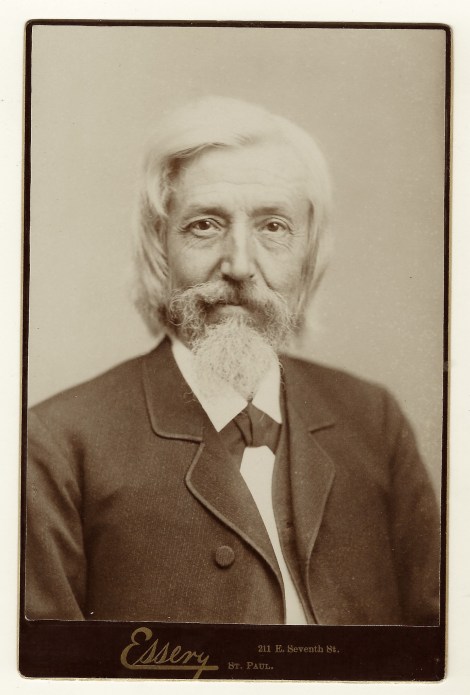
This cabinet card portrait features an older gentleman with long grey hair and and grey mustache and beard. His hair is unusually long. He is handsome and has a very kind face. The gentleman has piercing eyes. He is formally dressed. This studio photograph was taken at the Essery studio in St. Paul, Minnesota. Robert W. Essery (1845-1886) was born in Prince Edward Island, Canada. He operated studios in St. Paul between at least 1873 and 1885. His business was located at the 211 East Seventh St address seen on the front of this photograph between 1883 and 1885. At one point his studio was known as Sun Beam Gallery (partnered with Charles W. Stiff). After Essery’s death, his wife Ida ran the Essery Photograph Gallery.  (SOLD)

Published in: on December 2, 2016 at 12:05 pm  Comments (1)  
Tags: ,

PORTRAIT OF A SOUTHERN GENTLEMAN IN LEXINGTON, KENTUCKY

lexington

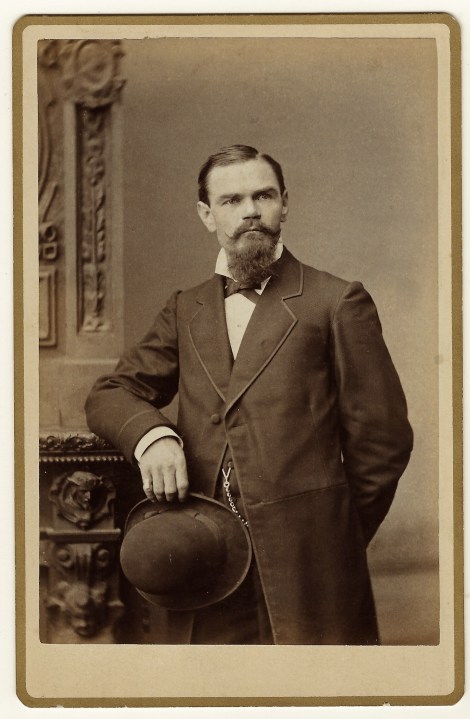
This cabinet card photograph features a portrait of a southern gentleman. He is finely dressed and holding his hat in his hand. He is wearing a stylish beard and mustache. His facial expression communicates arrogance. The photography studio that produced this image is the Johns & Faught studio of Lexington, Kentucky. The cabinet card gallery has other photographs by this studio and they can be seen by clicking the category “Photographer: Johns & Faught” or by placing the studio’s name in the search box. If you view the other photographs you will note that this studio does an outstanding job with their portrait photography. In the book “History of Fayette County, Kentucky” (1882) it is stated that W. E. Johns was born in Lexington in 1843. He began his photography business in Lexington in 1870 and by 1876 opened a new studio at the address (56 East Main Street) where he photographed this cabinet card. By at least 1886, James Faught worked for Johns as an operator in his studio. At a later date, the pair became partners in the business.   (SOLD)

lexington-1

Published in: on November 29, 2016 at 12:00 pm  Comments (1)  
Tags: , , ,

TWO ADORABLE CHILDREN IN TRADITIONAL GERMAN COSTUMES IN HAMBURG

kindermann

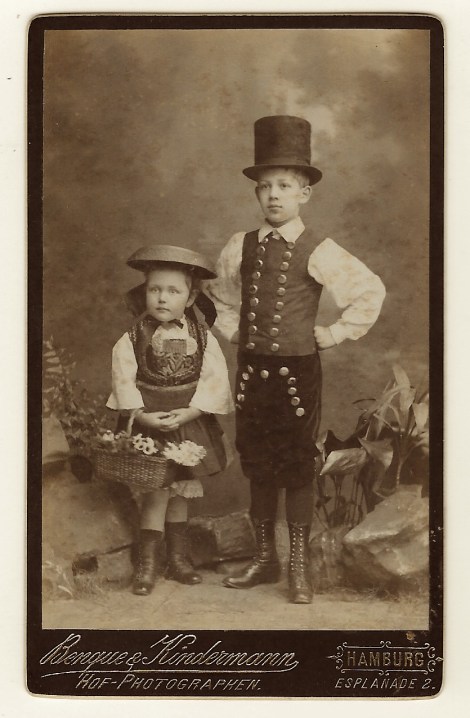
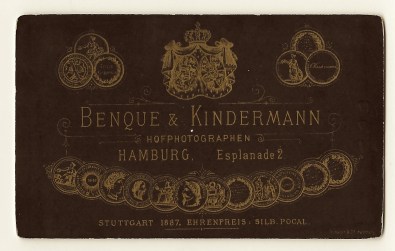
This wonderful Carte de Visite features two adorable children wearing traditional clothing posing for their portrait at the Banque & Kindermann studio in Hamburg, Germany. The boys outfit has an abundance of buttons and he is wearing a top hat. The little girl is holding a basket of pretty flowers and is wearing a hat that resembles a “frying pan”. On each side of the children are potted plants. The image is actually a lovely photograph. The reverse of the photograph has print that advertises the fact that the studio won medals at an 1887 exhibition in Stuttgart, Germany. This photograph was likely taken shortly after that contest. “The Photographic Times” (1897) tells the story of photographer Conrad Kindermann. He was born in Lubeck, Germany in 1842. He apprenticed in a cloth house in Riza, Russia for five years and worked there another year. He then was introduced to working as a photographer by his brother who had a studio in Hamburg. In 1863 he opened a studio in Lubeck. The ceilings in this studio were so low that they prohibited photographing adults when they were standing. The resourceful Kindermann decided to specialize in photographing children. It is very interesting to note that the word “kinder” means “children”. He was truly a Kindermann. In 1869 he met photographer Herr Benque. They becamse fast friends and were soon partners in a studio in Hamburg. The studio encountered financial problems so Benque left and soon the studio became very successful and Kindermann became known as one of the best photographers of children in the country. A review of the era’s photography journals demonstrate that he was often cited or the subject of articles. Another fascinating fact is that Darwin used three of Kindermann’s photographs in his book “The Expression of Emotions in Man and Animals” (1872).

kindermann-1

PORTRAIT OF A STRIKING WOMAN IN EUGENE, OREGON

striking-woman

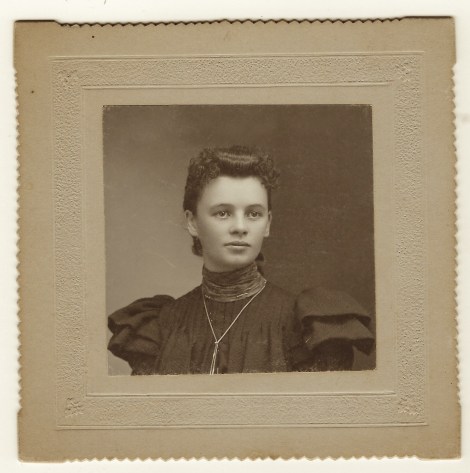
The young woman in this post cabinet card era photograph is strikingly attractive. She has wonderful eyes. She appears to be a teenager. The striking young lady is wearing a high collared and ruffled dress as well as a necklace. The photograph was taken at the Winter Photo Company in Eugene, Oregon. The photographer, John A. Winter was born in Ohio sometime around 1831. He was active in the photography business in Eugene between 1864 and 1869, and again between 1873 and 1900. During his career he also operated photography businesses in Albany, Brownsville, and Jefferson; all towns in Oregon.In 1864 he advertised that he intended to “devote his whole time to making pictures”. In 1865 he began his career operating photographic studios. A number of times during his career he was plagued with poor health. At one point he owned a sheep ranch in addition to a photography studio. Winter employed the bartering system in his business. One of his ads promises to trade portrait taking for firewood. From 1888 to 1900, Winter was the photographer of Oregon State University. Winter’s son, Clarence L. Winter was a photographer in Eugene between 1891 and 1906. However, a letter from C. L. Winter appears in the Photographic Times (1887) indicating that he likely began working in Eugene earlier than the aforementioned date. It is not clear whether John A. Winter or Clarence L. Winter is the photographer who produced the picture of this lovely young woman. Perusing the Cabinet Card Gallery’s collection of photographs by Mr Winter, it is clear that he had photographic talent. This photograph measures about 4 1/4″ x 4 1/2″. To view other photographs by Winter, click on the category “Photographer: Winter”.  (SOLD)
striking-woman-1

PORTRAIT OF A NEWSBOY

newsboy

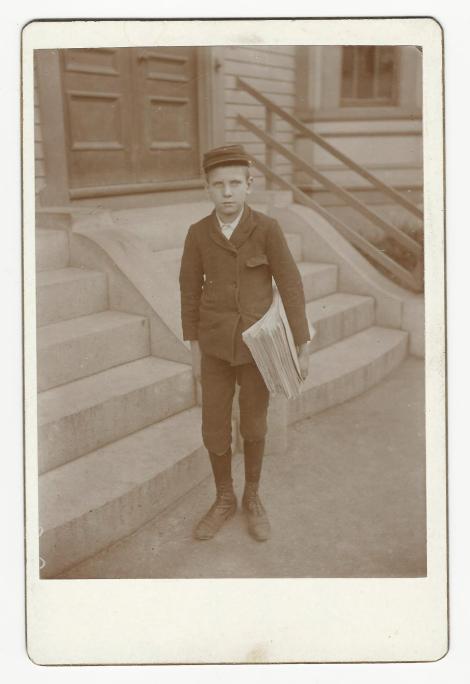
This cabinet card portrait features a young newsboy holding a stack of newspapers. Soon after the photograph was taken, he was probably delivering the newspapers or hawking them on the street. The young entrepreneur is displaying a serious business like expression. He is wearing an outer jacket, knee pants, long black stockings, and lace boots. Note his flat cap. The photographer’s name and location are unknown.

SOLD

Published in: on November 24, 2016 at 12:00 pm  Leave a Comment  
Tags: ,