AN ADORABLE BABY AND HER DOLL

girl-and-doll

This vintage real photo postcard features a lovely image of an adorable little girl holding a beautiful doll. The child is wearing a lacy dress, a necklace, and a pink ribbon in her hair. She is so photogenic. This postcard was sent by a woman named Suzanne to her younger brother living in Argentan, France. The postmark dates back to 1906. Suzanne wrote her name on the top right hand corner of the front of the postcard. She wrote it in red which is the same color ink she used to write her message on the reverse. The postcard was published by Germany’s Neue Photographische Gesellschaft (NPG) (New Photographical Society). The company was in business between 1894 and 1948. It was founded by Arthur Black (1862-1943) and it became of the most well known and largest companies involved in the production of postcards. Over time, NPG opened subsidiaries in London, Paris, Rome, and New York. Interestingly, the company was one of the “Best Companies to Work For”. Employees were given free medical treatment and illness benefits. Employees also received bonuses and life insurance. The company offered it’s employees a library, a casino, and a dining room which sold food for cost. In addition, the company offered it’s workers a reading room and a theater for lectures and theatrical performances. Now we know where Google and other employee friendly companies got some of their ideas from. Printing on the reverse of this postcard mentions that this postcard is an “Oranotypie” and also lists the name “A. G. Steglitz”. An oranotype is a trade name for a type of glossy real photo postcard published by NPG at the beginning of the 20th century. These cards are hand colored. I am unsure if Steglitz was a postcard publisher or a photographer. I have seen postcard aficionados refer to him as both a photographer and a publisher. My guess is that most of these “experts” are as unsure as I am about his role in producing postcards. 

girl-and-doll-2

A FATHER AND HIS YOUNG SON OUT FOR A BICYCLE RIDE

bike

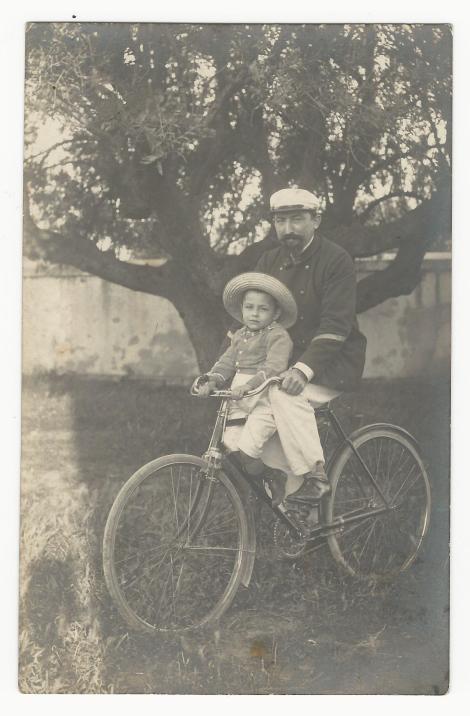
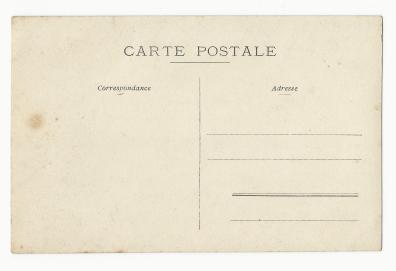
This vintage real photo postcard features a father and his young son outside for a bicyclc ride. The pair are posed in front of a large tree. Father is well dressed and wearing a cap. The little boy is also well dressed and he is wearing a straw hat. The postcard appears to be of French origin and is a rare find.

bike-2

Published in: on November 23, 2016 at 12:00 pm  Leave a Comment  
Tags:

MISS JOSE COLLINS: BEAUTIFUL STAGE AND FILM STAR (VINTAGE REAL PHOTO POSTCARDS)

jose-collins POSTCARD 1  (SOLD)

collins POSTCARD 2

The pretty woman featured in this vintage real photo postcard is Miss Jose Collins (1887-1958). The name “Jose” was a shortening of her given name “Josephine”. She was an English actress and singer known for her appearances in musical comedies and early movies. She was born in London. Her mother was a music hall performer and comedian named Lottie Collins. Interestingly, she was the singer who popularized the song “Ta-ra-ra Boom-de-ay”. Jose Collins father was Stephen Patrick Cooney, her mother’s music coach. Collins began as a child actress and as a teenager had already appeared in both pantomine and music hall performances as a singer and actress. Her debut performance in the West End was a major role in “The Antelope” (1908). She also appeared on Broadway  in the production of “Vera Violetta (1911), “The Merry Countess (1912), “The Whirl of Society” (1912), and other shows. In the later production, she sang a duet with Al Jolson. She also appeared in the Ziegfeld Follies (1913). In 1917 she appeared in the hit musical “The Maid of the Mountains”, a role for which she received much acclaim. She actually earned a nickname from the show; she was known as “The Maid of the Mountains”. She appeared in a number of shows through 1925. One of these productions was “A Southern Maid”  (at Daly’s Theatre) and this postcard portrait captures her in that role. The show was an operetta and her costar was Bertram Wallis. The production ran for 306 performances. The remainder of her career was spent acting in revues, variety and non-musical roles. She also appeared in films. The IMDB reports that she appeared in thirteen movies between 1915 and 1933. Miss Collins was married three times and these unions produced no children. The link below will take you to a Ziegfeld Follies performance by Jose Collins. She is singing “Just You and I and the Moon” (1913). This postcard was published by J. Beagles & Co. of London, England. The postcard is part of a series (no. 222 U). The photograph of Miss Collins is by Reville Studios.

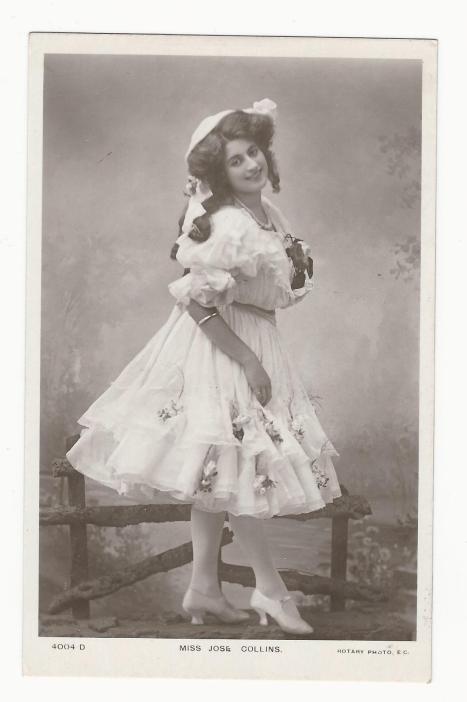
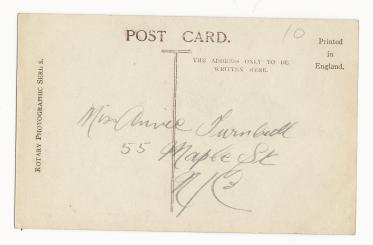
The second vintage real photo postcard presents Miss Collins in a relatively short frilly dress. She looks very pretty as she flashes a nice smile. The postcard was produced by Rotary Photo and is part of the Rotary Photographic Series (no. 4004 D)


jose-collins-1                                                                                                                 POSTCARD 1

collins-2                                                                                                                                                                                                        POSTCARD 2

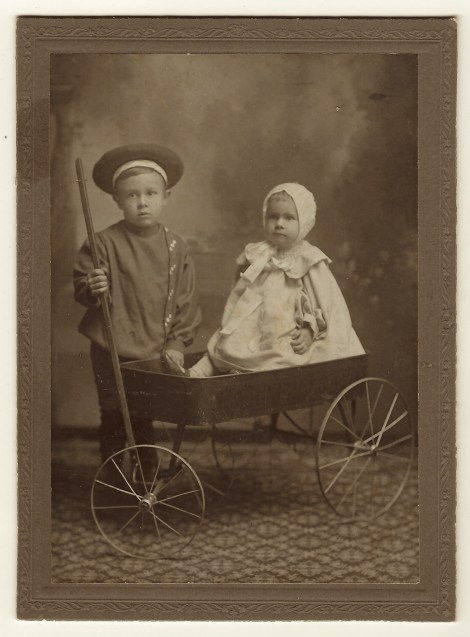
CUTE LITTLE SAILOR BOY AND HIS BABY SIBLING IN A WAGON

bieber-2

This vintage post cabinet card era photograph is charming. A little boy in a sailor suit stands beside his baby sibling who is sitting in a wagon. The baby is wearing a gown and bonnet. Big brother is holding the handle of the wagon. Note the large back wheels on the wagon. The wheels are metal, not the rubber wheels that came later in time. The photographer and the location of the photo studio are unknown. The photo measures about 4 1/2″ x 6 1/4″ and the mat may have been trimmed.

Published in: on November 21, 2016 at 12:00 pm  Leave a Comment  
Tags:

A GENTLEMAN WITH “MUTTON CHOPS” IN HAMBURG, GERMANY (PHOTO BY EMILIE BIEBER)

bieber

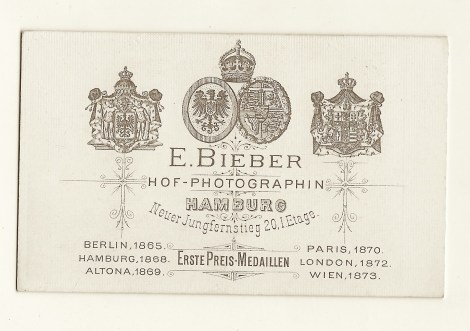
This carte de visite photograph is by celebrated photographer Emilie Bieber. She was a very successful and talented female photographer. Female photographers were uncommon in the cdv era. Bieber is definitely one of my favorite photographers. You may view additional photographs by Miss Bieber by typing her name in the cabinet card gallery’s search box. Bieber had two locations in Germany; Berlin and Hamburg. She ran her Hamburg studio from 1852 through 1872 when she was joined by her nephew, Leonard Berlin-Bieber. Emilie Bieber died in 1884. This cdv portrait features a well dressed gentleman with wonderful mutton chops. He is not wearing an accompanying mustache. Printing on the reverse of the carte de visite brags about the medals won by this studio. Awards were earned from exhibitions in Berlin (1865), Hamburg (1868), Paris (1870), Vienna (1873), as well as other photography competitions. This record of photographic honors informs us that this cdv was produced in 1873 or shortly afterward.

bieber-1

PORTRAIT OF A PRETTY WOMAN WITH MUSSED HAIR IN JOHNSTOWN, NEW YORK

johnstown

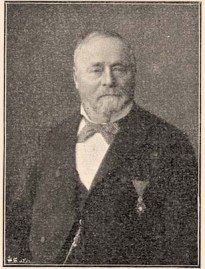
This cabinet card portrait features a pretty young woman wearing a dark dress full of distractions. The buttons on the dress are quite prominent and she is also wearing a collar jewelry and a corsage. Hanging from her chain necklace is a ring. One can hypothesize that the ring belongs to her husband or her beau. The woman’s hair is mussed but I imagine that we are looking at a hairstyle and not laziness or apathy on her part. This photograph was taken at the Kibbe studio in Johnstown, New York. William H. Kibbe (1846-1910) was born in Johnstown. As a school student he exhibited a great deal of talent via his pen and pencil sketching. He then worked briefly as a paint shop decorator but soon found more satisfying work at the studio of renowned engraver Vistus Balch. While working there he assisted in the production of engravings from drawings by Felix Octavius Carr Darley who was famous for his illustrations appearing in Charles Dickens’ novels. During this time Kibbe became acquainted with Napoleon Sarony’s portraits which contributed to his becoming an apprentice with photographer James F. Ryder. From this apprenticeship, Kibbe learned about every aspect of operating a photography studio and in 1871 he opened his own studio at 123 West Main Street in the “Kibbe building”.  His studio was decorated with his own oil and watercolor paintings and he was often joined there by his wife and son (Arthur Fonclair Kibbe) who would assist him. Kibbe was a major contributor to several photographic journals. His obituary appears in Wilson’s Photographic Magazine (1910). A portrait of Mr. Kibbe can be seen below.

datasheet_3091_datasheet_image1

Published in: on November 17, 2016 at 12:00 pm  Comments (3)  
Tags: , , ,

RARE VINTAGE POSTCARD ADVERTISING “HUNYADI JANOS” MINERAL WATER COMPANY


mineral-water

This rare vintage real photo postcard features an advertisement for a Hungarian medicinal water company. The product is named “Hunyadi Janos” and it was produced by Andreas Saxlehner of Budapest, Hungary. On the reverse of the postcard is the advertising phrase “Le purgatif des Famiiles” which google translate reveals to mean “The family laxative”. Interestingly, the label on the bottle is more reminiscent of a wine label than a laxative label. The print on the reverse of the postcard is written in French, so the postcard was likely produced in France. Research reveals that Andreas Saxlehner (1815-1889) was the owner of Hunyadi Janos Mineral Water Company. The business was established in 1863. The brand was named after Hanyadi Janos (1407-1456) who was a fifteenth century Hungarian military hero. Janos was acclaimed for driving the Turks out of the Balkans and stopping a Turkish siege of Belgrade. Saxlehner’s company was very successful. His residence became the home of Budapest’s Post Office Museum. His portrait can be seen below.

andreas_saxlehner

mineral-water-2

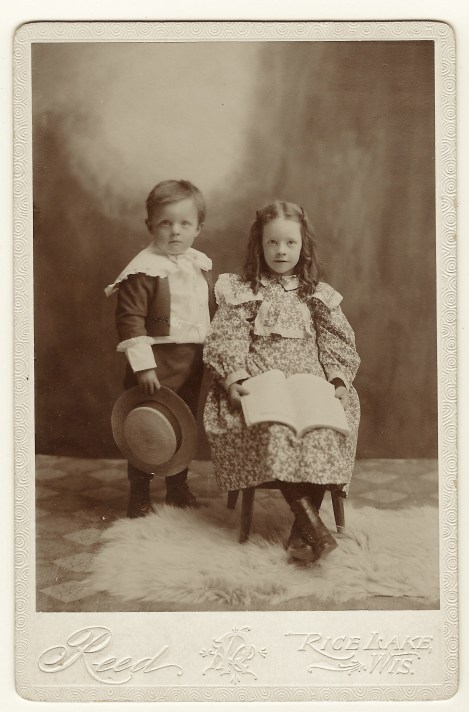
ADORABLE BROTHER AND SISTER IN RICE LAKE, WISCONSIN

rice-lake

This cabinet card portrait features an adorable and well dressed brother and sister. The cute little girl sits in a chair holding an open book in her lap. Her younger brother stands beside her holding his hat by his side. The photographer of this fine image is Homer C. Reed. The “History of Baron County” (1922) reveals that Reed bought the Rice Lake studio of T. H. Webster in 1893. The Wisconsin Photographers Index, compiled by the Wisconsin Historical Society reports that Webster operated his Rice Lake studio until 1928. Homer Reed was born in Michigan and began his photography career in Forest City, Iowa. He married Adda A. Smith in 1895 and she served as an assistant in his photography studio.   (SOLD)

Published in: on November 15, 2016 at 12:00 pm  Leave a Comment  
Tags: , ,

GEOFFREY: THE UNCONVINCING COWBOY

cowboy

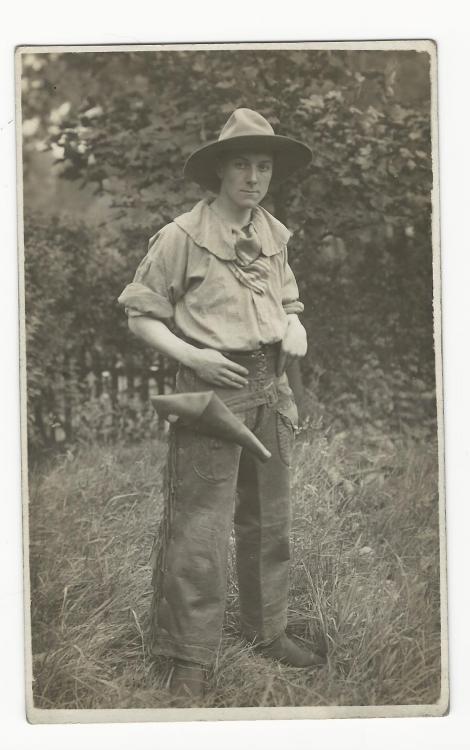
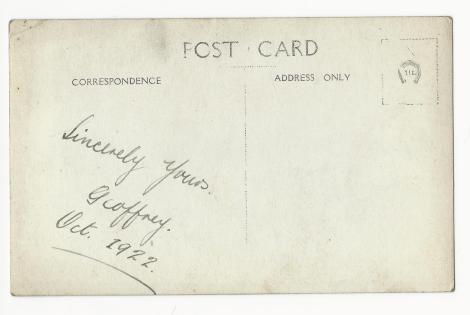
The reverse of this vintage real photo postcard indicates that the cowboy pictured on the front is named Geoffrey. My guess is that Geoffrey is a studio cowboy. His clothing, gun, holster, fringed chaps, and ten gallon hat were likely borrowed from a photography studio’s prop department. Geoffrey is not a convincing looking cowpoke or gunslinger. He has soft hands and a soft face. He certainly hasn’t been on too many cattle drives. However, this postcard is quite nice. The subject is well posed and the close-up perspective works well. An inscription on the card’s reverse reveals that he postcard photo was taken in 1922. The stamp box discloses that the publisher of the postcard stock was Vester & Company from Great Britain.
cowboy-2

Published in: on November 14, 2016 at 12:00 pm  Comments (1)  
Tags: ,

A MAN AND THREE YOUNG WOMEN POSE FOR A CIVIL WAR ERA TINTYPE PORTRAIT

tintype

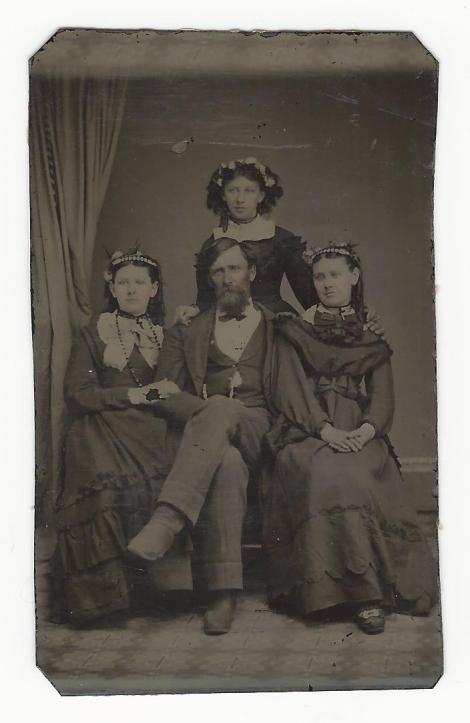
A well dressed middle aged man poses for his civil war era tintype portrait. He is accompanied in the image by three young women. The women are wearing dark dresses and each is adorned with a hair band. The woman standing behind the man is wearing her hair in a disheveled (natural?) style. One wonders what this man’s relationship is to the three women. Perhaps they are his daughters. Maybe one of the women is his wife (the woman holding his elbow?). One thing is for certain. This is an affectionate group. The foursome are sitting very close and there is a lot of touching going on. This image is the first tintype to appear in the Cabinet Card Gallery. A tintype, also known as ferrotype, is a photograph made on a thin sheet of metal coated with a dark lacquer or enamel. They were very popular during the 1860’s and 1870’s.   SOLD

tintype-2


Published in: on November 13, 2016 at 3:00 pm  Leave a Comment  
Tags: