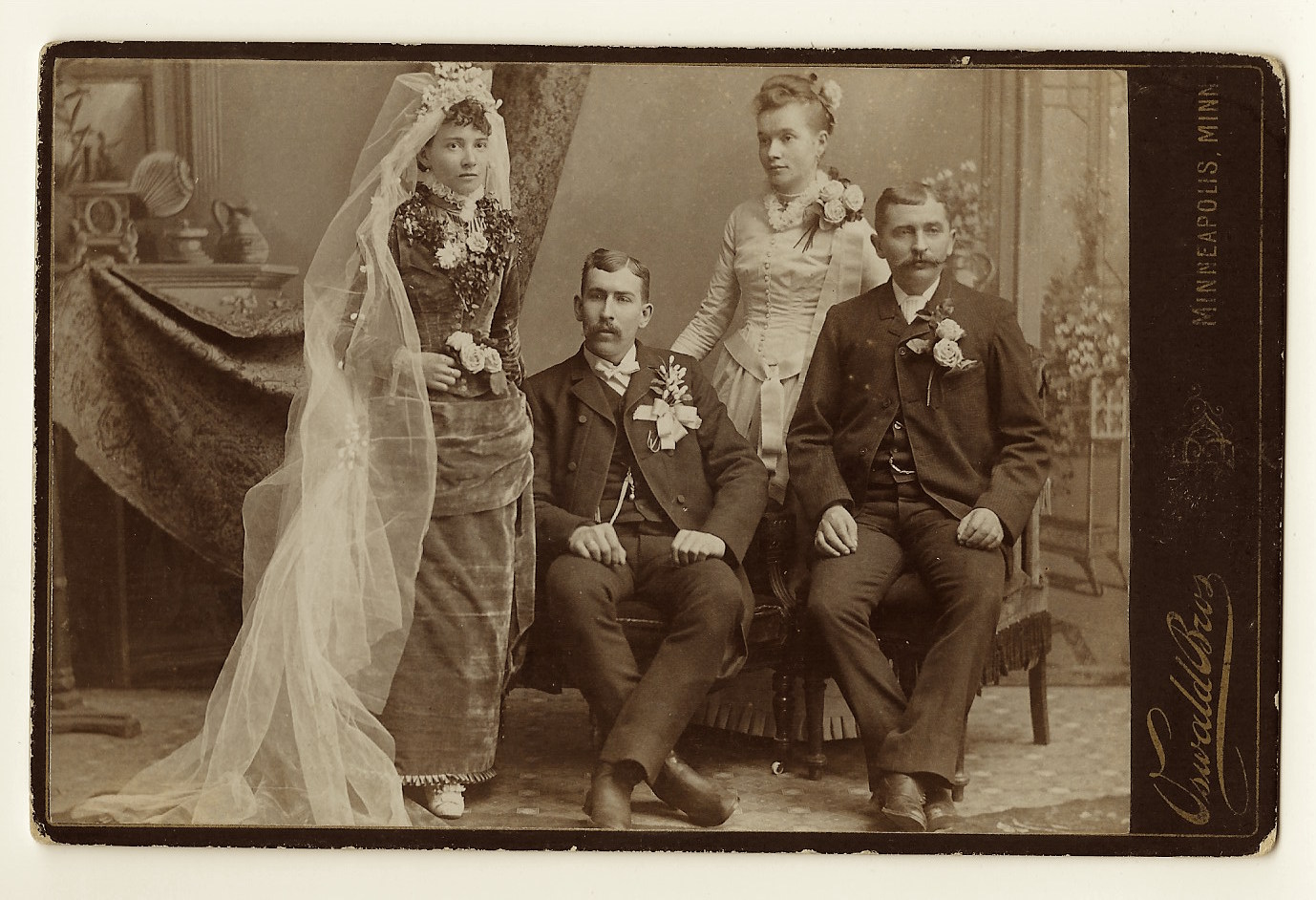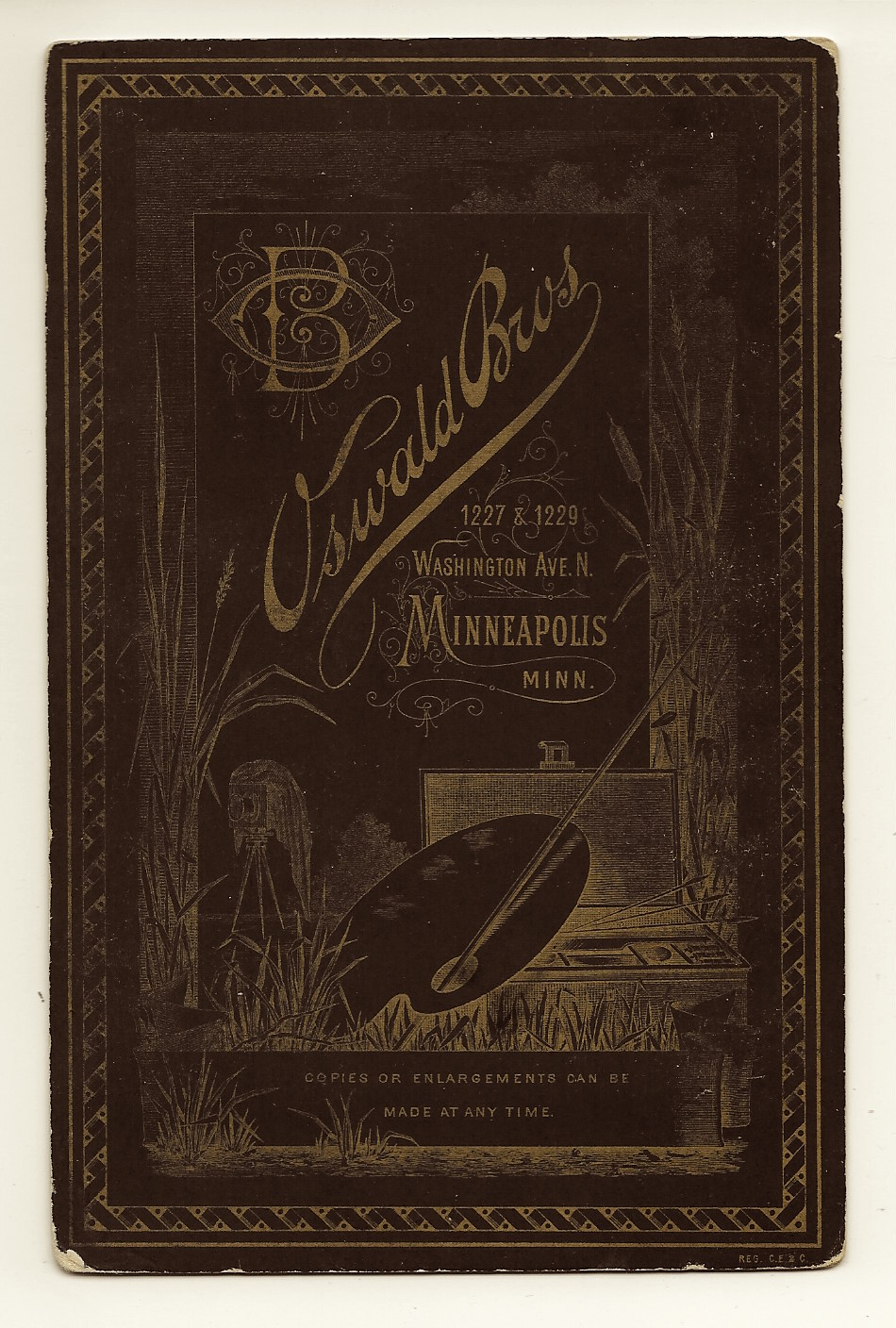
This cabinet card features a bride and groom and a couple from their wedding party. The brides gown is a bit unusual. One can find many dark colored wedding dresses but this one seems to be made from an unusual material. Perhaps someone can leave a comment that identifies the fabric. The bride is wearing a very long veil and is also wearing many flowers from her waist to the top of her dress. This photograph was taken by the Oswald Brother’s Studio in Minneapolis, Minnesota. The studio was located at 1227 and 1229 Washington Avenue North from at least 1887 through 1895. Prior to that address, the Oswalds operated out of a gallery at 116 Thirteenth Avenue North. A later location was 1221 Washington Avenue North. Charles Otto Oswald (1859-1940) and Emil C. Oswald (1864-1944) were Swiss born.
PORTRAIT OF TWO SIBLINGS IN CHICAGO, ILLINOIS
An adorable little boy poses alongside his little brother/sister at the Chicago Photo Company Studio. The children are looking at the photographer with apprehension. The unidentified children are nicely dressed. The Chicago Photo Company, not surprisingly, was located in Chicago, Illinois. (SOLD)
IMAGE AND STORY: YOUNG SOLDIER COMES HOME FROM WORLD WAR I (VINTAGE REAL PHOTO POSTCARD)
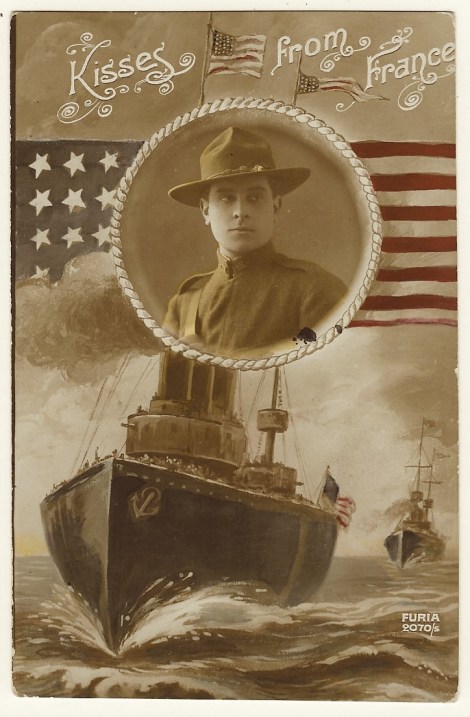
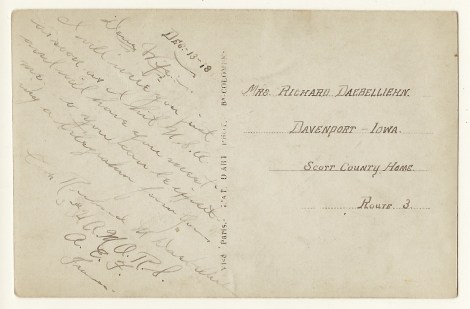
On November 11th, 1918, World War I came to an end. It was a joyous time and soldiers and sailors from all the fighting nations were able to return home to their loved ones. This real photo postcard provides a visual image of that time in history. We see two ships speeding home on a a rough ocean. The postcard shows an American soldier who is portrayed as being on one of these ships. Note the American flag in the background as well as the flags on each ship. This was truly a patriotic time. On the reverse of the postcard is a most interesting message. On 12/13/18, about a month after the war’s end, Richard M. Daebelliehn (1889-1964) wrote a message to his wife. I will decipher it the best that I can as it is not totally legible. “Dear Wife, I will wire you just as soon as I hit USA and will have you meet me. You can be expecting a telegram from me”. He signed his name and followed it with an alphabet soup of letters, “HQ (headquarters) M.O.R.S. (?) A. E. F. (American Expeditionary Force) France. It also appears that the word “Cook” appears before his name. Daebelliehn sent this postcard to his wife who was living in Davenport, Iowa. Research reveals that his wife’s name was Grace Luttsia Anderson. The 1920 US census reports that the couple had two children, Dorothea (age 9), and Robert (age 7). The census, as well as many city directories, indicate that Richard was a butcher (meat cutter) for many years. In fact, he owned his own business. Knowing that Richard was a butcher before the war likely explains why he was a cook in the military. Richard and his family lived in Rock Island, Illinois at the time of the census. I wish I could say that after Richard was reunited with his family that they lived happily together for many years. However, Grace died in September of 1921 in Springfield, Illinois. Richard remarried (Margaret Daebelliehn) sometime before 1930. This postcard was produced by Furia, a French postcard company. The postcard certainly is a relic of history with an image on one side and a story on the other side.
PORTRAIT OF AN AUSTRIAN MAN IN TYROLEAN GARB IN VIENNA, AUSTRIA (CDV WITH A THEATRICAL INSCRIPTION)
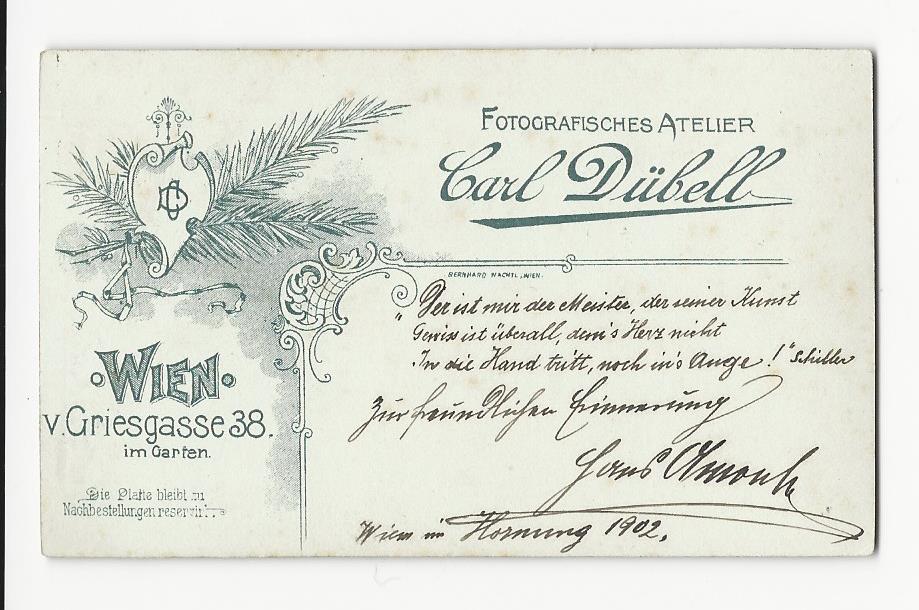
This beautiful carte de visite features a proud Austrian man wearing his nation’s traditional clothing. The young gentleman looks quite dapper in his Tyrolean garb. This CDV was produced by the Carl Dubell Studio which was located in Vienna, Austria. The photograph has an inscription on the reverse. The inscription is dated 1902 and according to the previous owner of this photograph, is taken from Friedrich von Schiller’s (1759-1805) drama, “William Tell”. The quote is translated as “But he, me thinks, is master of his craft. Who can at all times on his skill rely nor let his heart disturb or eye or hand.” To view other photographs by Carl Dubell, click on the category “Photographer: Dubell”.
PORTRAIT OF AN AFRICAN AMERICAN MAN IN POTTSVILLE, PENNSYLVANIA
This cabinet card portrait features a handsome middle aged African American man. He displays an intense expression and is wearing formal clothing for his visit to the photographer’s studio. The photographer of this cabinet card is Newton Mossheim Wonders. He was born in Ohio in 1862. He learned the photography business from his brother and worked in Cleveland (Ohio), Chicago (Illinois), and Lebanon (Pennsylvania) before opening his photography business in Pottsville (Pennsylvania) in 1891. His studio was originally located at 105 East Market Street (1893-1909). He moved the gallery to North Centre Street where it was located between 1910 and 1941. A review of US census data reveals that he was married to his wife Annie Wonders (1863-1963) in 1889. The couple had three children. Newton Wonders died in 1945 and is buried in the Charles Baber Cemetery in Pottsville. SOLD
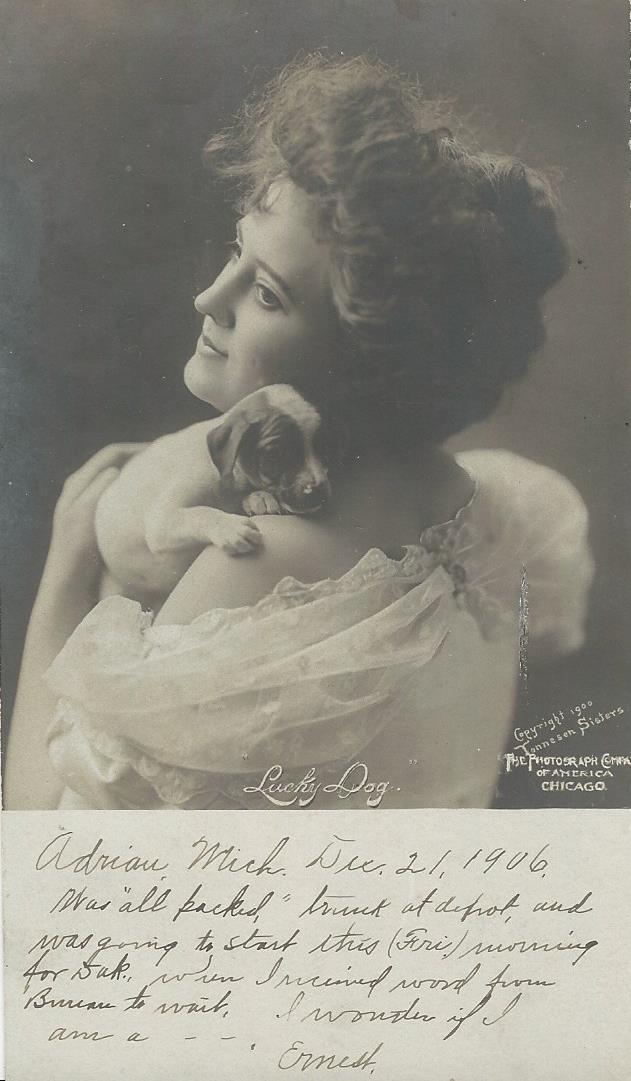
“LUCKY DOG” NESTLES INTO PRETTY WOMAN’S SHOULDER -1906 REAL PHOTO POSTCARD WITH MYSTERY MESSAGE
This vintage real photo postcard features a very cute puppy nestling into the shoulder af an attractive young woman. The humorous caption under the photo states “Lucky Dog”. The photograph is credited to “The Photographic Company of America” which was based in Chicago, Illinois. The 1900 copyright of the image is registered to the Tonnesen Sisters., The photographer of this postcard’s image is quite well known and well respected. Beatrice Tonnesen (1871-1958) was an American artist and photographer based in Chicago from 1896 through 1930. She pioneered the use of live models in print advertising. In addition, her photos were widely used as calendar art. Her sister, Clara handled the business aspects of Beatrice’s studio. The message on the postcard was written by “Ernest” in 1906 while he was in Adrian, Michigan. The postcard is addressed to Miss Gertrude Butters of Millinucket, Maine, Ernest’s message is quite mysterious and could be used as a lead in a story of intrigue. He writes “Was all packed. Trunk at depot and was going to start this (Friday) morning for Dakota when I received word for Bureau to wait. I wonder if I am a _ _.” Wow! First of all it seems likely that Ernest worked for the Bureau of Indian Affairs. Second, what was Ernest wondering about in regard to his orders to “wait”. Why didn’t he finish his last sentence of his message. This postcard is in very good condition and chock full of history and intrigue.
PORTRAIT OF A PRETTY YOUNG BRIDE (VINTAGE REAL PHOTO POSTCARD)
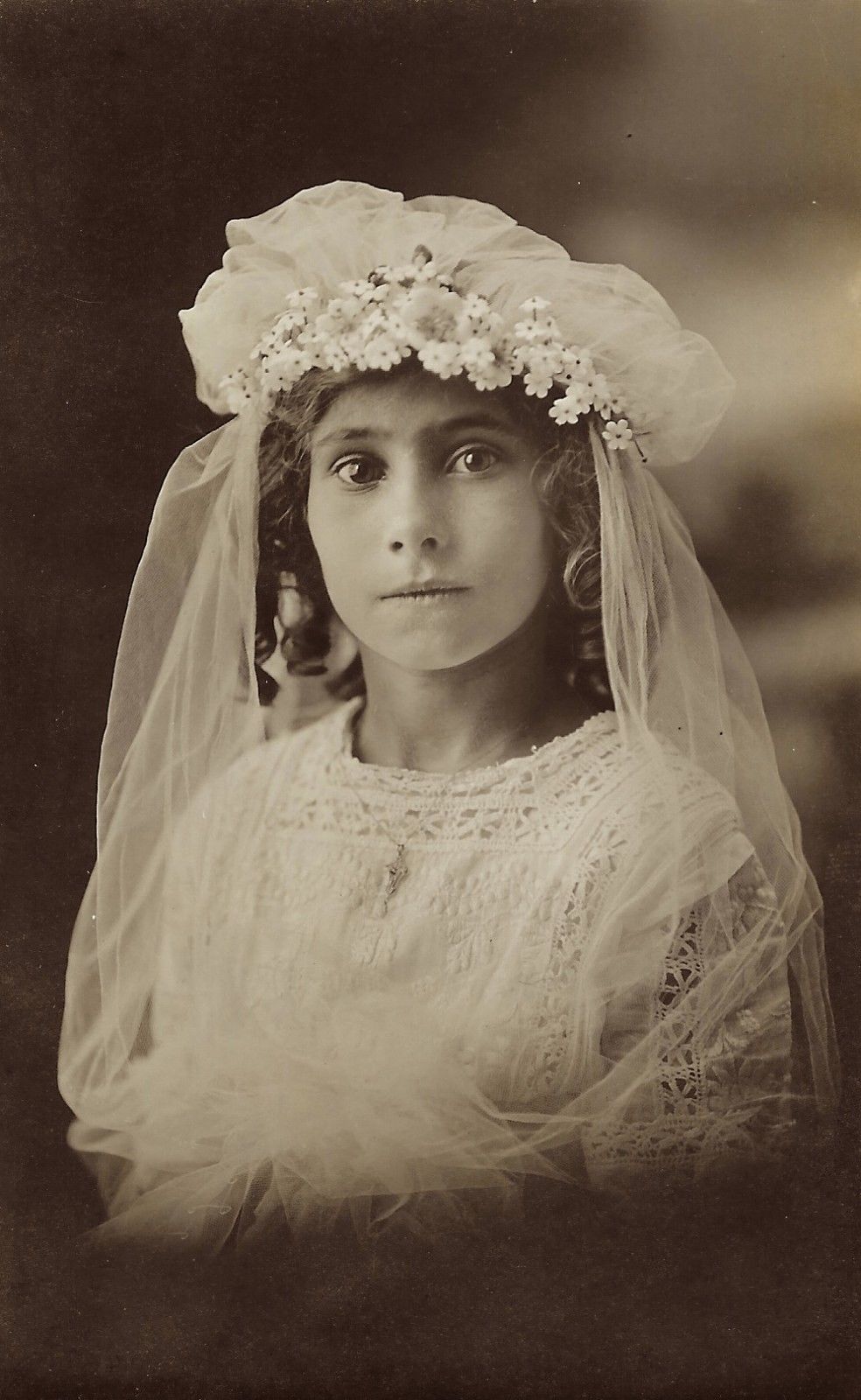
This vintage real photo postcard features a beautiful young bride. She is wearing a wedding gown and a pretty veil with a band of flowers. She has dark curly hair. She also has a dark complexion suggesting a non American or European origin. I am struck by her young appearance. The postcard has an “AZO’ stamp box indicating that it was produced between 1904 and 1918.
PORTRAIT OF A PRETTY YOUNG AFRICAN AMERICAN WOMAN (VINTAGE REAL PHOTO POSTCARD)
This vintage real photo postcard features a portrait of a pretty young African American woman. She projects an aura of sweetness. This image was created by an unknown photography studio. The AZO stamp box indicates that the photograph was taken between 1904 and 1918. SOLD
PORTRAIT OF A FARM FAMILY (VINTAGE REAL PHOTO POSTCARD)
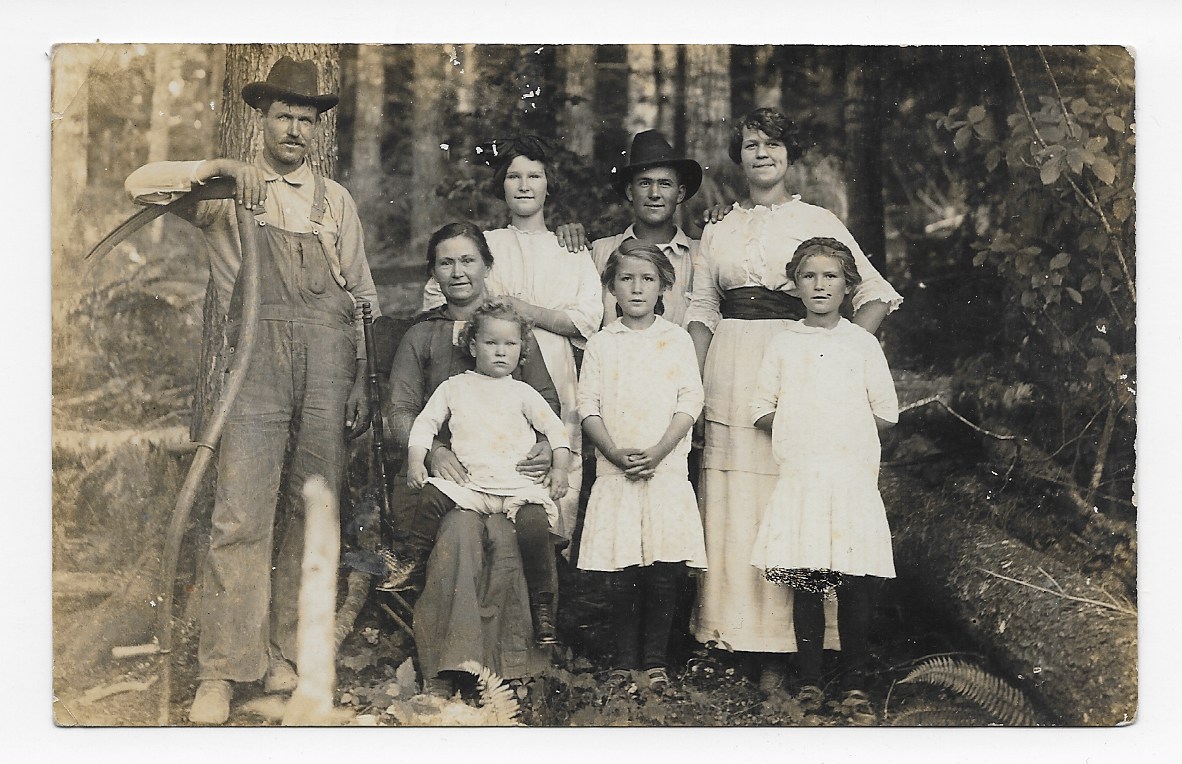
This vintage real photo postcard portrait features a farm family posing for their portrait in a field. An examination of the faces of this extended family displays the feeling of hard work and determination. The expression of the farmer holding his scythe truly captures the grit of a man facing lots of responsibility and pressure. Note that two of the girls in this family appear to be identical twins. This photo postcard is printed on AZO paper which was issued sometime between 1904 and 1918.
LOVELY COUPLE IN CINCINNATI, OHIO (PHOTOGRAPHED BY EARLY FEMALE PHOTOGRAPHER)
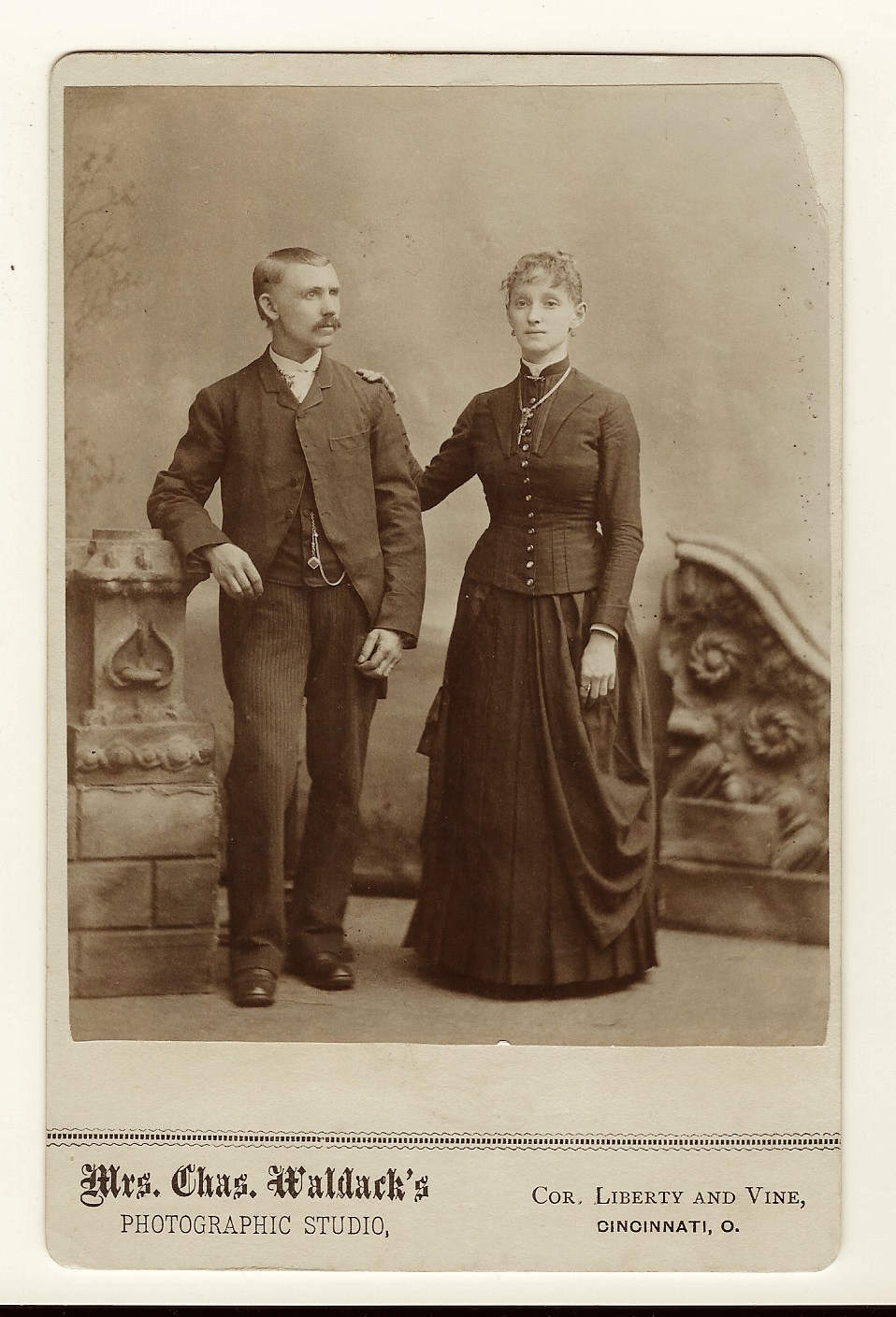
A nicely dressed couple pose for their portrait at the studio of Mrs. Charles Waldack (Mary Tanner) in Cincinnati, Ohio. The gentleman’s pocket watch chain can be seen under his jacket and the woman is wearing a collar pin and necklace. The woman is displaying affection by resting her hand on the man’s shoulder. The photographer, Mary Waldack was born about 1849 in Harford County, Kentucky. Although Mary was quite talented, her husband garnered the most attention. Charles Waldack was born in 1828 in Ghent, Belgium. In 1866 he became well known for using magnesium and gunpowder to make the first underground photographs in America. He took these photographs at Mammoth Cave in Kentucky. The pictures were published as stereo cards by E. and H.T Anthony of New York. Charles pursued his photographic career in Cincinnati from 1854 until 1881. In addition, he contributed many articles to photographic literature. In 1881 he took a trip to his native Belgium. He left his wife in charge of his studio. He died a brief time later and Mrs. Waldack managed the business until at least 1893. Mary Waldack is a member of a small group of pioneering women photographers. To view other images by early female photographers click on the category “Female Photographers”. SOLD