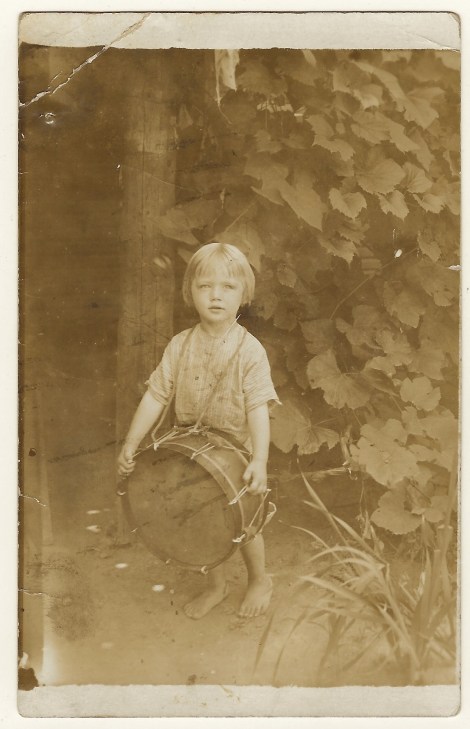
DRUMMER BOY: PORTRAIT OF JOHN NORRIS AT TWO YEARS OF AGE

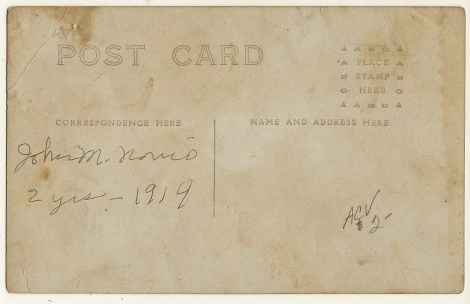
This endearing vintage real photo postcard captures a barefoot little boy and his drum. He is looking quite proud and serious. The drum does not look like a toy. Perhaps it saw some action during the civil war. The reverse of the postcard has an inscription revealing that the child is named John M. Norris and that he is two years old. The inscription also states that this photograph was taken in 1914. The AZO stamp box offers a confirmation of the date. This stamp box was utilized between 1904 and 1918. This postcard was purchased near Austin, Texas.  SOLD

Published in: on June 5, 2017 at 12:00 pm  Comments (1)  
Tags: , ,

PROFILE PORTRAIT OF A PRETTY YOUNG WOMAN IN LOS ANGELES, CALIFORNIA

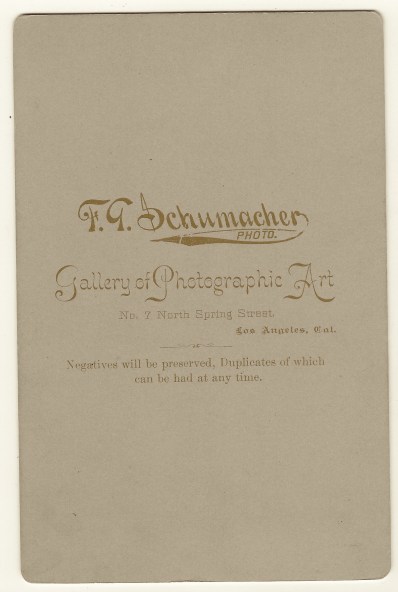
This cabinet card features a profile portrait of a a very pretty young woman. The photograph was taken by the F. G. Schumacher Gallery of Photographic Art in Los Angeles, California. The subject of this photograph appears to be in her teenage years. An article in the Los Angeles Herald (1886) is quite complimentary of Mr Schumacher. He is described as “one of the best photographic artists on the coast”. He is also referred to as “a graduate of the famous studio of Bradley & Rulofson” in San Francisco. The article also reports that he had taken portraits of many celebrities and had a particular talent in photographing children and infants. (To view photographs by Bradley & Rulofson, click on category Photographer: Bradley & Rulofson).  Frank G. Schumaker (1861-1930?) was born in California. The University of California (Berkley) archives asserts that he established a photography studio in 1882 on North Spring Street in Los Angeles. He is listed in Los Angeles business directories from at least 1888 through 1904. Wilson’s Photographic Magazine (1897) printed an article entitled “Photographic Studies by Schumacher. The article praised his work.  “SOLD”

Published in: on June 4, 2017 at 12:00 pm  Comments (1)  
Tags: , ,

“IF LOOKS COULD KILL”: PORTRAIT OF A FAMILY AND THEIR DOG

I wish I knew what was going on in the photograph on this vintage real photo postcard. Mom, Dad and their child all are displaying very intense expressions. The man and woman are staring at each other. It is as if their eyes are throwing darts at each other. The child, wearing a nautical outfit, looks like he just saw a ghost. The child is standing on a wagon. The family dog is standing on it’s hind legs with one paw on the wagon. This postcard’s AZO stamp box indicates that it was produced sometime between 1904 and 1918. (SOLD)

Published in: on June 3, 2017 at 12:00 pm  Comments (4)  
Tags: , , ,

YOUNG CHILD WEARING FANCY ATTIRE IN PORTSMOUTH, NEW HAMPSHIRE

This cabinet card features a portrait of a young child wearing fancy clothing. Note the large bow tie and the sash with tassels that serves as a belt. The photographer of this photograph is E. C. Nickerson. His studio was located in Portsmouth, New Hampshire. He is no stranger to the Cabinet Card Gallery. You may view more of his photographs by clicking on the category “Photographer: Nickerson”. Among his photographs are portraits of firemen. Nickerson’s name is listed in a number of Portsmouth directories from 1888 through 1892.   (SOLD)

Published in: on June 2, 2017 at 12:00 pm  Comments (1)  
Tags: , ,

PORTRAIT OF A PRETTY AND SWEET TEENAGE GIRL IN AUBURN, NEW YORK

This cabinet card portrait features a sweet and attractive looking young woman posing for her portrait at the Ernsberger Fine Art Gallery in Auburn, New York. She appears to be in her teenage years and is well dressed and holding a fur muff. Note her stylish hat. An inscription on the reverse of the photograph indicates that it was taken in May, 1880. William H. Ernsberger was a popular Auburn photographer judging by the large number of photographs by him in the collection of early Auburn images held by the Cayuga Museum. He was born in nearby Trumansberg in 1844 and moved to Auburn in 1865. He operated a photo studio in Auburn for more than sixty years. He was known to have photographed abolitionist Harriet Tubman (1822-1913) in 1908. At one point, his son Fred joined him in business. Ernsberger died in 1941. His obituary appeared in the Dunkirk Evening Observer. The article states that he was “reputedly” the oldest active photographer in the nation. He was 97 years old at the time of his death. SOLD

PORTRAIT OF DR LULU HUNT PETERS (1923 PRESS PHOTO OF THE PIONEER DIET DOCTOR)

This press photo features Lulu Hunt Peters (1873-1930), an American doctor and diet expert. She began by writing a featured newspaper column entitled “Diet and Health”. Her column appeared in more than 400 newspapers around the United States. She then wrote a book entitled “Diet & Health: With Key to the Calories” (1918). Dr Peters was the first person to popularize counting calories as a method of weight loss. She educated her readers about the concept of calories and urged them to think of food in terms of calories.  In other words, women should say “I ate 100 calories of bread” and not say “I ate a slice of bread”. Peters also taught her readers how to calculate their ideal weight. Peters maintained a strict diet of 1200 calories a day. Her book was the first weight-loss book to become a best seller. It was among the top ten selling non fiction books from 1922 through 1926. In 1918 the book sold two million copies, and spread the word that “thin is in”. Amazingly, Peters nine year-old nephew was the books illustrator. Peters was born in Maine and moved to California. She received her MD in 1909 from the University of California (Berkeley). Dr. Peters was very aware of obesity having grown up with a weight problem when at one point, she reached 220 pounds. Interestingly, during World War I, Peters considered her diet solution to be a form of patriotism. She viewed dieting as absolute self control and suggested that women organize “Watch Your Weight Anti-Kaiser Classes” to reach their goal weights. In addition, Peters believed that dieting would make war rationing easier and leave left over rations for children. Dr. Peters also supported the suffragist movement. She believed women needed to take better care of their health, exercise, and become more self-sufficient. It is clear that there were some problems associated with Dr Peters weight loss philosophy. Coupled with the fashion industry of that era, the communicated message was that all women should strive to be thin. Dieting was equated with being beautiful and having self esteem. Peters also believed that people who lacked self control over their weight were exhibiting poor morals. She contended that to be thin, women must be strong enough to resist temptation which she described using concepts such as sin, punishment, and redemption. After publishing her book, Peters went to Bosnia where she worked with the Red Cross. Dr Peters book remains in circulation today. In many ways she deserves credit for being a pioneer in the weight loss industry. On the other hand, she also advocated a philosophy that creates shame for those that are overweight, and worse yet, spawns eating disorders.


Published in: on May 27, 2017 at 12:00 pm  Comments (1)  
Tags: ,

ESTHER RALSTON: TALENTED FILM AND EARLY TELEVISION ACTRESS

This vintage real photo postcard features beautiful actress Esther Ralston (1902-1994). She was born in Bar Harbor, Maine and was active in acting between 1915 an 1962. Her career started while she was still a child. She appeared in a family vaudeville act called “The Ralston Family with Baby Esther, America’s Youngest Juliet”. By the time she was 18, she was appearing in silent films including “Huckleberry Finn” (1920) and “Peter Pan” (1924). In the late 1920’s she appeared in many films for Paramount Pictures. She was successful enough to earn as much as eight thousand dollars per week Although she received good reviews for dramatic roles, Ralston primarily appeared in comedies, often in the role of spirited society girls. Esther’s image was initially “wholesome and fun-loving”. Florenz Ziegfeld Jr repackaged her as “The American Venus” after she appeared in the role of a beauty queen in the film, “American Venus” (1926). Miss Ralston made a successful transition to sound pictures but by the mid 1930’s she was usually appearing in supporting roles. Her final starring role was in “To the Last Man (1933) and her final film was “Tin Pan Alley (1940). That same year she retired from film and focused on stage and radio through the 1940’s. With the advent of television, Ralston spent time appearing in this new medium. Esther Ralston was married three times and divorced three times. All of her husbands worked in the entertainment industry. The imdb lists Ralston as having 108 credits as an actress. She certainly made an impact in the entertainment world and this is reflected by the fact that she has a star on the Hollywood Walk of Fame. Esther Ralston’s obituary can be found at the web site of  “The Independent”. The obituary states that she was a “captivating blond beauty with an engaging sense of humor”. The article tells the story of Ralston’s reaction to co-starring with Clara Bow and Gary Cooper in “Children of Divorce” (1927) while Bow and Cooper were having an affair. In regard to Clara Bow, Ralston stated “I didn’t really dislike her, but she was pretty loose and I’d been brought up differently”. This photo postcard was pubished by Ross Verlag, a postcard publishing company based in Berlin, Germany. The postcard was produced for Paramount Pictures and is part of a series (No. 3393/1).

PORTRAIT OF A HANDSOME SOLDIER IN VIENNA, AUSTRIA

This cabinet card provides a portrait of a handsome uniformed Austro-Hungarian soldier. He is posing at the Rudolf Denk studio in Vienna, Austria. Note his high boots, sabre, and wrist watch. The soldier is wearing a couple of medals on his chest. His cap is on the table beside him. He is wearing a whistle which can be seen between his two breast pockets. The soldier is holding an open book. It is likely that this young man saw military action. World War I was not many years away from the time that he sat for this photograph.

Published in: on May 25, 2017 at 12:00 pm  Comments (1)  
Tags: , , , , ,

CARTES DE VISITE PORTRAIT OF A YOUNG GIRL IN GRONINGEN, NETHERLANDS

This carte de visite features a pretty young girl wearing a simple dress. She is posing in front of a window and alongside a chair in a studio setting. The photographer of this cdv image is the Bongenaar Gallery which was located in Groningen, Netherlands.  (SOLD)

Published in: on May 24, 2017 at 12:00 pm  Comments (1)  
Tags: ,

PORTRAIT OF TWO VISITORS IN A CONVERTIBLE AT BALANCED ROCK, GARDEN OF THE GODS, COLORADO

This is one of those vintage real photo postcards that one stumbles upon and is compelled to learn more about. The postcard is a wonderful find. The photograph shows a young couple driving a 1920’s (?) car past “Balanced Rock” in the Garden of the Gods. The popular tourist location is located in Colorado Springs, Colorado. In 1859, two surveyors who were instrumental in setting up Colorado City, explored the area and one of them decided that it would be a great place for a “beer garden”.  The second surveyor responded to the suggestion stating it would be better to call it “Garden of the Gods” because it was “a fit place for the Gods to assemble”. Many Native American tribes are connected to this area including the Apache, Cheyenne, Comanche, Utes, and Pawnee people. The Garden of the Gods became a National Natural Landmark in 1971. This postcard does an excellent job of providing a portrait of the “Balanced Rock”. The natural geological formation is put in even better perspective by photographing an open car in front of it’s precarious pose. The viewer holds their breath hoping that the auto and it’s two occupants pass by safely. Note that there is a pennant hanging on the side of the car. Printed on the pennant is “Kansas City”, which is likely the home of the lovely couple in the convertible. This postcard was produced by the Paul Goerke studio in Manitou, Colorado. It is printed on Artura paper and was produced between 1908 and 1924 (presumably sometime toward the end of this span). The story of photographer Paul Goerke is quite interesting. In the 1890’s, Goerke purchased the land around Balanced Rock. Goerke and his son, Curt, took photographs of tourists by the rock and sold them for 25 cents apiece. At the beginning of Goerke’s business there was no charge to view Balanced Rock. They made their money by charging for the portraits. Among the props supplied by Goerke, were burros. As personal cameras became readily available, Goerke needed to change his business concept. Curt Goerke built a wooden fence around Balanced Rock and began charging 25 cents admission. He also operated a lunch counter adjacent to nearby “Steamboat Rock” and created picnic areas for the thousand of visitors who came each summer. In 1932 the city of Colorado Springs purchased The Goerke property and tore down the fence.


Modern Photo Postcard of Balanced Rock


Published in: on May 23, 2017 at 6:14 pm  Leave a Comment  
Tags: , , , , ,