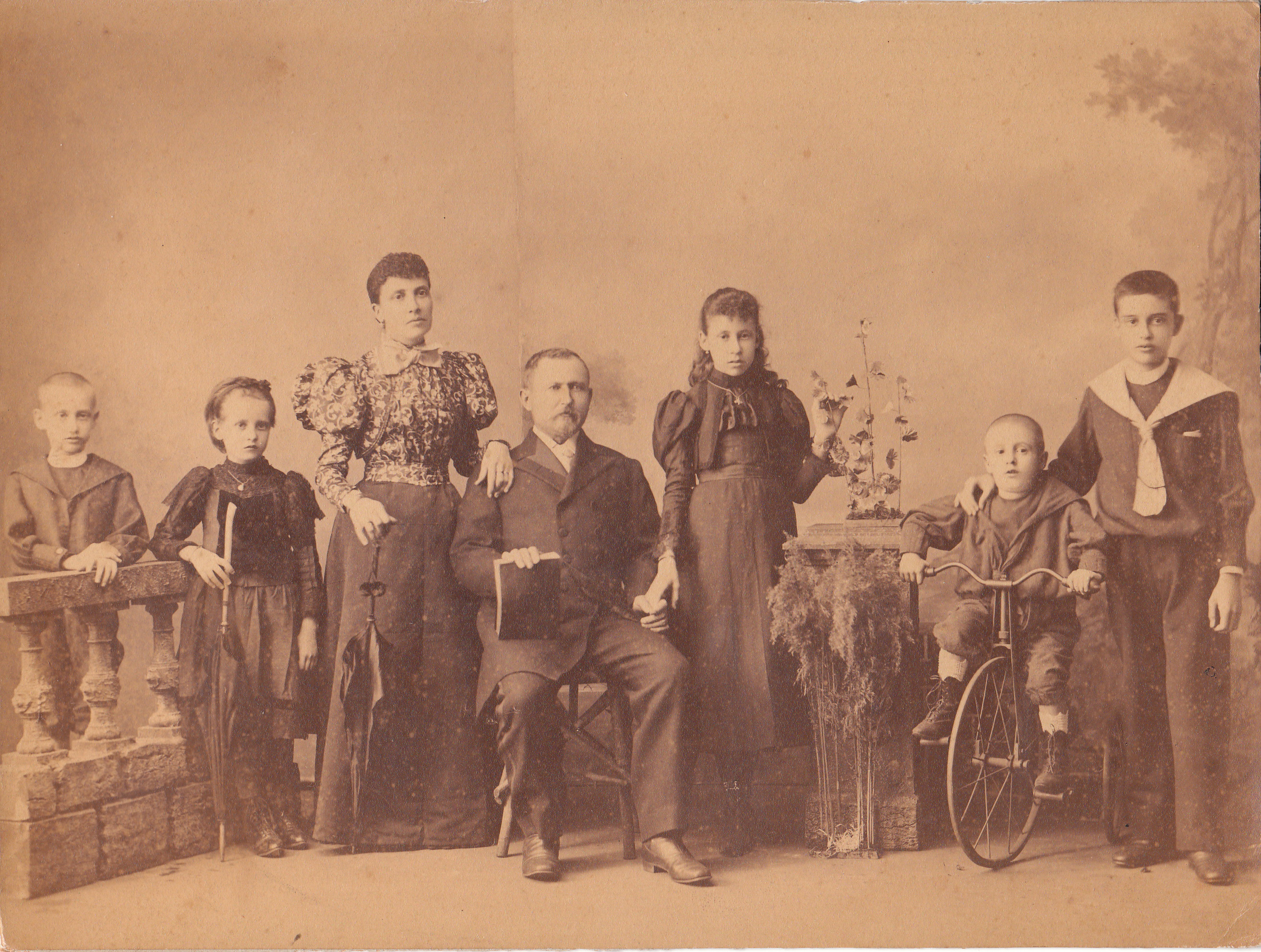
 This family portrait features a mother and father along with their five children. Mom and one of her daughters are holding umbrellas while dad balances a book on his knee. The eldest son is wearing a sailor suit and has his arm wrapped around his little brother who is sitting on a tricycle. Another brother stands alone on the opposite side of the wall than where the rest of his family is located. Does this have some psychological meaning, or is this just where he was posed by the photographer. The photographer is the Perez studio which was located in San Paulo, Brazil.
PARENTS AND THEIR FIVE CHILDREN IN SAN PAULO, BRAZIL

MOTHER AND DAUGHTER SIDE BY SIDE
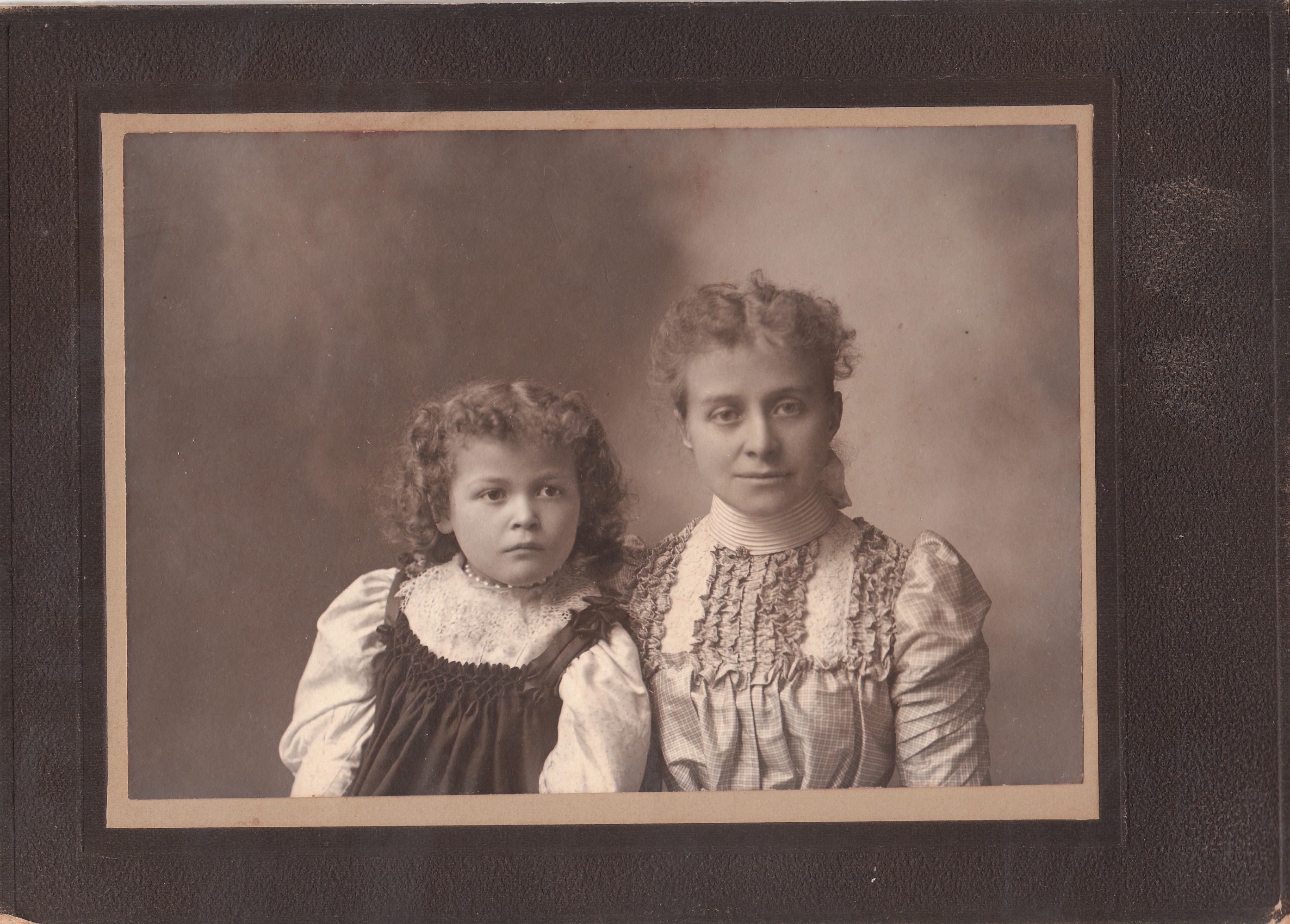 A mother and daughter pose for their portrait at an unidentified photography studio. On second thought, the young woman and the child seen in this image may actually be siblings. Looking at the way they are posed, I would guess that they share a sibling relationship rather than a parent-child relationship. The subjects certainly exhibit a family resemblance. The pair are nicely dressed. The little girl is wearing a beaded necklace, possibly pearls.
HAPPY FATHER’S DAY IN PLAINFIELD, NEW JERSEY ……. (PORTRAIT OF A LOVING FATHER AND DAUGHTER BY CELEBRATED PHOTOGRAPHER CHARLES EISENMANN)
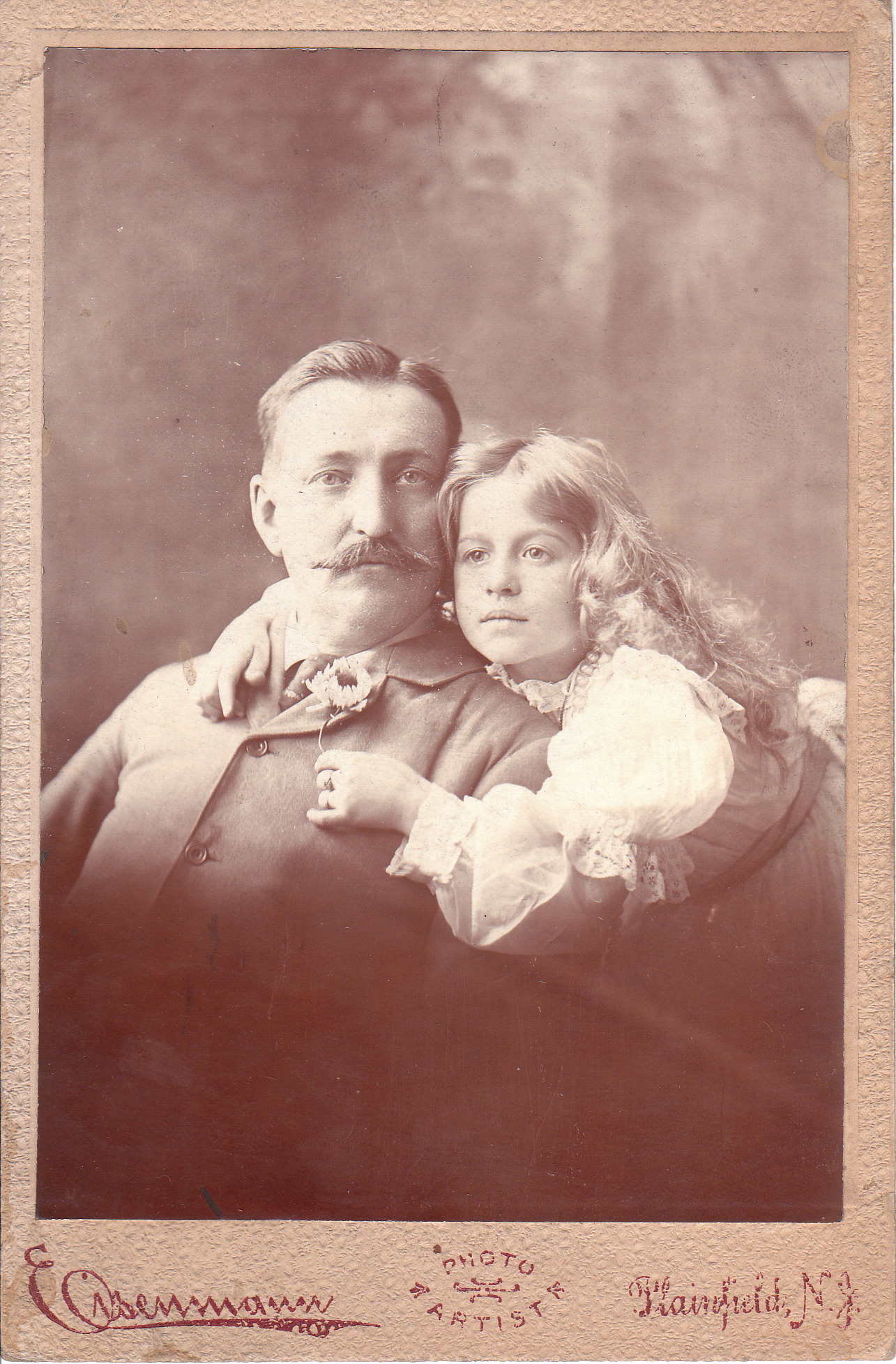
This photograph, by celebrated photographer Charles Eisenmann, exudes love. A young girl is pictured hugging her father and she exhibits a very loving expression. The father appears truly happy to be the recipient of such love. This photograph was taken by a famous photographer of the cabinet card era. Charles Eisenmann (1855-1927) was German born and was a celebrated cabinet card photographer during the 1880’s and 1890’s. His studio was located in New York City’s Bowery District. This part of the city was populated by many people who were considered “on the fringe of society”. The area was full of artists, transients, and prostitutes. The Bowery district appeared in the movie Gangs of New York (2002). Eisenmann was noted for his photographs of human oddities (side show “freaks” and people with unusual birth defects). He was also known for his photographs of Circassian beauties. These women were reported to be escapees from Turkish harems but in fact were local women who were costumed to look wild and wore teased “big” hairdos. Eisenmann also did celebrity portraits. His customers included P. T. Barnum, Major Tom Thumb, Mark Twain and Annie Oakley. He left his Bowery studio in 1898 and was succeeded by his intern/son-in-law Frank Wendt. For a few years he took portraits out of a studio he operated in Plainfield, New Jersey. The above photograph is a product of that studio. He later went to work for Dupont where he was the director of the photography department. A number of institutions have collections of Eisenmann’s work. Syracuse University’s library has a collection of more than 14,000 Eisenmann images.
PHOTOGRAPH OF WEDDING COUPLE EXHIBIT AT AMERICA’S FIRST WAX MUSEUM


This photograph features an exhibit from America’s first wax museum. Note how real the wax bride and groom appear in this exhibit. The groom is sitting in a decorative chair and wearing a pocket watch and corsage. The bride is wearing a wedding band, flowers, and a bridal veil. Her dark wedding dress is beaded and intricately ornate. This wedding couple looks so real. In fact, they are real. They just look waxen. No offense is meant toward this couple. They are probably posing the way they photographer had instructed them. The photographic process was not generous to their appearance. Writing this description caused me to wonder when wax museums came into existence. Research quickly revealed that the first wax museum originated some time in the early 18th century. However, the creation and use of wax figures for ceremonies occurred many years before that. This cabinet card presents a mystery that I was unable to resolve despite spending quite a bit of time on the endeavor. The mystery involves identifying the photographer of this image. I have copied his studio stamp that was on the reverse of this cabinet card and it can be seen above. Any attempt by the Cabinet Card Gallery’s vast unpaid research department (the gallery’s visitors) to discover the photographers identity would be appreciated. I did not find the name of the photographer to be legible. It also didn’t help that no town, city, or state was listed. For those up to the challenge, good luck in your search.
SWEET YOUNG WOMAN IN BOSTON, MASSACHUSETTS
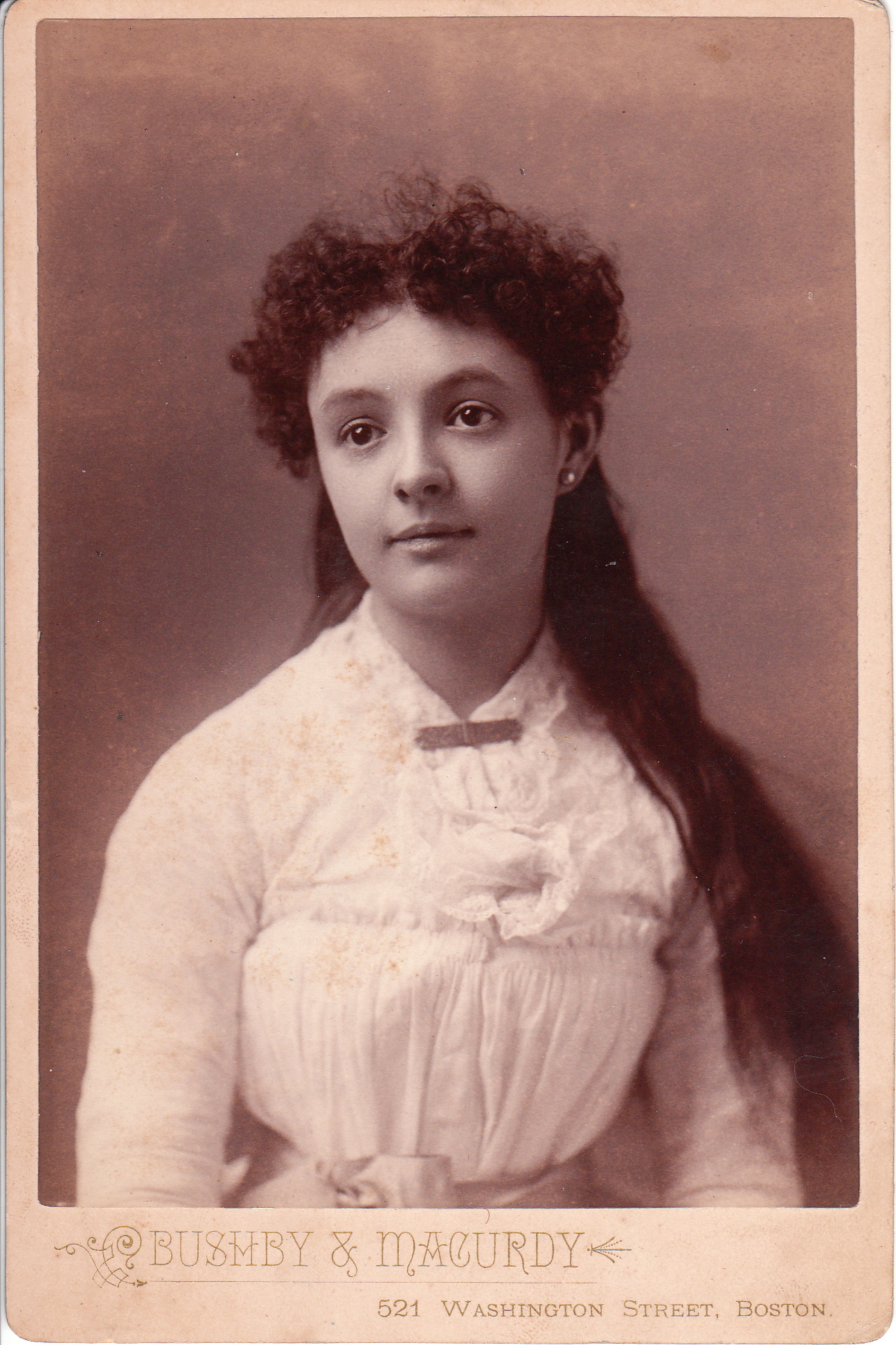 This cabinet card portrait captures a pretty young woman with a sweet smile. She is wearing a white dress and jewelry including a collar pin and earrings. Note the length of her long dark hair. The photograph was produced by the Bushby and Macurdy Studio which was located in Boston, Massachusetts. To learn more about photographers Asa Bushby and George Macurdy and to view more of their photographs, click on the category “Photographer: Bushby & Macurdy”.
PORTRAIT OF A WOMAN AND HER VIOLIN IN MASSACHUSETTS

This cabinet card photograph features a woman and her violin and bow. At least, I think its a violin. Hopefully, an informed visitor to the cabinet card gallery will confirm whether her instrument is a violin and if it isn’t, will correctly identify the stringed instrument. The portrait is a product of a photographer named W. C. Thompson. Mr Thompson operated the Opera House Studio in Amesbury, Massachusetts, as well as the Globe Studio which was located in Newsburyport, Massachusetts. One has to wonder whether the woman in this image was a performer at the Opera House in Amesbury. The Amesbury Opera House has an interesting history. P. Stevens, author of the History of Amesbury (1999) writes that the Opera House was “the most ostentatious building ever to grace the streets of Amesbury”. The citizens of Amesbury experienced a change of scenery when the building burned down in what is considered the worst fire in Amesbury’s history. A contributing factor to the lack of success that the fire department had in putting out the fire was the fact that the man in charge of keeping water pressure high to fight fires was away for the weekend and failed to designate anyone to relieve him during his time away. It seems safe to say that this portrait was photographed before the 1899 fire since the photographic studio likely also was destroyed in the the blaze. According to one source, the photographer of this image, William Cushing Thompson (1839-1917) operated his Amesbury studio between 1869 and 1893. It was located for at least some of this time at Market and Main Street. The Bulletin of Photography (1917) reported that Thompson was in the photography business when the civil war started and he temporarily quit his career to join the Union army. According to the article, he stayed in the war until it ended. Thompson entered the war as a private and mustered out as a sergeant. He served in Company A of the 48th Massachusetts Infantry. Some of Thompson’s photographs are in the collections of the New York Public Library and the Massachusetts Historical Society. Thompson was born and died in Newsburyport. He is buried in the Oak Hill Cemetery in Newsburyport. To view other photographs by this photographer, click on the category “Photographer: Thompson”.
A FAMILY PORTRAIT OF A FATHER AND HIS TWO CHILDREN IN ROCHESTER, NEW YORK

W. J. Lee, a photographer in Rochester, New York, produced this wonderful family portrait of a father and his two children. Dad is quite handsome. He is holding his derby hat on his knee. Dad has his arm tucked around the waist of his son. The son is wearing a hard to identify hat/cap. Is it a fez? The photographer did a terrific job of capturing the daughter’s facial expression. She is adorable and she is displaying an interesting “look”. Is she communicating a certain elegance, or is her glance an expression of apathy? One wonders why the children’s mother does not appear in this portrait. W. J. Lee is listed in various Rochester city directories beginning 1887 and ending 1902.
PRETTY YOUNG STAGE ACTRESS GLADYS WALLIS (PHOTOGRAPH BY B J FALK)
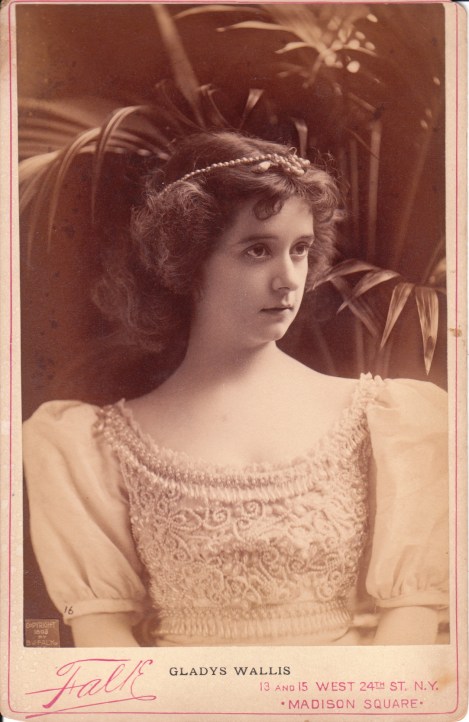 Gladys Wallis, theater star, is the subject of this portrait by celebrity photographer B. J. Falk. Miss Wallis appears to be very young when she posed for this cabinet card photograph. The image is numbered 16 in a series and has a copyright date of 1893. In fact, she was just eighteen years old when she sat for this portrait. Glady Wallis (1875-1953) lived an interesting life. The Florence Times (1932) tells some of her story in an article that is predominately about her husband Samuel Insull (1858-1938). The article was quite disparaging of Insull and in the lead of the story the reporter writes “The keen brain of Samuel Insull built a 4,000,000,000 public utilities empire but he failed when he attempted to bring about his wife’s come-back as an actress after her 26 year absence from the stage”. The attempt cost him 200,00 dollars. Gladys Wallis’s was originally named Mary Bird. She was of Irish descent and upon becoming an actress was determined to be viewed as a respectable woman. She was anti alcohol and reportedly, anti sex. Insull had originally seen her as a “starry eyed and raven-haired young ingenue in an 1898 theater production in Chicago. She was just a teenager and he was 36 years-old starstruck admirer. They later met at a dinner party and two years later, they married. Gladys quickly retired from the stage and became a society lady. She had a number of estates and servants, was active in fund raising for charities, went to high society affairs and functions, and wore expensive clothing and jewelry. It is reported that she wasn’t an easy person to get along with and was not very well liked among the ladies of society. She and Insull reportedly had a tempestuous relationship and among their issues was her disinterest in sex. Insull supported her temperance beliefs. The couple had a son who eventually attended Yale University. In 1925,Wallis revealed her desire to return to the stage because of her desire for “self expression”. Her husband funded the theatrical endeavor and its proceeds were to be directed toward charity. Society turned out in mass for the opening night of what was to be a two week engagement where Mrs. Insull played the “coquettish role”of Lady Teazle. Attendees included Marshall Fields, the Armours, the Drakes, and the Pullmans. The success of this limited engagement spurred Wallis to return to Broadway. Wallis may have felt ready for Broadway but apparently Brodway wasn’t ready for Wallis and she returned to Chicago in 1927. She was not yet done with acting so she took a five year lease on a Chicago theater and established a performing company. This project failed and before long he company was operating at a loss of more than a thousand dollars a day. Things also did not go well for Mr. Insull. The depression severely impacted his business and eventually there were even charges filed against him. He fled to Europe with his wife where they entered “voluntary exile”. He was eventually deported from Europe but was well defended in a Chicago trial and found innocent of all charges. However, the Insulls had lost their fortune and at the time of his death, his estate was quite meager. There are a number of books available about Mr. Insull and they probably make quite interesting reading. This photograph was taken by B. J. Falk, New York City celebrity photographer. To learn more about this photographer and to see more of his images, click on the category “Photographer: Falk”.
HANDSOME MAN WITH EXCEPTIONAL MUSTACHE IN ELMIRA, NEW YORK
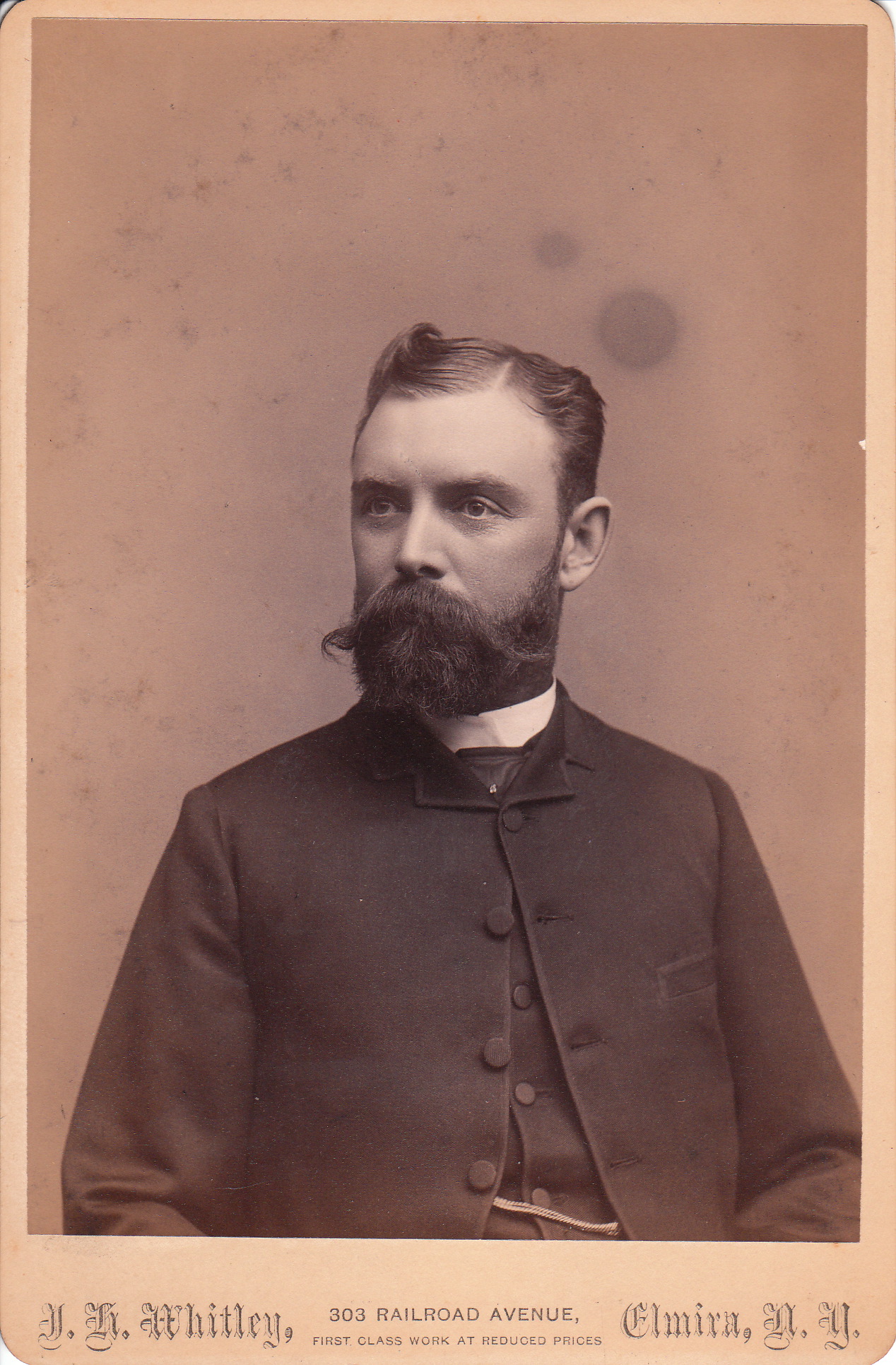
A well dressed handsome man poses for his portrait at the Whitley studio in Elmira, New York. He has a well groomed attractive beard and an exceptional mustache. A pocket watch chain is evident under his jacket and he appears to also be sporting a tie pin. To view other images of fantastic mustaches, click on the category “Mustaches (Only the Best). The photographer of this image is John H. Whitley. He was born in Candor, New York in 1831. He was a photographer in Oswego, New York, from 1858 through 1861. His next position was working with photographer C. C.Doty in Elmira, New York. After a short time he left his employ to work for the Erie Railroad car shop in Elmira. When the shop was destroyed by fire, he returned to photography and worked with Elmira photographer A. P. Hart. By 1864, Whitley had opened his own photography gallery in Elmira. To view more photographs by Whitley, click on the category “Photographer: Whitley”.
SWEET GIRL LEANING ON A CHAIR AND CLASHING FABRICS IN HUDSON, NEW YORK
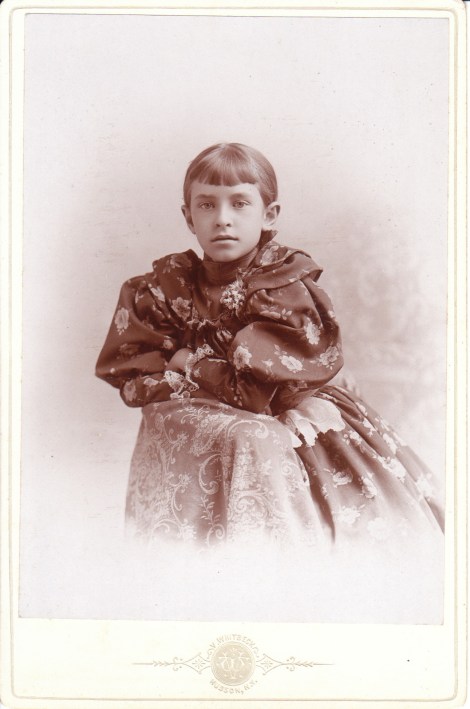 A sweet young girl with her arms crossed leans against a chair at the V. Whitbeck studio in Hudson, New York. One wonders if Whitbeck ever noticed the major pattern clash between the fabrics of the girl’s clothing and the chair. The reverse of the photograph has advertising that indicates that Whitbeck was successor to a photographer named Forshew. Frank Forshew (1827-1895) established his photography business in 1850 in Hudson, a small city on the banks of the Hudson River in upstate New York. He began as a daguerrian and progressed through the stages of photography, eventually producing cdv’s, cabinet cards, and stereoviews. He sold his business to Volkert Whitbeck (1843-?) in the early 1890’s. Whitbeck had joined the business after his discharge from the Union army in 1863. Whitbeck had enlisted into the 14th NY Infantry (Co K) as a corporal. Before his mustering out on 5/23/1863, he had reached the rank of sergeant. Records indicate that he remained in the reserves and continued to rise in rank reaching Captain. Whitbeck appears in the 1880 US census and at that point in time he worked as a photographer and shared his name and residence with his father. His father was a physician. Whitbeck’s photography business is listed in many Hudson city directories. The latest one appears to be 1913.


 THE CABINET CARD GALLERY