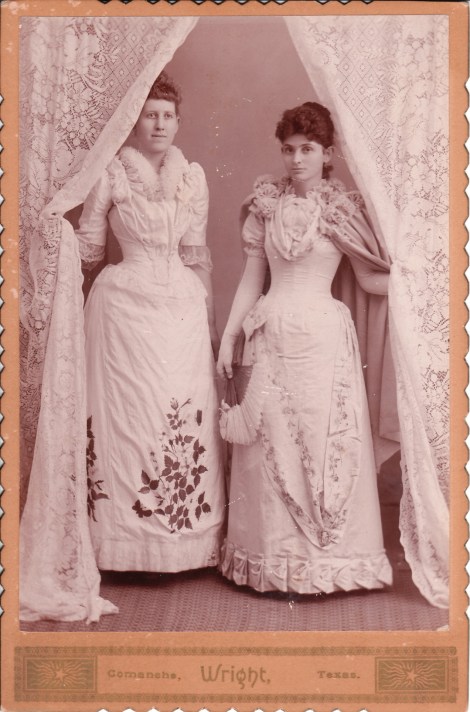
 This unusually posed Cabinet Card was photographed by Wright, in Comanche, Texas. Two beautifully dressed woman wearing long white dresses, pose behind a frilly lace curtain. The dresses are embellished with lace, flowers, and possibly fur or feathers. The woman on the right is holding a fan and wearing a cape. Who would have thought that these Comanche, Texas women could make such a beautiful fashion statement. Comanche, Texas is located in Central Texas and is the site of the saloon where gunfighter John Wesley Hardin killed a deputy in 1874. The Comanche Chief, the local newspaper, wrote in 1880 that James L Wright was the best photographic artist in Texas outside of some photographers in Galveston and Dallas. This claim sounds like a compliment with reservations.

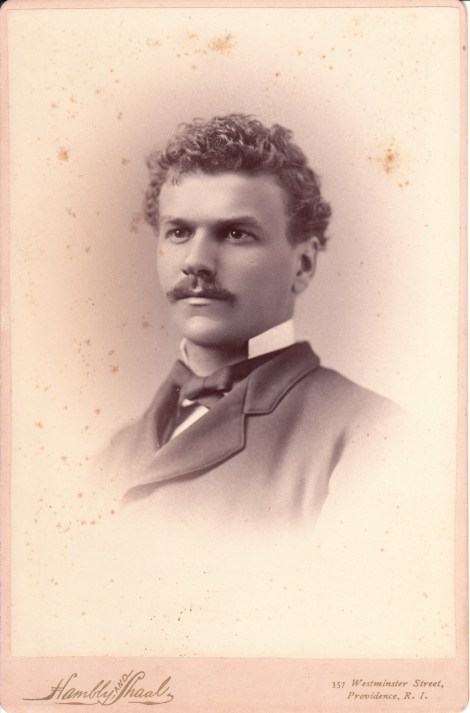 This Cabinet Card was found with 76 other Cabinet Card photographs in an album of members of the class of 1882 at Brown University in Providence, Rhode Island. It is believed that this image was taken in 1878. The subject of this photo is Sam Foss who was born in New Hampshire. After graduation from Brown he became a librarian and poet. His works include The House by the Side of the Road and The Coming American. In 1898 he became the librarian at the Somerville Public Library in Massachusetts. He wrote a poem a day for then newspapers and published five volumes of collected poetry. Until 2003, his words were on the granite wall at the Air Force Academy. He wrote “Bring me men to match my mountains, Bring me men to match my plains, Men with empires in their purpose, And new Eras in their brains” (from Coming American 1894) The photographic studio that produced this Cabinet Card is Hambly and Shoal in Providence, Rhode Island.
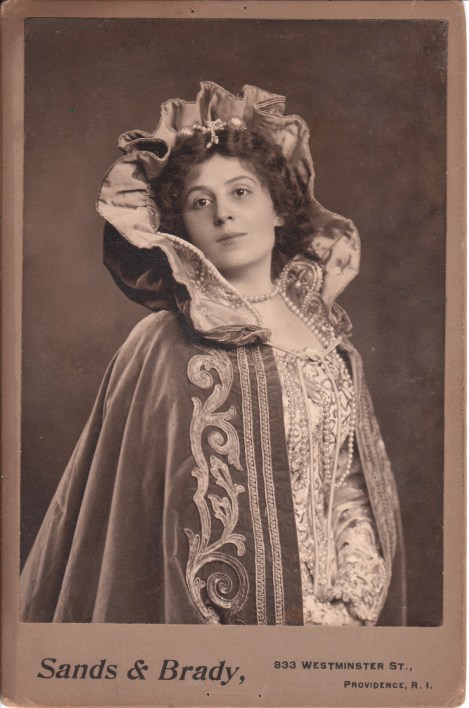 Viola Allen (1869-1948) was an American theater and silent film actress who acted in roles between 1882-1919. She was born in Alabama and was the daughter of an actor. Her first stage appearance in New York City was at age 14 when she substituted for the ill Annie Russell who was playing the title role of Esmeralda at Madison Square Theater. Allen’s father was also a member of the cast. Allen appeared in many productions including Masqueraders, Twelfth Night, Under the Red Robe, The Christian, and the Winter Tale. Her most popular roles were in Shenendoah and Little Lord Fauntleroy. The reverse of this card has writing that indicates that this image is from Allen playing the role of Dolores in “In The Palace of the King” (1901). The photographer of this Cabinet Card was the studio of Sands & Brady in Providence, Rhode Island.
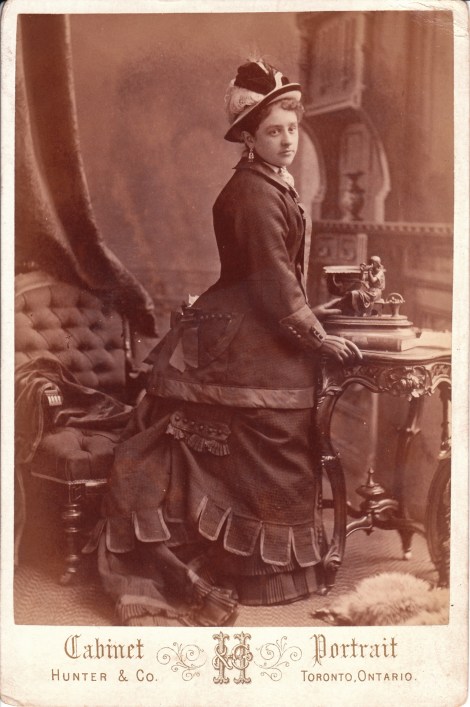 This Cabinet card was photographed by Hunter & Co. of Toronto, Ontario, Canada. The subject of the photograph is Mrs Fred Rathbun and she is fashionably dressed as she poses by a table topped by a book and a statue. The Rathbun name is a prominent name in Toronto, though no additional identifying information is currently available. Visitors to this site should feel free to leave any information they may have about the woman in this photograph.
 A pretty little girl poses for her portrait in Philadelphia, Pennsylvania. The photographer is Werner. She has very long hair and expressive eyes. She is holding her hat on her knee.
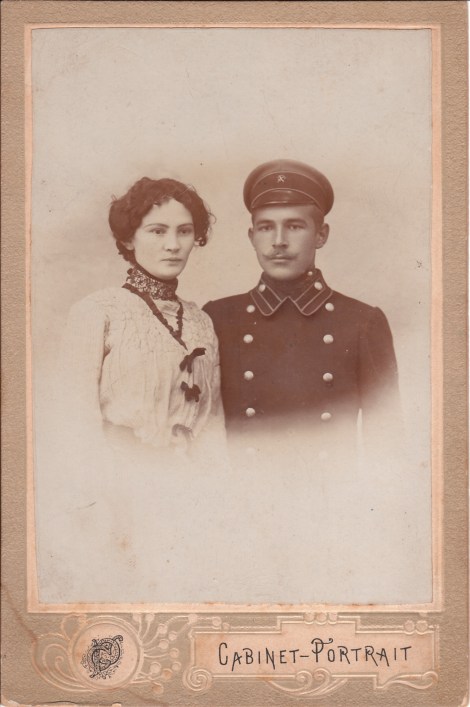 This Russian cabinet card is a portrait of a uniformed Russian sailor and his wife. The reverse of the card has an inscription in Russian which states “In good memory for dear Ivan Afansevich and Agrippa Petrovna, from Maria and Aleksandr Limonnivov”. The inscription is dated January 30th, 1906.
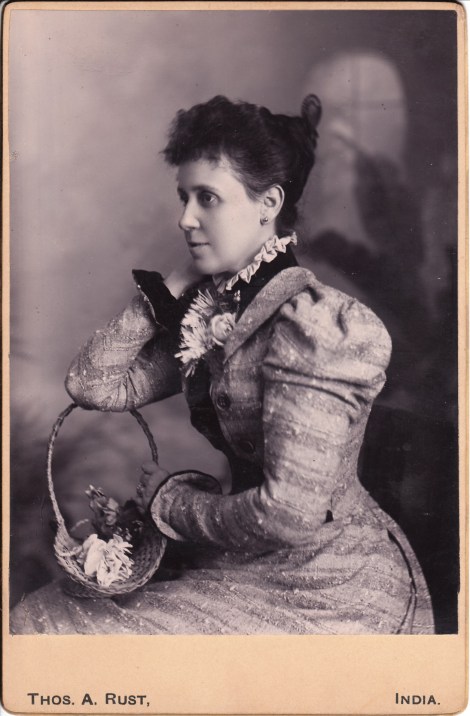 This cabinet card comes from the studio of Thomas A. Rust who was a well known photographer in India. The Cabinet Card Gallery has another portrait by Rust which can be viewed by clicking on the “Photographer: Thomas A. Rust” category found below. This photograph is a very clear image of a fashionable woman posing with a woven basket on her lap. The basket is holding flowers. To learn more about photographer Thomas A. Rust, click on his name below.
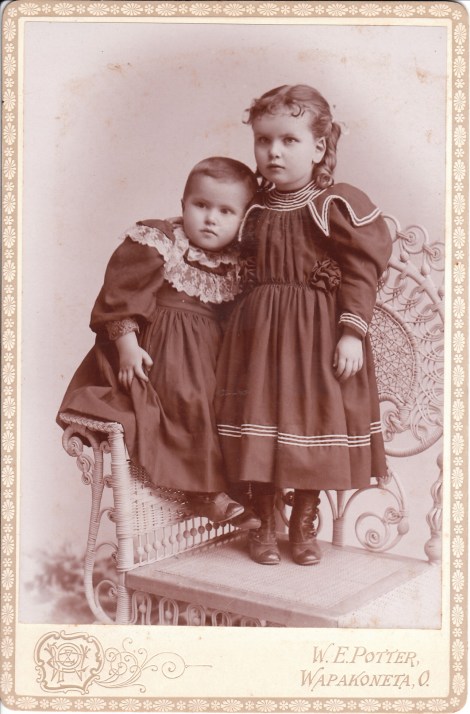 Two cute kids, probably, sisters, are seen in the Cabinet Card posing on a chair for photographer W. E. Potter of Wapakoneta, Ohio. Both girls look a bit intimidated by their experience in front of the camera. The youngest girl is leaning close into her sisters shoulder, perhaps out of fear rather than the photographers instructions. Wapokoneta was an important site to Ottawa Native Americans and they were later replaced by the Shawnee. In 1883 the Shawnee and Seneca Native Americans were forced to leave the town. This primarily agricultural town also developed an oil and natural gas drilling industry during the 1880’s.
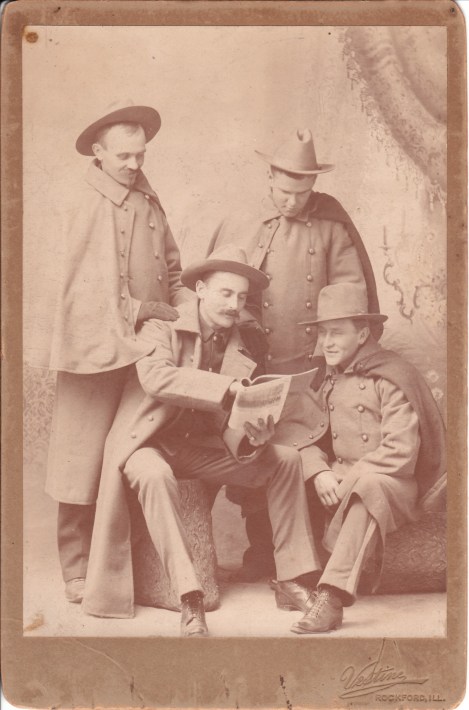 This Cabinet Card captures four Spanish American War era soldiers posing for their portrait in the studio of Vestine, located in Rockford, Illinois. The men are reading a magazine together and apparently find something amusing. Note the men’s military hats and overcoats. To view other photographs by Vestine, click on the category “Photographer: Vestine”.
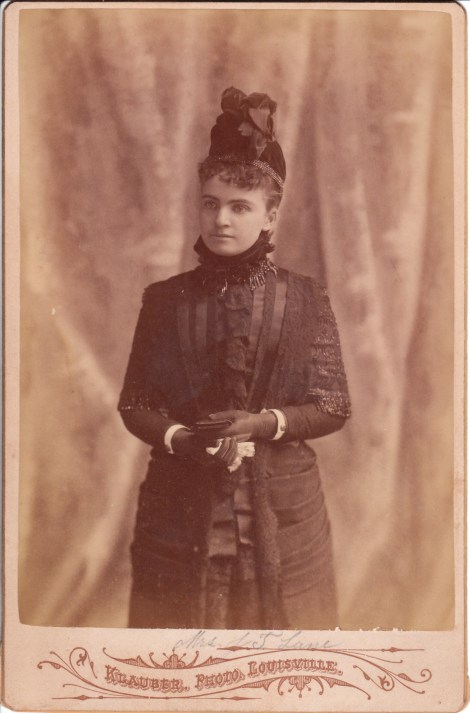 A beautiful woman poses for her portrait for a photographer in the studio of Klauber in Louisville, Kentucky. The woman’s name is J. T. Lane. She is wearing a black mourning dress with elaborate beading and ribbons. She is wearing an interesting black hat and black gloves. Ms Lane is holding a hankie and a book. The photograph comes from a collection of photographs which belonged to a Charleston, South Carolina family. The same collection featured a number of photographs of a woman named Effe May Blanchard who married prominent Charlestonian Julian Hazelhurst Walter. A portrait and description of the life of the attractive Ms Blanchard-Walter can be found by clicking on the tag found below this entry. The relationship between J. T. Lane and Ms Blanchard-Walter is unknown. The photographer of this portrait, Edward Klauber was considered by many to be one of the best photographers of his time. He was a native of Bohemia who came to the United States at age eighteen. His large and elegant studio was compared to the studio of Matthew Brady in New York City. The studio was lavishly furnished. Stage personalities like Mary Anderson enjoyed having portraits done by Klauber when they were in Louisville performing at the Macauley theatre. Klauber’s studio closed in 1913 and he died in 1918.


 THE CABINET CARD GALLERY