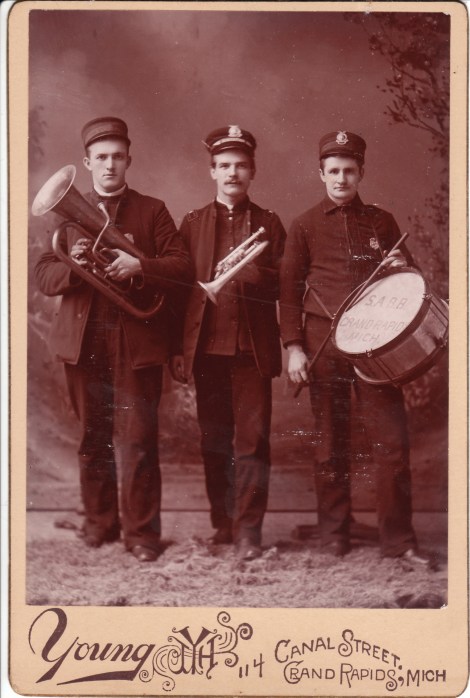
This Cabinet card is a photograph of three members of the Salvation Army Band. This is a terrific image of the band members, their instruments and their uniforms. The instruments are a baritone, trumpet and drum. The photographer was J. H. Young of Grand Rapids, Michigan. The Salvation Army is a Protestant Christian Church Denomination organized in a quasi-military manner. The group does charitable and social service work aiding the poor. The organization was founded in 1865 in London, England, as Christian Mission. In 1878 the group became the Salvation Army. The organization has expanded worldwide into 111 nations.

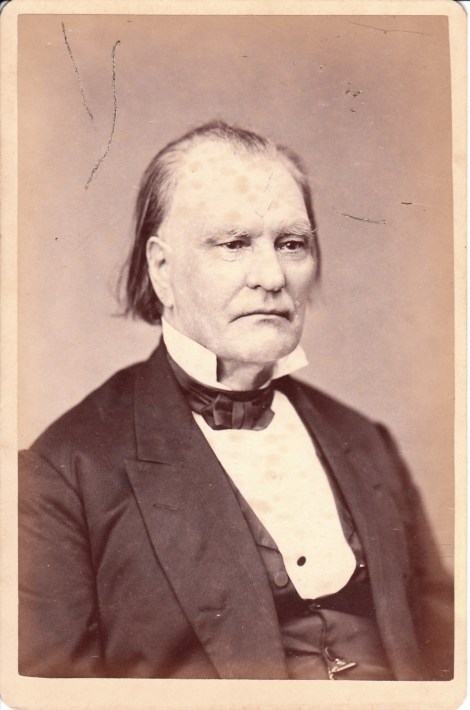 Benjamin Wade (1800-1878)) was born in Massachusetts. He worked as a laborer on the Erie Canal, taught school and then studied and practiced law in Ohio. As a member of the Whig Party he was elected to the Ohio State Senate and served two terms. He later became an Ohio court judge. Wade joined the Republican Party and in 1851 was elected to the US Senate. He became a Radical Republican along with Thaddeus Stevens and Charles Sumner. He fouhgt against the Fugitive Slave Act and the Kansas-Nebraska Act. He was very radical and supported women suffrage, trade union rights and equality for African Americans. In 1861 as chairman of the Committee on Territories he witnessed the defeat of the Union Army at the First Bull Run and was nearly captured by the confederates. During the American Civil War, Wade was extremely critical of Lincoln. After the war he pushed for African American units in the Regular Army. He was also instrumental in the impeachment of American President Andrew Johnson. Wade was considered by some as a good choice for Ulysses S Grant’s running mate but Grant refused. This cabinet card is from Matthew Brady’s National Portrait Gallery in Washington, D.C..
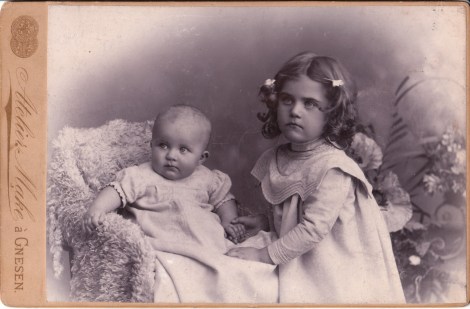 Two adorable kids (most likely siblings) pose in this Cabinet card photograph. The close-up of the baby is terrific and is an unusual pose for photographs of this era. Most babies I have seen in Cabinet cards are photographed from more of a distance. The photograper is Make of Gnesen. My research leaves me uncertain of whether Gnesen was part of Prussia or Germany at the time of this photograph. Please comment if you have information about what nation Gnesen was part of in the late 1800’s. Gnesen is currently part of Poland.


 THE CABINET CARD GALLERY