BLOOD BANK EVENT : PHOTO BY JIMMY BAYNES : CLEVELAND, OHIO : AFRICAN AMERICAN HISTORY

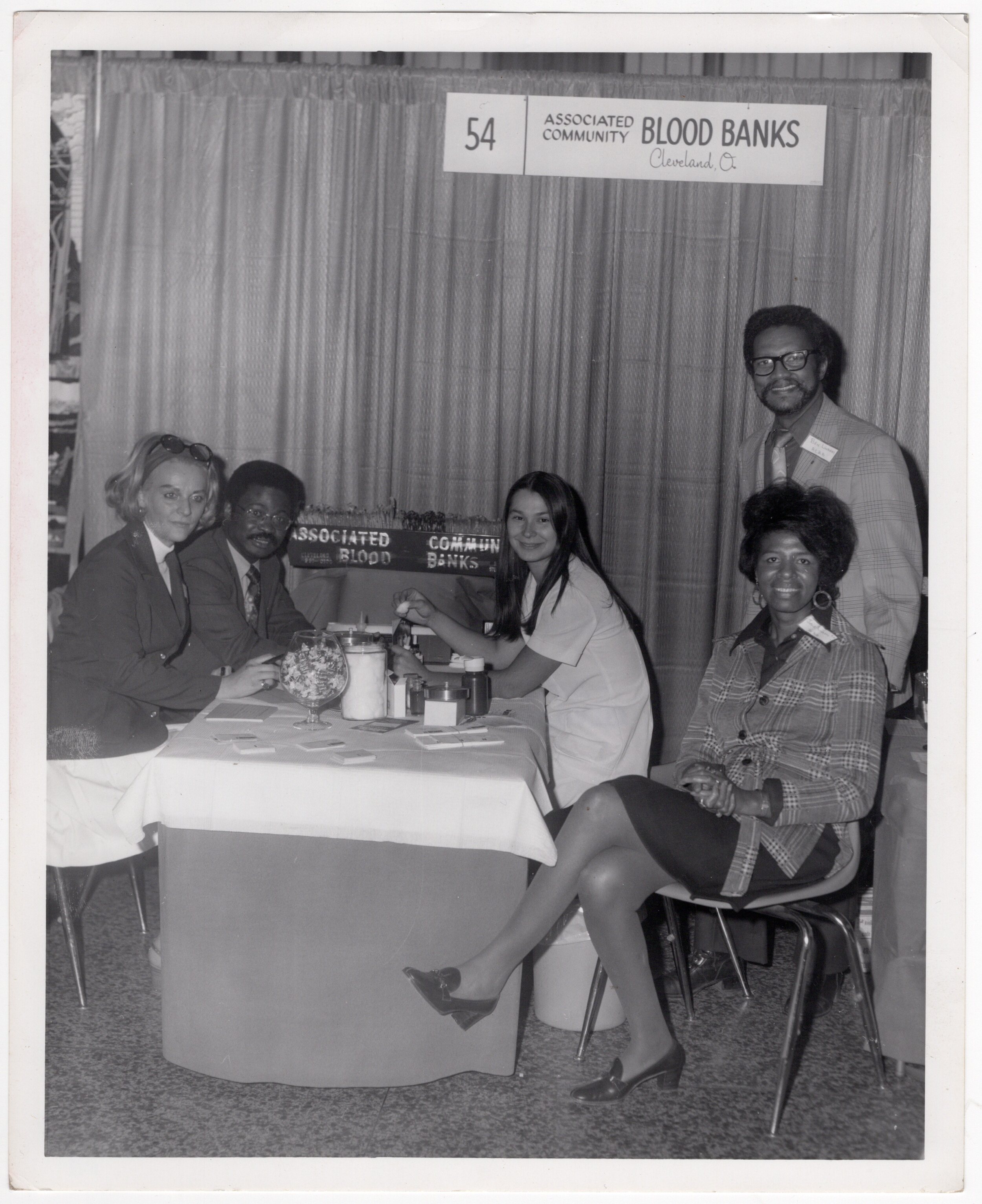
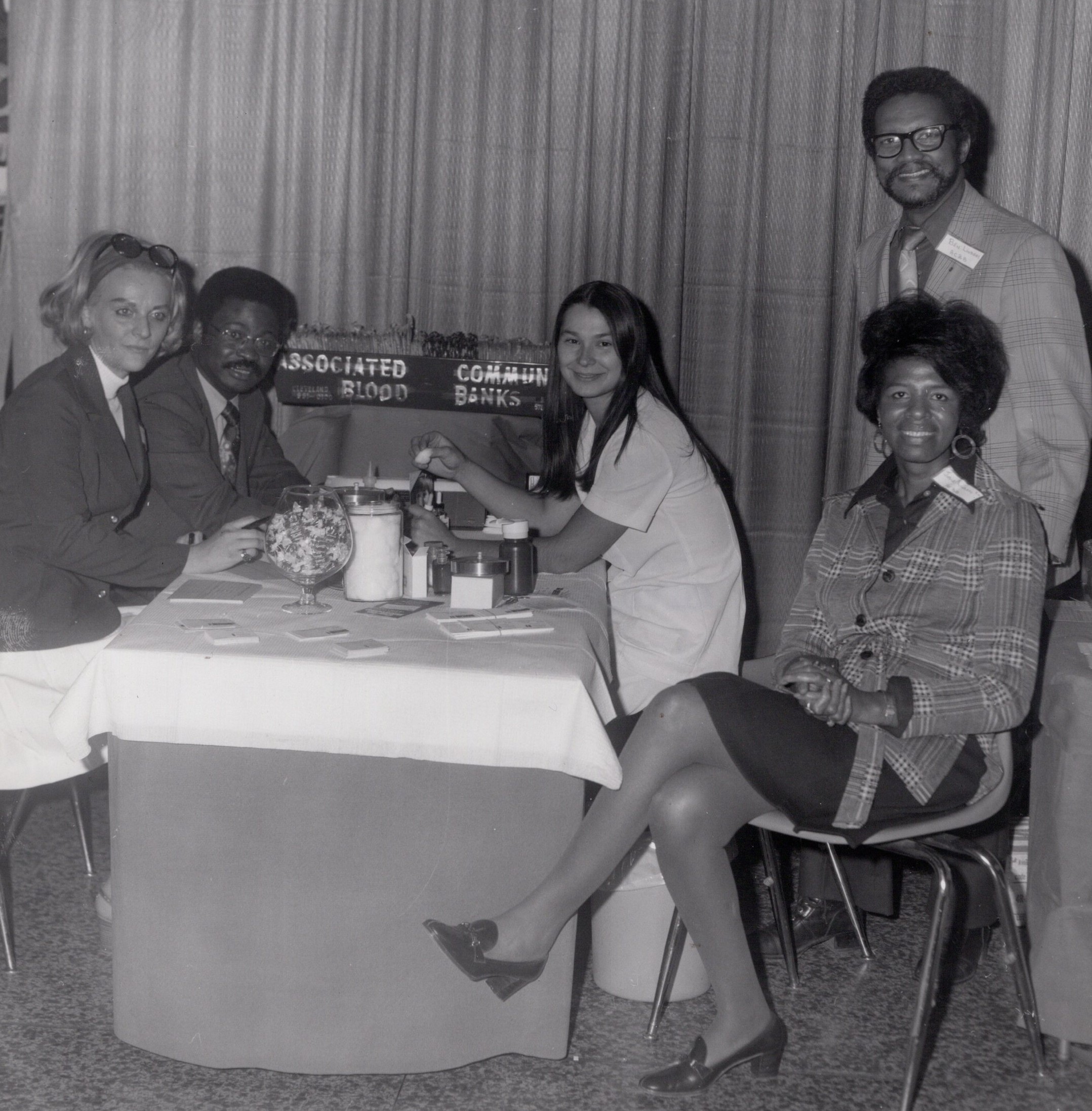
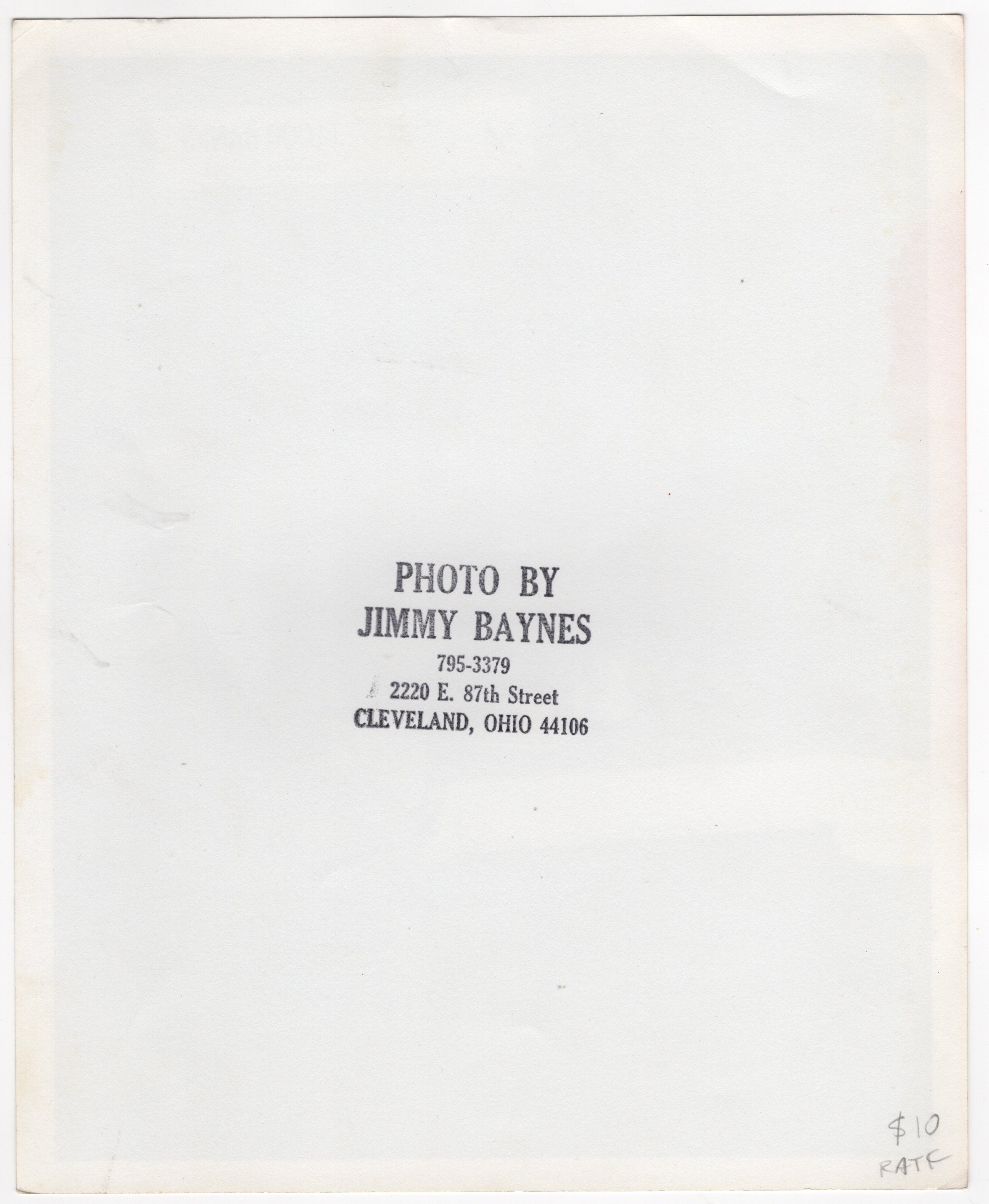
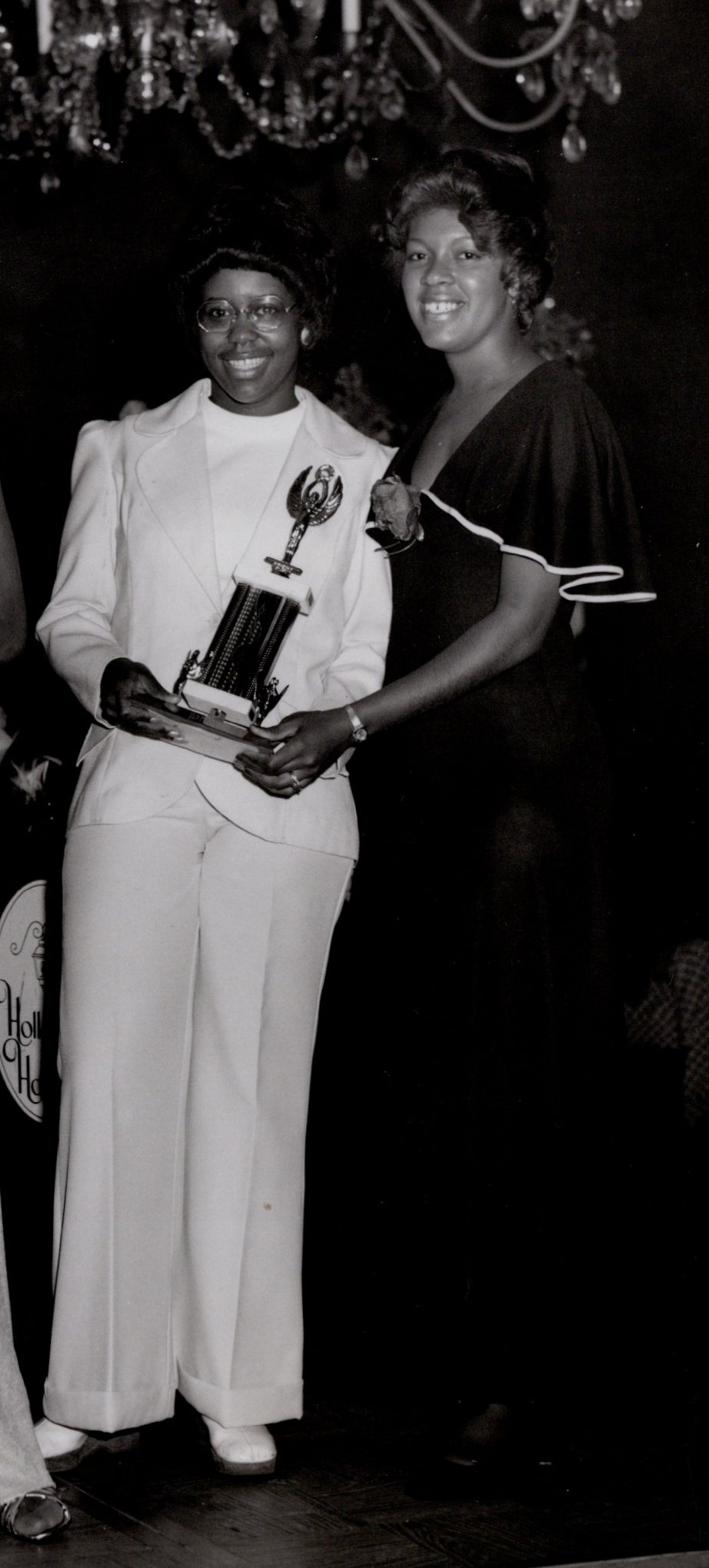
This original black-and-white press photograph was taken by noted Cleveland photographer Jimmy Baynes, whose stamp appears on the reverse. Baynes was a prolific photojournalist and chronicler of Cleveland’s African American community during the mid-20th century. His work documented civic events, political gatherings, cultural programs, and the everyday lives of African Americans in Cleveland. His images today stand as a vital record of local history and are increasingly valued by collectors of press photography and African American ephemera. The photograph depicts a group at the Associated Community Blood Banks booth (Cleveland, Ohio). The booth is labeled “54 Associated Community Blood Banks” on the backdrop. Five individuals are present. One of the individuals is a young woman wearing a white uniform and holding testing equipment. She is likely a  nurse or a blood bank technician. The scene captures both the professionalism and community service focus of Cleveland’s blood bank efforts in the late 1960s or 1970s, with an emphasis on outreach, participation, and health education. The candid but posed composition reflects Baynes’s signature style of highlighting people within civic and cultural spaces. The photographer of this photograph, Jimmy Baynes was  known for his ability to capture the essence of African American life, culture, and entertainment from the 1950s through the 1980s. Originally a postal worker, Baynes pursued photography as a passion, ultimately founding Baynes Foto Service. His work chronicled the vibrancy of mid-century African American social life, from intimate gatherings and beauty contests to the pulsating energy of live music performances and political events. Baynes photographed some of the most iconic figures in entertainment history, including Aretha Franklin, Louis Armstrong, Count Basie, Mahalia Jackson, Louis Jordan, Jerry Lee Lewis, the Platters, and the Drifters. His ability to capture both candid and staged moments gave his work a lasting impact, preserving the rich history of Cleveland’s African American community. His legacy is recognized today by institutions such as the Rock and Roll Hall of Fame and Museum Library and Archives in Cleveland, which houses a collection of his photographs, primarily focusing on music and entertainment. In 2010, shortly before his passing, his work was featured in the “Polaroid: Instant Joy” exhibition in Brooklyn, New York, reaffirming his role as a visual storyteller of African American life in the mid-20th century.  (SOLD)

PRETTY YOUNG AFRICAN AMERICAN WOMAN : STANDING BY FRONT PORCH : FLOWERS : RPPC

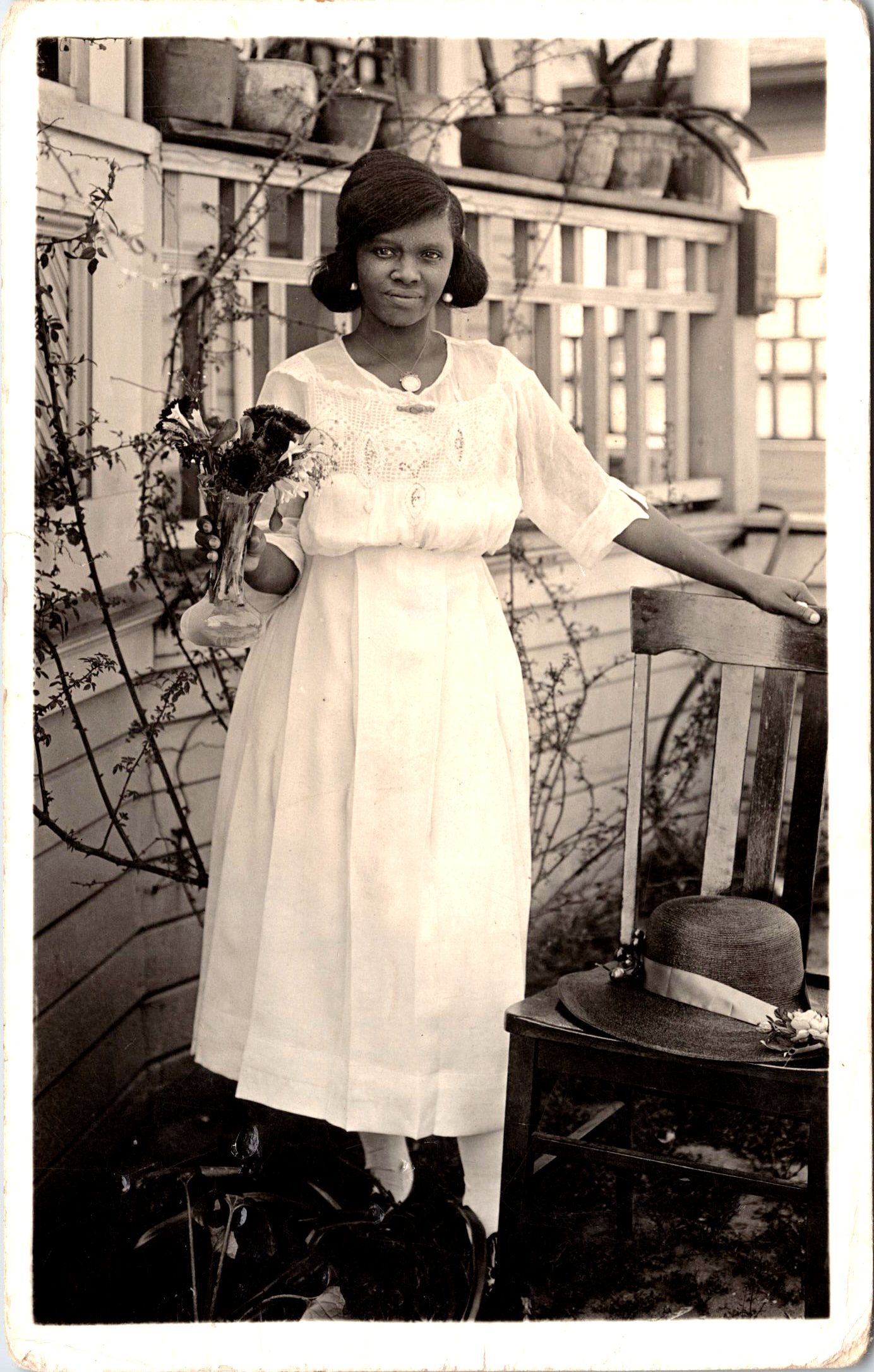
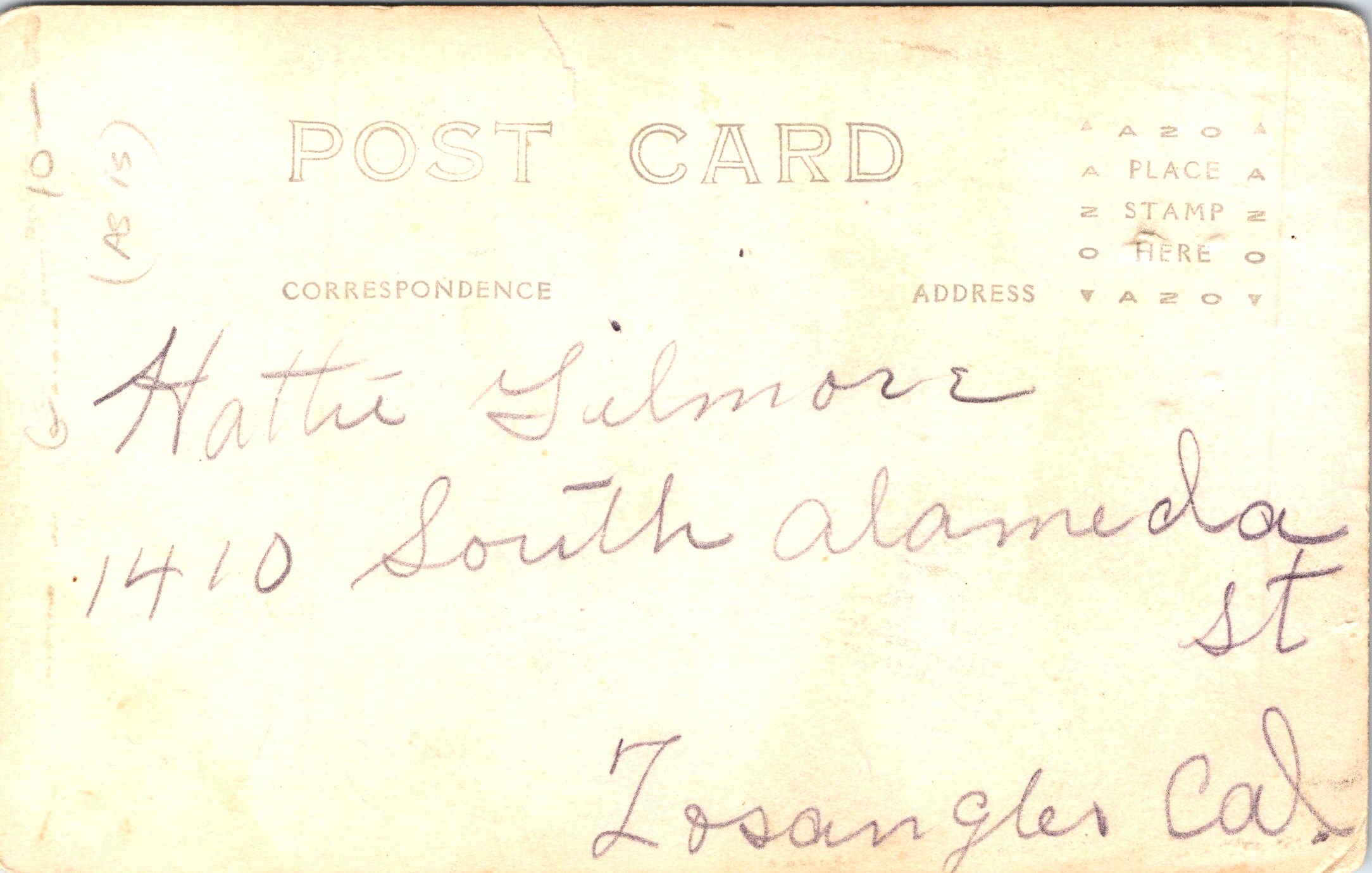
This is a vintage real photo postcard (RPPC) portrait of a young African American woman standing in front of a porch in front of a house. She holds a vase of flowers in one hand, and with the other she lightly rests on a wooden chair beside her, on which her hat lies. Along the porch railing (behind her) are potted plants that add a charming domestic detail to the setting. She’s dressed in a light-colored, modest dress with three-quarter sleeves. Around her neck is a pendant necklace suspended from a fine chain. The pendant appears to be a small oval or medallion (hard to see the exact motif, but visible in closeups). Her hair is styled simply (likely bobbed or softly waved), and her expression is calm, with a slight, poised gaze toward the camera. The photo was taken outdoors (natural light) in front of a porch, likely in a residential neighborhood. The background includes lattice or railings, and potted plants suggest someone cared for the space. The chair beside her provides a prop that complements the composition. On the reverse, the card bears an AZO stamp box, with two triangles at the top pointing upward and two triangles at the bottom pointing downward. That is a known style used in ASO / AZO postcard backs, and those two-up/two-down triangles typically date a postcard to the ~1918 to 1930 period. Also, the reverse has the handwritten name and address. The name is Hattie Gilmore and the address is in Los Angeles. Presumably, the woman in the photo is Hattie.  (SOLD)

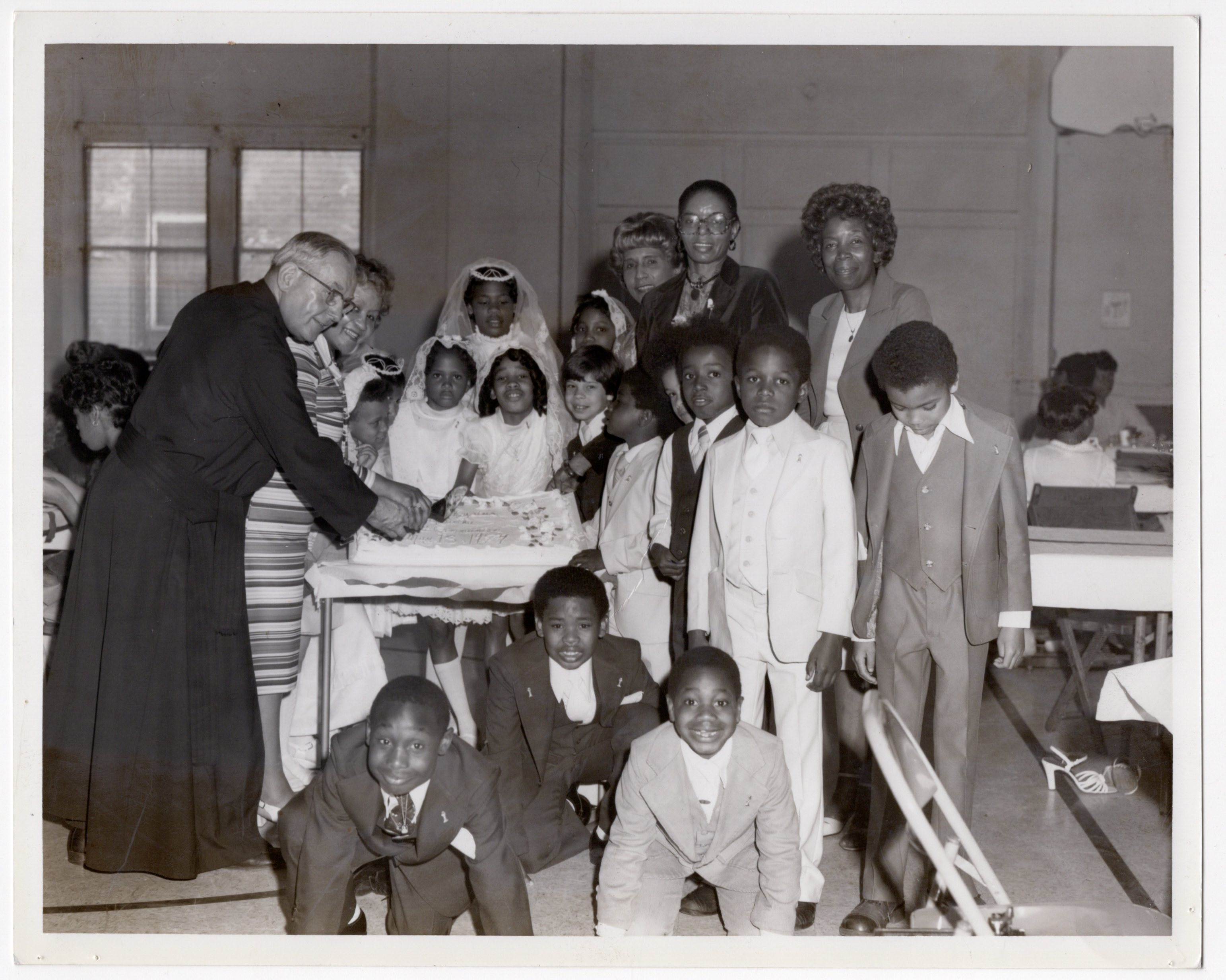
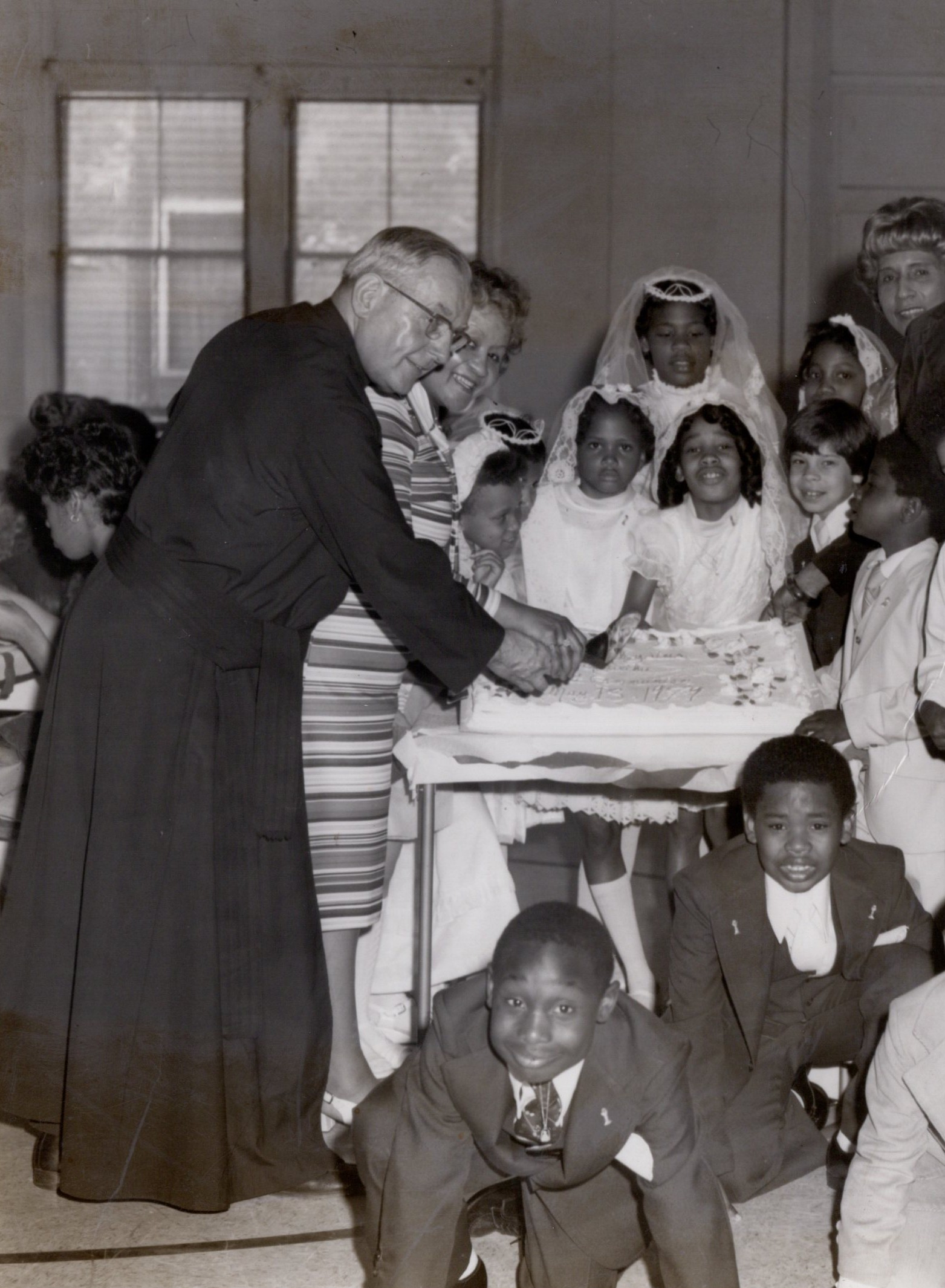
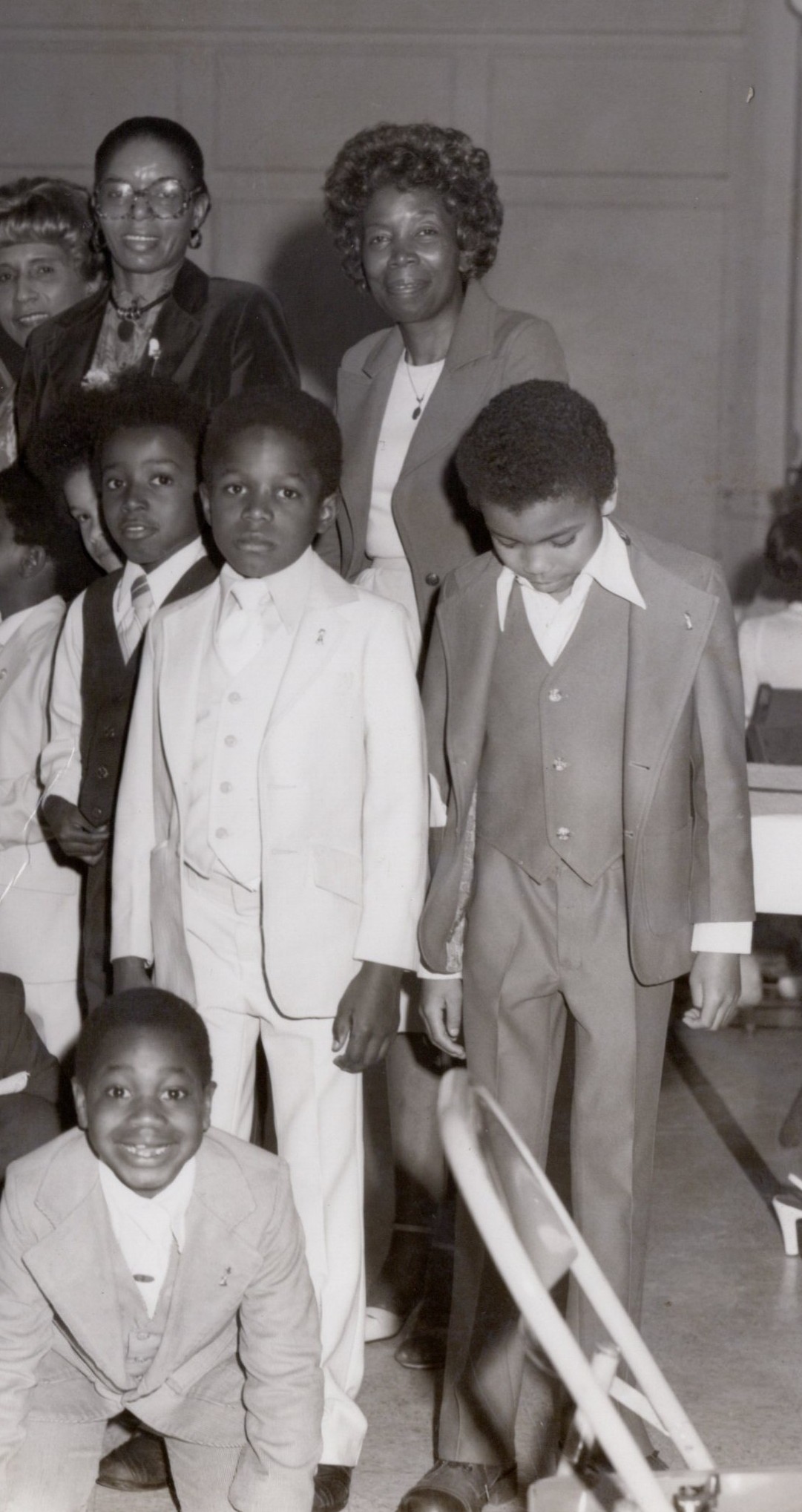
PRIEST & KIDS : 1st COMMUNION : PHOTO BY JIMMY BAYNES : CLEVELAND, OHIO c 1956

This original vintage press photograph (measuring approximately 8 by 10 inches) beautifully captures a celebratory moment in a church or parish hall, taken by noted African-American Cleveland photographer Jimmy Baynes. The scene shows a priest, dressed in his clerical robes, cutting a large frosted cake surrounded by children and adults. The children are dressed formally, with several girls wearing white communion dresses and veils, suggesting this may be a First Communion or confirmation celebration. The boys wear smart suits in both light and dark colors, complete with ties or bow ties. Their attire reflects both the solemnity of the religious occasion and the joy of the gathering. Some children smile brightly toward the camera, while others look on with curiosity and seriousness, lending authenticity and personality to the scene. Behind the children stand several women, elegantly dressed, who appear to be family members or parishioners sharing in the celebration. The priest’s presence at the cake table underscores the ceremonial importance of the event, blending sacred tradition with communal joy. The composition is lively and warm, with details like the children crouched at the front grinning toward the photographer, the ornate veils of the girls, and the cutting of the cake all contributing to a vivid record of mid-20th century African-American community life. The photographer of this photograph, Jimmy Baynes was  known for his ability to capture the essence of African American life, culture, and entertainment from the 1950s through the 1980s. Originally a postal worker, Baynes pursued photography as a passion, ultimately founding Baynes Foto Service. His work chronicled the vibrancy of mid-century African American social life, from intimate gatherings and beauty contests to the pulsating energy of live music performances and political events. Baynes photographed some of the most iconic figures in entertainment history, including Aretha Franklin, Louis Armstrong, Count Basie, Mahalia Jackson, Louis Jordan, Jerry Lee Lewis, the Platters, and the Drifters. His ability to capture both candid and staged moments gave his work a lasting impact, preserving the rich history of Cleveland’s African American community. His legacy is recognized today by institutions such as the Rock and Roll Hall of Fame and Museum Library and Archives in Cleveland, which houses a collection of his photographs, primarily focusing on music and entertainment. In 2010, shortly before his passing, his work was featured in the “Polaroid: Instant Joy” exhibition in Brooklyn, New York, reaffirming his role as a visual storyteller of African American life in the mid-20th century. This photograph was taken in the 1950’s. This is a powerful image not only for its documentary value but also for its warmth and charm, preserving a moment of community, faith, and celebration. (SOLD)

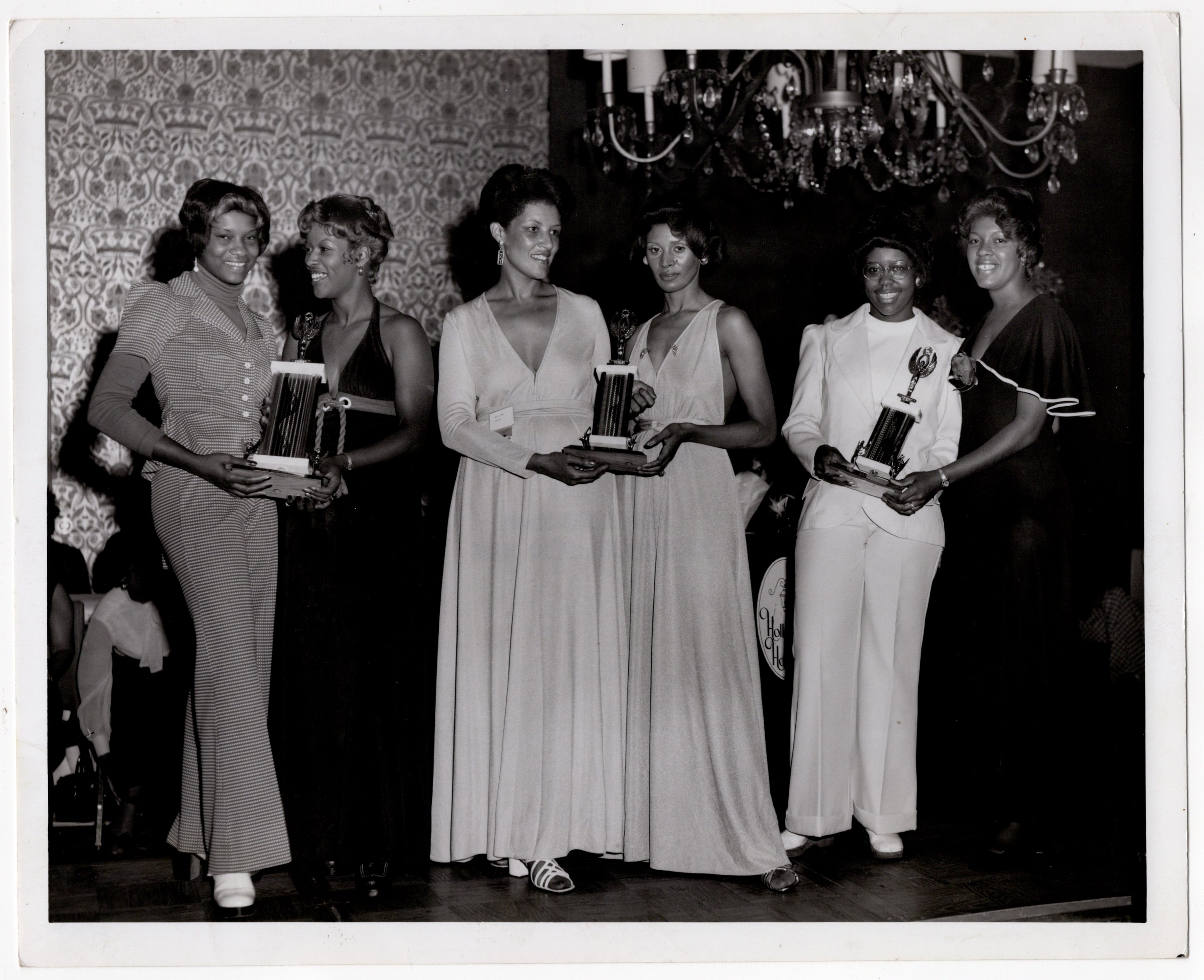
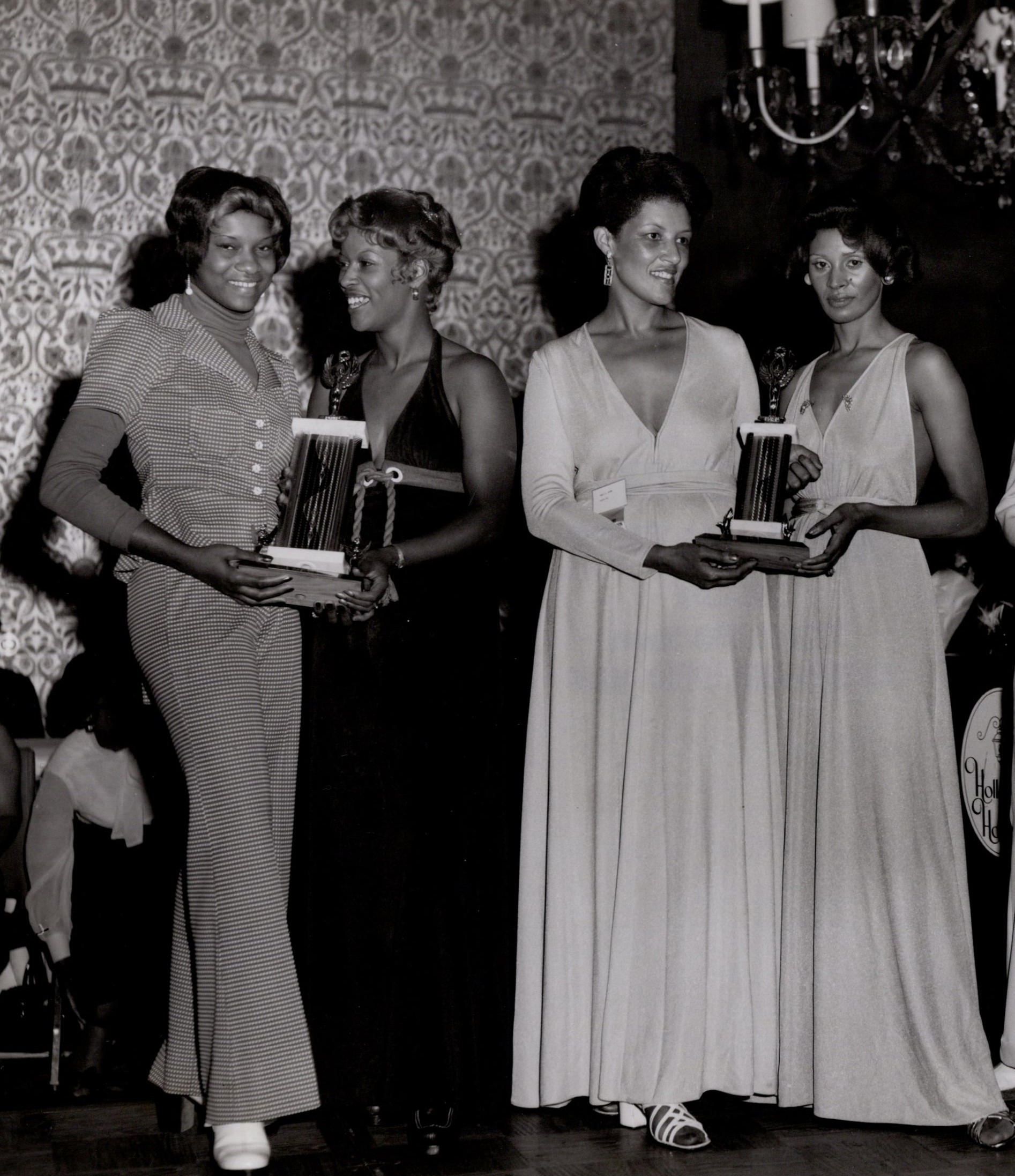
STYLISH AFRICAN AMERICAN WOMEN : PHOTO BY JIMMY BAYNES : CLEVELAND, OHIO c1956

This dynamic vintage press photograph captures a joyous and stylish moment at what appears to be a mid-century African-American social event or pageant, photographed by Jimmy H. Baynes, a notable African-American photographer who was active in Cleveland, Ohio. The image dates likely to the late 1950s or early 1960s, an era when such gatherings were vital community affairs celebrating Black excellence, fashion, and music. The central focus is a beautifully posed group of six African-American women, all elegantly dressed in cocktail or evening wear. The women wear a range of fashionable 1950s attire, from a sharp houndstooth pantsuit and flowing evening gowns to a crisp white suit. Their hairstyles are elegant and era-appropriate, and their expressions range from joy to pride to graceful composure. The setting appears to be a formal banquet hall or community venue, likely in Cleveland. Each woman holds a trophy, suggesting the conclusion of a pageant, award ceremony, or fashion competition. The photograph is the work of Jimmy H. Baynes, a prominent African-American photographer who chronicled the Black social and cultural scene in Cleveland throughout the mid-20th century. His work often captured the heart of the community—beauty pageants, civic events, family milestones, and musical gatherings—preserving an important visual history that is increasingly recognized and appreciated by collectors and scholars.  The photographer of this photograph, Jimmy Baynes was  known for his ability to capture the essence of African American life, culture, and entertainment from the 1950s through the 1980s. Originally a postal worker, Baynes pursued photography as a passion, ultimately founding Baynes Foto Service. His work chronicled the vibrancy of mid-century African American social life, from intimate gatherings and beauty contests to the pulsating energy of live music performances and political events. Baynes photographed some of the most iconic figures in entertainment history, including Aretha Franklin, Louis Armstrong, Count Basie, Mahalia Jackson, Louis Jordan, Jerry Lee Lewis, the Platters, and the Drifters. His ability to capture both candid and staged moments gave his work a lasting impact, preserving the rich history of Cleveland’s African American community. His legacy is recognized today by institutions such as the Rock and Roll Hall of Fame and Museum Library and Archives in Cleveland, which houses a collection of his photographs, primarily focusing on music and entertainment. In 2010, shortly before his passing, his work was featured in the “Polaroid: Instant Joy” exhibition in Brooklyn, New York, reaffirming his role as a visual storyteller of African American life in the mid-20th century. This photograph was taken in the 1950’s.  (SOLD)

STYLISH AFRICAN AMERICAN WOMEN : PHOTO BY JIMMY BAYNES : CLEVELAND, OHIO c 1956

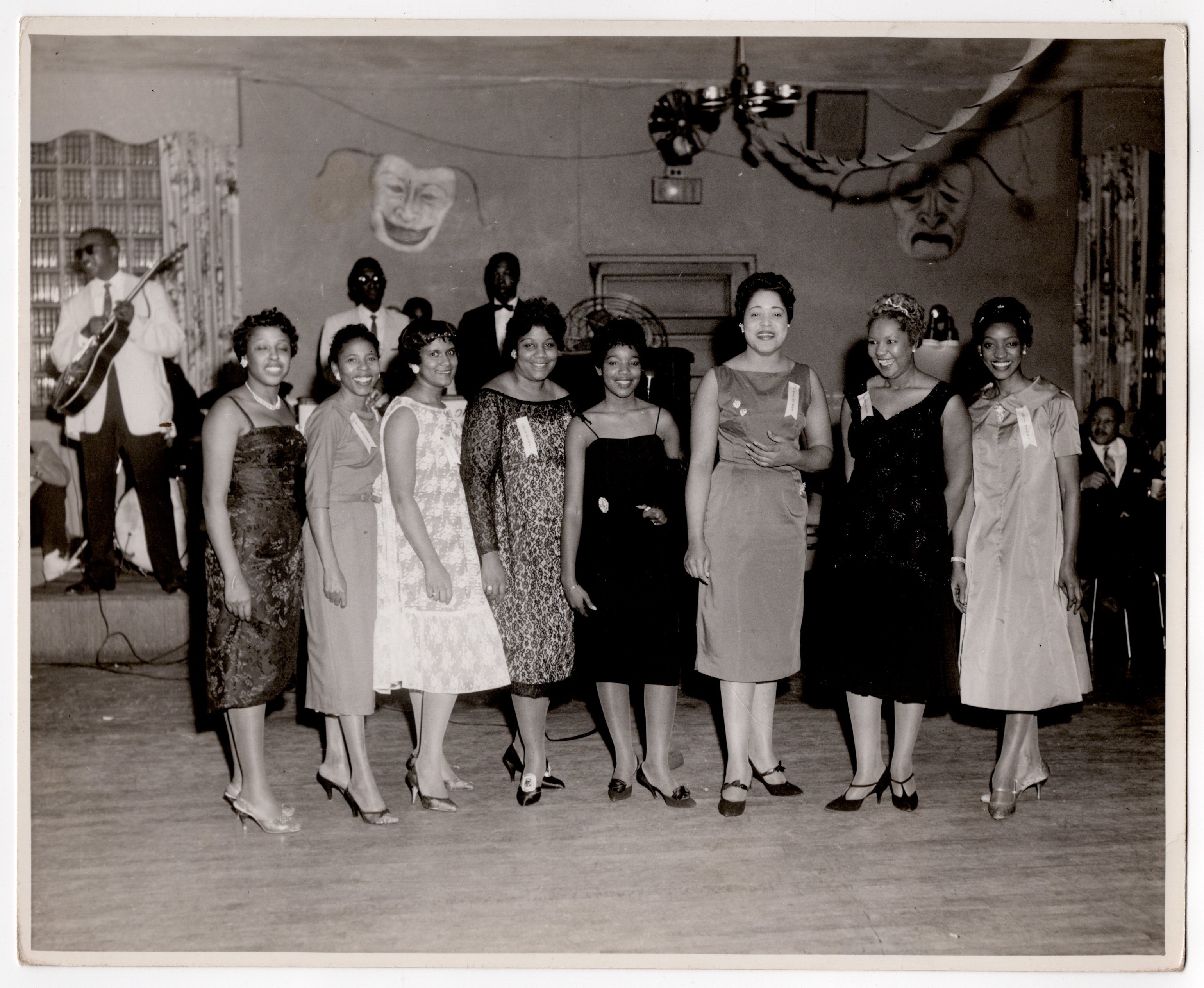
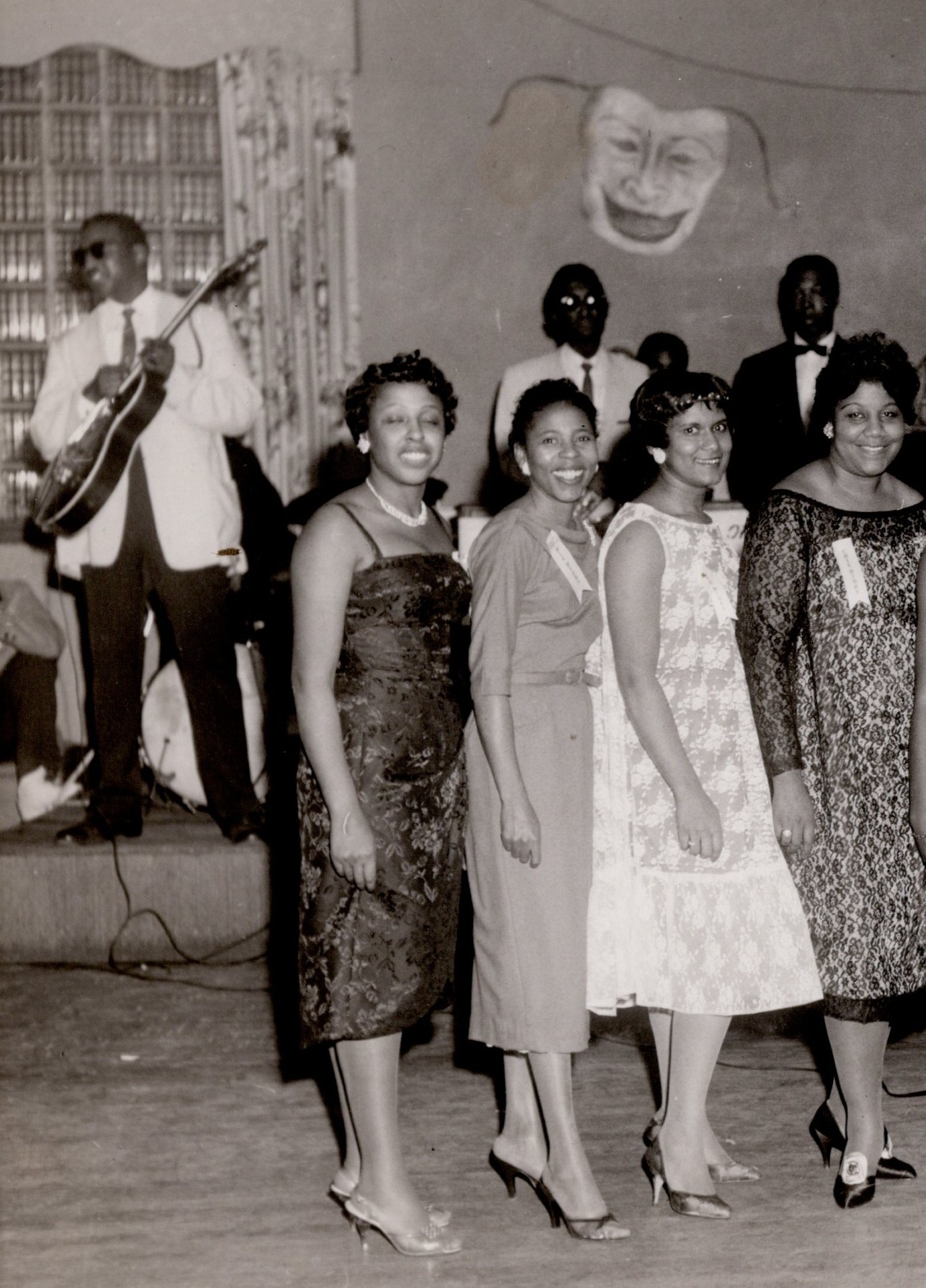
This dynamic vintage press photograph captures a joyous and stylish moment at what appears to be a mid-century African-American social event or pageant, photographed by Jimmy H. Baynes, a notable African-American photographer who was active in Cleveland, Ohio. The image dates likely to the late 1950s or early 1960s, an era when such gatherings were vital community affairs celebrating Black excellence, fashion, and music. The central focus is a beautifully posed group of eight African-American women, all elegantly dressed in cocktail or evening wear. Each woman wears a dress that reflects the fashion of the era—from sleek satin to lace, florals, and polished tailoring. Their heels, jewelry, and stylish hairdos speak to pride and sophistication. Several wear ribbons or corsages, suggesting this might be a pageant, cotillion, or civic recognition event. The women’s expressions range from warm smiles to dignified calm, exuding confidence and unity. In the background, we see a small jazz ensemble, including a guitarist in a white jacket and a saxophonist, adding to the lively, celebratory atmosphere. The wall décor includes two large theatrical masks (tragedy and comedy), enhancing the impression that this event took place at a community center, fraternal hall, or social club with cultural significance. The photograph is the work of Jimmy H. Baynes, a prominent African-American photographer who chronicled the Black social and cultural scene in Cleveland throughout the mid-20th century. His work often captured the heart of the community—beauty pageants, civic events, family milestones, and musical gatherings—preserving an important visual history that is increasingly recognized and appreciated by collectors and scholars. This original black-and-white photograph measures approximately 8 x 10 inches and is in very good condition with only minimal corner wear. The contrast is strong, the image is sharp, and all details are well preserved (see scans). The photographer of this photograph, Jimmy Baynes was  known for his ability to capture the essence of African American life, culture, and entertainment from the 1950s through the 1980s. Originally a postal worker, Baynes pursued photography as a passion, ultimately founding Baynes Foto Service. His work chronicled the vibrancy of mid-century African American social life, from intimate gatherings and beauty contests to the pulsating energy of live music performances and political events. Baynes photographed some of the most iconic figures in entertainment history, including Aretha Franklin, Louis Armstrong, Count Basie, Mahalia Jackson, Louis Jordan, Jerry Lee Lewis, the Platters, and the Drifters. His ability to capture both candid and staged moments gave his work a lasting impact, preserving the rich history of Cleveland’s African American community. His legacy is recognized today by institutions such as the Rock and Roll Hall of Fame and Museum Library and Archives in Cleveland, which houses a collection of his photographs, primarily focusing on music and entertainment. In 2010, shortly before his passing, his work was featured in the “Polaroid: Instant Joy” exhibition in Brooklyn, New York, reaffirming his role as a visual storyteller of African American life in the mid-20th century. This photograph was taken in the 1950’s.  SOLD

ELEGANT AFRICAN AMERICAN MEN : PHOTO BY JIMMY BAYNES : CLEVELAND, OHIO 1950’s

This striking black-and-white photograph, taken by Cleveland photographer Jimmy Baynes (1922–2010), captures a moment of unity, elegance, and pride. The image showcases a distinguished group of African American men, impeccably dressed in matching metallic-toned tuxedo jackets, crisp white dress shirts, and black bow ties. Their tailored jackets gleam under the light, emphasizing their polished, formal appearance. Completing their attire, neatly pressed black trousers and polished dress shoes reflect a commitment to both style and sophistication. Standing in a carefully arranged formation, the men present a sense of camaraderie and professionalism. Their expressions range from confident smiles to serious, poised looks—perhaps reflecting the anticipation of a performance or an important social event. Each man exudes dignity, their upright postures and synchronized attire reinforcing a sense of unity. The background is simple and unembellished, allowing the focus to remain on the subjects themselves, their expressions, and the sharp contrast of their gleaming jackets against the darkened floor. The photographer of this photograph, Jimmy Baynes was  known for his ability to capture the essence of African American life, culture, and entertainment from the 1950s through the 1980s. Originally a postal worker, Baynes pursued photography as a passion, ultimately founding Baynes Foto Service. His work chronicled the vibrancy of mid-century African American social life, from intimate gatherings and beauty contests to the pulsating energy of live music performances and political events. Baynes photographed some of the most iconic figures in entertainment history, including Aretha Franklin, Louis Armstrong, Count Basie, Mahalia Jackson, Louis Jordan, Jerry Lee Lewis, the Platters, and the Drifters. His ability to capture both candid and staged moments gave his work a lasting impact, preserving the rich history of Cleveland’s African American community. His legacy is recognized today by institutions such as the Rock and Roll Hall of Fame and Museum Library and Archives in Cleveland, which houses a collection of his photographs, primarily focusing on music and entertainment. In 2010, shortly before his passing, his work was featured in the “Polaroid: Instant Joy” exhibition in Brooklyn, New York, reaffirming his role as a visual storyteller of African American life in the mid-20th century. This photograph was taken in the 1950’s. (SOLD)

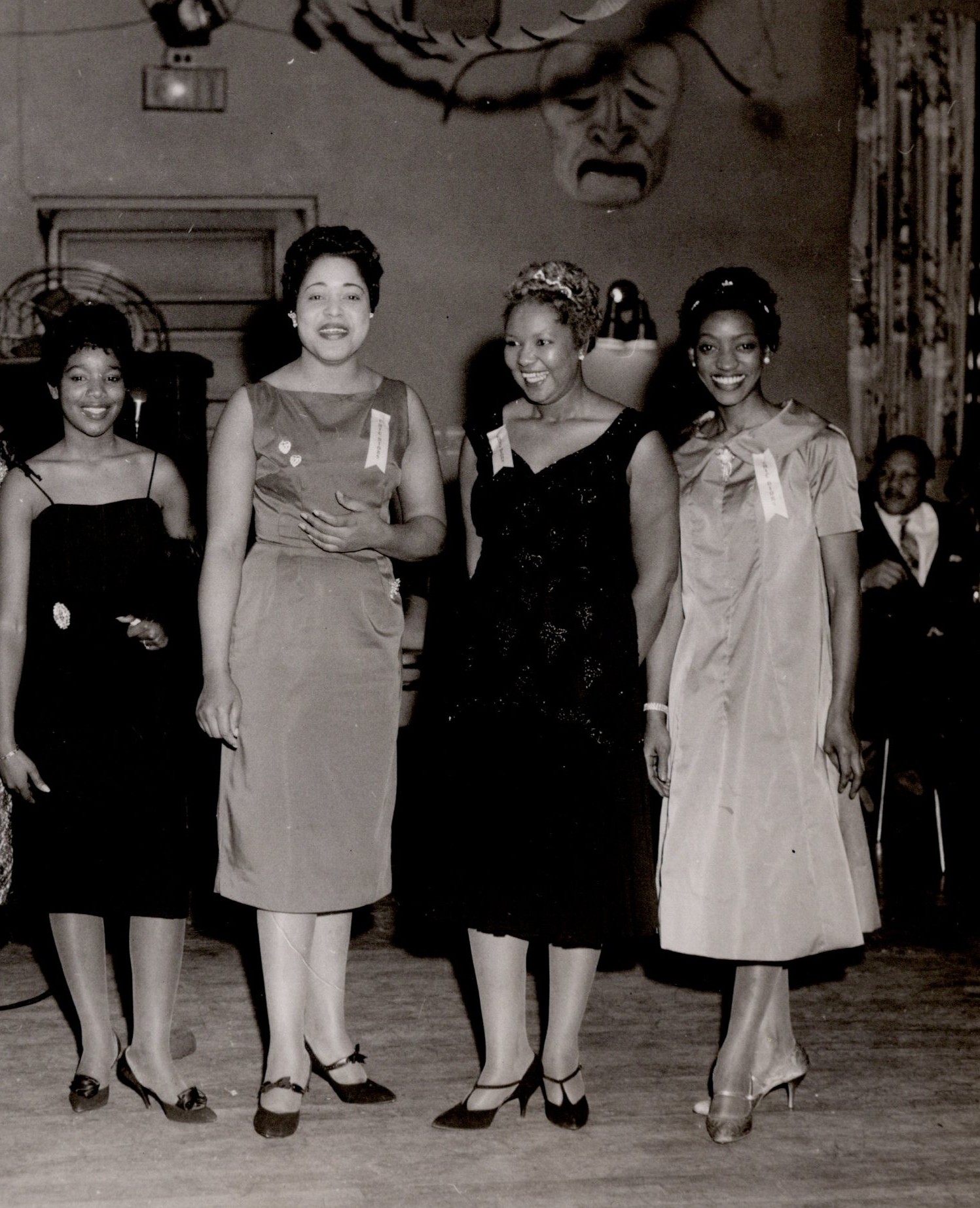
STYLISH AFRICAN AMERICAN WOMEN : PHOTO BY JIMMY BAYNES : CLEVELAND, OHIO 1956

A group of elegantly dressed African American women gathers for a formal event, their smiles warm and inviting. The air is filled with laughter and the quiet hum of conversation, the kind shared among close friends and social circles. Captured through the lens of Jimmy Baynes (1922-2010), this striking black-and-white photograph offers a window into a bygone era of grace and refinement. The photograph was taken in 1956. Each woman stands poised in a display of sophistication, dressed in the finest evening attire of the time. Flowing cocktail dresses and full-skirted gowns drape effortlessly, adorned with delicate lace, satin finishes, and off-the-shoulder silhouettes. Wrist corsages add a touch of tradition, suggesting the occasion could be a gala, a debutante ball, or an exclusive sorority event. Their accessories—clutch purses, pearl necklaces, and elegantly styled hair—complete their timeless looks, reflecting the pride and elegance of their community. The setting, a well-appointed room with patterned wallpaper and a shelf filled with trinkets, provides an intimate backdrop for this moment of celebration. The women lean into each other slightly, exuding warmth, camaraderie, and joy. This is more than just a photograph; it is a glimpse into a world where fashion, culture, and history intertwine. Baynes, a Cleveland-based photographer known for documenting African American life, produced this image which holds both artistic and historical significance. He is renowned for capturing the vibrancy of African American life from the 1950s through the 1980s. Initially working as a postal worker, Baynes pursued photography as a passionate side venture, eventually establishing Baynes Foto Service. ​Over more than three decades, Baynes documented a wide array of events, including weddings, beauty contests, burlesque shows, and live music performances. His portfolio features candid and authentic glimpses into Cleveland’s African American community, encompassing local politicians, nightclub entertainers, and everyday social gatherings. Notably, he photographed prominent figures such as Aretha Franklin, Louis Armstrong, Count Basie, Mahalia Jackson, Louis Jordan, Jerry Lee Lewis, the Platters, and the Drifters. ​Baynes’ work has been recognized and preserved by institutions like the Rock and Roll Hall of Fame and Museum Library and Archives in Cleveland, where a collection of his photographs is housed, primarily focusing on music and entertainment. His images offer a rich narrative of mid-20th-century African American public life in the Midwest, reflecting both the cultural significance and everyday experiences of the community.​ In the summer of 2010, just months before his passing, Baynes’ photographs were featured in a group exhibition titled “Polaroid: Instant Joy” at a gallery in Brooklyn, New York, highlighting the enduring impact of his visual storytelling. (SOLD)

BLACK FEMALE DANCER IN COSTUME : STUDIO PORTRAIT : VINTAGE RPPC

This vintage real photo postcard features a Black Woman in her dance costume. She is an unusual costume and she is lifting her skirt in a risque manner. The woman has a pretty smile.  SOLD

TWO AFRICAN AMERICAN MEN STANDING ON A BRICK WALL : WELL DRESSED: RPPC 1904-1918

This vintage real photo postcard features a portrait of two young African American men posed standing on a brick wall. The dapper men are well dressed, wearing a suit and tie. Note the men’s hats. It is presumed that these men are African American because this postcard was found in the US. However, it is possible that the men are actually from somewhere other than America. It would certainly be interesting to know why these men seem to be in the middle of nowhere standing on a wall. There are bricks behind them which may indicates that the men are at a construction site or perhaps, at the location of a destroyed building. The AZO stamp box on this card indicates that the postcard dates back to between 1918 and 1930. (SOLD)

Published in: on April 5, 2024 at 12:00 pm  Leave a Comment  
Tags: , ,

DOROTHY DANDRIDGE : AFRICAN AMERICAN ACTRESS & SINGER & ACTIVIST : TAMANGO : RPPC

This vintage real photo postcard features African American actress and singer, Dorothy Dandridge (1922-1965). She was born in Cleveland, Ohio. Her mother was an entertainer and her father was a cabinet maker and Baptist minister. Before Dorothy was born, her parents separated. Ruby’s mom built a song and dance act for Dorothy and her sister. Her mom’s lover managed the act and it is written that the children were given abusive discipline. They toured continuously for five years and they barely attended school. When the depression hit, Ruby moved her girls to Hollywood, California. Before long, the sisters teamed up with school mate Etta Jones to do a dance act called “The Dandridge Sisters”. The act did well for several years and played in venues such as the Cotton Club and the Apollo Theater. Dorothy’s first screen appearance occurred when she was 13 in an episode of “Our Gang”. This was followed by a number of other screen roles including an appearance in “A Day at the Races” (1937) with the Marx Brothers. Her firs credited film role was in 1940. Her film roles were limited because she rejected many stereotypical black roles. In the 1940’s she appeared in both film and on the stage. She also performed as a singer in films with Count Basie and Louis Armstrong. Her first starring role was in “Bright Road” (1952) where she played opposite Harry Belafonte. In 1954, she starred in “Carmen Jones”. She received great reviews and the movie made her one of Hollywood’s first African American sex symbols and she was featured on a number of national magazine covers. In addition, she was nominated for an Academy Award for Best Actress. In 1957, she appeared in the film “Island in the Sun” in which she was involved in an interracial love affair with a white man. The script had to be revised a number of times because of the Motion Picture Production Code. The movie was controversial but received positive reviews and was successful. The IMDb credits Dandridge with 39 films between 1935 and 1962. She was politically active and was involved with the National Urban League and the NAACP. Dandridge was married and divorced twice and had a four year affair with director, Otto Preminger. Toward the end of her career, she discovered that her financial advisors had stolen much of her money and she owed over 100,00 dollars in back taxes. Her finances were in shambles and she had to move into a small apartment. In 1965, she had a phone conversation with a friend in which she made cryptic remarks intimating that her time left on earth might be short lived. The next day she was found dead in her apartment. There were two investigation into the cause of her death. One concluded she died of an accidental overdose of an anti-depressant. The other investigation determined she died of an embolism. This postcard features Dorothy Dandridge in the film “Tamango” (1959). The film tells the story of a rebellion on a Dutch slave ship. The actor standing behind Dandridge is Alex Cressan, who played the leader of the rebellion. Cressan only appeared in this one film. When he was cast in the film, he was a medical student in Martinique. Cressan received good reviews for his acting in this film. How he lived his life after this film is unknown. This real photo postcard was published by Progress Starfoto. (SOLD)