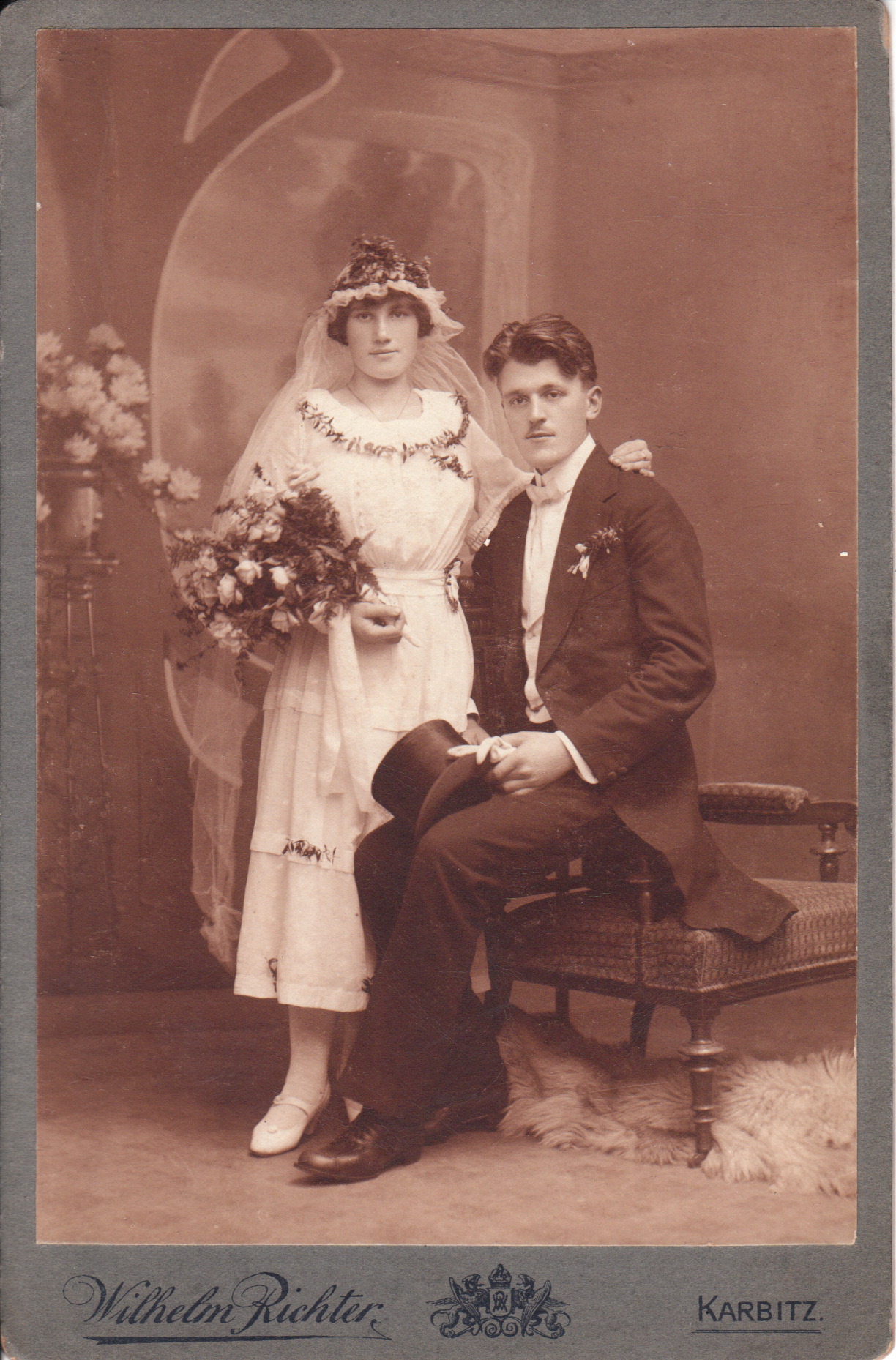
 If “cool” was a slang word used in the early 1900’s, than this is one very “cool” couple. Both subjects are very expressive as they pose for their wedding portrait at Wilhelm Richter’s studio in Karbitz, Czechoslovakia. The bride is holding a large bouquet of flowers and the the groom is wearing a flower on his lapel. A written notation on the reverse of the photograph indicates that the image was produced in 1920.
ATTRACTIVE AND EXPRESSIVE CZECH WEDDING COUPLE IN KARBITZ, CZECHOSLOVAKIA (1920)

ATTRACTIVE FAMILY IN PRAGUE, CZECHOSLOVAKIA (PORTRAIT BY LANGHANS)
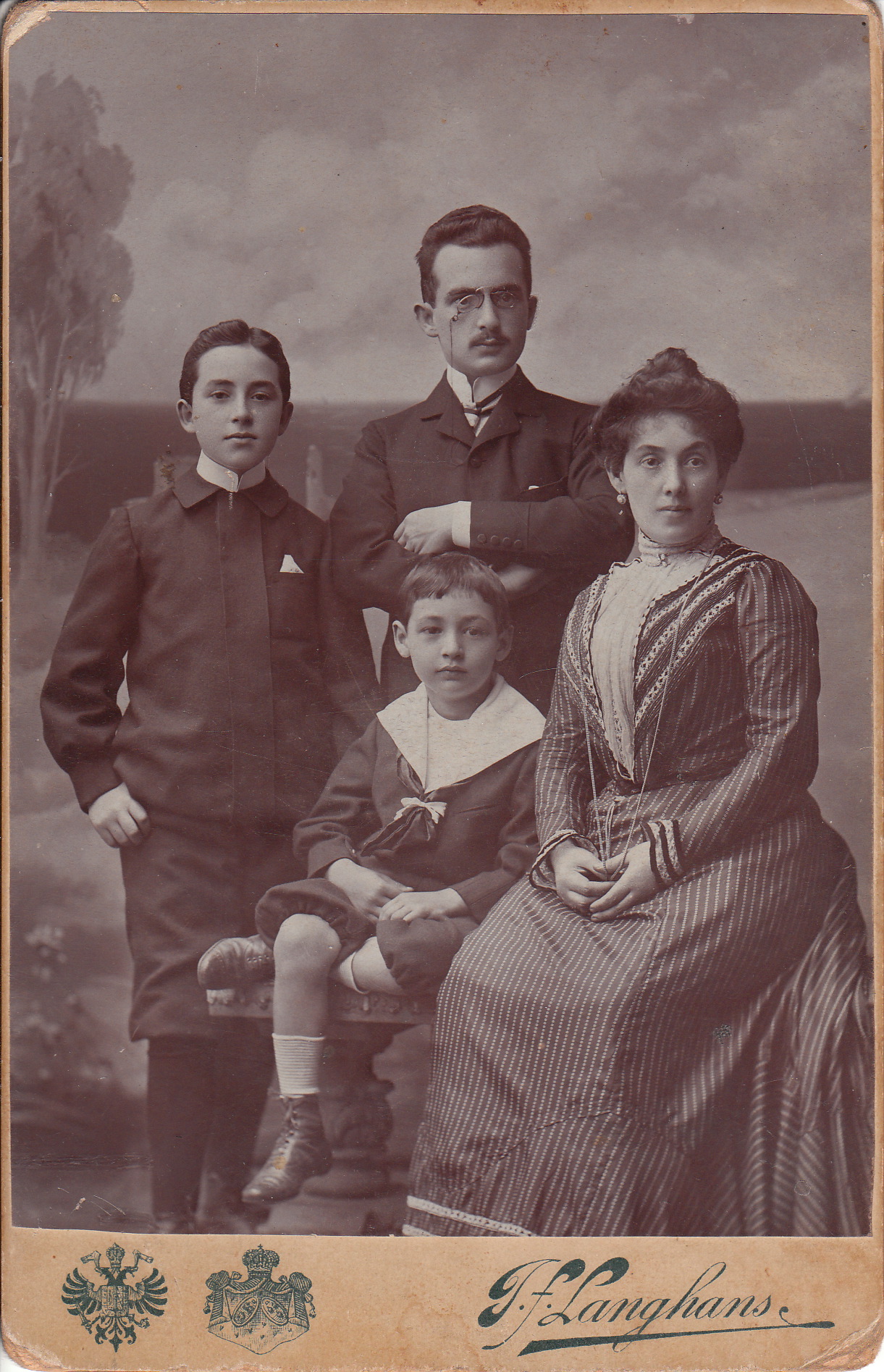
This cabinet card features an attractive family posing for their portrait at the studio of J. F. Langhans in Prague, Czechlosvakia. Mother, father, and their two sons are all beautifully dressed. Father appears to be small of stature and looks quite austere with his hands folded across his chest and his stern facial expression. The children in this photograph seem significantly more relaxed than their parents. Take note of the style of father’s eye glasses Jan Langhans (1851-1926) is the best known figure in Czech photography and his gallery is still in existence. There is a wealth of information about Langhans online at the “Langhans Archive”. The site provides biographical and historical information as well as the “Gallery of Personalities”. The gallery has photographs of many prominent Czech citizens as well as well known visitors to Czechoslovakia.. These portraits date from 1890 through 1948. The studio was founded by Jan Langhans, who was a food chemist by training but developed a passion for photography. He opened his first studio in 1876 and was the preeminent portrait photographer of the region. He opened a number of branch studios throughout Czechoslovakia. He photographed many celebrities and aristocrats. After World War I the gallery possessed over a million negatives. He gave the studio to his daughter Marie and her husband Viktor Meisner. After World War II, his grandson Viktor Meisner took over the studio. In 1948, soon after the Communist take-over, the studio was nationalized and most of the negatives were destroyed. Fortunately, more negatives were discovered and they comprise the Gallery’s current collection. To view other photographs by Langhans, click on the category “Photographer: Langhans”.
CLASS PHOTO IN FRONT OF RURAL SCHOOLHOUSE IN PRAGUE, NEBRASKA
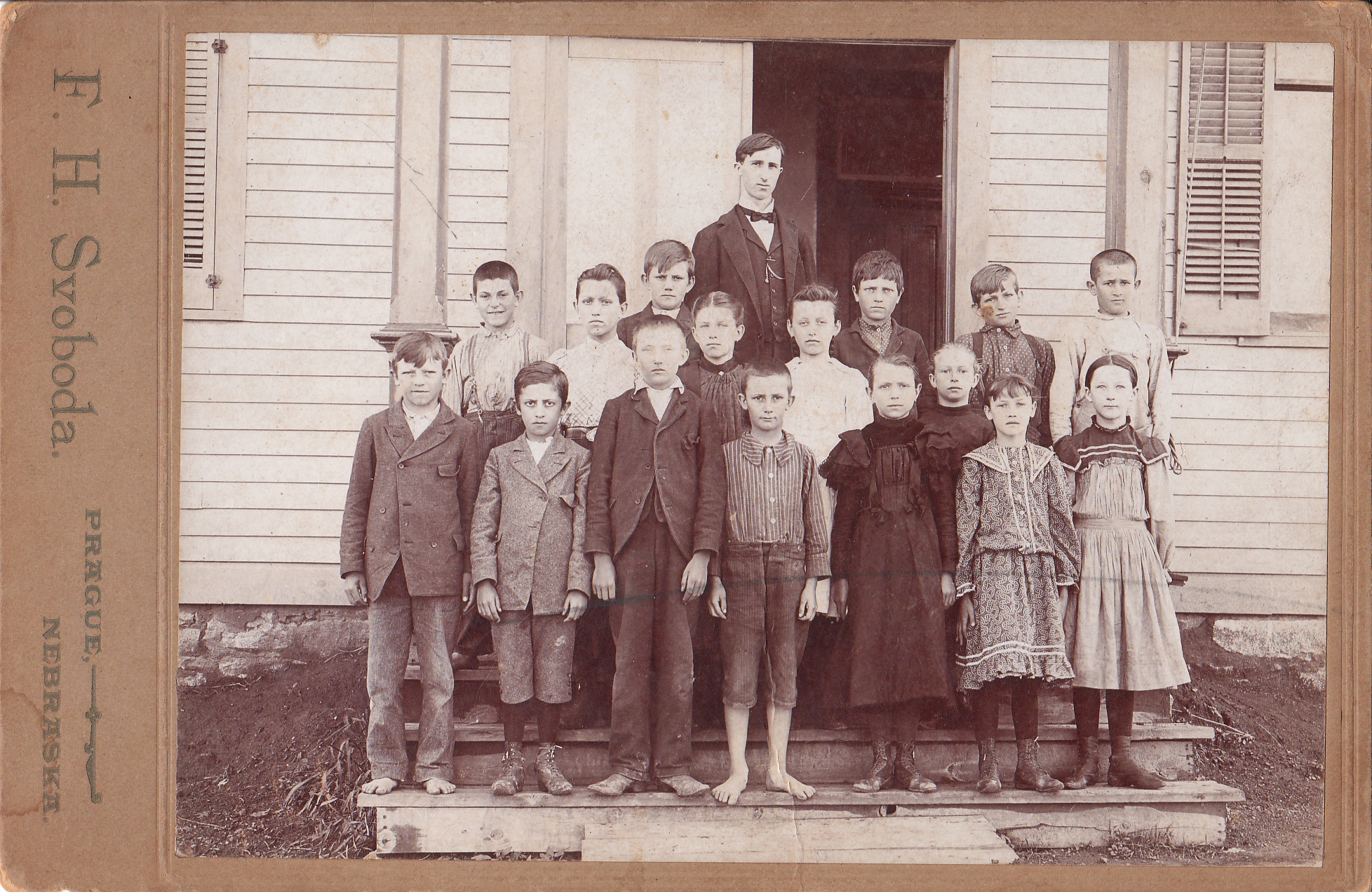 This cabinet card offers a glimpse back into historical times of the American education system. This image dates back before “teaching for the test” was standard policy for many school districts. Sixteen children are posed in front of their schoolhouse. Their young teacher stands behind his class. The children seem to have dressed nicely for “picture day”, but at least a couple of the boys are barefoot. F. H.Svoboda was the photographer of this image and his studio was located in Prague, Nebraska. At one time, Svoboda published the first, and only, Czech juvenile magazine in Nebraska. He was a school teacher and later engaged in photography. In 1909, he began to publish the Schuyler Messenger, which existed until 1920. The Messenger was a weekly newspaper in Schuyler, Nebraska. The town of Prague has an interesting history. Its early inhabitants included many Czech settlers who arrived in America seeking prosperity during the 1880’s. In 1887, the town was built to support a newly established railroad station. The town was built by the Lincoln Land Company and became a thriving community catering to the agricultural economy of the area. The largest business in the town was a lumberyard. The town’s name, Prague, is named after the capital city of Czechoslovakia.


 THE CABINET CARD GALLERY