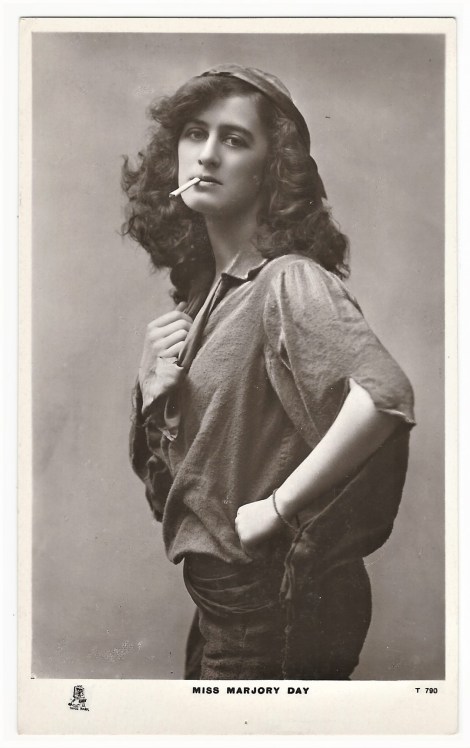
 This vintage real photo postcard features actress Marjory Day (1887-1940). She was born in New Zealand. She was an actress and was known for “The Woman Who Was Nothing” (1917), “The Life of Lord Byron” (1922), and “The Fighting Marine” (1926). Miss Day was married and divorced from producer/actor George Desmond (1881-1969). The National Portrait Gallery has 15 portraits of Miss Day in their collection. This postcard captures Day exhibiting socially inappropriate behavior. Day’s deviant behavior is the fact that she is smoking a cigarette. She also seems to be wearing pants which is also a violation that could get her in trouble with the fashion police. To top things off, she is rebelliously staring at the photographer as this photo was taken. At first, I thought that Marjory Day was one of those “bad girls” of the theatre (there were also “bad boys”). However, I later learned that this photograph was taken while Day was in costume for playwright George Bernard Shaw’s “Devil’s Disciple” (1897). This postcard was published by Rafael Tuck as part of the “Celebrities of the Stage” series (no. T 790). Raphael Tuck and his wife started their photography business in 1866 in London. Their store sold pictures, greeting cards, and in time, postcards. Their success came from the sale of postcards during the late 1890’s and early 1900’s. In the early 1900’s the firm conducted postcard competitions for collectors of Tuck postcards. These competitions offered cash prizes and they were very popular. The winner of one of these competitions had a collection consisting of over twenty-five thousand cards. Three of Tuck’s four sons participated in the business. The company was devastated by German bombing during World War II. In 1959 the company merged with two other printing companies. (SOLD)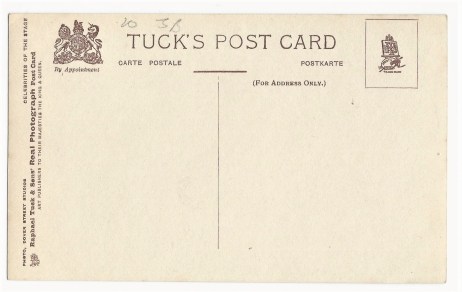




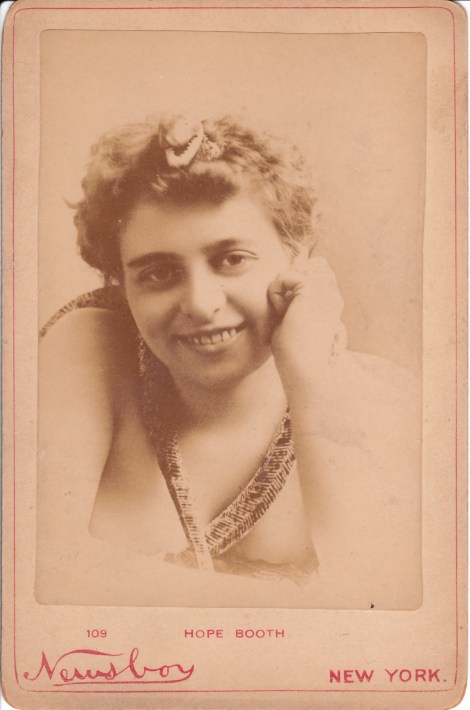 This Cabinet Card is a portrait of theatre actress, Hope Booth. This actress seems to have had a propensity for trouble. The New York Times (1896) reported that at age 23, after appearing at the “Casino Roof Gardens” in a sketch entitled “Ten Minutes in the Latin Quartier; or A Study in the Nude”, she was arrested along with the manager of the theatre. She was charged with violating public decency because of her scant costume and daring poses. Five years later, her husband, actor, James E. B. Earll was arrested after his opening appearance in a vaudeville act at Koster and Bials. Before her arrest, she appeared in George Bernard Shaw’s first play, “Widowers Houses” in 1892. A review described her as a “fetching but hopeless” actress. Shaw had seen her in an earlier show and had described her as a “young lady who can not sing, dance, or speak, but whose appearance suggests that she might profitably spend 3 or 4 years in learning the arts which are useful on stage”. Other news stories and books report that she was born in Canada, was once married to a Canadian member of Parliament, she was a distant relative of the theatrical Booth family, and that she went bankrupt bringing a play to England. She clearly led an interesting life. The Cabinet Card is part of the Newsboy Series and was used as a premium for the sale of Newsboy Plug Tobacco.


 THE CABINET CARD GALLERY