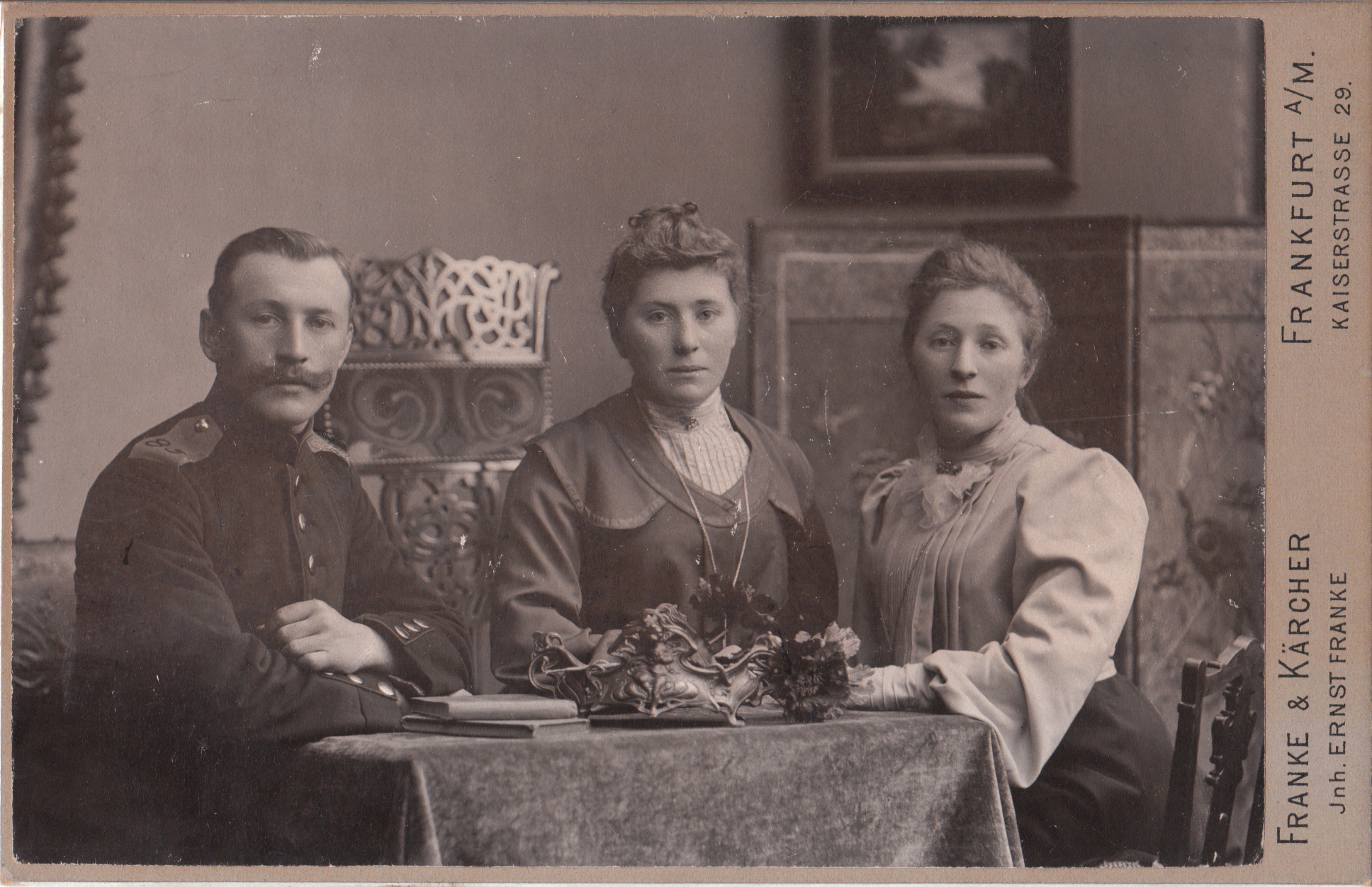
 This cabinet card features a military officer and two women seated at a table. All three individuals appear quite austere. On the table are two small books and a bowl with contents that include a pair of scissors. Perhaps this is a family photograph, but there is likely an interesting story about the lives of the subjects in this photograph. The photographer of this image is Franke & Karcher of Frankfurt. At the time of this portrait, Frankfurt was ruled by Prussia.
AN OFFICER AND TWO LADIES IN FRANKFURT, PRUSSIA

SOMBER FAMILY IN RINTELN, GERMANY
 This family portrait was photographed by Fritz Jungcurt, in Rinteln, Germany. All of the members of this family are very well dressed and also wear very serious facial expressions. They look like they’ve gathered together for an austere occasion.
ADORABLY DRESSED BOY WITH FUR HAT IN KARLSRUHE, GERMANY
 This cabinet card presents a young boy uncommonly dressed. He is photographed by Samson of Karlsruhe, Germany. Karlsruhe is in southwest Germany near the French-German border. The city is thought to be the model cityscape of Washington D.C.. The child is wearing a very interesting outfit. Does the outfit represent an ethnic or regional group? What is the story concerning the clothing item with the heart and other designs (are they suspenders or part of his shirt)? Is that a handkerchief barely tucked into the pocket of his jacket and why is the pocket near his elbow? The fur hat and the ties at the bottom of his pants also raise some interesting questions. Finally what is the lad holding in his right hand? It looks like a wand used to blow bubbles. Hopefully, a visitor to this site may share some enlightening information regarding this boys wardrobe.
PRUSSIAN SOLDIER AND HIS FAMILY POSE IN FURSTENWALDE, GERMANY
 A Prussian soldier, his wife, and son pose for their portrait in the Schmidt studio in Furstenwalde, Germany. The photograph is dated 1898. The photograph shows a bit more intimacy than most during this time period. The soldiers son is holding his fathers hand and the soldiers wife appears to have her arm against her husbands shoulder. Note the soldiers moustache; it curves upward rather than the regularly seen downward. Perhaps a visitor to this entry can ascertain the soldiers rank and branch of service.
Two Cute Kids Posing in Gnesen, (Prussia?)
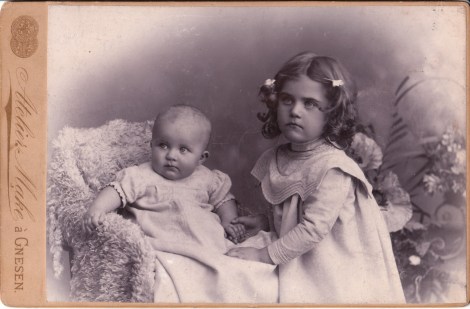 Two adorable kids (most likely siblings) pose in this Cabinet card photograph. The close-up of the baby is terrific and is an unusual pose for photographs of this era. Most babies I have seen in Cabinet cards are photographed from more of a distance. The photograper is Make of Gnesen. My research leaves me uncertain of whether Gnesen was part of Prussia or Germany at the time of this photograph. Please comment if you have information about what nation Gnesen was part of in the late 1800’s. Gnesen is currently part of Poland.
Adorable Siblings in Beuthen, Germany
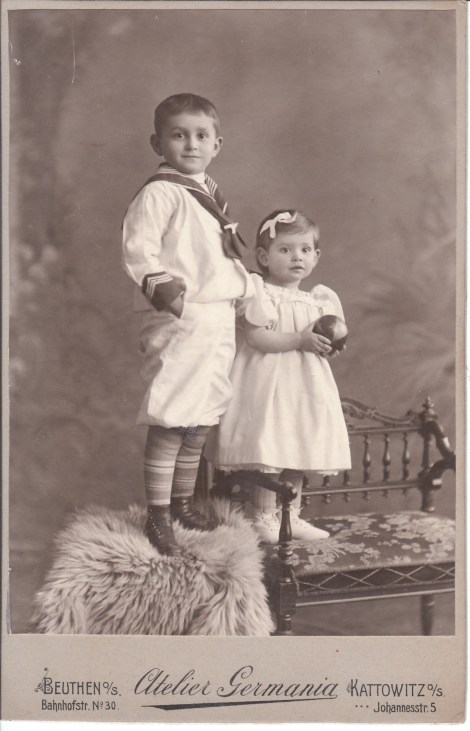
These two siblings are just adorable as they pose in the Germania Studio in Beuthen, Germany. Unlike many children seen in Cabinet Cards, these kids appear very relaxed and in good humor. The boy is cute in his sailor suit and the girl is holding a toy ball. The city of Beuthen is now called Bytom and is in southern Poland. Beuthen became part of Prussia in 1742 and part of the German empire in 1871. Beuthen was transferred to Poland in 1945.
Wounded Fencers from Jena, Germany
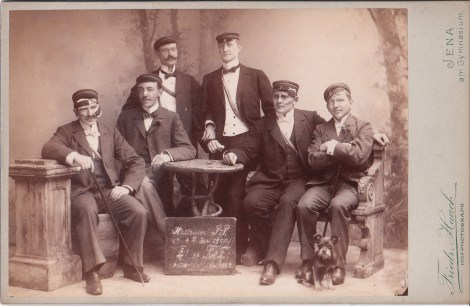
This Cabinet card image captures a fencing team after what must have been a tough match with another fencing club. Note the wounds and the little dog at the feet of the fencer furthest to the right of the photograph. Perhaps a reader of this blog can help identify the team and the words on the board in the center of the photo. The reverse of the card has German writing which I can not translate. It may list the two teams which competed. “Alleurarria contra Aruriscia” is the best interpretation I can make of the handwriting. Once again, I hope a fencing authority can comment and identify the competing teams. This is the second fencing Cabinet card that I have posted (look up the first under the category of sports). The photographer of both Cabinet cards is Friedr. Haack of Jena, Germany.
Three Fencers in Jena, Germany
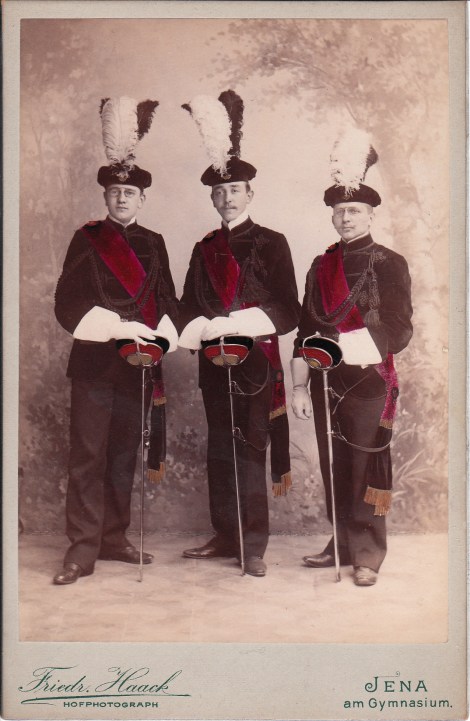
This Cabinet card is a terrific image of three fencers photographed by Friedr. Haack of Jena, Germany. Note the color which was added after the photograph was taken. Jena is a university city in central Germany. At the end of the 18th century Jena became a center for precision machinery, optics, and glass making. The subjects of this fencing Cabinet card probably were university students, as academic fencing was very popular during the time period this photograph was taken. I hope some knowledegable fencing aficionados can provide further information about the details concerning this image.
GERMAN OFFICER IN BAVARIA
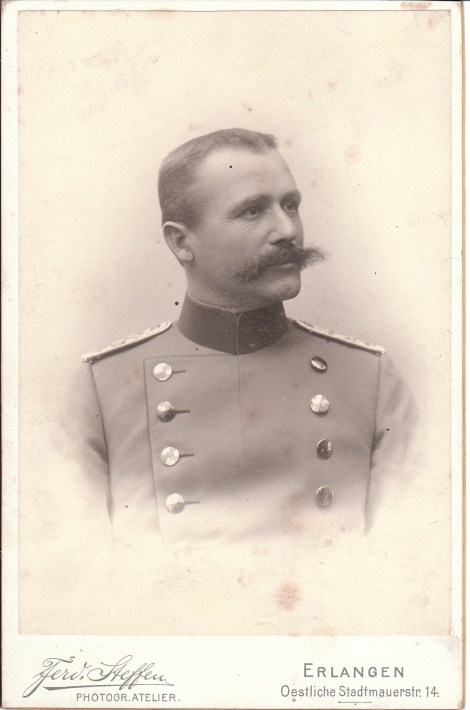
This cabinet photograph captures a German officer posing for photographer F. Steffen in Erlanger, Bavaria. I have been informed that this stern looking officer is a Hauptmann (captain). I would appreciate confirmation of this rank from a knowledgeable source, so please leave a comment if you have information.


 THE CABINET CARD GALLERY