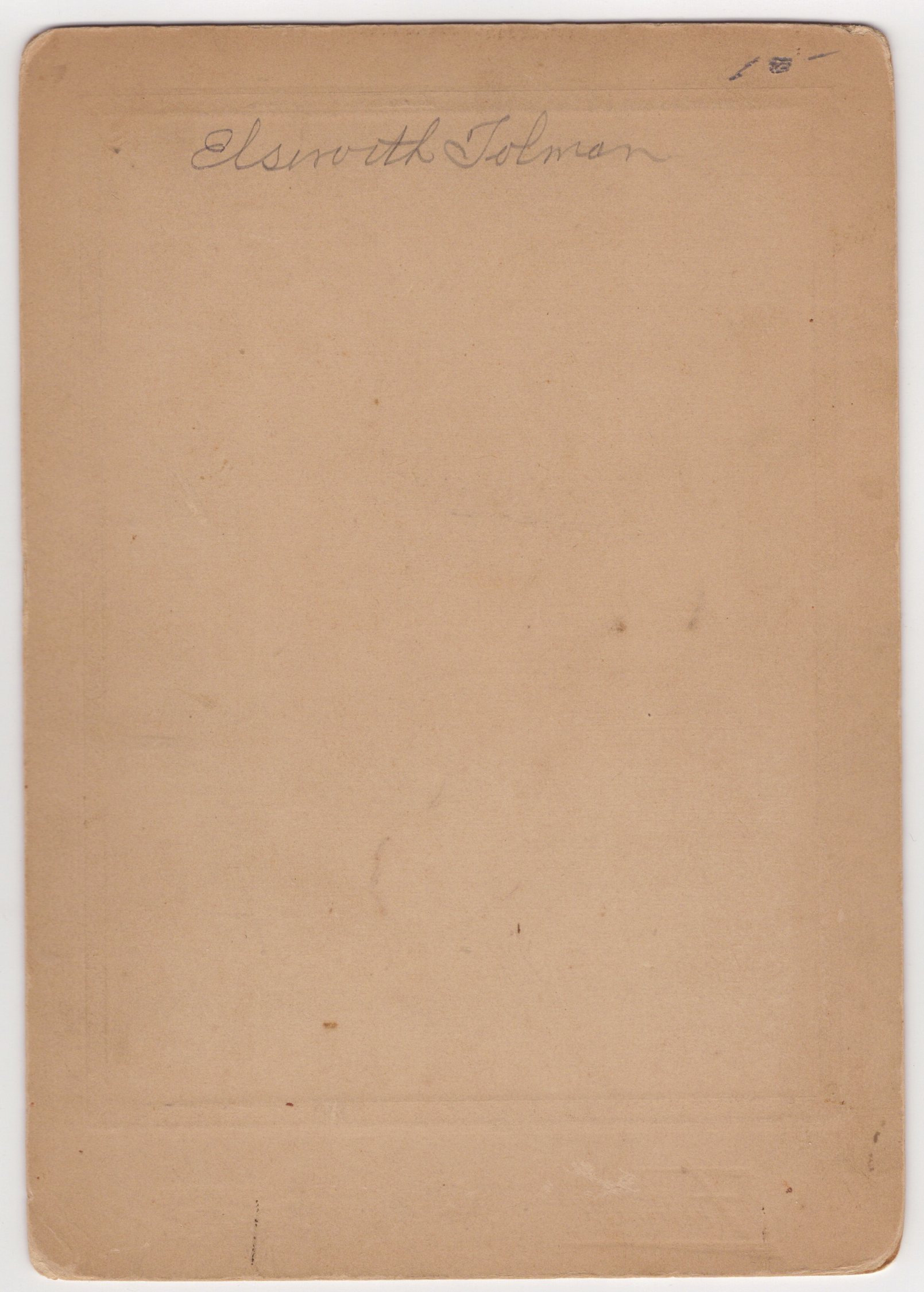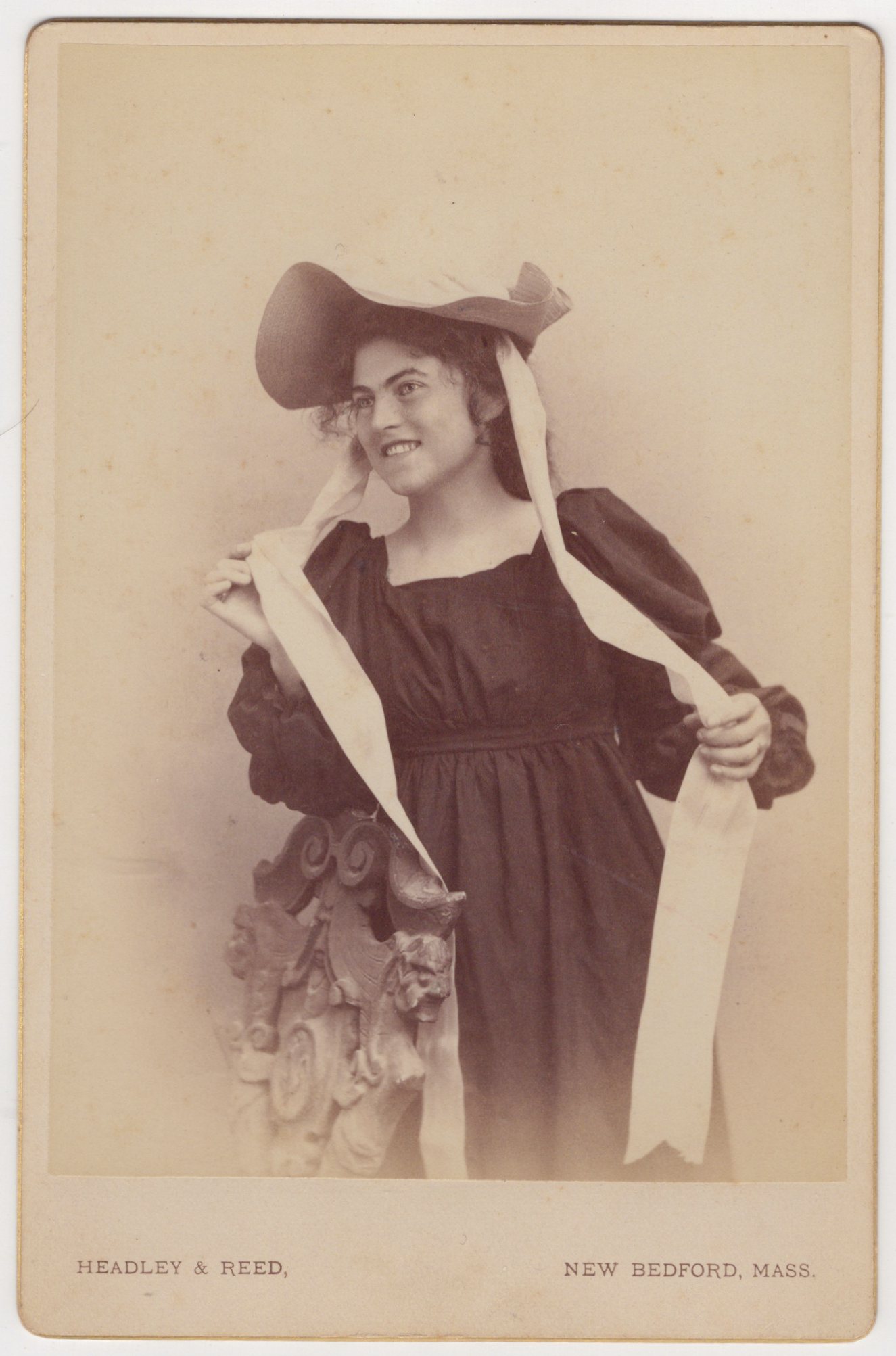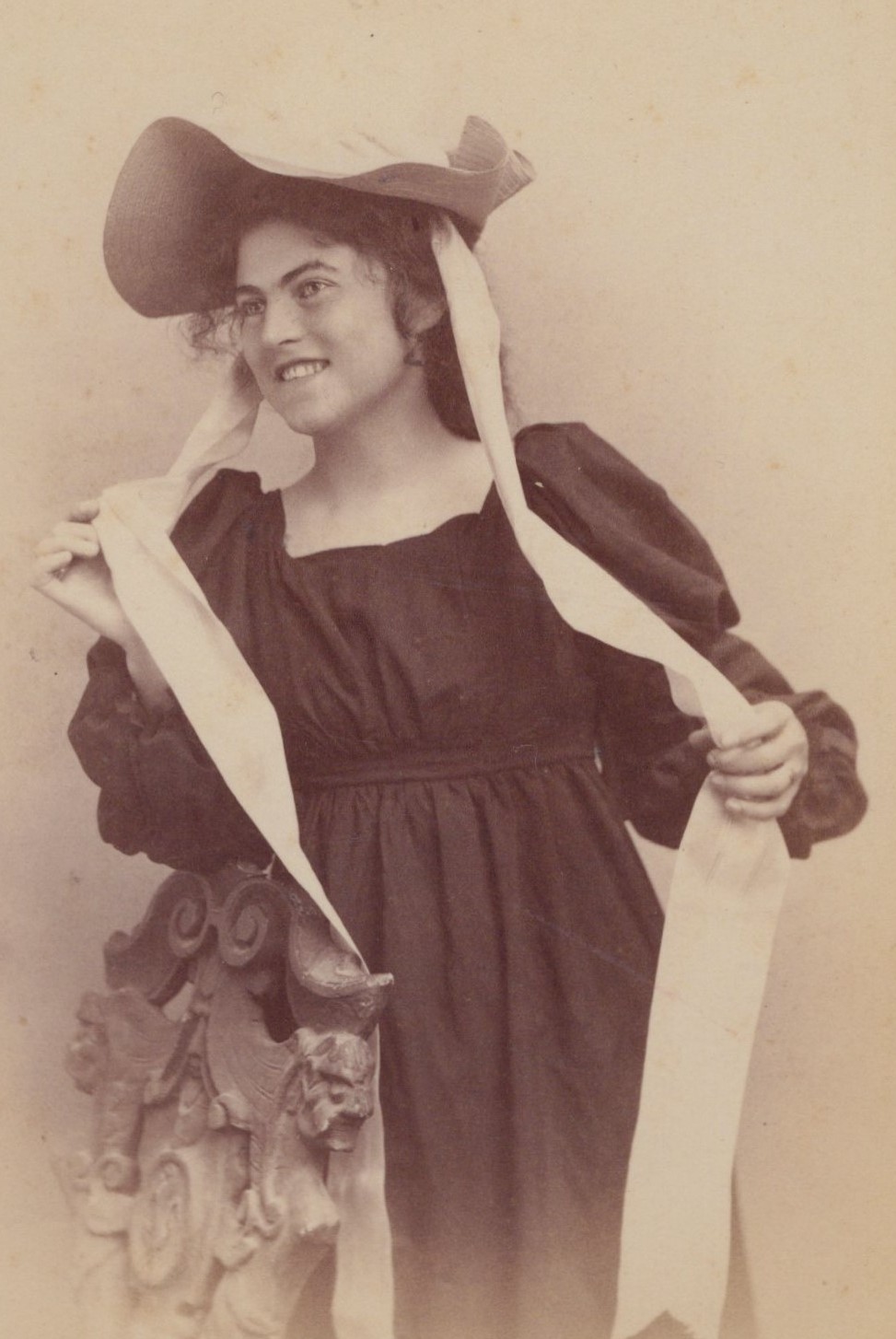
This cabinet card portrait features a fun looking vivacious young woman. She looks pretty and fashionable in her spring like clothing. She is wearing a wonderful hat and a beautiful smile. She shows an excellent and relaxed presence in front of the camera. Perhaps she was a local or touring actress. This young woman’s photograph was taken by the Headley & Reed studio in New Bedford, Massachusetts. The Headley & Reed partnership was an interracial one. Phineas Camp Headley (1858-1921) was a white man while James E. Reed (1864-1939) was an African American man. They operated a studio at 5 Purchase Street. Reed was an important figure in New Bedfords early history. He took photos of city streets, whaleships and people. His human subjects were both white and black. He had a passion for the field of photography and was prolific in his work. By 1895, he was making enough money to open his own studio, which he did with his partner, Mr. Headley. Headley, a white man, besides being a photographer, was a successful cotton broker. Headley & Reed were the premier studio in New Bedford and operated successfully from 1890 until 1896. One of Reed’s claims to fame was that he photographed Frederick Douglas. It is not known why Headly left the business. Reed continued running the business until 1914. Reed moved on to become the first Photostat (photocopier) Operator for the Massachusetts State Archives, a position he held until he retired. During Reed’s photography career, his wife, Anna Jourdain, colorized and tinted his photographs. She also worked on tiffany style lampshades. She was educated in art at the Swain School of Design (New Bedford). SOLD
CARTE de VISITE PORTRAIT OF A PRETTY YOUNG WOMAN : BOSTON, MASSACHUSETTS : 1878
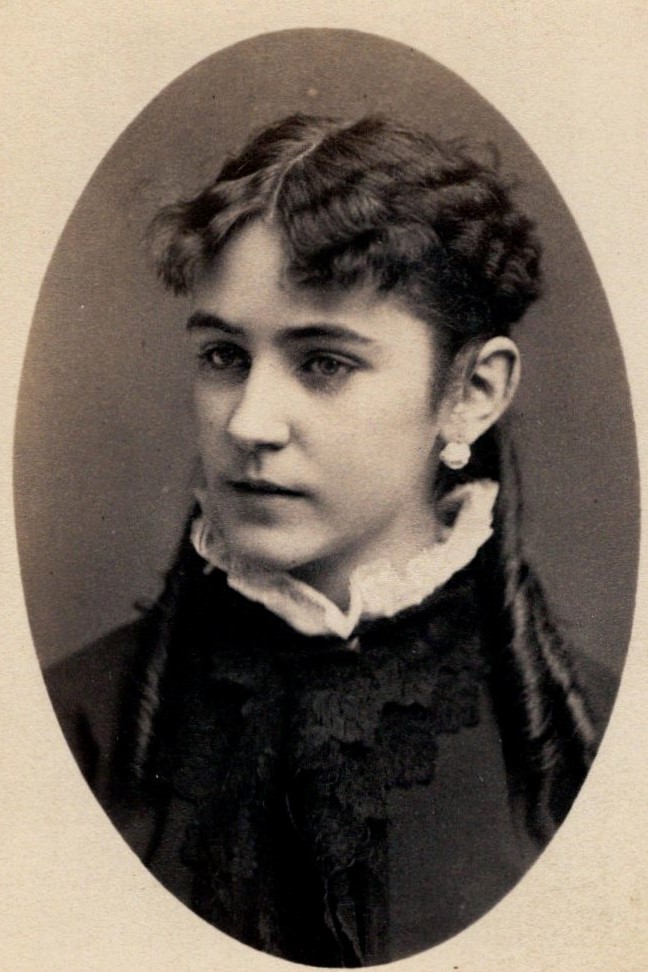
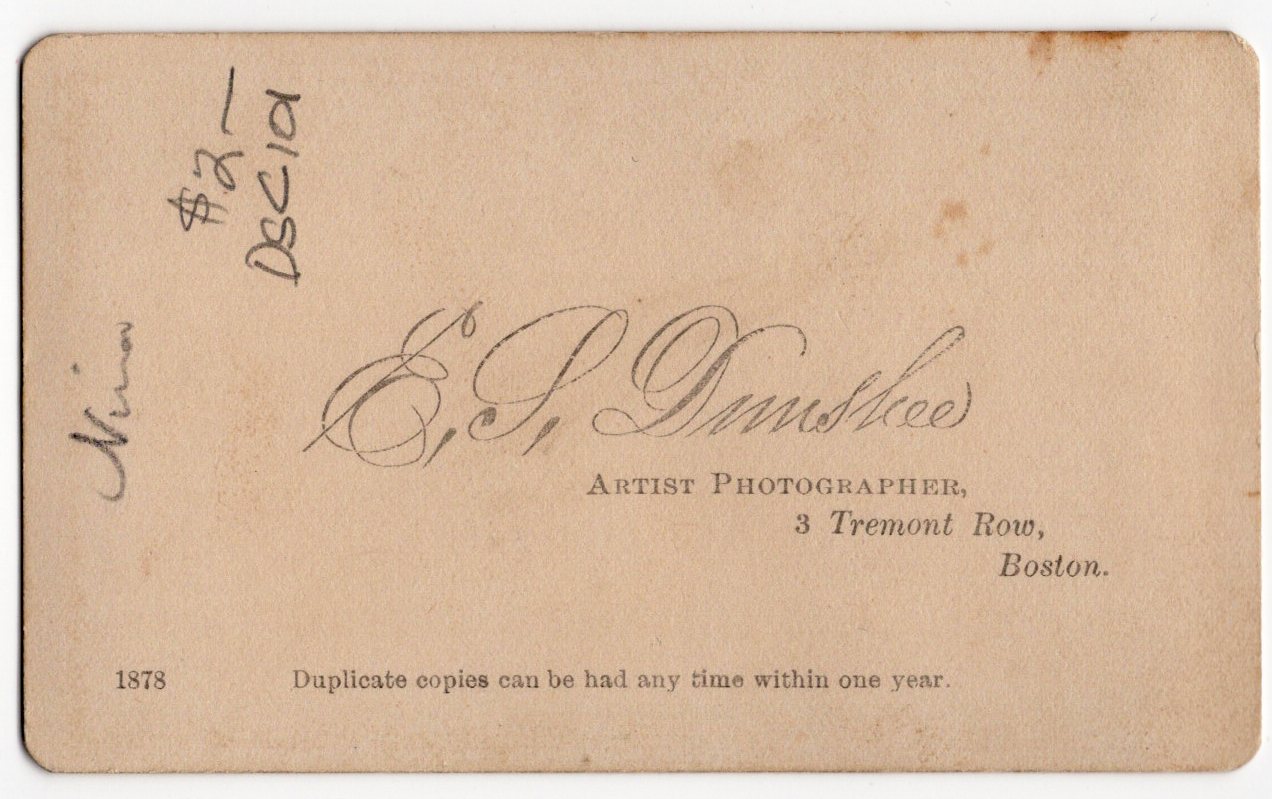
This carte de visite portrait features a pretty young woman. She is wearing a lace collar, earrings, and curls. She is identified by an accompanying note. Her name is “Nellie Smith”.She is posing for her portrait at the studio of E. S. Dunshee in Boston, Massachusetts. Photographer Edward Sidney Dunshee was born 1823 in Bristol, Vermont and died in 1907 in Philadelphia, Pennsylvania. In 1857 he and Cornelius Dunshee (his father) were photographers in Falls River, MA. He produced ambrotypes and daguerrotypes there. He next operated out of New Bedford, MA. One of his New Bedford clients was Henry David Thoreau, who sat for a portrait in 1861. By 1873 he and Thomas Rice Burnham operated as Dunshee and Burnham in Boston, MA. Between 1873 and 1876 he and Edward Byron Dunshee were in business as E. S. Dunshee and Son and located on Tremont Row in Boston, MA. By 1880, Edward Sidney Dunshee had moved to Philadelphia and apparently, after some time, his son took over the business. It appears that E. S. Dunshee had his last studio in Trenton, New Jersey (1894-1901). This cdv is dated 1878. Dunshee’s photography resume is confusing because different sources offer slightly different histories. In addition, the fact that his father and son were photographers, further clouds the accuracy of his biographical material. Clearly some writers have confused and entangled each of the Dunshee’s life story. (SOLD)
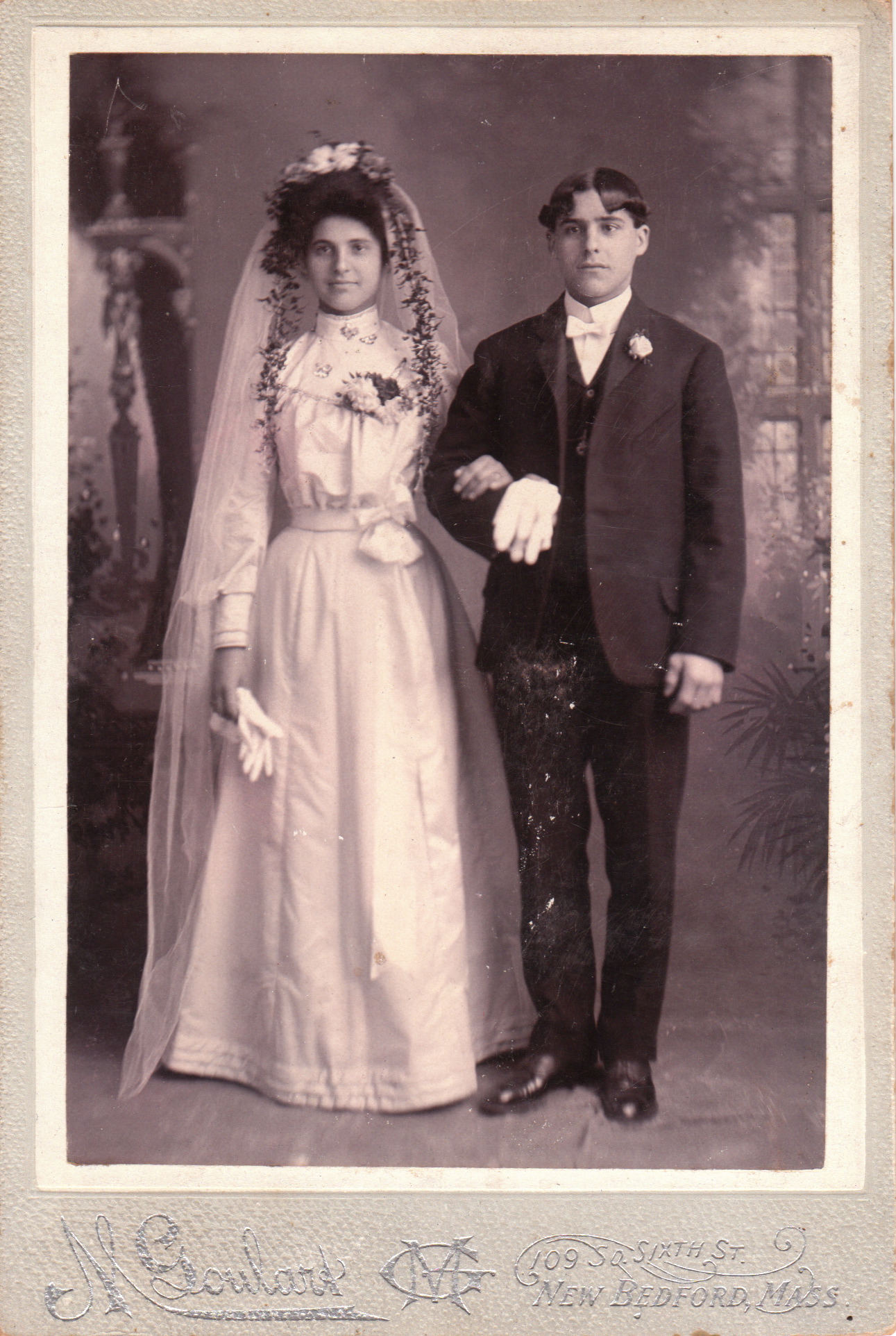
YOUNG AND ATTRACTIVE BRIDAL COUPLE IN NEW BEDFORD, MASSACHUSETTS
This photograph has significant damage but it finds it’s way to the cabinet card gallery because it features an attractive and very young looking bride and groom as well as an interesting photographer. Both of the subjects are holding formal gloves. The photographer of this image is M Goulart of New Bedford, Massachusetts. Manuel Goulart is a noted historical figure in American photography. In fact, he and his brother Jose Goulart were the subject of a book, “Two Brothers Goulart: Photography in New Bedford and the Azores” (1996). The Azorean brothers became interested in photography in the 1870’s. They were from the Portuguese island of Faial in the Azores and came to New Bedford in 1889. Between 1892 and at least 1899, Manuel Goulart’s studio was located at 109 South Sixth Street in New Bedford. New Bedford had a significant population of people of Portuguese ethnicity. It is likely that the bride and groom in this portrait were part of that Portuguese community. The brothers are noted for their late 19th century and early 20th century photographs from the Azores, Madeira, and Portugal. The New Bedford Whaling Museum has a large collection of Goulard photographs.
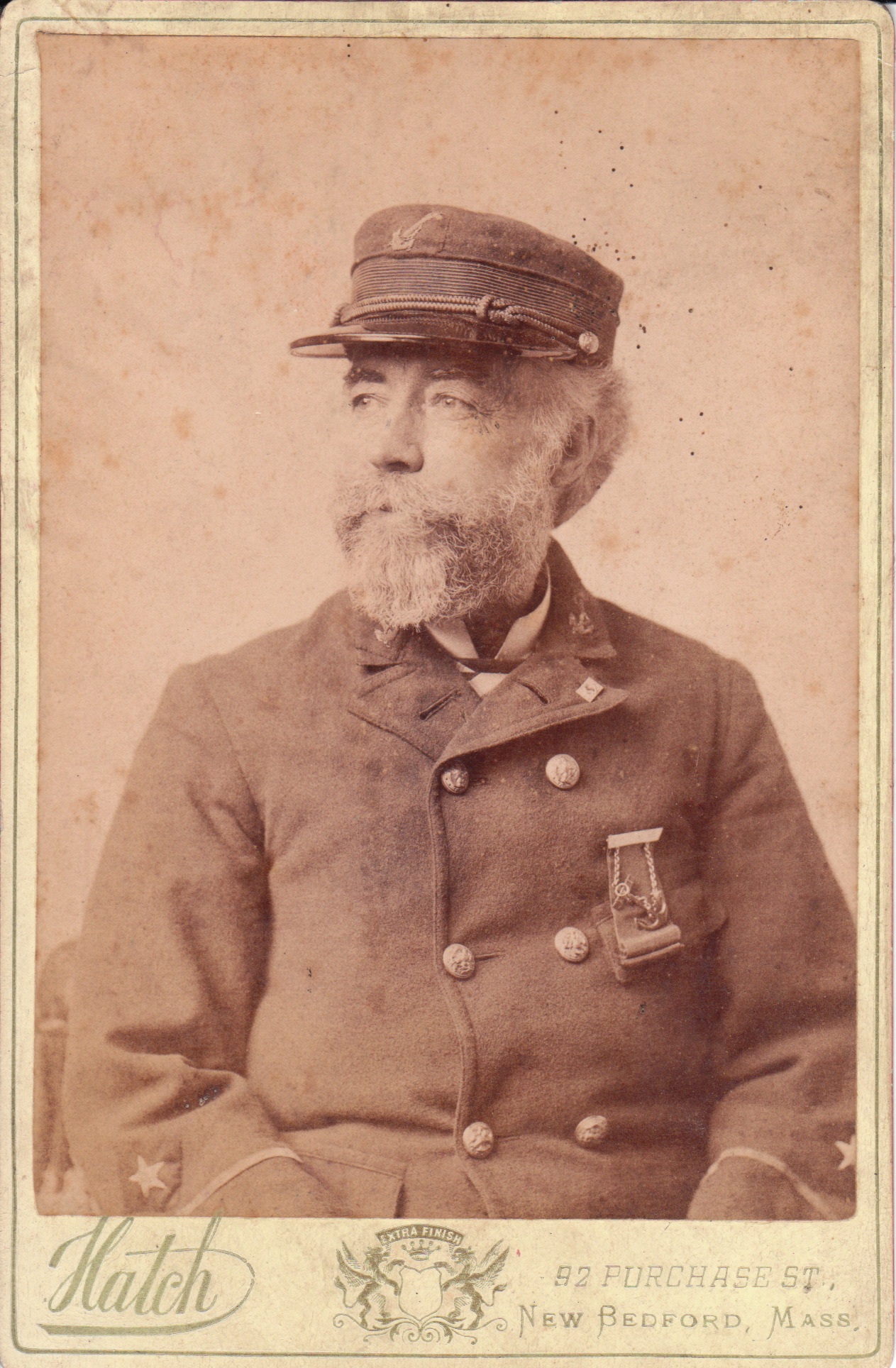
MERCHANT SHIP CAPTAIN IN NEW BEDFORD, MASSACHUSETTS
The salty gentleman featured in this cabinet card photograph appears to be a uniformed US merchant ship captain. The seaman is wearing a badge depicting an anchor on his chest. He also has stars on his sleeves and is wearing lapel pins. H. F. Hatch of New Bedford, Massachusetts is the photographer. An advertisement on the reverse of the image advertises that the gallery sells one dozen cabinet cards for five dollars. Such a deal! Henry F. Hatch is listed in the 1880 census. The document reports that he was born in Massachusetts in 1837. He was married to Etta Hatch and they were living together in New Bedford with their daughter Cecila (age 18). Henry was working as a photographer. Business directories from New Bedford indicate that he worked as a photographer from at least 1865 through 1895. Research uncovered an 1880’s advertising trade card for Hatch’s studio. The advertising copy on the card must have put fear in the hearts of the young mothers of New Bedford. The trade card’s copy stated that “Hatch loves to take babies”. It would be amazing if the trade card encouraged any parents to take their babies to the studio. However, it is not amazing that a New Bedford photographic studio produced a portrait of a ship captain. New Bedford is nicknamed “The Whaling City” because in the nineteenth century it was one of the most important whaling and fishing ports in the United States.
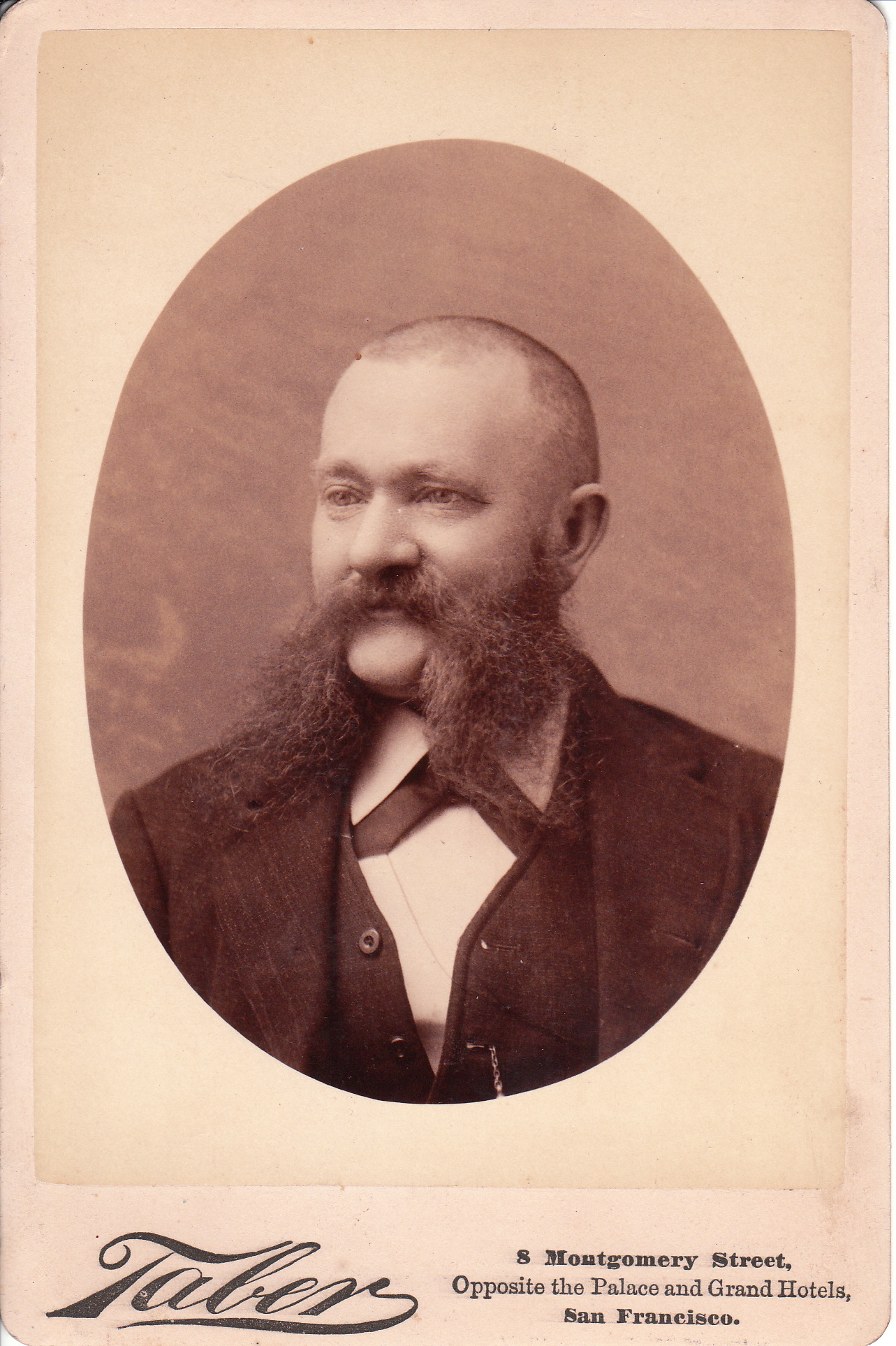
“A JOLLY GOOD FELLOW” POSES FOR HIS PORTRAIT IN SAN FRANCISCO, CALIFORNIA (PHOTOGRAPH BY TABER)
A jolly looking man poses for a portrait at the studio of Isaiah West Taber (1830-1912), in San Francisco, California. The happy gentleman has a wonderful mustache and earns the right to join other men with remarkable mustaches in the Cabinet Card Gallery’s category “Mustaches (Only the Best)”. Taber was a well known daguerreotypist, ambrotypist and photographer who photographed many California notables. Taber was also a sketch artist and a dentist. He was born in New Bedford, Massachusetts. Between 1845 and 1849, he worked on a whaling ship. He moved to California in 1850 and returned to the east, four years later. Upon his return, he opened a photography studio in Syracuse, New York. In 1864, he returned to California where he worked in the studio of Bradley and Rulofson until 1873. To view images by Bradley and Rulofson, click on the category, “Photographer: Bradley & Rulofson”. In 1871, Tabor opened his own studio and became famous for reproducing the photographs of well known California photographer, Carleton Watkins. Watkin’s business had gone bankrupt, and Taber reproduced his work without giving Watkins any credit. In 1880, Taber took a six week photographic trip to Hawaii. During part of that trip, he fulfilled his commission to photograph King Kalakaua. By 1890, Taber had expanded his operation to include studios in London and other parts of Europe. However, the 1906 San Francisco earthquake, put him out of business. The natural disaster destroyed Taber’s studio, gallery and negatives.
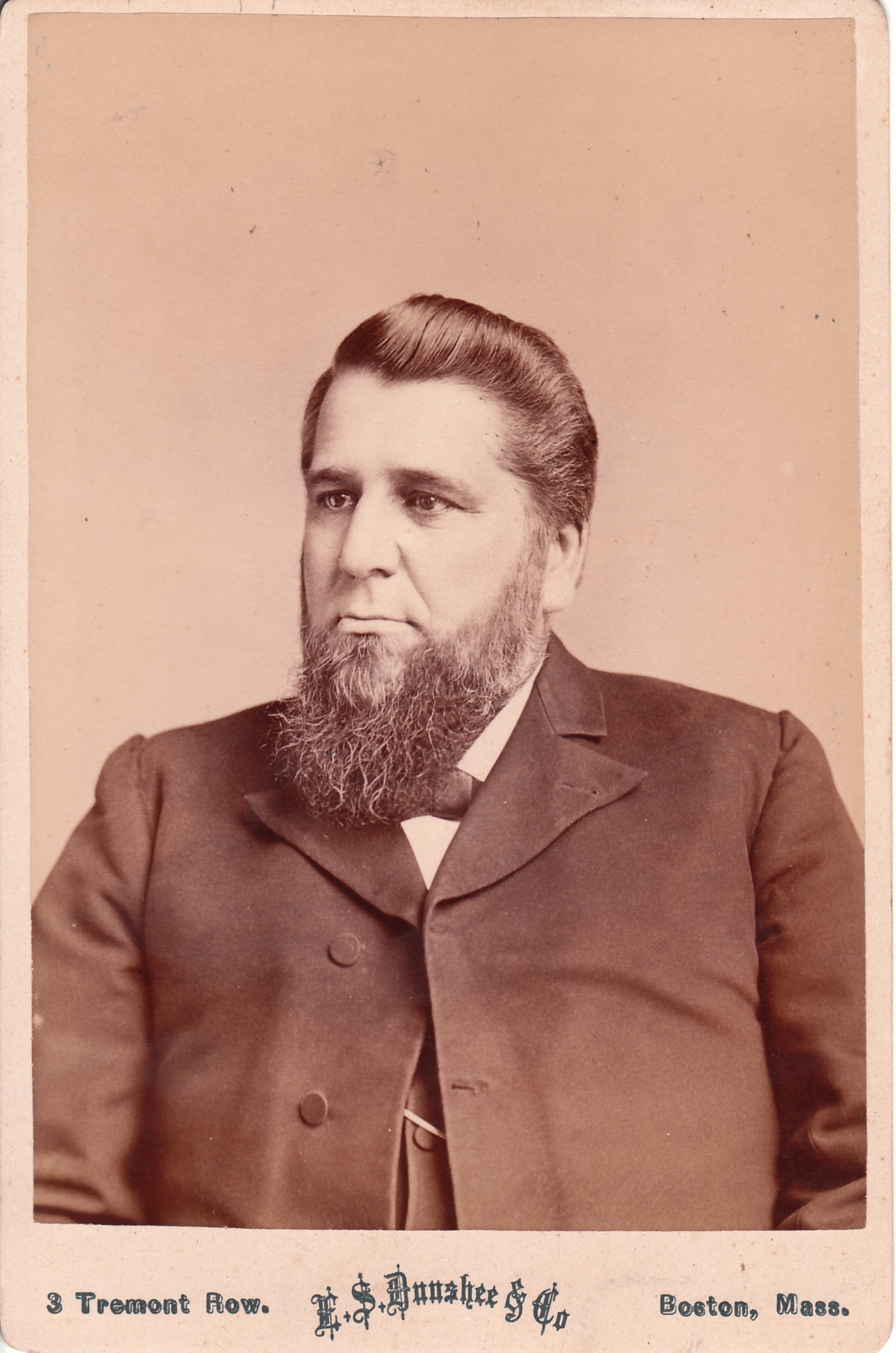
POINTY BEARD IN BOSTON, MASSACHUSETTS (1885)
Mr A. W. Sibley poses for his portrait at the studio of E. S. Dunshee in Boston, Massachusetts. Mr Sibley is well dressed and his hair and beard are very styled. His beard comes to a point and is eligible for the Cabinet Card Gallery’s category of “Beard (Only the Best)”. Please visit this beard hall of fame. Interestingly, unlike most hall of fame inductees, Mr Sibley lacks a mustache. Photographer Edward Sidney Dunshee was born 1823 in Bristol, Vermont and died in 1907 in Philadelphia, Pennsylvania. In 1857 he and Cornelius Dunshee (his father) were photographers in Falls River, MA. He produced ambrotypes and daguerrotypes there. He next operated out of New Bedford, MA. One of his New Bedford clients was Henry David Thoreau, who sat for a portrait in 1861.By 1873 he and Thomas Rice Burnham operated as Dunshee and Burnham in Boston, MA. Between 1873 and 1876 he and Edward Byron Dunshee were in business as E. S. Dunshee and Son and located on Tremont Row in Boston, MA. By 1880, Edward Sidney Dunshee had moved to Philadelphia and apparently, after some time, his son took over the business. It appears that E. S. Dunshee had his last studio in Trenton, New Jersey (1894-1901). This Cabinet Card is dated 1885 and appears to be a product of the studio when it was operated by the son in the business, Edward Byron Dunshee. To view other photographs by E. S. Dunshee, click on the category, “Photographer: Dunshee”. Dunshee’s photography resume is confusing because different sources offer slightly different histories. In addition, the fact that his father and son were photographers, further clouds the accuracy of his biographical material. Clearly some writers have confused and entangled each of the Dunshee’s life story.