This postcard features a portrait of American film actress, Colleen Moore (1899-1988). She began her career in the silent film era. She was a fashionista and one of the highest paid stars of her time. She is also noted for popularizing the “dutchboy bobbed haircut”. Like many silent film stars, she was unable to adapt to “talkies” and decided to retire after just making a few sound films. Upon retirement, Moore focused on investing, and was quite talented in that realm. She became a partner at Merrill Lynch and wrote a book about how to invest in the stock market. One of her hobbies involved dollhouses. In the early 1950’s, she helped design and curate “The Colleen Moore Dollhouse” which is still exhibited at the Museum of Science and Industry, in Chicago, Illinois. The dollhouse is 9 square feet and worth millions of dollars and has been seen by millions of museum goers. Moore was born in Michigan and her family relocated to Atlanta around 1908.They then moved on to Pennsylvania and finally, Tampa, Florida. At fifteen years of age, Moore had a screen test with director D. W. Griffith. Griffith owed a debt to Moore’s uncle, a successful newspaper man in Chicago. Moore must have done well on the screen test since she soon found herself playing heroines in Westerns. She signed a contract with Triangle-Fine Arts and for the first few years she appeared in minor supporting roles. When the Triangle Company folded she signed with Selig Polyscope. She appeared in “A Hoosier Romance” and “Little Orphant Annie”. They were popular films and Moore achieved some celebrity. When Selig closed their doors, Moore went to work on films from various companies. Her star kept rising. In 1922, Moore was named a WAMPAS Baby Star (honor for actresses on the threshold of fame). The IMDb credits Moore with 65 film appearances between 1918 and 1934. At the height of her career, she was earning over twelve thousand dollars a week. This vintage portrait postcard features Colleen Moore with her trademark dutch boy bobbed haircut. The card was published by Ross Verlag. Note the logo for First National Pictures in the lower right hand corner of the image. The card has a 1926 postmark. Moore was about 27 years old when the photograph was taken. SOLD
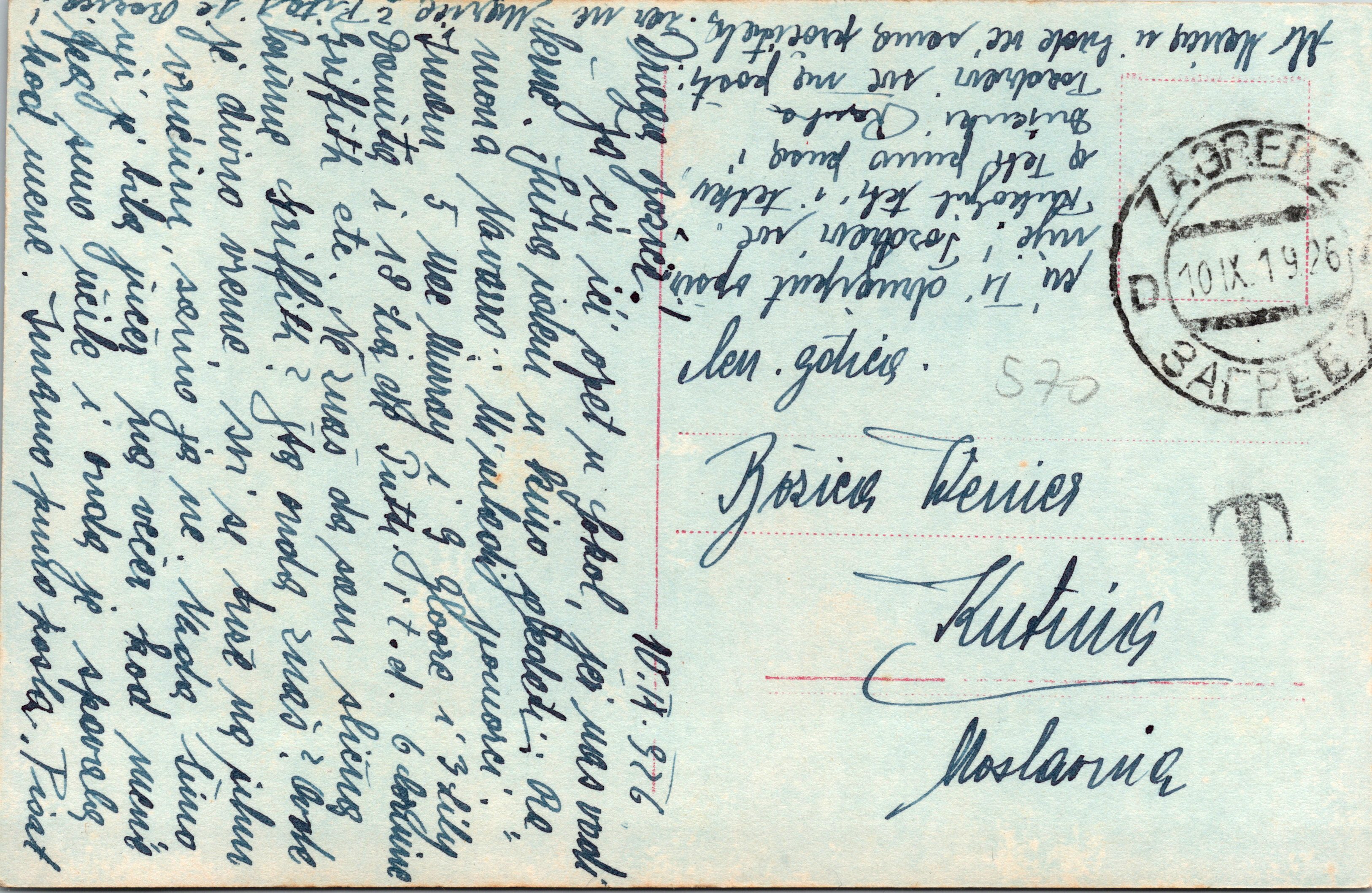
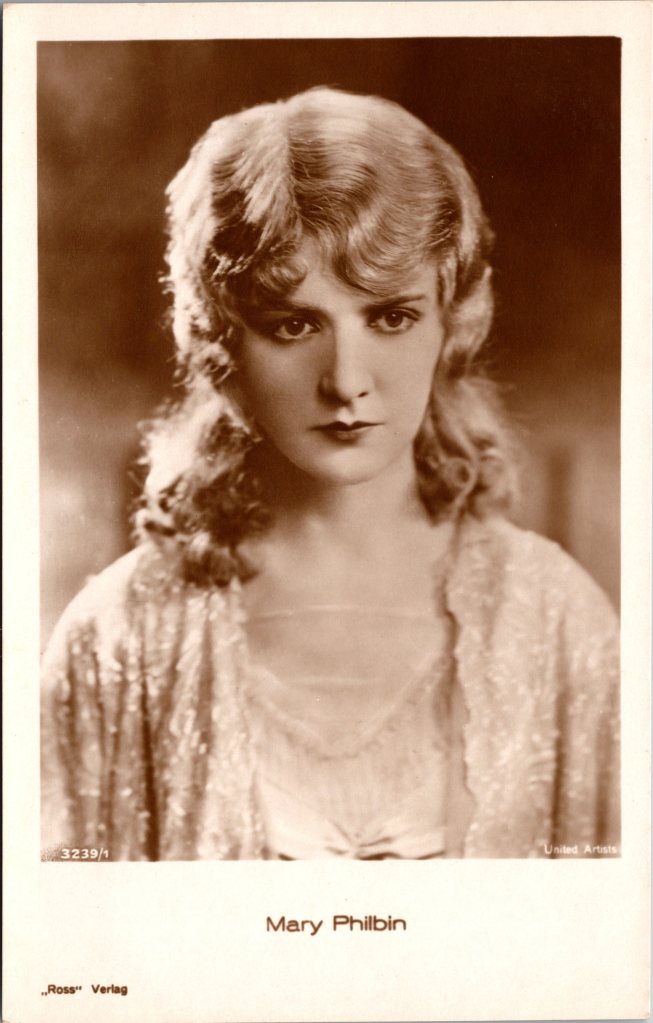
This vintage real photo postcard portrait (Postcard 1) features American actress Mary Philbin (1902-1993). She was active in film between 1918 and 1930. One of her most noted film roles was in “The Phantom of the Opera” (1925). She co-starred with Lon Chaney. A number of her roles involved playing the “beauty” in “Beauty and the Beast” type stories . Mary was born in Chicago, Illinois. Her parents were middle-class and of Irish descent. Her mother was convivial but controlling and domineering. She pushed her strong religious beliefs onto Mary. She adored her father who was “quiet, shy, and reserved”. She was very similar, personality-wise, to her dad. She would accompany him to the theater and there she developed a passion for the stage. She pursued dance and played the pipe organ and piano. She lacked a singing voice, and surprisingly, never received training in acting. Mary’s acting career was launched after she won a beauty contest sponsored by Universal Pictures. The motion picture company promptly signed her to a contract. Her screen debut was in 1921 and during the following year she was named a WAMPAS Baby Star. This prestigious annual award, given by an association of film advertisers, was awarded to thirteen young women each year. These women were predicted to be on the verge of becoming major movie stars. During the 1920’s, Mary’s film career blossomed and she starred in a number of successful films, including “Drums of Love (1920), directed by D. W. Griffith. When “talkies” arrived, she played in a few films and even dubbed her own voice for the sound version of “Phantom of the Opera”. Unfortunately, her voice was considered too “girlish” to be suitable for talking pictures. She retired from the screen in the early 1930’s in order to become a caretaker for her elderly parents. She lived the rest of her life as a recluse. She never married and seldom made public appearances. An exception occurred when she attended the Los Angeles opening of Andrew Lloyd Webber’s musical version of “Phantom of the Opera”. She died of pneumonia at the age of ninety and is buried in Los Angeles, California. The IMDb reports that Mary appeared in 34 film between 1921 and 1929. She never married. In 1926 she became engaged to Universal producer, Paul Kohner. When her family learned of the engagement, they were infuriated. They demanded a meeting with Kohner and all went reasonably well until the subject of religion arose. Kohner was Jewish and Mary’s family was Catholic. Mary’s mother was adamant in her belief that Kohner would attempt to convert Mary to Judaism. Paul and Mary informed her parents that no such thing would happen. An argument developed between Paul and Mary’s parents. She was told by her parents that she would be disowned if she proceeded with her wedding plans. Mary was ambivalent but, in the end, despite still loving Paul, she returned her engagement ring to him. A biographer contends that this traumaticrd experience is the reason Mary never married. This vintage postcard was published by Ross Verlag, of Berlin, Germany. It is part of a series (no. 968/1). The name of the film distribution company (Filmhaus Bruckmann) can be seen on the bottom right corner of the image. A stamp on the reverse of the postcard indicates that it once was part of a collection belonging to Herman Overeem, of Utrecht, the Netherlands. (SOLD)
Postcard 2 was published by Ross Verlag, of Berlin, Germany. It is part of a series (no. 3239/1). The name of the film company (United Artists) can be seen on the bottom left corner of the image. (SOLD)
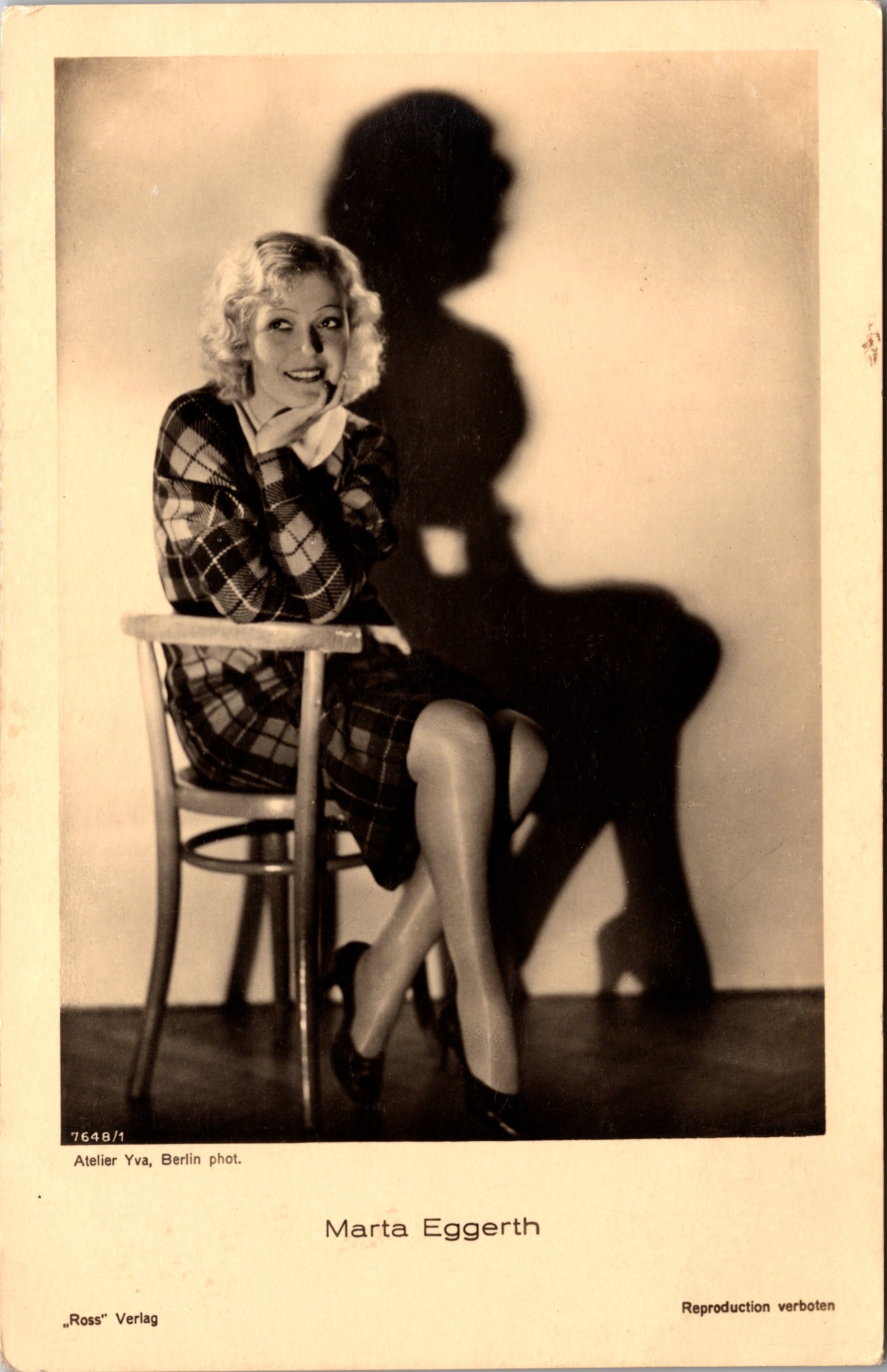
This vintage real photo postcard features Hungarian actress and singer, Marta Eggerth (1912-2013). She was a popular operetta star and many of the most famous composers of operettas, composed operetta works specifically for her. She was born in Budapest. Her mother was a dramatic operatic soprano. Eggerth began singing as a child and her mother devoted herself to developing Eggerth’s acting and singing talent. She made her theatrical debut at age eleven and while a teenager, toured internationally performing operatic works. By the early 1930’s, Eggerth achieved international fame acting in film. She made films in five languages. While making a film she met Polish tenor, Jan Kiepura and they married in 1936. The pair were an international sensation. Eggerth appeared in a Richard Rodgers production on Broadway. Eggerth and her husband starred in the Broadway production of “The Merry Widow”. She was in three different Broadway plays, all of them between 1940 and 1945. In addition, Eggerth signed with MGM made two films with Judy Garland. Throughout her career, Eggerth continued to perform operettas internationally. Her last stage appearance occurred when she was 99 years old. The IMDb gives Eggerth 39 acting credits between 1930 and 1999. This postcard was published by Ross Verlag as part of a series (No.7648/1). Eggerth’s portrait was taken by the Yva studio in Berlin, Germany. The name Yva is a pseudonym. The photographer was actually a woman named Else Ernestine Neulander-Simon (1900-1944). She was a German Jewish photographer and was well known for her “dreamlike, multiple exposed images”. She was a leading Berlin photographer during the Weimar Republic years of Germany. She specialized in fashion, nudes, and portraiture. Later, she became involved in the early days of producing photographs for advertising. Many of her photographs were published in magazines or were shown in international exhibitions. After the Nazis took power, she was forced to work as a radioagrapher (ie x-ray technician). In 1936 she was offered a job by Life Magazine, but her husband convinced her that life for German Jews would improve over time. He did not want to move and start a new life in a country where he did not speak the language. Unfortunately, she complied with his wishes. In 1938, Nazi regulations prohibited her from working as a photographer. In 1942, the Gestapo deported her and her husband to a death camp (probably Majdanek) where they were murdered. (SOLD)
This vintage real photo postcard features two smiling bathing beauties posing outside a beach cabana. This photograph is risque for it’s era. This image was produced by the studio of the esteemed photographer, Henry (Heinrich) Traut. The postcard was published by Rotophot Berlin (RPH). Rotophot eventually morphed into Ross Verlag. (SOLD)
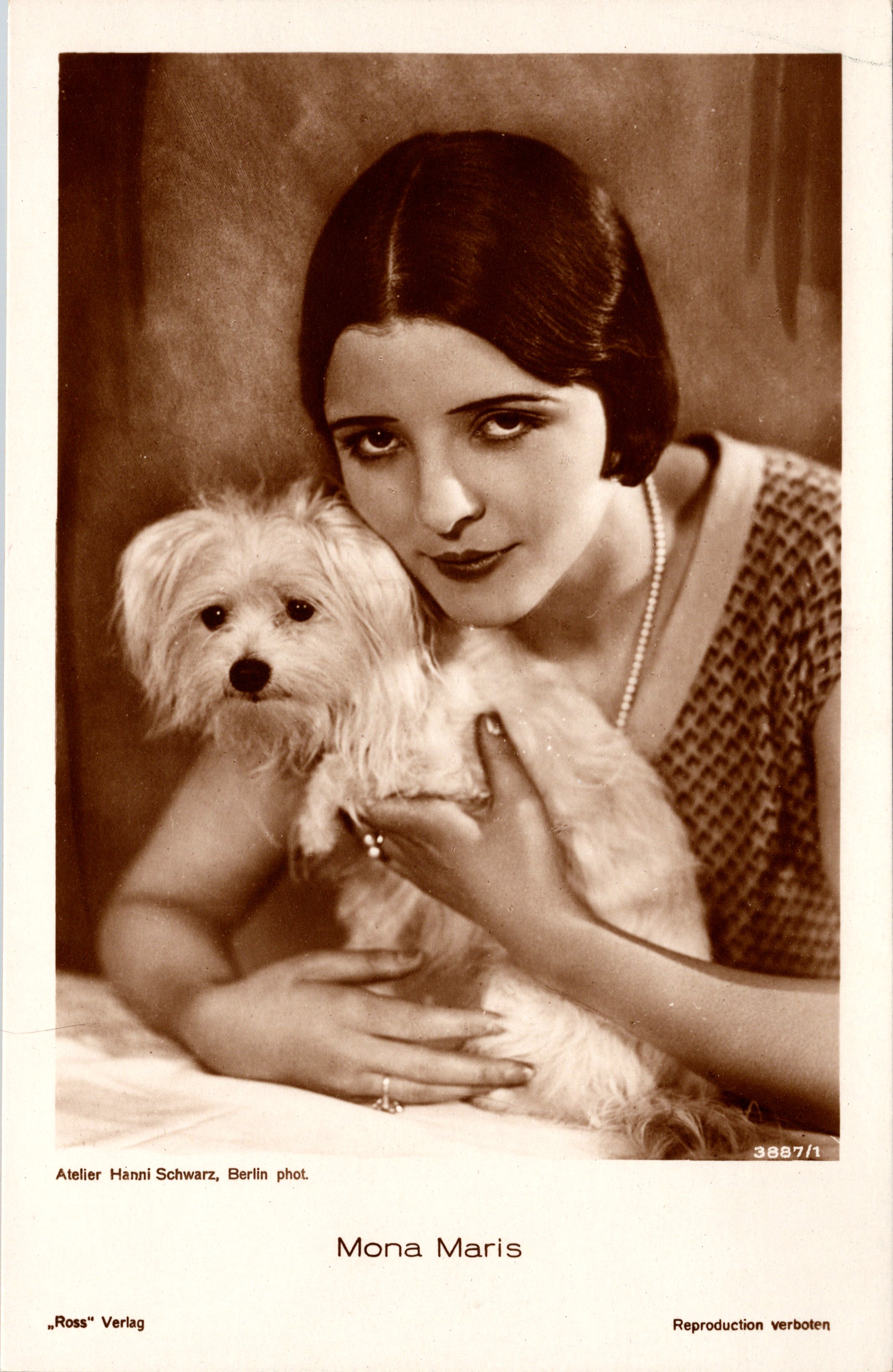
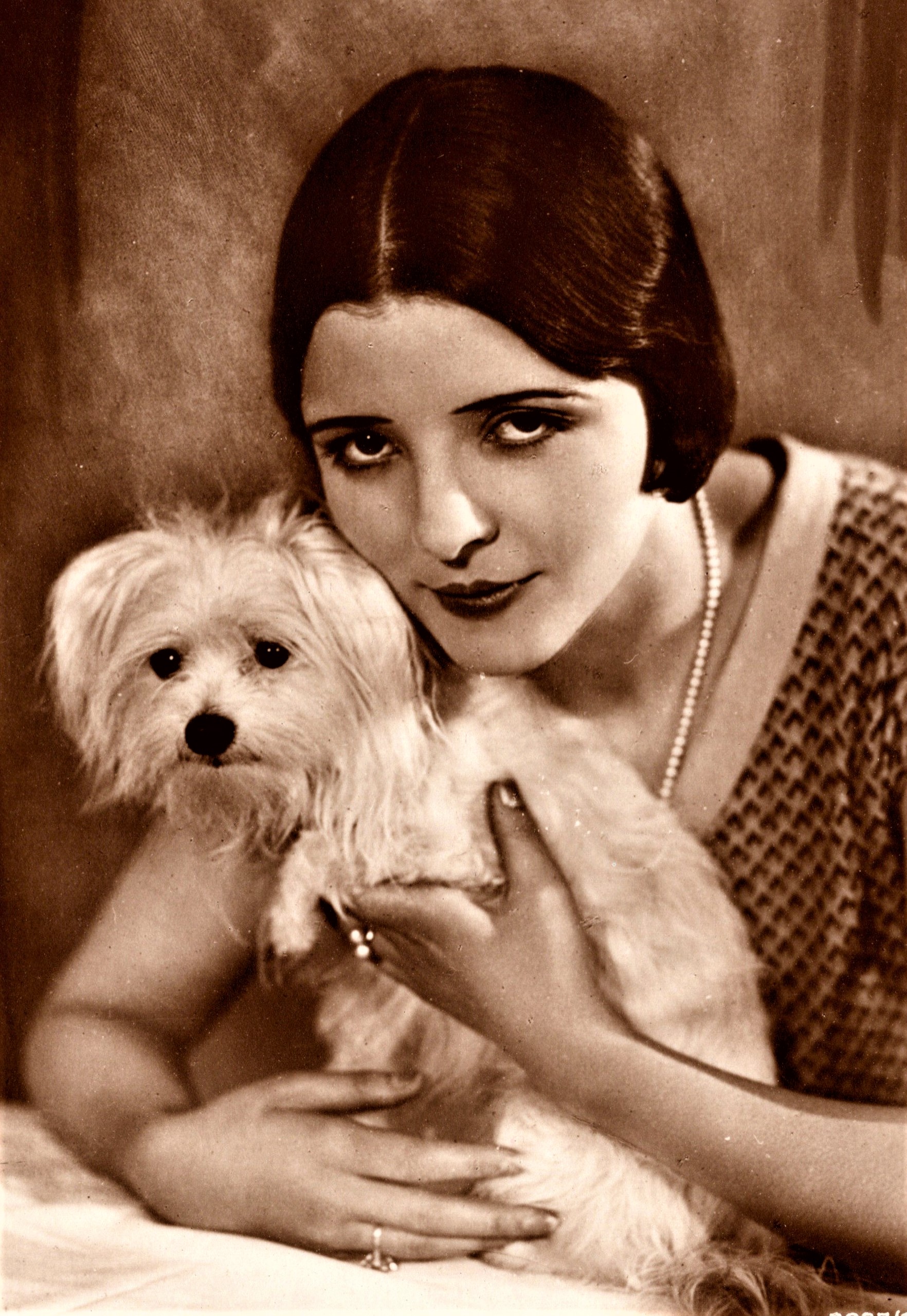
This uncommon vintage real photo postcard features actress Mona Maris (1903-1991). The postcard was published by Ross Verlag (No.3887/1). The photograph is from the Hanni Schwarz studio. Schwarz was a German female photographer and her work was praised in “American Photography” (1909). She was a well known professional photographer in Germany during the early 1900’s. She is thought to have worked until the 1930’s. The subject of this photo, Mona Maris was born in Argentina. Her mother was Spanish Basque and her father was French Catalan. At the early age of four, Mona was orphaned. She grew up with her grandmother in France where she was educated in a convent as well as in Germany and England. At age 19, she spoke four languages. It was during World War I that Mona decided to be an actress. While she was in school in France, she and her classmates wrote, directed and acted in plays to entertain nearby troops. Upon graduation, she went to England to live, where she stayed two and a half years. She was introduced to the President of the United Film Association by the Argentinian ambassador to Germany. She was signed to a five year contract by Germany’s Universum Film AG productions. She began her film career in either 1924 or 1925. After just four films in Germany, she began a Hollywood career in United Artists “The Apache” (1925). Despite knowing multiple languages, the onset of sound films created a problem. Her English was described as “almost unintelligible”. Between 1931 and 1941, she starred in 19 Spanish language versions of successful American films. The movies were produced by Fox Films. She has been described as “sultry” and “sleepy eyed”. The IMDb credits her with 53 film roles between 1925 and 1984. Mona was married twice and had no children. She died and was buried in Buenos Aires, Argentina. This vintage postcard features Mona Maris posing with an adorable smoll dog. Maris is very pretty. Note her eyes. They have been compared to Bette Davis’s eyes. (SOLD)
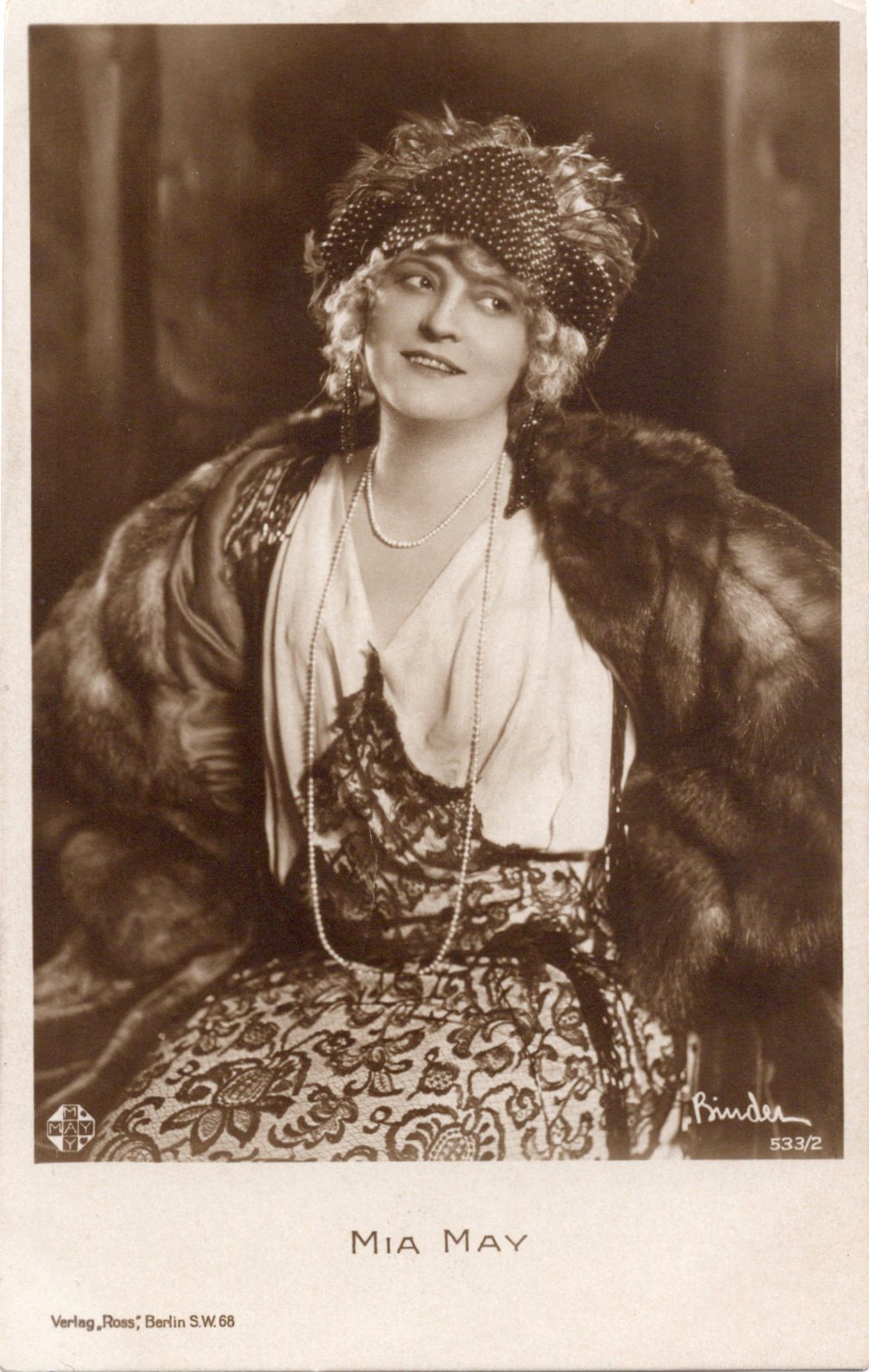
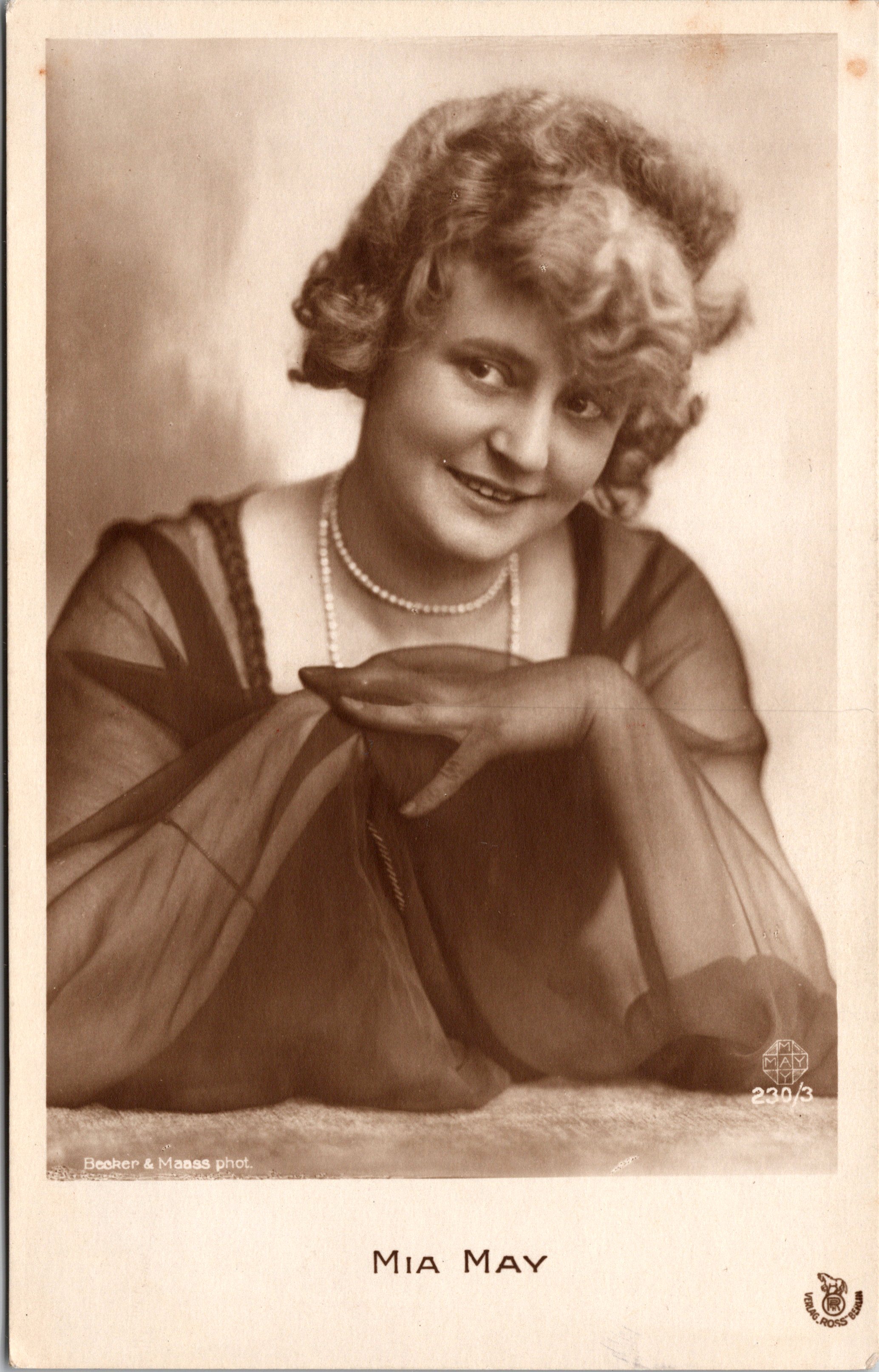
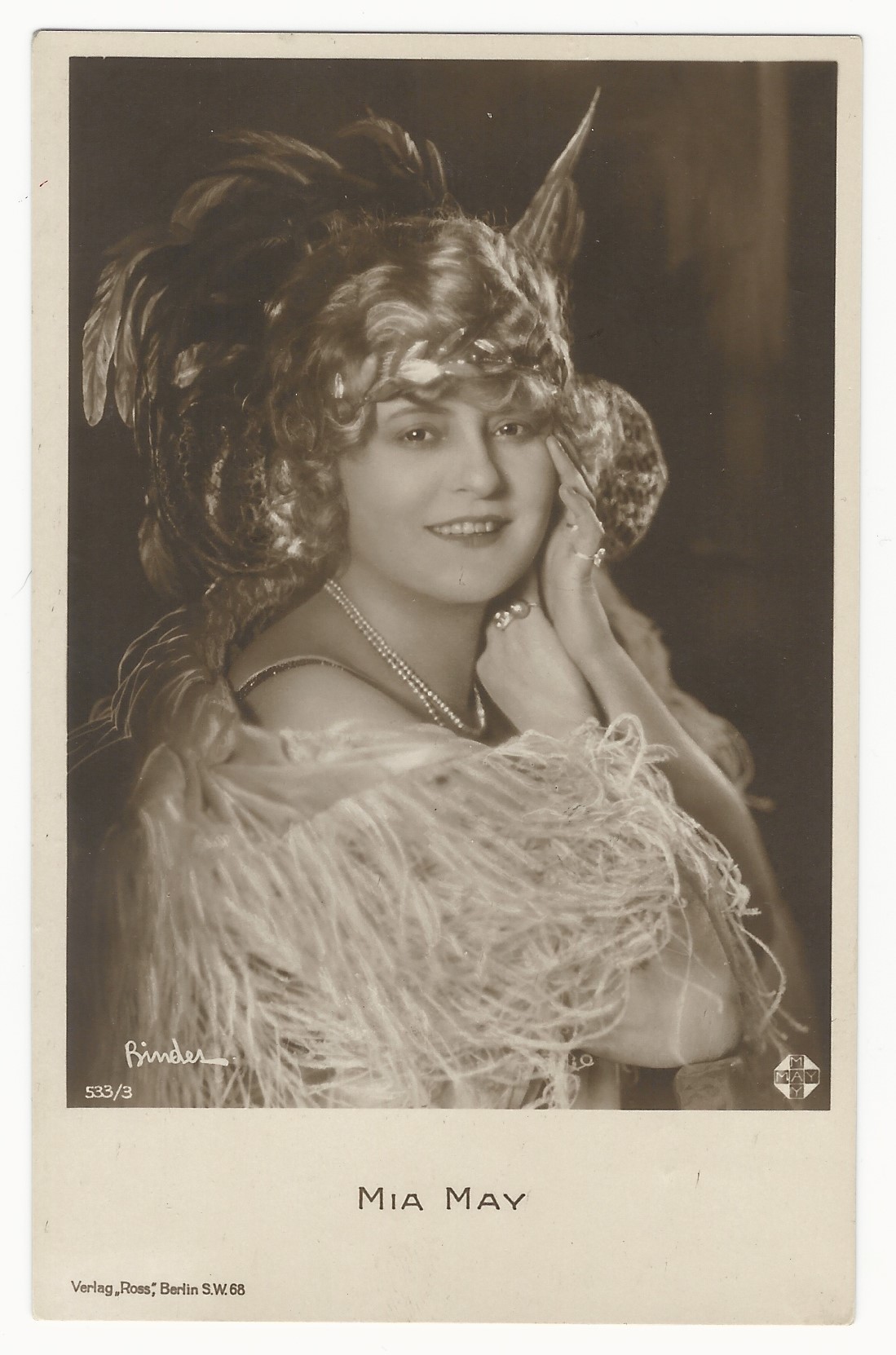
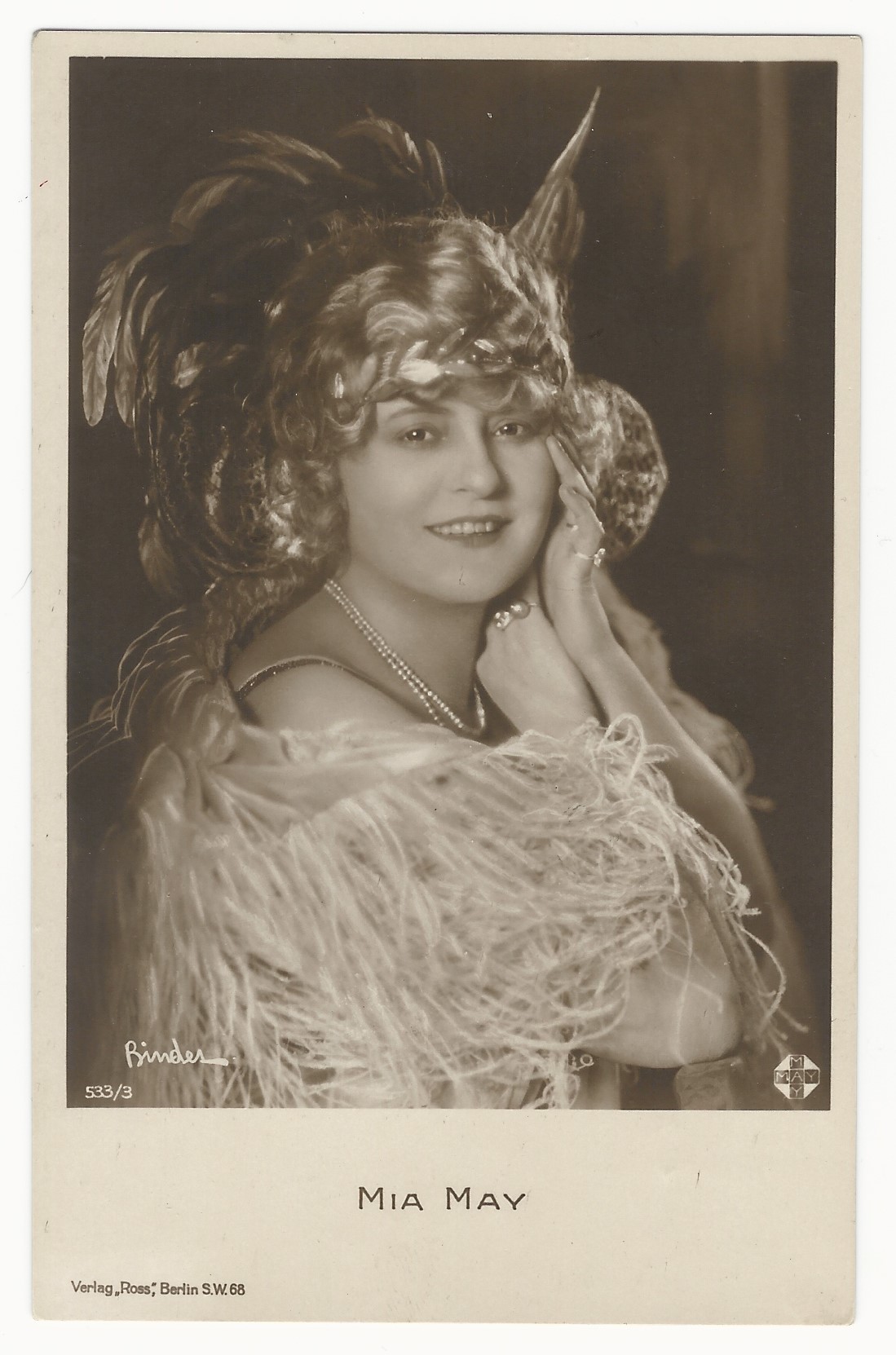
These vintage real photo postcards feature pretty Austrian actress Mia May (1884-1980). She was born in Vienna, the daughter of a baker. Her older sister was Mitzi Telmont (1879-1958), also an actress. Mia’s stage debut was when she was five years old. She played child roles until reaching age fourteen. As a teenager she appeared as Herma Angelot and performed as an actress and singer. While a high school student, she took ballet lessons. At age 18, she married Austrian, Julius Otto Mandl. The couple’s baby (Eva Maria Mandl) was born seven weeks later. Mia’s husband changed his name to Joe May, upon his entry into the film business. He became a successful film producer and director. This is how Eva adopted her performer name. She appeared in 44 films between 1912 and 1924. Mia’s daughter, Eva May, also became an actress. In 1912, Joe, Mia, and Eva moved to Berlin, where Joe worked as a film director. In 1912 he directed Mia in a film that launched her acting career. By 1914, little Eva May made her screen debut. Joe began his own film company, May-Film Gmb, in 1915. Mia took the position of Managing Director. In 1918, Mia wrote a screen play for “Your Big Secret”. Her movie career flourished in the 1910’s and early 1920’s. From 1919 to 1920 she was the star of an eight part film series (serial) called “Mistress of the World”. Mia reached a level of popularity equivalant to Asta Nielsen, Pola Negri, and Henny Porten. In 1923, she appeared in a film with a young Marlene Dietrich. Mia stated that Marlene Dietrich was “funny and engaging, attractive and original.” She added, “no man could resist her”. Mia May’s last film appearance was in “The Love Letters of Baroness S” (1924). She retired that same year after her daughter Eva committed suicide. In 1933, after seeing the Nazis gaining power, Mia and Joe May fled to America. The couple opened a restaurant (Blue Danube) in Los Angeles but it failed.
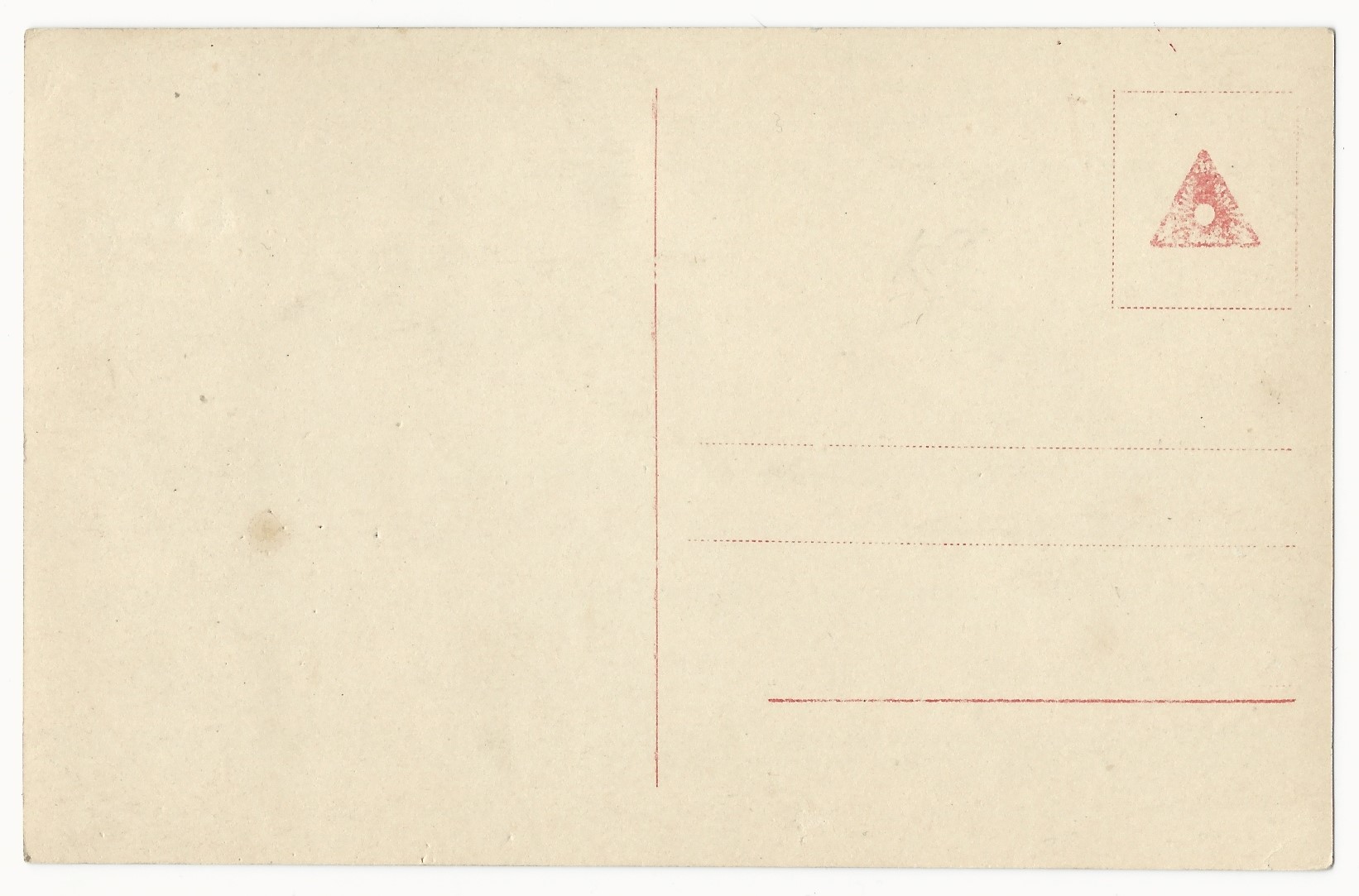
The photo portrait of Eva May seen Postcard 1 was taken by Alexander Binder. The photographer of this terrific image was Alexander Binder (1888-1929). He had the largest photo studio in Europe during the late 1920’s and the 1930’s. Many of his entertainment star portraits appear on Ross Verlag postards. It is thought that Binder was of Swiss origin. He was of the Jewish faith. He studied engineering but did not complete his studies. From 1908 to 1910 he studied photography at a school in Munich, Germany. After the completion of his photography studies, he went to Berlin and in 1913 opened his first photography studio. Before long, he became one of the premier photographers in Berlin. He primarily focused on fashion and celebrity photography. Since Berlin was the capital of the European film industry, Binder photographed all the stars of the European film industry including, Lilian Harvey, Conrad Veidt, and Lya De Putti. Many of his images were used in popular film portrait postcards. His photographs could be seen in postcards published by Ross Verlag and Photochemie. Binder died in 1929 but new photo cards bearing his signature continued to be published until 1937. It is thought that the real photographer of these new postcards was Hubs Floeter (1910-1974) who was employed at the studio as an operator. The studio continued to be owned by Binder’s widow, Mrs. Binder Alleman and their two daughters. The studio was managed by the Jewish Elisabeth Baroness Vonhedlis Stengel who was later deported to the Theresienstadt concentration camp. In 1938 the Nazi’s closed Binder’s studio and it was later taken over by an Aryan photographer, Karl Ludwig Haenchen . The postcard was published by Ross Verlag (Berlin) as part of a series (no533/3). Note the “May” logo in the lower right corner of the image. Miss May was working for May-Film at the time this photograph was taken. The stamp box seen on the reverse of this postcard has an interesting story attached to it. “NBC” (Neue Bromsilber Convention) was a price cartel established in 1909 that continued until the 1930’s. The purpose of the cartel was to ensure that the minimum price charged for postcards was kept at a sufficiently profitable level. A number of postcard publishing companies joined the cartel in an effort to stave off the effect of competition on the pricing of postcards. This vintage real photo portrait postcard has excellent clarity and is in very good condition (see scans).
Postcard 2 was also published by Ross Verlag. Once again, the photographer is Alex Binder. The postcard is part of the same series (533/2) as Postcard 1. The “May” logo can be seen on the bottom left corner of the image. This unposted postcard is in good condition (see scans).
Postcard 3 was published by Ross Verlag (Berlin) as part of a series (no230/3). Note the “May” logo in the lower right corner of the image. Miss May was working for May-Film at the time this photograph was taken. This vintage real photo portrait postcard has excellent clarity. The postcard has small stains in it’s top right corner. Overall, the postcard is in Good Condition (see scans)
Buy this original Vintage Real Photo Postcard (includes shipping within the US) #3356
To purchase this item, click on the Pay with PayPal button below
$20.00
Buy this Vintage Real Photo Postcard (includes International shipping outside the US) 3356
To purchase this item, click on the Pay with PayPal button below
$29.00
Buy this Vintage Real Photo Postcard (includes shipping within the US) #3715
To purchase this item, click on the Pay with PayPal button below
$13.39
Buy this Vintage Real Photo Postcard (includes International shipping outside the US) 3715
To purchase this item, click on the Pay with PayPal button below
$22.39
Buy this Vintage Real Photo Postcard (includes shipping within the US) #5113
To purchase this item, click on the Pay with PayPal button below
$13.74
Buy this Vintage Real Photo Postcard (includes International shipping outside the US) 5113
To purchase this item, click on the Pay with PayPal button below
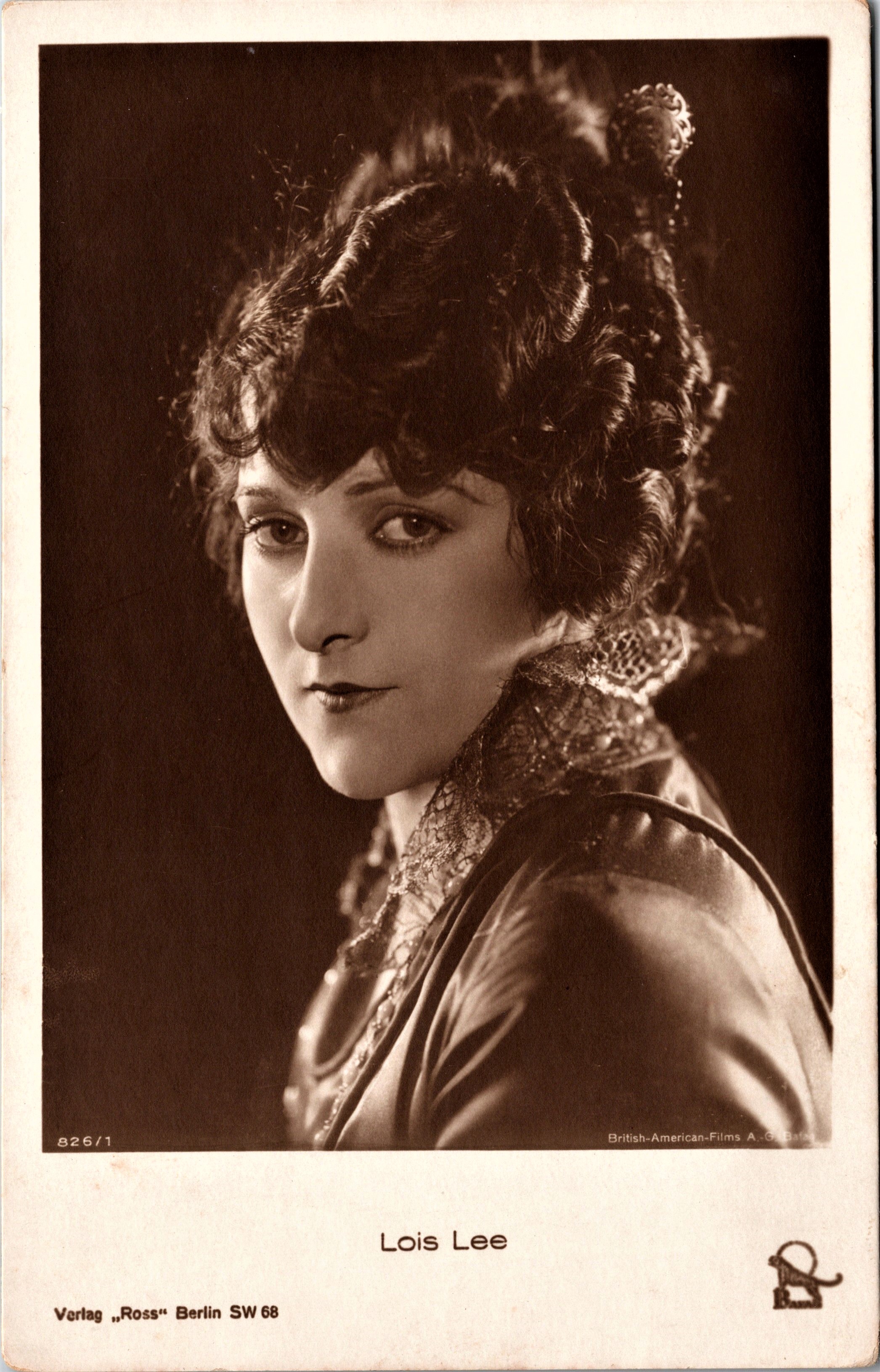
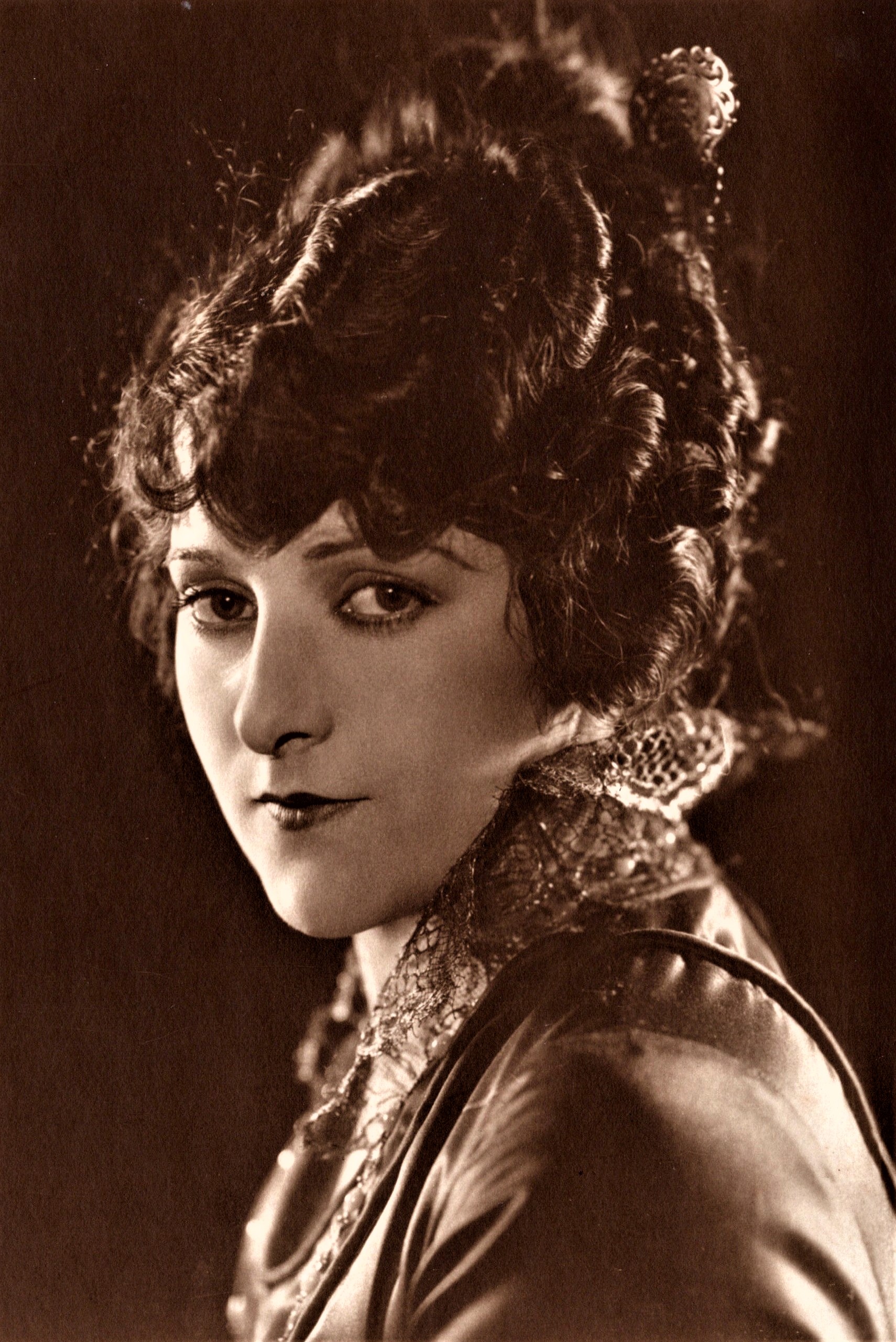
This uncommon vintage real photo postcard features beautiful American film actress, Lois Lee (1892-1967). She is most well known for “The Lincoln Highwayman” (1919), “The Phantom Melody” (1920), and “The Prisoner of Zenda” (1922). Her IMDb filmography includes 4 credits between 1919 and 1922. This portrait of Miss Lee was taken to promote her appearance in “The Prisoner of Zenda”. The photo was taken in 1921. Lee was married to comedian and actor, Harvey Stone. This postcard was published by Ross Verlag as part of a series (No.826/1). Note the British-American-Film logo in the lower right hand corner of the image. Lee was under contract with the company at the time the photo was taken. (SOLD)
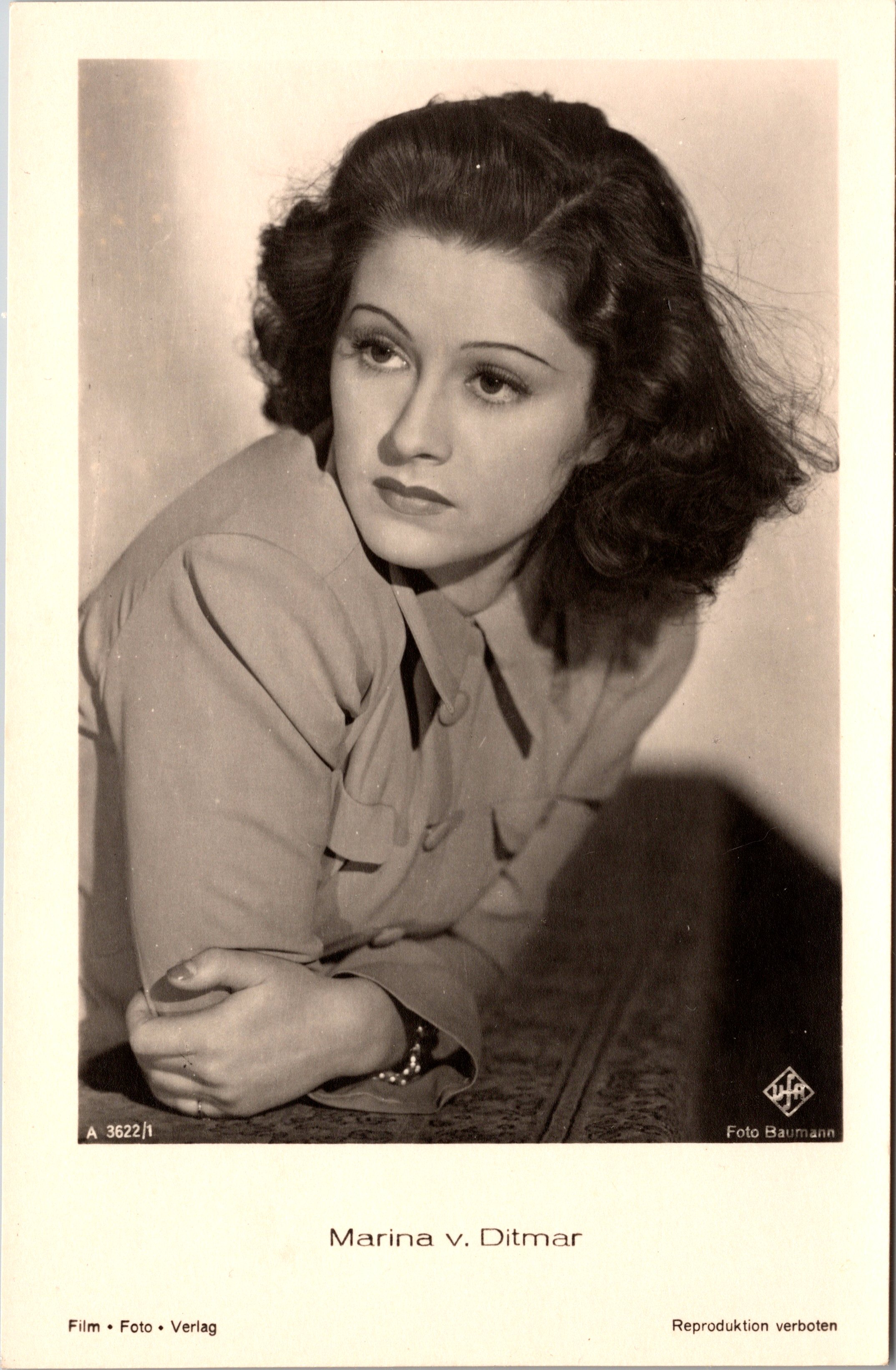
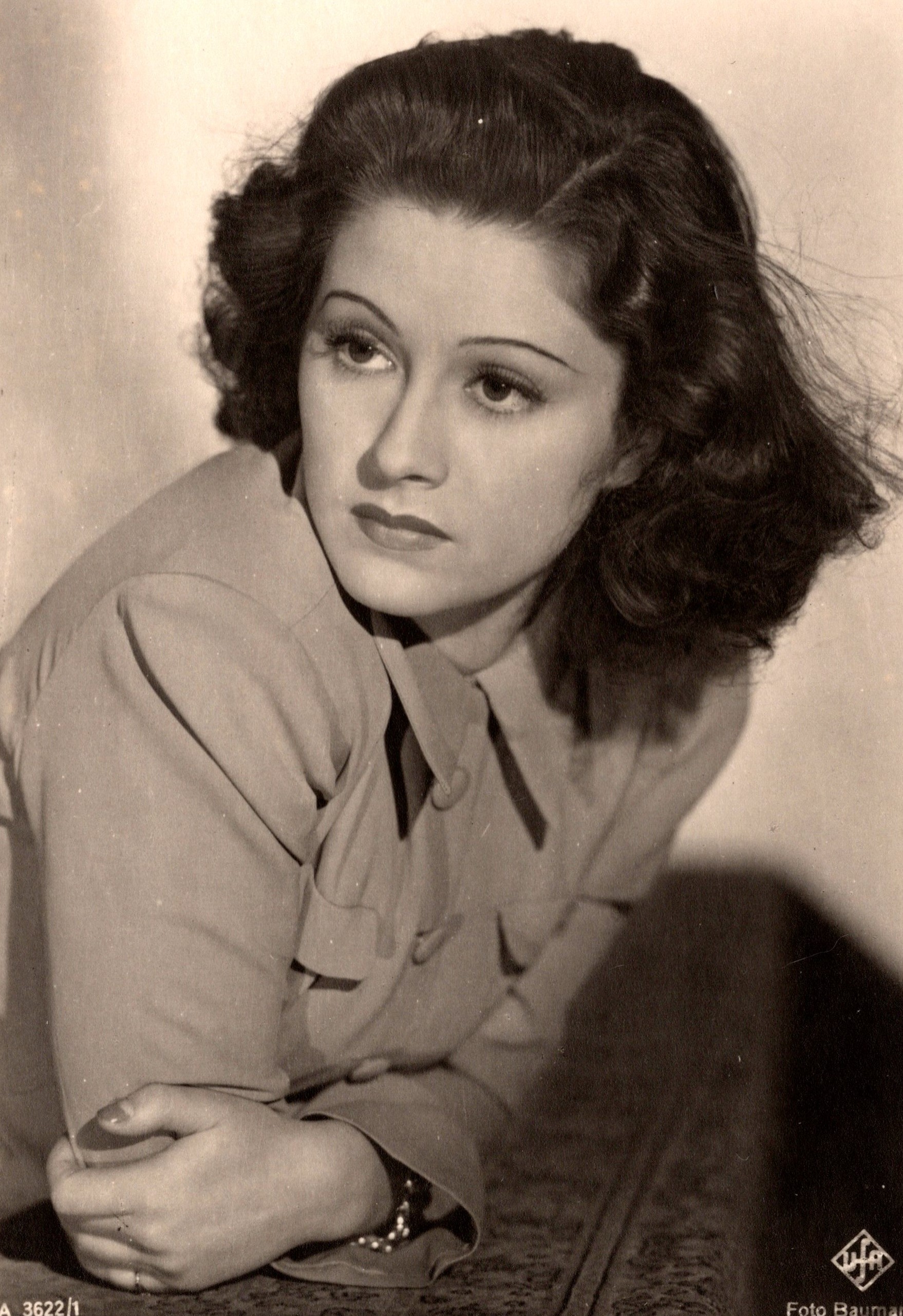
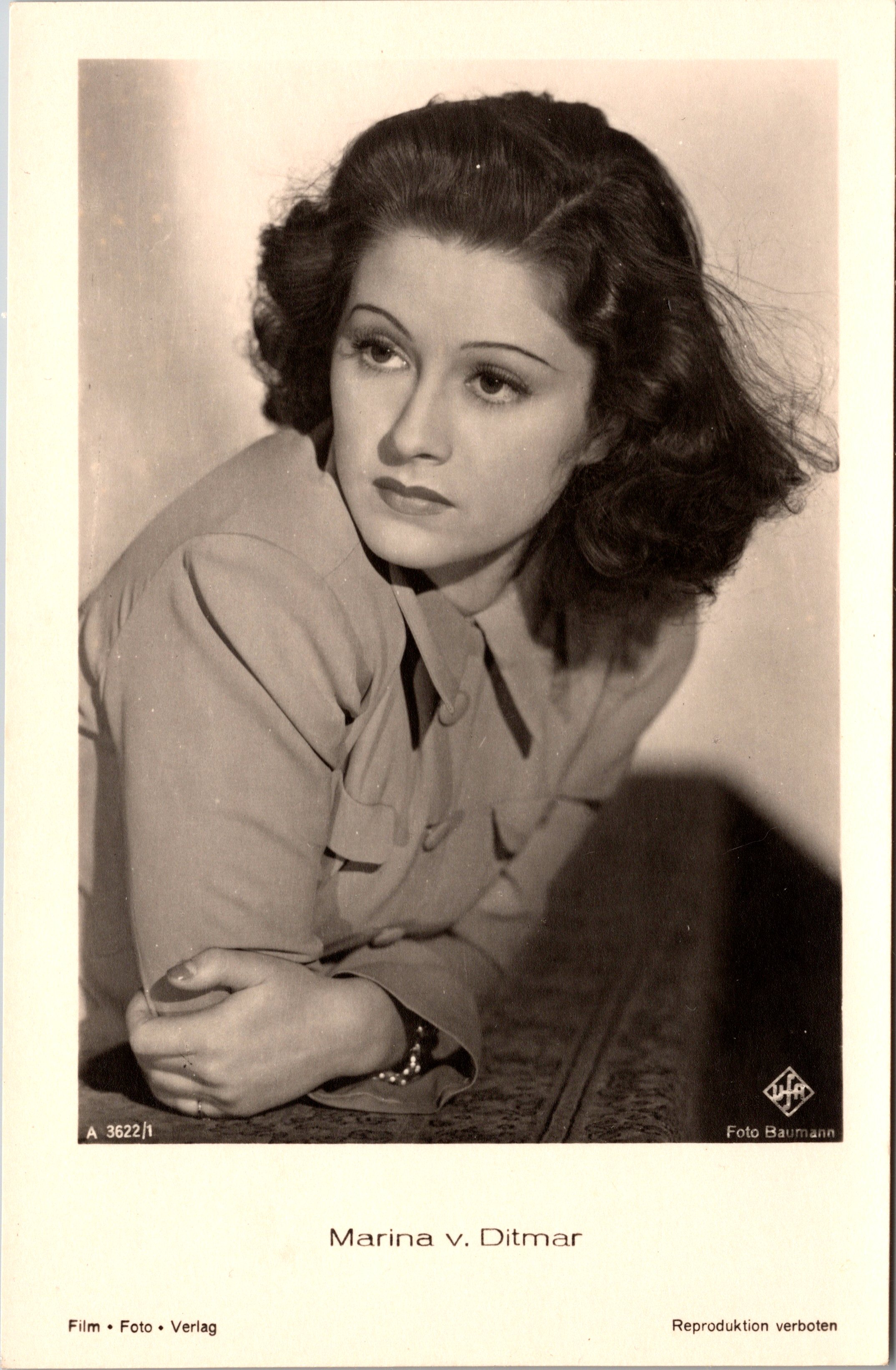
This real photo postcards feature German film actress Marina von Ditmar (1914-2014), a leading lady of the 1930’s and 40’s. . She was born in the Russia Empire and was of Baltic German descent. When she moved to Germany she studied acting. Her first roles were appearances at Schauspielhaus, Bremen, and the Altes Theater (Leipzig). In 1937 she joined the ensemble at the Volksbuhne in Berlin and by 1940, she was a permanent actress at this venue. Her first major movie success was in “The Csardas Princess” (1934). In 1943, she starred in “Muchhausen”, a film that had great commercial success. Von Ditmar was also well known for her role in “The Big Shadow” (1942). She appeared in several Nazi propaganda film including Stukas (1941). She married D. Hans-Georg Dehnhardt (1913-2001), a leading physician and owner of a sanitarium, Soon after her marriage, she retired from acting. The IMDB credits Miss von Ditmar with thirty film roles. This postcard was published by Film-Forto-Verlag and was part of a series (A 3622/1). The photographer was Baumann and there is an advertising logo for the German film company UFA. Film-Foto-Verlag published this postcard. The company became known for it’s postcard portraits of film stars of the German and Italian cinema. The company was formerly known as Ross Verlag but changed it’s name in 1941.This postcard is in excellent condition (see scans).
Buy this Vintage Real Photo Postcard (includes shipping within the US) #5017
To purchase this item, click on the Pay with PayPal button below
$7.74
Buy this Vintage Real Photo Postcard (includes International shipping outside the US) 5017
To purchase this item, click on the Pay with PayPal button below
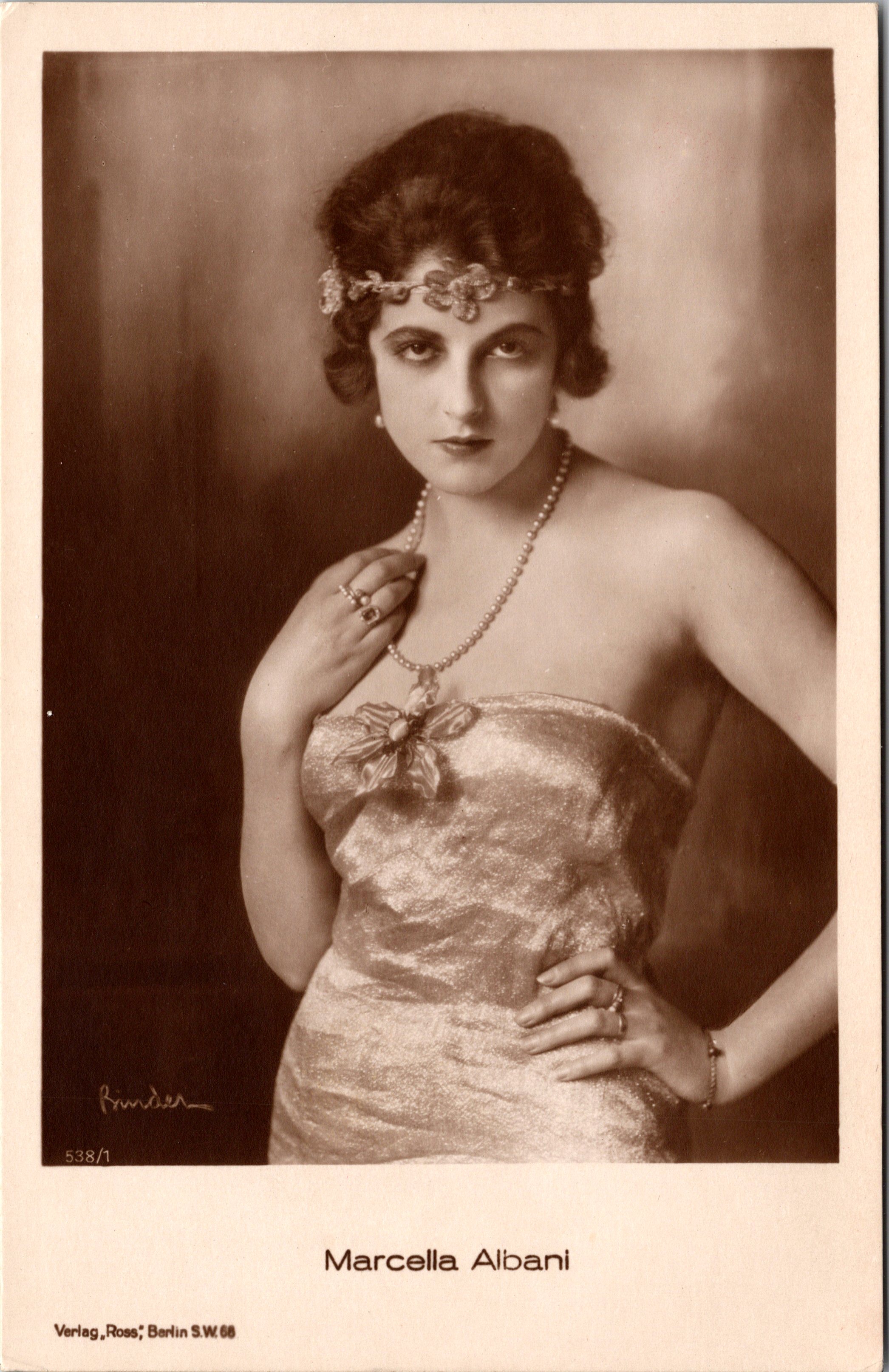
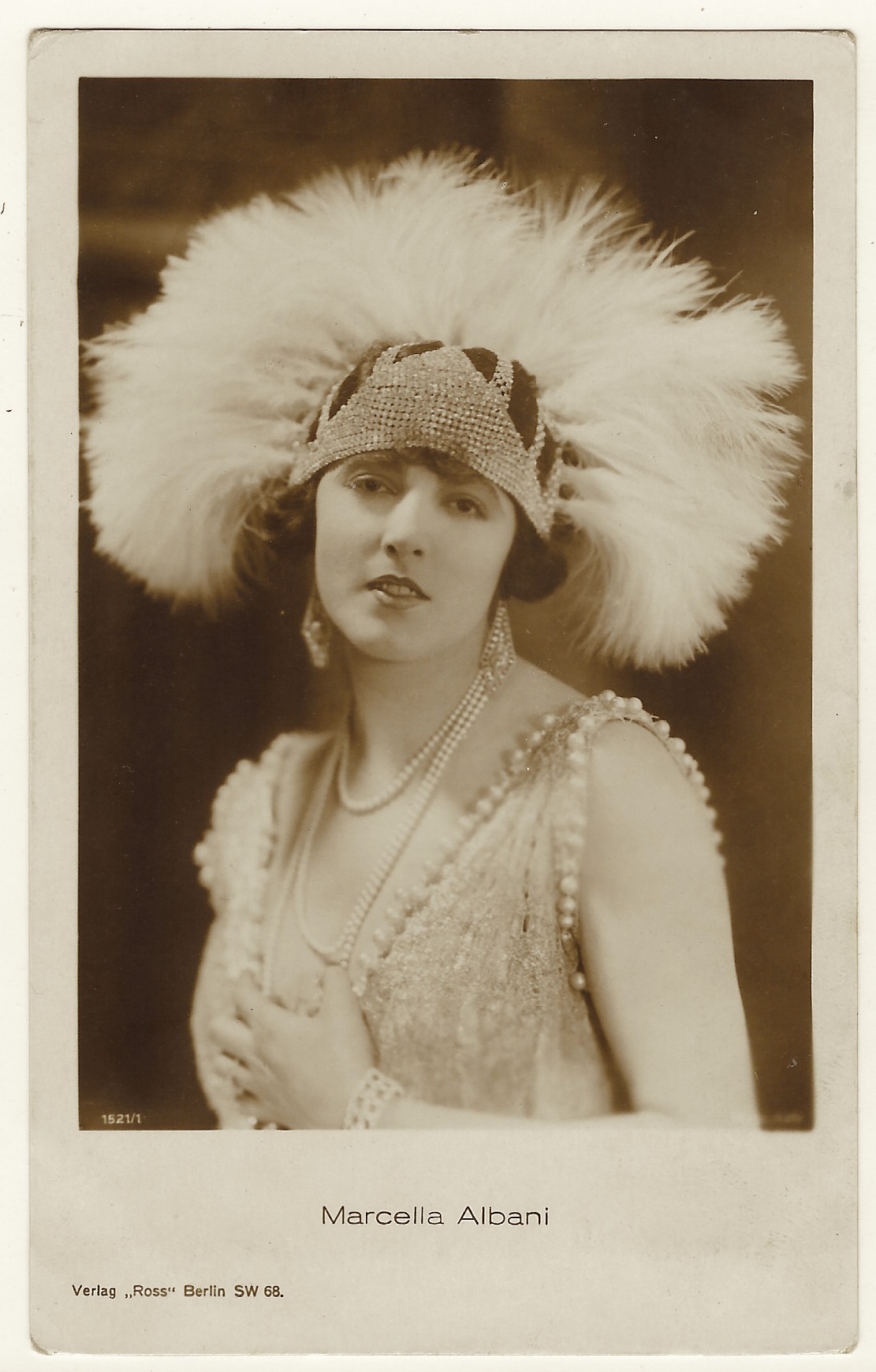
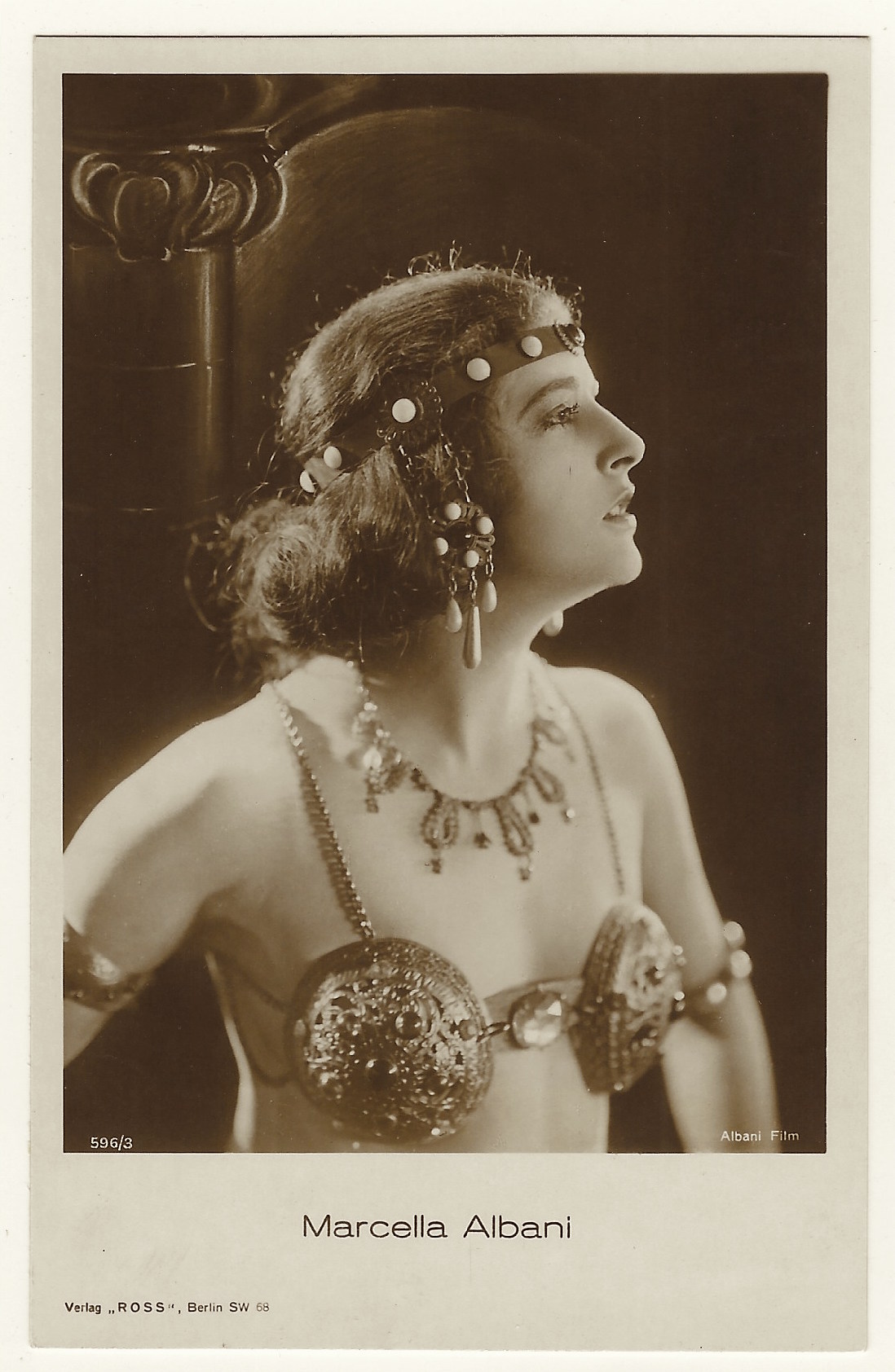
Marcella Albani (1899-1959) was an Italian film actress that appeared in 50 films between 1919 and 1936. Albani was “discovered” by writer/director Guido Parish (Schamberg) when she was twenty years old. They became a very successful film couple until 1924 when they parted ways. Their movies were predominately tear jerkers and adventure stories. The actress also worked with other famous directors such as Joe May, Friedrich Zelnik, and Wilhelm Dieterle. Albani was a major star in the European cinema in the late 1920’s. Her films were made in five different European countries. Many of Albani’s roles were portraying elegant Latin beauties. At the advent of sound movies, Miss Albani turned to writing. One of her several novels was turned into a movie. She continued to act until 1936. Albani was married to director Mario Franchini in 1931.
Albani certainly looks elegant, sensual, and beautiful in thisPostcard 1portrait. She is dressed exquisitely. The postcard image is a bit risque for it’s era. This postcard was published by Ross Verlag of Berlin, Germany. The postcard is part of a series (no. 538/1). This portrait of Miss Albani was taken by celebrity photographer, Alexander Binder. (SOLD)
In the photograph seen onPostcard 2, Albani again looks elegant, and beautiful. Her hat is a fashion statement in itself. The card is of German origin and published by Ross Verlag of Berlin. The postcard is part of a series (no. 1521/1). The photo is by Aafa film. According to one reliable source, the postcard was issued sometime between 1927 and 1928. (SOLD)
Postcard 3 features a beautiful risque portrait of Miss Albani. The publisher of this postcard is also Ross Verlag of Berlin, Germany. The postcard is part of a series (no. 596/3). Printed on the postcard is the name “Albani Film”. The company was a film production and distribution firm and was active in 1934. (SOLD)
Postcard 4 accentuates the beauty of Miss Albani. The portrait is artistic and risque. This postcard was published by Ross Verlag as part of a series (no.596/4). Print in the bottom right hand corner of the image states “Albani Film”. (SOLD)
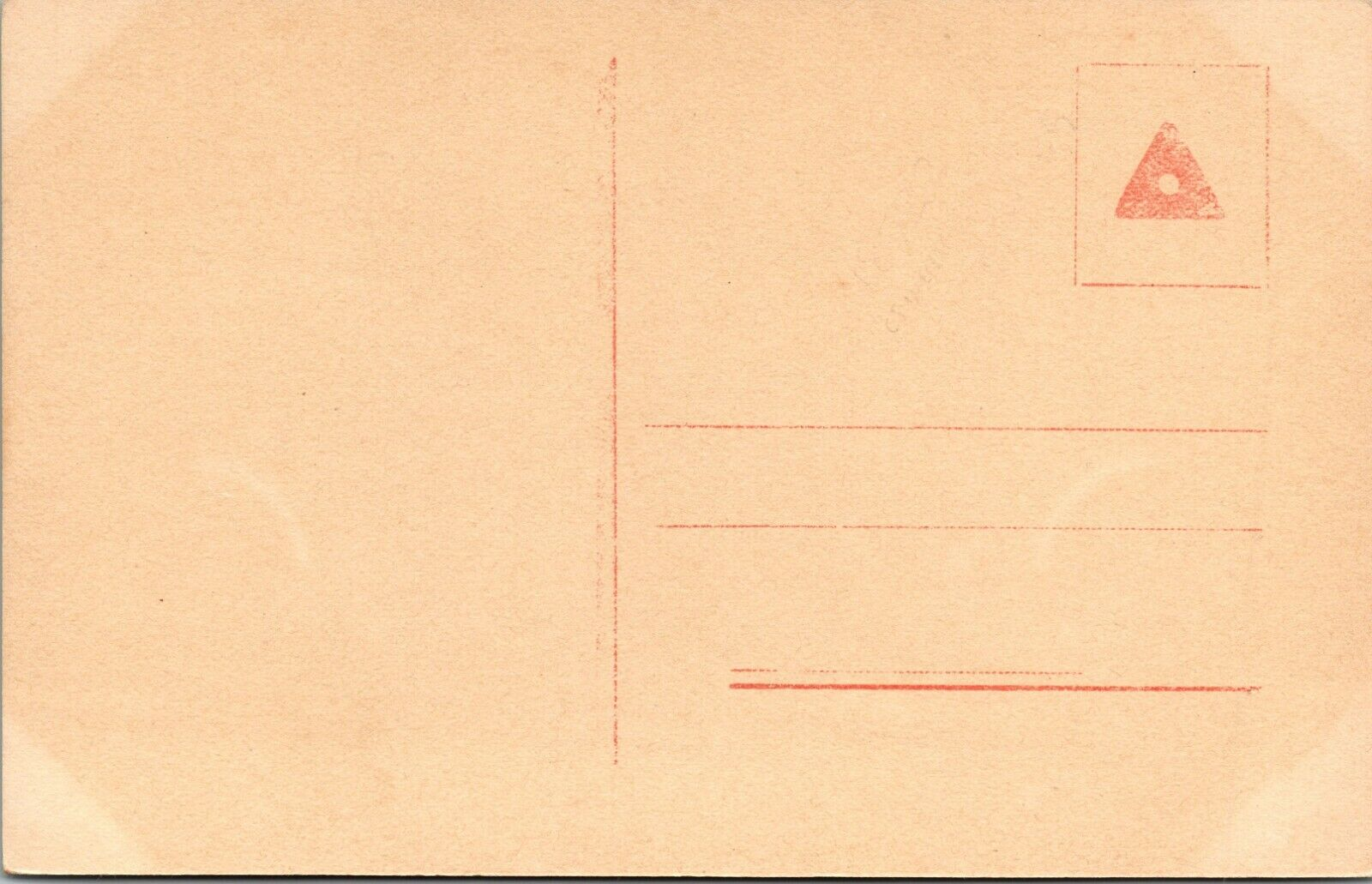
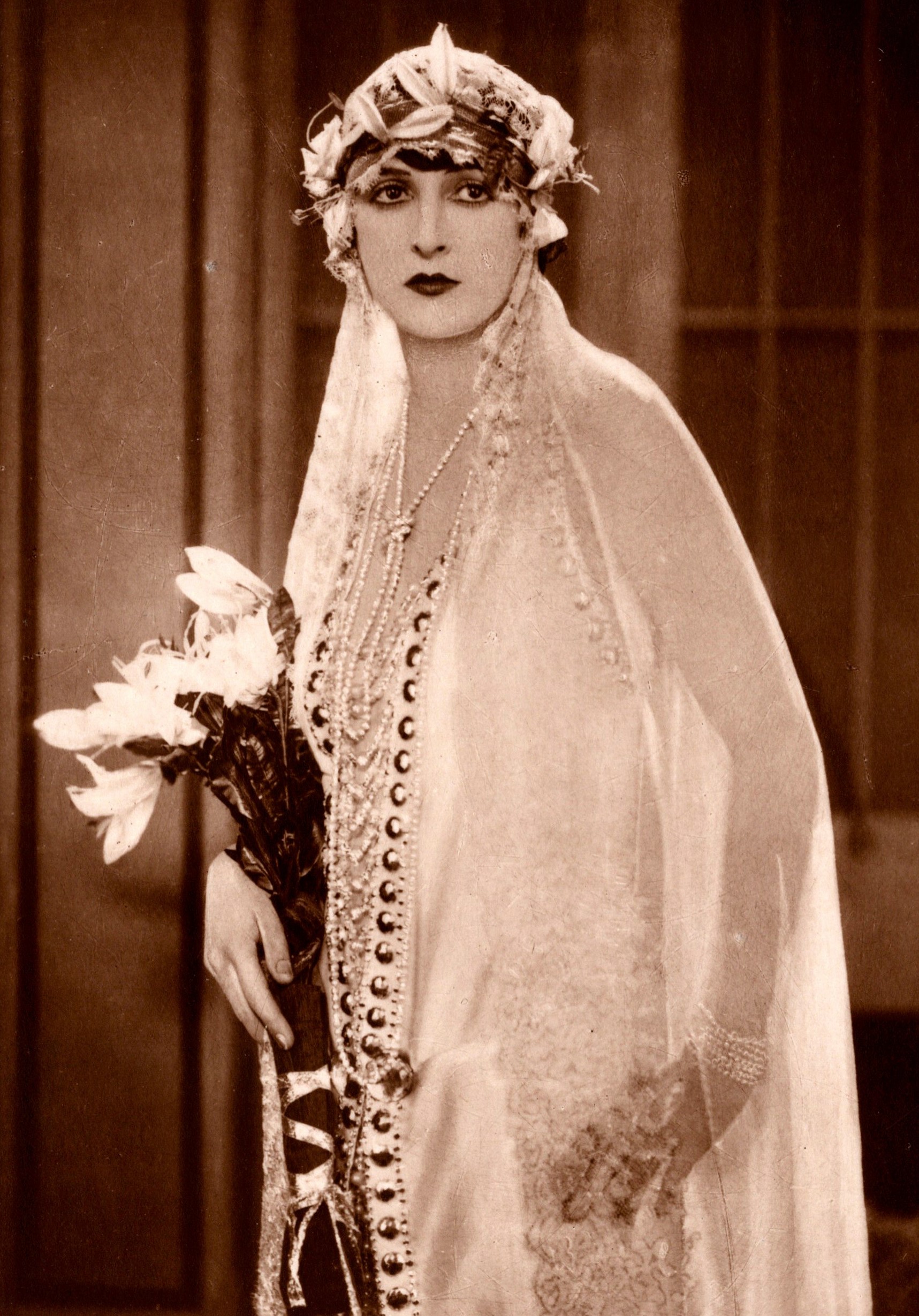
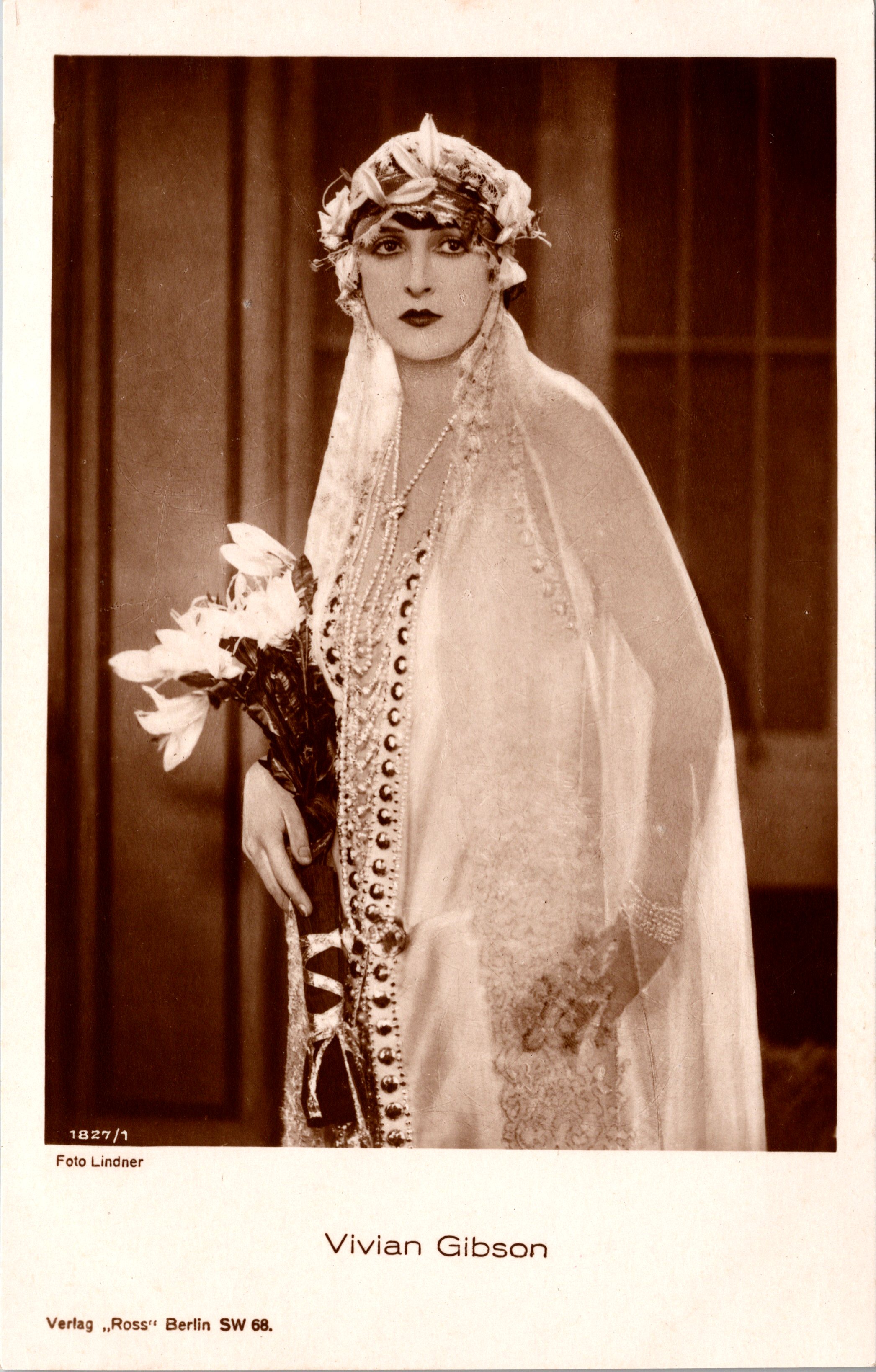
This vintage real photo postcard features British born Austrian film actress, Vivian Gibson (1898-1981). Her early education included dance training. She is most associated with “Tense Moments From the Opera” (1922), “The Man Who Sold Himself” (1925), and “The Gypsy Baron” (1927). She began her film career in England, she also appeared regularly in German productions. Although she was a sucess in silent film, she was unable to make the transition into sound films. She retired and went to Vienna where she authored books. Little is known about her private life beyond that she never married. The IMDb gives Gibson 57 film credits between 1916 and 1932. This vintage postcard was published by Ross Verlag (Berlin, Germany) as part of a series (No.1827/1).Gibson’s portrait for this card was taken by the Lindner studio. He was probably a German photographer but I could not confirm his background. This postcard is in excellent condition (see scans).
Buy this Vintage Real Photo Postcard (includes shipping within the US) #3863
To purchase this item, click on the Pay with PayPal button below
$17.64
Buy this Vintage Real Photo Postcard (includes International shipping outside the US) 3863
To purchase this item, click on the Pay with PayPal button below




 POSTCARD 2 (SOLD)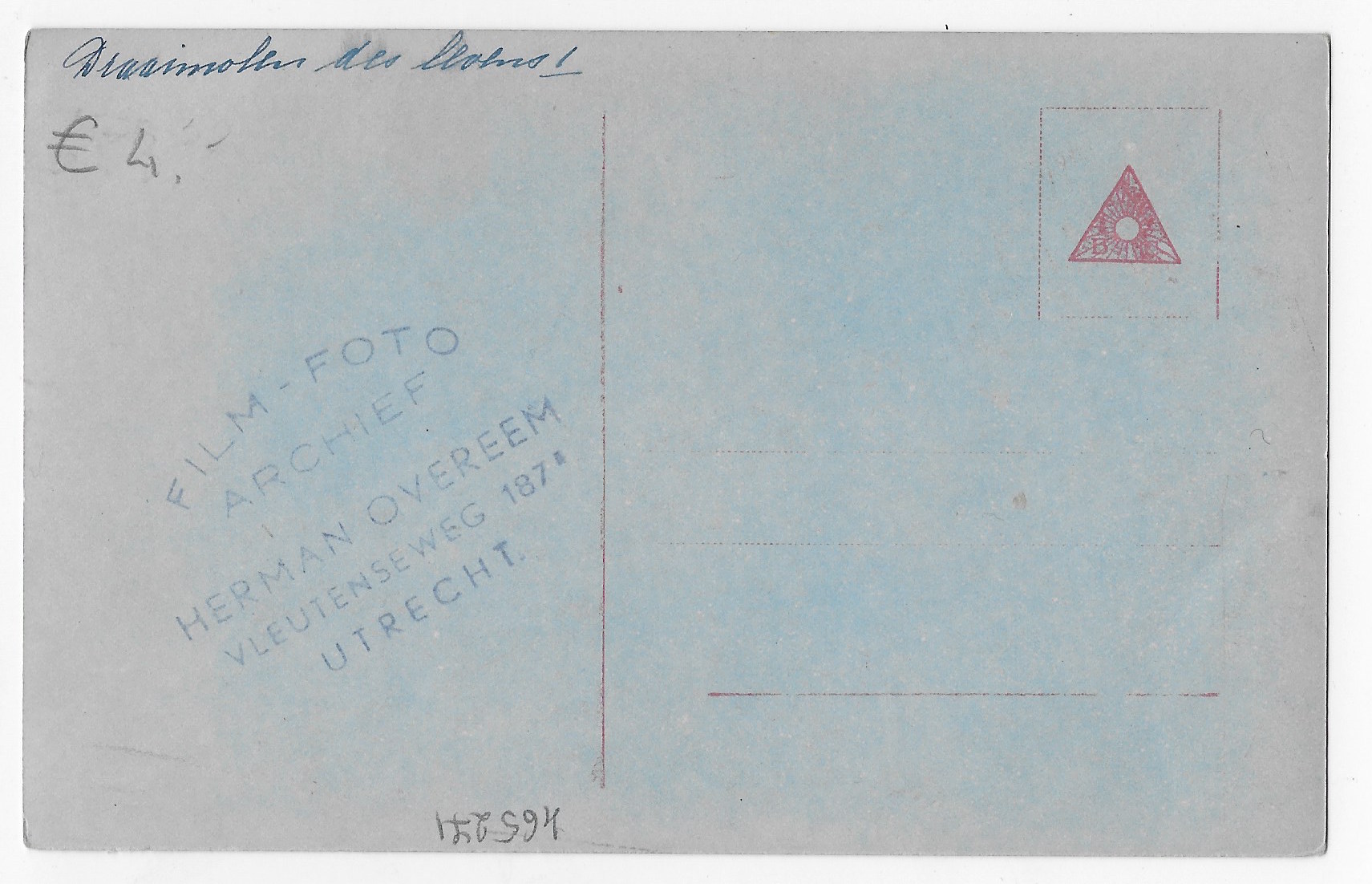






 POSTCARD 2 (SOLD)
 POSTCARD 3 (SOLD)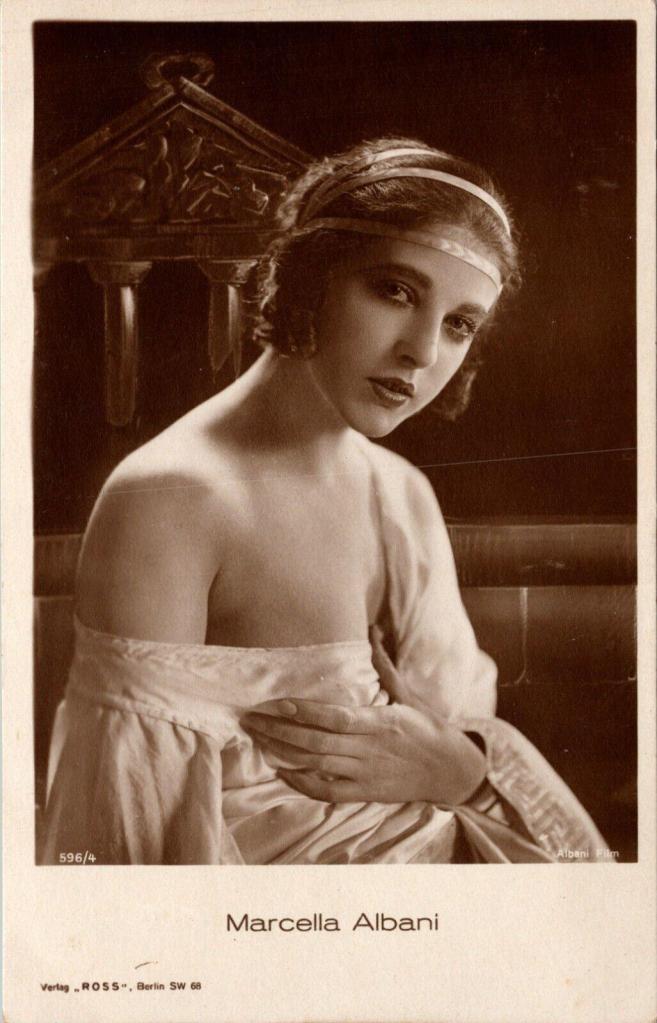
 Postcard 2
 Postcard 3



 THE CABINET CARD GALLERY