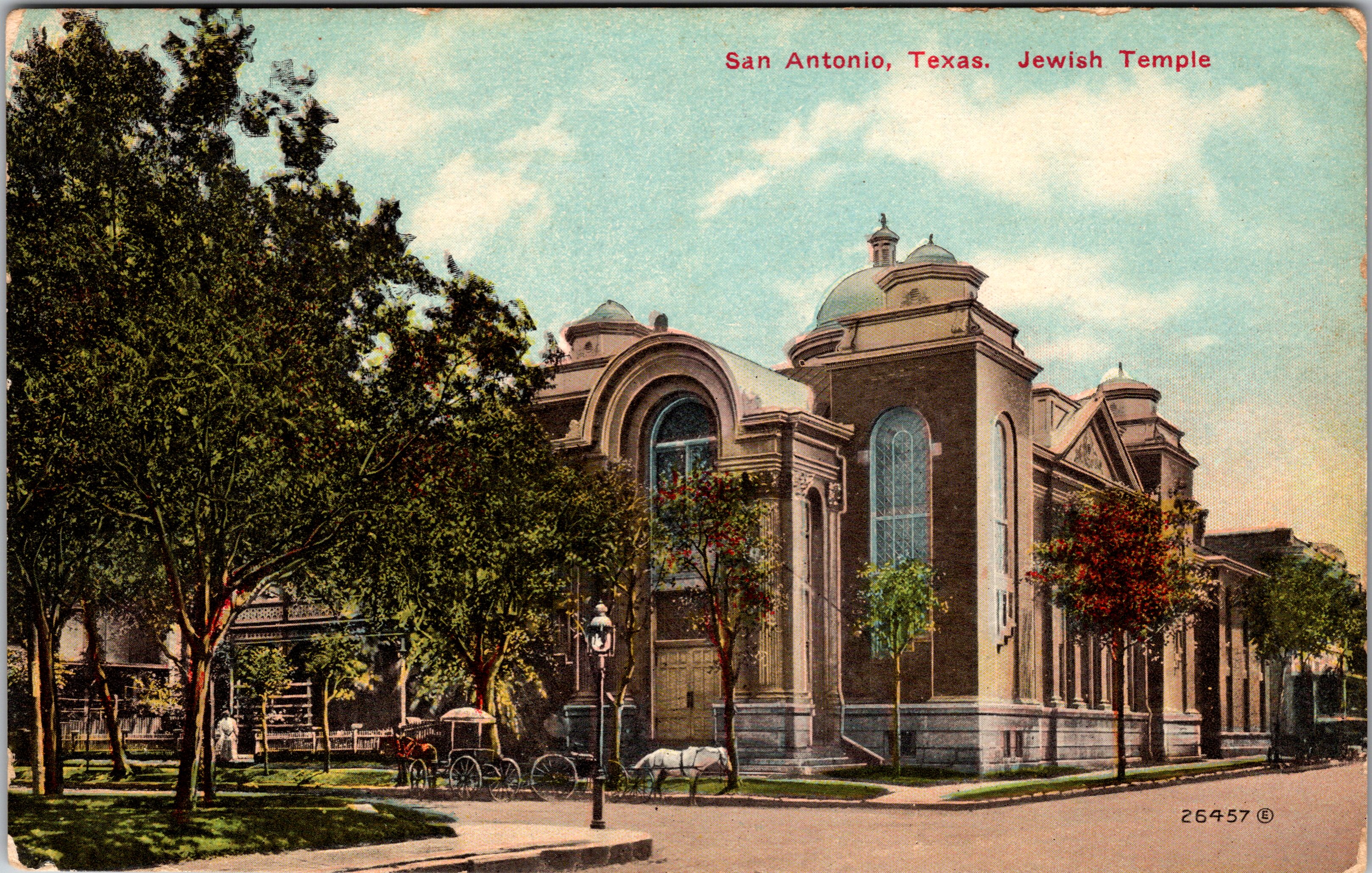
This vintage lithographic postcard features a Jewish Temple, located in San Antonio, Texas. Note the two horse and carriages at the curb in front of the temple. The temple appearing on this postcard is “Temple Beth El”. The congregation was founded in 1874 and its first temple was opened in 1875. Many of the temple’s members were German immigrants who came to Texas in the 1850’s and 1860’s. In 1903, the congregation opened another temple to replace the first which was outgrown. The second temple, built on the site of the first, is pictured on this postcard. The second temple was replaced in 1927. This postcard is from the 1900’s or 1910’s. It was published by Paul Ebers, located in San Antonio. SOLD
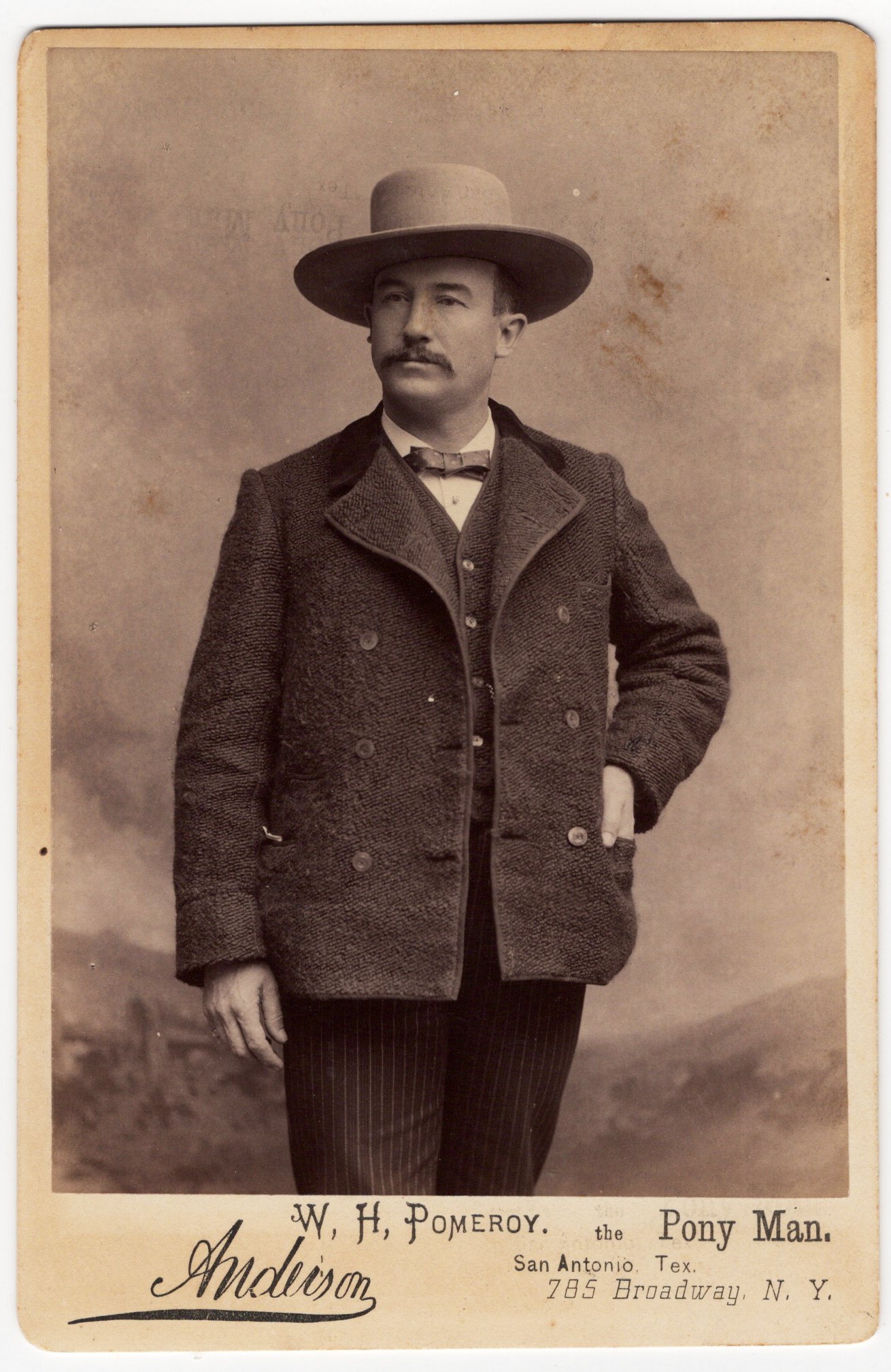
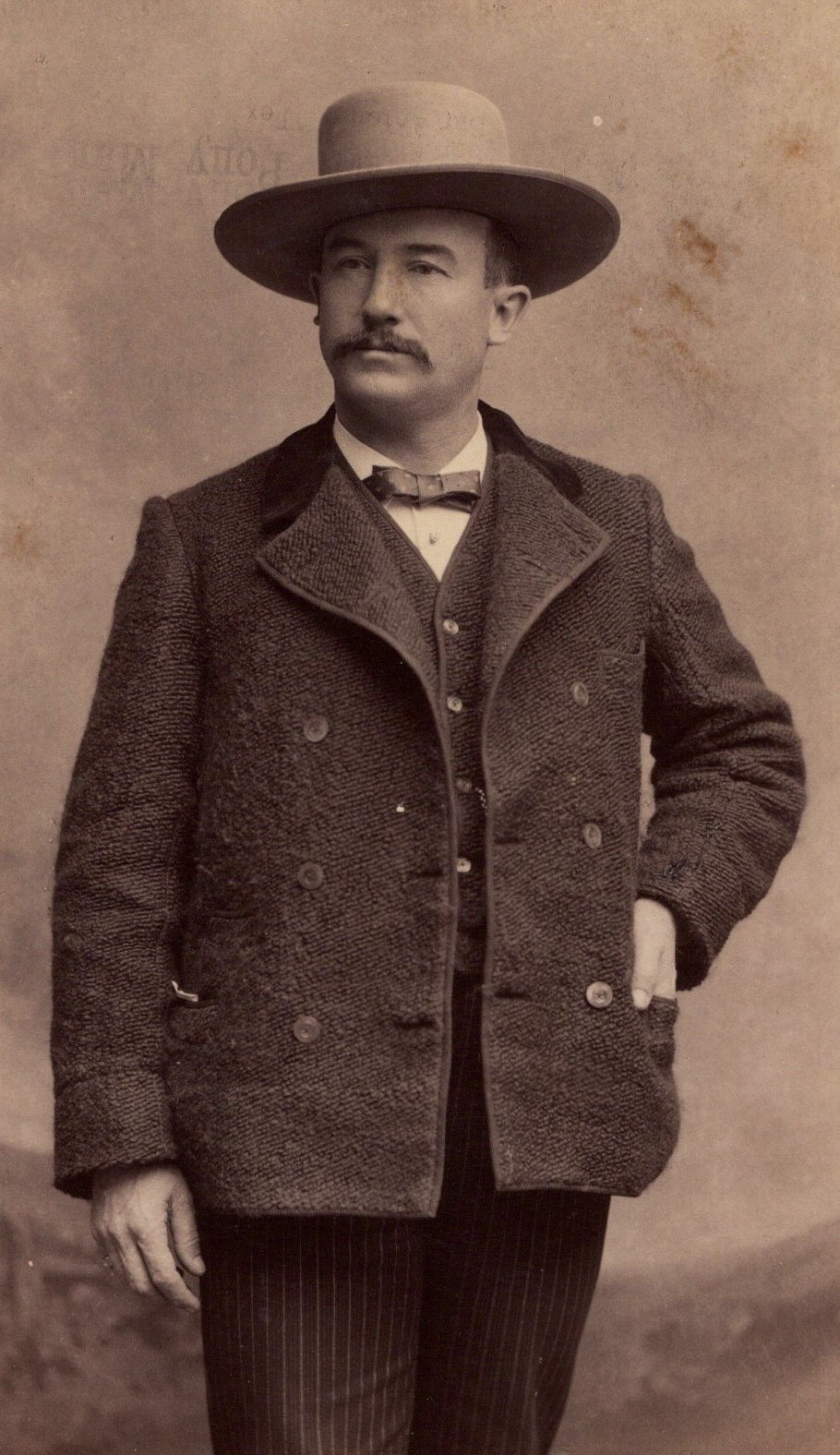
This cabinet card photograph features a handsome man posing for his portrait at the Anderson studio in New York City. A caption under the image identifies him as “W. H. Pomeroy, the Pony Man”. The caption also indicates that Pomeroy was from San Antonio, Texas. During the late 1880’s, Pomeroy owned “Pomeroy’s Western World Troupe” and “Pomeroy’s Western World Show”. Both were Wild West shows. The show was composed of more than 100 people and 125 horses, ponies, donkeys, and mules. The show also included a ten piece band. In 1891, Pomeroy partnered with Max Samuels, from San Antonio, to found a circus. The circus was called “Pomeroy & Samuel’s Great International Railroad Shows”. Pomeroy is well dressed and sports a nicely trimmed mustache. in this photograph. He is wearing a coarse wool coat and a matching waist coat. He is dressed in a crisp white shirt accentuated by a small silk bow tie. Atop his head is a flat crowned felt planter hat. There is something peeking out of his left jacket pocket. Mr. Pomeroy is posing in front of a backdrop. The photographer of this image was D. H. Anderson who operated a studio on Broadway in New York City. Anderson used the same photo studio formerly occupied by the famed photographer, Matthew Brady. Anderson had worked in various other American cities before moving to New York in 1881. He became known as a talented celebrity photographer. This photograph has an interesting aberration. If you look very closely in the sky next to the left side of his hat (slightly above the brim), you can see the words “Pony Man”. The words are very light and upside down. This developing error occurred more than one hundred years ago. SOLD
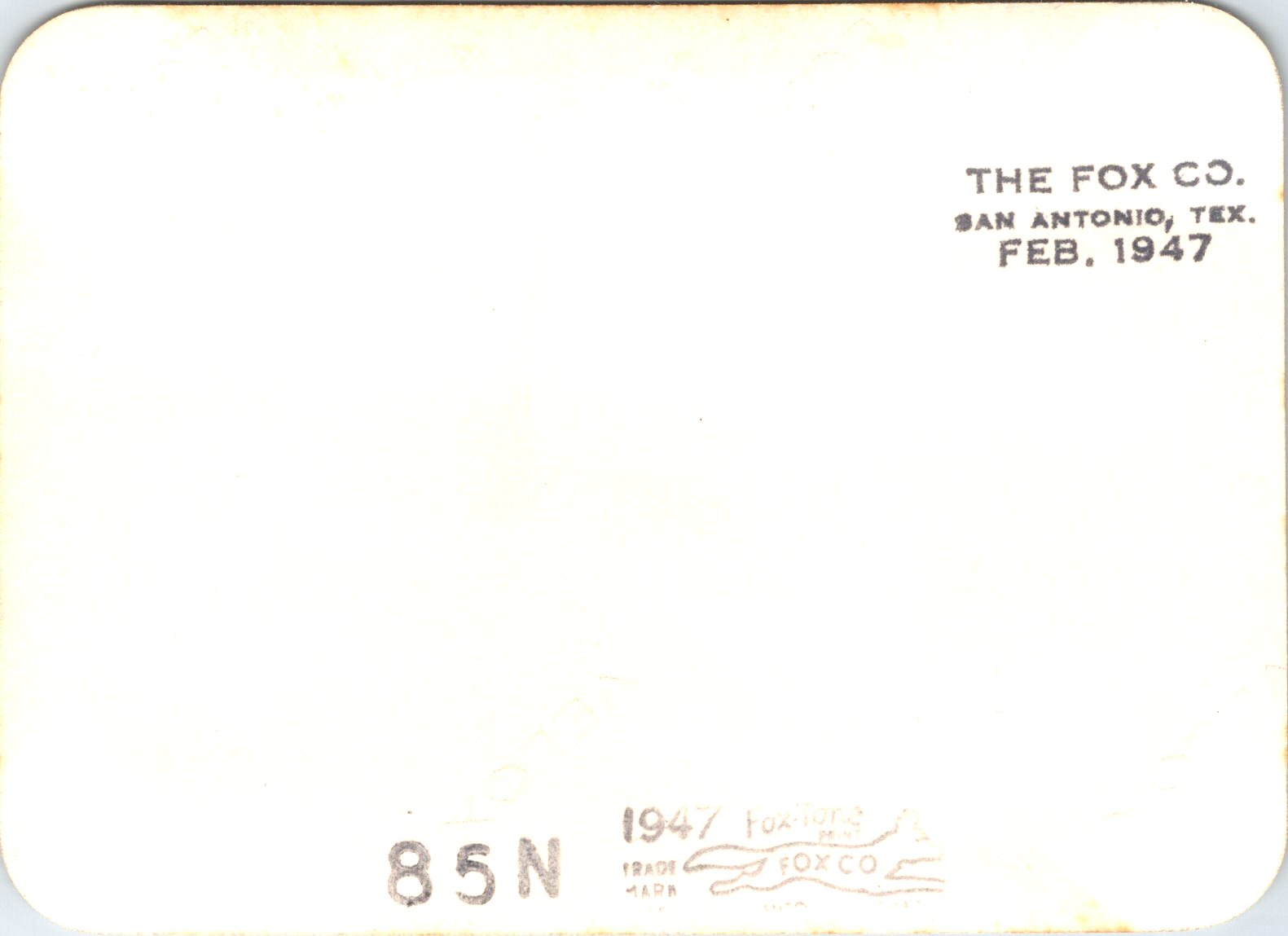
This vintage photograph features two young men standing next to their automobile. One of the men has a hand on his hip and he is appearing very confident and comfortable in front of the camera. This photo was purchased with a group of photos that were purchased in the Texas Hill Country. Some of the photos in the group were definitely taken in Texas. It is likely that this photograph was taken in Texas too. This image was developed by Foxco in San Antonio in 1947. The company has an interesting history. The Fox Photo Studio was opened by Arthur C. Fox in 1906 in San Antonio, Texas. Fox sold the studio for seven hundred dollars to Carl D. Newton in 1909. Newton was a clever entrepreneur. One of his gimmicks was to offer a free camera to anyone buying three rolls of film and prepaying developing and printing fees. His successor to the business was Carl D Newton II. By the mid 1930’s Fox advertised itself as the world’s largest Kodak finishers. Their processing plant was in operation around the clock. The company expanded and opened facilities in Dallas, Houston, Louisiana and Oklahoma. The company grew and grew and ultimately reached 12,000 dealers nationwide. In 1986, the company was sold to Kodak. Carl D Newton III kept the retail division of the business, calling it Fox Photo. Later, the business changed hands a number of times until it faded into history. SOLD
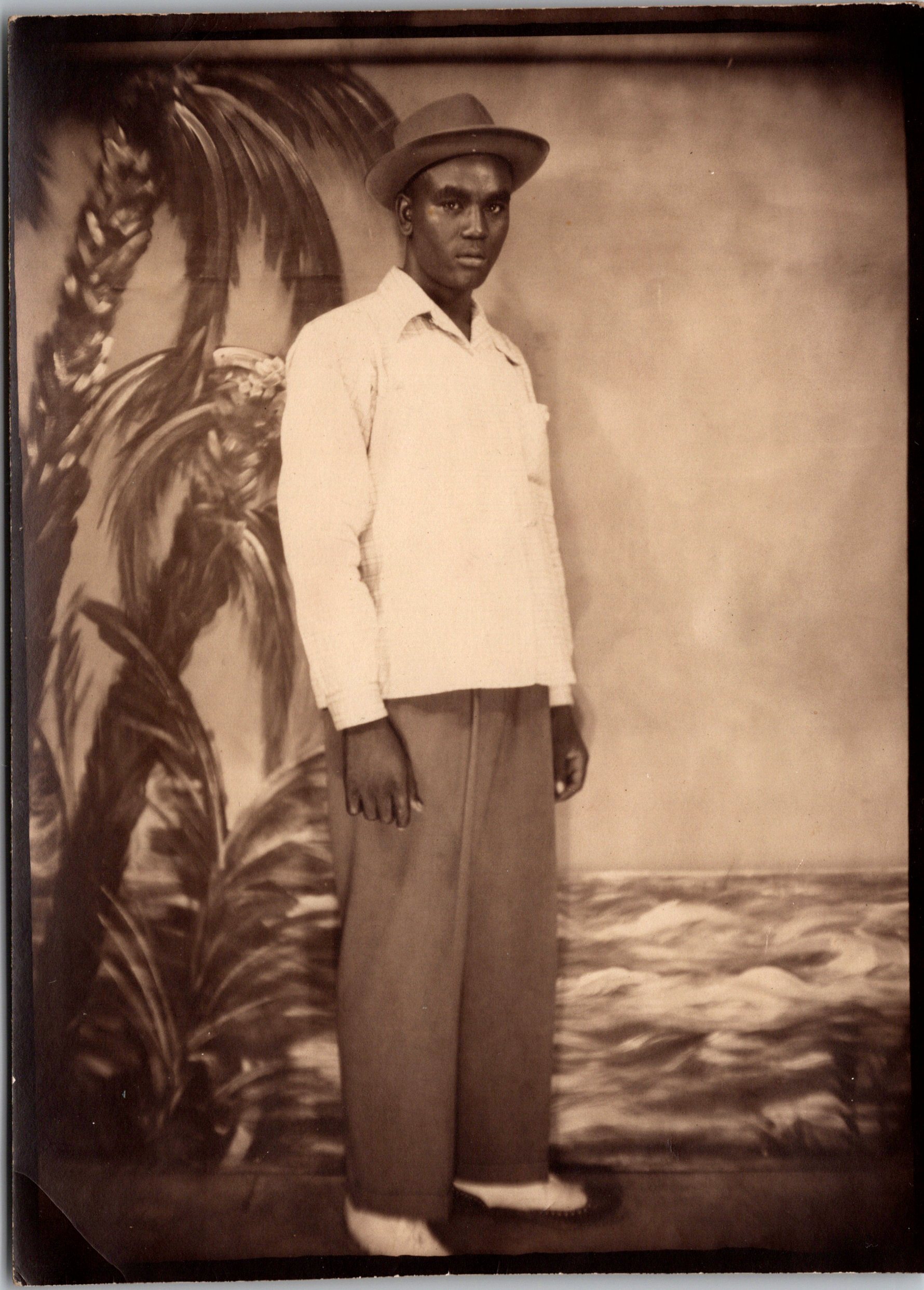
This vintage photograph features a nicely dressed African American man posing for his portrait at an unidentified photography studio. I found this photograph in San Antonio, Texas. The photograph measures about 3″ x 4 1/8″. SOLD
This photograph features a uniformed soldier standing in a farmer’s field and posing behind his bicycle. This photo was found in a shop in the Texas Hill Country. It was part of a group of Foxco images from the mid 1940’s. This photograph was developed by Foxco of San Antonio. The company has an interesting history. The Fox Photo Studio was opened by Arthur C. Fox in 1906 in San Antonio, Texas. Fox sold the studio for seven hundred dollars to Carl D. Newton in 1909. Newton was a clever entrepreneur. One of his gimmicks was to offer a free camera to anyone buying three rolls of film and prepaying developing and printing fees. His successor to the business was Carl D Newton II. By the mid 1930’s Fox advertised itself as the world’s largest Kodak finishers. Their processing plant was in operation around the clock. The company expanded and opened facilities in Dallas, Houston, Louisiana and Oklahoma. The company grew and grew and ultimately reached 12,000 dealers nationwide. In 1986, the company was sold to Kodak. Carl D Newton III kept the retail division of the business, calling it Fox Photo. Later, the business changed hands a number of times until it faded into history. The photo measures about 3 1/4″ x 2 1/4″. (SOLD)
Four young couples pose in front of a dusty car that is parked on a dirt driveway. Three of the women stand in front of a man, likely their beaus. The fourth woman is keeping her distance from the fellow who stands behind her. The three men who are standing behind the three women appear to be quite “handy”. One supposes that we are looking at a photograph of a “quadruple date”. The setting may be a Texas ranch. This photograph was found in the Texas Hill Country. Do you think these four couples arrived at this location via the car that is parked behind them? If so, the seating must have been quite crowded. The image was photographed by Foxco in 1946. The company has an interesting history. The Fox Photo Studio was opened by Arthur C. Fox in 1906 in San Antonio, Texas. Fox sold the studio for seven hundred dollars to Carl D. Newton in 1909. Newton was a clever entrepreneur. One of his gimmicks was to offer a free camera to anyone buying three rolls of film and prepaying developing and printing fees. His successor to the business was Carl D Newton II. By the mid 1930’s Fox advertised itself as the world’s largest Kodak finishers. Their processing plant was in operation around the clock. The company expanded and opened facilities in Dallas, Houston, Louisiana and Oklahoma. The company grew and grew and ultimately reached 12,000 dealers nationwide. In 1986, the company was sold to Kodak. Carl D Newton III kept the retail division of the business, calling it Fox Photo. Later, the business changed hands a number of times until it faded into history. This photo was taken somewhere near San Antonio. The photo is printed on paper thinner than stock used for cdvs or cabinet cards. This photograph measures about 3 1/4″ x 2 1/4″ and is in good condition (see scans).
Buy this original Vintage Photograph (includes shipping within the US) #2632
To purchase this item, click on the Pay with PayPal button below
$15.00
Buy this original Vintage Photograph (includes international shipping outside the US) #2632
To purchase this item, click on the Pay with PayPal button below
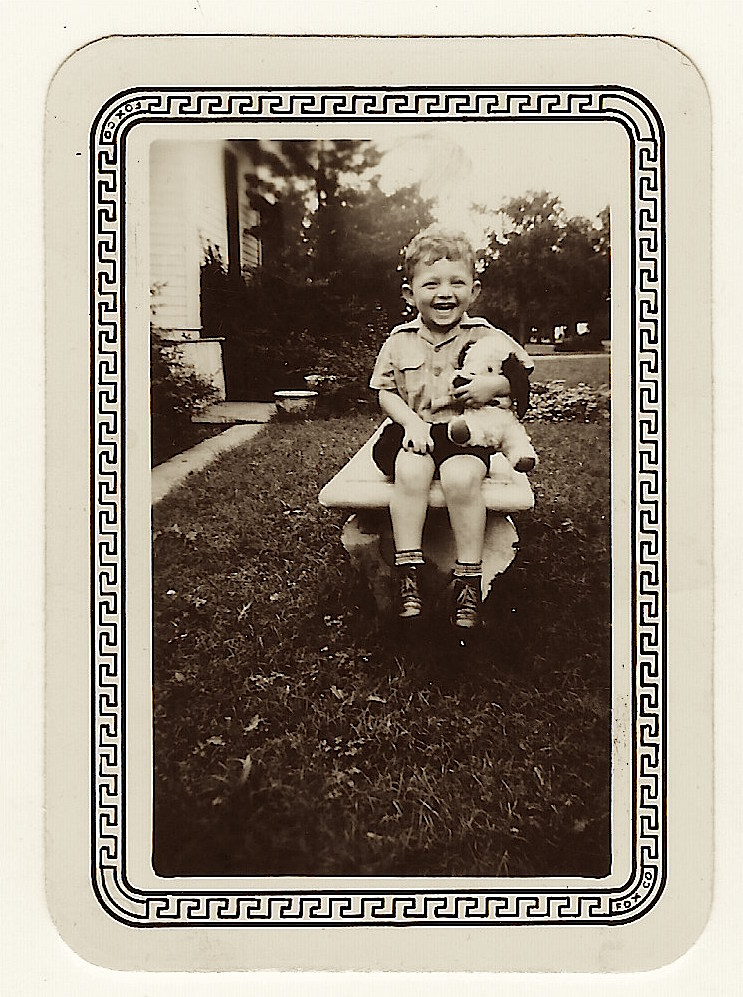
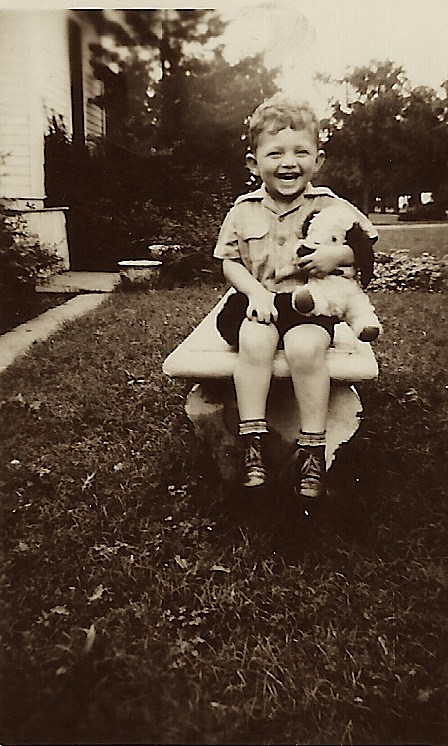
This vintage photograph features a little boy and his stuffed animal. He is sitting outside on a concrete bench. The yard in which he’s sitting is nicely landscaped. He is smiling almost ear to ear. The postcard was published by Fox Company (San Francisco) in 1944. The company was started in San Antonio, Texas, in 1906. After being bought by another company, it became the largest Kodak finishing firm. Ultimately, the company grew to 12,000 dealers nationwide. The photo is printed on paper that is thinner than stock used for cdvs or cabinet cards. The postcard measures about 2 1/8″ x 3″ and is in very good condition.
Buy this original Vintage Photograph (includes shipping within the US) #2607
To purchase this item, click on the Pay with PayPal button below
$10.00
Buy this original Vintage Photograph (includes international shipping outside the US) #2607
To purchase this item, click on the Pay with PayPal button below
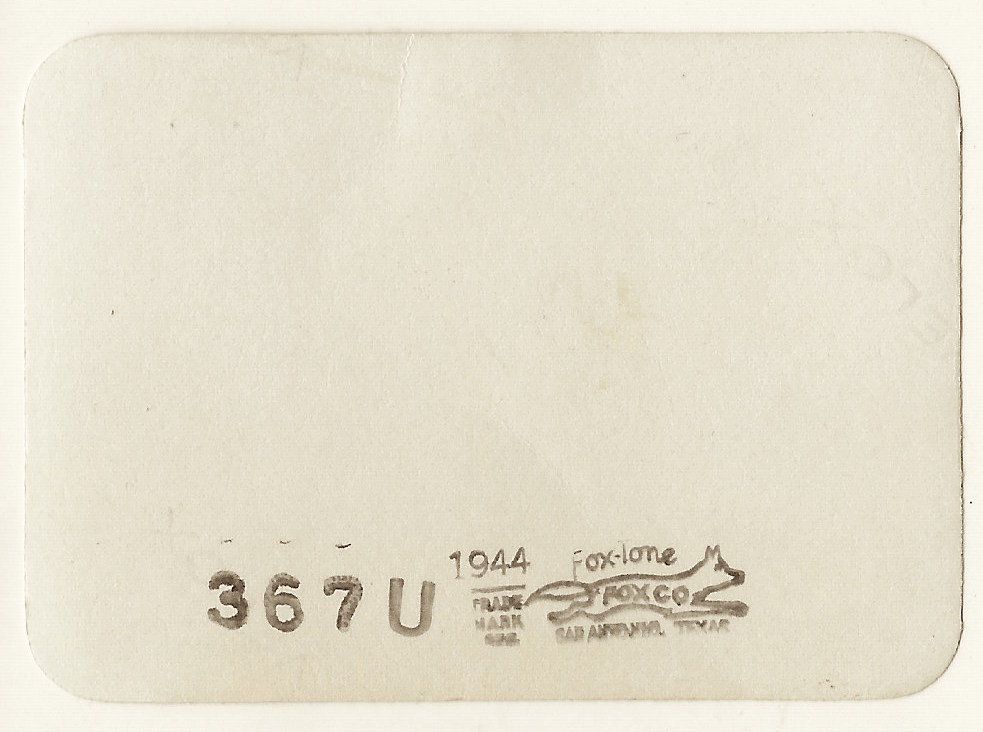
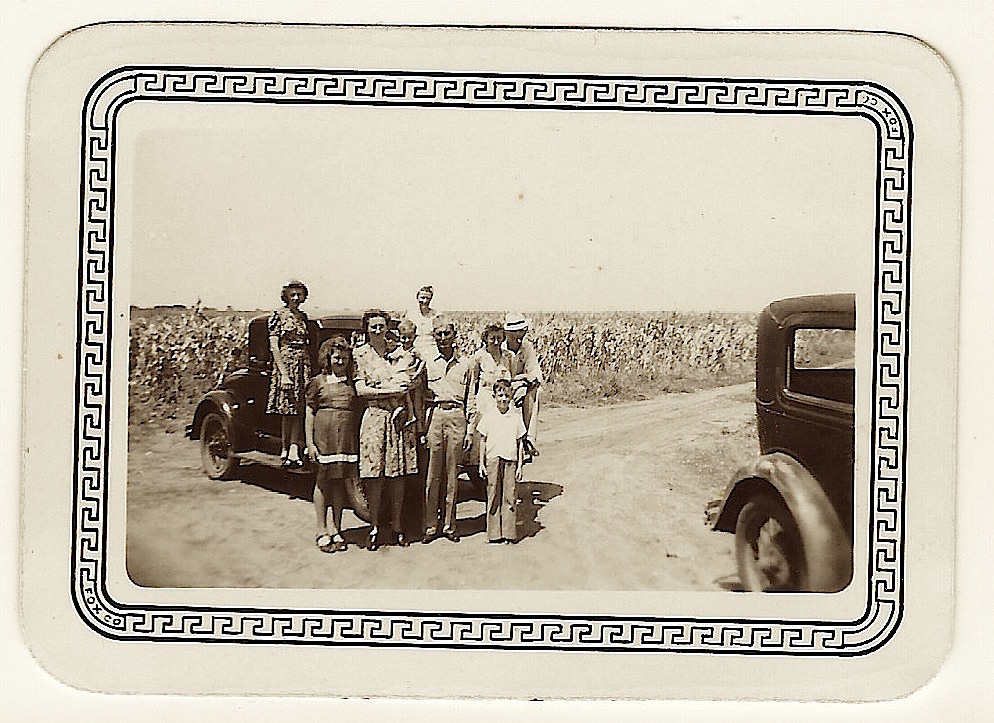
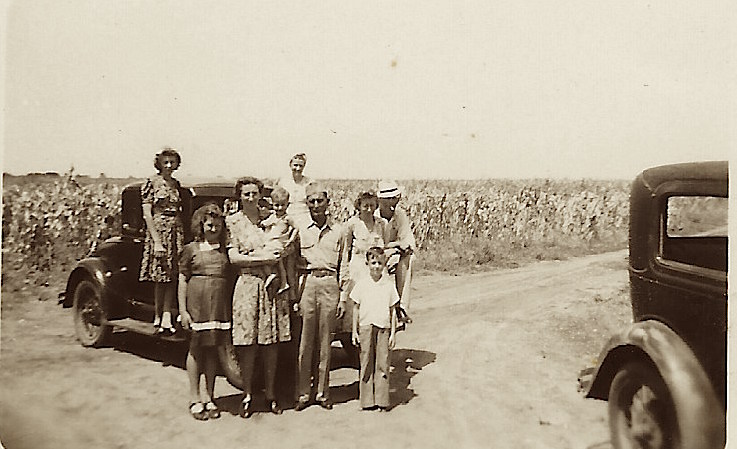
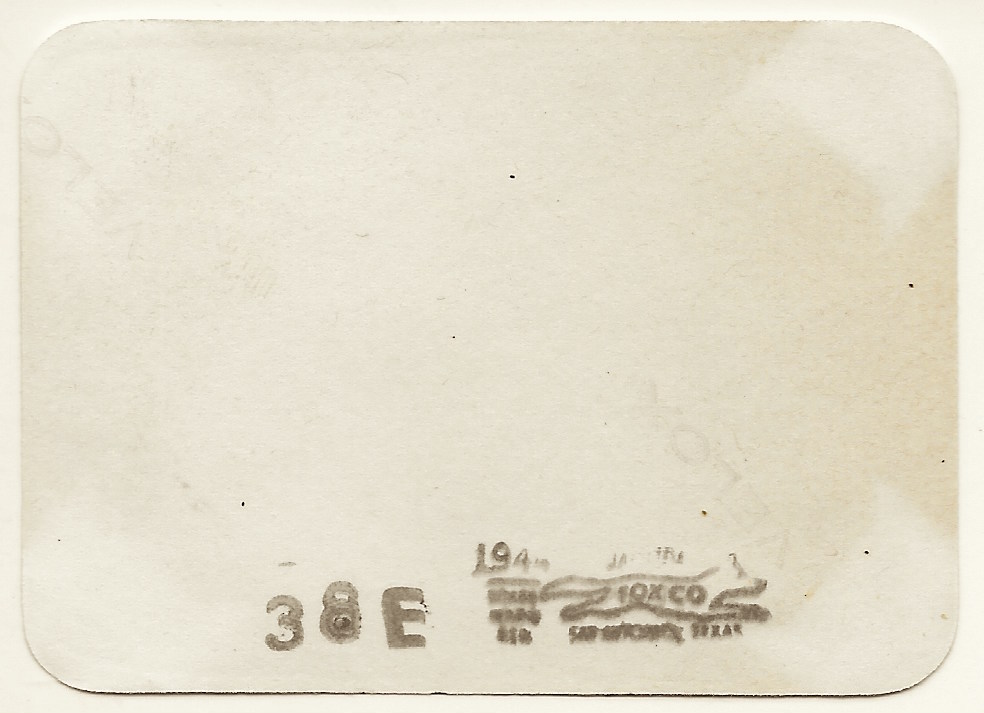
This vintage photograph features a group photo of what is likely an extended family. The two cars ferried six adults and three children to this rural spot for their portrait. The group is standing on a dirt road and posing in front of an agricultural field. One of the men in the photograph is wearing a military uniform. Perhaps he is home on leave. The image was photographed by Foxco in 1944. The company has an interesting history. The Fox Photo Studio was opened by Arthur C. Fox in 1906 in San Antonio, Texas. Fox sold the studio for seven hundred dollars to Carl D. Newton in 1909. Newton was a clever entrepreneur. One of his gimmicks was to offer a free camera to anyone buying three rolls of film and prepaying developing and printing fees. His successor to the business was Carl D Newton II. By the mid 1930’s Fox advertised itself as the world’s largest Kodak finishers. Their processing plant was in operation around the clock. The company expanded and opened facilities in Dallas, Houston, Louisiana and Oklahoma. The company grew and grew and ultimately reached 12,000 dealers nationwide. In 1986, the company was sold to Kodak. Carl D Newton III kept the retail division of the business, calling it Fox Photo. Later, the business changed hands a number of times until it faded into history. This photo was taken somewhere near San Antonio. The photo is printed on paper thinner than stock used for cdvs or cabinet cards. The photograph measures about 3″ x 2 1/4″ and is in very good condition.
Buy this original Vintage Photograph (includes shipping within the US) #2554
To purchase this item, click on the Pay with PayPal button below
$9.50
Buy this original Vintage Photograph (includes International shipping outside the US) #2554
To purchase this item, click on the Pay with PayPal button below
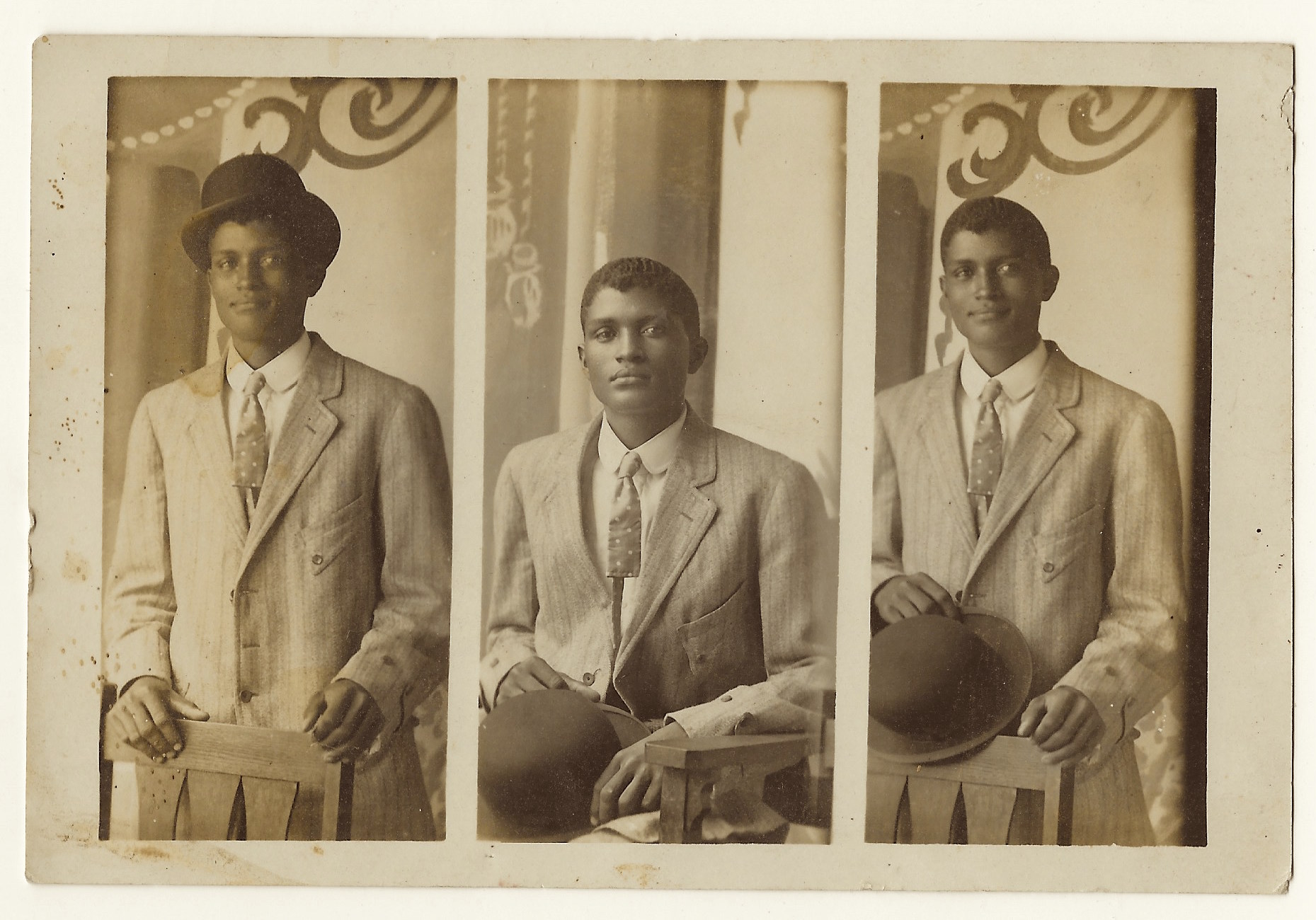
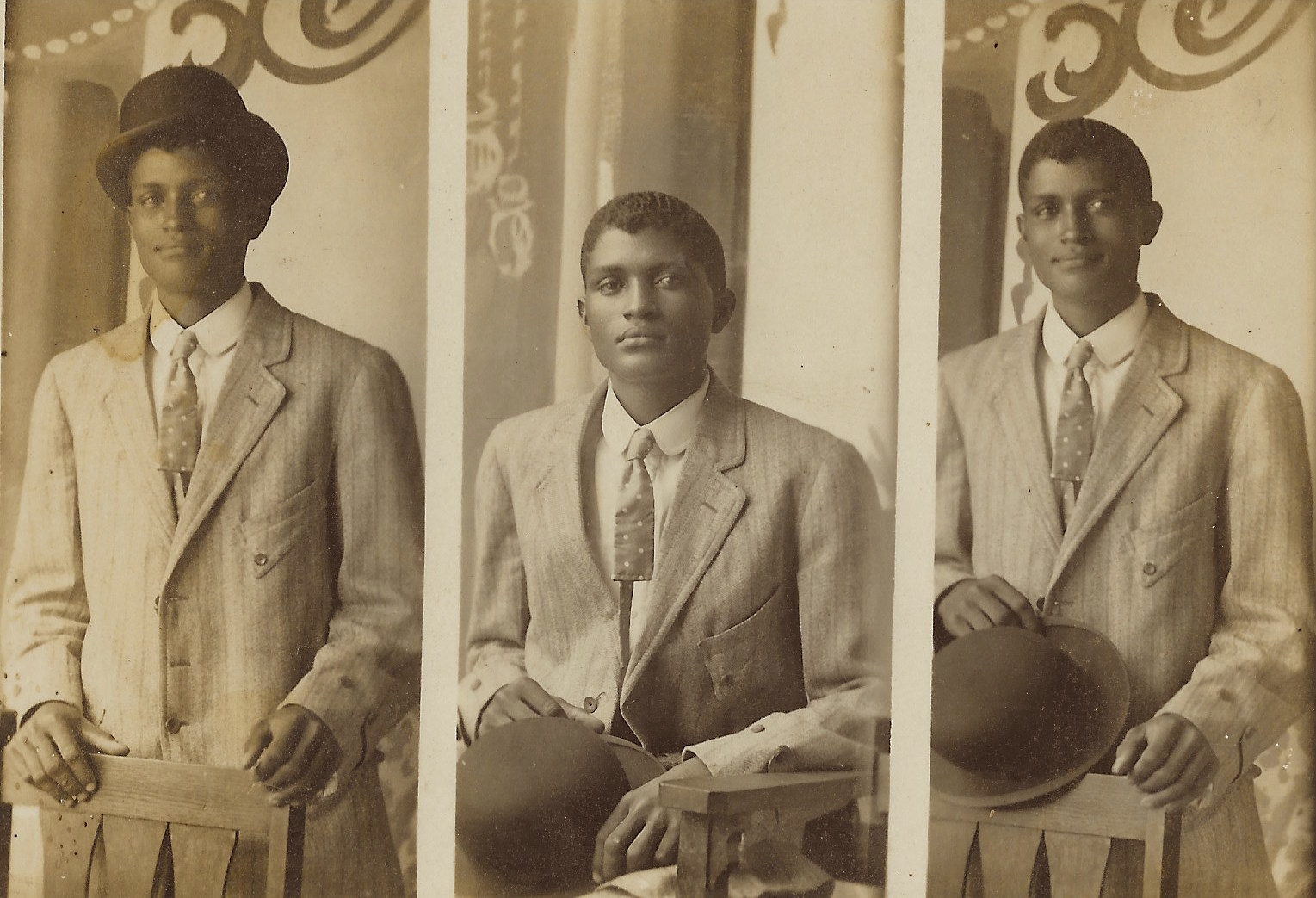
This three panel vintage photograph features a young African American man. He appears to be in his late teens and is nicely dressed in a suit and tie. Note his derby hat. Subject and photographer are not identified. The image was purchased in Austin, Texas and was part of a group of photographs described as the “San Antonio Collection”. The reverse of the photograph has residue that indicates it once resided in a scrap book or photo album. SOLD
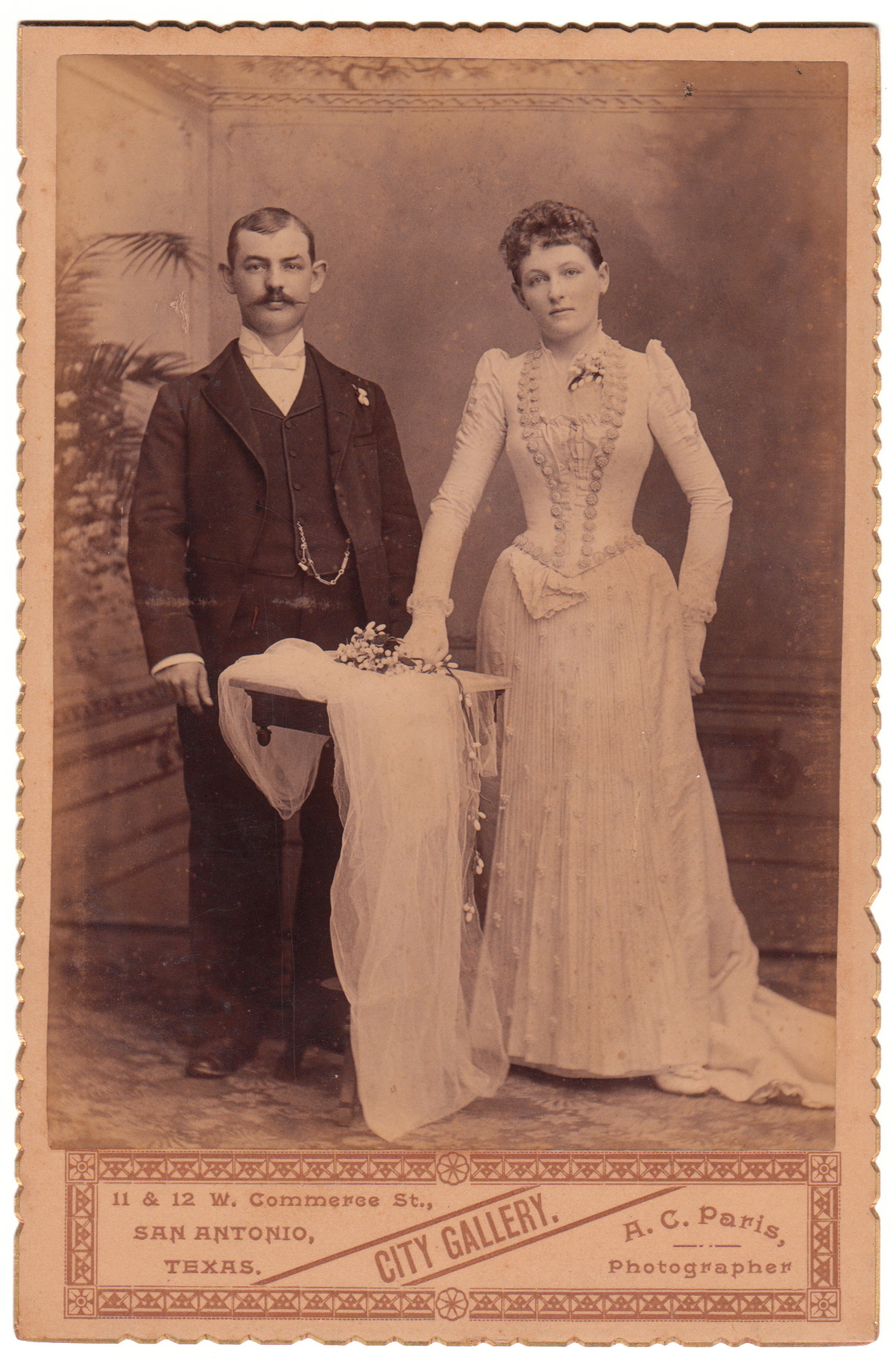
A. C. Paris, the proprietor of the City Gallery of San Antonio, Texas, produced this elegant wedding portrait . On the reverse of the cabinet card is an inscription stating “Alex Rossy, Josephine Fink’s father”. The cabinet card’s edges are gold embossed and scalloped. Census research reveals that the groom in this image, Alex Rossy (1862-1925) was the son of Charles and Aminda Rossy. Alex’s father was of Austrian ancestry. The 1880 US census reports that Alex was the fourth of seven children living in the Rossy’s home. San Antonio business directories assert that Alex’s occupation for many years was “Cigar Manufacturer”. Josephine Fink was actually Josephine Rossy Fink (1897-1980) and she was the daughter of Alex Rossy. She later became the wife of Lewis Fink.


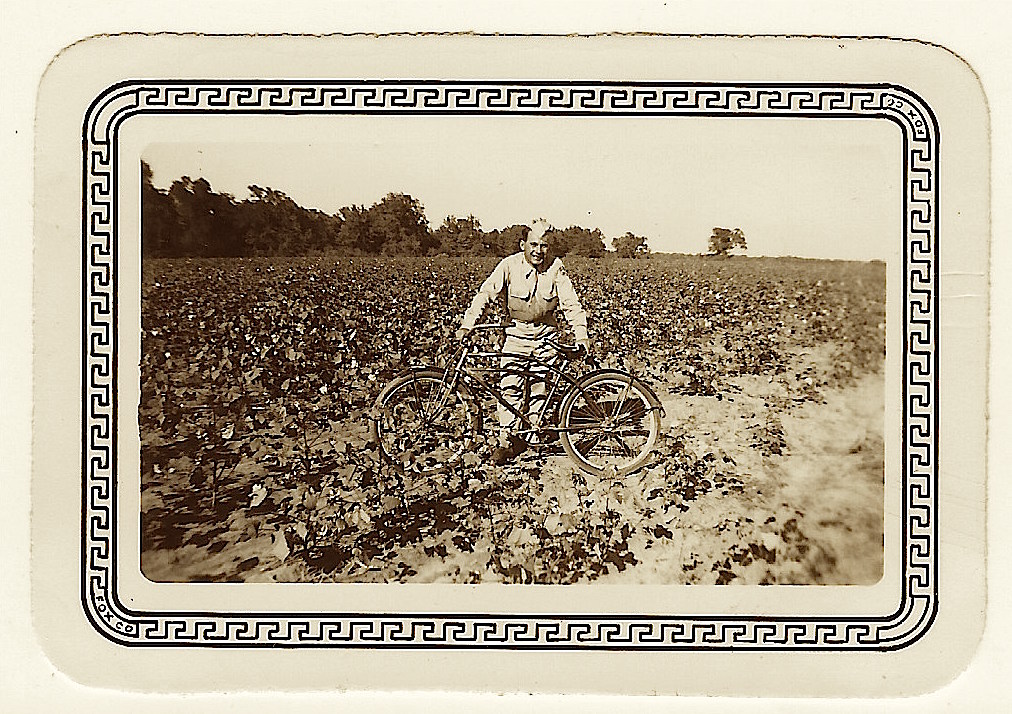
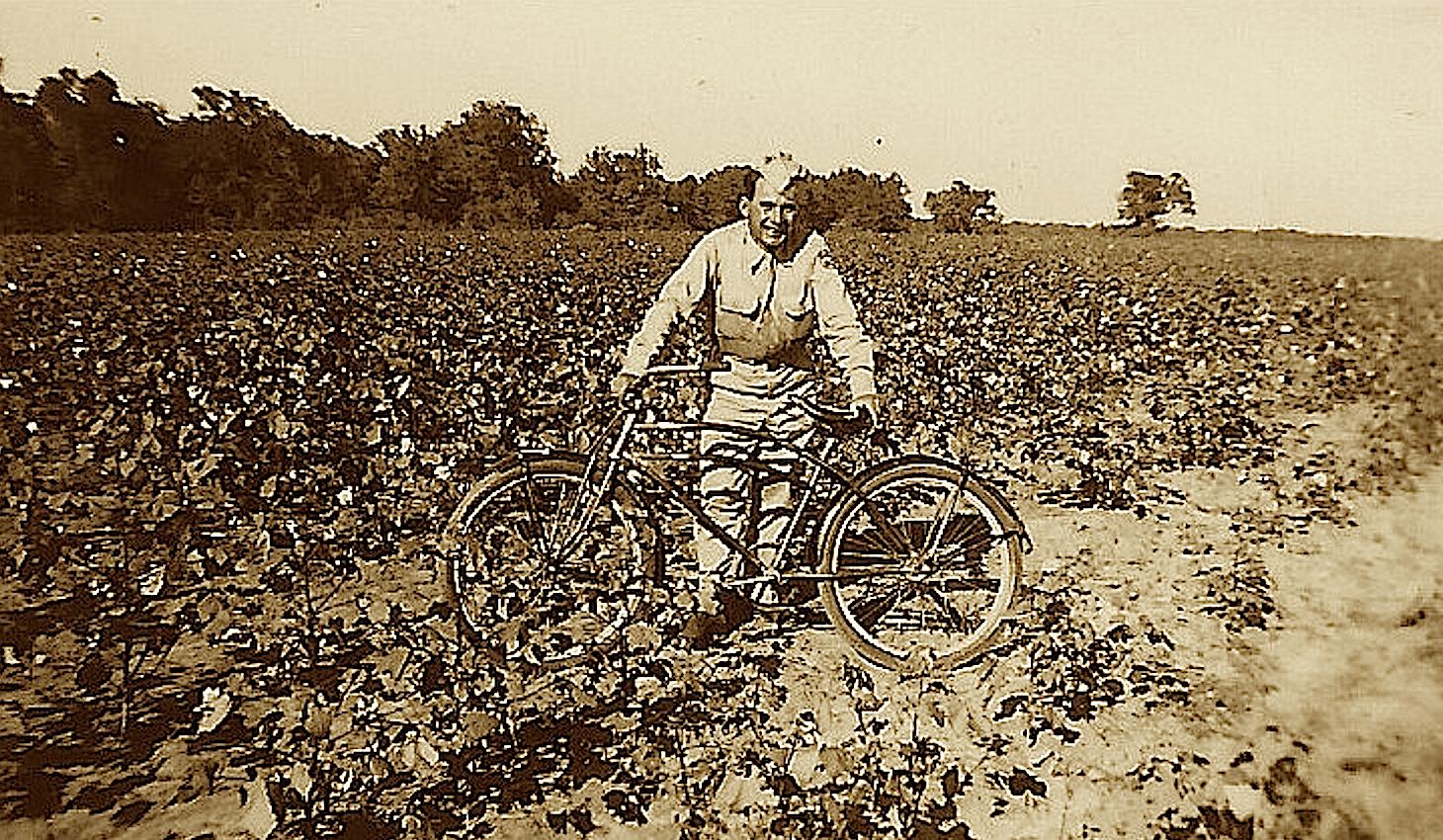 This photograph features a uniformed soldier standing in a farmer’s field and posing behind his bicycle. This photo was found in a shop in the Texas Hill Country. It was part of a group of Foxco images from the mid 1940’s. This photograph was developed by Foxco of San Antonio. The company has an interesting history. The Fox Photo Studio was opened by Arthur C. Fox in 1906 in San Antonio, Texas. Fox sold the studio for seven hundred dollars to Carl D. Newton in 1909. Newton was a clever entrepreneur. One of his gimmicks was to offer a free camera to anyone buying three rolls of film and prepaying developing and printing fees. His successor to the business was Carl D Newton II. By the mid 1930’s Fox advertised itself as the world’s largest Kodak finishers. Their processing plant was in operation around the clock. The company expanded and opened facilities in Dallas, Houston, Louisiana and Oklahoma. The company grew and grew and ultimately reached 12,000 dealers nationwide. In 1986, the company was sold to Kodak. Carl D Newton III kept the retail division of the business, calling it Fox Photo. Later, the business changed hands a number of times until it faded into history. The photo measures about 3 1/4″ x 2 1/4″. (SOLD)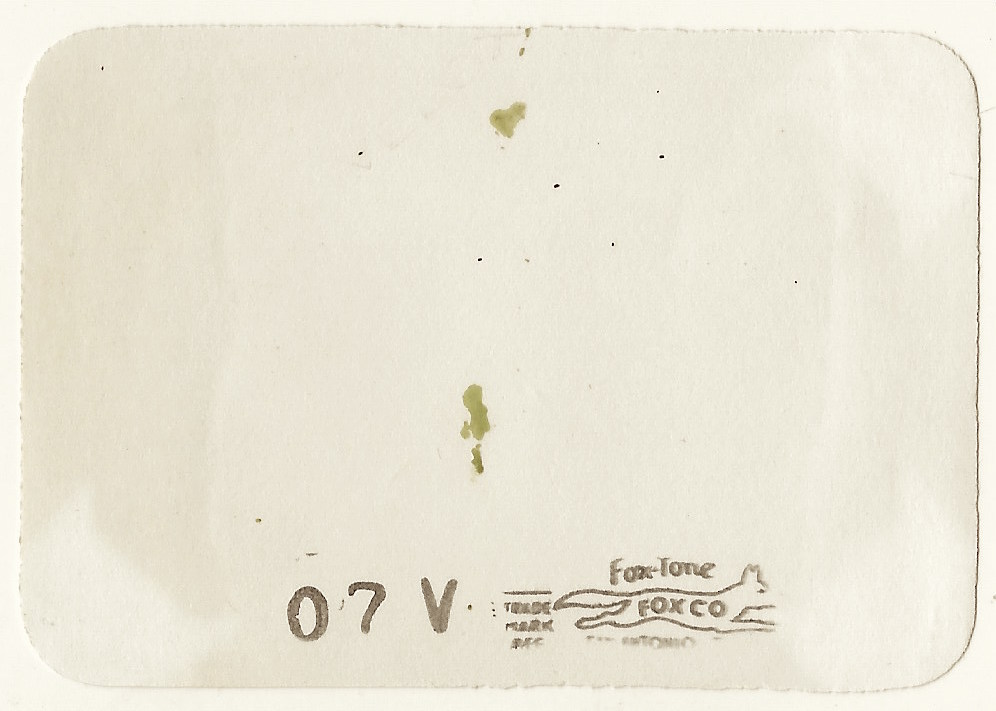
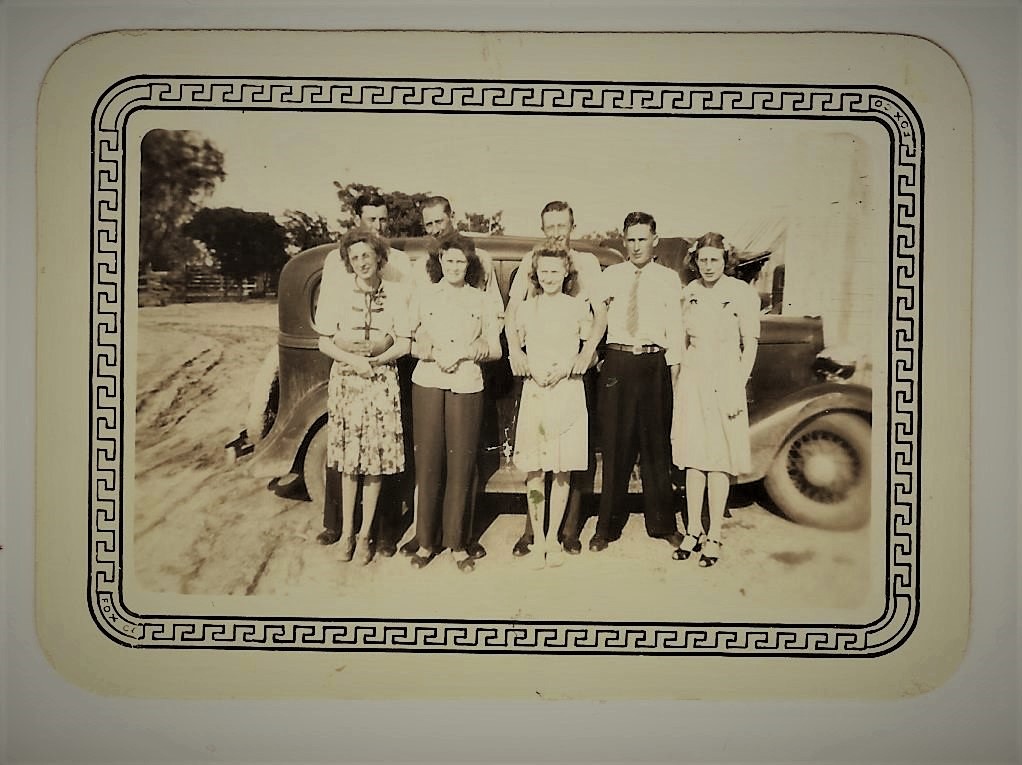
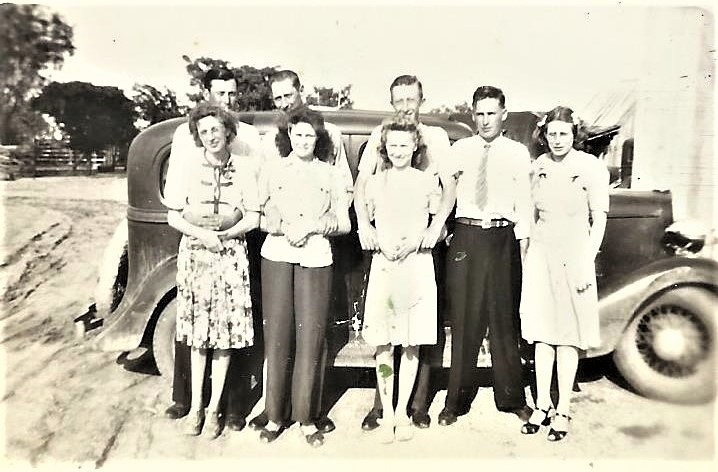 Four young couples pose in front of a dusty car that is parked on a dirt driveway. Three of the women stand in front of a man, likely their beaus. The fourth woman is keeping her distance from the fellow who stands behind her. The three men who are standing behind the three women appear to be quite “handy”. One supposes that we are looking at a photograph of a “quadruple date”. The setting may be a Texas ranch. This photograph was found in the Texas Hill Country. Do you think these four couples arrived at this location via the car that is parked behind them? If so, the seating must have been quite crowded. The image was photographed by Foxco in 1946. The company has an interesting history. The Fox Photo Studio was opened by Arthur C. Fox in 1906 in San Antonio, Texas. Fox sold the studio for seven hundred dollars to Carl D. Newton in 1909. Newton was a clever entrepreneur. One of his gimmicks was to offer a free camera to anyone buying three rolls of film and prepaying developing and printing fees. His successor to the business was Carl D Newton II. By the mid 1930’s Fox advertised itself as the world’s largest Kodak finishers. Their processing plant was in operation around the clock. The company expanded and opened facilities in Dallas, Houston, Louisiana and Oklahoma. The company grew and grew and ultimately reached 12,000 dealers nationwide. In 1986, the company was sold to Kodak. Carl D Newton III kept the retail division of the business, calling it Fox Photo. Later, the business changed hands a number of times until it faded into history. This photo was taken somewhere near San Antonio. The photo is printed on paper thinner than stock used for cdvs or cabinet cards. This photograph measures about 3 1/4″ x 2 1/4″ and is in good condition (see scans).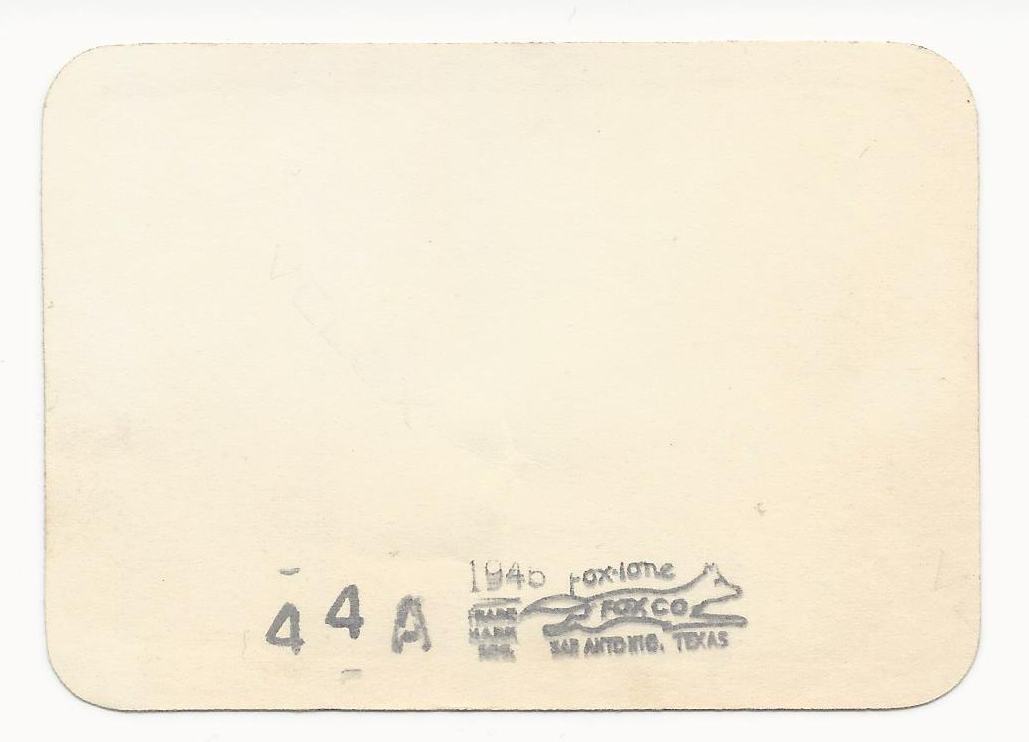


 THE CABINET CARD GALLERY