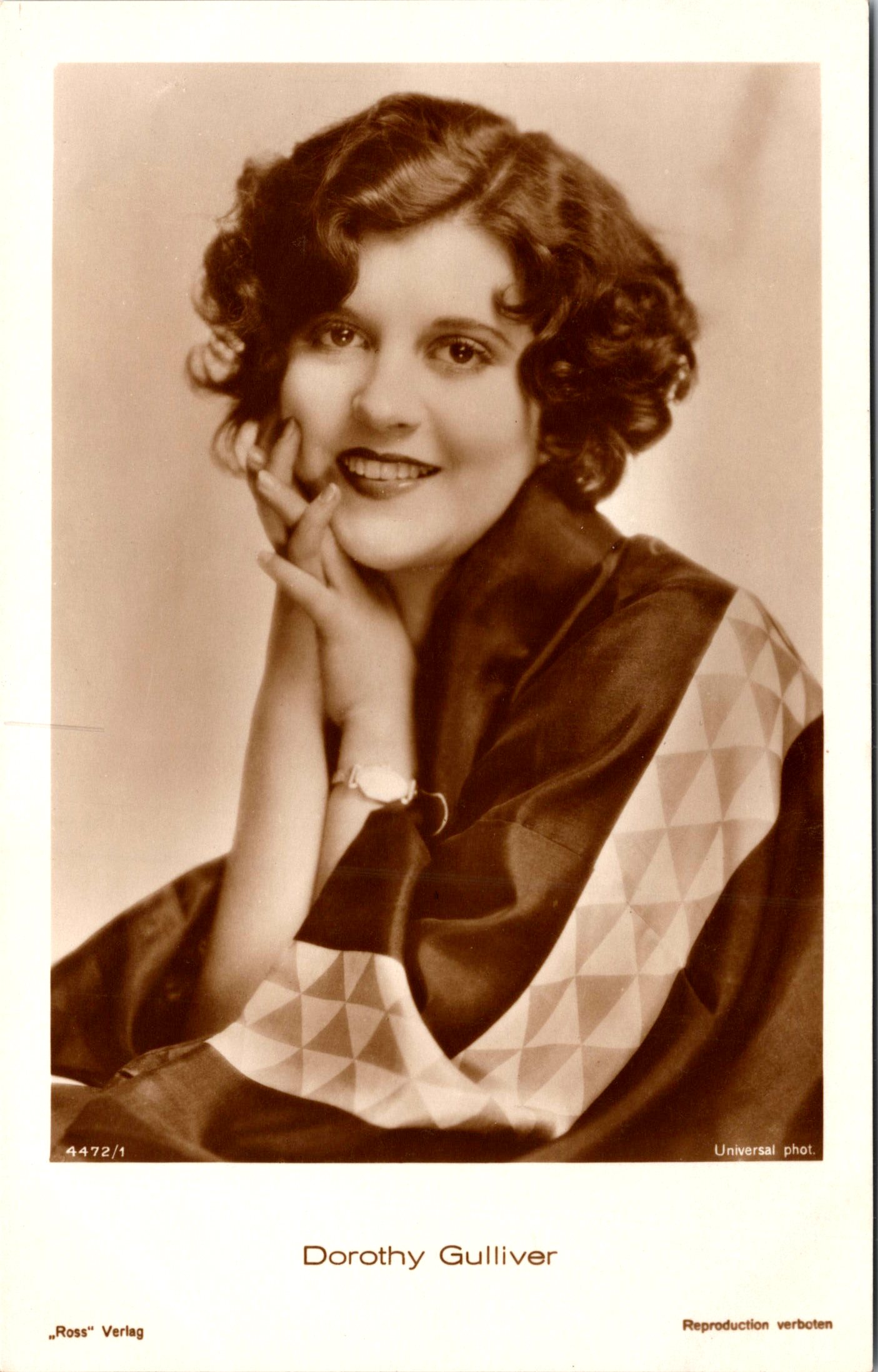
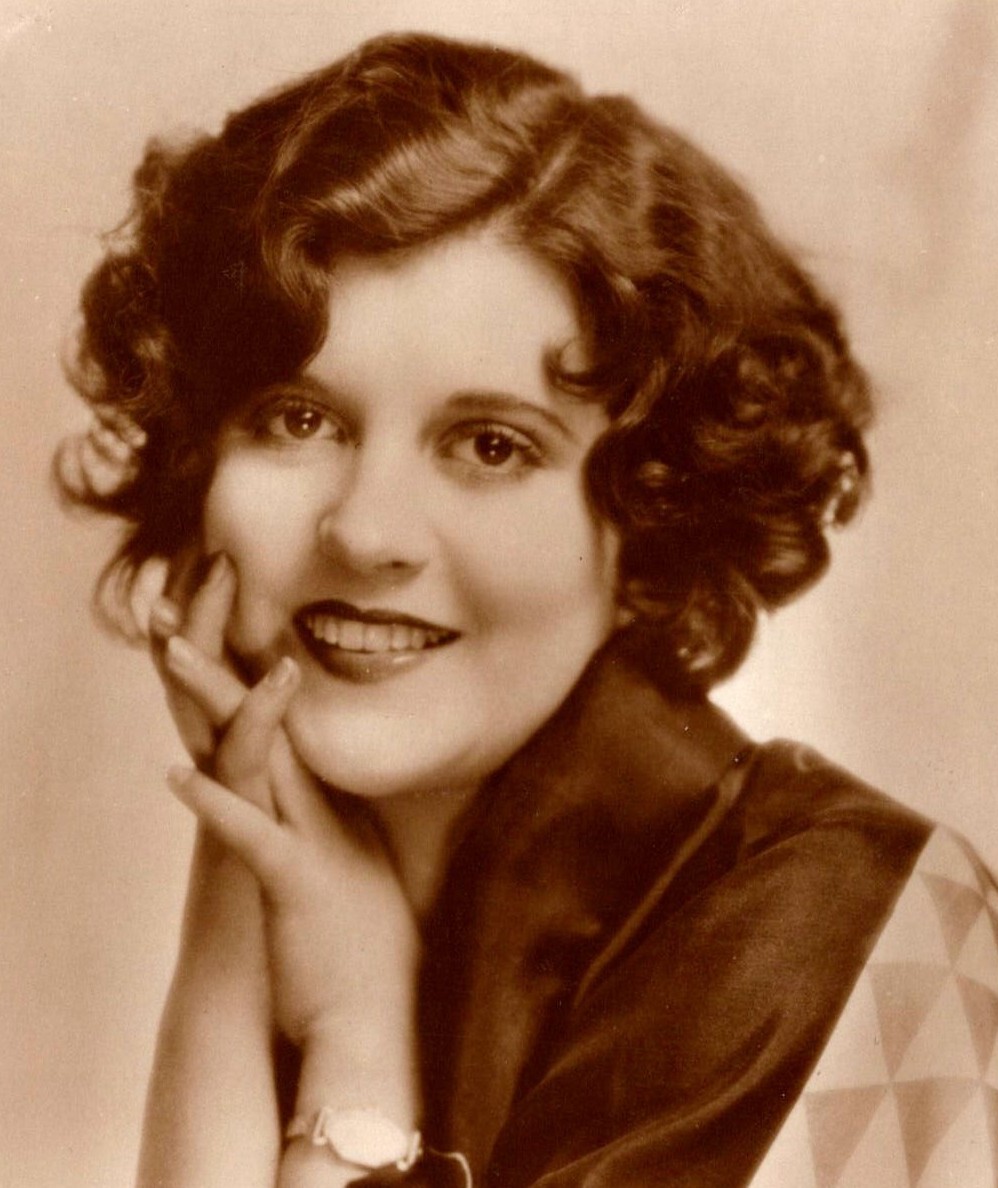
This is a beautifully composed real photo postcard (RPPC) of Dorothy Gulliver, produced by Ross Verlag, bearing the series number 4472/1. The photograph credit on the front says “Universal phot.”, indicating the image was taken under Universal’s photographic unit. Dorothy is shown in an elegant three-quarter pose, her head slightly tilted, her eyes bright and engaging, and a gentle, confident smile touching her lips. Her coiffed hair is waved softly around her face. She wears a silky, draped garment with geometric patterned panels, possibly a robe or decorative wrap, giving a graceful, glamorous look. The lighting highlights her complexion and facial features delicately, lending the image an enchanting, almost glowing quality. Her expression is poised but warm — she seems aware of her image and projecting a subtle star quality, rather than an overly stiff studio pose. The overall look is refined, feminine, and suited to her identity as a screen actress. This postcard is part of Ross Verlag’s cinema star series, a popular line of European film star postcards in the 1920s–1930s.The inclusion of “Universal phot.” connects this portrait directly to the film studio world. Take note that Dorothy produced relatively few postcards, and this is an attractive example. Dorothy Kathleen Gulliver was born in 1908, in Salt Lake City, Utah. She was raised in a Mormon family, one of six children, and even from youth expressed a desire to act. Her break came in 1925 when she won a Universal-sponsored national contest (after earlier local pageant success) which awarded her a six-month contract with Universal. She began appearing in silent short films and serials such as The Winking Idol (1926) and Strings of Steel (1926). In 1928, she was honored as one of the WAMPAS Baby Stars, a promotional campaign that highlighted rising actresses. Throughout the late 1920s, Dorothy appeared in The Collegians series of short films produced by Universal, often paired with George J. Lewis. When sound came in, she successfully made the transition and worked frequently in 1930s serials and Westerns — titles include The Galloping Ghost, The Phantom of the West, The Shadow of the Eagle, The Last Frontier, and Custer’s Last Stand. Her film career spanned decades (officially credited in nearly 100 films), though after the 1930s her roles tended toward smaller or uncredited parts. Remarkably, in 1968 she had a notable role in John Cassavetes’ Faces. Her final film appearance was a cameo in Won Ton Ton, the Dog Who Saved Hollywood (1976). On the personal side, Dorothy’s first marriage was in 1926 to Chester De Vito (an assistant director), which ended in divorce by 1932. In 1947 she married Jack R. Proctor, and they remained together until his death in 1976. She passed away in 1997, in California. Interestingly, her life story encompasses the classic arc of early Hollywood: beauty contest discovery, silent film stardom, adaptation to talkies, and then gradual fading into character work. (SOLD)



 THE CABINET CARD GALLERY