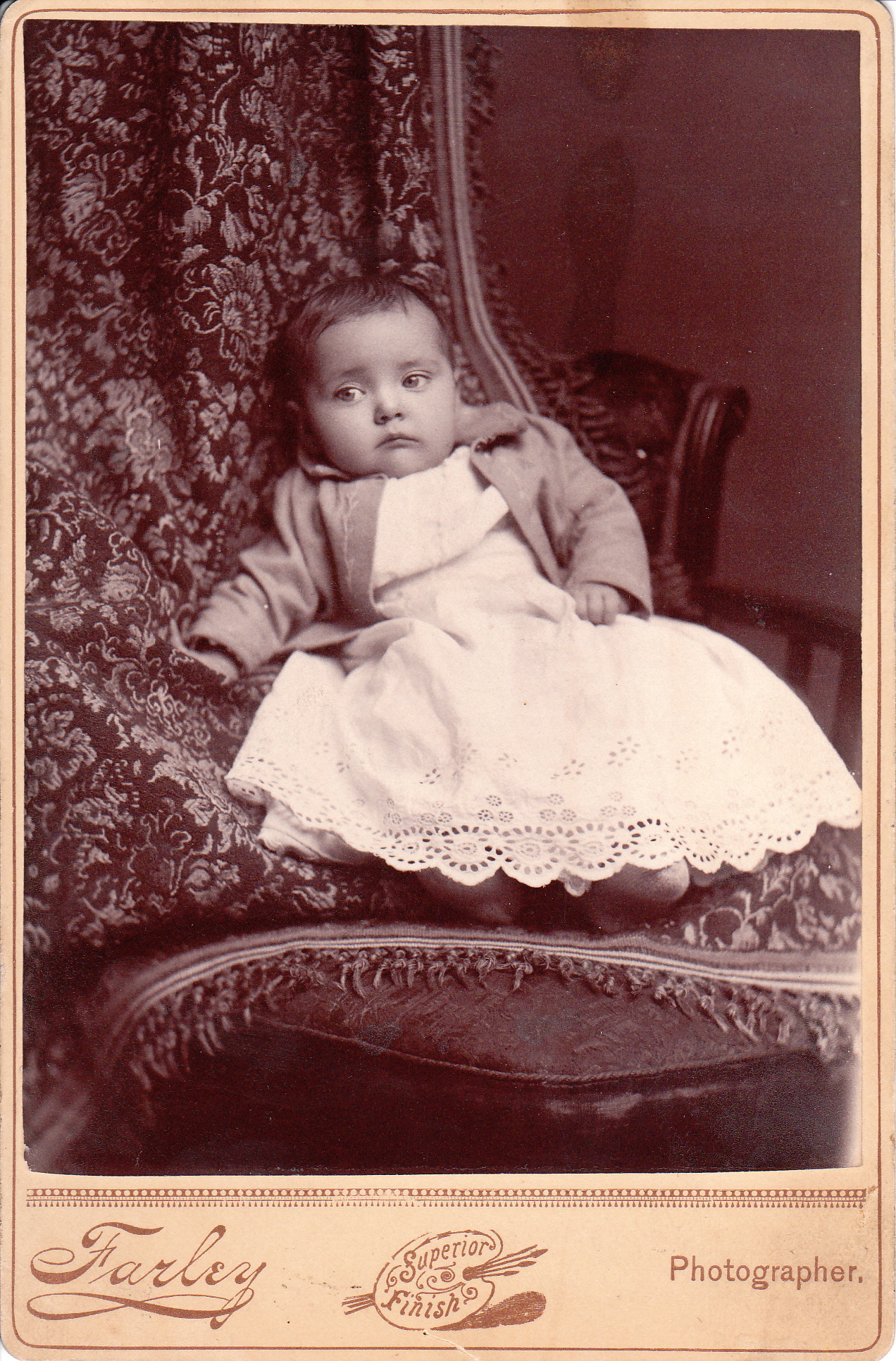
This cabinet card photograph features a very cute baby wearing a gown and sweater. She has beautiful big eyes According to an inscription on the reverse of the image, the baby is named Atalie Jean Crum and she was five months and two days old, at the time the photograph was taken. Atalie Crum can be found on both the 1900 and 1910 U.S. census. She was born in 1890 and resided in Penn, Illinois. She lived with her parents, Brooke W. Crum, and Laura V. Crum. Both of her parents were born in Pennsylvania and her father was a farmer. The 1910 census reveals that at age twenty, Atalie was employed as a school teacher. A 1913 publication from the Illinois Office of Public Instruction, states that Atalie taught school in Stark County, Illinois (District 53). At an unknown age, she married Claude Sterling, a local farmer. An obituary in the Peoria Star (1936), reports the death of John Wesley Crandell. He died at the age of 78 in Castleton, Illinois. He was his community’s last surviving civil war veteran. A male quartet sang at the funeral and they were accompanied by a Mrs Atalie Sterling at the piano. This is likely the Atalie Sterling in the photograph. Atalie lived a long life, dying in 1969 at age eighty in Wyoming, Illinois. The photographer of this cabinet card is difficult to identify with any certainty. There was a photographer named W. H. Farley who operated in Crete and Gibson Illinois in the 1880’s. A photographer named A. Farley also had a studio in Illinois. Research uncovered another cabinet card with the same Farley logo as this cabinet card. The card was from a studio located in Tampico, Illinois. Tampico is the likely place that Atalie Crum was photographed.
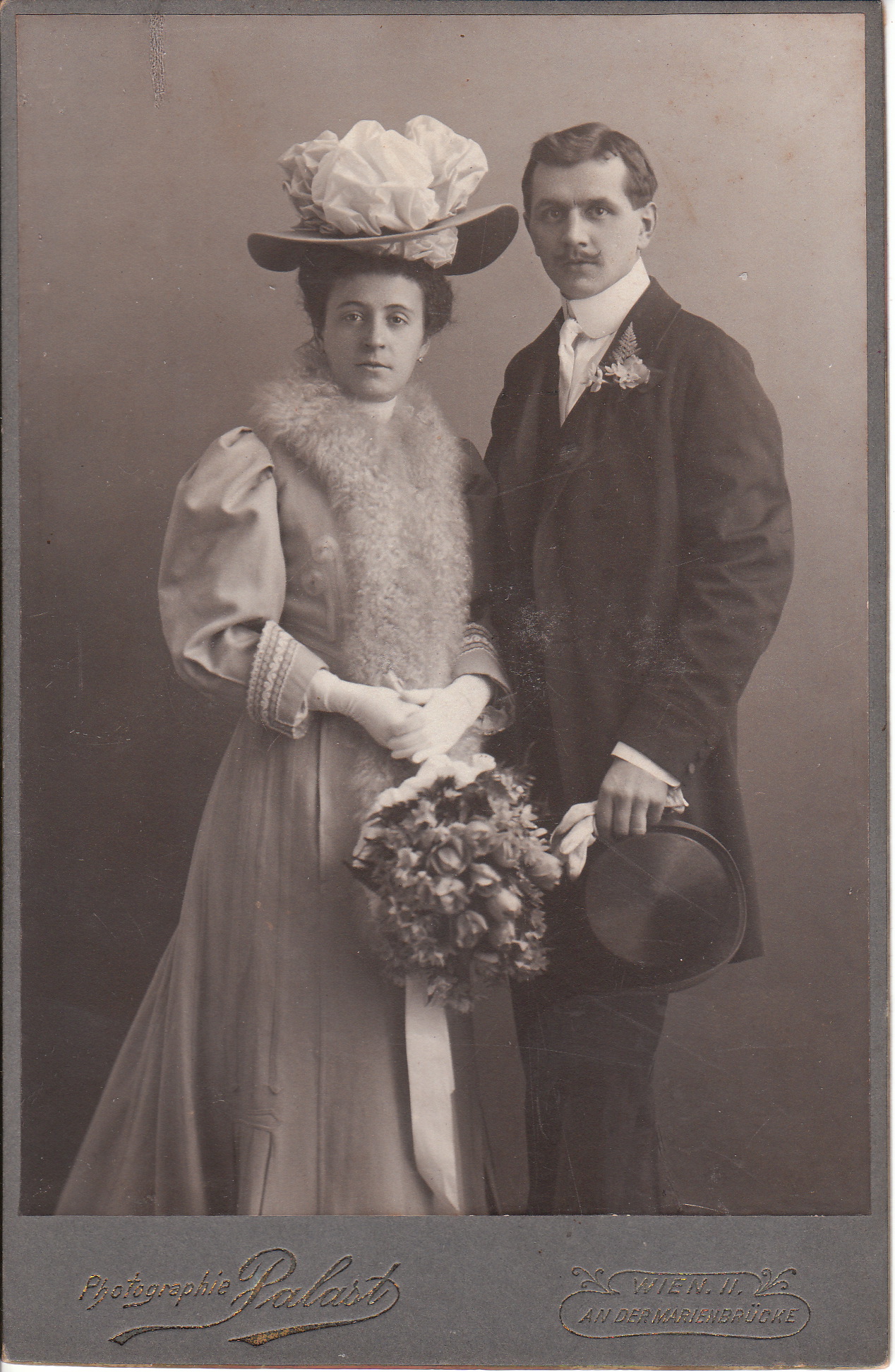
BEAUTIFULLY DRESSED AND ATTRACTIVE COUPLE IN VIENNA, AUSTRIA
The couple in this photograph are attractive and handsomely dressed. The woman is wearing a fashionable hat and gloves, and is holding an arrangement of flowers. The gentleman is formally dressed, holding a pair of gloves, and wearing a corsage. He is also holding, what appears to be a top hat. The couple is likely from the wealthy and privileged class. The photographer is named Palast, or something close to that name. The legibility of the name of the photographer is not clear and any help from cabinet card gallery visitors in identifying the photographer, would be appreciated. The photographer’s studio was located in Vienna, Austria.
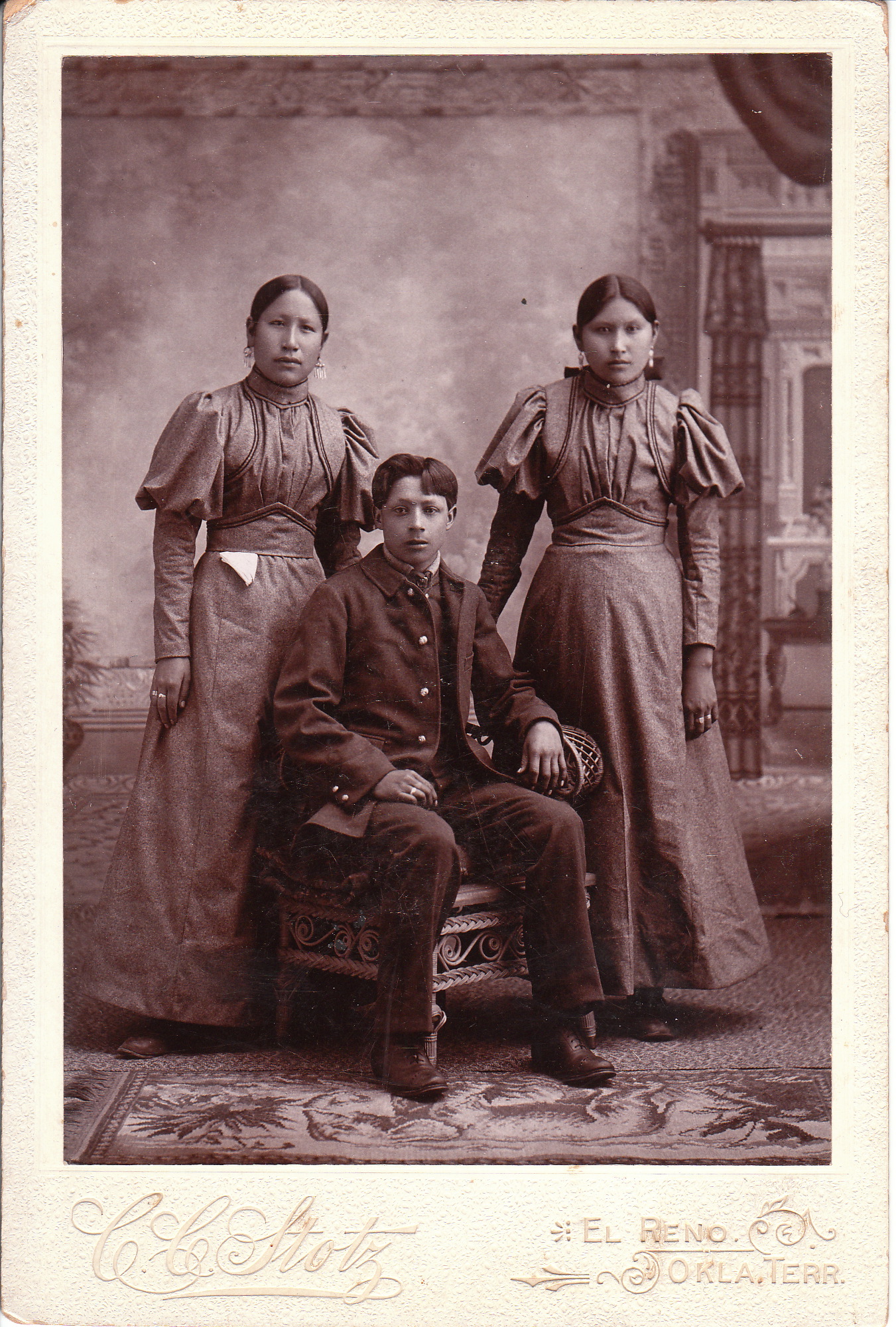
THREE NATIVE AMERICAN SIBLINGS IN EL RENO, OKLAHOMA TERRITORY (PHOTOGRAPHED BY STOTZ)
This cabinet card is chock full of history. The photograph features three young Native Americans posing for their portrait at the studio of Christopher Charles Stotz (1851-1932), in El Reno, Oklahoma Territory. The subjects of this image are likely siblings. The young women are wearing identical dresses and are adorned with rings and beautiful earrings. The specific Indian tribe that these three young people represent, is unknown. Oklahoma was the home of many Indian Tribes including Pawnee, Creek, Apache, Arapaho, Choctaw, and others. Many tribes were relocated there from other states. As mentioned earlier, the photographer of this cabinet card is C. C. Stotz and his studio was located in El Reno, Oklahoma Territory. Oklahoma became a state in 1907 which means that this photograph was taken before that year. El Reno is located in central Oklahoma, about 25 miles from Oklahoma City. Fort Reno was built in 1874 and it’s first commander was Civil War hero, General Philip Sheridan. Sheridan named the fort after his friend, General Jesse L. Reno, who was killed in the Civil War. The fort was near the Cheyenne-Arapaho reservation. One of the fort’s missions was to “protect” the “Five Civilized Tribes”. This group was comprised of the Cherokee, Chickasaw, Choctaw, Creek, and Seminole tribes. Employing the term “civilized tribe” was evidence of the special prejudice held against the tribes not among the designated five civilized tribes. Tribes described as civilized were tribes that had adopted many of the customs and values that were held by European-Americans at the time. Who was C. C. Stotz? Stotz was born in Columbia, Pennsylvania. He established a studio in El Reno in 1889; the same year El Reno was founded. Therefore, this photograph was taken between 1889 (El Reno founded) and 1907 (Oklahoma statehood). During the 1880’s and 1890’s, he made field and studio photographs of Southern Plains Indians. Stotz is an acclaimed early photographer of Native American’s and Native American life.
UNIDENTIFIED ACTRESS WEARING A RAIN SLICKER HAT IN NEW YORK CITY
This cabinet card features a pretty young actress wearing, what appears to be, a rain slicker hat. The photograph is a bit risque for its time. The actress’s neckline may not be plunging, but it leaves a lot uncovered. She was photographed at the studio of celebrity photographer, D. H. Anderson, in New York City.
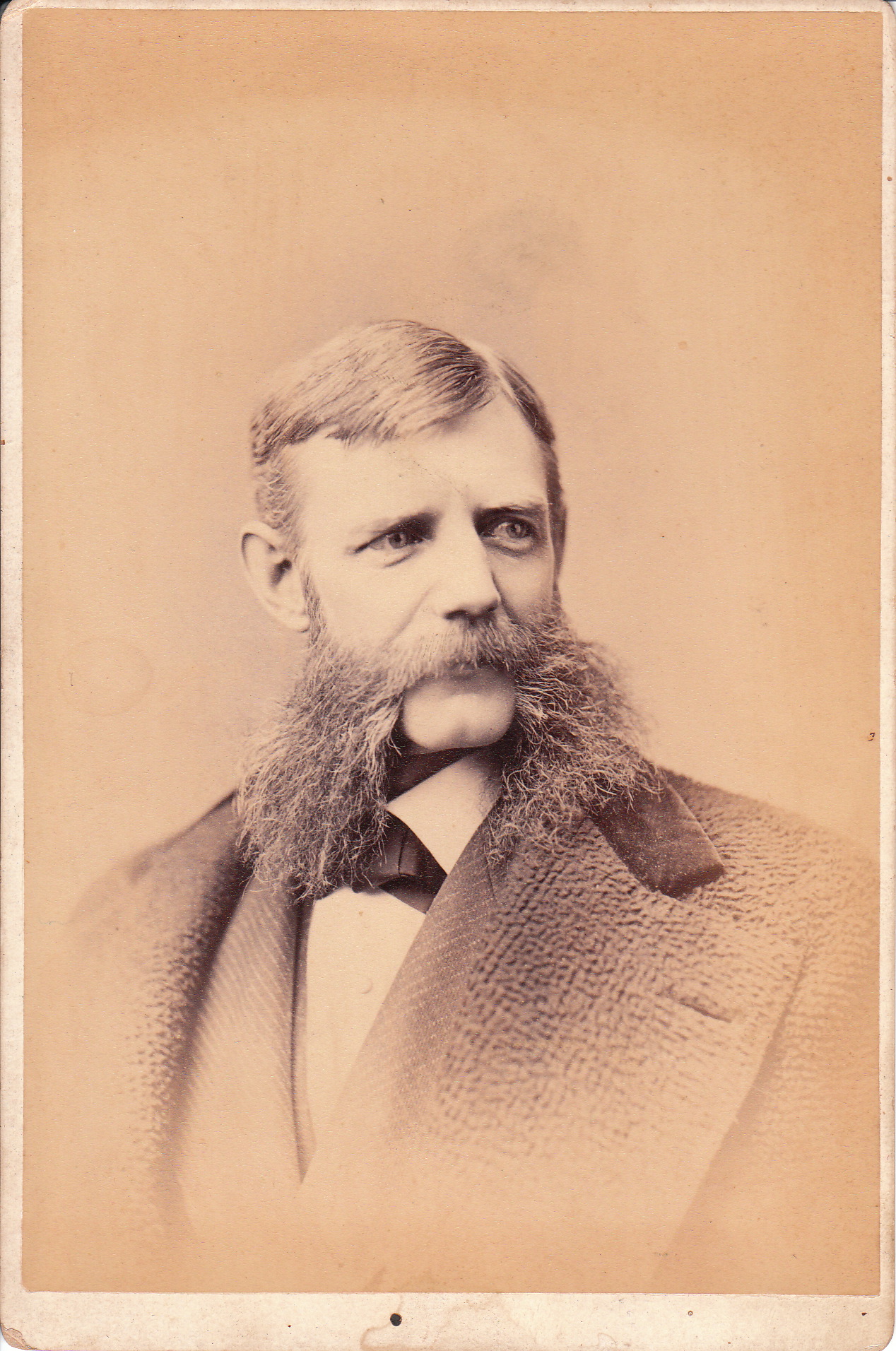
PORTRAIT OF A MAN WITH A NOTABLE MUSTACHE (BY SARONY OF NEW YORK)
Any aficionado of cabinet card photography knows that “they don’t make mustaches like they used to”. Men wore mustaches that were styled as if they were a work of art. The gentleman photographed in this cabinet card, has one of those terrific mustaches. His mustache is bushy in the middle and becomes radically bushy at its ends. To view other interesting mustaches, click on Cabinet Card Gallery’s category, “Mustaches (Only the Best). The gentleman in this image was photographed by Sarony, a highly respected celebrity photographer. Sarony’s studio was located at 680 Broadway in New York City, New York. To view more of Sarony’s photographs, click on Photographer: Sarony”.The subject of this photograph may have been an actor, or some other celebrated man of his time. There is no documentation available concerning the subject’s actual identity. SOLD
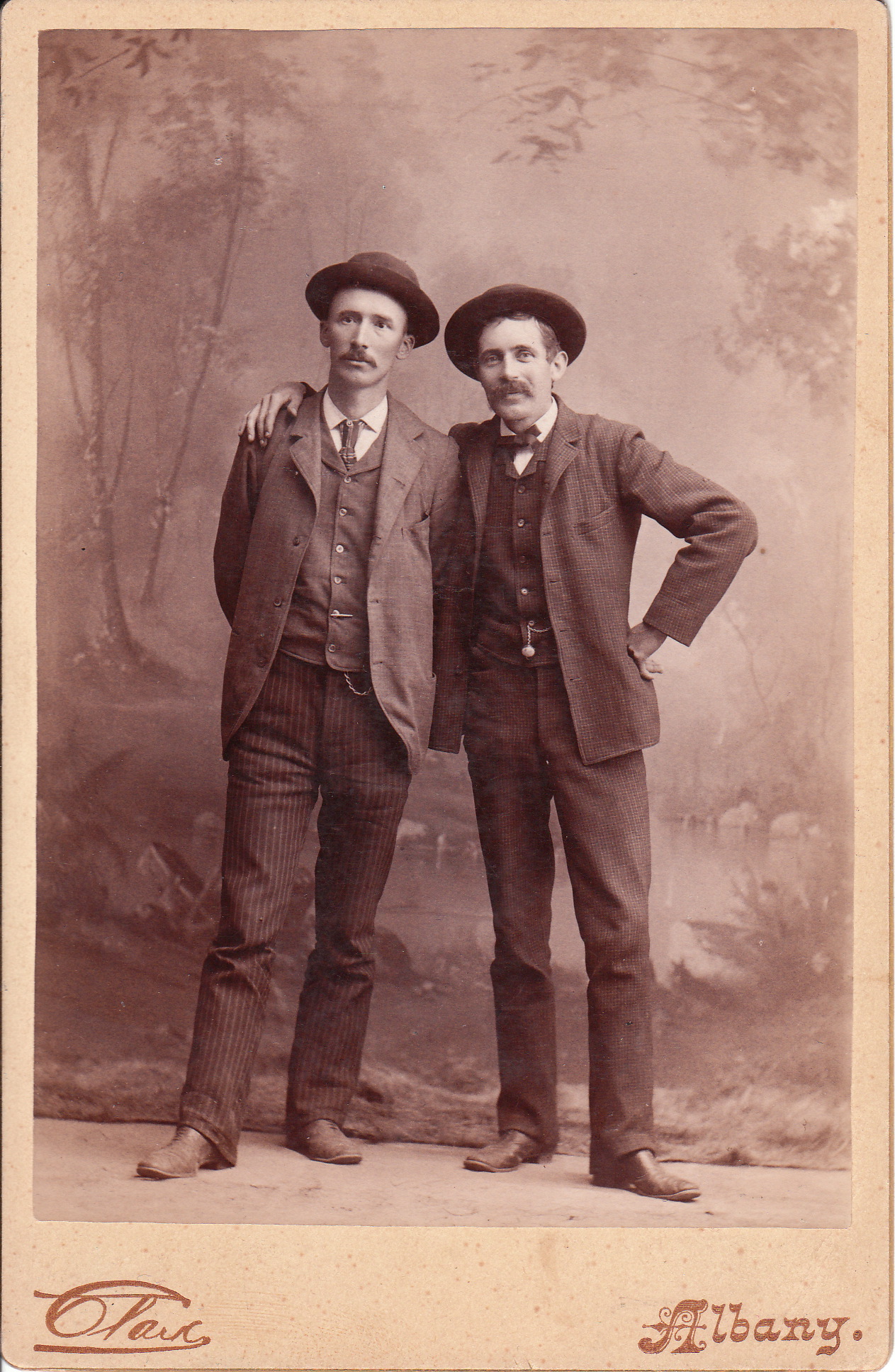
TWO FRIENDLY GUYS IN ALBANY, NEW YORK
Two men pose together at the Clark studio in Albany. It is not clear which state Albany is located in, but the most likely answer is New York. L. Wilson Clark was a photographer in Albany, New York. He may be the photographer that produced this cabinet card. The two fellows in this image seem to be well acquainted. The man on the right has a big smile, while the gentleman on the left, seems rather uncomfortable with his friend’s intimacy. The men are wearing suits with neckties and wonderful hats. Their clothing does not seem to be of the finest quality.