MISS MARJORIE VILLIS : RISQUE PORTRAIT OF A STRIKINGLY PRETTY BRITISH ACTRESS

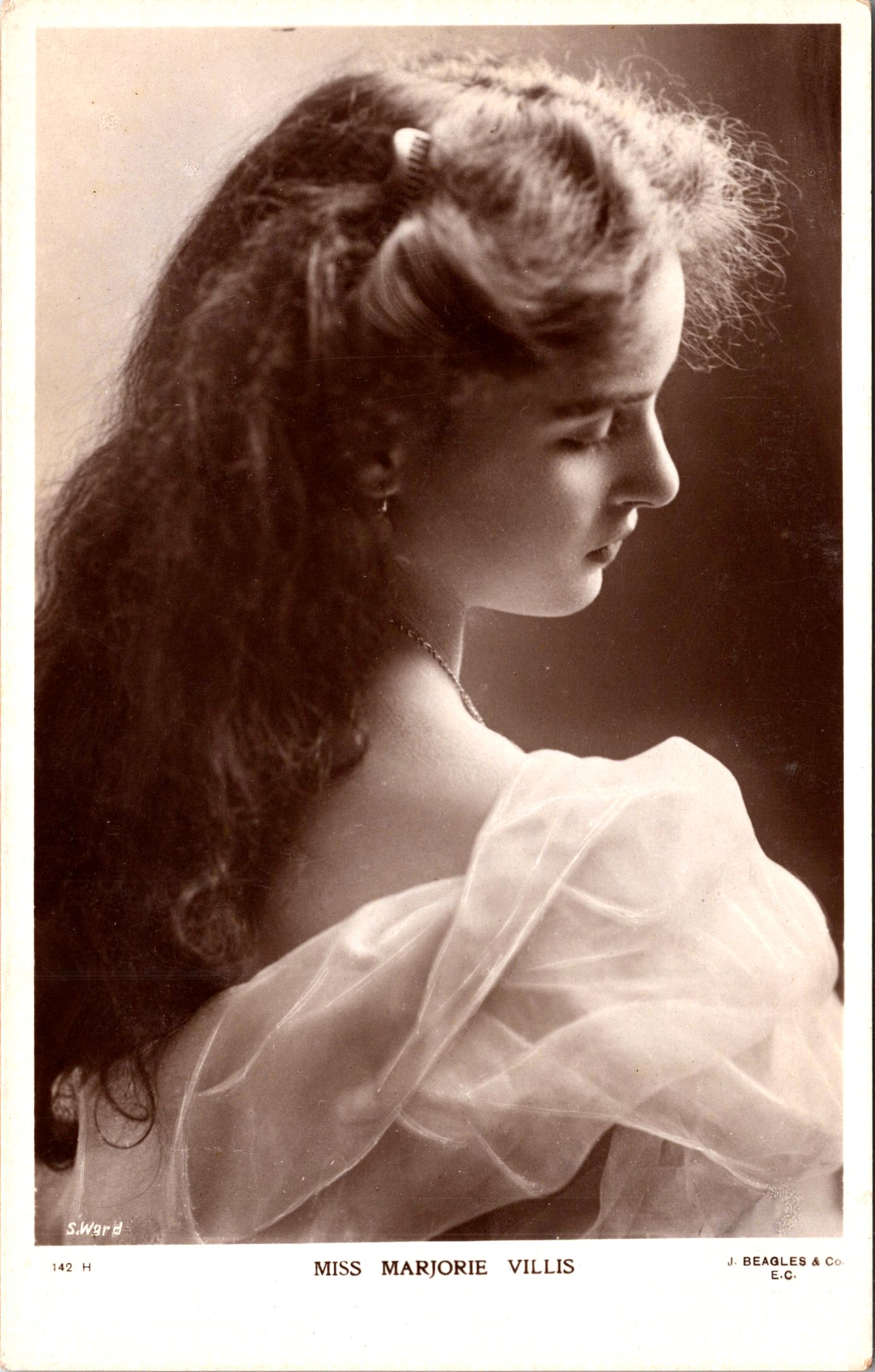
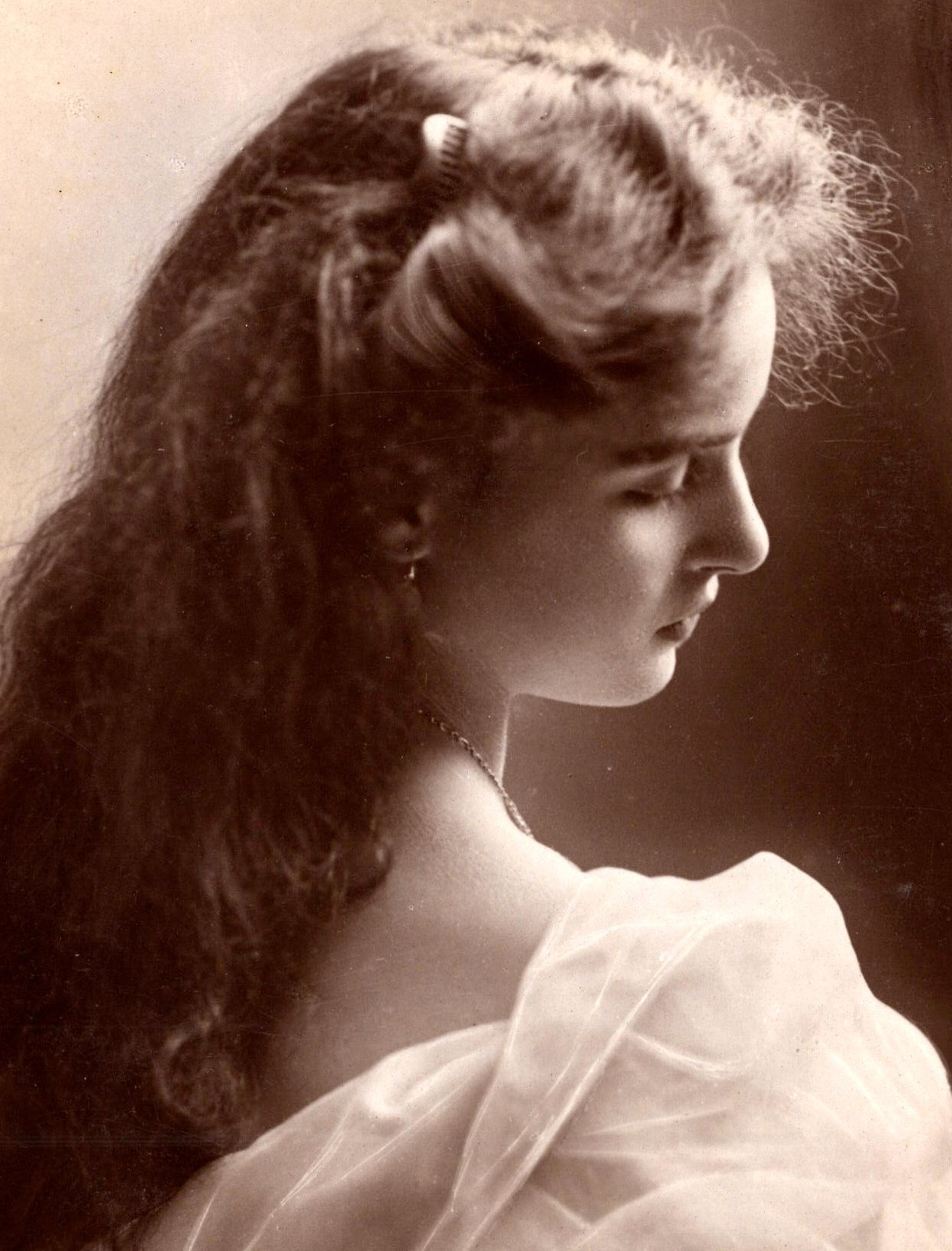
This vintage real photo postcard portrait feature British silent film actress, Marjorie Villis (1891-1981). Miss Villis is quite pretty and has a wonderful smile. This photograph captures her in a risque pose and a risque costume. What an amazing elaborate and busy costume. When I first saw this image, I immediately became motivated to find information about this provocative actress. I met little success in learning about Marjorie Villis. Photographs of her appear to be uncommon, and I could not find the postcard above anywhere online. I did learn that she sat for seven postcard portraits that can be found in the UK’s National Portrait Gallery, All of the portraits were taken by celebrated photographer, Alexander Bassano. The IMDb credits Villis with 15 film roles between 1915 and 1922. Villis was most noted for her roles in “The Rugged Path (1918), “A Romany Lass (1918)”, and  “Brenda of the Barge (1920). She had a relatively short career. I wonder why her career ended so abruptly? The first talkie feature film did not get released until 1927, so we know that, unlike many other silent film stars, Villis was not shut out of the film industry because of an unsuitable voice or foreign accent. This postcard was published by J. Beagles & Company (London)  as part of a series (no.142 J). The wonderful portrait of Miss Villis was taken by S. Ward. This vintage postcard is in very good condition (see scans)

This cabinet card is available for purchase at my store, The History Peddler, for $35.00 or best offer.

Interested collectors may view the listing here:

https://www.ebay.com/itm/336231732840

PORTRAIT OF A FASHIONABLE & EXPRESIVE TRIO : EDWARDIAN PHOTO : c 1900-1906

This evocative early 20th-century photographic portrait depicts three young adults posed in a studio setting, arranged in a classic triangular composition that emphasizes both formality and subtle interpersonal dynamics. The photograph measures 6 ¼ x 4 ¼ inches, a size commonly associated with privately commissioned portraits from the late 1890s to early 1900s, just before the widespread dominance of postcards. The man stands at center, slightly behind the two seated women, resting one arm casually across the back of a chair. He wears a dark suit jacket, a crisp white shirt, and a neatly tied bow tie, topped with a flat cap. His expression is steady and unsmiling, projecting quiet confidence and composure rather than overt warmth—typical of male portraiture of this era, where restraint was often equated with dignity. The two women flanking him are dressed in fashionably structured blouses with high collars, each wearing an elaborate hat that reflects the period’s emphasis on millinery as a marker of style and social standing. The woman on the right appears more reserved, her face calm and serious, eyes directed forward with little visible emotion. The woman on the left, however, is especially compelling. Her expression carries a subtle complexity—a faint, knowing half-smile combined with alert, engaged eyes. Rather than the blank neutrality seen in many studio portraits, her gaze feels self-aware, even slightly amused, as if she is conscious of the moment and perhaps skeptical of its formality. This small emotional deviation gives the photograph much of its charm and individuality. The studio backdrop features a painted decorative scene with ornate scrollwork, lending depth and visual interest without overpowering the sitters. The photograph itself is in very good antique condition, with strong contrast and excellent clarity in facial features and clothing details. No creases, tears, or losses are evident. Overall, this piece displays well and retains significant visual and historical appeal.

This cabinet card is available for purchase at my store, The History Peddler, for $28.00 

Interested collectors may view the listing here:

https://www.ebay.com/itm/236561726141

Published in: on January 10, 2026 at 12:00 pm  Leave a Comment  

PICNIC DINNER AT STODDARD’S CAMP : BY FRASHER : IDAHO : RPPC : MEMORIAL DAY 1914

This engaging real photo postcard captures a large picnic gathering posed around a long wooden table. The scene is identified in caption as a “Picnic Dinner at Stoddard’s Camp, May 30, 1914.” The scene appears to be set beneath a rustic open-sided shelter, likely part of a campground or excursion destination, with heavy timber beams overhead and large rocks visible in the background—details that strongly evoke an early 20th-century recreational camp environment. Seated and standing around the table are fourteen young adults, men and women, most appearing to be in their late teens to early thirties. The men wear period-appropriate shirts, ties, and jackets—some with suspenders—while the women are dressed in modest blouses and long skirts, several accessorized with wide-brimmed hats typical of the 1910s. Their expressions range from relaxed to quietly formal, suggesting the photographer asked the group to pause mid-meal. The table is covered with cups, plates, and food, reinforcing the sense of a communal outing rather than a staged studio portrait. The overall mood is social and intimate, offering a vivid snapshot of leisure culture just before World War I, when group picnics and organized outings were popular among young working adults and social clubs. The shelter structure and natural surroundings hint that this was a known destination rather than a private backyard. In the lower right corner of the image, the photographer credit appears to read “Frasher Photo” followed by a number (possibly “863”). This attribution is consistent with Frasher, a well-known western U.S. photographer active in the early 20th century, particularly in the Pacific Northwest and Intermountain West.  Burton Frasher (1888 –1955) was an influential American photographer and publisher best known for his extensive documentation of the landscapes, towns, and daily life of the American West in the first half of the 20th century. Frasher began his career in photography in 1914 when he established a studio in Lordsburg(now La Verne) California. By 1921, he relocated the studio to Pomona, California, where Frasher shifted his focus toward producing and publishing real photo postcards. These postcards—marketed as “Frasher Fotos”—quickly became popular, capturing scenic vistas, historic towns, and the evolving infrastructure of the West. His work spanned California, Arizona, New Mexico, Colorado, Utah, Nevada, Oregon, Washington, Alaska, and parts of Mexico. The reverse of the postcard is clearly marked “IDAHO” in pencil. There was a Stoddard’s Camp in Idaho, believed to have been a recreational campground (likely in northern Idaho), making Idaho a plausible—though not absolutely confirmed—location for this image. There were  campgrounds in other states that had “Stoddard” in their names. In addition, if Frasher took the photo on this card, it had to be very early in his career since the photo was taken in his first year of business. The question remains, was there another photographer, sharing the Frasher name who operated the same time as Burton Frasher. It is strange though that both photographer labeled their postcards, “Frasher Photos’.  In regard to condition, the image side is in good vintage condition, with strong tonal contrast and clear facial detail. There is a very difficult to detect pin hole at the top center  of the postcard. It is more detectable on the reverse of the card. Notably, there is a patch of tape residue at the bottom center of the reverse, which does not affect the image side. Overall, the card presents well and remains an excellent social-history photograph from the 1910s (see scans).

This cabinet card is available for purchase at my store, The History Peddler, for $18.00 at auction

Interested collectors may view the listing here:

https://www.ebay.com/itm/236561664667

Published in: on January 9, 2026 at 12:00 pm  Comments (1)  

MARY PICKFORD : AMERICA’S SWEETHEART : VERSATILE FILM ACTRESS : UNCOMMON RPPC

Mary Pickford (1892-1979) was a Canadian-American actress and one of the most influential figures in early Hollywood. She was often referred to as “America’s Sweetheart”. She was a pioneer of silent film and a co-founder of the film industry as we know it today. Pickford’s career began in childhood when she performed in theater productions in Canada and the United States. By the early 1900s, she transitioned to film, working with director D.W. Griffith at Biograph Studios. Her delicate beauty and expressive acting quickly made her a fan favorite, setting her apart in an era when exaggerated stage-style performances dominated silent films. During the 1910s and 1920s, Pickford became one of the highest-paid and most beloved actresses in the world. Starring in films such as Rebecca of Sunnybrook Farm (1917), Daddy-Long-Legs (1919), and Pollyanna (1920), she was known for playing wholesome, spirited young women. Her curly hair and signature on-screen innocence became iconic, but she was also a savvy businesswoman who understood the power of her brand. Pickford was not only a star but also a trailblazer in the film industry. In 1919, she co-founded United Artists alongside Charlie Chaplin, Douglas Fairbanks (her then-husband), and director D.W. Griffith. This revolutionary move allowed filmmakers to control their own productions rather than rely on major studios, changing the industry forever. As the film industry transitioned to “talkies,” Pickford retired from acting in the early 1930s, though she continued to produce films. Her contributions earned her an honorary Academy Award in 1976 for her lasting impact on cinema. Mary Pickford’s influence extends beyond her films. She helped shape the star system, paved the way for women in Hollywood, and co-founded the Motion Picture Relief Fund to support struggling actors. She remains an enduring symbol of early Hollywood glamour and innovation. Mary Pickford was born into a working-class family in Toronto, Canada. Her father, John Charles Smith, was an alcoholic who struggled to provide for the family and died from a workplace accident when Mary was just six years old. Her mother, Charlotte Hennessey Smith, was left to raise Mary and her two younger siblings, Lottie and Jack, on her own. To support the family, Charlotte encouraged her children to enter acting, and Mary began performing in theater at a young age. She soon became the family’s primary breadwinner, and her siblings, Lottie Pickford and Jack Pickford, also pursued film careers. Pickford transitioned from theater to film in the early 1900s, quickly rising to fame with her expressive acting and wholesome on-screen persona. By the 1910s and 1920s, she was one of the most recognizable stars in the world, earning the nickname “Queen of the Movies.” She also helped establish the Academy of Motion Picture Arts and Sciences. Mary Pickford was married three times. Pickford’s first marriage was to silent film actor Owen Moore (1911-1920). Her second and most famous marriage was to fellow silent film actor, Douglas Fairbanks (1920-1936). Her third marriage was to actor Charles “Buddy” Rogers (1937-1979). After retiring from acting in the early 1930s, Pickford focused on producing films and philanthropy. She became more reclusive in her later years, struggling with alcoholism and health issues. Today, she is remembered as a pioneering force in cinema history. This is a classic profile portrait of Mary Pickford, photographed in a soft-focus, romantic style that emphasizes elegance rather than celebrity bravura. She is shown in left-facing profile, her gaze cast downward, which lends the image a quiet, introspective quality typical of late 1910s–early 1920s studio portraiture. Her hair is worn long and loosely waved, flowing down her back in a natural cascade — a visual hallmark of Pickford’s screen persona during her peak years. The lighting is gentle and diffuse, carefully modeling her features without harsh shadows, while the dark background isolates her silhouette and heightens the sculptural effect of the profile. She wears a light-colored gown with a soft neckline and a single-strand pearl necklace, reinforcing the refined, feminine image that made her internationally recognizable. The overall effect is idealized and ethereal, very much in keeping with publicity imagery intended for the European market. The postcard was issued by Verlag “Ross,” Berlin, with distribution credited to Transocean-Film Co., Berlin, indicating a German publisher producing authorized star portraits for international film audiences during the silent era. (SOLD)

Published in: on January 8, 2026 at 12:00 pm  Leave a Comment  

REAL PHOTO POSTCARD GERMAN FAMILY : PARENTS CHILDREN INFANT : RPPC c1920

This evocative scallop edged, early 20th-century real photo postcard, presents a carefully posed family portrait, photographed outdoors in what appears to be a wooded park or garden setting. The image depicts a young couple with two children, arranged in a formal yet intimate composition that reflects both affection and dignity. The father, standing behind the group, wears a dark tailored suit with narrow lapels, a stiff white collar, slim tie, and a neatly groomed mustache—hallmarks of late 1910s to early 1920s European men’s fashion. His hair is closely cropped and carefully parted, reinforcing the formal tone of the portrait. The mother, seated at right, cradles an infant in her arms. She wears a dark long-sleeved dress with a modest neckline and a long decorative pendant necklace. Her softly waved hair, worn up but not tightly pinned, is consistent with post–World War I women’s fashion, circa 1919–1923. The older child, a little girl seated at left, appears to be approximately 3–4 years old. She wears a dark dress, light stockings, and strap shoes, with a large bow in her hair. Her direct, serious gaze gives the photograph much of its emotional weight and presence. The infant, likely under one year of age, is dressed in a long white christening-style gown, commonly used for formal portraits and special occasions during this period. The contrast between the dark adult clothing and the infant’s bright garment draws the viewer’s eye to the youngest family member. Overall, this is not a casual snapshot but a deliberately composed, commissioned portrait, intended to commemorate family life during the immediate post-war years. The reverse is divided-back, with a handwritten message in German, written in flowing cursive script. The card is postally unused (no stamp or cancellation). An approximate translation of the message is “Grechwitz (Germany), March 29, Dear Luise! On your birthday we send you our warmest good wishes. For your dear children…Warm greetings” to everyone.” The message is affectionate and familial in tone, suggesting this postcard was sent as a birthday greeting, reinforcing the idea that this portrait held personal significance for the sender and recipient. On the reverse of the card is the printed name “Leonar”. Leonar was a German photographic paper and postcard publisher. The postcard is on Leonar paper but it is not certain that the firm was also the publisher of the card. This vintage postcard is in very good condition. The card has light, even age toning. There is minor edge and corner wear. The image is clear with strong contrast.  (SOLD)

Published in: on January 7, 2026 at 12:00 pm  Comments (1)  
Tags: , , ,

HARMAN’S KENTUCKY FRIED CHICKEN : PHOENIX AZ : DEXTER POSTCARD 1963

This vintage color postcard depicts Harman’s Kentucky Fried Chicken, a locally branded early franchise of Kentucky Fried Chicken operating in Phoenix, Arizona during the early 1960s. The image shows a classic mid-century roadside restaurant with bold signage, expansive parking, and exterior lighting designed to attract passing motorists—an architectural style closely associated with America’s postwar car culture. At the time this postcard was produced, Kentucky Fried Chicken franchises were often permitted to incorporate the owner’s surname into the business name, resulting in signage such as Harman’s Kentucky Fried Chicken. This practice was common during the brand’s early expansion under Colonel Harland Sanders, before later corporate standardization phased out most locally branded names. The postcard was published by Dexter Press for the Phoenix Specialty Advertising Company and photographed by Tom Reed. Based on Dexter’s internal coding system, the card dates to circa 1963, placing it squarely in the formative era of KFC’s national growth. Evidence suggests that at least two Harman’s Kentucky Fried Chicken locations operated in Phoenix, making this card an especially interesting record of early fast-food franchising in the Southwest. The reverse is a standard Dexter Press divided-back format, printed for souvenir and promotional use. Cards like this were often sold at the restaurant or nearby tourist outlets. This postcard is in very good vintage condition. The card features a clean image with strong color and contrast. There is light corner wear consistent with age. There are no creases or tears. The reverse remains clean and legible. Overall, this is a well-preserved example that displays well (see scans).

This cabinet card is available for purchase at The History Peddler for $22.00 at auction

Interested collectors may view the listing here:

https://www.ebay.com/itm/236566876440

Published in: on January 6, 2026 at 12:00 pm  Leave a Comment  

MARY PICKFORD : AMERICA’S SWEETHEART : ROTARY PHOTO : HAND TINTED RPPC 1920

This beautiful vintage real photo postcard features Mary Pickford, shown here in a soft, introspective portrait that perfectly captures the romantic visual style of the early 1910s. Pickford is posed in three-quarter profile, her gaze cast downward, with her signature long curls cascading over her shoulders. She wears a delicate, flowing gown rendered in subtle hand-applied color, with pale blue and warm cream tones carefully brushed over the original photograph, lending the image a dreamy, ethereal quality. The overall effect is gentle and luminous, emphasizing her youthful features and expressive eyes. This postcard was produced by Rotary Photo, one of the most prolific and collectible publishers of celebrity real photo postcards in the early 20th century. The image is identified by the ID No. S.62-2, printed at the lower edge, and the reverse confirms it was printed in England via (Rajer Bromide). Mary Pickford needs little introduction; often called “America’s Sweetheart,” she was one of the most beloved and influential actresses of the silent film era, helping to define early Hollywood stardom. This particular image emphasizes her emotional subtlety and screen presence rather than theatrical glamour, making it especially appealing to collectors of classic film portraiture. The reverse reveals the postcard was postally used and that it is bearing a British King George V one-penny red stamp, postmarked in 1920. The card was mailed to someone in Harrogate, England. The handwritten message reads, in part “Just a card to let you know I am quite well. Hoping you are the same. Best love…”.  (SOLD)

GERMAN SCHOOLBOY POSES WITH GIANT PRETZEL : FIRST DAY OF SCHOOL : RPPC 1928

This evocative scalloped edge vintage real photo postcard captures a young school-aged child posed formally in a studio setting, dated 1928, during the late Weimar Republic period in Germany. The child stands confidently beside a sculptural studio prop resembling intertwined branches, resting one hand upon it while wearing a traditional school outfit of the era. Slung over the shoulders is a rigid school satchel (Schultasche), a detail that firmly anchors this image in everyday German childhood life of the 1920s. Most striking is the oversized pretzel-shaped prop placed prominently in the foreground. Far more than a whimsical accessory, the pretzel is a long-standing symbol in German culture, often associated with good fortune, nourishment, and childhood traditions. Its exaggerated size suggests a playful studio device meant to charm parents and relatives, blending symbolism with visual appeal.The painted studio backdrop—featuring a tree trunk and rustic fencing—adds a pastoral, storybook quality, contrasting gently with the child’s serious, composed expression. This blend of innocence and formality is characteristic of early 20th-century European studio portraiture. The sign beside the child translates as : “My First Day of School – 1928”. This inscription confirms the occasion and elevates the postcard from a simple portrait to a commemorative milestone image. Postcards like this were often produced to mark important life events—first school day, confirmations, or birthdays—and were commonly sent to extended family members. The clean, unused reverse suggests this example was preserved as a keepsake rather than mailed. The overall condition of this postcard is very good. The card has light, even age toning consistent with period silver gelatin postcards. There is minor surface wear at it’s corners. There are no creases. The image remains sharp with excellent contrast. Please review scans carefully for full condition details.

This cabinet card is available for purchase at The History Peddler for $36.00 at auction

Interested collectors may view the listing here:

https://www.ebay.com/itm/236546499067

EASTER GREETINGS : CHILDREN IN CHICK COSTUMES PUSHING EGG CART : C. 1908

This embossed charming and slightly surreal early Easter greeting postcard dates to the pre–World War I era (circa 1907–1912), a golden age for richly illustrated holiday cards. The scene shows two children dressed as fluffy yellow chicks, with one clinging to a large red Easter egg mounted on a small wheeled cart, while the second child strenuously pulls the cart forward. The imagery blends childhood whimsy with springtime symbolism—rebirth, fertility, and renewal—hallmarks of Edwardian Easter iconography. The artist leans into playful fantasy: the children’s chick costumes blur the line between human and hatchling, a visual trope that was extremely popular in Easter cards of this period. The textured, patterned background and soft pastel palette are typical of high-quality chromolithographic printing. The front of the card bears the greeting “Easter Greetings” in decorative script. There is no captioned joke or verse—this is a pure visual fantasy card, designed to charm rather than instruct. Cards like this were often sent to children or between close family members, especially grandparents to grandchildren. Although no publisher imprint is visible on the front, the illustration style, printing quality, and subject matter are strongly consistent with German-produced holiday cards, which dominated the American Easter postcard market before WWI. German printers excelled at embossed chromolithography and frequently exported cards for U.S. distribution. In regard to condition, the card’s colors remain strong and well saturated. There is light corner and edge wear consistent with age. The embossing remains crisp and well-defined and there are no creases or tears. No major creases or tears. Overall, this postcard is in good vintage condition for a holiday card of this age. It appears to have been produced in the 1910’s.  

This vintage postcard is available for purchase at The History Peddler for $14.00

Interested collectors may view the listing here:

https://www.ebay.com/itm/236541491118

Published in: on January 3, 2026 at 12:00 pm  Leave a Comment  
Tags: , ,

NORMA WHALLEY : PRETTY STAGE & FILM ACTRESS : JOHNSTON & HOFFMAN : UNCOMMON RPPC

The pretty actress seen on this vintage real photo postcard is Norma Whalley (?-1954). She was an Australian stage and film actress performing in the United States and Great Britain. Whalley toured South Africa during the late 1890’s. She married J. Sherrie Matthews in 1901. He was an American Vaudeville performer. In 1902, a stroke left him permanently disabled. She divorced him in 1904 and married barrister Sir Percival Clarke. Whalley came to the US to perform on the stage with George Edwardes company. She worked in Chicago and New York for several years from the late 1890’s. She performed on Broadway in “The Man in the Moon” (1899). Whalley also had a film career. The IMDb credits her with 21 films between 1920 and 1935. This postcard was published by Aristophot as part of a series (No.E92). 
Aristophot was known for publishing “made in Germany” real photo postcards. They operated from Germany (Saxony) and New York and produced high quality postcards. The firm’s focuses included capturing images of stage and film starsWhalley was photographed for this portrait by the Johnston & Hoffman studio. The postcard is in good condition (see scans). There is minor corner and surface wear. (See Scans). Postcards featuring Miss Whalley are not difficult to find, however, this particular postcard portrait of the actress is uncommon.

This cabinet card is available for purchase at my store, The History Peddler, for $22.00 or best offer.

Interested collectors may view the listing here:

https://www.ebay.com/itm/336367805879