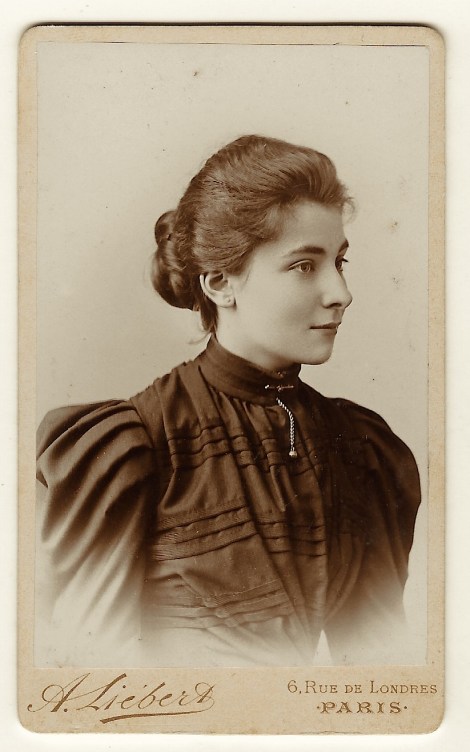
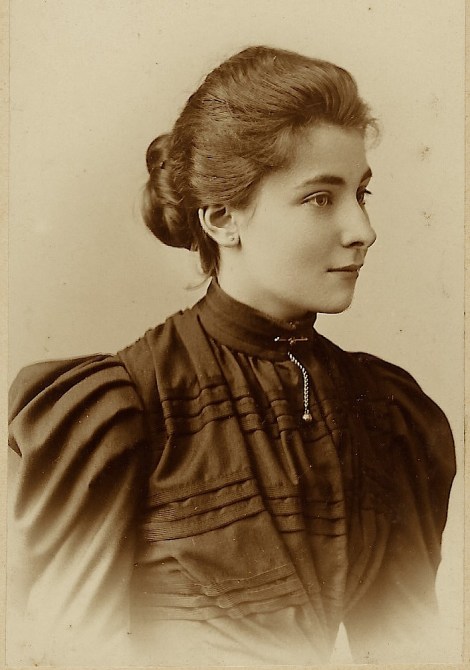
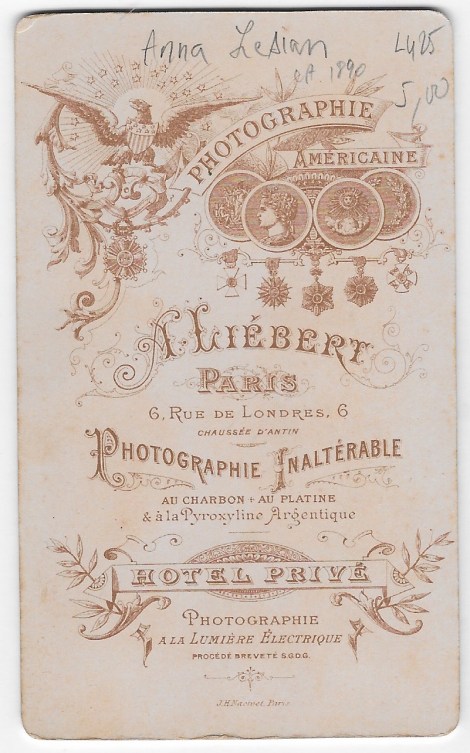
 The pretty young woman seen in this carte de visite portrait, is named Anna Lesian. An inscription on the reverse of the cdv reveals her name and the year (1890) that the photograph was taken. The photo was taken at the studio of A. Liebert, in Paris, France. The Getty Museum, located in Los Angeles, California, as well as other fine museums, have photographs in their collections by Paris photographer, Alphonse J. Liebert (1827-1913). Many of his Parisian subjects were actresses. Perhaps Miss Lesian is one of those actresses. Mr. Liebert has an interesting story. He was a photographer in Nevada City, California (1857-1862), and later, operated in Paris (1863-1890’s). He was born in France. He became an officer in the French Navy. He left the navy in 1848 to study daguerreotypy. He must have reenlisted in the navy because In 1851, he arrived in San Francisco, as a Lieutenant on a French ship. This was a time when there was much excitement about Gold mining. As a result, there was a mass desertion of the ship’s crew. The sailors joined the rush for gold. Liebert had in mind, his own venture. He and two partners decided to take on the project of refurbishing a steamship. They sought investors and hired workers to transform the ship. However, due to the partners inexperience, the venture failed. Liebert than tried gold mining but met little success. In 1857 he opened a photo gallery in Nevada City. He lost thousands of dollars after a fire in 1858. In 1859 Liebert ridiculed a former photography pupil of his, named Louis Celarie, in the press. This started a bitter professional feud. Soon after, Liebert announced that he had won a medal at the state fair. Unfortunately, there was no evidence to confirm this claim. The competition between Liebert and Celarie was fierce. Each offered special promotions to best the other. By 1861, Liebert triumphed, evidenced by the sale of Celarie’s studio. About a year later, Liebert sold his photo gallery. By 1863, he had returned to France and opened a gallery specializing in tintypes. Liebert closely identified with his photography experience in America, and as a result, he named his Paris gallery “Photographie Americaine”. That very name can be seen on the reverse of this CDV. Liebert began to write photography articles and books, and ultimately, invented a prototype solar camera. In 1867, Liebert had a problem with the law. He was sentence to two months in prison and levied a fine of 200 francs. He was charged for the intent to distribute banned post mortem photographs. These were not photos of some random person. Instead, they were images of Emperor Maximillian, who had been executed in Mexico. Liebert ultimately did exhibit these photos. Liebert was becoming more and more successful. His photo gallery was so lavish that a reviewer for the British Journal of Photography wrote that it was “worthy of the smiles of the ‘God of Light’, and a repository for some of the best productions of the photographic art”. In 1879, Liebert’s gallery was the first studio to utilize electric light. By 1880, he was considered to have the most impressive photo studio in Paris. This carte de visite portrait has excellent clarity and is in very good condition (see scans). (SOLD)


 A young child and dog pose for their portrait at the photo studio of Dietrich and White in Chemnitz, Germany. On the reverse of the cdv, photographer White is further identified as “Joh Carl White”. Chemnitz is a city in eastern Germany. To be more exact, it is located in Saxony.

 Paul Metzner & Sons studio took this carte de visite portrait of a pretty young woman. Her dress is lace trimmed and she is wearing earrings and a necklace. The photographer is located in Chaux-de-Fonds, Switzerland. The city is located in the Jura mountains and is just a few kilometers south of the French border. (SOLD)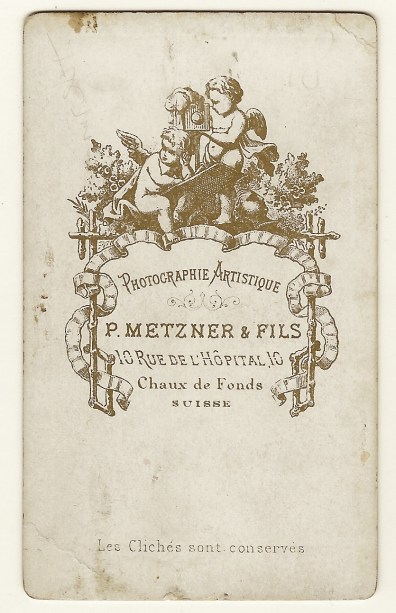
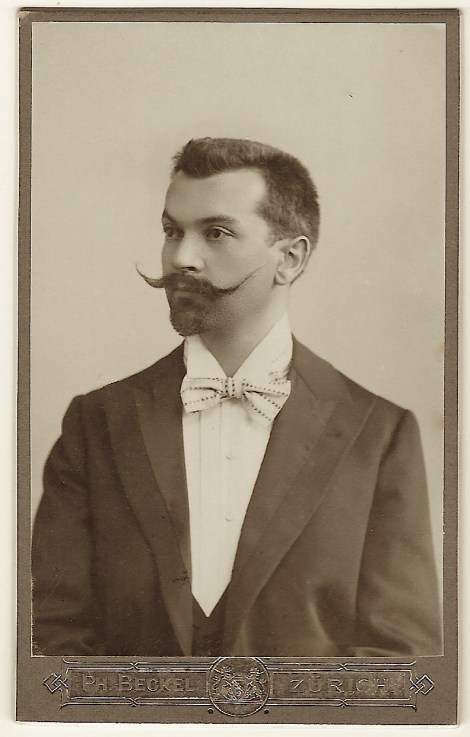
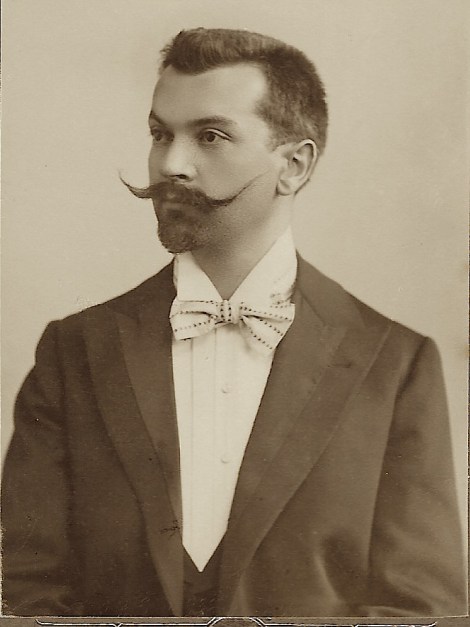 This carte de visite photograph features a dashing young man with an imposing mustache. He is elegantly dressed in formal clothing. The photo was taken by the Beckel studio in Zurich, Switzerland. The cdv photograph was taken sometime shortly after 1895. The date is apparent because the reverse of the image advertises some of the awards received by the studio. The last award listed is from an exhibition in Glarus (Switzerland) in 1895, revealing that this image was created after that year. This carte de visite photograph is in excellent condition (see scans).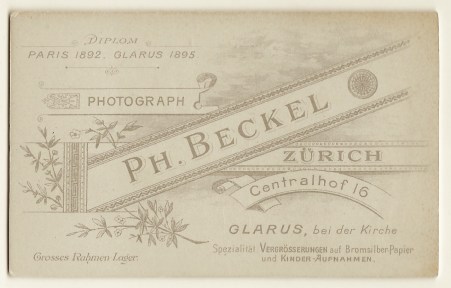
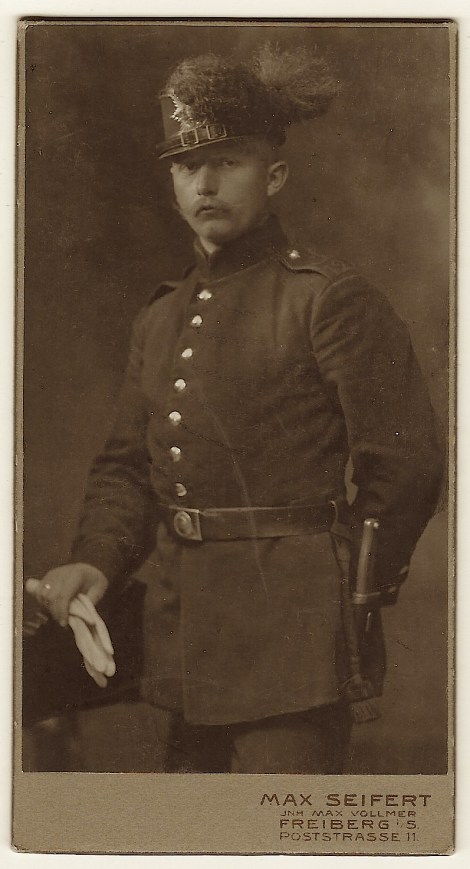
 This carte de visite photograph features a German soldier. I believe that he is an officer in his dress uniform. Note the white gloves that he is holding and his sidearm. I bet that his sheathed knife is a frightening weapon. He is wearing an awesome hat decorated with feathers. This photograph was taken circa the late nineteenth century. The photographer was Max Seifert. He operated a studio in Freiberg, Germany. Freiberg is a town located in the the Free State of Saxony, Germany.
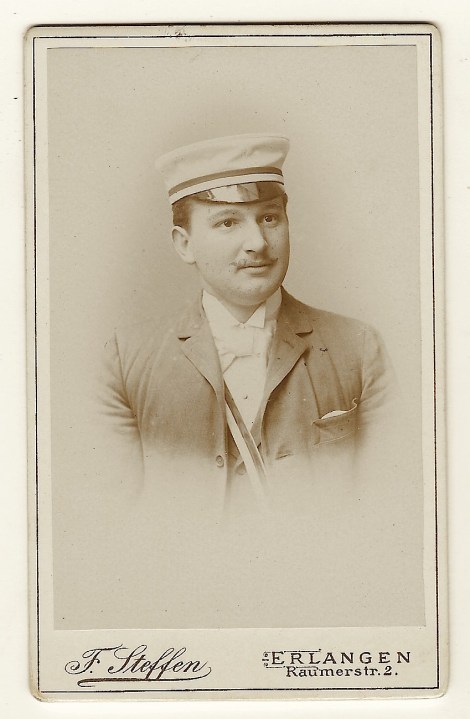
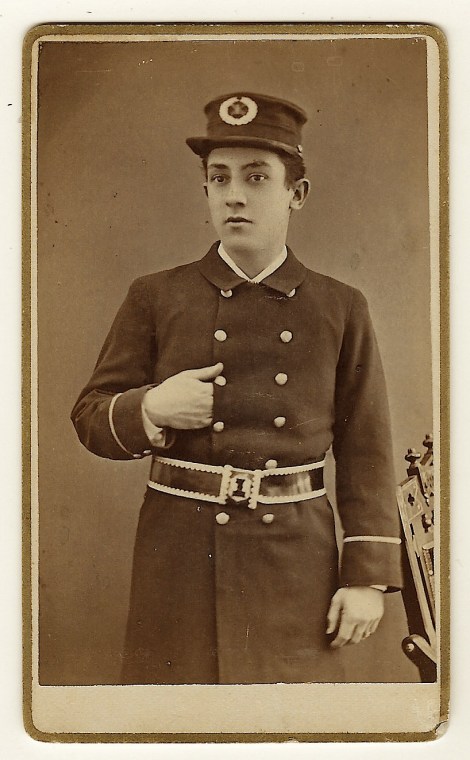
 This carte de visite features a gentleman in some sort of uniform which includes a cap and sash. He appears very “official”. Is he a military veteran? Is he a train conductor or a law enforcement officer? The photographer of this image is F. Steffen. He operated a studio in Erlangen, Germany. The city is located in the Bavarian region of Germany. The Cabinet Card Gallery has another photograph by Steffen in it’s collection. You may view the image by placing the word “Steffen” in this site’s search box. (SOLD)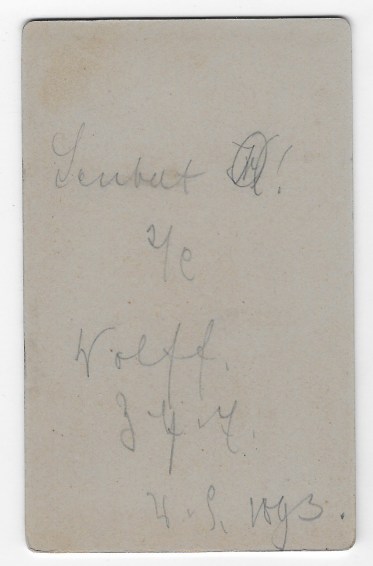

 This cartes de visite features a pretty young woman posing for her portrait at the Heron studio in Montlucon, France. She is well dressed and well coiffed. She appears to be holding back a full smile. Her eyes are bright and engaging. Preliminary research yielded little information about Monsieur Heron. The Cabinet Card Gallery exhibits another photograph by Heron. That image is a photo of a bride and groom. It can be seen by entering the name “Heron” in the search box. Montlucon, the studio’s home, is a town in central France on the Cher River. Adolphe Heron (1865-?) was born in Rotterdam, Netherlands. He got married in Paris (1887) and at that time he was working as a photographer there. He began working in Montlucon in 1893. This cdv photograph is in very good condition (see scans).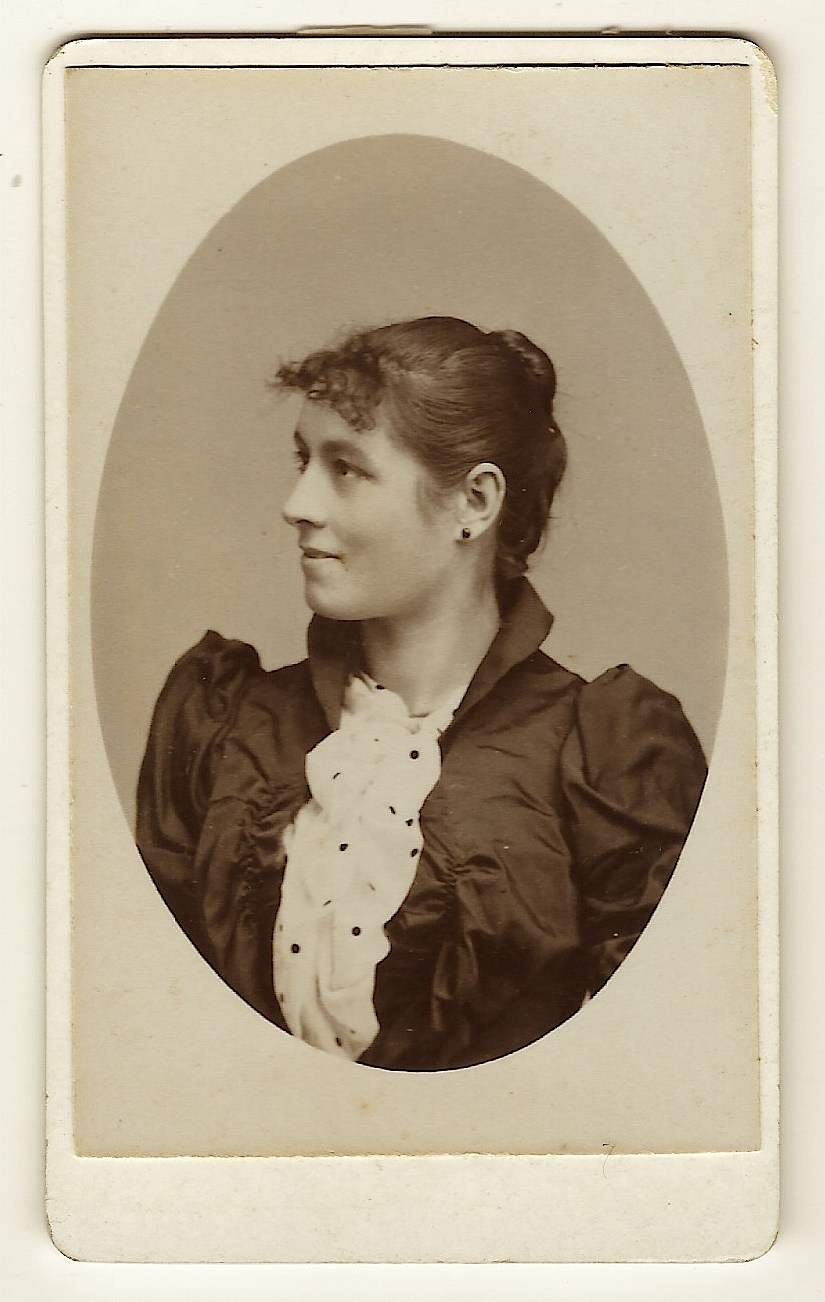

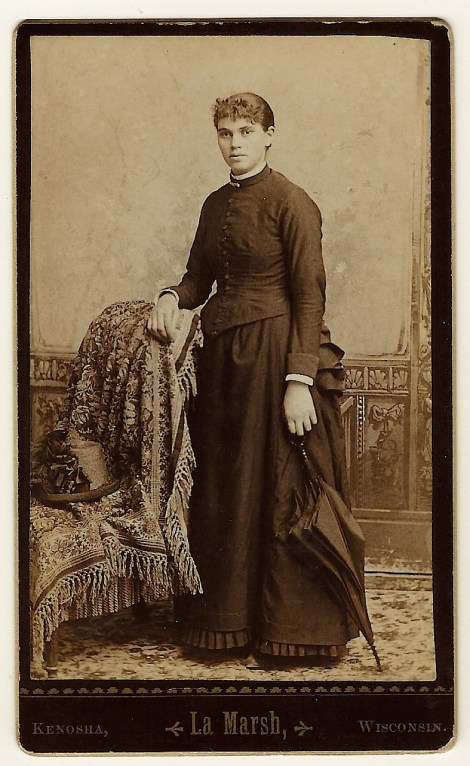
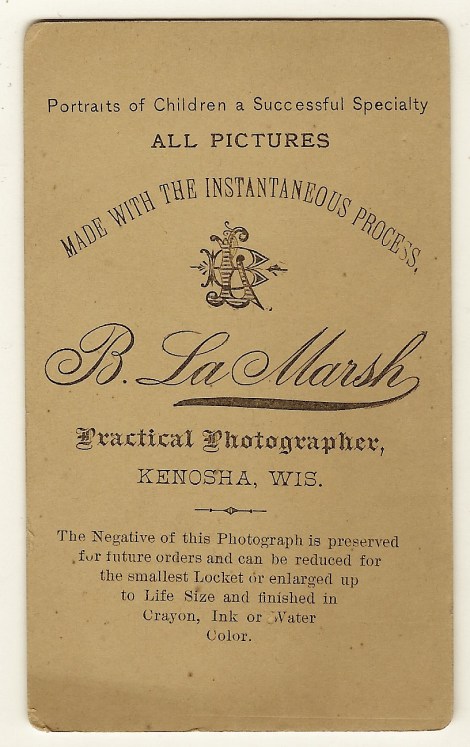
 A lovely young lady poses for her full length carte de visite portrait at the LaMarsh studio in Kenosha, Wisconsin. She is wearing a collar pin and holding a parasol. She appears to be in her teenage years. The book, “Portrait and Biographical Album of Racine and Kenosha Counties, … (1892) includes some background information about photographer, Bernard LaMarsh. He was born in Prussia in 1848. His father spent some time in the military but he was a butcher by trade. The LaMarsh family moved to the United States in 1856. The family first settled in Chicago but moved to Kenosha in 1872. During his teenage years he helped his father in the butcher business and in 1869, he entered the US Army as a drummer. He served for four years and then returned to Kenosha where he took a job as a barber. He was unhappy in the tonsorial business and in 1874 began learning photography with A. F. Wells who operated a gallery in Kenosha. After a few months of training, he bought a gallery in Marseilles, Illinois. After just a year and a half he sold his business and went to Chicago for further training with photographer, J. Steffens. In 1876, LaMarsh returned to Kenosha and opened a gallery which he ran for two years. From 1878 until 1884, he partnered with S. W. Truesdell. The partnership ended because LaMarsh bought out Mr. Truesdell. In 1879, LaMarsh married Augusta Harlis. She was ten years his junior. LaMarsh died in 1929. This cdv photograph has excellent clarity and is in good condition (see scans).


 THE CABINET CARD GALLERY