This photograph tells a story and it is up to the viewer of the photograph to create the story. Not all viewers will create identical stories so the image is more like a Rorschach Test. The stories we originate tell us something about ourselves. Here is my story about this photograph. A young maid prepares to serve tea to the lady of the house. It is a beautiful day, so the tea is served in the garden and the tables have been set with fine lace tablecloths. The garden is located behind a lovely house in the English countryside. Now, back to reality. The photographer of this image and the location of his studio is unknown. The identity of the subject is also a mystery.
ACTRESS MARY ANDERSON: BEAUTIFUL STAR OF THE AMERICAN AND ENGLISH STAGE

These cabinet cards feature American stage actress, Mary Anderson (1859-1940). Interestingly, Anderson’s father was an Oxford educated New Yorker who after Mary was born, moved his family to Kentucky. He then joined the Confederate army and was killed in action when Mary was just three years old. Mary was not much of a student but loved to read Shakespeare. Her step father sent her to New York at age 14 to take ten professional acting lessons. In 1875, at age 16, Mary Anderson began her stage acting career in a Kentucky production of Romeo and Juliet. She continued acting in Kentucky and then appeared in a number of other cities, including New York. Her critical reviews tended to be mixed but she was well loved by the public. She then worked the New York and touring company stages for twelve years until she spent the next six years on the English stage (appearing in a lot of Shakespeare productions). She then returned to the United States, and at age 30, collapsed on stage with a case of nervous exhaustion. This experience, likely coupled with less than favorable reviews, caused her to retire from acting.
Cabinet Card 1 features Anderson in the role of Galatea. A review of Mary Anderson’s performance in this role appeared in the New York Times in a September 1884 edition. She was appearing opposite British actor William Terriss, in the play “Pygmalion and Galatea”, at the Lyceum Theatre in London. Many notables were in attendance, including Oscar Wilde. The review states ” Miss Anderson surpassed herself and that the performance was throughly artistic and finished”. The cabinet card was photographed by The Vanderweyde Light of London, England (182 Regent Street W.). Henry Van Der Weyde (1838-1924) was an artist and photographer. In 1877, he became the first photographer to install and take photographs by electric light. (SOLD)
The second cabinet card was photographed by celebrity photographer, Sarony. The image reflects Mary Anderson’s great beauty. To view other photographs by Sarony, click on Cabinet Card Gallery’s category “Photographer: Sarony”.
The third cabinet card was photographed by “The Sparks Studio”. The studio was located in Philadelphia, Pennsylvania and the artist/manager was Elliott Houseworth. This cabinet card offers a profile portrait of the attractive Ms. Anderson. The 1880 census lists Elliott A. Houseworth as being born in 1855, residing in San Francisco, California, and working as a photographer. Houseworth also appears in the 1900 census as living in Norwood, Pennsylvania and working as a manager. These demographics fit the photographer of this image, since Houseworth managed Sparks Photography Studio and Norwood is only about eleven miles from Philadelphia. To view other photographs of actresses by Sparks, click on the category “Photographer: Sparks Photo Publishing Co.”.
The fourth cabinet card features a smartly dressed Mary Anderson and was photographed by George Rockwood, of New York City. To learn more about Rockwood and to view more of his photographs, click on the category “Photographer: Rockwood”. A sticker on the reverse of the photograph indicates that the image was once part of the Kean Archives in Philadelphia, Pennsylvania. The Kean Archives was a company that served as a source of illustrations and photographs for various modes of media. They eventually were purchased by Getty Images.
MILES TO NOWHERE: COUPLE DRIVING ZERO MILES PER HOUR IN PORTOBELLO, EDINBURGH, UNITED KINGDOM
“Miles from nowhere. Guess I’ll take my time. Oh yeah, ….to reach there.” The lyrics of Cat Stevens’s song, “Miles to Nowhere”, pretty much sums up the driving experience of the couple in the mock car in this photograph. They are going nowhere fast. If you are a regular visitor to the Cabinet Card Gallery, then this cabinet photograph may look familiar to you. There is a portrait in the gallery of a another couple sitting in a mock automobile that is identical to the one in this photograph. That photograph was taken in a studio located in the Isle of Man. To view that photograph, click on the category “Automobile”. The image pictured here was photographed by William Lees of Portobello, Edinburg, in the United Kingdom. The studio address was 28 Bath Street. John Lees, T.Lees, and William E. Lees operated their Portobello photo studio from 1892 until 1952. William Lees kept a stuffed donkey in his studio. SOLD
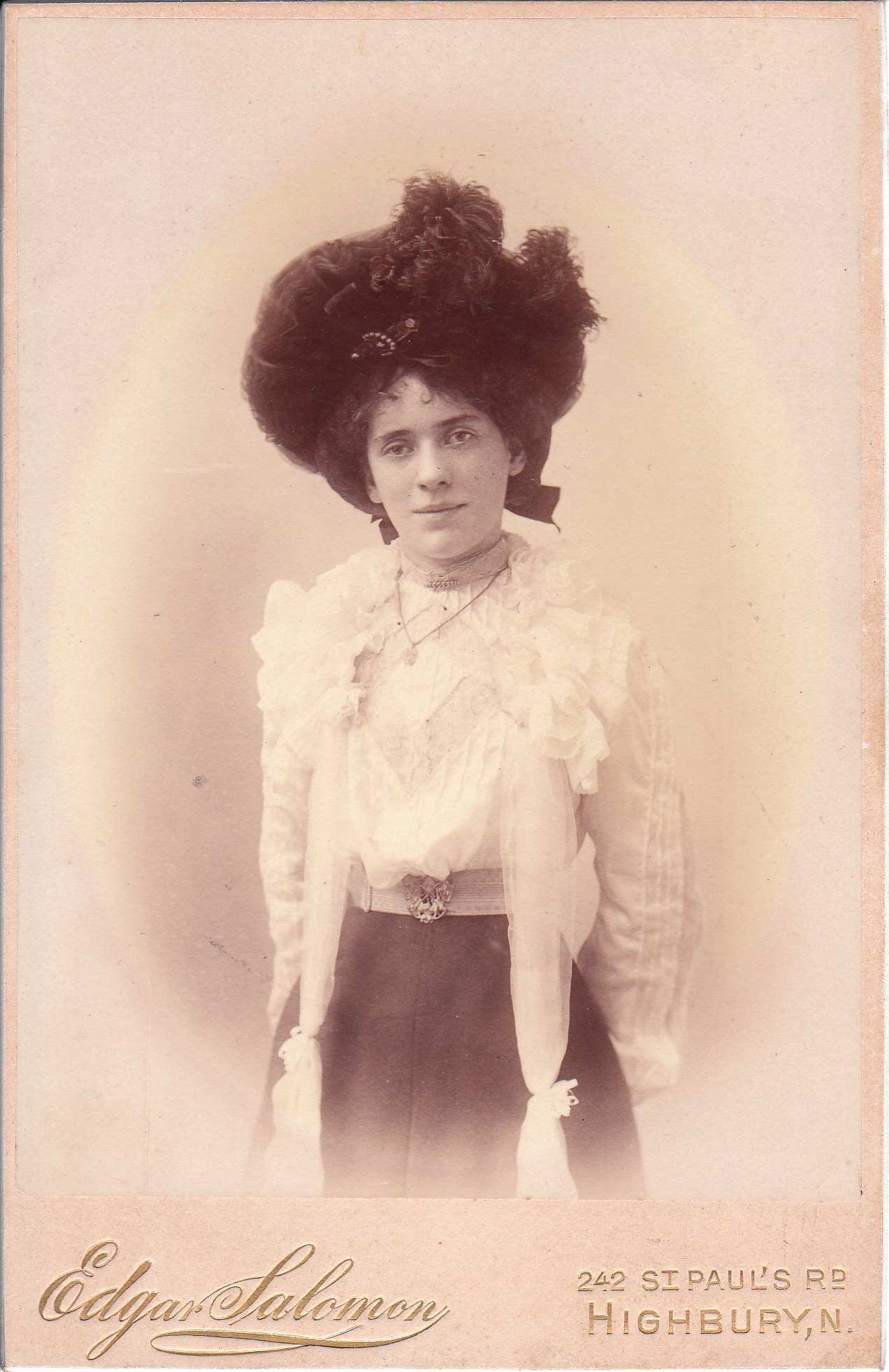
EIGHTEEN YEAR OLD GIRL IS A FUNKY DRESSER IN 1902 LONDON, ENGLAND
An internet dictionary defines funky as ” modern and stylish in an unconventional or striking way”. The pretty young lady in this cabinet card photograph is certainly dressed in a funky manner. She has a great smile and is remarkably well poised as she stands before the camera. Her scarf appears to be made of a fine fabric, and seems to be tied at the ends by ribbons. She is wearing an interesting belt with a decorative buckle. She is also wearing a terrific hat. Note her necklace and the brooch at her collar. A pencilled notation on the reverse of the cabinet card indicates that the young woman in the image is eighteen years of age and that the photograph was taken in 1902. The photographer was Edgar Salomon. He had a studio in two English cities; Highbury and London.
A XYLOPHONE DUET IN LIVERPOOL, ENGLAND
Two sisters, in identical dresses, pose for a cabinet card portrait, as they play separate xylophones. The girls are very conscious of the camera as they pretend to play their duet. The xylophones are atop interesting pieces of furniture, or perhaps, trunks. Viewers of this image must consider the possibility that the sisters in this photograph are actually one, and the same, person. It was not unusual during this era for a photographer to use trick photography to place one person in two positions in the same photograph. The photographer of the cabinet card was E. J. (possibly E. T.) Vanderbilt, whose studio was located in Liverpool, England.
JULIA NEILSON (1861-1957): BRITISH STAGE STAR
Julia Neilson (1868-1957) was an English actress remembered for her numerous performances as Lady Blakeney in “The Scarlet Pimpernell” and for her roles in many tragedies and historical romances. In addition, she is also known for her portrayal of Rosalind in “As You Like It”. She became noticed after acting in a series of plays by W. S. Gilbert in 1888. She then joined the company of Herbert Beerbohm Tree, where she remained for five years. She married actor, Fred Terry and their daughter became a well known actress, Phyllis Neilson-Terry. From 1900 through 1930, Neilson and her husband became noted producers of plays. The photographer of this cabinet card was W. & D. Downey of London, England. To view other p;hotographs by the Downey studio, click on the category “Photographer: Downey”. This cabinet card captures Ms Neilson in her role as “Drusilla Ives” in “The Dancing Girl”. The photograph was taken in 1891.
ORIGINAL PLAYBOY BUNNY POSES IN TUNSTALL, ENGLAND
A young woman poses for her portrait at the studio of J. Addison & Company in Tunstall, England. Why didn’t the photographer or a family member tell this woman that her outfit made her look like a bunny rabbit? She is dressed in white, and her hat has two white feathers that point straight up like rabbit ears. Apologies to all those visitors looking for the original playboy bunny.
THE MAN WITH THE STEEL WOOL BEARD IN EXETER, ENGLAND
A well dressed man poses for his portrait at the studio of Charles Keeping in Exeter, England. The subjects beard looks remarkably similar to a Brillo pad. Pity his poor wife during their amorous times together. The photographer, Charles Keeping (1842-?) was born at Lymington in Hampshire. He first worked as a photographer in Exeter in about 1870.He set up a studio at New Bridge Street after moving to Exeter from Torquay between 1867 and 1870. The studio moved to the address listed on this cabinet card (1, Exe Bridge) in 1873. Keeping also had a number of branch studios. In the mid to late 1880’s the business was known as the “Exonia Studio”. The available history indicates that this image was produced between 1873 and the late 1880’s. The subjects steel wool type beard is his ticket to enter the Cabinet Card Gallery’s category “Beards (Only the Best). Click on the category to see an amazing collection of unusual and interesting beards.
ADORABLE CLOSE-UP PORTRAIT OF YOUNG GIRL IN LONDON, ENGLAND
This portrait features a beautifully dressed cute child. The child appears to be a girl, but this is only a guess. The child’s fancy outfit includes a lace collar and a pretty cap. She is holding a branch with only a single leaf. The studio that photographed this child is Pearce & Smith of London, England.
PRETTY YOUNG GIRL IN LIFRACOMBE, ENGLAND
A pretty young girl poses for her portrait at the photographic studio of Chevalier Lafosse at 5 Belgrave Promenade in Lifracombe, England. Lfracombe is a seaside resort on the North Devon coast and has a small harbor surrounded by cliffs.

Cabinet Card 1 (SOLD)