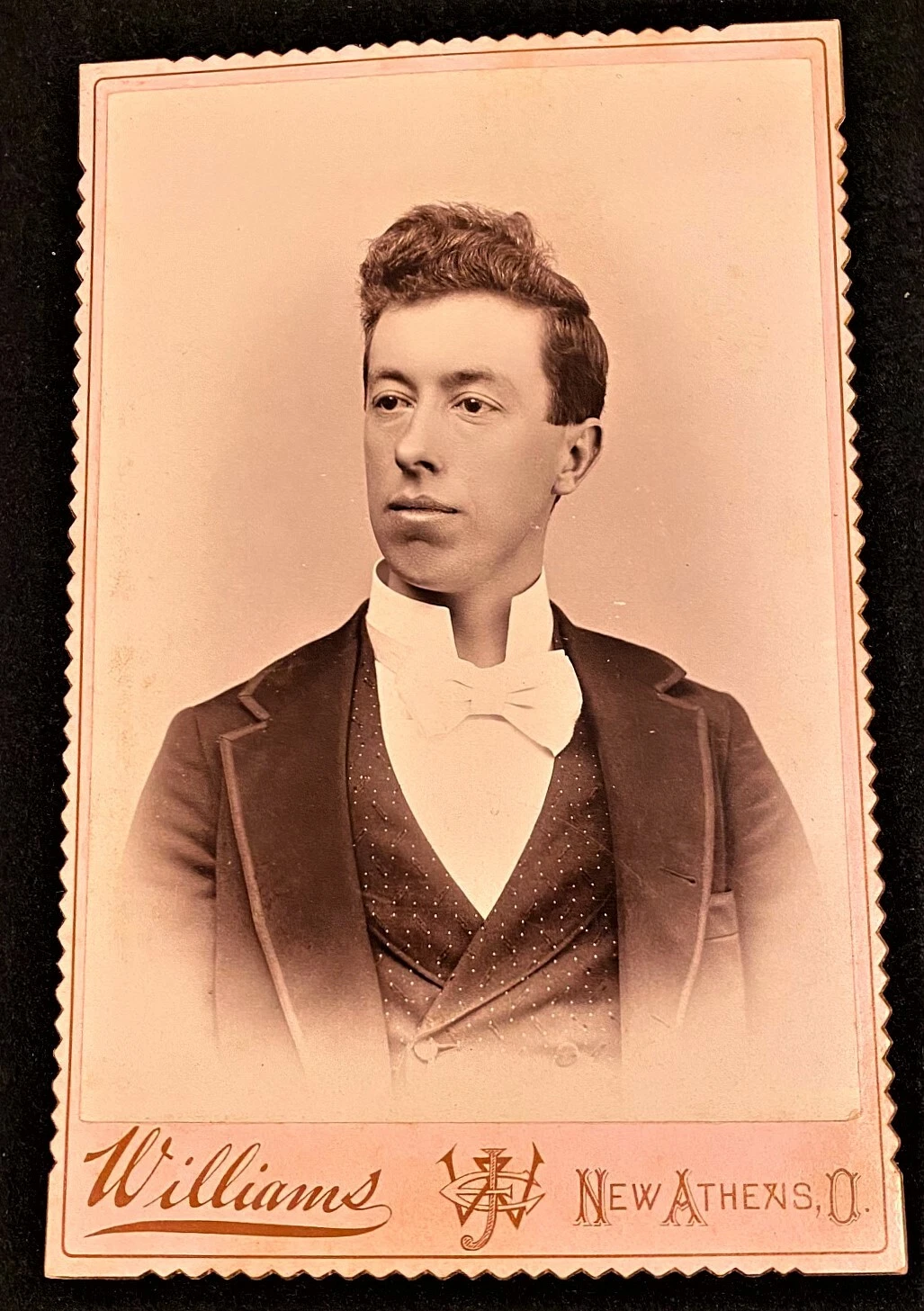
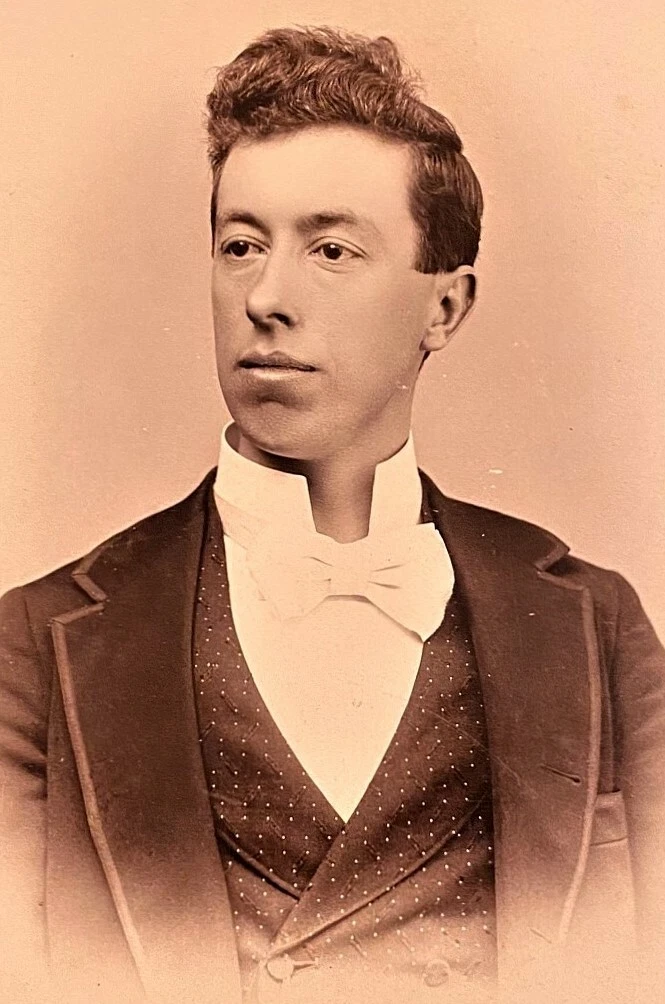
This cabinet card portrait (sorry for the poor quality of the scans) features a flamboyant looking, but handsome, young man. He is well dressed and well poised in front of the camera. Note his pouffey hair. This gentleman was photographed at the Williams studio in New Athens, Ohio. Joseph E. Williams (1856-1946) career as a New Athens photographer spanned decades. SOLD
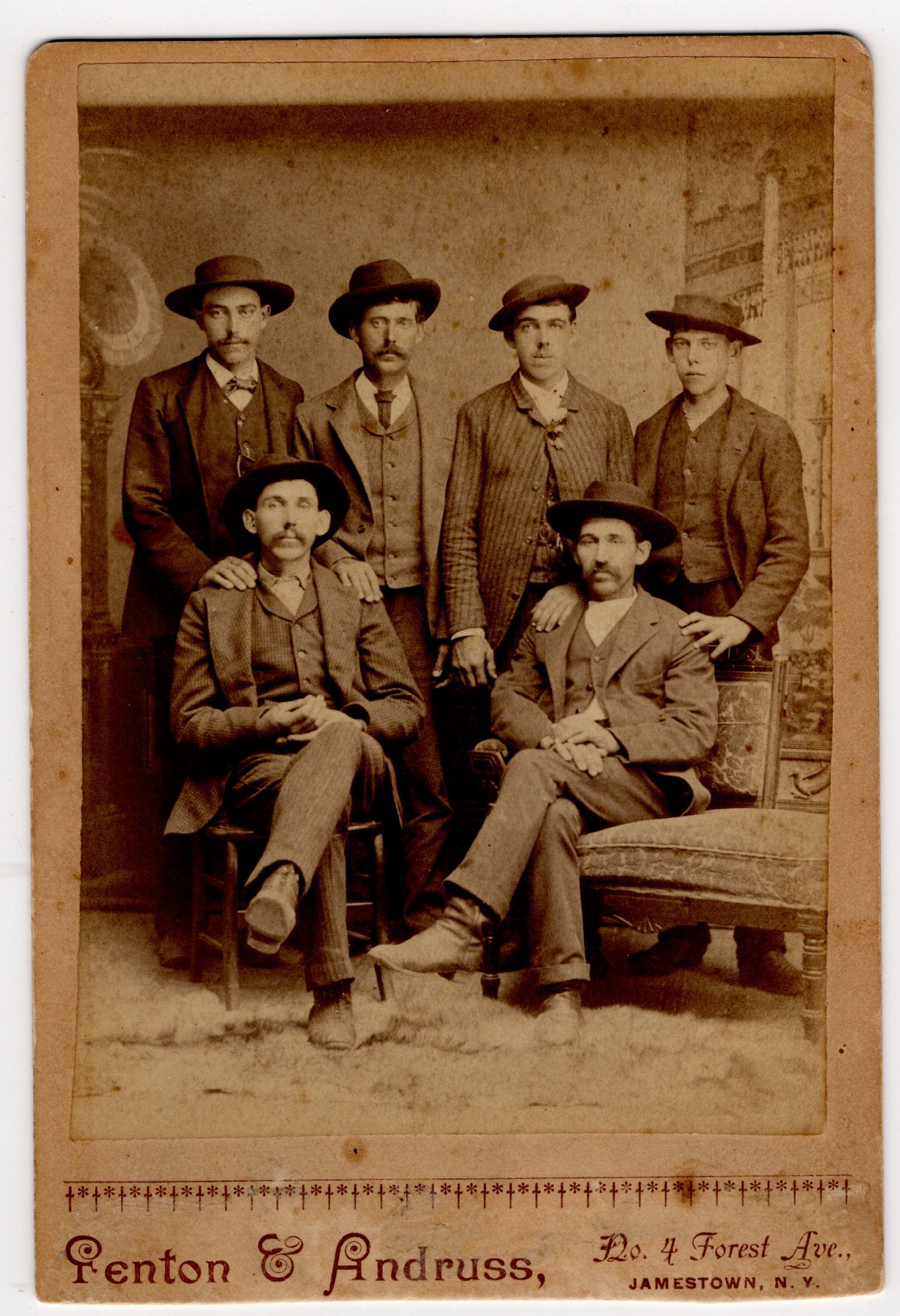
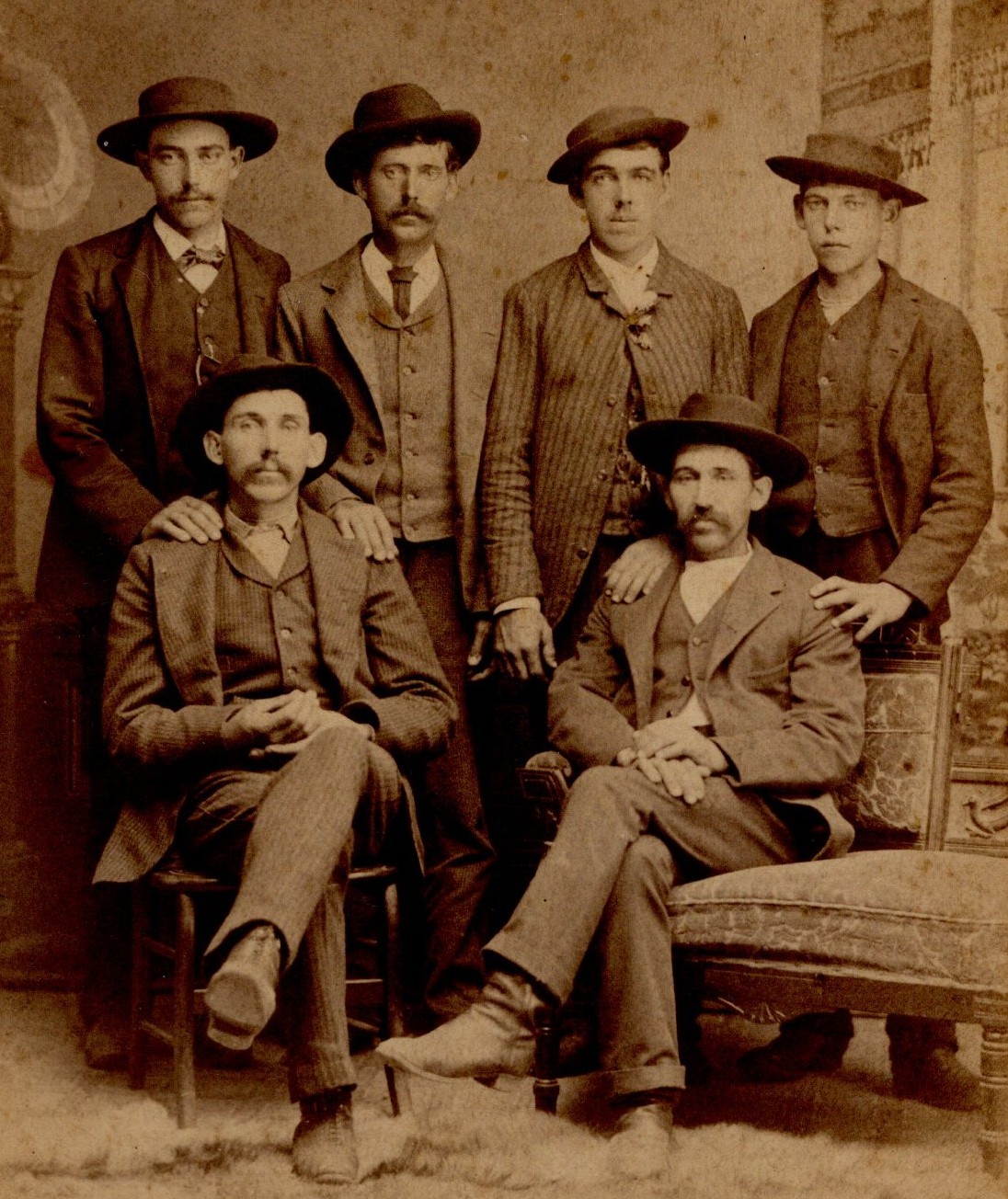
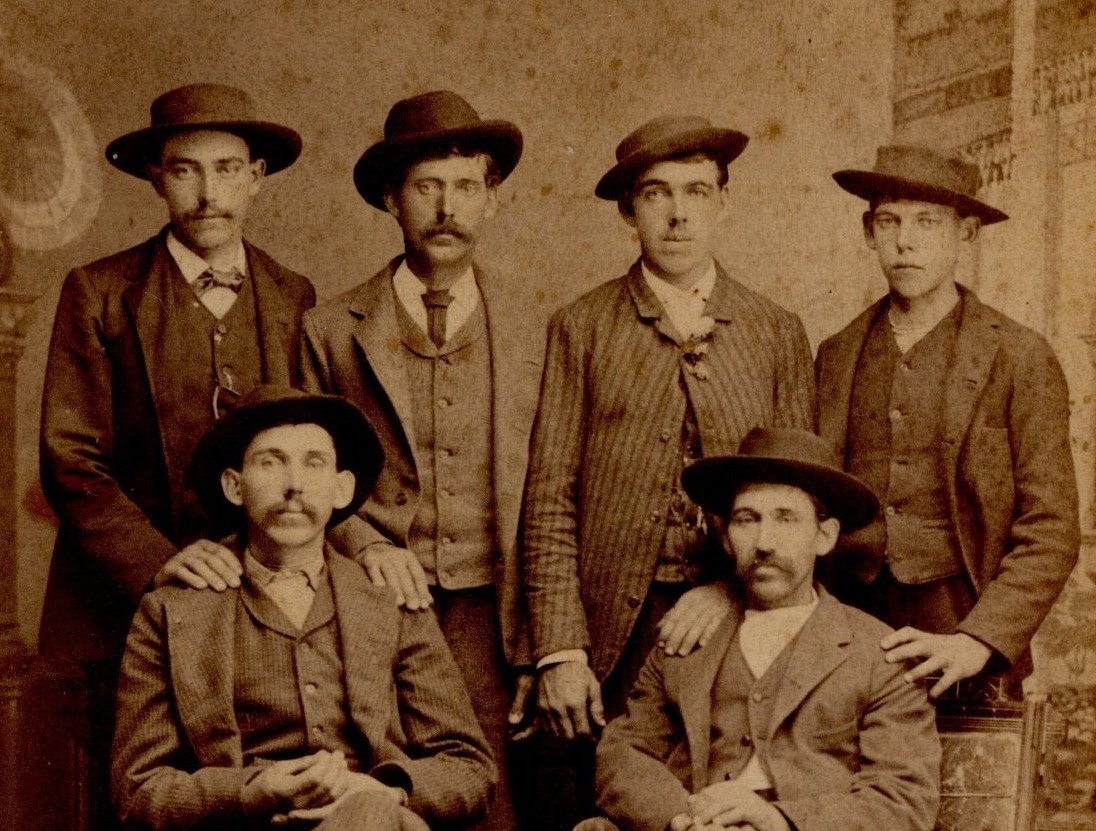
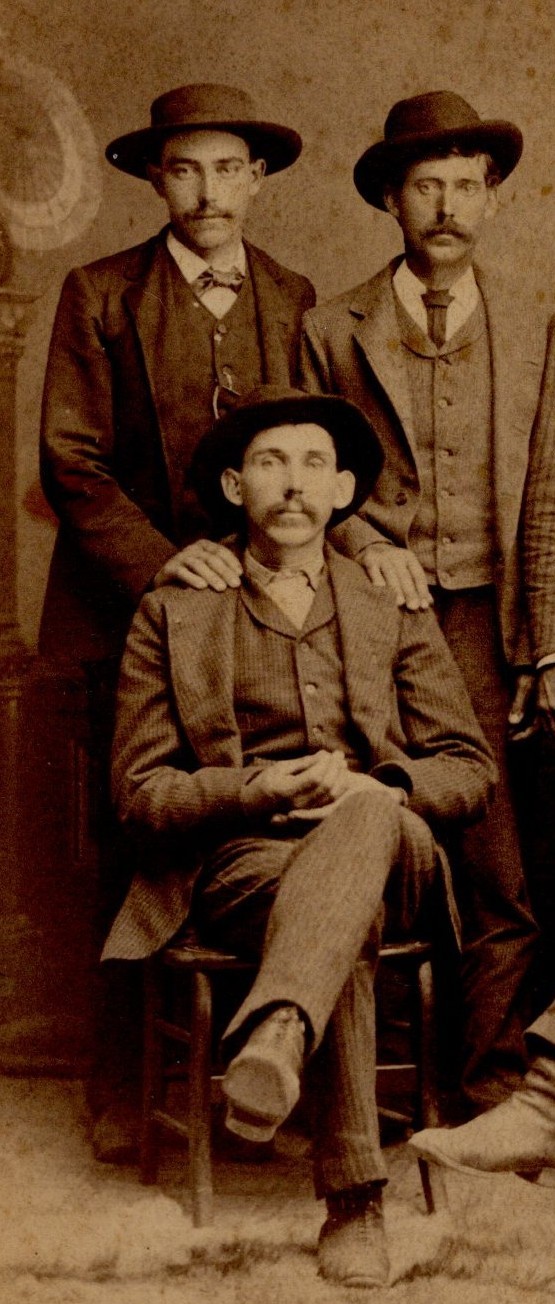
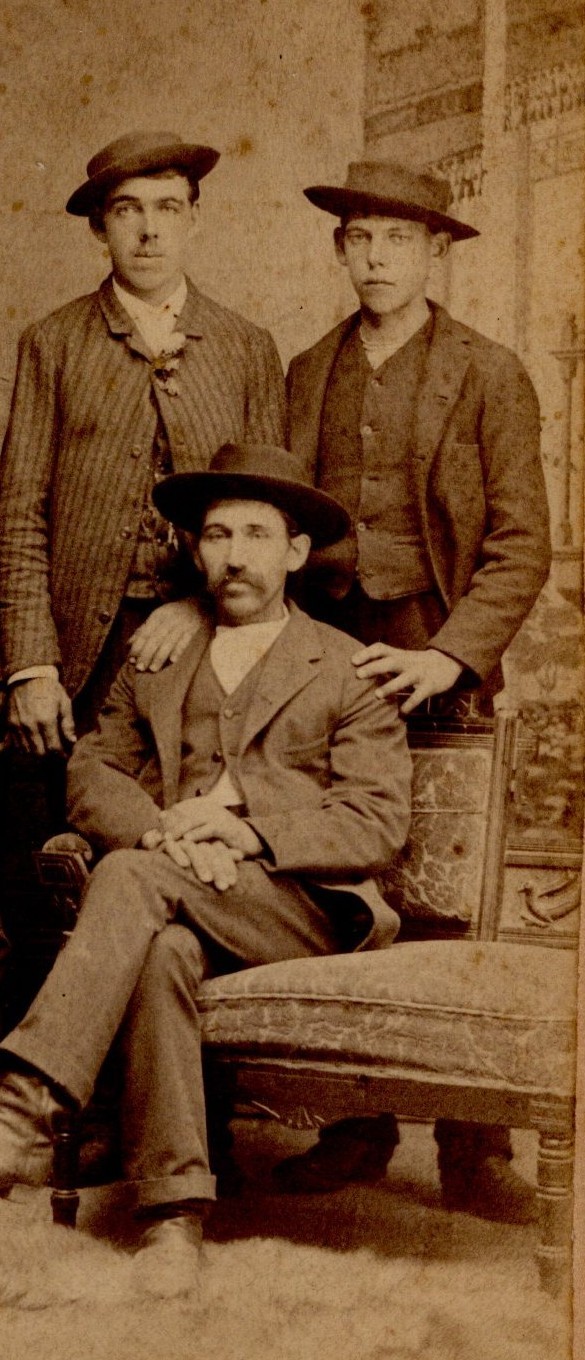
This striking original cabinet card photograph dates from the late 19th century, likely circa 1890, and captures a group portrait of six well-dressed men posing in a photographic studio in Jamestown, New York. The image was taken by Penton & Andruss, located at No. 4 Forest Ave., Jamestown, N.Y., as identified by the ornate imprint on the front mount. The men are dressed in typical late Victorian attire, wearing a variety of three-piece suits, waistcoats, high-collar shirts, and neckties or cravats. Each man wears a broad-brimmed hat, suggesting either a regional or occupational identity—possibly connected to rural life, ranching, or even a fraternal organization. The group is arranged in a formal pose: four men standing in the back and two seated in front on elegant studio furniture. The backdrop features painted columns and drapery, a common studio motif of the period meant to evoke elegance and sophistication. The seated men have a relaxed posture, one with legs crossed and hands folded in his lap, while the other leans slightly forward with a composed, confident expression. Each subject maintains a serious or neutral facial expression—typical for 19th-century portraiture due to long exposure times and social conventions around photographic solemnity. Penton & Andruss, the photographers, was a partnership based in Jamestown, New York during the late 19th century. While detailed biographical records on the firm are limited, they appear in regional business directories and period listings as active professional photographers. Jamestown was a thriving industrial and lumber town during this period, and it’s possible that these men were involved in local trades or belonged to acommunity club, union, or fraternal society. (SOLD)
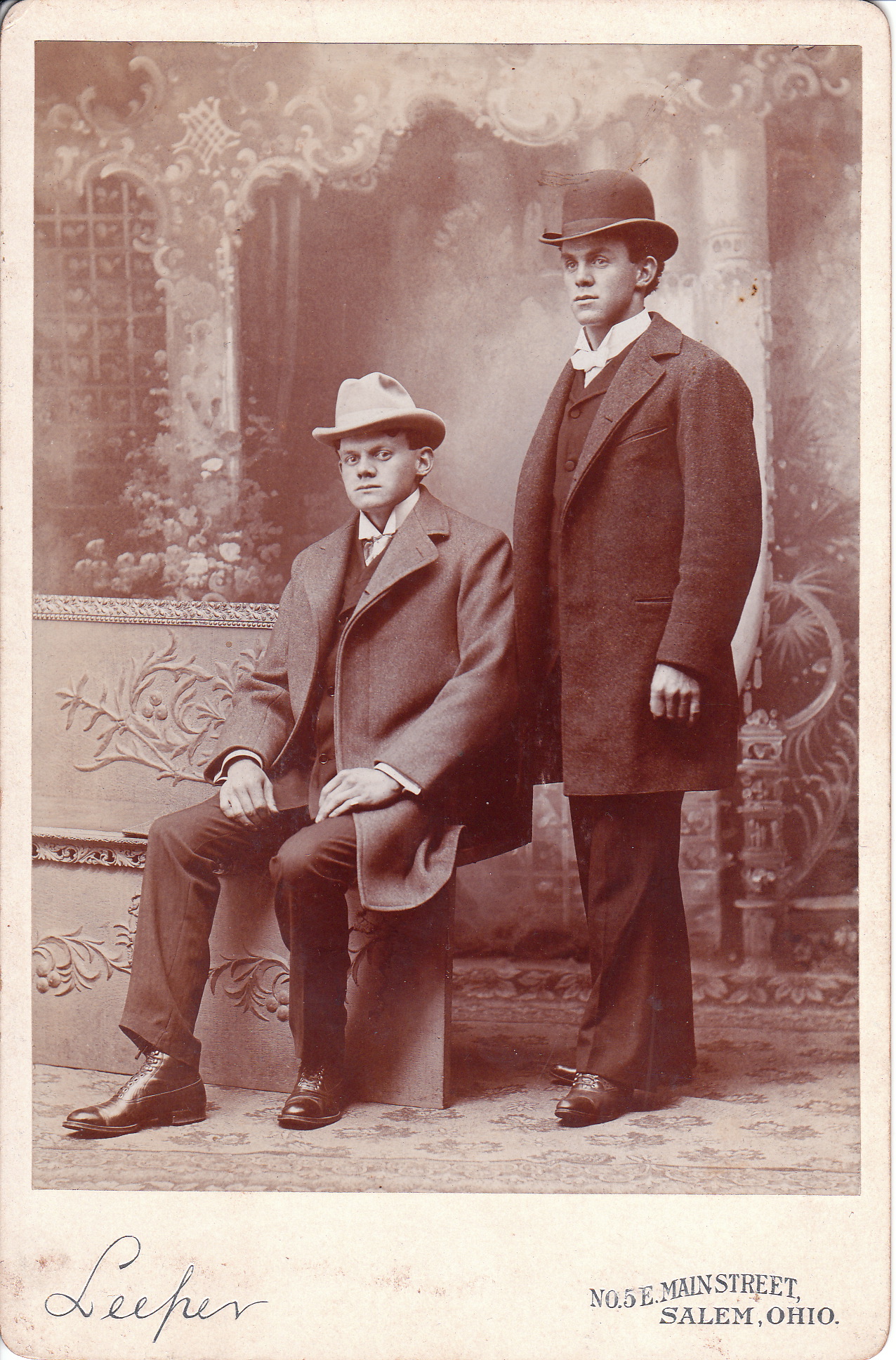
Two dapper men, looking quite professional, pose for their portrait at the Leeper studio, in Salem, Ohio. These men look like their on business. Are they lawmen? The gentleman who is standing is extremely handsome so perhaps the men are actors. The photographer is Burt Leeper. Leeper was born in Pennsylvania in 1865. He worked in Salem at the end of the nineteenth century. An article in a photographic journal (1900) cites Mr. Leeper as being part of a “Picture Trust”. It seems that he was part of a “price fixing” combine that was formed to resist the lowering of photographic studio prices as a result of fierce competition between photographers. Leeper and three other photographers agreed to match each others prices for services and goods. In addition, Leeper and two of the other photographers agreed to take turns being open for business on Sundays. The fourth photographer declined, preferring to stay closed on all Sundays. This cabinet card photograph is in good condition (see scans).
This cabinet card is available for purchase at The History Peddler for $38.00 or Best Offer.
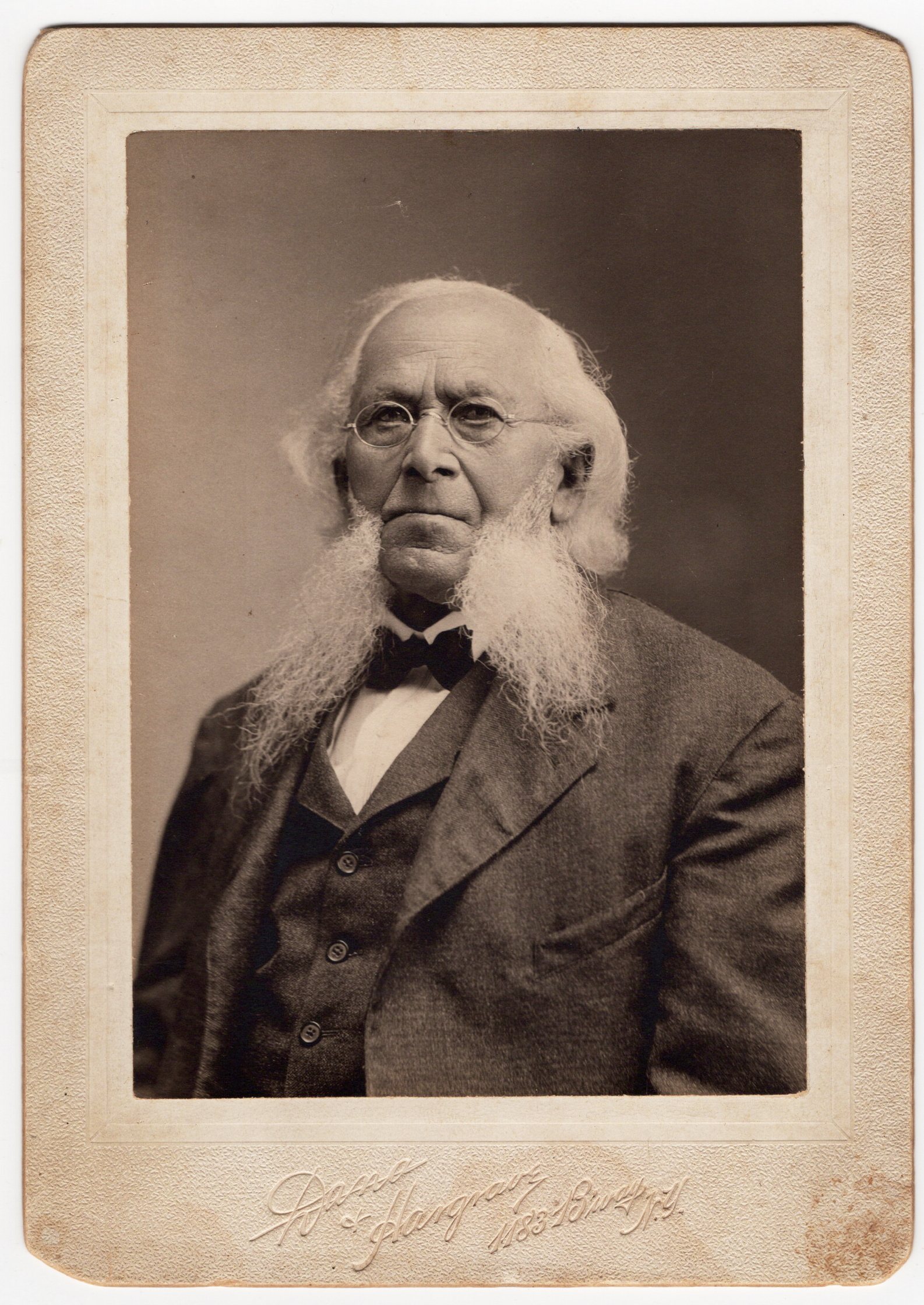
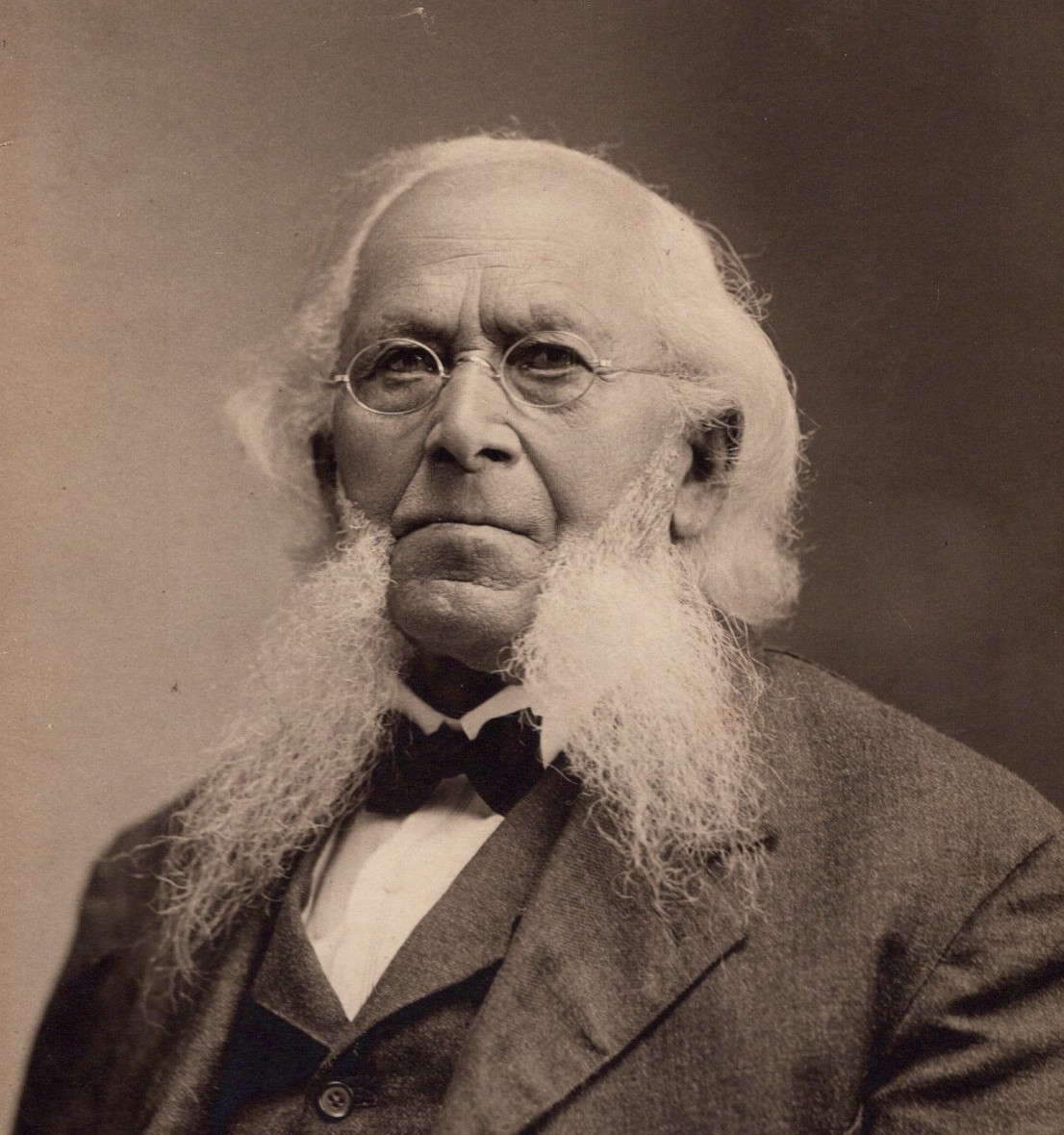
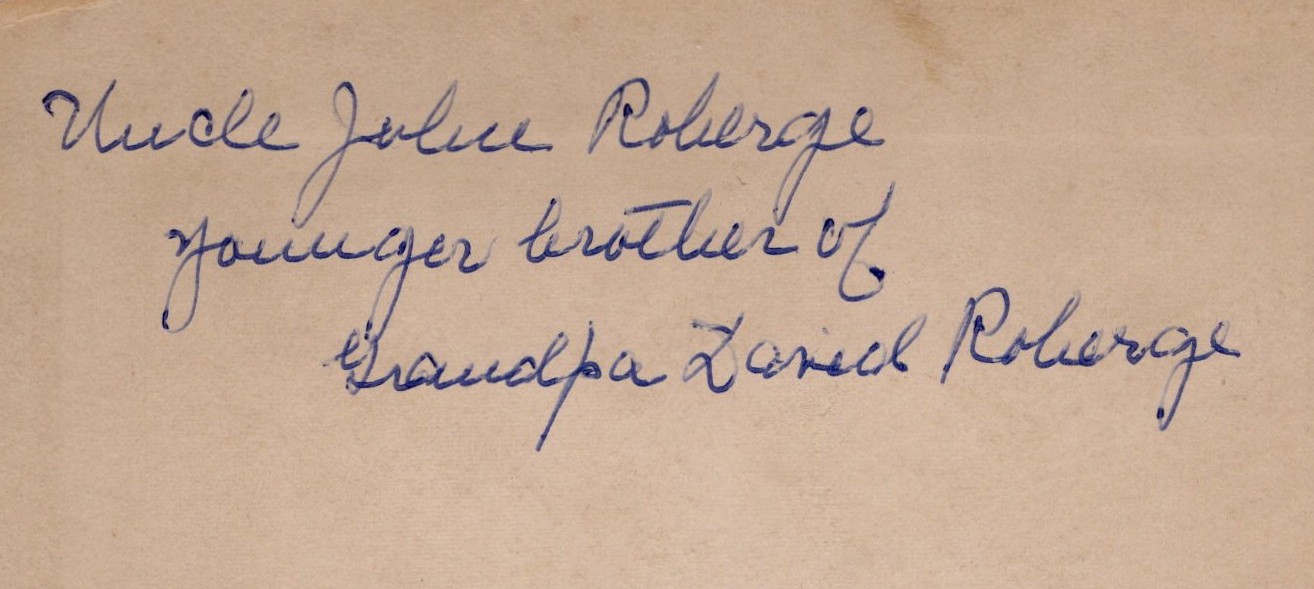
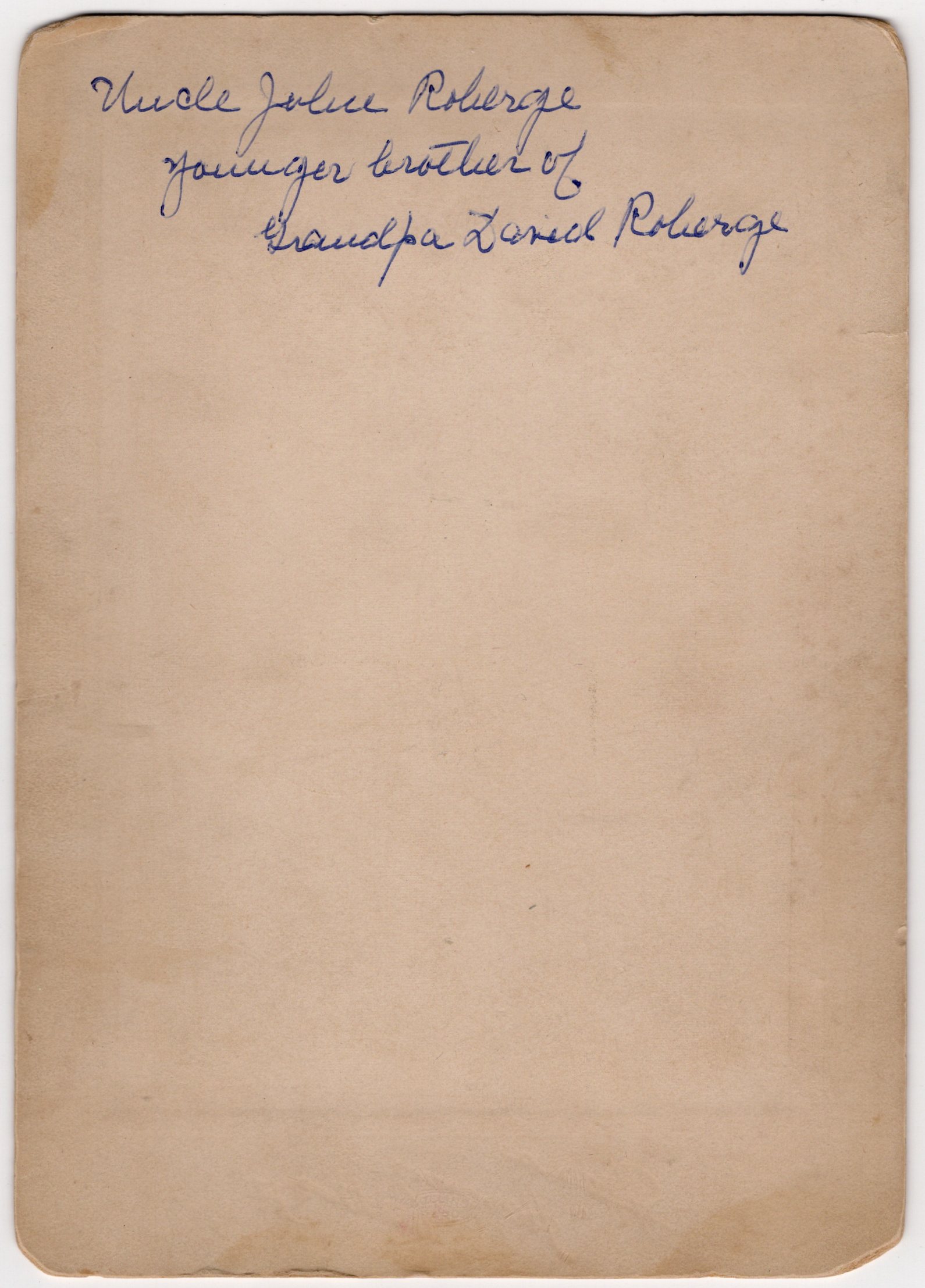
Offered here is a striking and highly detailed cabinet card photograph of a distinguished older gentleman, taken by the celebrated New York photographic firm Dana & Hargrave, located at 1183 Broadway, New York City. The image likely dates to the 1890s. The subject is dressed in formal 19th-century attire, wearing a three-piece wool suit with a buttoned vest, a high-collared white shirt, and a neatly tied bow tie. His long, full sideburns and clean-shaven chin—a style known as “friendly mutton chops”—are an impressive feature, accentuating his age, dignity, and gravitas. He wears round spectacles perched low on his nose, giving him a scholarly or ministerial air. His expression is serious and contemplative, with a quiet confidence that reflects the formality of the period. The photograph is crisp and beautifully lit, with sharp contrasts and soft tonal gradation typical of high-quality late 19th-century studio work. This portrait was taken by Dana & Hargrave, a respected photographic studio based at 1183 Broadway, New York, active in the 1880s–1890s. The primary name, Dana, refers to Edward C. Dana (1852-1897), a prominent 19th-century photographer who specialized in portraiture of the elite and artistic figures of New York society. Dana was well-known for his careful composition and the lifelike quality of his cabinet cards. He developed an interest in photography during the Civil War after seeing conflict images displayed publicly in Boston. He later trained with Boston photographer James W. Turner. In 1875, he opened his first studio in Brooklyn, eventually relocating to Manhattan, where he established a gallery at 14th Street and 6th Avenue. By the late 1880s, his innovative approach—particularly his rejection of painted backdrops—brought national attention and awards, including a Gold Medal in 1887. Further honors followed, such as a gold medal from the Photographers’ Association of America in 1891, an award at the 1893 World’s Columbian Exposition, and a bronze medal in 1894. With growing prestige, he moved to 872 Broadway. Embracing advancements in halftone printing, he worked closely with leading printers and shifted his business model from selling portraits directly to the public to licensing images to editors and publishers, often with financial backing from producers seeking publicity. There is an inscription on the reverse of the photograph. The inscription identifies the subject as “Uncle John Roberge, younger brother of Grandpa Lionel Roberge”. (SOLD)
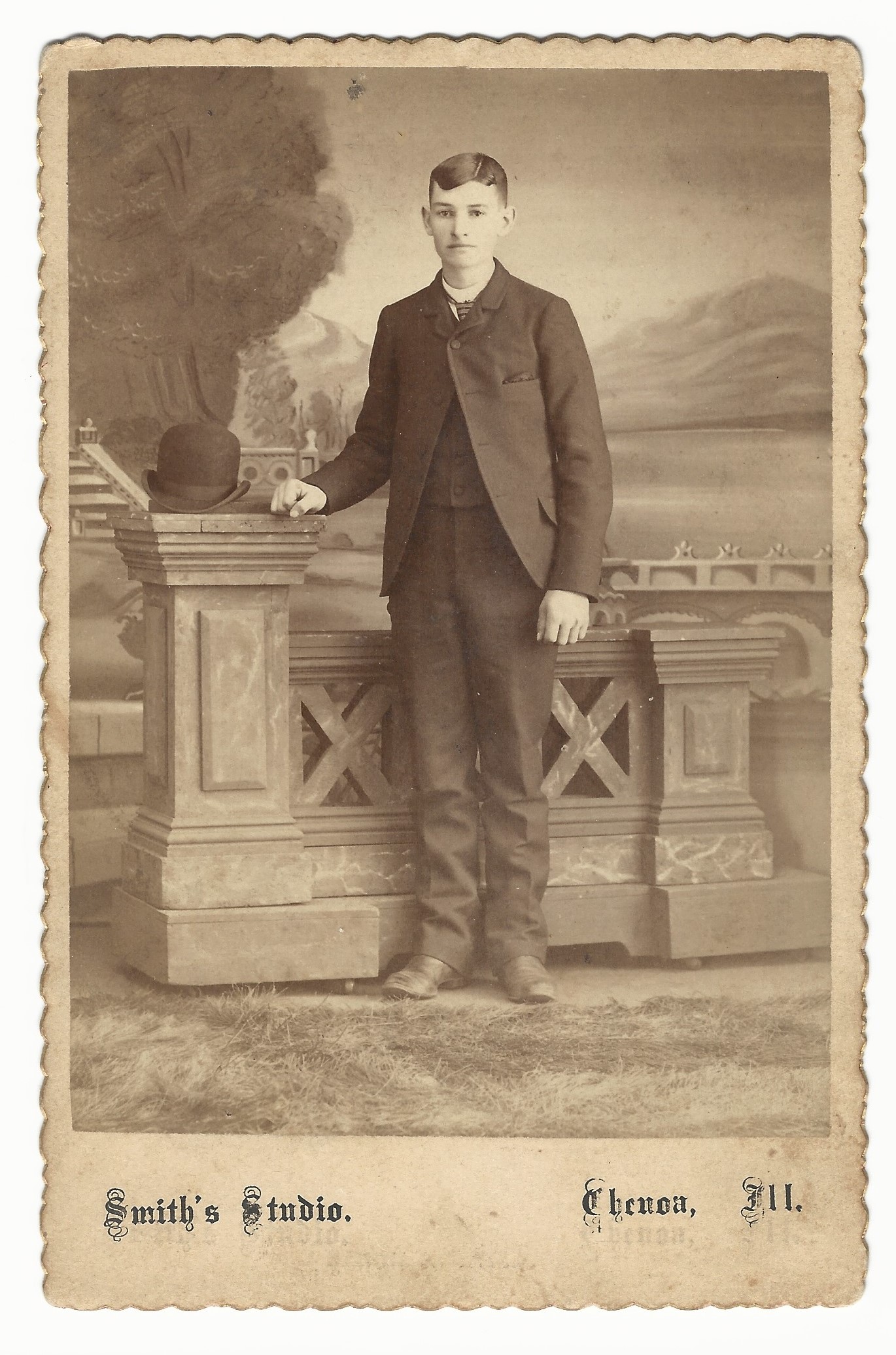
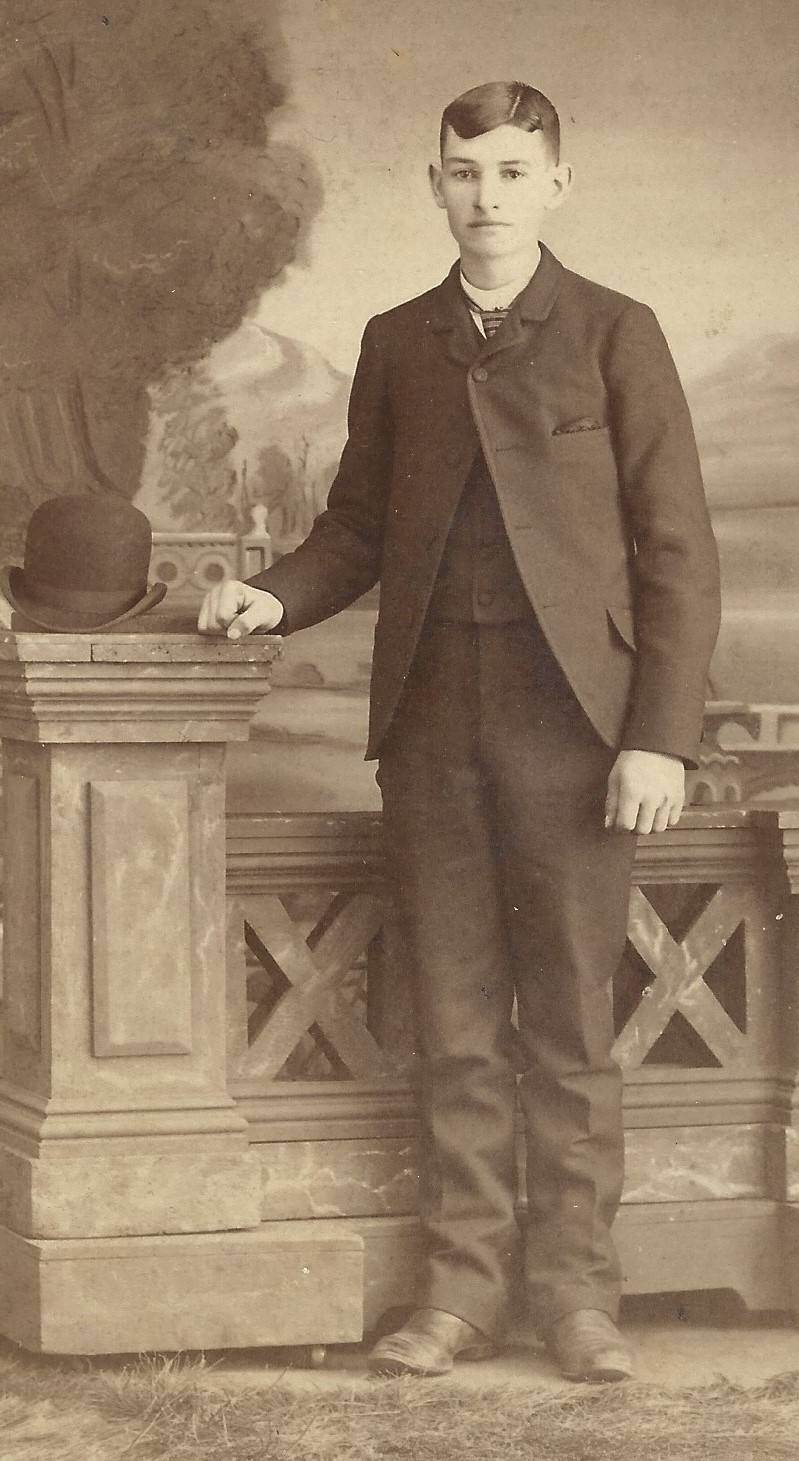
This cabinet card features a teenage boy posing for his portrait at Smith’s Studio in Chenoa, Illinois. He is well dressed in his three piece suit. His derby hat is beside him, sitting on a faux wall. Note the backdrop. The artist who created it did not have an abundance of talent. SOLD
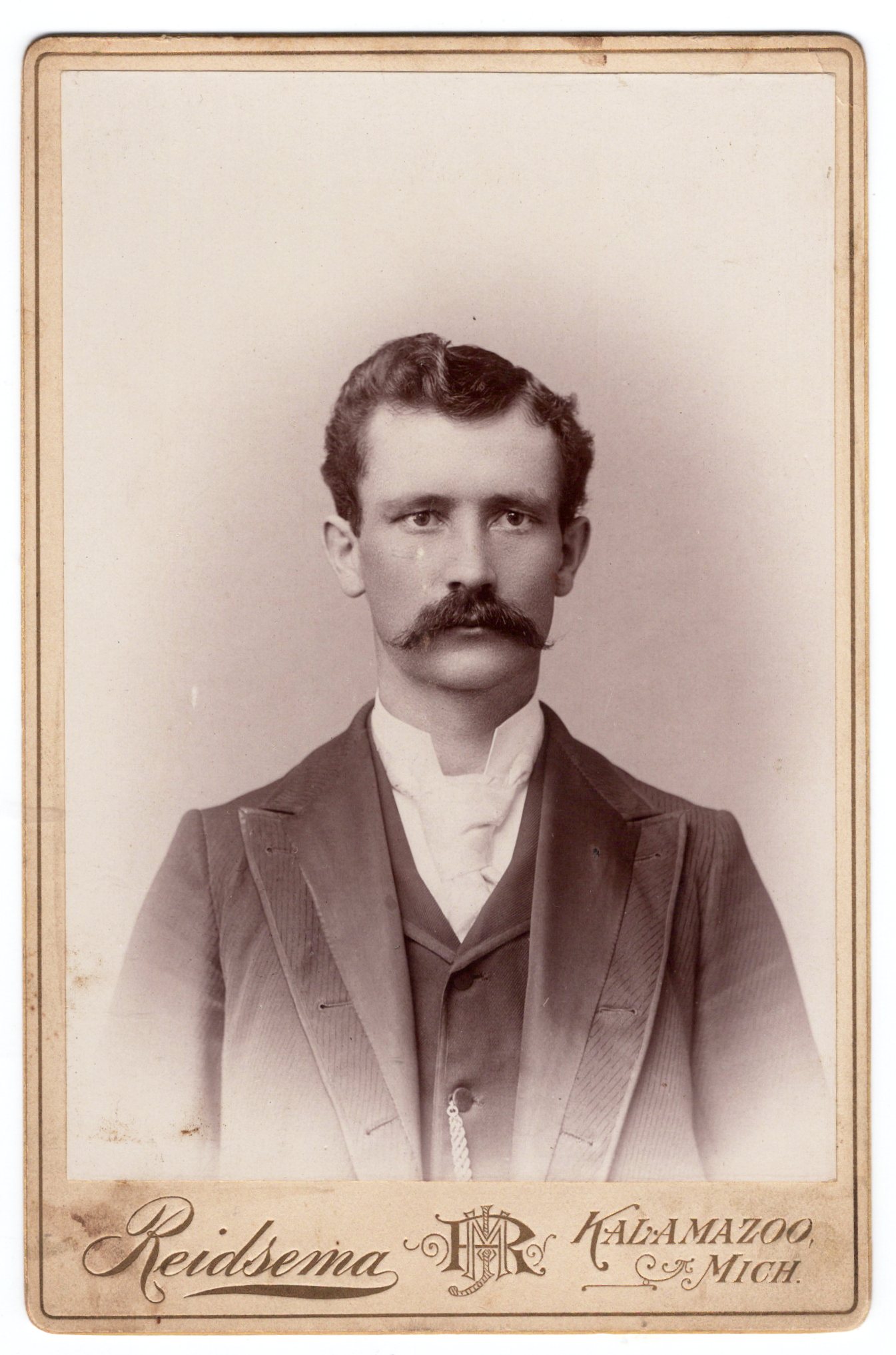
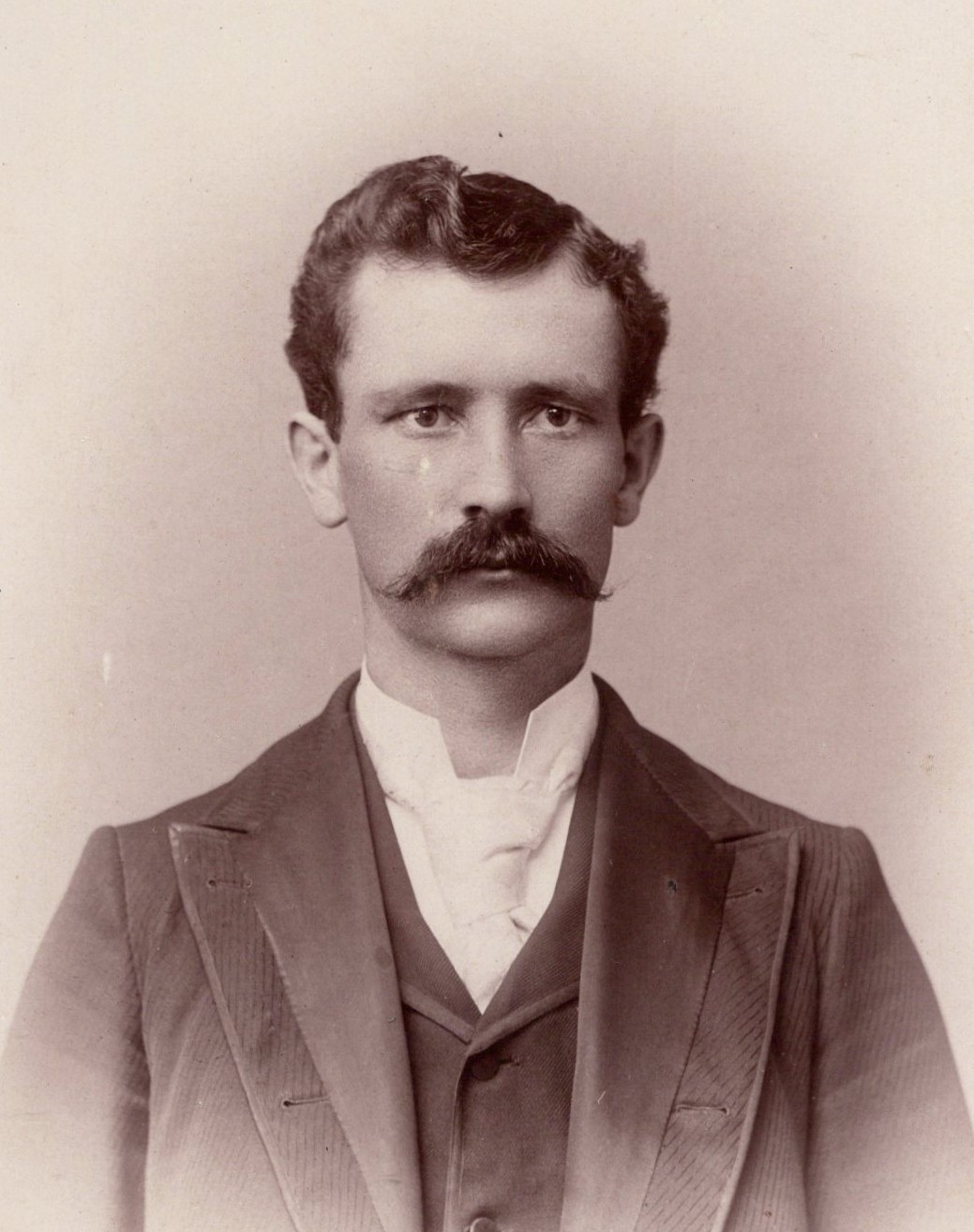
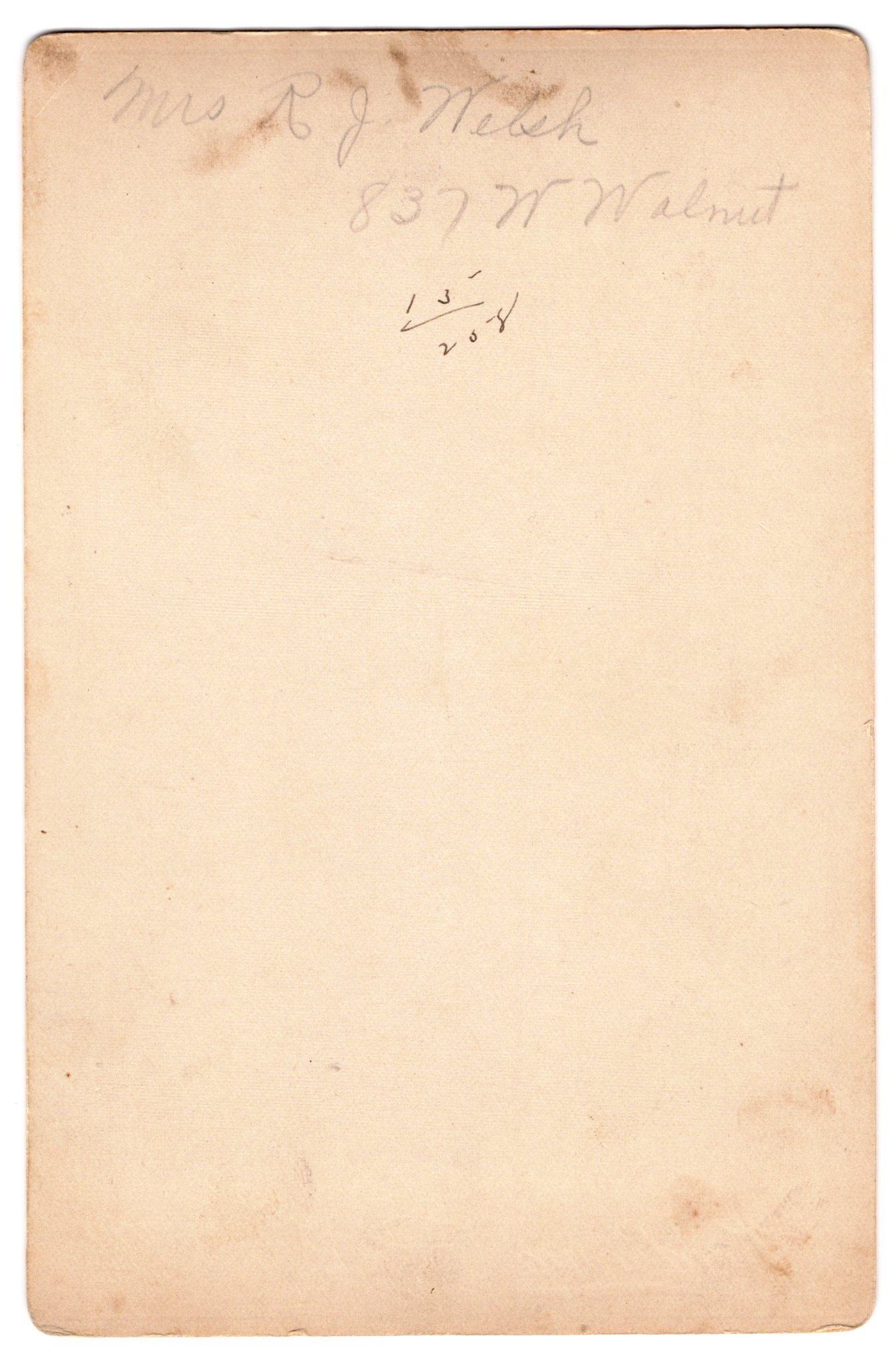
This cabinet card features a handsome young man with a composed, serious expression. His piercing eyes are steady and direct, suggesting confidence and a sense of purpose. He sports a neatly groomed, full mustache that accentuates his strong facial features, and his dark, wavy hair is styled close to the head with a modest wave. He is dressed formally in a three-piece suit typical of the late 19th century, consisting of a dark jacket with a subtle pinstripe, a matching vest, and a white high-collared shirt adorned with a cravat or tie tucked neatly into the collar. A pocket watch chain is visible just below the vest’s center buttons, a common accessory for men of the era. The photograph was taken by Reidsma Studio, as indicated by the imprint on the bottom mount. The ornate script spells out “Reidsma” alongside the photographer’s monogram and location: Kalamazoo, Michigan. Research into Mr. Reidsma reveals that the photographer was likely John Reidsma, a Dutch-American who operated a photography studio in Kalamazoo in the late 19th century. His work is known for its clarity and careful composition, often capturing the middle class and professional residents of the area during a time of industrial growth in Michigan. The presence of the brown line framing the image—also called a “rule line”—was a stylistic element commonly used in cabinet cards from the 1885–1895 period. This, along with the fashion and card style, helps date the photograph to the early 1890s. On the reverse, written in pencil, is the name: Mrs. R. J. Welch, 837 W. Walnut. The address is likely a local address for Kalamazoo itself or a nearby city. It is quite likely that Mrs. R.J. Welch was the wife of the man pictured. During this era, it was common for women—especially wives—to manage household affairs, including the commissioning and ordering of photographic portraits from local studios. Her name inscribed on the back may indicate ownership or responsibility for this photograph, perhaps sent or shared with family members.
The gentleman in this cabinet card portrait looks amazingly like Abraham Lincoln (1809-1865), the 16th President of the United States. As much a I would like this to be an early photograph of Lincoln, it most certainly is not. This photograph was produced several years after Lincoln’s death. The photographer of this image was George Pine (1840-1906). For part of George’s photography career he operated a studio with his brother Robert G. Pine. Records indicate that Pine conducted his business at the 27 & 29 East State between 1878 and 1888. He operated out of several addresses over the course of his career and all of his galleries were located in Trenton, New Jersey. I was able to confirm that he ran the studios from at least 1872 through the early 1900’s. George was born in New Jersey. An 1867 business directory indicates that he and his brother had a gold and silver plating business before entering the field of photography. The 1880 US census reveals that George lived in Trenton with his wife Theodosia Burroughs Pine (1842-1900). The couple were living alone. The Trenton Evening Times (1906) ran George’s obituary. He died in Trenton although he did spend some years in Florida where his wife passed away. At the time of his death he was the curator of the Cadwalader Park Museum. The article states that after a successful photography career, George had become a “prominent naturalist”. Cadwalader Park is located in Trenton.The park is nearly 100 acres and is the city’s oldest park (construction began in 1887). The park was designed by Frederick Law Olmsted (creator of New York City’s Central Park). SOLD
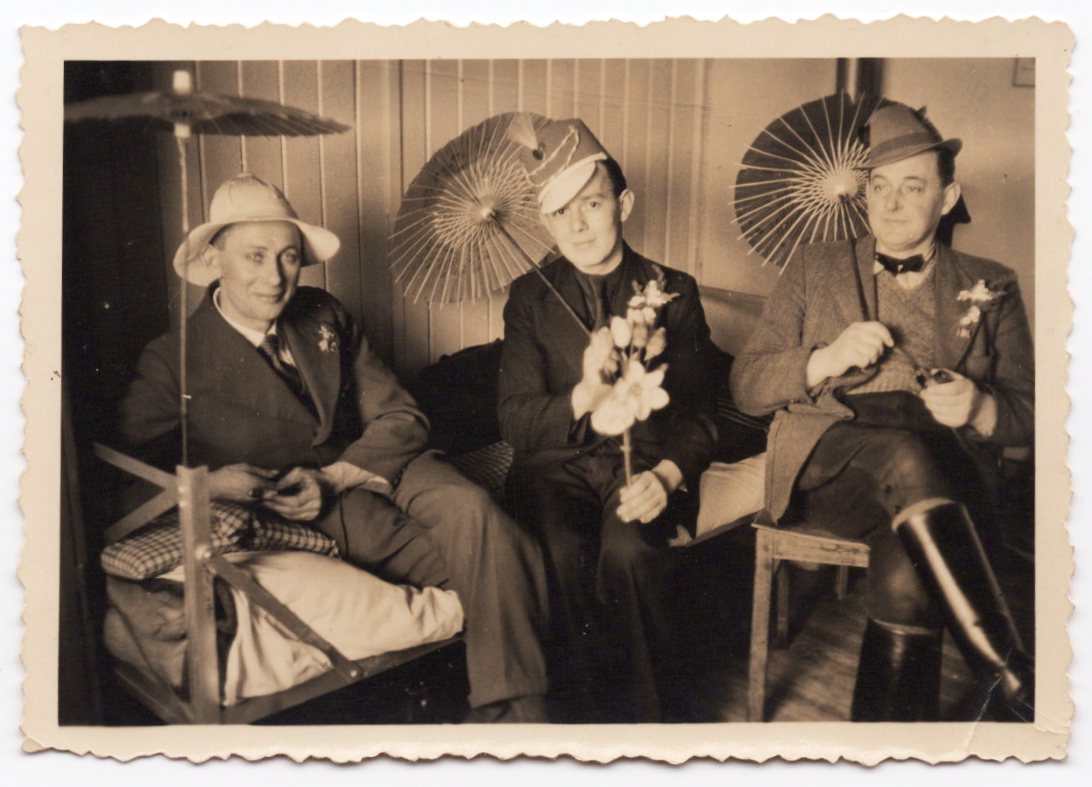
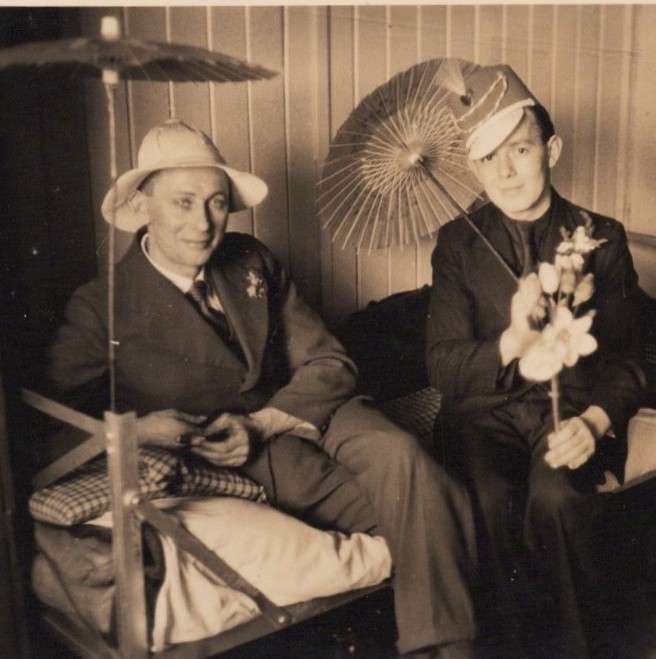
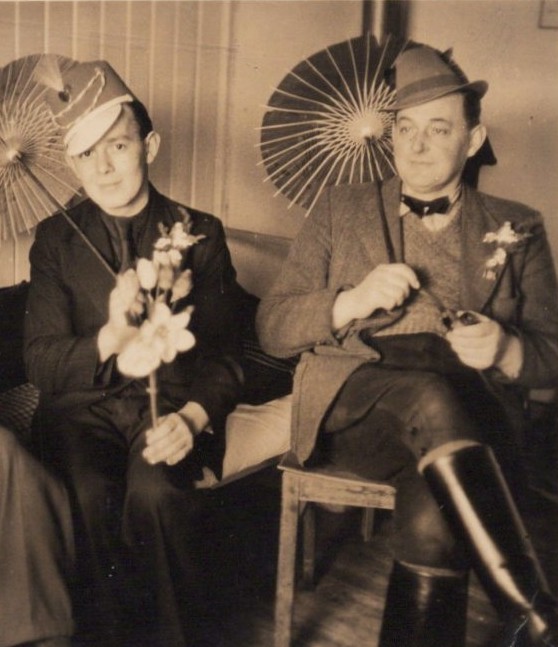
This small vintage snapshot photograph measures 2½ inches by 3⅜ inches and offers a wonderfully quirky scene of three men posing indoors, apparently during some kind of playful or costume event. The three men are seated closely together on benches. All three are dressed in semi-formal or smart-casual clothing. The man on the left wears a suit jacket, tie, and slacks, topped off with a light-colored, wide-brimmed hat reminiscent of a pith helmet or safari hat. He has a pleasant, slightly amused expression on his face. The man in the middle, dressed in dark clothing, holds a small bouquet of artificial flowers and wears a whimsical hat cocked at an angle. His expression is earnest, almost deadpan, which adds to the surreal charm of the scene. The man on the right sports a tweed jacket, bow tie, and riding boots. He also wears a jaunty hat and is casually holding a pipe in one hand, looking slightly amused and relaxed. In the background, Asian-style paper parasols are hanging or propped against the wall, adding an even more unusual and festive element to the setting. The combination of the flowers, whimsical hats, parasols, and formal clothing creates a truly bizarre, humorous, and delightful scene, suggesting this may have been a themed party, costume event, or simply friends enjoying a bit of light-hearted fun. This delightful vintage snapshot likely dates to the late 1930s or early 1940s, based on clothing and photographic style. (SOLD)
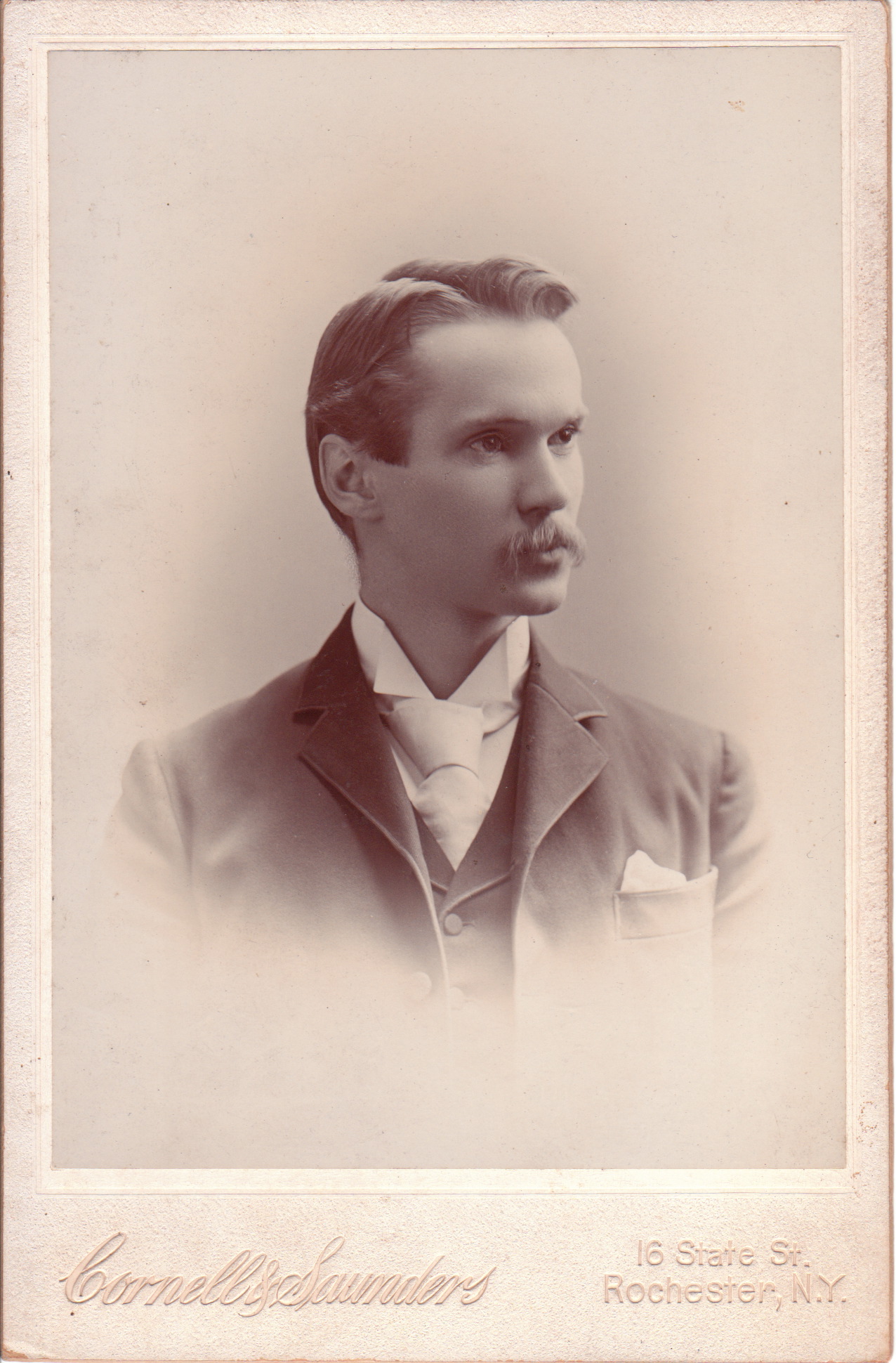
A handsome and well groomed young man poses for his portrait at the studio of Cornell and Saunders, in Rochester, New York. References to Cornell and Saunders were found in photographic journals of 1893 and 1894. SOLD
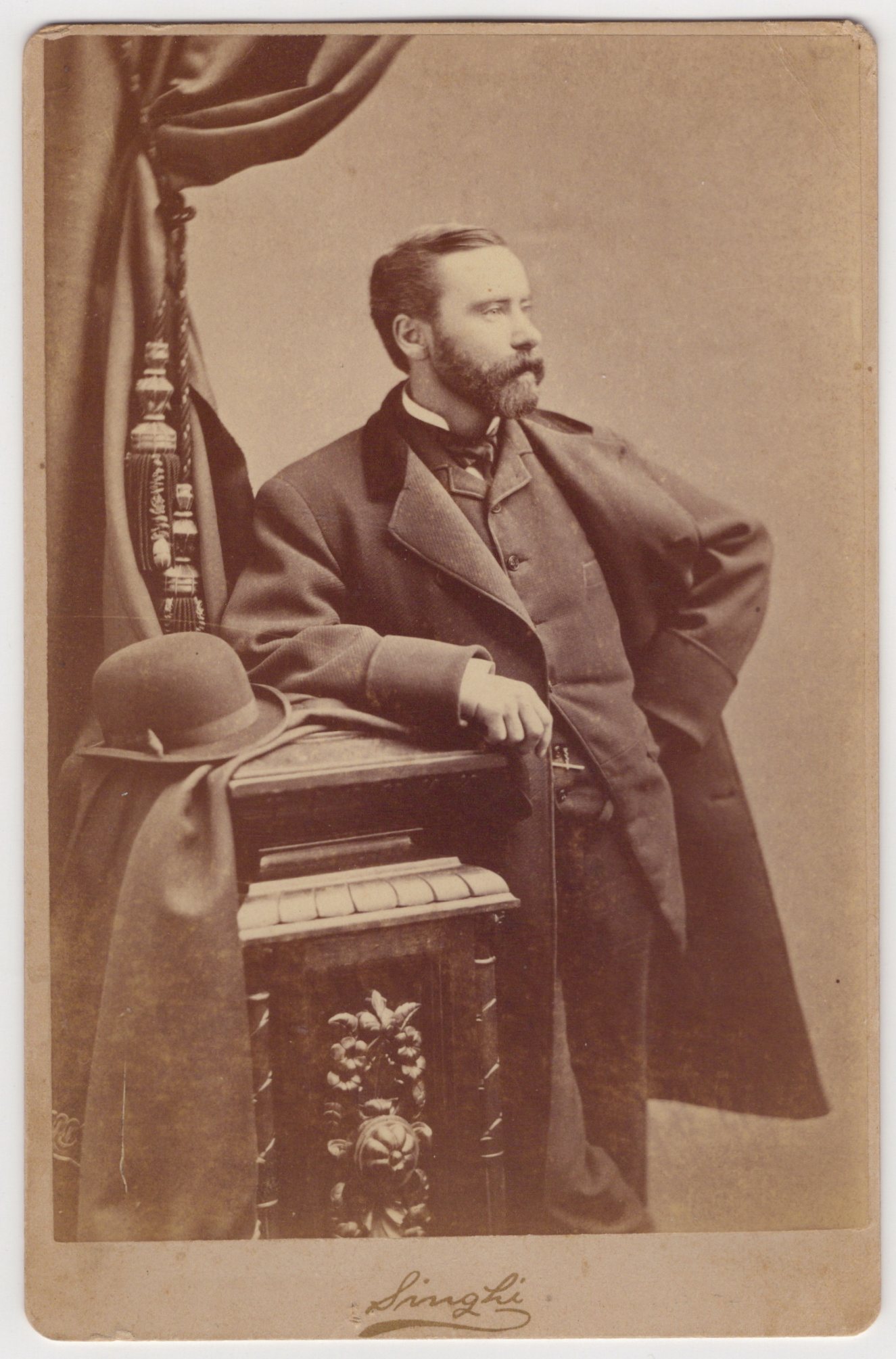
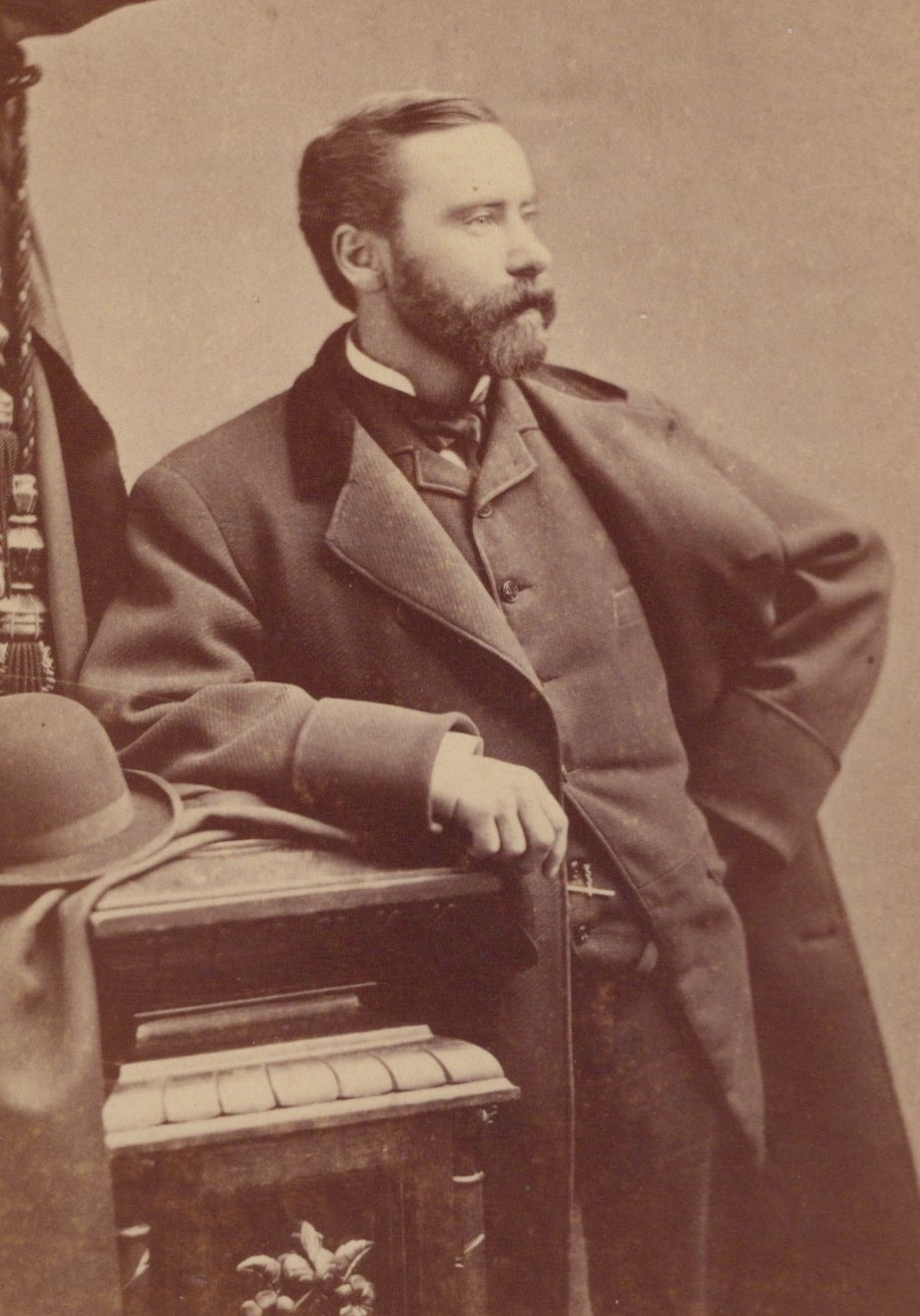
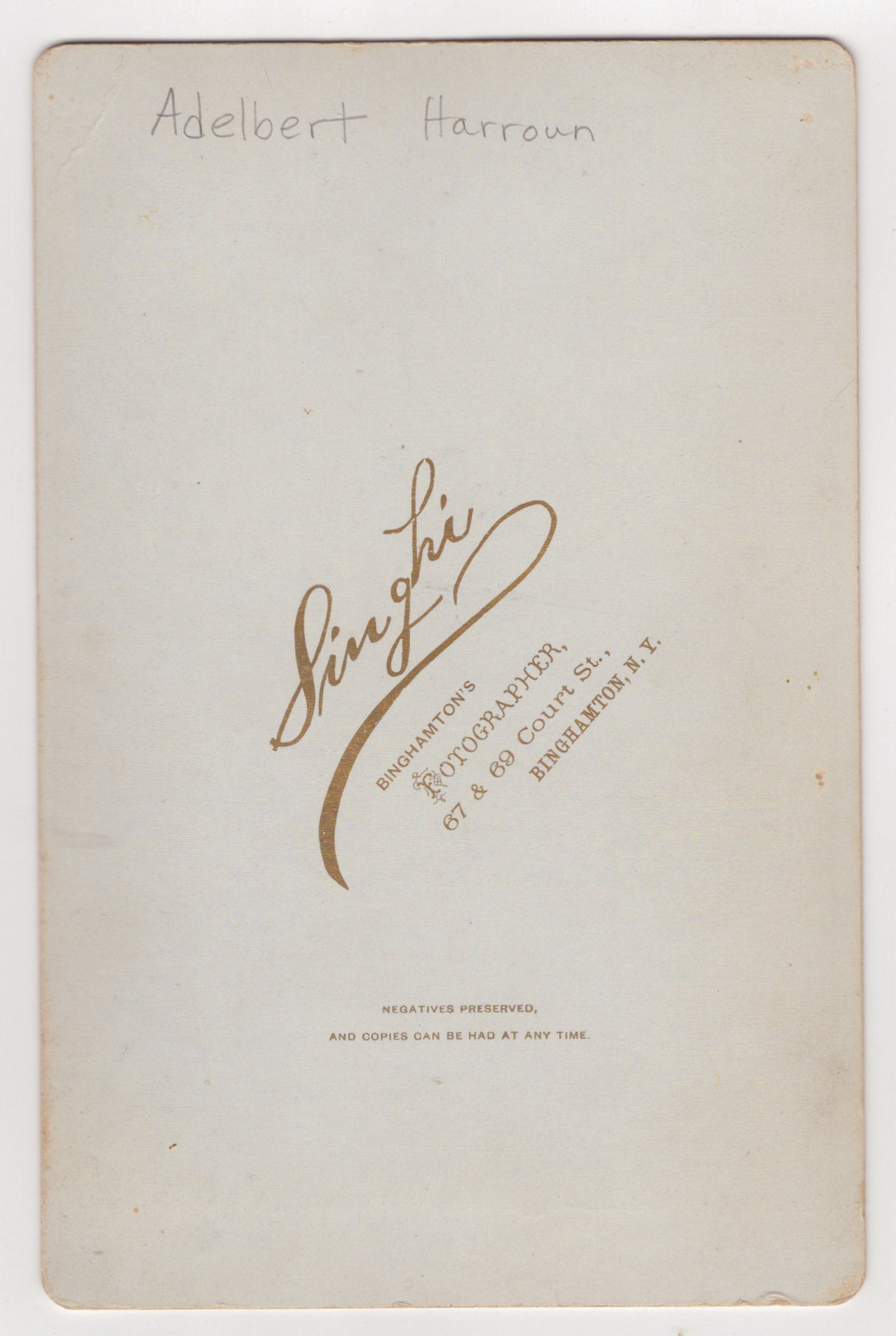
The man in this cabinet card photograph appears to be a professional gentleman. He is wearing an overcoat and a nicely trimmed beard. He is standing next to his derby hat and has a pocket watch. Perhaps the well dressed gentleman is an attorney. Maybe its not a coincidence that the Binghamton, New York based photographer, Singhi, was located on Court Street. The reverse of the photograph has an inscription which identifies the gentleman as “Adelbert Harroun”. Research reveals that Mr. Harroun was not a lawyer but instead, he was an accountant. The 1870 census notes that Thomas Adelbert Harroun (1851-?) was the 19 year-old son of Thomas Harroun (1824-1907) and Salina King Harroun (1824-1903). His father’s occupation was listed as a “Presiding Elder” and further research found that he was a Methodist clergyman. His mother was a homemaker. Adelbert lived with his parents and two siblings in Norwich, New York. Sister Flora (age 22) was a music teacher and brother Arthur (age 11) was a student. He married his wife, Mary Winton, in 1888. The couple had two children. The 1900 census finds the 47 year old Harroun living in Dunleith, Illinois. He was living with his wife, Mary, their son N. Winton (age 10), and daughter Anna Augusta (age 9). Harroun was working as a railroad yard clerk. Further investigation revealed that daughter Anna Augusta died in 1904 in Dubuque, Illinois. The 1920 census reports that the 67 year-old Harroun was widowed and living in Waukegan Lake, Illinois with his sister Flora. He was working as an accountant. The 1930 census locates Harroun in Prineville, Oregon and living as a boarder. At 79 years of his age, he was still working (bookkeeper). The photographer of this image is Will G. Singhi. He worked in Binghamton, New York between 1872 and 1886. His albumen print “A Winter Scene” is exhibited in the online “American Museum of Photography”. Singhi had taken a photograph that appeared to capture a snowball in mid flight heading toward a newsboy who was prepared to deflect it. The museum also has on display a funny cartoon self portrait caricature that Singhi used as an advertisement. The Photographic Times and American Photographer (1883) comments on Singhi’s wonderful sense of humor. SOLD




 THE CABINET CARD GALLERY