LOVELY MEXICAN AMERICAN FAMILY IN THE TEXAS HILL COUNTRY

family-of-four

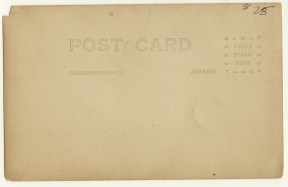
This vintage real photo postcard features a portrait of a lovely ethnic family. A father and mother and their son and daughter are all wearing dressy clothing for their day at the photographer. The photographer’s studio provided a lovely homey background in which to take this photograph. This postcard image was found in an antique shop in the Texas hill country. It is likely that this family is of Mexican American origin but that hypothesis can not be confirmed. The AZO stamp box indicates that this photo postcard was created sometime between 1910 and 1930.  (SOLD)

family-of-four-1

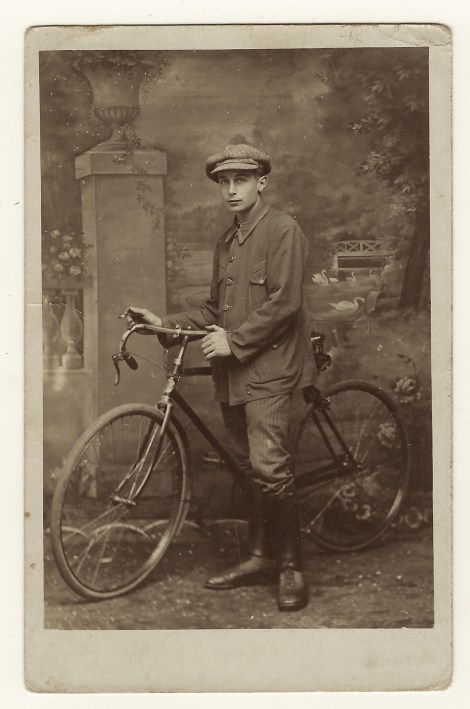
A NERVOUS YOUNG MAN AND HIS BICYCLE

bike-boy

This vintage real photo postcard features a young man standing beside his bicycle. The look on his face can be described as similar to a “deer in the headlights”. One could also describe his expression as nervous. It is as if he just got caught doing something wrong. Maybe it has something to do with the cigarette that he is holding in his right hand, though I doubt it. He is wearing a great outfit and cap but I would surmise that his boots don’t make pedaling a bicycle particularly easy. Note that the backdrop in this studio photo is quite pretty and detailed despite that it is obviously fake. This postcard was produced in the very early 1900’s.  (SOLD)

bike-boy-1

Published in: on January 3, 2017 at 5:52 pm  Comments (2)  
Tags:

PORTRAIT OF KARINA BALL: BEAUTIFUL ACTRESS AND BREWERY DIRECTOR

bell


bell-1

Karina Bell’s beauty is quite apparent in this vintage real photo postcard portrait.  She was born in Hellerup, Denmark in 1898 and died in Denmark in 1979. Bell was a film actress who began her career as a ballet dancer. She made her stage debut in 1919. Most of her films were silent films produced in Sweden, Denmark or Germany. She did appear in two talkies. She was known for her roles in “Little Dorrit” (1924), Klovnen (1926), and “5 Raske Piger” (1933). Bell was one of the most popular stars of the Nordisk Films Kompagni in the 1920’s. She was married in 1934 to Knud Parkov (1894-1949). He was the director of a Danish brewery (Wiibroes Brewery) and a member of the Danish resistance. She retired from acting after she got married. The IMDb gives Karina Bell 20 credits. Her film appearances occurred between 1919 and 1933. Upon her husbands death, Bell took over his director duties at the brewery. This Austrian postcard was produced by Iris Verlag as part of a series (no. 589). The photograph was by Lux-Film.

bell-2

SEXUAL CHEMISTRY IN FILM: VIRGINIA VALLI AND GEORGE O’BRIEN (RPPC)

valli

valli-1

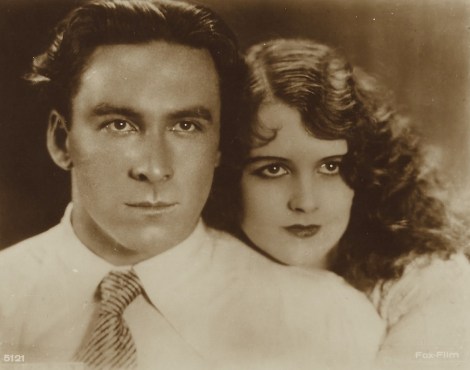
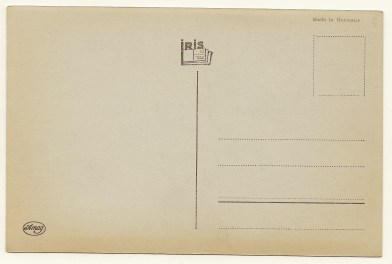
Can sexual chemistry be photographed? This fantastic vintage real photo postcard provides evidence that the answer is yes. This image captures early film stars George O’Brien and Virginia Valli in an emotionally charged scene in an unknown movie. The pair starred together in at least two silent movies produced by Fox. The films were “Paid to Love” (1927) and “Eastside Westside” (1927). Virginia Valli (1898-1968) was an American stage and film actress. Her early acting experience was with a Milwaukee based stage troupe. Her film career started in the silent film era and ended in the early stages of the talkies (1930’s). She has 65 credits on the IMDB web site. She began her film work with Essanay Studios in her hometown of Chicago in 1916. By the mid 1920’s, she was an established star at Universal Studios. She was the star of  King Vidor’s “Wild Oranges” (1924). Most of her films were produced in the mid 1920’s and include Alfred Hitchcock’s first feature movie, “The Pleasure Garden” (1925). Her first sound picture was in 1929. She left the movie business in 1931 due to her high salary command and declining appeal to audiences. She moved to Palm Springs, California with her second husband, actor Charles Farrell. She was very much part of the social scene there. She died in Palm Springs at age seventy. George O’Brien (1899-1985) was an American actor popular during the silent film era as well as the early talkies era of the 1930’s. He is remembered most for his role in Murnau’s 1927 film “Sunrise: A Song of Two Humans”. He had an active film career which is evident by the fact that the IMDB web site gives him 85 credits. O’Brien was born in San Francisco and his father at one time, was the city’s chief of police.  During World War I, O’Brien was in the US Navy and served on a submarine chaser. He worked as a stretcher bearer for wounded Marines and was decorated for his bravery. Following the war, O’Brien became the light-heavyweight champion of the Pacific Fleet. After completing is service, O’Brien was in his early twenties and he went to Hollywood to seek work as a cameraman. He did find employment in the field and helped film for Tom Mix and Buck Jones. He then entered acting by playing bit parts and by being a stuntman. His first starring role was in “The Man Who Came Back” (1927) where he played opposite Doroth Mackaill. He then appeared in “Iron Horse” by famed director John Ford in which his counterpart was Madge Bellamy. The film was a great success and the experience forged a colloborative relationship with Ford that resulted in O’Brien appearing in nine more of the directors films. He spent much of the 1920’s as a leading man in action and adventure type roles. During the 20’s he received the nickname “the torso” because of his excellent physique. With the arrival of sound, O’Brien appeared predominately in Westerns during the 1930’s and he was considered a major draw. With the arrival of World War II, O’Brien re-enlisted in the US Navy and served as a beachmaster in the Pacific theater. He was decorated several times and when he was discharged he had attained the rank of commander. He later joined the Naval Reserve where he served as a captain. O’Brien’s last leading role was in a film that included the Three Stooges. According to his obituary,  O’Brien was buried at sea courtesy of the US Navy. This real photo postcard was published by Iris Verlag and made in Germany. The postcard is part of a series (no. 5121) and credits Fox Film.
ADDENDUM: After viewing this image, a visitor contacted me to claim that the beautiful woman in this photograph is not Virginia Valli, but instead, it is June Collyer (1906-1968). I was unable to locate information or relevant comparison images to definitively confirm that it is Collyer that is in the photograph, but I did find a film publicity photo identical to the postcard image above. The description of that photo indicates that the pictured woman is Collyer. Collyer was born in New York City and as a society girl was chosen by Allan Dwan (Director, Producer, Screen Writer) to her first starring role in “East Side, West Side. She did eleven silent films and made a successful transition to talkies. In 1928 she was he was one of the thirteen girls selected as “WAMPAS BABY STARS”. In 1930 she appeared in “The Three Sisters” and “Sweet Kitty Bellairs”. From 1930 through 1936 she starred in nineteen films. She took a sabbatical from acting in the 1940’s and did television acting during the 1950’s. June was the sister of radio actor/announcer Bud Collyer (1908-1969). He became a major game show star hosting such programs as “Beat the Clock” and “To Tell the Truth”. June Collyer was married to actor Stu Erwin. In conclusion, I am unsure whether the beautiful woman in this image is Miss Valli or Miss Collyer. It is an answerable question if someone is willing to do the requisite research.
valli-2

AFRICAN AMERICAN WOMAN SITTING ON A BENCH (REAL PHOTO POSTCARD)

afro-bench

This real photo picture postcard features a middle aged African American woman sitting on a bench. She is clutching a purse in her left hand and is wearing a long coat. The AZO stamp box indicates that the postcard was produced by a studio sometime between 1926 and 1940.

afro-bench-1

Published in: on December 15, 2016 at 10:02 pm  Leave a Comment  
Tags: ,

ERUDITE CHILD LECTURES ST. BERNARD ON STEROIDS

st-bernard

This vintage real photo postcard features a little boy (or is it a girl) and his (her) dog. The dog is a giant. I think someone’s been putting steroids in the dog’s food. The dog appears to be at least partially a St. Bernard. The child is smartly dressed and has an air of privilege. The child looks as if he is lecturing the dog. The child’s index finger is pointed as if he is making a major point. This postcard is dated 1906. The postcard was published by Germany’s Neue Photographische Gesellschaft (NPG) (New Photographical Society). The company was in business between 1894 and 1948 and was one of the most well known and largest companies involved in the production of postcards.

st-bernard-1

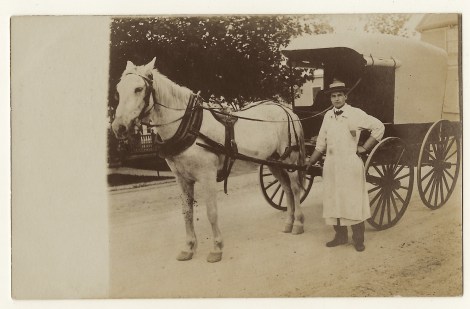
A MAN AND HIS HORSE AND WAGON (VINTAGE OCCUPATIONAL REAL PHOTO POSTCARD)

delivery-cart

This vintage real photo postcard features a man and his horse and his partially covered wagon. Judging by the man’s clothing; he is a working man. Perhaps he is a delivery man of some sort. He is wearing a white shirt, bow tie and smock. I believe that he is wearing long heavy gloves. The gloves probably pertain to his occupation. The stamp box on the reverse of this postcard indicates that when it was published, the postcard postal rate was 1 cent. The one cent rate was in effect until World War I when it was raised to 2 cents on a temporary basis (1917-1919). The rate was again raised between 1925 and 1928. The rate became permanantly two cents in 1951. As a result, the stamp box in this case, is not helpful in establishing the date that this postcard was produced. However, the style of the front of this postcard indicates that it was produced not long after the 1900’s or 1910’s.

delivery-cart-1

Published in: on December 5, 2016 at 8:37 pm  Comments (2)  
Tags: ,

AN ADORABLE BABY AND HER DOLL

girl-and-doll

This vintage real photo postcard features a lovely image of an adorable little girl holding a beautiful doll. The child is wearing a lacy dress, a necklace, and a pink ribbon in her hair. She is so photogenic. This postcard was sent by a woman named Suzanne to her younger brother living in Argentan, France. The postmark dates back to 1906. Suzanne wrote her name on the top right hand corner of the front of the postcard. She wrote it in red which is the same color ink she used to write her message on the reverse. The postcard was published by Germany’s Neue Photographische Gesellschaft (NPG) (New Photographical Society). The company was in business between 1894 and 1948. It was founded by Arthur Black (1862-1943) and it became of the most well known and largest companies involved in the production of postcards. Over time, NPG opened subsidiaries in London, Paris, Rome, and New York. Interestingly, the company was one of the “Best Companies to Work For”. Employees were given free medical treatment and illness benefits. Employees also received bonuses and life insurance. The company offered it’s employees a library, a casino, and a dining room which sold food for cost. In addition, the company offered it’s workers a reading room and a theater for lectures and theatrical performances. Now we know where Google and other employee friendly companies got some of their ideas from. Printing on the reverse of this postcard mentions that this postcard is an “Oranotypie” and also lists the name “A. G. Steglitz”. An oranotype is a trade name for a type of glossy real photo postcard published by NPG at the beginning of the 20th century. These cards are hand colored. I am unsure if Steglitz was a postcard publisher or a photographer. I have seen postcard aficionados refer to him as both a photographer and a publisher. My guess is that most of these “experts” are as unsure as I am about his role in producing postcards. 

girl-and-doll-2

MISS JOSE COLLINS: BEAUTIFUL STAGE AND FILM STAR (VINTAGE REAL PHOTO POSTCARDS)

jose-collins POSTCARD 1  (SOLD)

collins POSTCARD 2

The pretty woman featured in this vintage real photo postcard is Miss Jose Collins (1887-1958). The name “Jose” was a shortening of her given name “Josephine”. She was an English actress and singer known for her appearances in musical comedies and early movies. She was born in London. Her mother was a music hall performer and comedian named Lottie Collins. Interestingly, she was the singer who popularized the song “Ta-ra-ra Boom-de-ay”. Jose Collins father was Stephen Patrick Cooney, her mother’s music coach. Collins began as a child actress and as a teenager had already appeared in both pantomine and music hall performances as a singer and actress. Her debut performance in the West End was a major role in “The Antelope” (1908). She also appeared on Broadway  in the production of “Vera Violetta (1911), “The Merry Countess (1912), “The Whirl of Society” (1912), and other shows. In the later production, she sang a duet with Al Jolson. She also appeared in the Ziegfeld Follies (1913). In 1917 she appeared in the hit musical “The Maid of the Mountains”, a role for which she received much acclaim. She actually earned a nickname from the show; she was known as “The Maid of the Mountains”. She appeared in a number of shows through 1925. One of these productions was “A Southern Maid”  (at Daly’s Theatre) and this postcard portrait captures her in that role. The show was an operetta and her costar was Bertram Wallis. The production ran for 306 performances. The remainder of her career was spent acting in revues, variety and non-musical roles. She also appeared in films. The IMDB reports that she appeared in thirteen movies between 1915 and 1933. Miss Collins was married three times and these unions produced no children. The link below will take you to a Ziegfeld Follies performance by Jose Collins. She is singing “Just You and I and the Moon” (1913). This postcard was published by J. Beagles & Co. of London, England. The postcard is part of a series (no. 222 U). The photograph of Miss Collins is by Reville Studios.

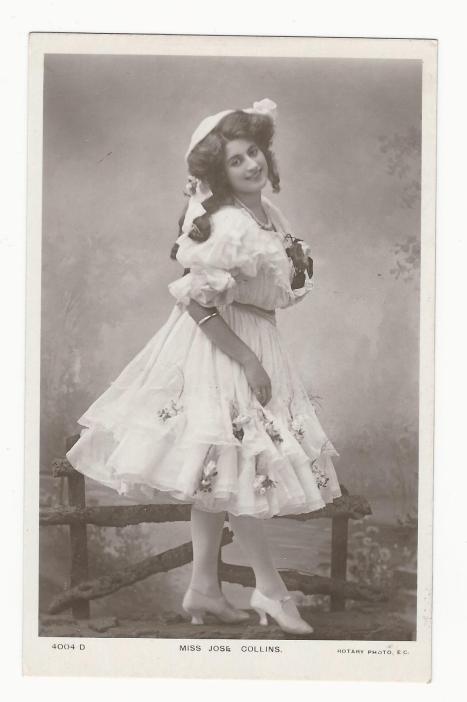
The second vintage real photo postcard presents Miss Collins in a relatively short frilly dress. She looks very pretty as she flashes a nice smile. The postcard was produced by Rotary Photo and is part of the Rotary Photographic Series (no. 4004 D)


jose-collins-1                                                                                                                 POSTCARD 1

collins-2                                                                                                                                                                                                        POSTCARD 2

GEOFFREY: THE UNCONVINCING COWBOY

cowboy

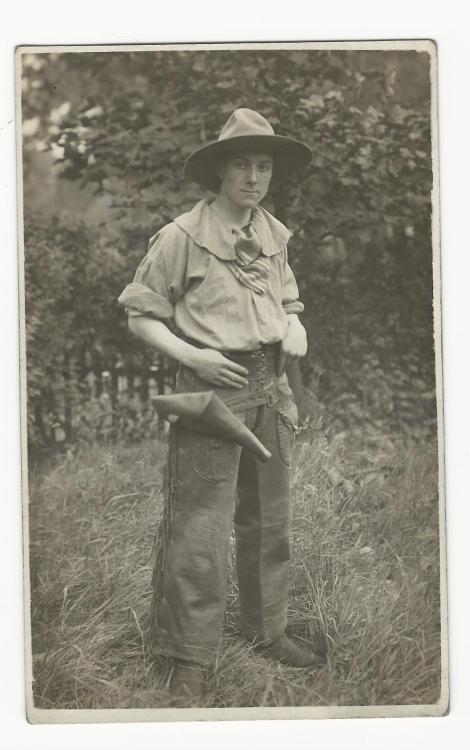
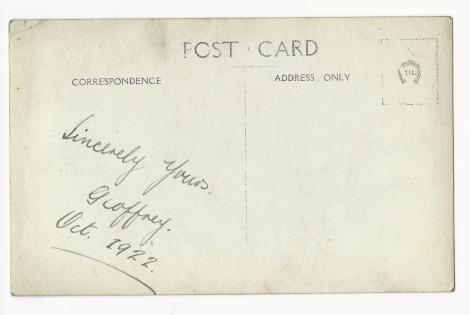
The reverse of this vintage real photo postcard indicates that the cowboy pictured on the front is named Geoffrey. My guess is that Geoffrey is a studio cowboy. His clothing, gun, holster, fringed chaps, and ten gallon hat were likely borrowed from a photography studio’s prop department. Geoffrey is not a convincing looking cowpoke or gunslinger. He has soft hands and a soft face. He certainly hasn’t been on too many cattle drives. However, this postcard is quite nice. The subject is well posed and the close-up perspective works well. An inscription on the card’s reverse reveals that he postcard photo was taken in 1922. The stamp box discloses that the publisher of the postcard stock was Vester & Company from Great Britain.
cowboy-2

Published in: on November 14, 2016 at 12:00 pm  Comments (1)  
Tags: ,