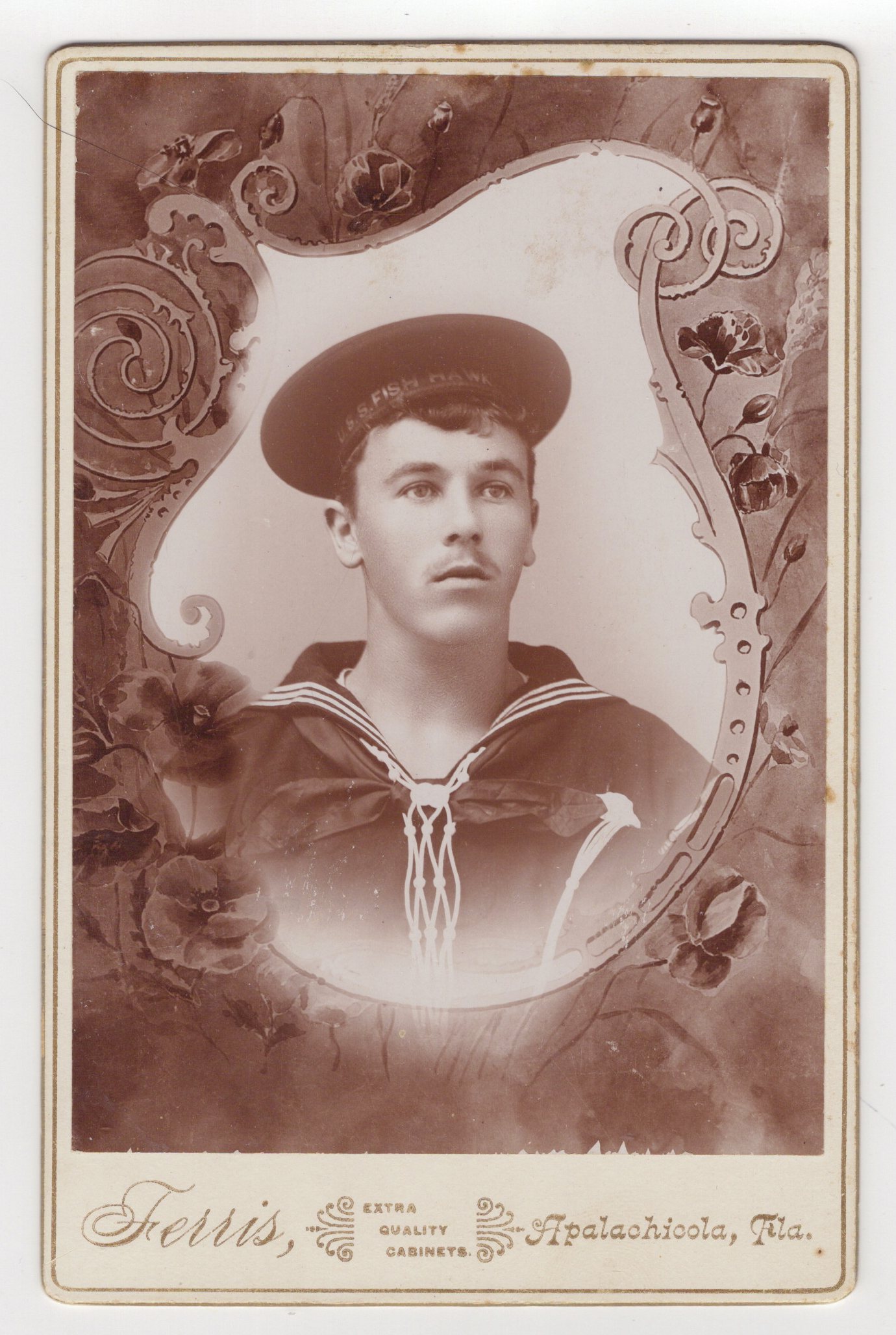
This cabinet card portrait features a young and handsome naval sailor in uniform. His cap reveals that he was part of the crew of the USS Fish Hawk. The ship was launched in 1879. Originally, called the USFC Fish Hawk, the ship was a fisheries science research ship. It conducted research and ran a large fish hatchery on board. The ship was operated by the United States Commission of Fish and Fisheries. The Fish Hawk was the first large ship built by any country for the purpose of promoting fisheries. The ship operated during it’s 46 year career along the US eastern coast and in the Gulf of Mexico. However, the ship also served in the US Navy in 1898 during the Spanish-American War and from 1918 to 1919. The sailor seen in this cabinet card portrait was serving on the ship during the Spanish-American War. The sailor had his photograph taken a the Ferris studio in Apalachicola, Florida. The city of Apalachicola is located on the shore of Apalachicola Bay, an inlet of the Gulf of Mexico. The city was captured by the Union navy early in the Civil War. Before the late 19th century, Apalachicola was the third busiest port on the Gulf of Mexico. It was only behind New Orleans and Mobile. This cabinet card portrait is an interesting remnant of American naval history. SOLD
INFANTRYMAN IN SYRACUSE, NEW YORK (SPANISH AMERICAN WAR ERA)
This cabinet card features a soldier posing in uniform at the studio of Edward E. Coatsworth (1841- ?) in Syracuse, New York. The soldier is from the era of the Spanish American War. It is my hope that the vast unpaid research department of the Cabinet Card Gallery will be able to provide more exact information about the time period of this photograph as well as specific information about his unit. Based on his badges, it is my guess that he served in the infantry and that he was in the 203rd regiment and company K. The 203rd Infantry Regiment of the New York Volunteers was a Spanish American War unit. It served its term of service within the continental United States. Company K was formed from the 16th Separate Company of Catskill, New York The crossed rifle insignia was the cap badge of the U.S. Army Infantry. In 1898, the badge was moved to the collar of the military uniform. Underneath the crossed rifles badge on his hat is another badge and hopefully someone can identify it and leave a comment with an explanation. It is interesting to note the polka dot handkerchief the infantryman is wearing around his neck. Coatsworth was once partners with Frank G. Smith in operating a photographic studio in Syracuse (1889-1894). (SOLD)
PORTRAIT OF A SAILOR FROM THE U.S.S. BOSTON IN NAGASAKI, JAPAN (1896)
This cabinet card portrait features a uniformed sailor from the navy ship, the U.S.S. Boston. The photograph was taken by Kiosheikwan of Nagasaki, Japan. The sailor probably had the photograph taken in order to send it to family or a girlfriend back home in the United States. A web site dedicated to the U.S.S. Boston and the men who served on her, was very helpful in providing details about the ship and the dates it served in the Pacific. The site reveals that there has been seven ships named “Boston” that served America since 1776. The ship that the sailor in the photograph served on was a Protected Cruiser that sailed between 1887 and 1940. She was the U.S. Navy’s second steel ship and was propelled by sails and/or steam engine. The ship’s crew consisted of about 284 men. Initially. the ship patrolled the waters of Latin America and Haiti, but in 1892, she began to serve in the Pacific. In 1896, she was attached to the Asiatic Station at Yokohama, Japan. When the Spanish American War occurred in 1898,the U.S.S. Boston took part in the Battle of Manila Bay as well as, the capture of Manila. Reviewing the history of the ship, it seems probable that this photograph was taken in 1896 or 1897. (SOLD)
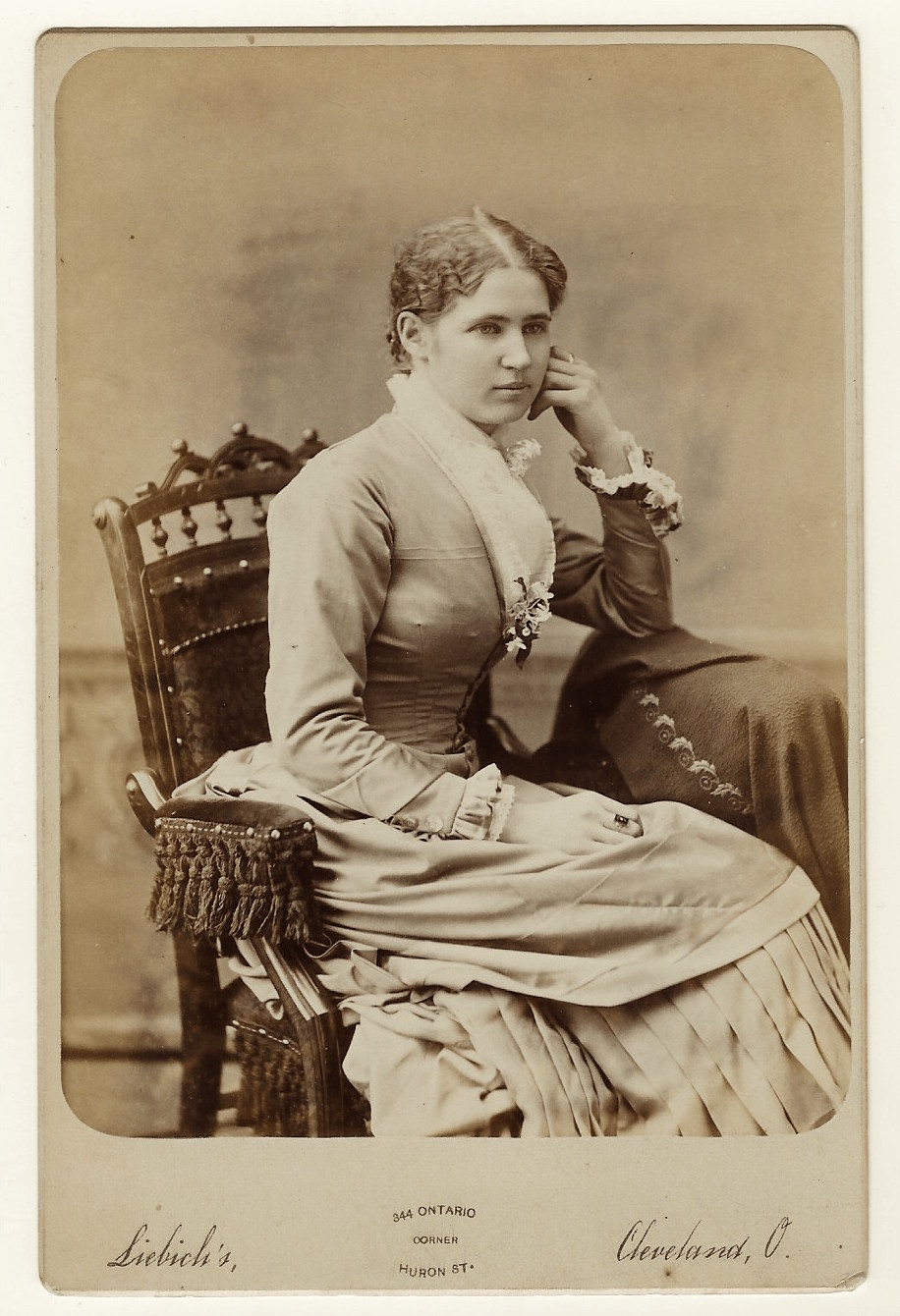
PRETTY FASHIONABLE YOUNG WOMAN IN CLEVELAND, OHIO

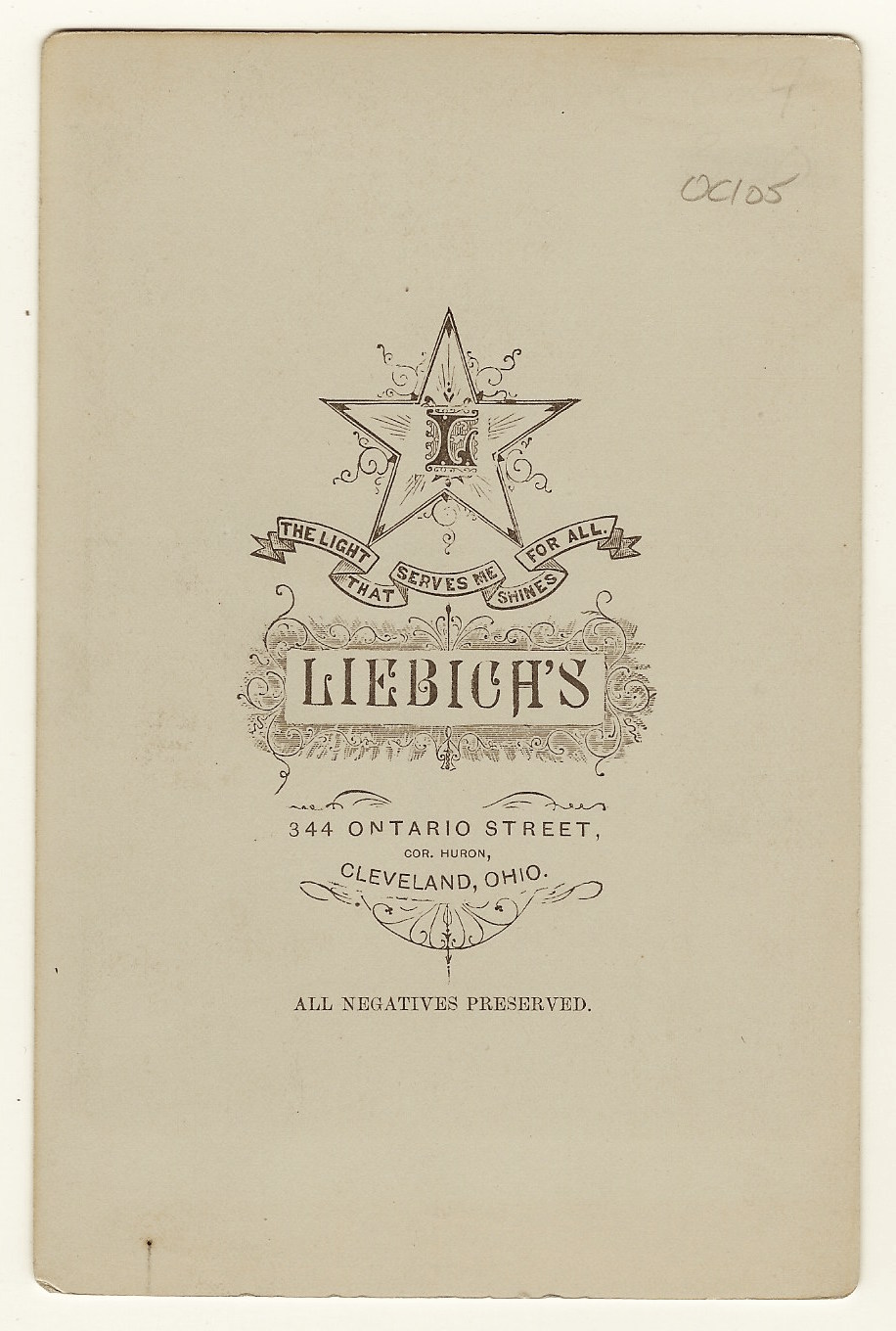
This cabinet card portrait features a pretty and fashionable young woman. She was posed in a manner which suggests she was having a pensive moment. The photographer of this image is either Moritz or Arthur K. Liebich. Arthur K. Liebich (1834-1905) was an active photographer in Cleveland between 1874 and his death in 1905. He was the son of Moritz S. Libich (1825-1888) who was born in Germany and came to America in 1862. Moritz was a trained artist and he taught art for twelve years at the Jewish Orphan Asylum. Moritz was of the Jewish faith. Moritz and his son Arthur opened their studio on the corner of Ontario and Huron in 1876. In 1885 they added a branch studio on Broadway. In 1890 they moved their primary studio to a street called Euclid. Moritz was married to Alice Gerlach while in Germany and the couple had five children. Moritz’s son Arthur was born in Germany. Arthur came to Cleveland in 1863. He began his photography career working with William Case North and than joined his father’s studio eventually becoming partners with his father (1881-1888).Arthur was a major in the Spanish American War with the Cleveland regiment. In 1881 he married Alice Lacey of Aurora. An interesting fact about the reverse of this cabinet card is that the Liebich’s gallery had a slogan which appears on the card. The quotation is “The light that serves me shines for all.” Research reveals that this slogan appears on the reverse of a number of other Ohio photographer’s cabinet cards. “The Daily Record” (2003), a small Ohio newspaper describes a cabinet card from Harrington’s Gallery (Orville, Ohio) as having the same company motto. In addition, Teeple’s French Light Galleries (Wooster and Ashland, Ohio) also used the same quotation. Research failed to find the origin of this quotation or for it’s relevance in cabinet card photography. (SOLD)

“AMERICA FOREVER”: PATRIOTIC TEN YEAR OLD IN DAYTON, OHIO SUPPORTS AMERICAN SOLDIERS AND SAILORS DURING THE SPANISH AMERICAN WAR
A ten year-old boy named Horace H. Justice Jr. poses proudly in a sailor suit at the studio of Anderson & Hartshorn in Dayton, Ohio. Horace’s naval cap displays the name “Dewey” rather than the more typical ship name. Admiral George Dewey (1837-1917) was a US naval officer best known for his victory at the Battle of Manila Bay during the Spanish American War. He came home to the United States and was received as a conquering war hero. Young Horace is clearly paying tribute to Admiral Dewey. The Spanish American War era was a time marked by a escalation of patriotism in the United States and this image provides an illustration of this nationalistic fervor. It is also possible that Horace’s father may have served with Admiral Dewey and that Horace Jr. is emulating Horace Sr.. Initial research found a Horace J. Justice living in Dayton. The 1900 US census reveals that Justice was married to Mattie Justice 1885) and at the time of the census, they had a twelve year old son also named Horace. Horace Justice Sr. is mentioned in many Dayton city directories from 1871 through 1909. He worked many years as a travelling salesman. It could not be established that Horace Sr. was in the armed forces. It appears that Horace Jr was born in 1888 and died in 1948. Information was also found about the photographers. Photographer James Otto Hartshorn was a leading Dayton photographer. He was born in Ohio in 1869. A Dayton history book reveals that he was “deprived” of his parents when he was thirteen years-old and forced to live with various friends. He worked on a farm until he turned eighteen and and then moved to Dayton and for a short time worked in a cotton batting factory. In 1888 he became employed in a photography studio where he learned to become a very skilled photographer. In 1891 he married Ella M. Huesman of Dayton. In 1894 Hartshorn partnered with Charles F. Anderson and opened up the studio that produced the portrait of Horace Justice Jr..
ARMED AND READY TO DEPLOY: SPANISH AMERICAN WAR SOLDIER IN MINNEAPOLIS, MINNESOTA
This Spanish American War era soldier is dressed, armed and ready to deploy. Note his long rifle and the bayonet he is wearing on his side. He is wearing two medals, one which the previous owner of the photograph identified as signifying that he was the son of a Union civil war veteran. This photograph was taken at Dempsie Portraits which was located at 316 Nicollet Avenue in Minneapolis, Minnesota. George M. Dempsie began operating in Minneapolis in about 1887 and worked until at least 1910. He was at the Nicollet Avenue address between 1889 and 1910. He operated under the names of Dempsie’s New Photographic Rooms, Dempsie Portraits, and Dempsie & Andrews. At various times he employed his sons George R. Dempsie and Guy C. Dempsie.
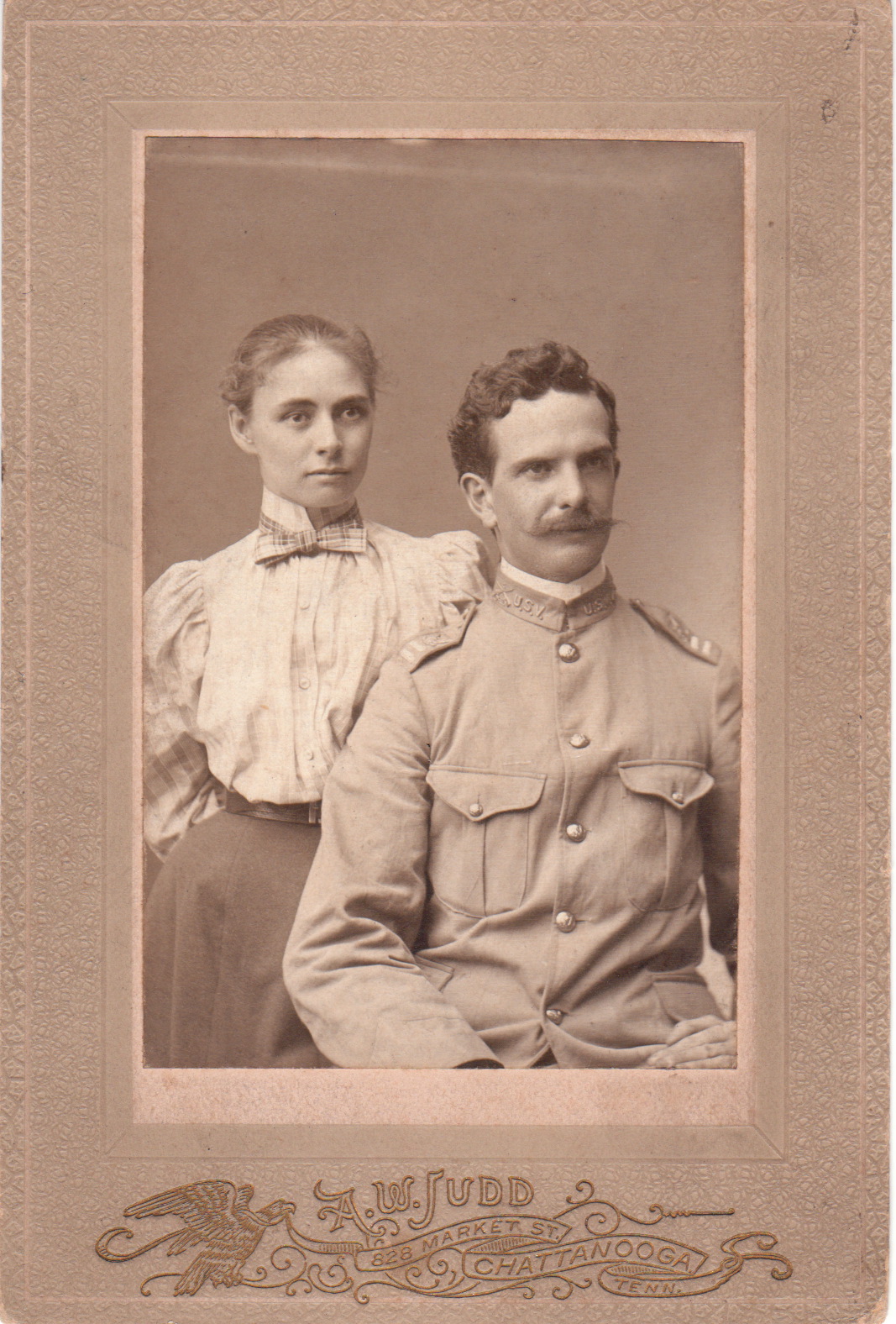
UNITED STATES VOLUNTEER UNIFORMED SOLDIER AND HIS WIFE IN CHATTANOOGA, TENNESSEE
This photograph features a military man with a young woman who is likely his wife. The soldier is wearing collar pins that identify him as a member of the United States Volunteers. Members of the USV were enlisted in the army but were separate from units of the regular US Army. Although volunteer regiments existed during the civil war, the USV was not officially named until the Spanish American War in 1898. The volunteer army was a quick way to supplement the regular army during times of war and was unnecessary during times of peace. This portrait was likely taken during or just after the Spanish American War. The photograph is smaller than a cabinet card. It measures 3.5″ x 5.25″. Note that the woman is standing behind the man making him appear much more prominent. It almsost seems like that she was not even in the original pose and that she was superimposed onto his photographic portrait. The photographer is A. W. Judd of Chattanooga, Tennessee. Judd was born in 1846. The book “Chattanooga” (1996) reports that Amos Wilson Judd was a civil war veteran who began his photography business in 1877. His name and studio appears in Chattanooga’s business directories from 1890 through 1920. He died in 1929. He had two brothers who were photographers. His son succeeded him in running his studio. Judd had two portraits appear in Wilson’s Photographic Magazine (1900). The Photo Beacon (1906) states that Judd was the President of the Kentucky/Tennessee Photographers Association. Wilson’s Photographic Magazine (1908) indicates that he held a patent for a photography invention. A confederate soldier named Amos Judd was a member of the 2nd Battalion Georgia Infantry (State Guard), Company B. He mustered in as a private and left the service with the same rank.
HENRY GOES TO WAR (PORTRAIT OF A SPANISH AMERICAN WAR ERA SOLDIER)
A Spanish American War era soldier poses for his portrait at an unknown studio in an unknown place. Note the US pin and crossed rifles pin on each side of his collar. He also has pins on the front of his hat indicating he was a member of the 5th regiment, company E. The 5th Infantry Regiment was nicknamed the ‘”Bobcats” and is the third-oldest infantry regiment of the U.S. Army. It was established in 1808. The regiment arrived in the Philippines too late to participate in the war but did perform occupation duties and later saw action in the Philippines War of 1900. The photograph has an inscription on the reverse that identifies the soldier as “Henry”. It is not clear whether “Henry” is this young man’s first or last name. Other background information about this image was likely lost when a previous owner trimmed the photograph to fit it into a frame. Hopefully, a visitor to the cabinet card gallery can confirm that this is indeed a Spanish American War era soldier and not a World War I era soldier.
ARMED SOLDIER POSES OUTDOORS IN BRISTOL, PENNSYLVANIA
A soldier, armed with a rifle, poses for his portrait in Bristol, Pennsylvania. He appears to be standing outside but it is possible that he actually is posed in front of an excellent backdrop of an outside scene. The young man is in uniform wearing a long coat, cape, and hat. He appears to have a bayonet at his side. The previous owner of this cabinet card stated that he was an Indian War era soldier but I am wondering if he may be more likely from the Spanish American War era. Perhaps a visitor to the cabinet card gallery will enlighten us about the time period that this soldier served. There are a number of knowledgeable military collectors that visit this site who always are happy to share their wealth of information. The photographer of this image has the last name of Schafer and his studio was located on Otter Street. Judging by the monogram below the photograph, his first initial appears to be “A”. No further information about the photographer was located.
PRESIDENT THEODORE ROOSEVELT AND MRS. ROOSEVELT (SOUVENIR OF VISIT- 1902)
This cabinet card features President Theodore Roosevelt (1858-1919) and first lady, Edith Roosevelt (1861-1948). Roosevelt was the 26th President of the United States and served between 1901 and 1909. He was truly a remarkable man. Among the titles that could describe him are; athlete, naturalist, explorer, hunter, author, cowboy, soldier, father, cowboy, and politician. He had a wide range of interests and achievements. As president, Roosevelt was a leader of the progressive movement, was a successful “trust-buster”, created an active government conservation effort, helped develop the Panama Canal, and negotiated a settlement to the Russo-Japanese War (won the Nobel Peace Prize). He was well known for his international relations policy characterized by the slogan, “speak softly and carry a big stick”. Roosevelt’s political career included holding positions as a New York State Assemblyman, member of the Civil Service Commission, New York City Police Commissioner, Assistant Secretary of the Navy, Governor of New York, and Vice President under William Mckinley. Upon Mckinley’s assassination, Roosevelt became the President of the United States. Roosevelt was a busy and productive man. Despite all the aforementioned activities, he also had a military career. He led a regiment of soldiers during the Spanish American War. He helped form a unit called “The Rough Riders”. The Rough Riders included an interesting combination of soldiers, including many cowboys, and many ivy leaguers. The unit was very successful and fought valiantly during the war. Pictured alongside Roosevelt on this cabinet card is his first lady, Edith Roosevelt. She was Roosevelt’s second wife; his first wife had died. Interestingly, Edith and Teddy were childhood friends and playmates. In fact they were next door neighbors while growing up in New York City. She was best friends with Roosevelt’s sister and even attended Roosevelt’s first wedding. Edith Kermit Carow and Theodore Roosevelt had five children. The caption on this cabinet card raises some interesting questions. This cabinet card was given out, or sold, as a souvenir. What event or place used the photograph as a memento? What is the significance of the year 1902? Perhaps a visitor to this site will have some knowledge they can share to address these questions. (SOLD)