
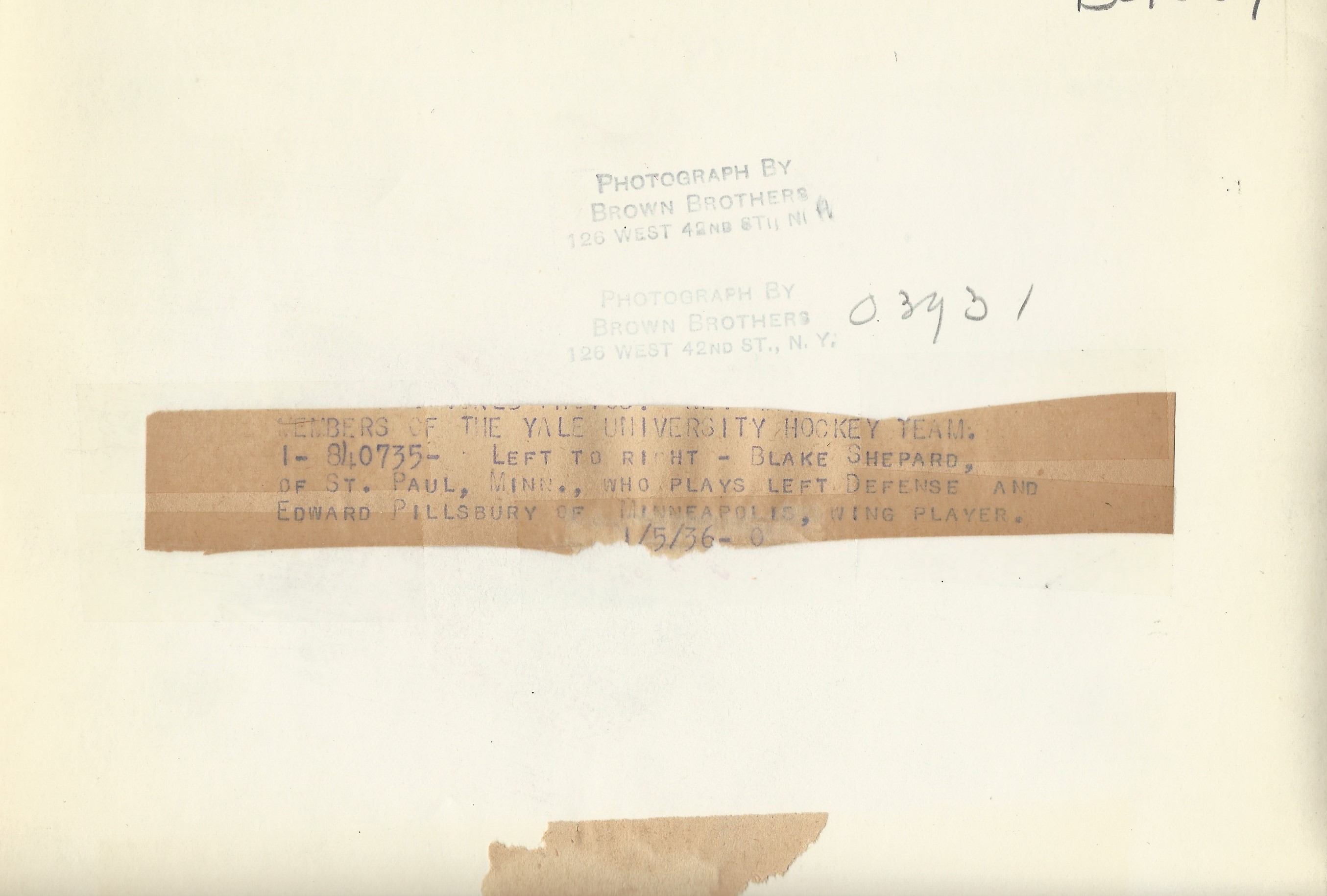
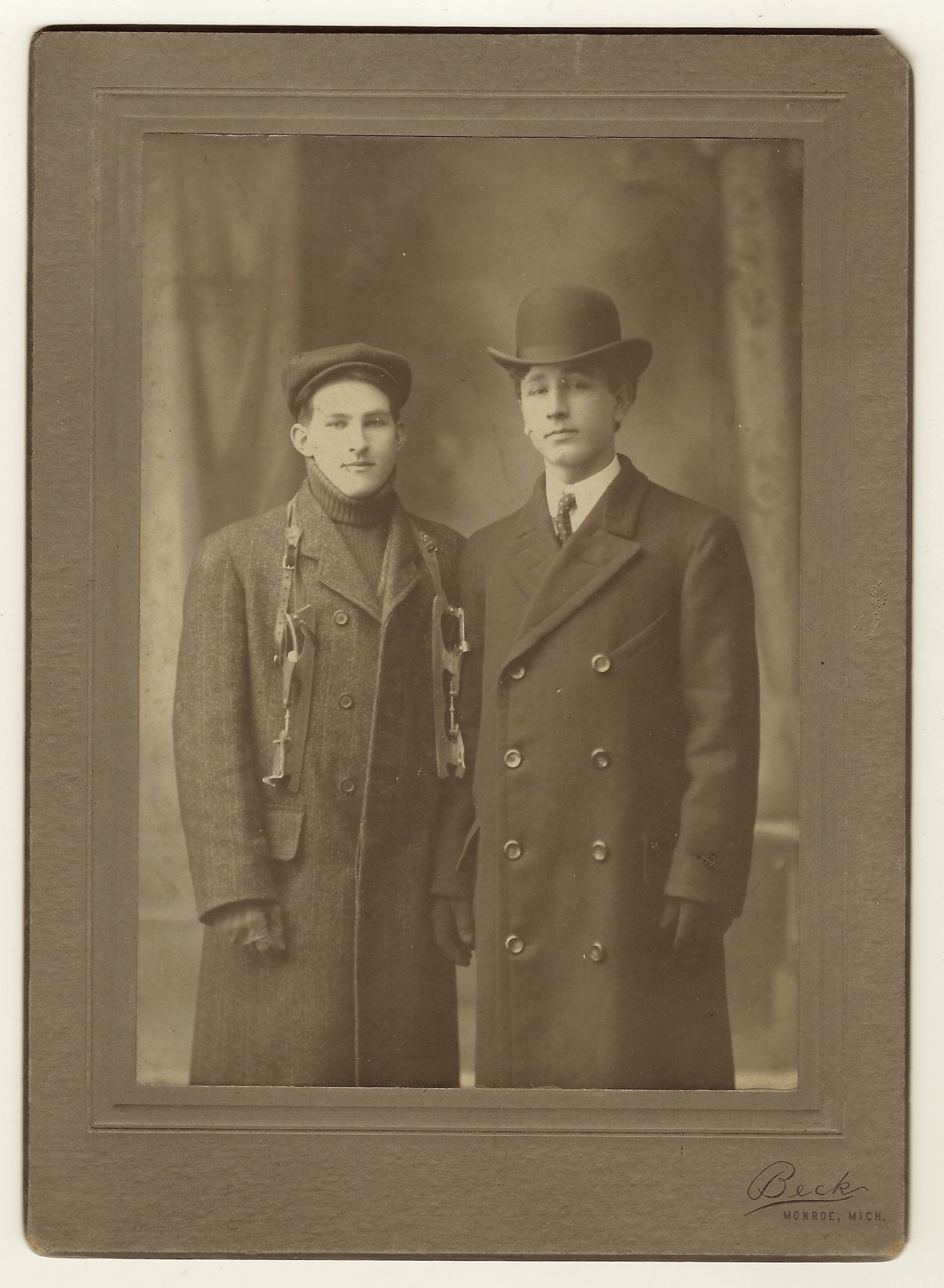
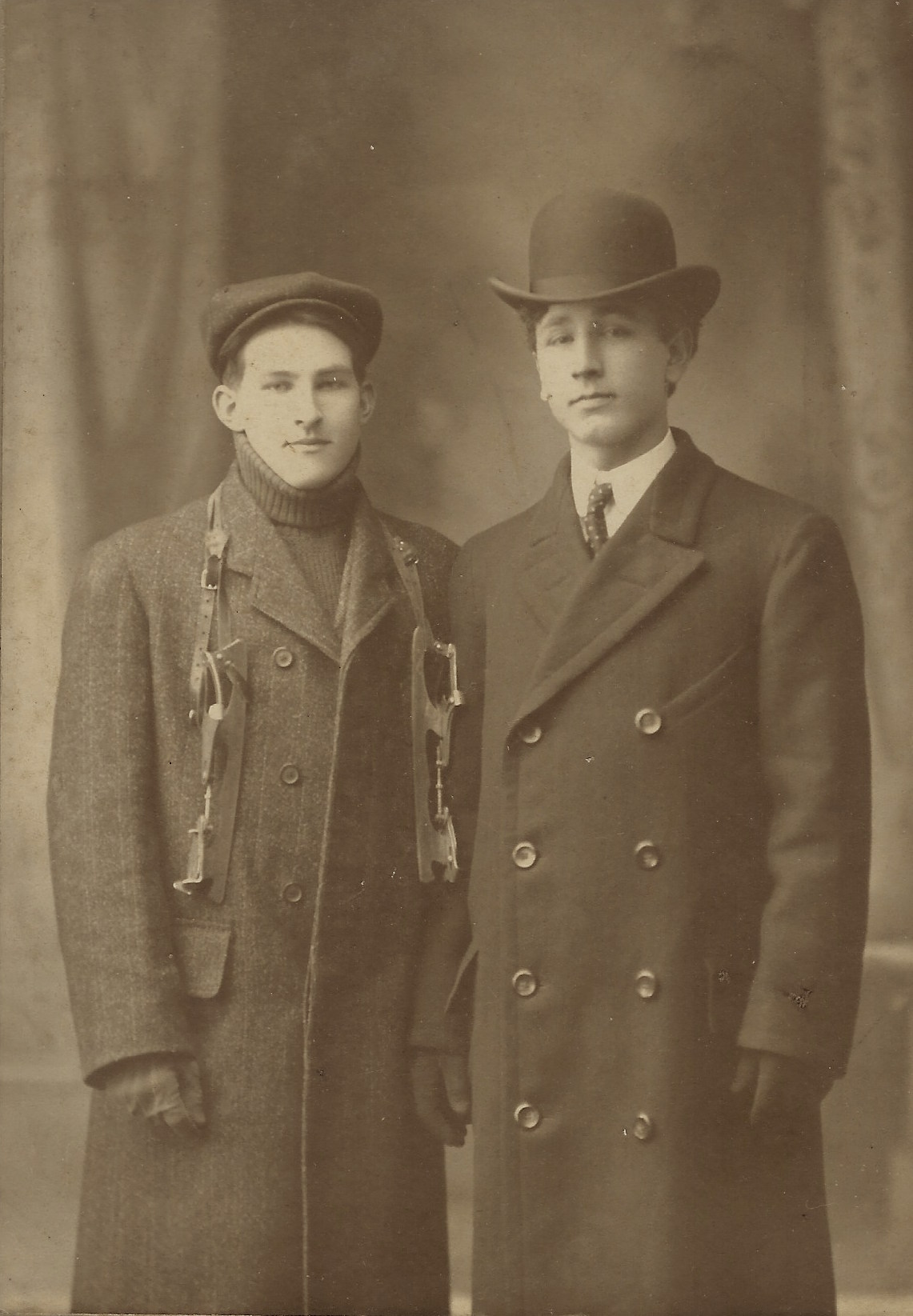
This vintage press photo is from 1936 and features two Yale University ice hockey players. The player on the left is named Blake Shepard and his hometown was St. Paul, Minnesota. Blake played the position of left defenseman. The player on the right is identified as Edward Pillsbury who hailed from Minneapolis, Minnesota. Edward played the wing position. Both Shepard and Pillsbury played hockey only one year (1935/36) at Yale. Shepard had more success on the ice than Pillsbury. Shepard is mentioned several time in the Yale Daily News. He earned praise for his “standout” performance at defense in a game against US Olympic Team candidates (12/9/35). Shepard started a game against Clarkson (1/23/36). He scored a goal and earned an assist in a 9-2 win over Brown University (2/20/36). Review of the Yale newspaper seems to indicate that Shepard also played football and baseball there. An internet search yielded no information about Pillsbury’s collegiate hockey career, other than him being on Yale’s hockey team (35/36) roster. This vintage photograph once belonged to Brown Brothers, a major stock photo agency. It was established in 1904 and built an archive of over one million photographs and negatives. SOLD


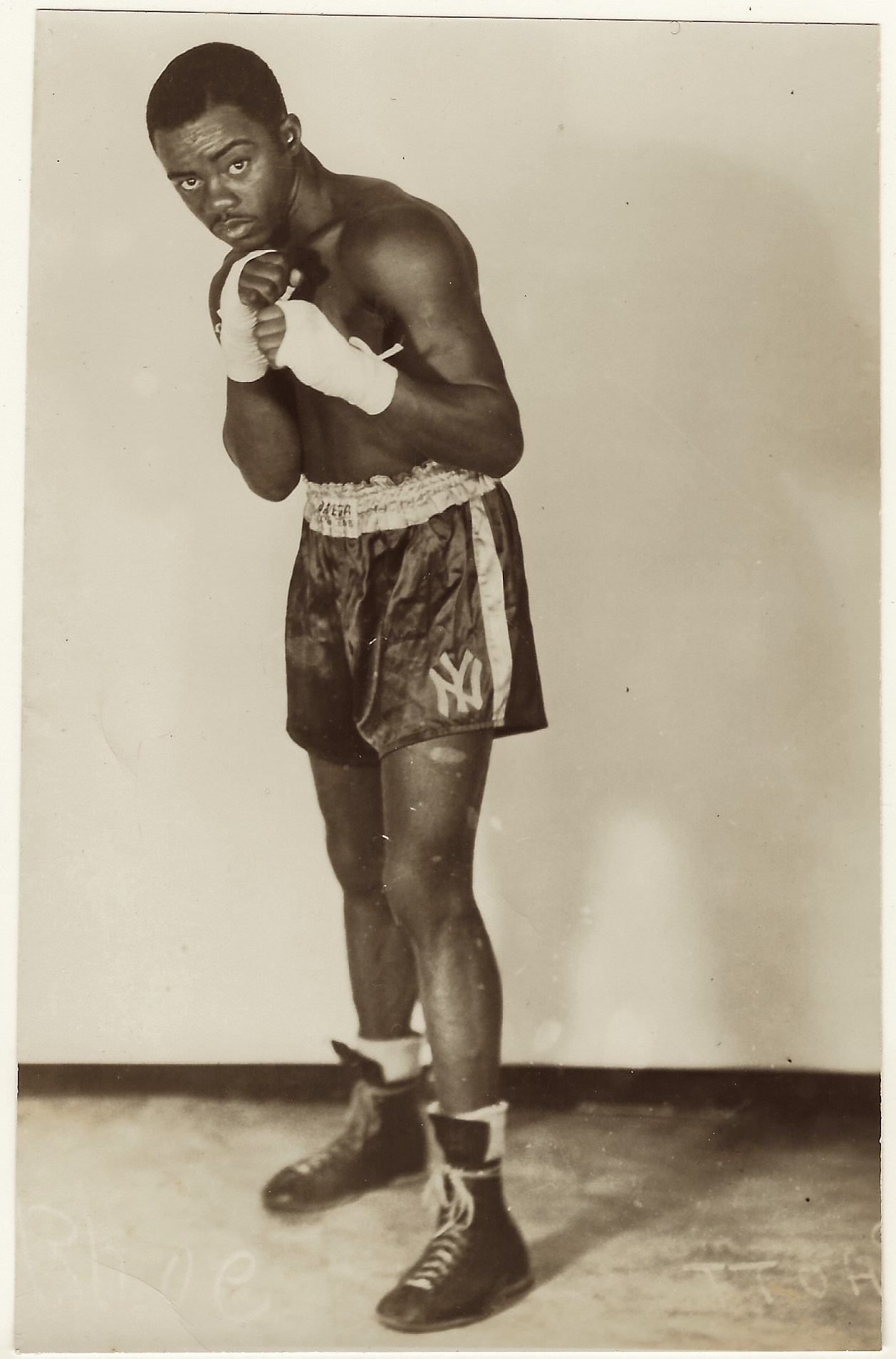
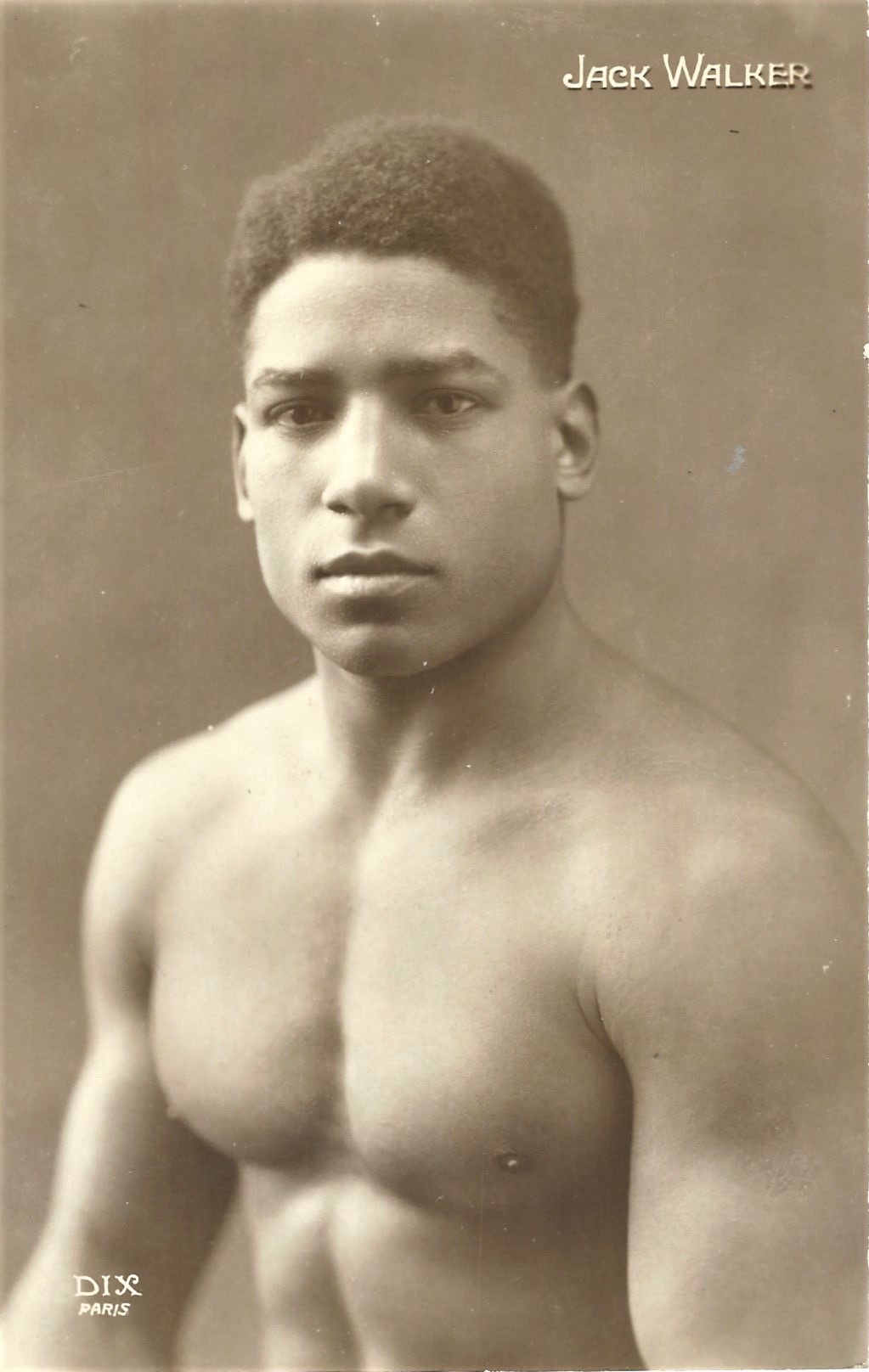 This vintage real photo postcard features boxer Jack Walker (Leone Jacovacci). His story is fascinating. He was born in Pomba (Belgian Congo) in 1902. His father was an Italian agronomist and his mother was Congolese. At age three, his father took him away from his mother and went to Italy where he left Jack to be raised by grandparents. Jack’s dad returned to the Congo. The child was a victim of racism in Italy so at sixteen years of age, he went to work as a “cabin boy” on a British ship. After arriving in England, he changed his name to John Douglas Walker, thinking the English name would help him be more socially accepted. He enlisted and served in the British army. Upon discharge, he learned to box in England and began his fighting career. During his boxing career he weighed about 150 pounds and his height was 5″ 10″. His final record as a fighter was 21 Wins, 22 Losses, and 5 Ties. His official record is thought to be incomplete. He began boxing in 1920 and his career ended in 1932. His fights were in Europe. He fought in England, France, Switzerland, Belgium, Italy, Norway, Austria, Denmark, and Spain. He fought using Italian citizenship and became the Middleweight Champion of Europe. Despite a number of successes in the ring, Jack never was accepted in Italy the way he would have liked. The racist and fascist society did not allow him to really feel like a full Italian citizen or enjoy the fruits of his boxing successes. After ending his boxing career, he became a wrestler for a few years and moved to France. He was trapped there through World War II. His companion, Berthe Salmon, changed her last name to avoid being identified as Jewish. Berthe gave birth to their only child, a daughter. Post war, he worked for the United Nations and assisted refugees. Later he was employed as a bit player in the Italian film industry. In his old age, he worked as an apartment doorman and janitor. Walker died in Milan, Italy in 1983. This postcard was published by Dix, a company located in Paris. Apparently, they published a series of portraits of boxers of the day. The Cabinet Card Gallery has another postcard from the series (Pierre Calloir: French Bantam Weight). SOLD
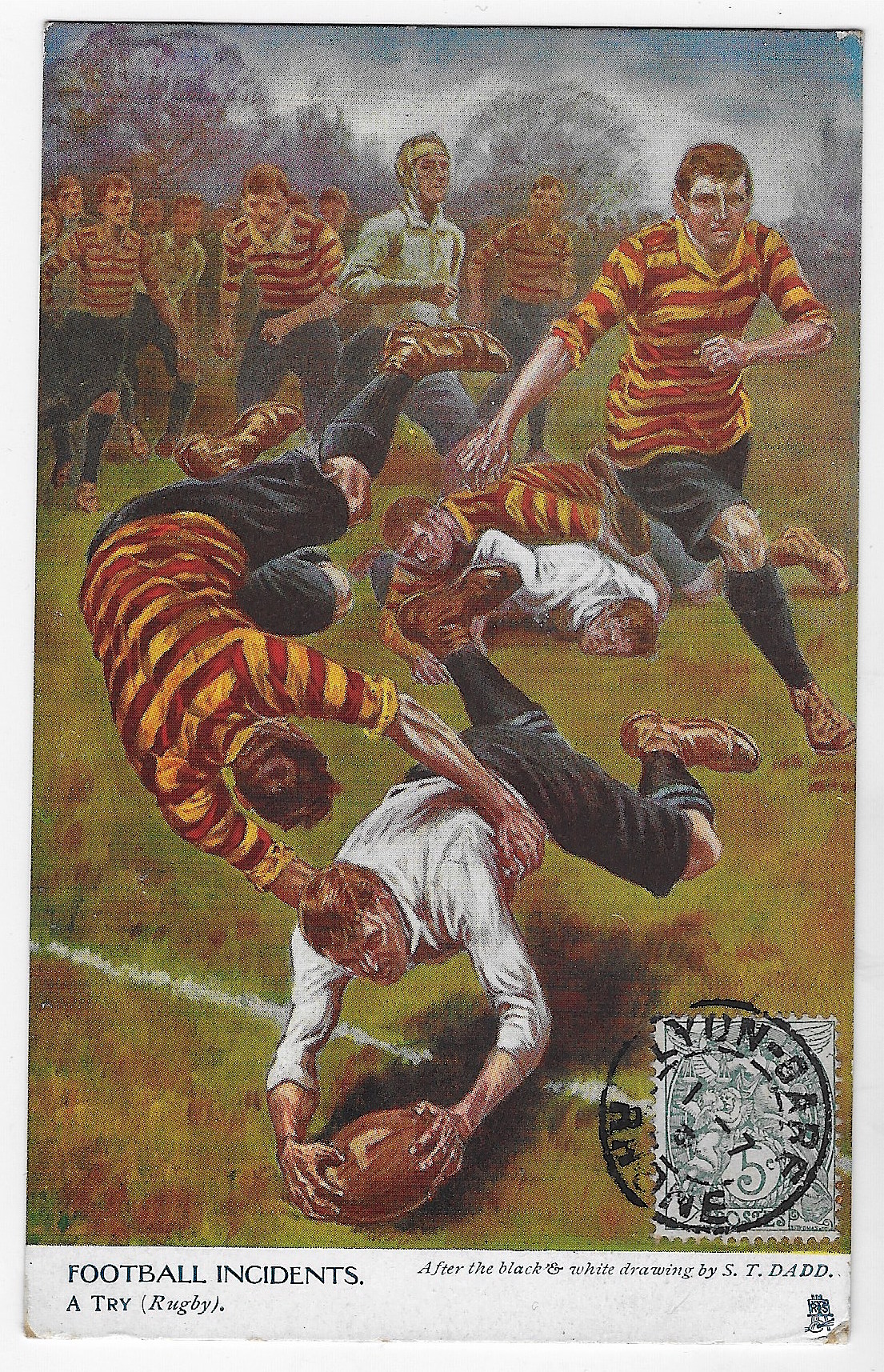 This action packed postcard features a rugby player getting past the defense and making a score (try). In rugby, a “try” earns moret points (5) than other type of scores. A “try” occurs when a player puts the ball down inside the opposing team’s designated area near the goal. This postcard was published by Raphael Tuck & Sons and is part of the “Oilette ” series (no. 1746). Oilette cards are copies of the work of commissioned artists. This postcard is part of a sub series entitled “Football Incidents”, and the card itself is captioned “A Try”. This rugby image was modeled after a black & white drawing by S. T. Dadd. The postcard was postmarked in 1907, but was issued in 1904. Raphael Tuck and his wife started their photography business in 1866 in London. Their store sold pictures, greeting cards, and in time, postcards. Their success came from the sale of postcards during the late 1890’s and early 1900’s. In the early 1900’s the firm conducted postcard competitions for collectors of Tuck postcards. These competitions offered cash prizes and they were very popular. The winner of one of these competitions had a collection consisting of over twenty-five thousand cards. Three of Tuck’s four sons participated in the business. The company was devastated by German bombing during World War II. In 1959 the company merged with two other printing companies. This postcard is in very condition (see scans).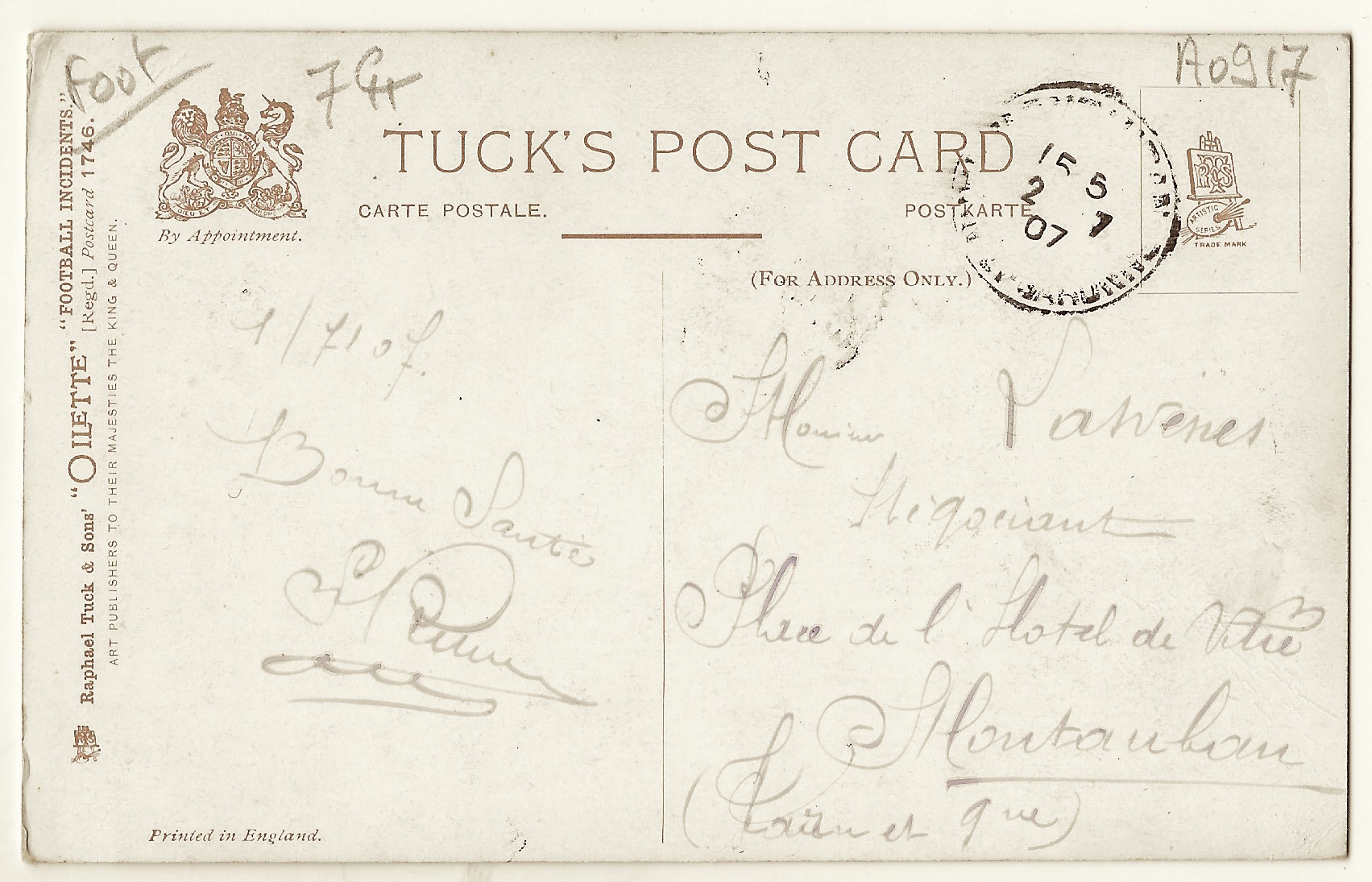
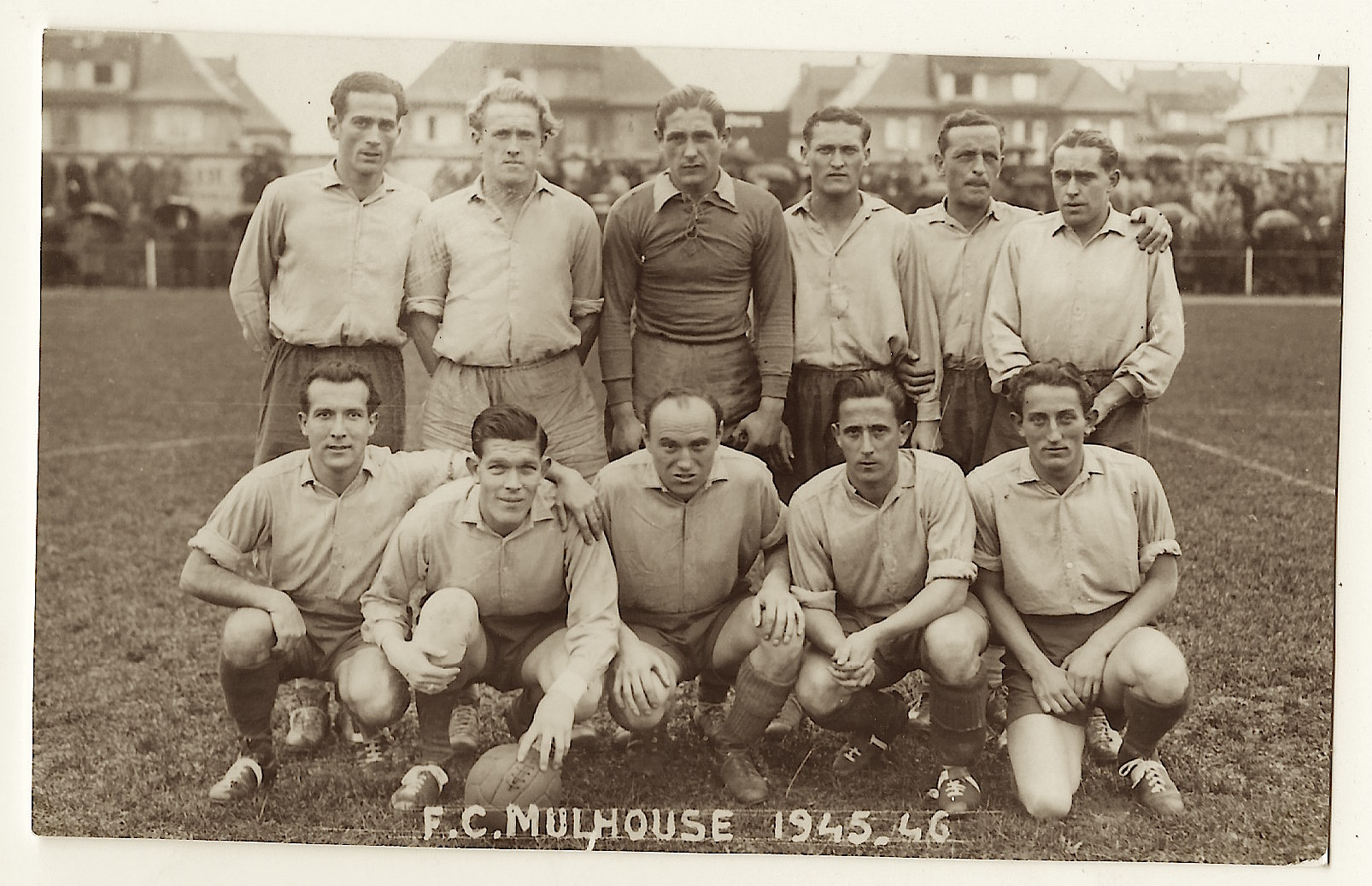 This vintage photograph features the F.C. Mulhouse (1945/46) soccer team. After examining this photo, I was positive that this team was a rugby team, rather than a soccer team. The men on the team are certainly a scrappy group. Some of the guys are built for a scrum. My guess is that the squad was composed of ex French soldiers. World War 2 had ended only a year before this photograph was taken. The Football Club de Mulhouse was established in 1893. The team is often referred to as FCM, or Mulhouse. The team is a French association football club. It is the second oldest football club in France. Mulhouse is a city in eastern France. It is located near the Swiss and German borders. During the times that the Alsace Region was controlled by Germany, the team and city was called Mulhausen. This photograph measures about 5″ x 3″ and is in very good condition.





 THE CABINET CARD GALLERY